HOSE replacement BMW 318i 1992 E36 User Guide
[x] Cancel search | Manufacturer: BMW, Model Year: 1992, Model line: 318i, Model: BMW 318i 1992 E36Pages: 759
Page 171 of 759
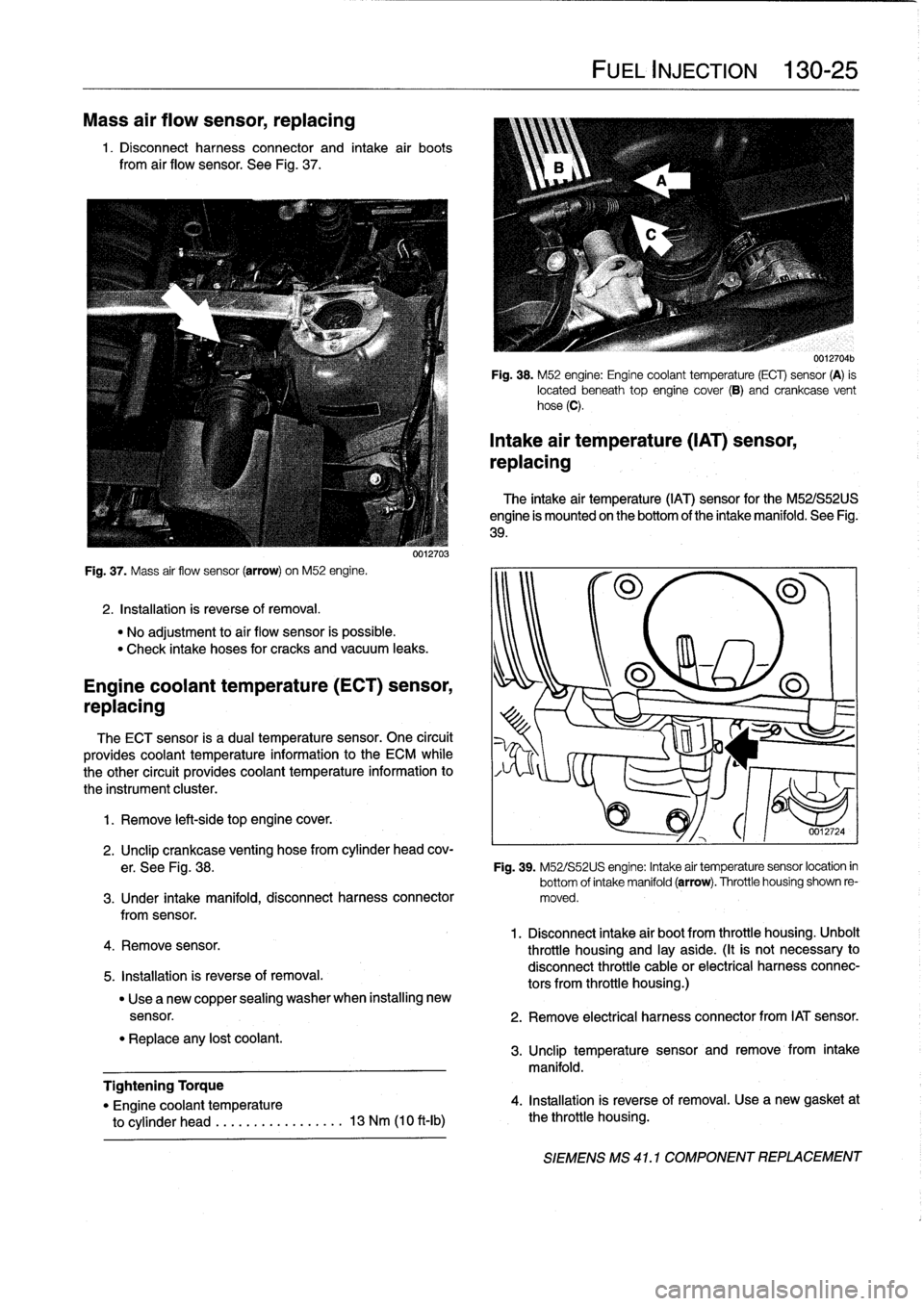
Mass
air
flow
sensor,
replacing
1
.
Disconnect
harness
connector
and
intake
air
boots
from
air
flow
sensor
.
See
Fig
.
37
.
Fig
.
37
.
Mass
air
flow
sensor
(arrow)
on
M52
engine
.
2
.
Installation
is
reverse
of
removal
.
"
No
adjustment
to
aír
flow
sensor
is
possible
.
"
Check
intake
hoses
for
cracks
and
vacuum
leaks
.
Engine
coolant
temperature(ECT)
sensor,
replacing
The
ECT
sensor
is
a
dual
temperature
sensor
.
One
circuit
provides
coolant
temperature
information
to
the
ECM
while
the
other
circuit
provides
coolant
temperature
information
to
the
instrument
cluster
.
1
.
Remove
left-side
top
engine
cover
.
4
.
Remove
sensor
.
5
.
Installation
is
reverse
of
removal
.
"
Replace
any
lost
coolant
.
0012703
"
Use
a
new
copper
sealing
washer
when
installing
new
Tightening
Torque
"
Engine
coolant
temperature
to
cylinder
head
.....
..
.
...
......
13
Nm
(10
ft-Ib)
FUEL
INJECTION
130-
25
0012704b
Fig
.
38
.
M52
engine
:
Engine
coolant
temperature
(ECT)
sensor
(A)
is
located
beneath
top
engine
cover
(8)
and
crankcase
vent
hose
(C)
.
Intake
air
temperature
(IAT)
sensor,
replacing
The
intake
air
temperature
(IAT)
sensor
for
the
M52/S52US
engine
is
mounted
on
the
bottom
of
the
intake
manifold
.
See
Fig
.
39
.
2
.
Unclip
crankcase
venting
hose
from
cylinder
head
cov-
er
.
See
Fig
.
38
.
Fig
.
39
.
M52/S52US
engine
:
Intake
air
temperaturesensor
location
in
bottom
of
intake
manifold(arrow)
.
Throttle
housing
shown
re
3
.
Under
intake
manifold,
disconnect
harness
connector
moved
.
fromsensor
.
1
.
Disconnect
intake
air
bootfrom
throttle
housing
.
Unbolt
throttle
housing
and
¡ay
aside
.
(It
is
not
necessary
to
disconnect
throttle
cable
or
electrical
harnessconnec-
tors
from
throttle
housing
.)
sensor
.
2
.
Remove
electrical
harness
connector
from
IAT
sensor
.
3
.
Unclip
temperature
sensor
and
remove
from
intake
manifold
.
4
.
Installation
is
reverse
of
removal
.
Use
a
new
gasket
at
the
throttle
housing
.
SIEMENS
MS
41
.1
COMPONENT
REPLACEMENT
Page 194 of 759
160-
1
0
FUEL
TANK
AND
FUEL
PUMP
3
.
Operate
fuel
pump
as
described
earlier
under
Operat-
ing
fuel
pump
for
tests
.
Check
that
fuel
pressure
cor-
responds
to
specifications
listed
in
Table
c
.
"
If
system
pressure
is
low,
repeat
test
whilegradually
pinching
off
return
hose
.
Pressure
should
rise
rapidly
.
If
not,fuel
pump
is
most
likely
faulty
.
"
If
system
pressure
is
too
high,
check
return
line
from
pressure
regulator
to
tank
.
Check
for
kinks
in
hose
.
Blow
compressed
air
through
line
to
check
for
block-
ages
.
If
no
faulty
canbe
found,
pressure
regulator
is
most
likely
faulty
.
See
130
Fuel
Injection
for
testing
and
replacementprocedures
.
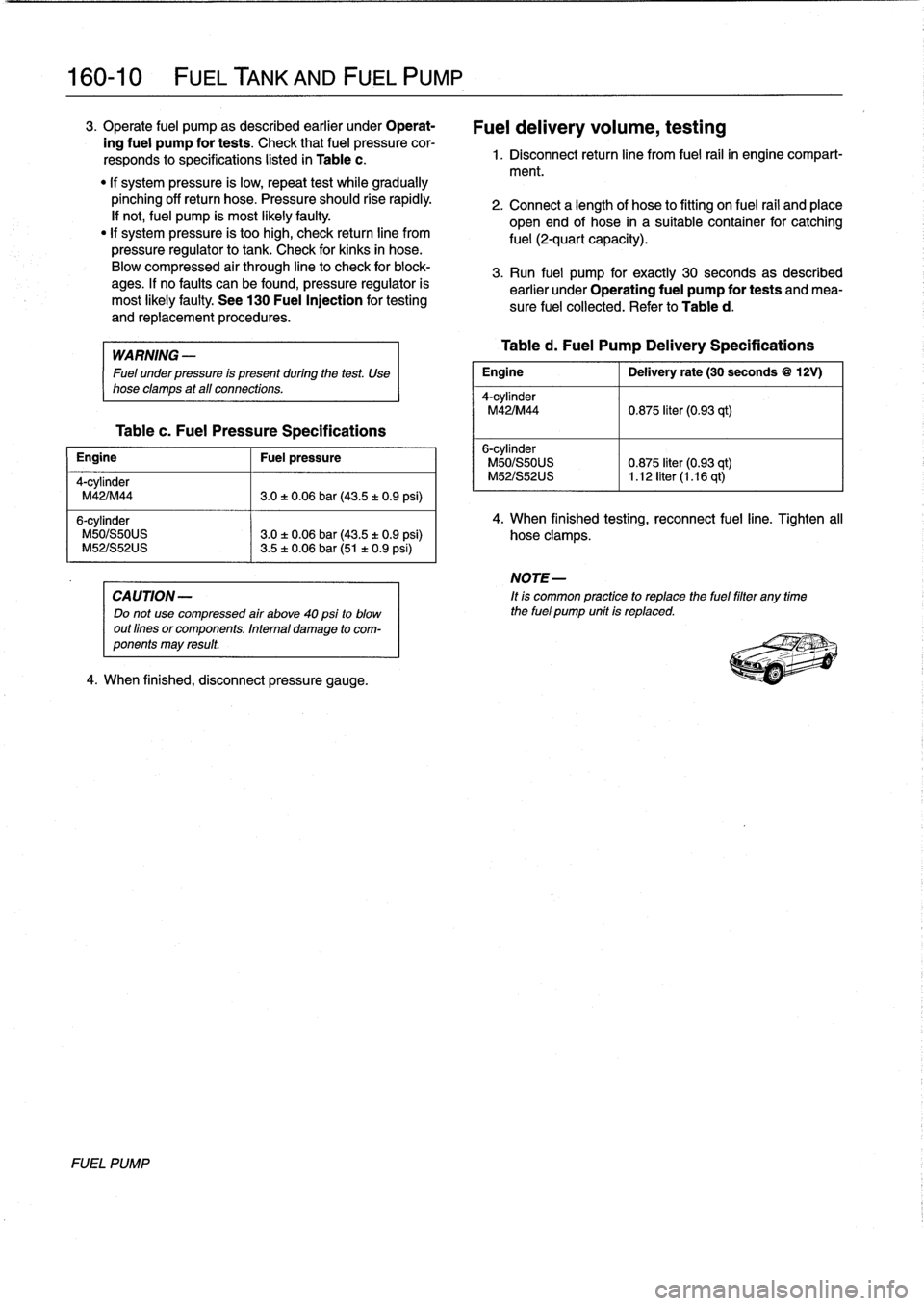
Table
c
.
Fuel
Pressure
Specifications
Engine
1
Fuel
pressure
4-cylinder
M42/M44
3
.0
:e
0
.06
bar(43
.5
±0
.9
psi)
6-cylinder
M50/S50US
3
.0
:j-
0
.06bar(43
.5
t0
.9
psi)
M52/S52US
3
.5
t
0
.06
bar
(51
t0
.9psi)
CA
UTION-
Do
not
use
compressed
air
above
40
psi
to
blow
out
fines
or
components
.
Interna¡
damage
to
com-
ponents
may
result
.
4
.
When
finished,
disconnect
pressure
gauge
.
FUEL
PUMP
Fuel
delivery
volume,
testing
1
.
Disconnect
return
line
from
fuel
rail
in
engine
compart-
ment
.
2
.
Connect
a
length
of
hose
to
fitting
on
fuel
rail
and
place
open
end
of
hose
in
a
suitable
container
for
catching
fuel
(2-quart
capacity)
.
3
.
Run
fuel
pump
for
exactly
30
seconds
as
described
earlier
under
Operating
fuel
pump
for
tests
and
mea-
sure
fuel
collected
.
Refer
to
Table
d
.
WARNING-
Table
d
.
Fuel
Pump
Delivery
Specifications
Fuel
under
pressure
is
present
duringthe
test
.
Use
I
Engine
Delivery
rate
(30
seconds
@
12V)
hose
clamps
at
all
connections
.
4-cylinder
M42/M44
0
.875
fter
(0
.93
qt)
6-cylinder
M50/S50US
0
.875
fter(0
.93
qt)
M52/S52US
~
1
.12
liter
(1
.16
qt)
4
.
When
finished
testing,
reconnect
fuel
line
.
Tighten
all
hose
clamps
.
NOTE-
It
is
common
practice
to
replace
the
fuel
filter
any
time
the
fuel
pump
unit
is
replaced
.
Page 196 of 759
170-2
RADIATOR
AND
COOLING
SYSTEM
Cooling
Fans
TROUBLESHOOTING
Belt-driven
coolingfan
.
The
primary
cooling
fan
is
belt-
driven
.
It
is
mounted
to
the
frontof
the
coolant
pump
through
a
fan
clutch
.
The
fan
clutch
is
a
viscous
fluid
coupling
that
con-
trols
the
speed
of
thefan
based
on
engine
compartment
tem-
perature
.
Electric
cooling
fan
.
Models
with
M44
engine
and
stan-
dard
transmission
substitute
an
electric
fan
for
the
belt-driven
viscous
fan
.
This
is
attached
to
the
rear
of
the
radiator
and
controlledvia
the
DME
5
.2
engine
management
system
.
NOTE-
The
electric
cooling
fan
in
these
models
is
activated
by
the
engine
control
module
(ECM)
.
Auxiliary
coolingfan
.
In
al¡
models
a
two-speed
electric
auxiliary
cooling
fan
is
mounted
behind
the
front
grill
and
in
front
of
the
radiator
.
This
fan
is
primarily
used
for
the
A/C
sys-
tem,
but
also
operates
when
the
coolant
temperature
ex-
ceeds
a
predetermined
leve¡
.
Warnings
and
Cautions
The
following
warnings
and
Cautions
should
beobserved
when
working
on
the
cooling
system
.
WARNING
-
"
Atnormal
operating
temperature
the
cooling
sys-
tem
is
pressurized
.
Allow
the
system
to
cool
as
long
as
possible
before
opening-a
minimum
of
an
hour-then
release
the
cap
slowly
to
allow
sale
release
of
pressure
.
"
Releasing
the
cooling
system
pressure
lowers
the
coolants
boiling
point
and
the
coolant
may
boíl
suddenly
.
Use
heavy
gloves
and
wear
eye
and
laceprotection
to
guard
against
scalding
.
"
Use
extreme
care
when
draining
and
disposing
of
engine
coolant
.
Coolant
is
poisonous
and
lethal
to
humans
and
pets
.
Pets
are
attracted
to
coolant
because
of
its
sweet
smell
and
taste
.
Consult
a
veterinarian
immediately
if
coolant
is
ingested
byan
animal
.
CAUTION-
"
Avoidadding
cold
water
to
the
coolant
while
the
engine
is
hot
or
overheated
.
If
it
is
necessary
to
add
coolant
to
ahot
system,
do
so
only
with
the
engine
running
and
coolant
pump
tuming
.
"
Prior
to
disconnecting
the
battery,
read
the
bat-
tery
disconnection
cautions
given
at
the
front
of
this
manual
on
page
viii
.
TROUBLESHOOTING
Most
cooling
system
faults
can
be
grouped
into
one
of
three
categories
:
"
Cooling
system
leaks
"
Poor
coolant
circulation
"
Radiator
cooling
fan
faults
When
investigating
the
cause
of
overheating
or
coolant
loss,
begin
with
a
visual
inspection
.
Be
sure
to
check
the
con-
dition
and
tension
of
the
coolant
pump
drive
belt
.
Check
hoses
for
cracks
or
softness
.
Check
clamps
for
looseness
.
Check
the
coolant
leve¡
and
check
for
evidence
of
coolantleaks
from
the
engine
.
Check
that
the
radiator
fins
are
not
blocked
with
dirt
or
de-
bris
.
Clean
the
radiator
using
low-pressure
water
or
com-
pressed
air
.
Blow
outward,
fromthe
engine
side
out
.
Inspect
the
coolant
pump
by
first
removing
the
drive
belt
from
the
pump
.
Firmly
grasp
opposite
sídes
of
the
pulley
and
check
for
play
in
all
directions
.
Spin
the
pulley
and
check
that
the
shaft
runs
smoothly
.
NOTE-
The
coolant
provides
lubrication
for
the
pump
shaft,
soan
occasional
drop
of
coolant
leaking
from
the
pump
is
acceptable
.
If
coolant
drips
steadily
from
the
vent
hole,
the
pump
should
be
replaced
.
The
cooling
system
becomes
pressurized
at
normal
operat-
ing
temperature,
which
raises
the
boiling
point
of
the
coolant
.
Leaks
may
prevent
the
system
from
becoming
pressurized,
allowing
the
coolant
to
boil
at
a
lower
temperature
.
If
visual
ev-
idence
is
inconclusive,
a
cooling
system
pressure
test
can
help
to
pinpointhard-to-find
leaks
.
If
the
cooling
system
is
full
of
coolant
and
holds
pressure,
the
next
most
probable
cause
of
overheating
are
:
"
Faulty
radiator
fan
"
Loose
or
worn
drive
belt
"
Failed
thermostat
or
coolant
pump
"
Clogged/plugged
radiator
or
coolant
passages
.
NOTE
-
"
Some
early
style
coolant
pumps
were
fitted
wíth
fi-
berlplastic
type
impellers
.
Over
time,
this
impeller
can
wear
away
and
result
in
overheating
.
The
plastic
im-
peller
can
also
slip
or
free-wheel
on
the
pump
shaft
.
If
the
engine
overheats
and
no
other
faults
canbe
found,
theold
style
impeller
may
be
the
cause
of
the
problem
.
"
Only
pumps
with
the
updated
metal
impeller
should
be
used
for
replacement
.
Page 204 of 759
170-10
RADIATOR
AND
COOLING
SYSTEM
Coolant
pump,
replacing
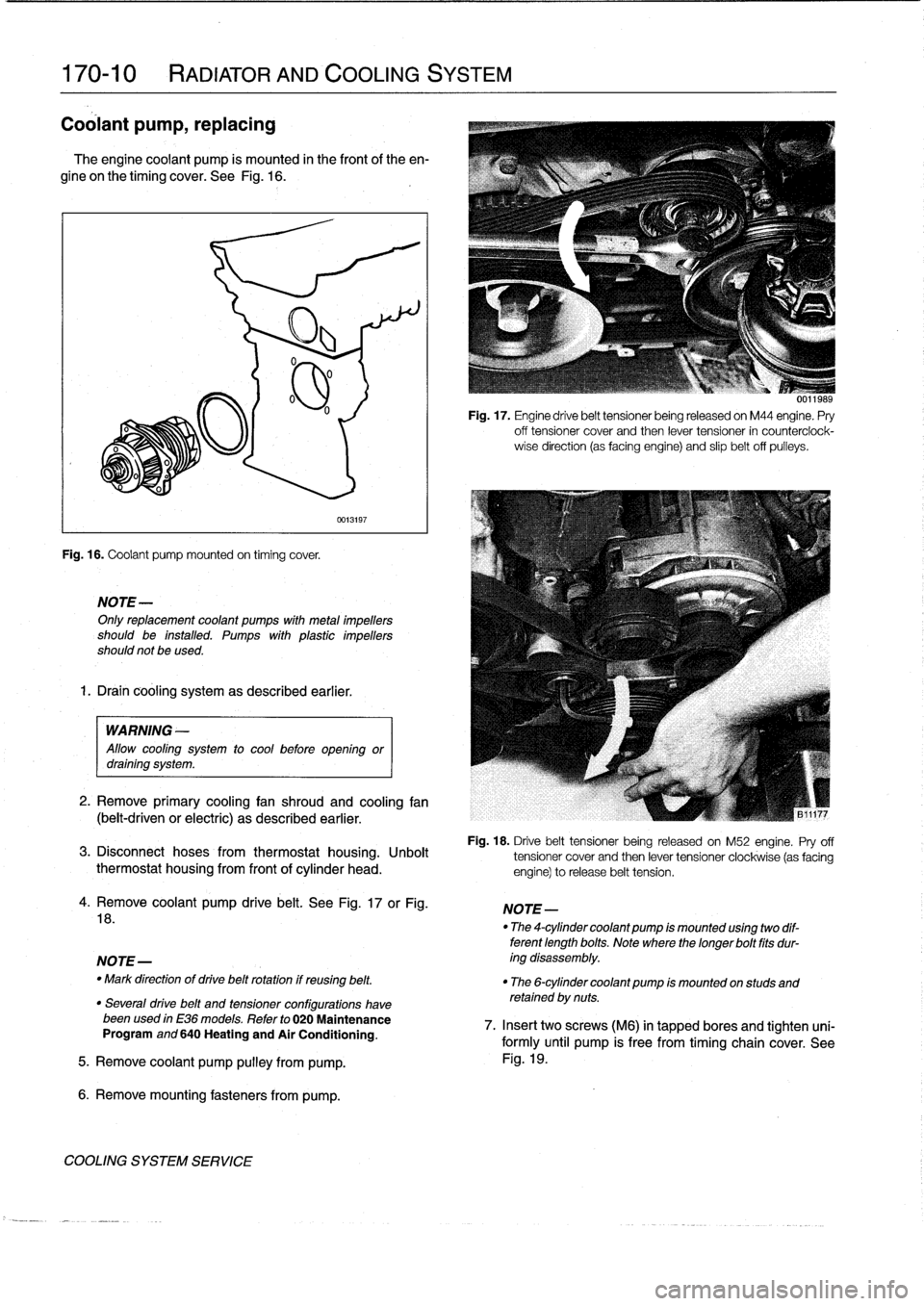
The
engine
coolant
pump
is
mounted
in
the
frontof
the
en-
gine
on
the
timing
cover
.
See
Fig
.
16
.
Fig
.
16
.
Coolant
pump
mounted
on
timing
cover
.
NOTE-
Onlyreplacement
coolant
pumps
with
metal
¡mpellers
should
be
installed
.
Pumps
with
plastic
impellers
should
not
be
used
.
1.
Drain
cooling
system
as
described
earlier
.
0013197
WARNING
-
Allow
cool¡ng
system
to
cool
before
open¡ngor
drain¡ng
system
.
2
.
Remove
primary
cooling
fan
shroud
and
cooling
fan
(belt-driven
or
electric)
as
described
earlier
.
Fig
.
17
.
Engine
drive
belt
tensioner
being
released
on
M44
engine
.
Pry
off
tensioner
cover
and
then
lever
tensioner
in
counterciock-
wise
direction
(as
facing
engine)
and
slip
belt
off
pulleys
.
Fig
.
18
.
Drive
belt
tensioner
being
released
on
M52
engine
.
Pry
off
3
.
Disconnect
hoses
from
thermostat
housing
.
Unbolt
tensioner
cover
and
then
lever
tensioner
clockwise
(as
facing
thermostat
housing
from
front
of
cylinder
head
.
engine)torelease
belt
tension
.
4
.
Remove
coolant
pump
drive
belt
.
See
Fig
.
17
or
Fig
.
18
.
NOTE-
-
Mark
direction
of
drive
belt
rotation
if
reusing
belt
.
"
The
6-cylinder
coolant
pump
¡s
mounted
on
studs
and
retained
by
nuts
.
"
Severa¡
drive
belt
and
tensioner
configurations
havebeenused
in
E36
models
.
Refer
to
020
Maintenance
Program
and
640
Heating
and
Air
Conditioning
.
5
.
Remove
coolant
pump
pulley
from
pump
.
6
.
Remove
mounting
fasteners
from
pump
.
COOLING
SYSTEM
SERVICE
NOTE-
"
The
4-cylinder
coolant
pump
¡s
mounted
us¡ng
two
dif-
terent
length
bolts
.
Note
where
thelonger
bolt
fits
dur-
ing
disassembly
.
0011989
7
.
Insert
twoscrews
(M6)
in
tapped
bores
and
tighten
uni-
formly
until
pump
is
free
from
timing
chain
cover
.
See
Fig
.
19
.
Page 258 of 759
310-2
FRONT
SUSPENSION
WARNING-
"
Physical
safety
could
be
impaired
if
procedures
described
here
areundertaken
without
the
proper
service
tools
and
equipment
.
Be
sure
to
have
the
right
tools
onhand
before
beginning
any
job
.
"
Do
notreuse
self-locking
nuts
or
bolts
.
They
are
designed
to
beused
only
once
and
may
fail
if
re-
used
.
Always
replace
self-locking
fasteners
any
timethey
are
loosenedor
removed
.
"
Do
not
install
bolts
and
nuts
coated
with
under-
coating
wax,
as
the
correct
tightening
torque
can-
not
beassured
.
Always
clean
the
threads
with
solventbefore
installation,
or
install
new
parts
.
"
Do
not
attempt
to
weld
or
straighten
any
suspen-
sion
components
.
Replace
damaged
parts
.
SHOCK
ABSORBERS
AND
SPRINGS
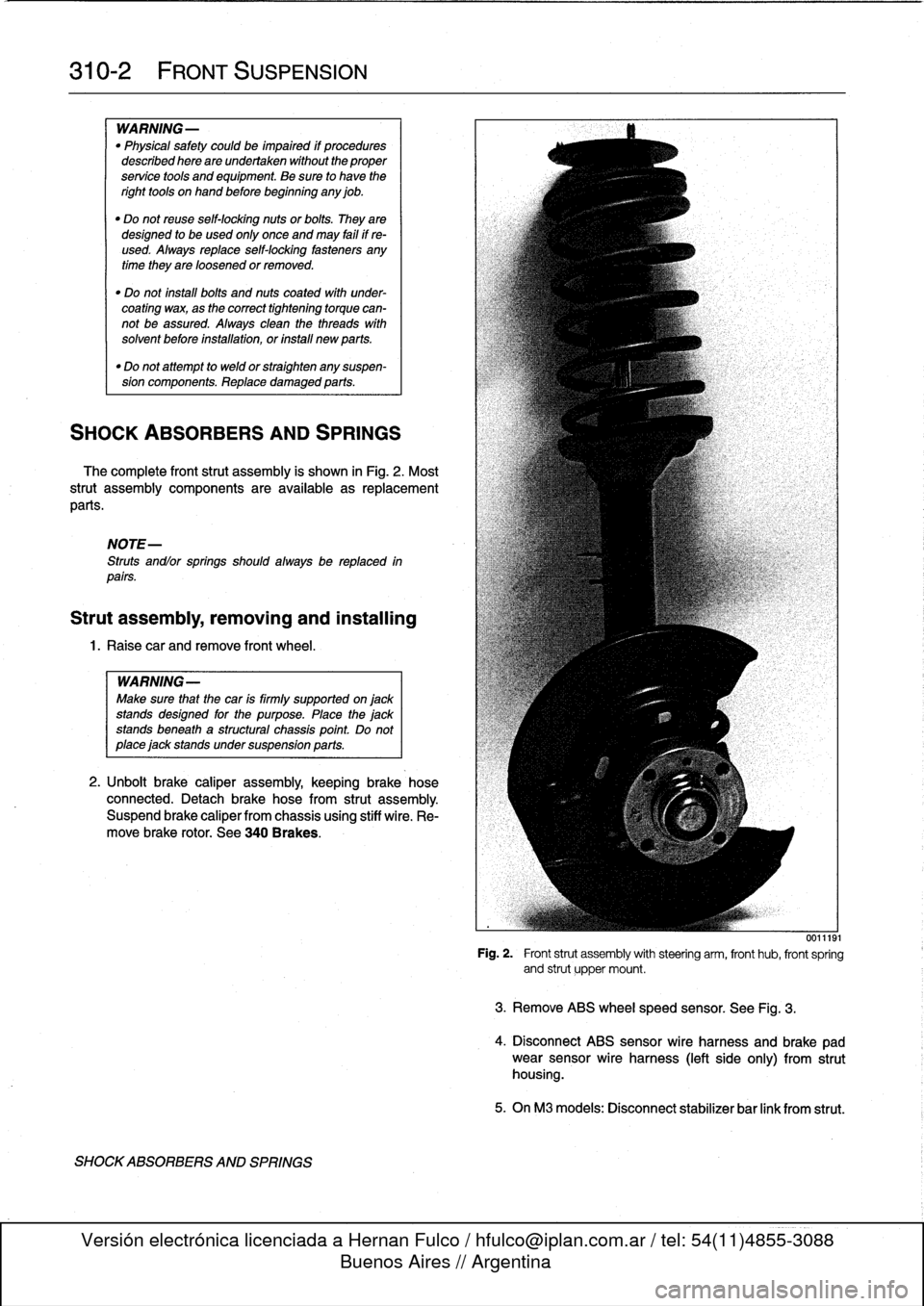
The
complete
front
strut
assembly
is
shown
in
Fig
.
2
.
Most
strut
assembly
components
are
available
asreplacement
parts
.
NOTE-
Struts
andlor
springs
shouldalways
be
replaced
in
parts
.
Strut
assembly,
removing
and
installing
1
.
Raisecar
and
remove
front
wheel
.
WARNING-
Make
sure
that
the
car
is
firmly
supported
on
jack
standsdesigned
for
the
purpose
.
Place
the
jack
standsbeneath
a
structural
chassis
point
Do
not
place
jack
stands
under
suspension
parts
.
2
.
Unbolt
brake
caliper
assembly,
keepingbrake
hose
connected
.
Detach
brake
hose
from
strut
assembly
.
Suspend
brake
caliper
from
chassis
using
stiff
wire
.
Re-
move
brake
rotor
.
See
340
Brakes
.
SHOCKABSORBERS
AND
SPRINGS
0011191
Fig
.
2
.
Front
strut
assembly
with
steering
arm,
front
hub,
front
spring
and
strut
upper
mount
.
3
.
Remove
ABS
wheelspeed
sensor
.
See
Fig
.
3
.
4
.
Disconnect
ABS
sensor
wire
harness
and
brake
pad
wear
sensor
wire
harness
(left
side
only)
from
strut
housing
.
5
.
OnM3
modeis
:
Disconnect
stabilizer
bar
link
from
strut
.
Page 291 of 759
Brake
rotor,
removing
and
installing
.
.
.
.
.
.
.
.
340-7
MASTER
CYLINDER
............
.
.
.
.
.
.
.340-7
Master
cylinder,
removing
and
installing
.
...
.
340-7
GENERAL
TROUBLESHOOTING
WARNING
-
"
Although
semi-metallic
and
metallic
Brake
friction
materials
in
Brake
pads
or
shoes
no
longer
con-
tain
asbestos,
they
produce
dangerous
dust
.
"
Brake
fluid
is
poisonous,
highly
corrosive
and
dangerous
to
the
environment
Wear
safety
glasses
and
rubber
gloves
when
working
with
Brake
fluid
.
Do
not
siphonBrake
fluid
with
your
mouth
.
Immediately
clean
away
any
fluid
spilled
on
painted
surfaces
and
wash
with
water,
asBrake
fluid
will
remove
paint
.
"
Always
use
new
Brake
fluid
froma
fresh,
un-
opened
container
.
Brake
fluid
will
absorb
mois-
ture
from
the
air
.
This
canlead
to
corrosion
problems
in
the
brakingsystem,
and
will
also
low-
er
the
Brake
fluid's
boiling
point
.
Dispose
of
Brake
fluid
properly
.
"
Do
notreuse
self-locking
nuts,bolts
or
fasteners
.
They
are
designed
to
be
used
only
once
and
may
failif
reused
.
Always
replace
them
with
new
self-
locking
fasteners
.
BMW
E36
models
areequipped
with
vacuum
power-assist-
ed
four-wheel
disc
brakes
with
an
integral
Antilock
Brake
Sys-
tem
(ABS)
.
Single-pistoncalipers
act
on
solid
or
vented
front
rotors
and
solid
rear
rotors
.
A
brake
pad
wear
sensor
for
each
axle
indicates
when
brake
padsneed
replacement
.
The
dual
drum-type
parking
brakesystem
is
integrated
with
the
rear
brake
rotors
.
NOTE-
M3
models
havevented
directional
Brake
rotors
on
the
rearaxle
as
well
ason
the
front
.
340
Brakes
BRAKES
340-1
GENERAL
.
.
.
.
.
.
.........
.
.
.
..........
340-1
BRAKE
BOOSTER
.........
.
.
.
.
.
...
.
.
.
.
340-8
TROUBLESHOOTING
.......
.
......
.
...
340-1
Brake
booster,
removing
and
installing
....
.
.
340-8
PARKING
BRAKE
.
.....
.
...
.
.
.
.....
.
.
.
340-10
BLEEDING
BRAKES
.
.
.
.
.
.
.
.
..........
340-3
Parking
brake,adjusting
.
.
.
.
.
.
.
.
.
.
.....
.
340-10
Pressure
bleeding
brakes
Parking
brake
shoes,
removing
and
installing
.
340-11(except
cars
with
AST)
.
.
.
.
.
.
.
.
.
...
.
.
.
.
.340-3
Parking
Brake
cable,
replacing
.
.
.
.
.
.
.
.
.
.
.
.
340-11
BRAKE
PADS,
CALIPERS,
ANTILOCK
BRAKE
SYSTEM
(ABS)
.
.
.
.340-11
AND
ROTORS
..........
.
.......
.
.
.
.
.
.
.
340-3
ABS
System
Inspection
.
...
.
.......
.
.
.
..
340-12
Brake
pads,
replacing
............
.
.
.
.
.
.
.
340-4
ABS
wheel
speed
sensors,
replacing
.
.
.
.
..
340-12
Brake
caliper,
removing
and
installing
.
..
..
.
340-6
TABLES
a
.
Brake
System
Troubleshooting
.....
...
.
.
.....
.340-2
b
.
Brake
Rotor
Reconditioning
Specifications
.
.....
.340-7
Brakeperformance
is
mainly
affected
by
three
things
:
the
leve¡
and
condition
of
the
brake
fluid,
the
system's
abilíty
to
create
and
maintain
hydraulic
pressure,
and
the
condition
of
the
friction
components
.
Air
in
the
Brake
fluid
will
make
the
Brake
pedal
feel
spongy
during
braking
or
will
increase
the
Brake
pedalforce
required
to
stop
.
Fluid
contaminated
by
moisture
or
dirt
can
corrode
the
system
.
Inspect
the
Brake
fluid
inside
the
reservoir
.
Ifit
is
dirty
or
murky,
or
is
over
a
year
old,
the
fluid
should
be
replaced
.
Visually
check
the
hydraulic
system
startingat
the
master
cylinder
.
To
check
the
function
of
the
master
cylinder
hold
the
brake
pedal
down
hard
with
the
engine
running
.
The
pedal
should
feelsolid
and
stay
solid
.
If
the
pedal
slowly
falls
to
the
floor,
either
the
master
cylinder
is
leaking
internally,
or
fluid
is
leaking
externally
.
If
no
leaks
canbe
found,
the
master
cylin-
der
is
faulty
and
should
be
replaced
.
Check
all
Brake
fluid
lines
and
couplings
for
leaks,
kinks,
chafing
and
corrosion
.
Check
the
Brake
booster
by
pumping
the
Brake
pedal
ap-
proximately
10
times
with
the
engine
off
.
Hold
the
pedal
down
and
start
the
engine
.
The
pedal
should
fa¡¡
slightly
.
If
not,
check
for
any
visiblefaults
before
suspecting
a
faulty
brake
booster
.
Check
for
strong
vacuum
at
the
vacuum
hose
fitting
at
the
booster,
and
check
the
non-retum
valve
for
one-way
flow
.
Worn
or
contaminated
brake
pads
will
cause
poor
braking
performance
.
Oil-contaminated
or
glazed
pads
will
cause
stopping
distances
to
increase
.
Inspect
the
rotors
for
glazing,
discoloration
and
scoring
.
Steering
wheel
vibration
while
braking
at
speed
is
often
caused
by
warped
rotors,
but
can
also
be
caused
byworn
suspension
components
.
TROUBLESHOOTING
Page 449 of 759
9
.
Release
blower
motor
retaining
strap
andremove
blow-
er
motor
and
fans
fromcowl
opening
.
NOTE-
Twist
and
rotate
blowermotor
assembly
to
facilítate
re-
moval
from
opening
.
If
the
blower
motor
is
to
be
rein-stafled,
use
care
not
to
damage
fan
wheels
during
removal
.
ff
the
blower
motor
fs
to
be
replaced,
cut
offfan
wheels
at
center
to
aid
in
removal
.
10
.
Installation
is
reverse
of
removal
.
When
installing
a
re-
placement
blower
motor,
instan
motor
into
cowlarea
before
installing
fan
wheels
.
Blower
motor
test
specifi-
cations
are
listed
in
Table
a
.
NOTE
-
On
replacementblowermotors
from
BMW,
thefan
wheels
come
unattached
to
aid
in
installation
.
Locatearrow
on
blower
motor
and
instan
fan
wheels
atthis
po-
sition
.
Be
sure
color
coolng
matches
.
Retain
fan
wheels
using
the
new
clips
.
See
an
authorized
BMW
parts
de-
partment
for
the
latest
parts
information
.
Table
a
.
Blower
Motor
Test
Values
Testingvoltage
13
VDC
Operating
voltage
9-15
VDC
Max
.
current
consumption
(approx
.)
12
amps
Maximum
speed
3,600-4,000rpm
Axialplay
(max
.
allowable)
1
.0
mm
(0
.04
in
.)
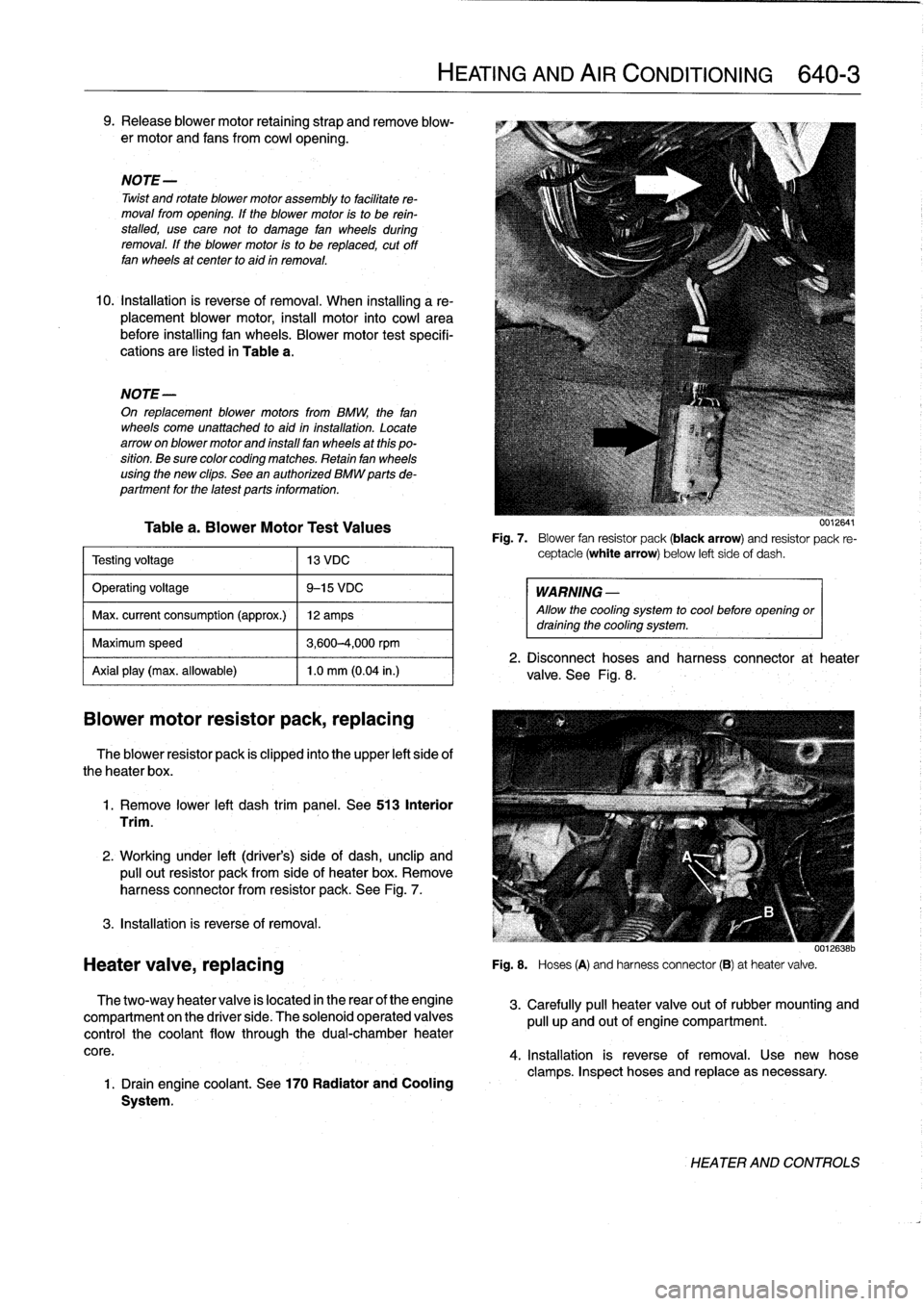
Blower
motor
resistor
pack,
replacing
The
blower
resistor
pack
is
clipped
into
the
upper
left
side
of
theheater
box
.
1
.
Remove
lower
left
dash
trim
panel
.
See513
Interior
Trim
.
2
.
Working
under
left
(driver's)
side
of
dash,
unclip
and
pulí
out
resistor
pack
from
sideof
heater
box
.
Remove
harness
connector
from
resistor
pack
.
See
Fig
.
7
.
3
.
Installation
is
reverse
of
removal
.
Heater
valve,
replacing
The
two-way
heater
valve
is
located
in
the
rear
of
the
engine
compartment
on
the
driver
side
.
The
solenoid
operated
valves
control
the
coolant
flow
through
the
dual-chamber
heater
core
.
1
.
Drain
engine
coolant
.
See
170
Radiator
and
Cooling
System
.
HEATING
AND
AIR
CONDITIONING
640-
3
uuiGO4I
Fig
.
7
.
Blower
fan
resistor
pack
(black
arrow)
and
resistor
pack
re-
ceptacle
(white
arrow)
below
left
sideof
dash
.
WARNING
-
Allow
the
cooling
system
to
cool
before
opening
ordraining
the
cooling
system
.
2
.
Disconnect
hoses
and
harness
connector
at
heater
valve
.
See
Fig
.
8
.
001[ó38b
Fig
.
S
.
Hoses
(A)
and
harnessconnector
(B)
at
heatervalve
.
3
.
Carefully
pull
heater
valve
out
of
rubber
mounting
and
pull
up
and
out
of
engine
compartment
.
4
.
Installation
is
reverse
of
removal
.
Use
new
hose
clamps
.
Inspect
hoses
and
replace
asnecessary
.
HEATER
AND
CONTROLS