air BMW 318i 1995 E36 User Guide
[x] Cancel search | Manufacturer: BMW, Model Year: 1995, Model line: 318i, Model: BMW 318i 1995 E36Pages: 759
Page 12 of 759
010-
4
FUNDAMENTALS
FOR
THE
DO-ITYOURSELF
OWNER
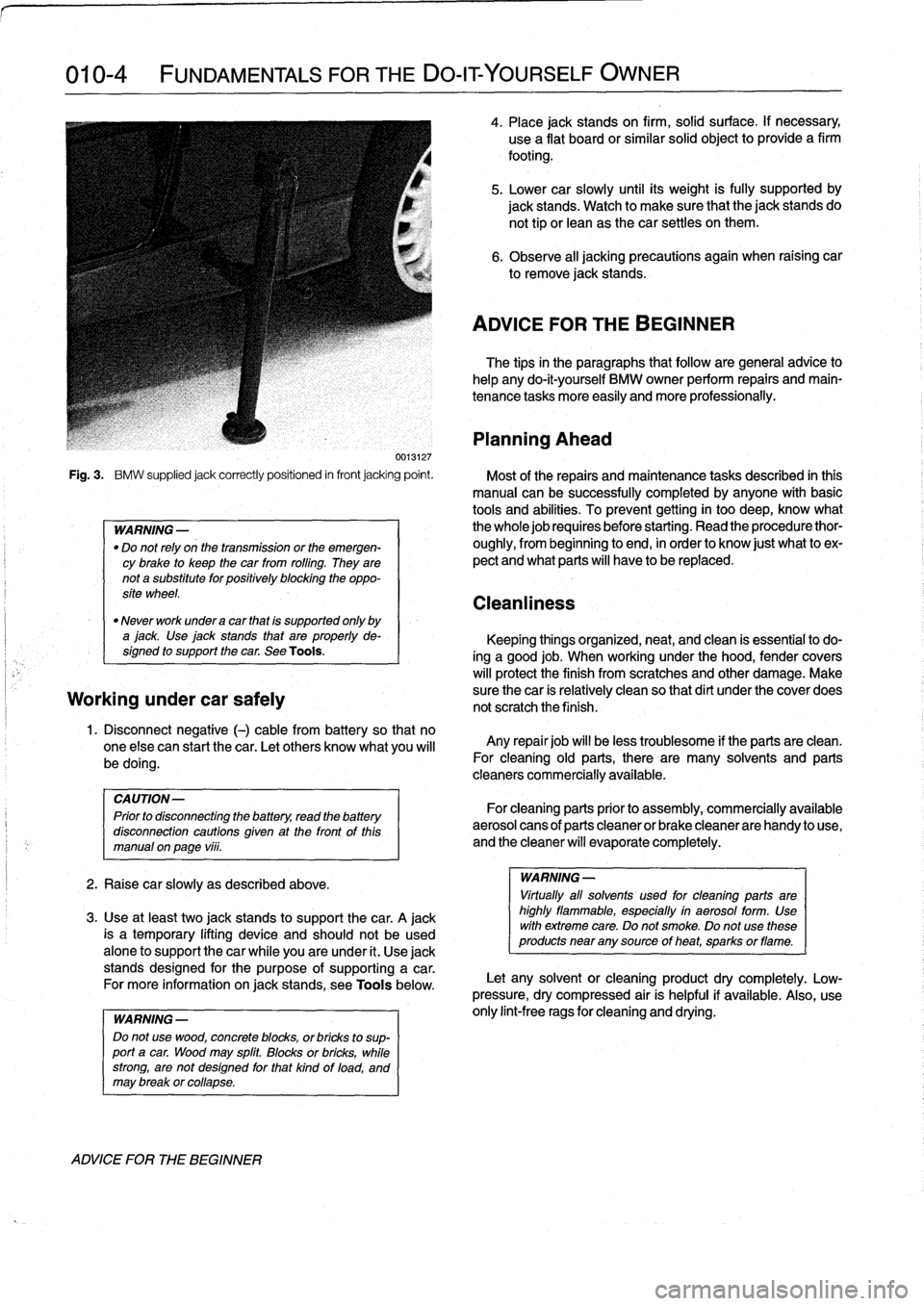
Fig
.
3
.
BMW
supplied
jack
correctly
positioned
in
front
jacking
point
.
Most
of
the
repairs
and
maintenance
tasks
described
in
this
manual
can
be
successfully
completedby
anyone
with
basic
tools
and
abilities
.
To
prevent
getting
in
too
deep,
know
what
WARNING-
the
wholejob
requires
before
starting
.
Read
the
procedure
thor-
"
Do
not
rely
on
thetransmission
or
the
emergen-
oughly,
from
beginning
to
end,
in
order
to
know
just
what
to
ex
cybrake
to
keep
thecar
from
rolling
.
They
are
pect
and
what
parts
will
have
to
be
replaced
.
nota
substitute
for
positively
blocking
the
oppo-
site
wheel
.
"
Never
work
undera
car
that
is
supported
only
by
ajack
Use
jack
stands
that
are
properly
de-
signed
to
support
the
car
.
See
Tools
.
Working
under
car
safely
1
.
Disconnect
negative
(-)
cable
from
battery
so
that
no
one
else
can
start
thecar
.
Let
others
know
what
you
will
be
doing
.
CAUTION-
Prior
to
disconnecting
the
battery
read
the
battery
disconnection
cautions
given
at
the
front
of
this
manual
on
page
vüi
.
2
.
Raisecar
slowly
as
described
above
.
3
.
Use
at
least
two
jack
stands
to
support
thecar
.
A
jack
is
atemporary
lifting
device
and
should
not
be
used
alone
to
support
the
car
while
you
are
under
it
.
Use
jack
stands
designed
for
the
purpose
of
supporting
a
car
.
For
more
information
on
jack
stands,
see
Toolsbelow
.
WARNING
-
Do
notusewood,
concrete
blocks,
orbricks
to
sup-
port
acar
.
Woodmay
split
.
Blocks
or
bricks,
while
strong,
are
not
designed
for
that
kind
of
load,
and
may
brakkor
collapse
.
ADVICE
FOR
THE
BEGINNER
4
.
Place
jack
stands
on
firm,
solid
surface
.
If
necessary,
use
a
flat
board
or
similar
solid
object
to
provide
a
firm
footing
.
5
.
Lower
car
slowly
until
its
weight
is
fully
supportedby
jack
stands
.
Watch
to
make
sure
that
the
jack
stands
do
not
tip
orlean
as
thecar
settles
on
them
.
6
.
Observe
all
jacking
precautions
again
when
raising
car
to
remove
jack
stands
.
ADVICE
FORTHE
BEGINNER
The
tips
in
the
paragraphs
that
follow
are
general
advice
to
help
any
do-it-yourself
BMW
owner
perform
repairs
and
main-
tenance
tasks
more
easily
and
more
professionally
.
Planning
Ahead
Cleanliness
Keeping
things
organized,
neat,
and
clean
is
essential
to
do-
ing
a
good
job
.
When
working
under
the
hood,
fender
covers
will
protect
the
finish
from
scratches
and
other
damage
.
Make
sure
the
car
is
relatively
clean
so
thatdi
rt
under
the
cover
does
not
scratch
the
finish
.
Any
repair
job
will
be
less
troublesome
if
the
parts
are
clean
.
For
cleaning
old
parts,
there
are
many
solvents
and
parts
cleaners
commercially
available
.
For
cleaning
parts
priorto
assembly,
commercially
available
aerosol
cans
of
parts
cleaner
or
brake
cleaner
are
handy
to
use,
and
the
cleaner
will
evaporate
completely
.
WARNING
-
Virtually
all
solvents
used
for
cleaning
parts
are
highly
flammable,
especially
in
aerosol
form
.
Use
wíth
extreme
care
.
Do
not
smoke
.
Do
not
use
these
products
near
any
source
of
heat,
sparksor
flame
.
Let
any
solvent
orcleaning
product
dry
completely
.
Low-
pressure,
dry
compressed
air
is
helpful
if
available
.
Also,
use
only
lint-free
rags
for
cleaning
and
drying
.
Page 13 of 759
FUNDAMENTALS
FOR
THEDO-ITYOURSELF
OWNER
010-
5
WARNING
-
Avoid
getting
tools
or
clothing
near
the
battery
.
Bat-tery
electrolyte
is
a
corrosive
acid
.
Be
careful
with
brake
fluid,
as
it
can
damage
the
cars
paint
Finally,
keep
rubber
parts
such
as
hoses
and
bolts
free
from
oil
orgasoline,
as
they
will
cause
the
material
to
soften
and
fail
prematurely
.
Non-reusable
Fasteners
Many
fasteners
usedon
the
cars
coveredby
this
manual
mustbe
replaced
with
new
osesonce
they
are
removed
.
These
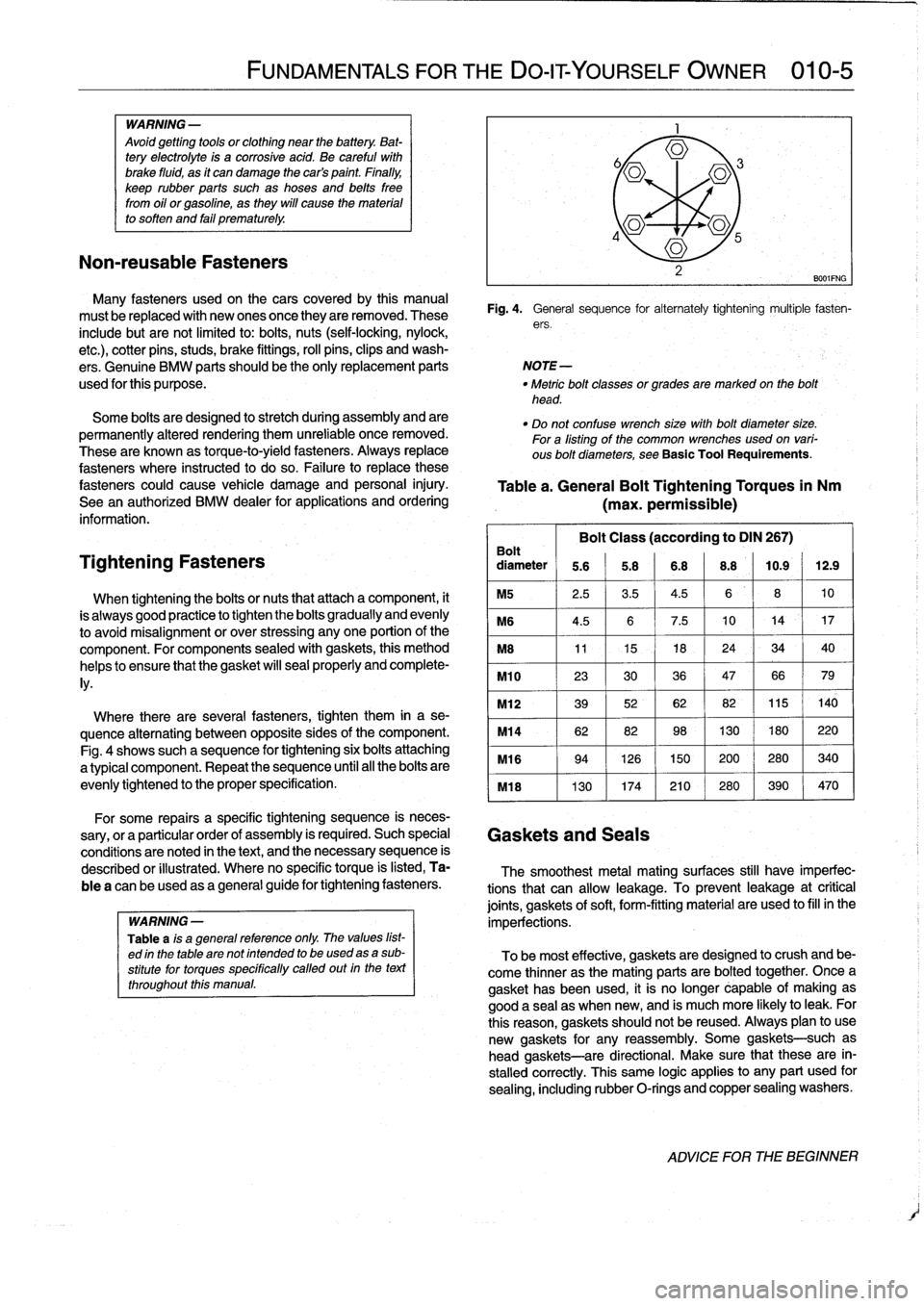
Fig
.
4
.
General
sequence
for
alternately
tightening
multiple
fasten-
include
butarenot
limited
to
:
bolts,
nuts
(self-locking,
nylock,
ers
.
etc
.),
cotterpins,
studs,
brake
fittings,
rol¡
pins,clips
and
wash-
ers
.
Genuine
BMW
parts
should
be
the
only
replacement
parts
NOTE-
used
for
this
purpose
.
"
Metric
bolt
classes
or
grades
are
markedon
the
bolt'
head
.
Some
bolts
are
designed
to
stretch
during
assembly
and
are
permanently
altered
rendering
them
unreliable
once
removed
.
These
are
known
as
torque-to-yield
fasteners
.
Always
replace
fasteners
where
instructed
to
doso
.
Failure
to
replace
these
fasteners
could
cause
vehicle
damage
and
personal
injury
.
See
an
authorized
BMW
dealer
for
applications
and
ordering
information
.
Tightening
Fasteners
When
tighteningthe
bolts
ornuts
that
attach
acomponent,
it
is
always
good
practice
to
tighten
the
bolts
gradually
and
evenly
to
avoid
misalignment
or
over
stressing
anyone
portion
of
the
component
.
For
components
sealed
with
gaskets,
this
method
helps
to
ensure
that
thegasket
will
seal
properly
and
complete-
ly
.
Where
there
are
severa¡
fasteners,
tighten
them
in
a
se-
quence
alternating
between
opposite
sides
of
the
component
.
Fig
.
4
shows
such
a
sequence
for
tightening
six
bolts
attaching
a
typical
component
.
Repeat
the
sequence
until
al¡
the
bolts
are
evenly
tightened
to
theproper
specification
.
"
Do
not
confuse
wrench
sizewithbolt
diameter
size
.
Fora
listing
of
the
common
wrenches
used
on
vari-
ous
bolt
diameters,
see
Basic
Tool
Requirements
.
Table
a
.
General
Bolt
Tightening
Torques
in
Nm
(max
.
permissible)
Bolt
Class
(according
to
DIN
267)
Bolt
diameter
5
.6
5
.8
6
.8
8
.8
10
.9
12
.9
M5
2
.5
3
.5
4
.5
6810
M6
4
.5
6
7
.5
10
14
`
17
M8
11
15
-
18
24
34
40
M10
233036476679
M12
3952
62
82115140
M14
6282
98
130
180220
M16
9426150
200280340
M18
130174210280
390
470
For
some
repairs
a
specific
tightening
sequence
is
neces-
sary,
or
a
particular
order
of
assembly
is
required
.
Such
special
Gaskets
and
Seals
conditions
are
noted
in
the
text,
and
the
necessary
sequence
is
described
or
illustrated
.
Where
no
specific
torque
is
listed,
Ta-
The
smoothest
metal
mating
surfaces
still
have
imperfec
blea
can
be
used
as
a
general
guide
for
tightening
fasteners
.
tions
that
can
allow
leakage
.
To
prevent
leakage
atcritica¡
joints,
gaskets
of
soft,
form-fitting
material
are
used
to
fill
in
the
WARNING
-
imperfections
.
Table
ais
a
general
reference
only
.
The
values
list-
ed
in
the
table
are
not
intended
to
be
used
asa
sub-
To
be
most
effective,
gaskets
are
designed
to
crush
and
be-
stitutefor
torques
specifically
called
out
in
the
text
come
thinner
as
the
mating
parts
are
bolted
together
.
Once
a
throughout
this
manual
.
gasket
has
been
used,
it
is
no
longer
capable
of
makingas
good
a
sea¡
as
when
new,
and
is
muchmore
likely
toleak
.
For
this
reason,
gaskets
should
not
be
reused
.
Always
plan
to
use
new
gaskets
for
any
reassembly
.
Some
gaskets-such
as
head
gaskets-are
directional
.
Make
sure
that
these
are
in-
stalled
correctly
.
This
same
logic
applies
to
any
part
used
for
sealing,
including
rubber
O-rings
and
copper
sealing
washers
.
ADVICE
FOR
THE
BEGINNER
Page 14 of 759
010-
6
FUNDAMENTALS
FOR
THE
DO-ITYOURSELF
OWNER
In
places
where
a
shaft
mustpass
through
a
housing,
flexible
lip
seals
areused
to
keep
the
lubricating
oil
or
grease
from
leak-
ingout
past
the
rotating
shaft
.
Seals
should
never
be
reused
once
they
have
been
removed
.
When
removing
a
seal,
be
care-
ful
not
lo
scratch
or
otherwise
damage
the
metal
surfaces
.
Even
minor
damage
to
sealing
surfaces
can
cause
sea¡
damage
and
leakage
.
The
key
to
sea¡
installation
is
to
get
the
sea¡
in
straight
without
damaging
¡t
.
Use
a
sea¡
driver
that
is
the
same
diameter
as
the
seal
housing
to
gently
and
evenly
insta¡I
into
place
.
If
a
proper
size
seal
driver
is
not
available,
a
socket
of
the
right
size
will
do
.
When
installing
a
seal,
¡t
a
good
idea
to
coat
the
sea¡
with
o¡I
to
aid
installation
.
Some
seals
are
directional
and
special
instal-
lation
instructions
apply
.
Make
sure
¡t
is
installed
with
the
lip
fac-
ing
the
correct
way
.
Normally
the
lip
faces
the
inside
.
Note
the
installation
direction
of
the
old
sea¡before
removing
¡t
.
Electrical
Testing
Many
electrical
problems
canbe
understood
and
solved
with
only
a
little
fundamental
knowledge
of
how
electrical
circuits
Insulate
the
finished
connection
.
Electronics
stores
can
sup-
function
.
ply
heat-shrinkable
insulating
tubing
that
can
be
placed
onto
the
wire
before
connectiog,
slid
over
the
finished
joint,
and
Electric
current
only
flows
in
a
complete
circuit
.
To
operate,
shrunk
to
a
tight
fit
with
a
heat
gun
orhair
dryer
.
The
nextbest
every
electrical
device
in
thecar
requires
a
complete
circuit
in-
alternative
is
electrical
tape
.
Make
sure
the
wire
is
clean
and
cluding
a
voltage
source
and
a
pathto
ground
.
The
positive
(+)
free
ofsolder
flux
or
other
contamination
.
Wrap
the
joint
tightly
side
of
the
battery
is
the
original
voltagesource,
and
ground
is
to
sea¡
out
moisture
.
See
600
Electrical-General
for
more
in-
any
retum
path
to
the
negative
()
-
side
ofth
e
battery°
whether
li
formation
.
through
the
wiring
harness
or
thecar
body
.
Except
for
portions
of
the
charging
system,
al¡
electrical
current
in
the
car
is
direct
current
(DC)
and
flows
from
positive
(+)
to
negative
(-)
.
BVYING
PART$
Switches
are
used
to
turn
components
on
or
off
by
complet-
ing
or
interrupting
#he
circuit
.
A
switch
is
"open"
when
the
circuit
Many
of
the
maíntenance
and
repair
tasks
in
this
manual
cal¡
is
ínterrupted,
and
"closed"
when
the
circuit
is
completed
.
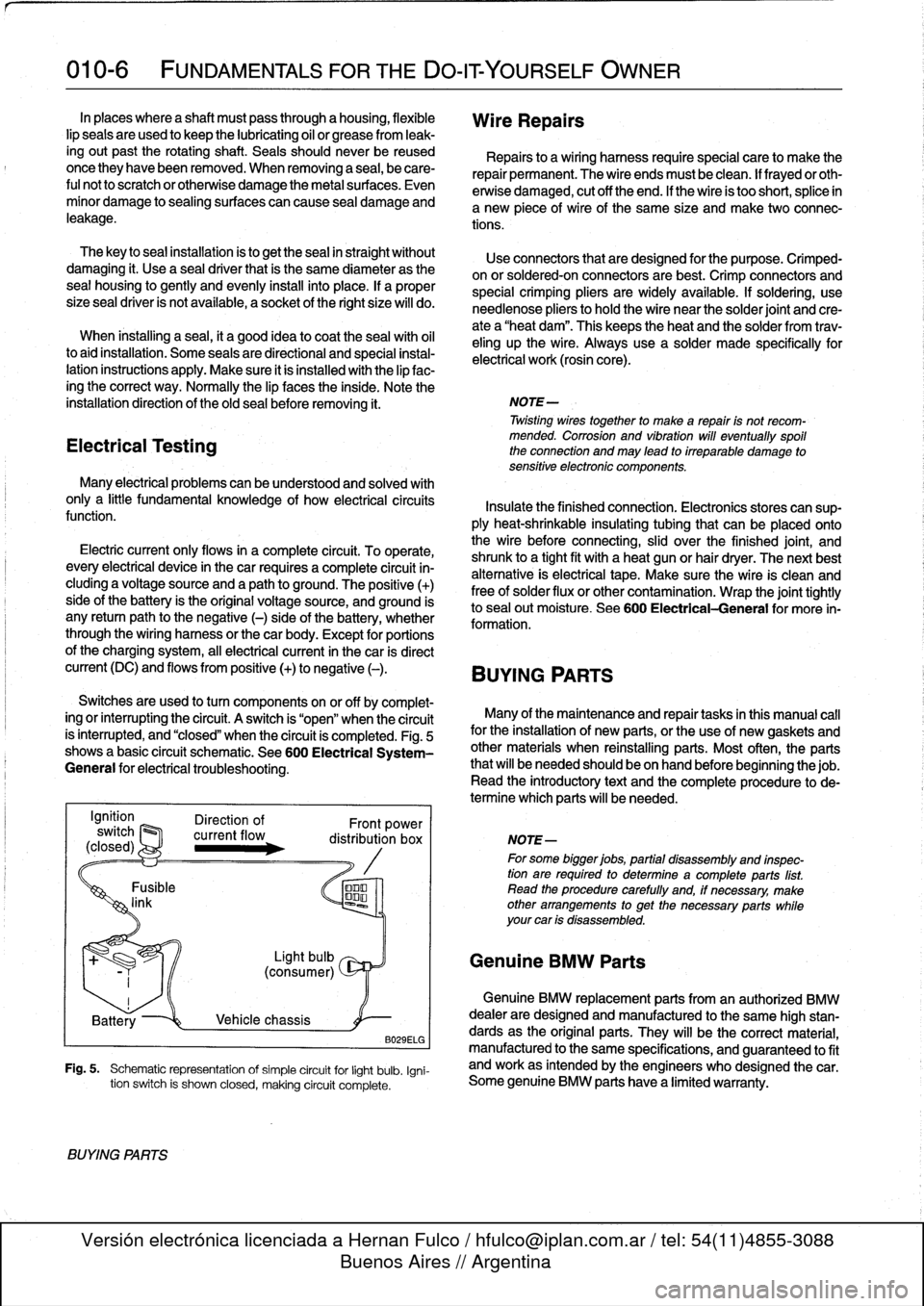
Fig
.
5
for
the
installation
of
new
parte,
or
the
use
of
new
gaskets
and
shows
a
basic
circuit
schematic
.
See600
Electrical
System-
other
materials
when
reinstalling
parts
.
Most
often,
the
parts
General
for
electrical
troubleshooting
.
that
will
be
needed
should
be
on
hand
beforebeginningthe
job
.
Read
the
introductory
text
and
the
complete
procedure
to
de-
termine
which
parts
will
be
needed
.
B029ELG
Fig
.
5
.
Schematic
representation
of
simple
circuit
for
light
bulb
.
Igni-
tion
switch
is
shown
closed,
making
circuit
complete
.
BVYING
PARTS
Wire
Repairs
Repairs
to
a
wiring
harness
requirespecial
care
to
make
the
repair
permanent
.
The
wire
endsmust
be
clean
.
lf
frayedor
oth-
erwise
damaged,
cut
off
the
end
.
If
the
wire
is
too
short,
splice
in
a
new
piece
of
wire
of
the
same
size
and
make
two
connec-
tions
.
Use
connectors
that
are
designed
for
the
purpose
.
Crimped-
on
or
soldered-onconnectors
are
best
.
Crimp
connectors
and
special
crimping
pliers
are
widely
available
.
If
soldering,
use
needlenose
pliers
tohold
the
wire
near
the
solder
joint
and
cre-
ate
a
"heat
dam"
.
This
keeps
the
heat
and
the
solder
from
trav-
eling
up
the
wire
.
Always
use
a
solder
made
specifically
for
electrical
work
(rosin
core)
.
NOTE-
Twisting
wirestogether
to
make
a
repair
is
not
recom-
mended
.
Corrosion
and
vibration
will
eventually
spoil
the
connection
and
may
lead
to
irreparable
damage
to
sensitive
electronic
componente
.
NOTE-
For
some
bigger
jobs,
partial
disassembly
and
inspec-
tion
are
required
to
determine
acomplete
parts
list
.
Read
the
procedure
carefully
and,
if
necessary,
make
other
arrangements
to
get
the
necessary
parts
while
your
car
is
disassembled
.
Genuine
BMW
Parts
Genuine
BMW
replacement
parts
from
an
authorized
BMW
dealer
are
designed
and
manufactured
lo
the
same
high
stan-
dards
as
the
original
parts
.
They
will
be
the
correct
material,
manufactured
to
the
same
specifications,
and
guaranteed
lo
fit
and
work
as
intended
by
the
engineers
who
designed
thecar
.
Some
genuine
BMW
parts
have
a
limited
warranty
.
Page 15 of 759
Non-returnable
Parts
FUNDAMENTALS
FOR
THEDO-ITYOURSELF
OWNER
010-
7
Many
independent
repair
shops
make
a
point
of
using
genu-
Original
body
paneis
and
other
large
components
are
identi-
ine
BMW
parts,
even
though
they
may
at
times
be
more
expen-
fied
by
a
label
bearing
the
VINand
two
BMW
roundellogos
.
Re-
sive
.
Theyknow
the
value
of
doing
thejob
right
with
the
right
placement
parts
have
a
similar
label,
bearing
one
BMW
roundel
parts
.
Parts
from
other
sources
can
beas
good,
particularly
if
logo
and
the
letters
DOT-R
.
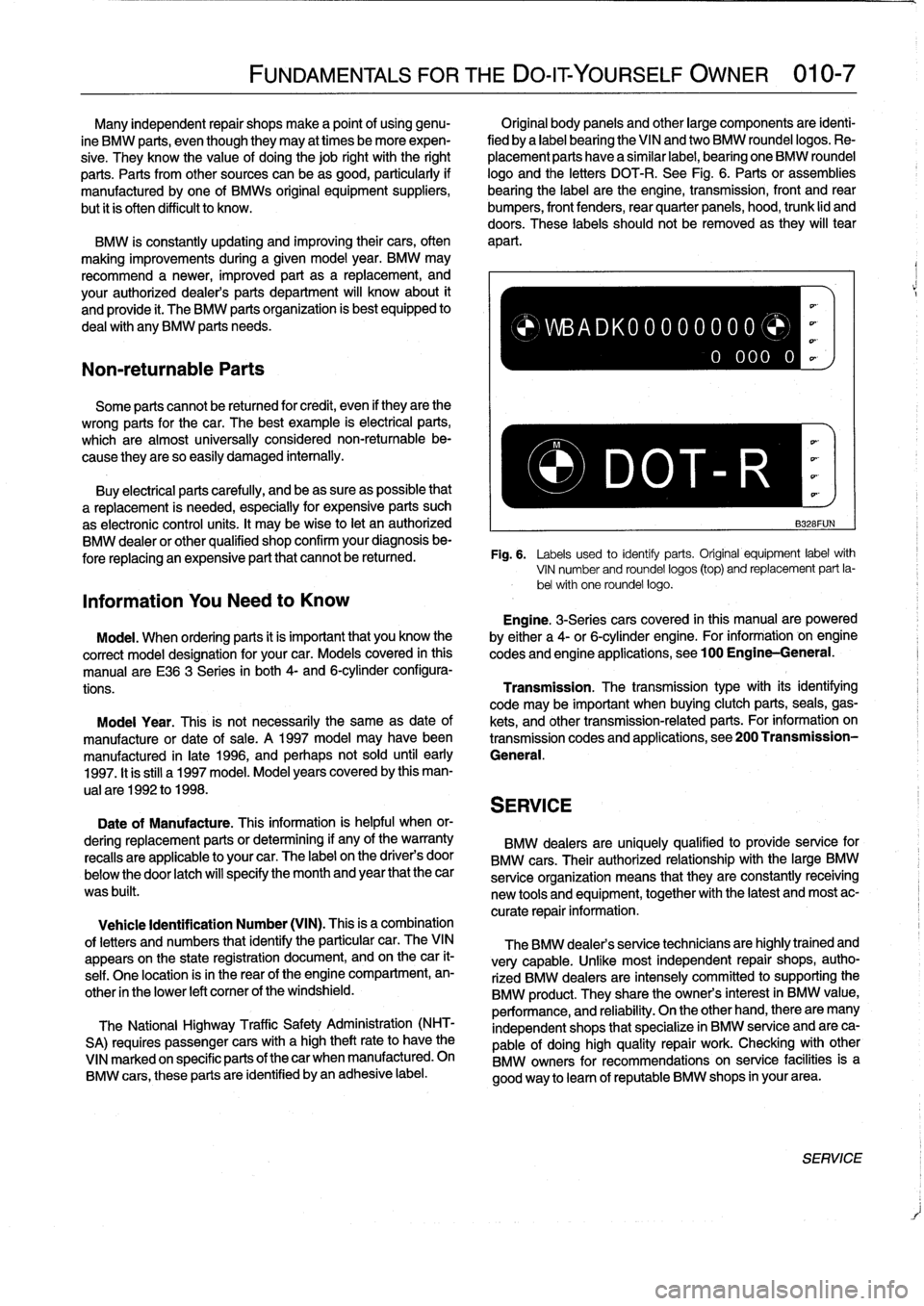
See
Fig
.
6
.
Parts
or
assemblies
manufactured
by
one
of
BMWs
original
equipment
suppliers,
bearing
the
label
arethe
engine,
transmission,
front
and
rear
but
it
is
often
difficult
to
know
.
bumpers,
front
fenders,
rear
quarter
paneis,
hood,
trunk
lid
and
doors
.
These
labels
shouldnot
be
removed
as
they
will
tear
BMW
is
constantly
updating
and
improving
their
cars,
often
apart
.
making
improvements
during
a
given
model
year
.
BMW
may
recommend
a
newer,
improved
part
as
a
replacement,
and
your
authorized
dealer's
parts
department
will
know
about
it
and
provide
it
.
The
BMW
parts
organization
is
best
equipped
to
deal
with
any
BMW
parts
needs
.
Some
parts
cannot
be
returned
for
credit,
even
if
they
arethe
wrong
parts
forthe
car
.
The
best
example
is
electrical
parts,
which
are
almost
universally
considered
non-returnable
be-
,
..
cause
they
are
so
easily
damaged
internally
.
Buy
electrícal
parts
carefully,
and
beas
sure
as
possible
that
P-
DOT~
R
a
replacement
is
needed,
especially
for
expensive
parts
such
as
electronic
control
units
.
It
may
bewise
to
let
an
authorized
B328FUN
BMW
dealeror
other
qualified
shop
confirm
your
diagnosisbe-
fore
replacing
an
expensive
part
that
cannot
be
retuned
.
Fig
.
6
.
Labels
used
to
identiy
parts
.
Original
equipment
labelwith
VIN
number
and
roundel
logos
(top)
and
replacement
part
la-
bel
with
one
roundel
logos
Information
You
Need
to
Know
Engine
.
3-Seriescars
covered
in
this
manualare
powered
Model
.
When
ordering
parts
it
is
important
that
you
know
the
by
either
a
4-or
6-cylinder
engine
.
For
information
-
on
engine
correct
model
designation
for
your
car
.
Models
covered
in
this
codes
and
engine
applications,
see100
Engine-General
.
manual
are
E36
3
Series
in
both
4-
and
6-cylinderconfigura-
tions
.
Transmission
.
The
transmissiontype
with
its
identifying
code
may
be
important
when
buying
clutch
parts,
seals,
gas
Moda¡
Year
.
This
is
not
necessarily
the
same
as
date
of
kets,
and
othertransmission-relatedparts
.
For
information
on
manufacture
or
date
of
sale
.
A
1997
model
may
havebeen
transmission
codes
and
applications,
see200
Transmission
manufactured
in
late
1996,
and
perhaps
not
sold
until
early
General
.
1997
.
It
is
still
a1997
model
.
Model
years
covered
by
this
man-
ual
are
1992
to
1998
.
SERVICE
Date
of
Manufacture
.
This
information
is
helpful
when
or-
dering
replacement
parts
or
determining
if
any
of
the
warranty
BMW
dealers
are
uniquely
qualified
to
provide
service
for
recalls
are
applicable
to
your
car
.
The
label
on
the
driver's
door
BMW
cars
.
Their
authorized
relationship
with
the
large
BMW
below
the
door
latch
will
specify
the
month
and
year
that
the
car
serviceorganization
means
that
they
are
constantly
receiving
was
built
.
new
tools
and
equipment,
together
with
the
latest
and
most
ac-
curate
repair
information
.
Vehicle
Identification
Number
(VIN)
.
This
is
a
combination
of
letters
and
numbers
that
identify
the
particular
car
.
TheVIN
appears
on
the
state
registration
document,
and
on
thecar
it-
self
.
One
location
isin
the
rear
of
the
engine
compartment,
en-
other
in
the
lower
left
comer
of
the
windshield
.
The
National
Highway
Traffic
Safety
Administration
(NHT-
SA)
requires
passenger
cars
with
a
high
theftrateto
have
the
VINmarked
on
specific
parts
of
thecar
when
manufactured
.
On
BMW
cars,
these
parts
are
identified
byan
adhesive
label
.
)WBADK00000000
0
000
0
The
BMW
dealers
service
technicians
are
highlytrained
and
very
capable
.
Unfke
most
independent
repair
shops,
autho-
rized
BMW
dealers
are
intensely
committed
tosupporting
the
BMW
product
.
They
share
the
owners
interest
in
BMW
value,
performance,
and
reliability
.
On
the
other
hand,
there
are
many
independent
shops
that
specialize
in
BMW
service
and
are
ca-
pable
of
doing
high
quality
repair
work
.
Checking
with
other
BMW
owners
for
recommendations
on
service
facilitiesis
a
good
way
to
leam
of
reputable
BMW
shops
in
yourarea
.
SERVICE
Page 16 of 759
010-
8
FUNDAMENTALSFORTHE
DO-ITYOURSELF
OWNER
TOOLS
Mostmaintenance
can
be
accomplished
with
a
small
selec-
tion
of
the
right
tools
.
Toolsrange
in
quality
from
inexpensive
junk,
which
may
brakk
at
first
use,
tovery
expensive
and
well-
made
tools
for
the
professional
.
The
best
tools
for
most
do-it
yourself
BMW
owners
He
somewhere
in
between
.
O
Many
reputable
tool
manufacturers
offer
good
quality,
mod-
erately
priced
tools
with
a
lifetime
guarantee
.
These
are
your
best
buy
.
They
cost
a
little
more,
but
they
are
good
quality
tools
that
will
dowhat
is
expected
of
them
.
Sears'
Craftsman®
line
is
one
such
source
of
good
quality
tools
.
Some
of
the
repairs
covered
in
this
manual
require
the
use
of
special
tools,
suchas
a
custom
puller
or
specialized
electrical
test
equipment
.
These
special
tools
are
called
out
in
the
text
andcan
be
purchased
through
an
authorized
BMW
dealer
.
As
an
alternative,
some
special
tools
mentioned
may
be
pur-
chased
from
the
following
tool
manufacturers
andlor
distribu-
tors
:
"
Assenmacher
Specialty
Tools
6440
Odell
Place,Boulder,
CO
80301
(303)
530-2424
"
Baum
Tools
Unlimited
.
Inc
.
PO
.
Box
87,
Longboat
Key,
FL
34228
(800)
848-6657
"
Schley
Products
Inc
.
5350
E
.
Hunter
Ave
.,
Anaheim
Hills,
CA
92807
(714)
693-7666
"
Zelenda
Machine
and
Tool
Corp
.
66-02
Austin
Street,
Forest
Hills,
NY
11375
(718)
896-2288
Basic
Tool
Requirements
The
basic
hand
tools
described
below
canbe
used
to
accom-
plish
most
of
thesimple
maintenance
and
repair
tasks
.
Fig
.
8
.
Types
of
wrench
heads
.
From
left,
open-end,
12-point
box-
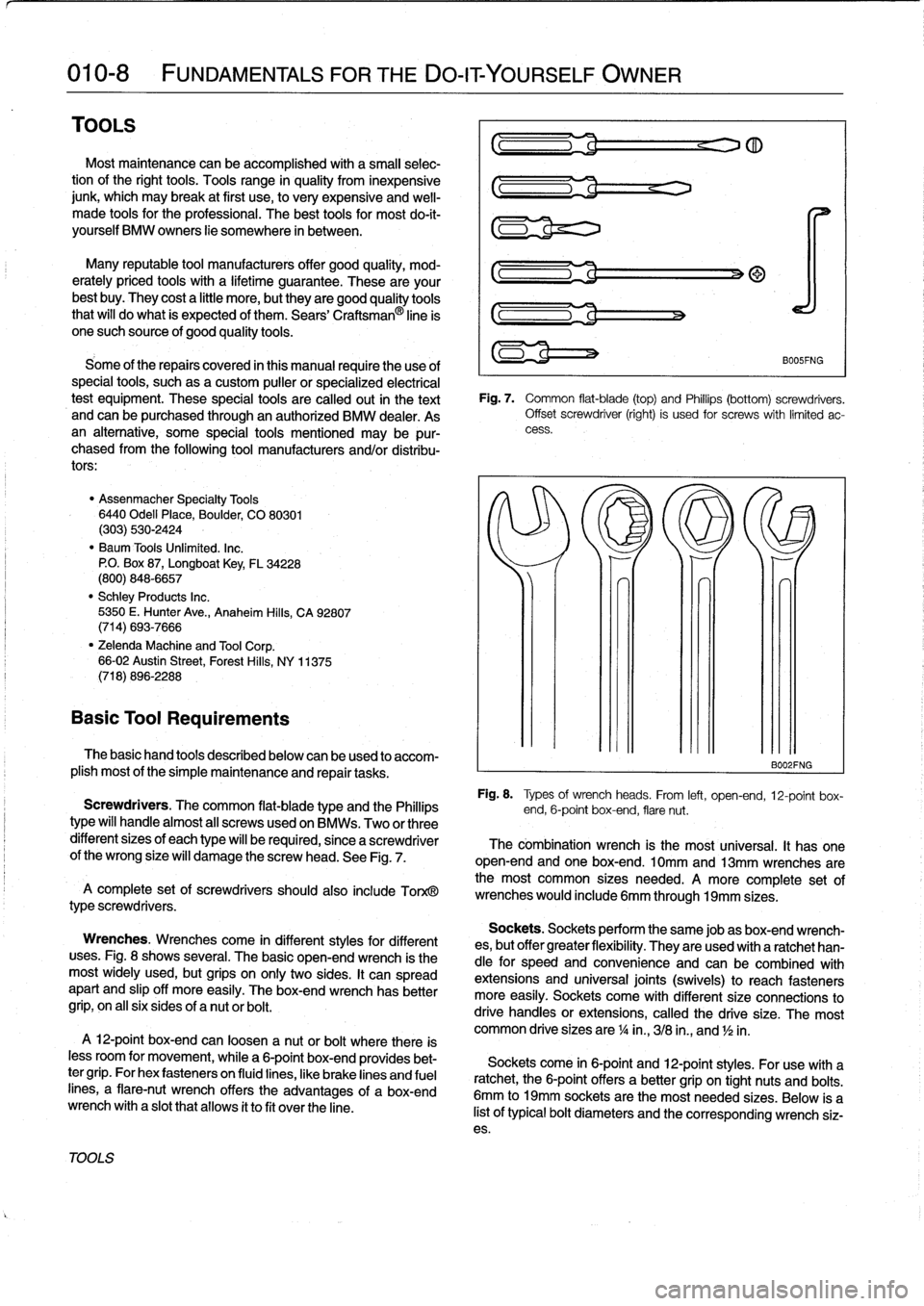
Screwdrivers
.
The
common
fíat-blade
type
and
the
Phillips
end,6-point
box-end,
fiare
nut
.
type
will
handlealmost
all
screws
used
on
BMWs
.
Two
orthree
different
sizes
of
each
type
will
be
required,
since
a
screwdriver
The
cómbination
wrench
is
the
most
universal
.
It
hasone
of
the
wrong
size
will
damage
the
screw
head
.
See
Fig
.
7
.
open-end
andone
box-end
.
10mm
and
13mm
wrenches
arethe
most
common
sizes
needed
.
A
more
complete
set
of
A
complete
set
of
screwdrivers
should
also
include
Torx@
wrenches
would
inciude
6mm
through
19mm
sizes
.
typescrewdrivers
.
Wrenches
.
Wrenches
come
in
different
styles
for
different
uses
.
Fig
.
8
shows
several
.
The
basic
open-end
wrench
is
the
most
widely
used,
but
grips
on
only
two
sides
.
It
can
spread
apart
and
slip
off
more
easily
.
The
box-end
wrench
has
better
grip,
on
al¡
six
sides
of
a
nut
or
bolt
.
A
12-point
box-end
can
loosen
a
nut
or
bolt
where
there
is
less
room
for
movement,
while
a
6-point
box-end
provides
bet-
ter
grip
.
Forhex
fasteners
on
fluid
lines,
like
brake
lines
and
fuel
lines,
a
fiare-nut
wrench
offers
the
acivantages
of
a
box-end
wrench
with
a
slot
that
ailows
it
to
fit
over
the
line
.
TOOLS
B005FNG
Fig
.
7
.
Common
flat-blade
(top)
and
Phillips
(bottom)
screwdrivers
.
Offset
screwdríver
(right)
is
used
for
screws
with
limited
ac-
cess
.
B002FNG
Sockets
.
Socketsperform
the
same
job
asbox-end
wrench-
es,
but
offer
greater
flexibility
.
They
are
used
with
a
ratchet
han-
dle
for
speed
and
conveniente
and
can
be
combined
with
extensions
and
universal
joints
(swivels)
to
reach
fasteners
more
easily
.
Sockets
come
with
different
size
connections
to
drive
handies
or
extensions,
called
the
drive
size
.
The
most
common
drive
sizes
are
1
/4
in
.,
318
in
.,
and
1
/2
in
.
Sockets
come
in
6-point
and
12-point
styles
.
For
use
with
a
ratchet,
the
6-point
offers
a
better
grip
on
tight
nuts
and
bolts
.
6mm
to
19mm
sockets
arethe
most
needed
sizes
.
Below
is
a
list
oftypical
bolt
diameters
and
the
corresponding
wrench
siz-
es
.
Page 18 of 759
010-10
FUNDAMENTALS
FOR
THE
DO-IT
YOURSELF
OWNER
TOOLS
Torque
Wrench
B021FNG
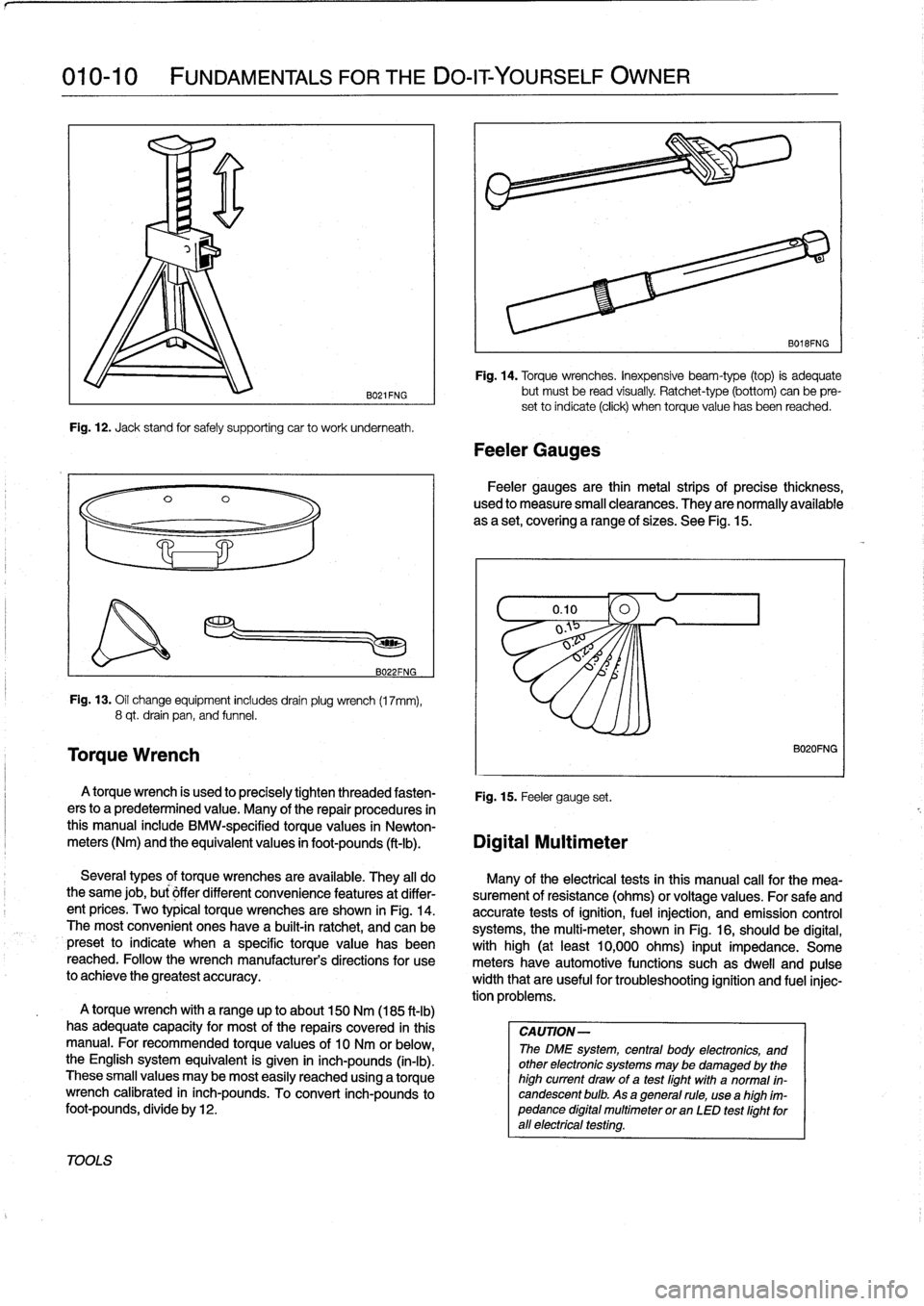
Fig
.
12
.
Jack
stand
for
safely
supporting
car
to
work
underneath
.
B022FNG
Fig
.
13
.
Oil
change
equipment
includesdrainplug
wrench
(17mm),
8
qt
.
drain
pan,
and
funnel
.
A
torque
wrench
is
used
to
precisely
tighten
threaded
fasten-
Fig
.
15
.
Feeler
gauge
set
.
ers
to
a
predetermined
value
.
Many
of
the
repair
procedures
in
this
manual
include
BMW-specified
torquevalues
in
Newton-
meters
(Nm)
and
the
equivalent
values
in
foot-pounds
(ft-Ib)
.
Digital
Multimeter
A
torque
wrench
with
a
range
up
to
about
150
Nm
(185
ft-lb)
has
adequate
capacity
for
most
of
the
repairs
covered
in
this
manual
.
For
recommended
torque
values
of
10
Nm
or
below,the
English
system
equivalent
is
given
in
inch-pounds
(in-lb)
.
These
small
values
may
be
most
easily
reached
using
a
torque
wrench
calibrated
in
inch-pounds
.
To
convert
inch-pounds
to
foot-pounds,
divide
by12
.
Fig
.
14
.
Torque
wrenches
.
Inexpensive
beam-type
(top)
is
adequate
but
must
be
read
visually
.
Ratchet-type
(bottom)
can
be
pre-
set
to
índicate
(click)
when
torquevalue
has
been
reached
.
Feeler
Gauges
B018FNG
Feeler
gauges
are
thin
metal
strips
of
precise
thickness,
used
to
measure
small
clearances
.
They
are
normally
available
as
a
set,
covering
a
range
of
sizes
.
See
Fig
.
15
.
Several
types
of
torque
wrenches
are
available
.
They
al¡
do
Many
of
the
electrical
tests
in
Chis
manual
cal¡
for
the
mea-
the
same
job,
bu¡
óffer
different
convenience
features
at
differ-
surement
of
resistance
(ohms)
or
voltage
values
.
For
safe
and
ent
prices
.
Two
typical
torque
wrenches
are
shown
in
Fig
.
14
.
accurate
tests
of
ignition,
fuel
injection,
and
emission
control
The
most
convenient
ones
have
a
built-in
ratchet,
and
can
be
systems,
the
multi-meter,
shown
in
Fig
.
16,
should
be
digital,
preset
to
indicate
when
a
specific
torque
value
has
been
with
high
(at
least
10,000
ohms)
input
impedance
.
Some
reached
.
Followthe
wrench
manufacturer's
directions
for
use
meters
have
automotive
functions
suchas
dweil
and
pulse
to
achieve
the
greatest
accuracy
.
width
that
are
useful
fortroubleshooting
ignition
and
fuel
injec-
tion
problems
.
CAUTION-
The
DME
system,
central
body
electronics,
and
other
electronic
systems
may
be
damaged
by
the
high
current
draw
of
a
test
fight
with
a
normal
in-
candescent
bulb
.
As
a
general
rule,
usea
high
ím-
pedance
digital
multimeter
or
an
LED
test
fightforall
electrfcal
testfng
.
B020FNG
Page 19 of 759
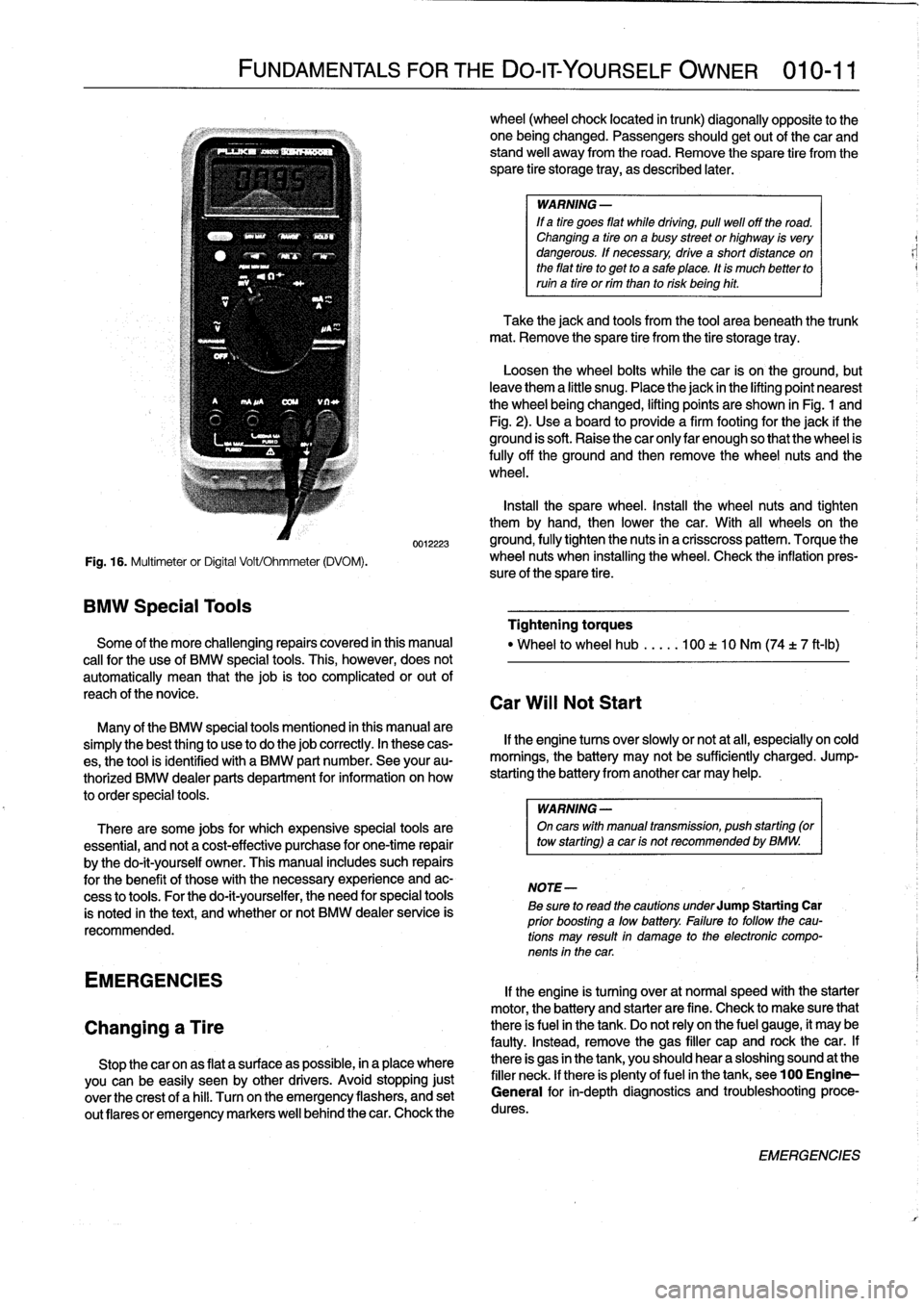
Fig
.
16
.
Multimeter
or
Digital
Volt/Ohmmeter
(DVOM)
.
BMW
Special
Tools
FUNDAMENTALS
FOR
THE
DO-ITYOURSELF
OWNER
010-11
0012223
Some
of
the
more
challenging
repairs
covered
in
this
manual
cal¡
for
the
use
of
BMW
special
tools
.
This,
however,
does
not
automatically
mean
that
thejob
is
too
complicated
or
out
of
reach
of
thenovice
.
Many
of
the
BMW
special
tools
mentioned
in
this
manual
are
simplythe
best
thing
to
use
to
do
thejob
correctly
.
In
these
cas-
es,
the
tool
is
identified
with
a
BMW
part
number
.
See
your
au-
thorized
BMW
dealer
parts
department
for
information
on
how
to
order
special
tools
.
There
are
some
jobs
for
which
expensive
special
tools
are
essential,
and
not
a
cost-effective
purchase
for
one-time
repair
by
the
do-it-yourself
owner
.
This
manual
includes
such
repairs
for
the
benefit
of
these
with
the
necessary
experience
and
ac-
cess
to
tools
.
For
the
do-it-yourselfer,
the
need
for
special
tools
is
noted
in
the
text,
and
whether
or
not
BMW
dealer
service
is
recommended
.
EMERGENCIES
Changing
a
Tire
Stop
thecar
onas
flat
a
surface
as
possible,
in
a
place
where
you
canbe
easily
seen
by
other
drivers
.
Avoid
stopping
just
over
the
crest
of
a
hill
.
Turnon
the
emergency
flashers,
and
set
out
(lares
or
emergency
markers
well
behindthecar
.
Chock
the
wheel
(wheel
chock
located
in
trunk)
diagonally
opposite
to
the
one
being
changed
.
Passengers
shouldgetout
of
thecar
and
stand
well
away
from
the
road
.
Remove
the
spare
tire
from
the
spare
tire
storage
tray,
as
described
later
.
WARNING
-
If
a
tire
goes
fíat
while
drtving,
pull
well
off
the
road
.
Changing
a
tire
ona
busy
street
or
highway
is
very
dangerous
.
If
necessary,
drive
a
short
distance
on
the
fíat
tire
to
get
to
a
sale
place
.
tt
is
much
better
to
ruin
a
tire
or
rim
than
to
risk
being
hit
.
Take
the
jack
and
tools
from
the
tool
area
beneath
the
trunk
mat
.
Remove
the
spare
tire
from
the
tire
storage
tray
.
Loosen
the
wheel
bolts
while
the
car
is
on
the
ground,
but
leave
them
a
little
snug
.
Placethe
jack
in
the
lifting
point
nearest
the
wheel
beingchanged,
lifting
points
are
shown
in
Fig
.
1
and
Fig
.
2)
.
Use
a
board
to
provide
a
firm
footing
for
the
jack
if
the
ground
is
soft
.
Raise
the
car
only
lar
enough
so
that
the
wheel
is
fully
off
the
ground
and
then
remove
the
wheel
nuts
and
the
wheel
.
Insta¡¡
the
spare
wheel
.
Install
the
wheel
nuts
and
tighten
them
by
hand,
then
lower
the
car
.
With
all
wheelson
the
ground,
fully
tighten
the
nuts
in
a
crisscross
pattern
.
Torque
the
wheel
nuts
when
installing
the
wheel
.
Check
the
inflation
pres-
sure
of
the
spare
tire
.
Tightening
torques
"
Wheel
to
wheel
hub
.....
100
t
10
Nm
(74
t
7
ft-Ib)
Car
Will
Not
Start
If
the
engine
tucos
over
slowly
or
not
at
all,
especially
on
cold
mornings,
the
battery
may
not
be
sufficiently
charged
.
Jump-
starting
the
battery
from
another
car
may
help
.
WARNING
-
On
carswith
manual
transmisston,
push
starting
(or
tow
starting)
acar
ts
not
recommended
by
BMW
.
NOTE-
Be
sure
to
read
the
cautions
underJump
Starting
Car
prior
boosting
a
low
battery
.
Fatlure
to
followthe
cau-
tions
may
result
in
damage
to
the
electronic
compo-
nents
in
the
car
.
If
the
engine
is
turning
over
at
normal
speed
with
the
starter
motor,
the
battery
and
starter
are
fine
.
Check
to
make
sure
that
there
is
fuel
in
the
tank
.
Do
not
rely
on
the
fuel
gauge,
it
may
be
faulty
.
Instead,
remove
the
gas
filler
cap
and
rock
thecar
.
If
there
is
gas
in
the
tank,
you
should
hear
a
sloshing
sound
at
the
filler
neck
.
lf
there
is
plenty
offuel
in
the
tank,
see100
Engine-
General
for
in-depth
diagnostics
and
troubleshootingproce-
dures
.
EMERGENCIES
Page 20 of 759
010-12
FUNDAMENTALSFOR
THE
DO-IT
YOURSELF
OWNER
Jump
Starting
Car
Cars
with
discharged
or
dead
batteries
can
be
jump-started
using
the
good
battery
from
another
car
.
When
jump-starting
the
engine,
always
note
the
following
warnings
.
WARNING
-
"
Battery
acid
(electrolyte)
can
cause
severe
burns,
and
will
damage
the
car
and
clothing
.
lf
electrolyte
is
spilled,
wash
the
surface
with
large
quantities
of
water
.
lfit
gets
finto
eyes,
flush
them
with
water
for
severa¡
minutes
and
cal¡
a
doctor
.
"
Batteries
produce
explosive
and
noxious
gas-
ses
.
Keep
sparks
and
flames
away
.
Do
not
smoke
near
batteries
.
"
Do
not
jump-start
the
engine
if
you
suspect
that
the
battery
is
frozen
.
Trapped
gas
may
explode
.
Allow
the
battery
to
thaw
first
.
"
Do
not
quick-charge
the
battery
(for
boost
start-
ing)for
longer
than
one
minute,
and
donot
ex-
ceed
15
volts
at
the
battery
with
the
boosting
cables
attached
.
Wait
at
least
one
minutebefore
boosting
the
battery
a
second
time
.
"
Some
electrical
system
'comfort"
features
may
not
function
correctly
once
battery
power
is
restored
.
For
example,
the
front
window
one-touch-up
func-
tion
may
be
disabled
.
Some
electrical
systems
will
need
to
be
reinitialized
Consult
the
appropriate
re-
pairgroup
formore
specific
information
.
1
.
Place
cars
close
together,
but
do
not
allow
them
to'touch
each
other
.
Turn
off
the
engine
of
thecar
with
the
good
battery
.
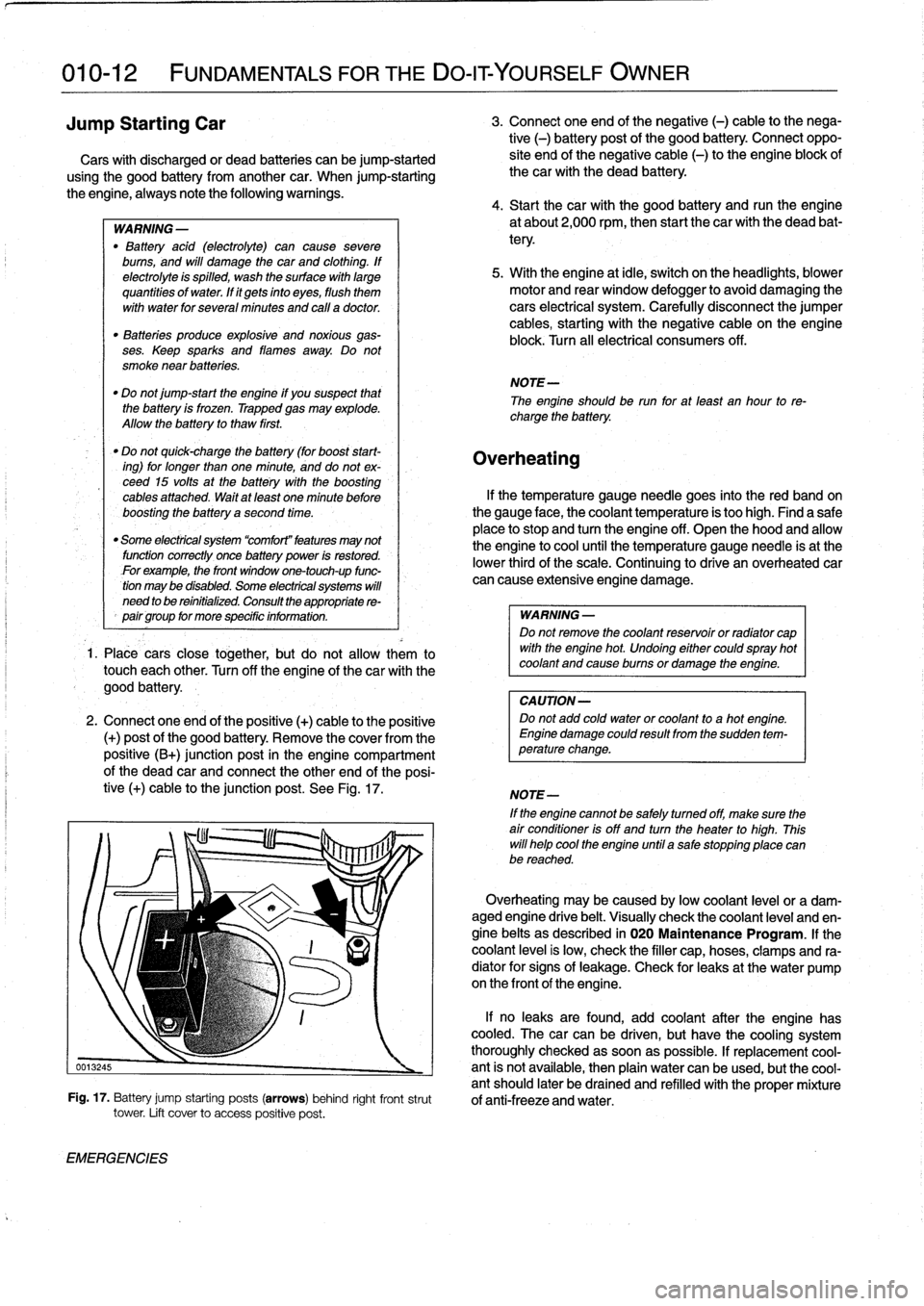
2
.
Connect
oneend
of
the
positive
(+)
cable
to
the
positive
(+)
post
of
the
good
battery
.
Remove
the
coverfromthe
positive
(B+)
junction
post
in
the
engine
compartment
of
the
dead
car
and
connect
the
other
end
of
the
posi-
tive
(+)
cable
to
the
junction
post
.
See
Fig
.
17
.
EMERGENCIES
3
.
Connect
one
end
of
the
negative
(-)
cable
to
the
nega-
tive
(-)
battery
post
of
the
good
battery
.
Connect
oppo-
site
end
of
the
negative
cable
(-)
to
the
engine
block
of
thecar
with
the
dead
battery
.
4
.
Start
thecar
with
the
good
battery
and
runthe
engine
at
about2,000
rpm,
then
start
the
car
with
the
dead
bat-
tery
.
5
.
With
the
engine
at
¡dle,
switch
on
the
headlights,
blower
motor
and
rear
window
defogger
to
avoid
damaging
the
cars
electrical
system
.
Carefully
disconnect
the
jumper
cables,
starting
with
the
negative
cable
on
the
engine
block
.
Turn
all
electrical
consumers
off
.
NOTE-
The
engineshould
be
run
for
at
least
an
hour
to
re-
charge
the
battery
.
Overheating
lf
the
temperature
gauge
needle
goes
into
the
red
band
on
the
gauge
face,
the
coolant
temperature
is
too
high
.
Find
a
safe
place
to
stop
and
turn
the
engine
off
.
Open
the
hood
and
allow
the
engine
to
cool
until
the
temperature
gauge
needle
is
at
the
lower
thirdof
the
scale
.
Continuing
to
drive
an
overheated
car
can
cause
extensive
engine
damage
.
WARNING
-
Do
not
remove
the
coolant
reservoir
or
radíator
cap
with
the
engine
hot
.
Undoing
either
couldspray
hot
coolant
and
cause
burns
or
damage
the
engine
.
CAUTION-
Do
not
add
cold
water
or
coolant
to
a
hot
engine
.
Engine
damage
could
result
from
the
sudden
tem-
perature
change
.
NOTE-
If
the
enginecannot
be
safely
tumed
off,
make
sure
the
air
condifioner
isoff
and
turn
the
heater
to
high
.
This
will
helo
cool
the
engine
until
a
salestopping
place
canbe
reached
.
Overheating
may
be
caused
bylow
coolant
leve¡
or
a
dam-aged
engine
drive
belt
.
Visually
check
the
coolant
leve¡
and
en-
gine
belts
as
described
in
020
Maintenance
Program
.
lf
the
coolant
leve¡
is
low,
check
the
filler
cap,hoses,
clamps
and
ra-
diator
for
signs
of
leakage
.
Check
for
leaks
at
the
water
pump
on
the
frontof
theengine
.
lf
no
leaks
are
found,
add
coolant
after
the
engine
has
cooled
.
The
carcan
be
driven,
but
have
the
cooling
system
thoroughly
checked
assoonas
possible
.
lf
replacement
cool
0013245
-
ant
is
not
available,
then
plain
water
canbe
used,
butthe
cool-
antshould
later
be
drained
and
refilled
with
theproper
mixture
Fig
.
17
.
Battery
jump
starting
posts
(arrows)
behind
right
frontstrut
of
anti-freeze
and
water
.
tower
.
Lift
cover
to
access
positive
post
.
Page 21 of 759
If
steam
is
coming
from
the
engine
compartment
thenthere
is
With
the
engine
and
ignition
off,
check
for
loose
or
corroded
most
likely
a
burst
coolant
hose
or
a
large
leak
in
the
cooling
battery
cables
or
wires
at
the
battery
or
thealtemator
.
Discon-
system
.
To
find
the
leak,
look
for
signs
of
coolant
leakage
on
necting,
cleaning,
and
reinstalling
corroded
wires
and
connec-
hoses,
at
hose
connections,
or
on
the
radiator
.
Let
theengine
tors
may
solve
the
problem
.
Also
check
drive
belt
tension
as
cool
thoroughly,
then
add
coolant
or
water
to
fill
the
system
and
described
in
020
Maintenance
Program
.
start
the
engine
.
If
a
great
deal
of
water
or
coolant
flows
out
of
the
hole,
then
thecarshouldnot
be
driven
until
repairs
are
made
.
lf
there
is
slight
seepage,
then
it
may
be
possible
to
drive
TOWi
ng
a
short
distance,
adding
coolant
as
needed
.
The
cars
covered
by
this
manual
should
be
towed
witha
tow
truck
using
wheel
lift
or
flat
bed
equipment
.
Do
not
tow
thecar
on
all
four
wheels
except
for
very
short
distances
to
move
it
to
a
safe
place
.
If
thered
engine
oil
pressure
warning
light
illuminates,
imme-
diately
stop
thecar
and
turn
off
the
engine
.
Have
the
vehicle
A
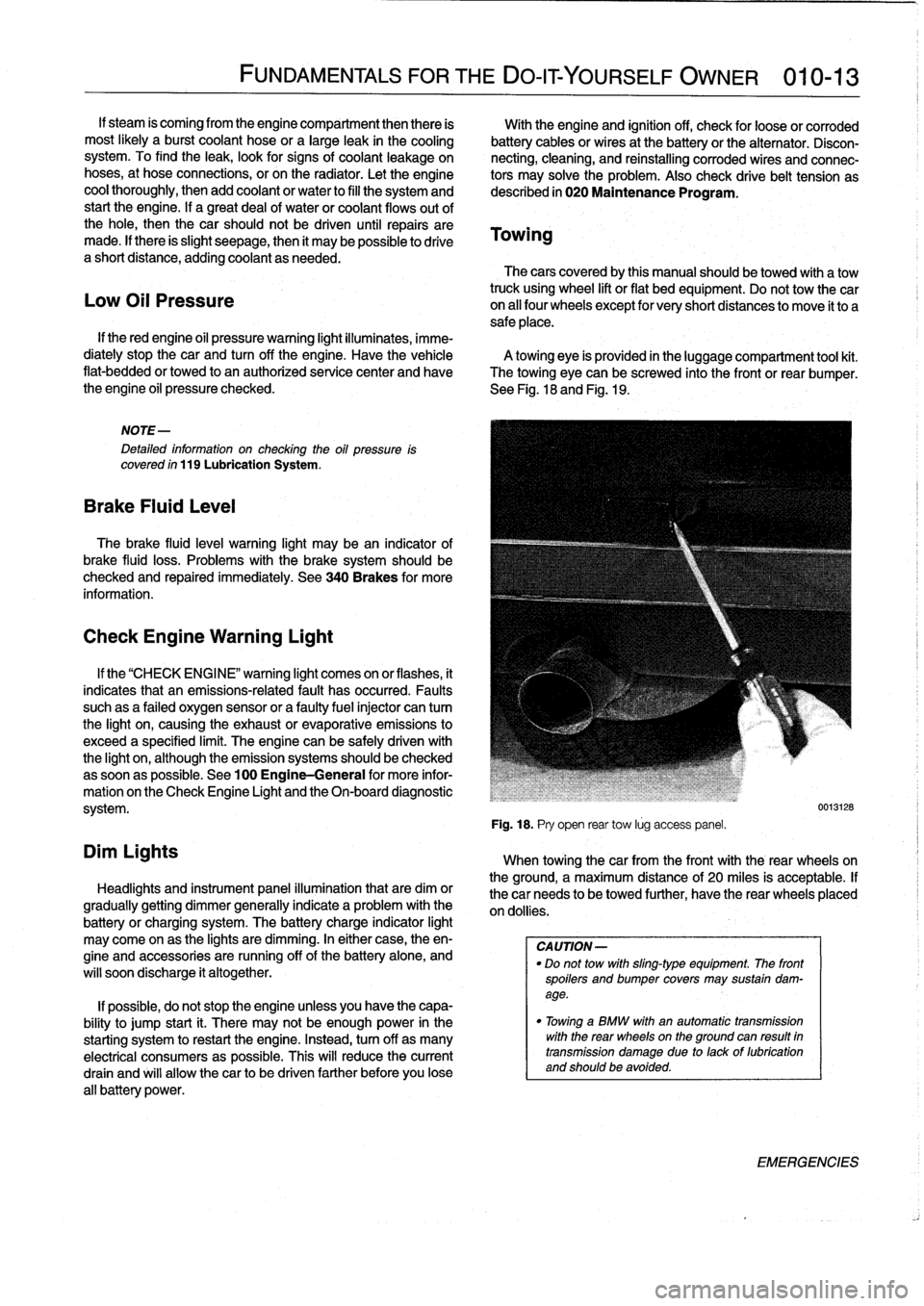
towing
eye
is
provided
in
the
luggage
compartment
tool
kit
.
flat-bedded
or
towed
to
an
authorized
service
center
and
have
The
towing
eye
can
be
screwed
into
the
front
or
rear
bumper
.
the
engine
oil
pressure
checked
.
See
Fig
.
18
and
Fig
.
19
.
Low
Oil
Pressure
NOTE-
Detafed
information
on
checking
the
oil
pressure
is
covered
ín
119
Lubrication
System
.
Brake
Fluid
Leve¡
The
brake
fluid
leve¡
warning
light
may
bean
indicator
of
brake
fluid
loss
.
Problems
with
the
brakesystem
should
be
checked
and
repaired
immediately
.
See
340Brakes
for
more
information
.
Check
Engine
Warning
Light
Dim
Lights
FUNDAMENTALS
FOR
THE
DO-IT
YOURSELF
OWNER
010-13
If
the
"CHECK
ENGI
NE"
warning
light
comes
on
or
flashes,
it
indicates
that
an
emissions-related
fault
has
occurred
.
Faults
suchas
a
failed
oxygen
sensor
or
a
faultyfuelinjector
can
tum
the
light
on,
causing
the
exhaust
or
evaporative
emissions
to
exceed
a
specified
limit
.
The
engine
can
be
safely
driven
with
the
light
on,
although
the
emission
systems
should
be
checked
assoonas
possible
.
See
100
Engine-General
for
more
infor-
mation
on
the
Check
Engine
Light
and
the
On-board
diagnostic
system
.
Headlights
and
instrument
panel
illuminationthat
are
dim
or
gradually
getting
dimmer
generally
indicate
a
problem
with
the
battery
or
charging
system
.
The
battery
charge
indicator
light
may
come
on
as
the
lights
are
dimming
.
In
either
case,
theen-
gine
and
accessories
are
running
off
of
the
battery
alone,
and
will
soon
discharge
it
altogether
.
If
possible,
do
not
stop
the
engine
unless
you
have
the
capa-
bility
to
jump
start
¡t
.
There
may
not
be
enough
power
in
the
starting
system
torestart
the
engine
.
Instead,turn
off
as
many
electrical
consumers
as
possible
.
This
will
reduce
the
current
drain
and
will
allow
thecar
to
be
driven
farther
before
you
lose
all
battery
power
.
Fig
.
18
.
Pry
open
rear
tow
lúg
access
panel
.
When
towingthecar
from
the
front
with
the
rear
wheelson
the
ground,
a
maximum
distance
of
20
miles
is
acceptable
.
If
thecar
needs
to
be
towed
further,
have
the
rear
wheels
placed
on
dollies
.
CA
UTION-
"
Do
not
tow
with
sling-type
equipment
The
front
spoilers
andbumper
covers
may
sustain
dam-
age
.
"
Towínga
BMW
with
an
automatic
transmission
with
the
rear
wheelson
the
ground
can
resuft
in
transmission
damage
due
to
lackof
lubrication
and
should
be
avoided
.
0013128
EMERGENCIES
Page 22 of 759
010-14
FUNDAMENTALS
FOR
THE
DO-ITYOURSELF
OWNER
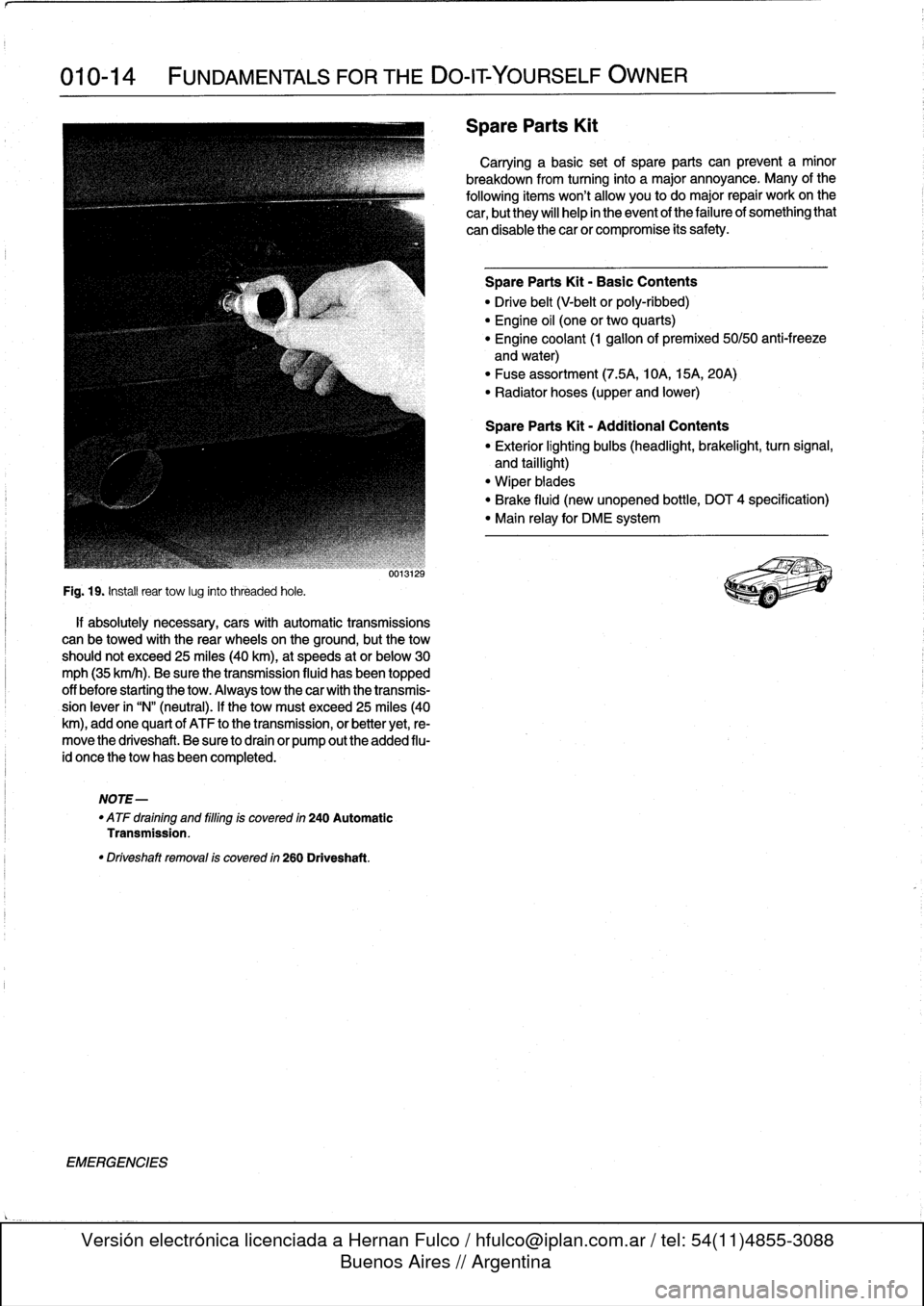
Fig
.
19
.
Instaf
rear
tow
lug
into
threaded
hole
.
if
absolutely
necessary,
cars
with
automatic
transmissions
can
be
towed
with
the
rear
wheels
on
the
ground,
butthe
tow
should
not
exceed
25
miles
(40
km),at
speeds
at
or
below30
mph
(35
km/h)
.
Be
sure
the
transmission
fluid
hasbeen
topped
off
before
starting
the
tow
.
Always
tow
thecar
with
the
transmis-
sion
lever
in
"N"
(neutral)
.
If
the
tow
must
exceed25
miles
(40
km),
add
one
quart
of
ATF
to
the
transmission,
or
better
yet,
re-
move
the
driveshaft
.
Be
sure
to
drain
or
pump
outthe
added
flu-
id
once
the
tow
has
been
completed
.
NOTE-
"
ATF
draining
and
filling
is
covered
in
240
Automatic
Transmission
.
"
Driveshaft
removal
is
covered
in
260
Driveshaft
.
EMERGENCIES
úo1W¿b
Spare
Parts
Kit
Carrying
a
basic
set
of
spare
parts
can
prevent
a
minor
breakdown
from
turning
into
a
major
annoyance
.
Many
of
the
following
itemswon't
allow
you
todo
major
repair
workon
the
car,
but
they
will
help
in
the
event
of
the
failure
of
something
that
can
disable
thecar
or
compromise
its
safety
.
Spare
Parts
Kit
-
Basic
Contents
"
Drive
belt
(V-belt
or
poly-ribbed)
"
Engine
oil
(one
or
two
quarts)
"
Engine
coolant
(1
gallonof
premixed
50/50
anti-freeze
and
water)
"
Fuse
assortment
(7
.5A,
10A,
15A,
20A)
"
Radiator
hoses
(upper
and
lower)
Spare
Parts
Kit
-
Additional
Contents
"
Exterior
lighting
bulbs
(headlight,
brakelight,
turn
signal,
and
taillight)
"
Wiper
biades
"
Brake
fluid
(new
unopened
bottle,
DOT
4
specification)
"
Main
relay
for
DME
system