Front suspension torque BMW 318i 1996 E36 Owner's Manual
[x] Cancel search | Manufacturer: BMW, Model Year: 1996, Model line: 318i, Model: BMW 318i 1996 E36Pages: 759
Page 283 of 759
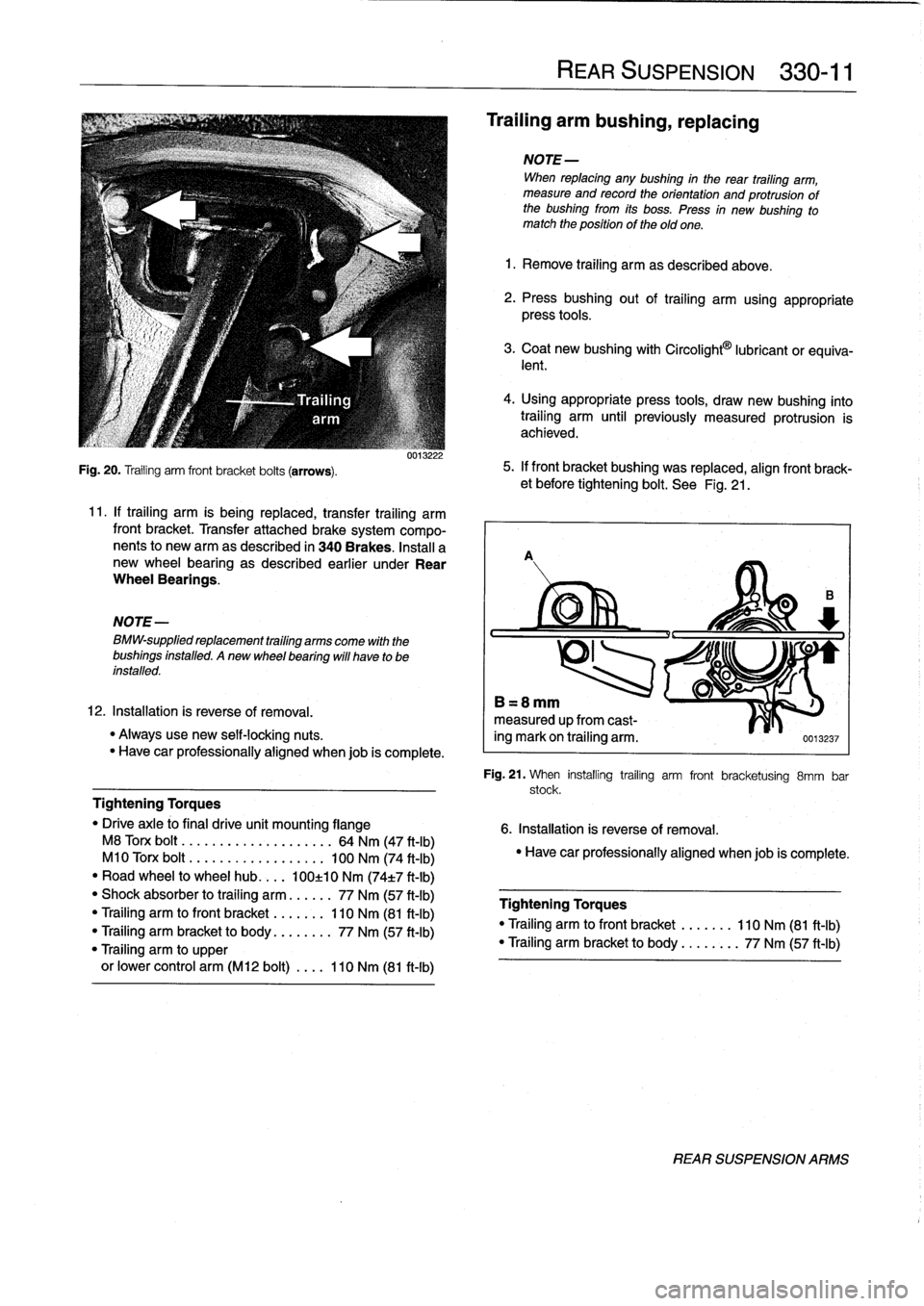
Fig
.
20
.
Trailing
arm
front
bracket
bolts
(arrows)
.
NOTE-
BMW-supplied
replacement
trailing
arms
come
with
the
bushings
installed
.
Anew
wheel
bearing
will
have
to
be
installed
.
0013222
11
.
If
trailing
arm
is
being
replaced,
transfer
trailing
arm
front
bracket
.
Transfer
attached
brake
system
compo-
nents
to
newarm
as
described
in
340Brakes
.
Insta¡¡
a
new
wheel
bearing
as
described
earlier
under
Rear
Wheel
Bearings
.
12
.
Installation
is
reverse
of
removal
.
"
Alwaysuse
new
self-locking
nuts
.
"
Have
car
professionally
aligned
when
job
is
complete
.
Tightening
Torques
"
Drive
axle
#o
final
drive
unit
mounting
flange
M8
Torx
bolt
......
.
...
.....
.
..
..
64
Nm
(47
ft-Ib)
M10
Torx
bolt
.....
...
.
....
.....
100
Nm
(74
ft-Ib)
"
Road
wheel
to
wheel
hub
.
...
100±10
Nm
(74t7
ft-Ib)
"
Shock
absorber
to
trailing
arm
......
77
Nm
(57
ft-Ib)
"
Trailing
arm
tofront
bracket
.......
110
Nm
(81
ft-Ib)
"
Trailing
arm
bracket
to
body
........
77
Nm
(57
ft-Ib)
"Trailing
arm
to
upper
or
lower
control
arm
(M12
bolt)
....
110
Nm
(81
ft-Ib)
REAR
SUSPENSION
330-
1
1
Trailing
arm
bushing,
replacing
NOTE-
When
replacing
any
bushing
in
the
rear
trailing
arm,
measure
and
recordthe
orientation
and
protrusion
of
the
bushing
from
its
boss
.
Press
in
new
bushing
to
match
the
positionof
theold
one
.
1
.
Remove
trailing
arm
as
described
above
.
2
.
Pressbushing
out
of
trailing
arm
using
appropriate
press
tools
.
3
.
Coat
new
bushing
with
Circolight
9
lubricant
or
equiva-
lent
.
4
.
Using
appropriate
press
tools,
draw
new
bushing
into
trailing
arm
until
previously
measured
protrusion
is
achieved
.
5
.
If
front
bracket
bushing
was
replaced,
alignfront
brack-
et
before
tightening
bolt
.
See
Fig
.
21
.
A
B=8mm
measured
upfrom
cast-
ing
mark
on
trailing
arm
.
0013237
Fig
.
21
.
When
installing
trailing
arm
front
bracketuising
8mm
bar
stock
.
6
.
Installation
is
reverse
of
removal
.
"
Have
car
professionally
aligned
when
job
is
complete
.
Tightening
Torques
"
Trailing
arm
tofront
bracket
.......
110
Nm
(81
ft-Ib)
"Trailing
arm
bracket
to
body
......
.
.
77
Nm
(57
ft-Ib)
REAR
SUSPENSION
ARMS
Page 289 of 759
Final
driveinputshaft
oil
sea¡,
replacing
1
.
Raise
car
and
support
safely
.
2
.
Drain
final
drive
oil
as
described
earlier
.
3
.
Remove
driveshaft
from
final
drive
inputshaft
flange
.
See
260
Driveshaft
.
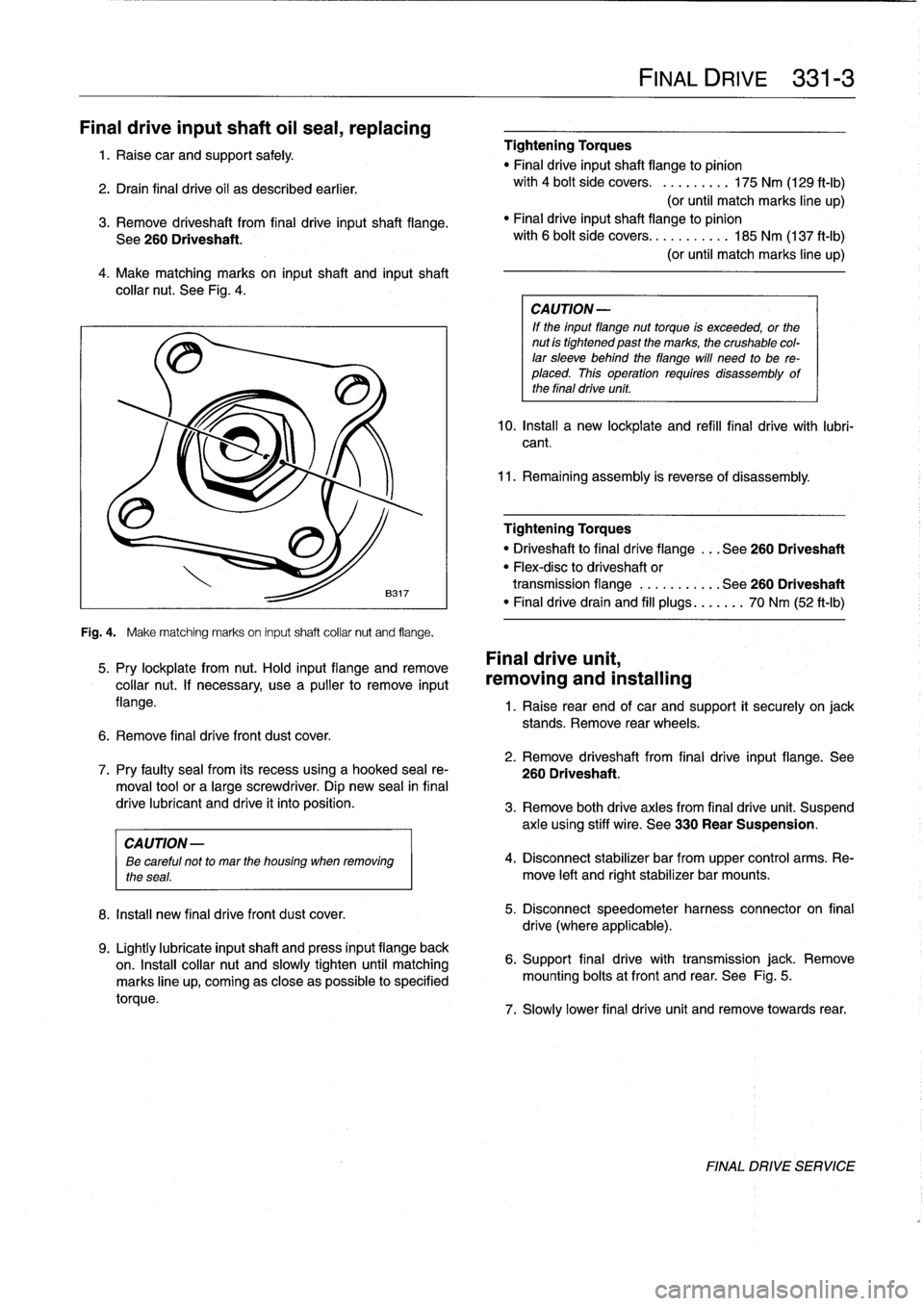
4
.
Make
matching
marks
on
input
shaft
and
inputshaft
collar
nut
.
See
Fig
.
4
.
Fig
.
4
.
Make
matching
marks
on
input
shaft
collar
nut
and
flange
.
5
.
Pry
lockplate
from
nut
.
Hold
input
flange
andremove
collar
nut
.
If
necessary,
usea
pullerto
remove
input
flange
.
6
.
Remove
final
drive
front
dust
cover
.
8
.
Install
new
final
drivefront
dust
cover
.
9
.
Lightly
lubricate
inputshaft
and
press
input
flange
back
on
.
Insta¡¡
collar
nut
and
slowly
tighten
until
matching
marks
line
up,
coming
as
close
aspossible
to
specified
torque
.
Tightening
Torques
"
Final
driveinputshaft
flange
to
pinion
with
4
bolt
side
covers
.
.........
175
Nm
(129
ft-Ib)
(or
until
match
marks
line
up)
"
Finaldriveinputshaft
flange
to
pinion
with
6
bolt
side
covers
...........
185
Nm
(137
ft-Ib)
(or
until
match
marks
line
up)
CA
UTION-
If
the
input
flange
nuttorque
is
exceeded,
or
the
nut
is
tightened
past
the
marks,
the
crushable
col-
lar
sleeve
behind
theflange
will
need
to
be
re-
placed
.
This
operation
requires
disassembly
of
the
final
drive
unit
.
10
.
Install
a
new
lockplate
and
refill
final
drive
with
lubri-
cant
.
11
.
Remaining
assembly
is
reverse
of
disassembly
.
Tightening
Torques
"
Driveshaftto
final
dríve
flange
...
See260
Driveshaft
"
Flex-disc
to
driveshaft
or
transmission
flange
...........
See260
Driveshaft
"
Finaldrivedrain
and
fill
plugs
...
.
..
.
70
Nm
(52
ft-Ib)
Final
drive
unit,
removing
and
installing
FINAL
DRIVE
331-
3
1
.
Raise
rear
end
of
car
and
support
it
securely
on
jack
stands
.
Remove
rear
wheels
.
2
.
Remove
driveshaft
from
final
drive
input
flange
.
See
7
.
Pry
faulty
sea¡
from
its
recess
using
a
hooked
sea¡
re-
260
Driveshaft
.
moval
toolor
a
large
screwdriver
.
Dip
new
sea¡
in
final
drive
lubricant
and
drive
it
into
position
.
3
.
Remove
both
drive
axles
from
final
drive
unit
.
Suspend
axle
using
stiff
wire
.
See
330
Rear
Suspension
.
CAUTION
-
ee
careful
not
to
mar
the
housing
when
removing
4
.
Disconnect
stabilizer
bar
from
upper
control
arms
.
Re-
the
seas
.
move
left
and
rightstabilizer
bar
mounts
.
5
.
Disconnect
speedometer
harness
connector
on
final
drive
(where
applicable)
.
6
.
Support
final
drive
with
transmission
jack
.
Remove
mounting
bolts
atfront
and
rear
.
See
Fig
.
5
.
7
.
Slowly
lower
final
drive
unit
and
remove
towards
rear
.
FINAL
DRIVE
SERVICE
Page 293 of 759
When
bleeding
the
brakes,
startat
the
wheel
farthest
from
4
.
Close
bleeder
screw
and
release
brake
pedal
.
Refill
the
master
cylinder
and
progress
in
the
following
order
:
brake
fluid
reservoir
and
proceed
to
rear
left
wheel
.
"
right
rear
brake
5
.
Proceed
with
the
remaining
wheels
using
the
order
list-
"
left
rear
brake
ed
earlier
.
"
rightfront
brake
"
left
front
brake
Pressure
bleeding
brakes
(except
carswith
AST)
1
.
Top
off
brake
fluid
in
reservoir
and
connect
pressure
bleeder
to
reservoir
.
Connect
bleeder
hose
and
bottle
to
right
rearcaliper
bleeder
screw
.
Pressurize
system
to
approximately
1
bar
(14
.5
psi)
.
BRAKES
340-
3
Tightening
Torques
"
Bleeder
screws
:
7
mm
screw
..........
..
.
.
.
.
......
5
Nm
(4
ft-Ib)
9
mm
screw
..........
..
.
..
.......
6
Nm
(5
ft-Ib)
BRAKE
PADS,
CALIPERS,
AND
ROTORS
CAUTION-
TheE36
front
brake
caliper
is
shown
in
Fig
.
2
.
The
rear
Do
not
exceed
a
pressure
of
2
bar
(29
psi)
when
brake
caliper
is
shown
in
Fig
.
7
.
pressure
bleeding
the
brake
system
.
Excessive
pressure
will
damage
the
brake
fluid
reservoir
.
Brake
pads
canbe
replaced
without
disconnecting
the
brake
fluid
hose
from
the
caliper
or
having
to
bleed
the
brakes
.
2
.
Have
a
helperhold
brake
pedal
down
.
The
rotors
can
be
replaced
without
disassembling
the
wheel
huband
bearing
.
Always
machine
or
replace
rotors
in
parts
.
3
.
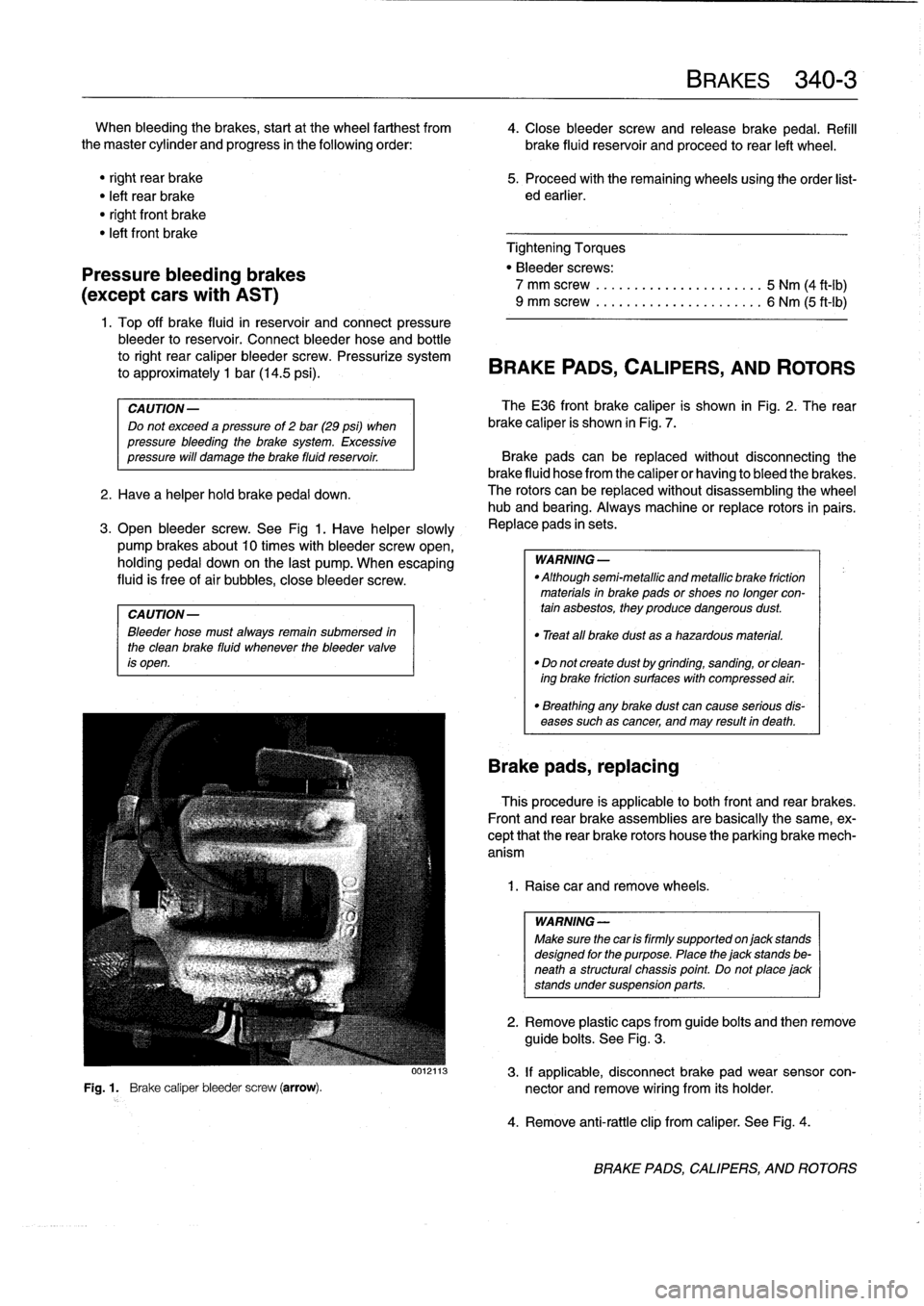
Open
bleeder
screw
.
See
Fig
1
.
Have
helper
slowly
,
Replace
pads
in
sets
.
pump
brakes
about10
times
with
bleeder
screw
open,
holding
pedal
down
on
the
last
pump
.
When
escaping
WARNING-
fluid
is
free
of
air
bubbles,
close
bleeder
screw
.
"
Althoughsemi-metallicandmetallicbrake
friction
materials
in
brake
pads
or
shoes
no
longer
con
CAUTION-
tain
asbestos,
they
produce
dangerous
dust
.
Bleeder
hose
must
alwaysremain
submersed
in
"
Treat
all
brake
dust
asa
hazardous
material
.
the
clean
brake
fluid
whenever
the
bleeder
valve
is
open
.
"
Do
not
create
dust
by
grinding,
sanding,
orclean-
ing
brake
friction
surfaces
with
compressed
air
.
"
Breathing
any
brake
dust
can
cause
serious
dis-
eases
such
as
cancer,
and
may
result
in
death
.
Brake
pads,
replacing
This
procedure
is
applicable
lo
both
front
and
rear
brakes
.
Front
and
rear
brake
assemblies
are
basically
the
same,
ex-
cept
that
the
rear
brake
rotors
house
the
parking
brake
mech-
anism
1
.
Raise
car
andremove
wheels
.
WARNING
-
Make
sure
thecar
is
firmly
supported
onjack
stands
designed
for
the
purpose
.
Place
the
jack
stands
be-
neath
a
structural
chassis
point
.
Do
not
place
jack
stands
undersuspension
parts
.
2
.
Remove
plastic
caps
from
guide
bolts
and
then
remove
guide
bolts
.
See
Fig
.
3
.
0012113
3
.
If
applicable,
disconnect
brake
pad
wear
sensor
con-
Fig
.
1
.
Brake
caliper
bleeder
screw
(arrow)
.
nector
and
remove
wiring
from
its
holder
.
4
.
Remove
anti-rattle
clip
from
caliper
.
See
Fig
.
4
.
BRAKE
PADS,
CALIPERS,
AND
ROTORS
Page 326 of 759
510-4
EXTERIOR
TRIM,
BUMPERS
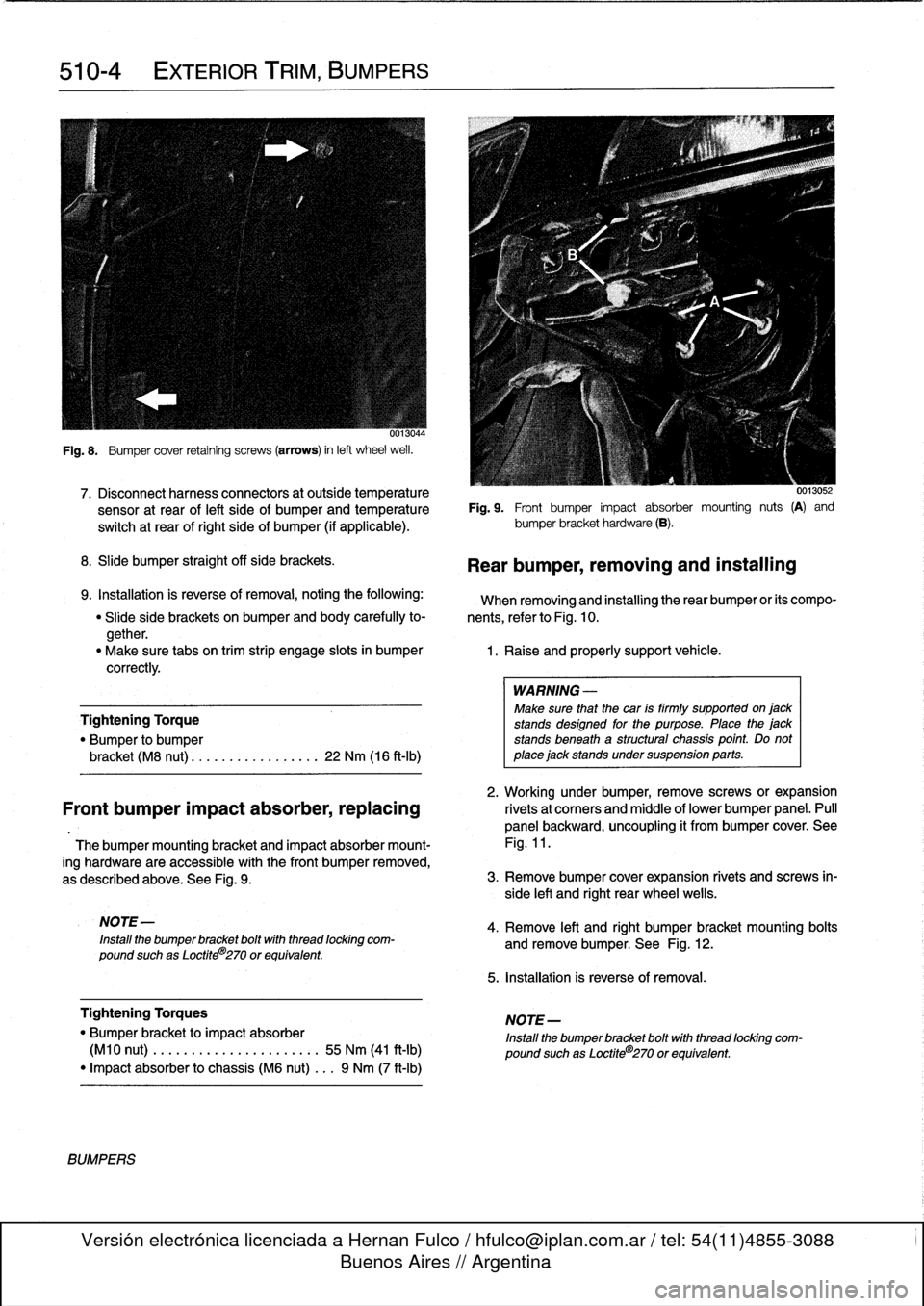
Fig
.
8
.
Bumper
cover
retaining
screws
(arrows)
in
left
wheel
weil
.
7
.
Disconnect
harnessconnectors
at
outside
temperature
0013052
sensor
at
rear
of
left
side
of
bumperand
temperatura
Fig
.
9
.
Front
bumper
impact
absorber
mounting
nuts
(A)
and
switch
at
rear
of
right
side
of
bumper
(if
applicable)
.
bumper
bracket
hardware
(B)
.
8
.
Slide
bumper
straight
off
sida
brackets
.
9
.
Installation
is
reverse
of
removal,
notingthe
following
:
When
removing
and
installing
therear
bumper
or
its
compo-
"
Slide
side
brackets
on
bumper
and
body
carefully
to-
nents,
referto
Fig
.
10
.
gether
.
"
Make
sure
tabs
on
trim
strip
engage
slots
in
bumper
1
.
Raise
and
properly
support
vehicle
.
correctly
.
Tightening
Torque
"
Bumper
to
bumper
bracket
(M8
nut)
............
...
.
.
22
Nm
(16
ft-Ib)
2
.
Working
under
bumper,
remove
screws
or
expansion
Front
bumper
impact
absorber,replacing
rivetsat
corners
and
middle
of
lower
bumper
panel
.
Pull
panel
backward,
uncoupling
it
from
bumper
cover
.
See
Thebumper
mounting
bracket
and
impact
absorber
mount-
Fig
.
11
.
ing
hardware
are
accessible
with
the
Font
bumper
removed,
as
described
above
.
See
Fig
.
9
.
3
.
Remove
bumper
cover
expansion
rivets
and
screws
in-
side
left
and
right
rear
wheel
wells
.
NOTE
-
Install
the
bumper
bracket
boltwith
thread
locking
com-
pound
suchas
Loctite
8
270
or
equivalent
.
Tightening
Torques
"
Bumper
bracket
to
impact
absorber
(M10
nut)
.
..
.
...
.............:.
55
Nm
(41
ft-Ib)
"
Impact
absorber
to
chassis
(M6
nut)
...
9
Nm
(7
ft-Ib)
BUMPERS
Rear
bumper,
removing
and
installing
WARNING
-
Make
sure
that
the
car
is
firmly
supported
on
jack
stands
designad
for
the
purpose
.
Place
the
jack
stands
beneath
a
structural
chassis
point
.
Do
not
place
jack
stands
under
suspension
parts
.
4
.
Remove
left
and
right
bumper
bracket
mounting
bolts
and
remove
bumper
.
See
Fig
.
12
.
5
.
Installation
is
reverse
of
removal
.
NOTE-
Install
the
bumper
bracket
bolt
with
thread
locking
com-
pound
suchas
Loctite®270
or
equivalent
.
Page 328 of 759
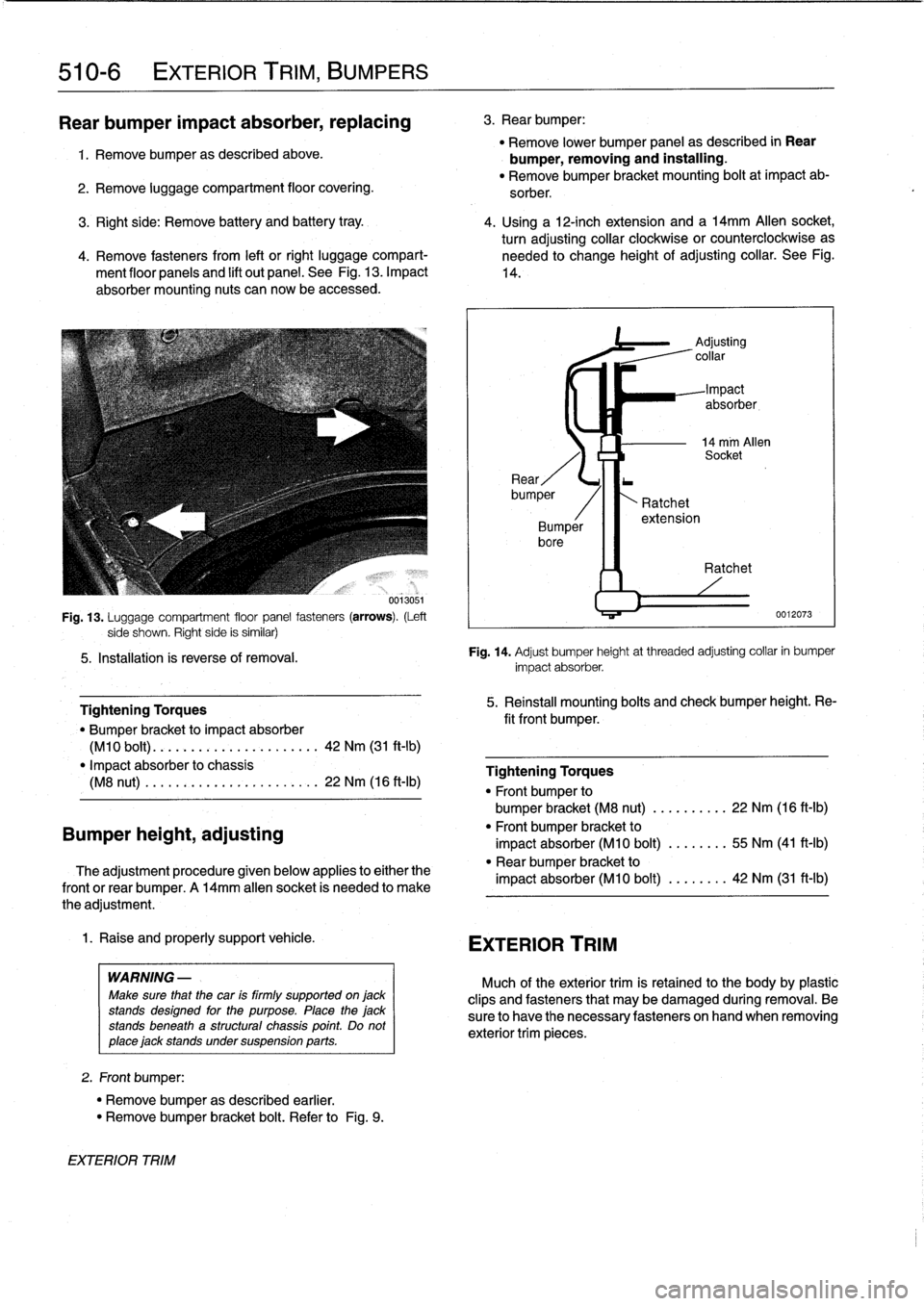
510-
6
EXTERIOR
TRIM,
BUMPERS
Rear
bumper
impact
absorber,replacing
1
.
Remove
bumperas
described
above
.
2
.
Remove
luggage
compartment
floor
covering
.
Fig
.
13
.
Luggage
compartment
floor
panel
fasteners
(arrows)
.
(Left
side
shown
.
Righf
side
is
similar)
5
.
Installation
ís
reverse
of
removal
.
Bumper
height,
adjusting
Tightening
Torques
"
Bumper
bracket
to
impact
absorber
(M10
bolt)
.
............
.
...
..
..
.
42
Nm
(31
ft-lb)
"
Impact
absorber
to
chassis
(M8
nut)
.
.
..........
.
......
.
.
.
.
22
Nm
(16
ft-Ib)
The
adjustment
procedure
given
below
applies
to
either
the
frontor
rear
bumper
.
A
14mm
allen
socket
is
needed
to
make
the
adjustment
.
1
.
Raise
and
properly
support
vehicle
.
WARNING
-
Make
sure
that
the
car
is
firmly
supported
on
jack
stands
designed
for
the
purpose
.
Place
the
jack
stands
beneath
a
structural
chassis
point
.
Do
not
place
jack
stands
under
suspension
parts
.
2
.
Front
bumper
:
"
Remove
bumper
as
described
earlier
.
"
Remove
bumper
bracket
bolt
.
Refer
to
Fig
.
9
.
EXTERIOR
TRIM
3
.
Rear
bumper
:
"
Remove
lower
bumper
panel
as
described
in
Rear
bumper,
removing
and
installing
.
"
Remove
bumper
bracket
mounting
bolt
at
impact
ab-
sorber
.
3
.
Right
side
:
Remove
battery
and
battery
tray
.
4
.
Using
a
12-inch
extension
and
a
l4mm
Allen
socket,
turn
adjusting
collar
clockwise
or
counterclockwise
as
4
.
Remove
fasteners
from
left
or
right
luggage
compart-
needed
to
change
height
of
adjusting
collar
.
See
Fig
.
ment
floor
panels
and
lift
out
panel
.
See
Fig
.
13
.
Impact
14
.
absorber
mounting
nuts
can
now
be
accessed
.
~4
EXTERIOR
TRIM
Ratchet
extension
Adjusting
collar
Impact
absorber,
14
mm
Allen
Socket
Ratchet
0012073
Fig
.
14
.
Adjust
bumper
height
at
threaded
adjusting
collar
in
bumper
impact
absorber
.
5
.
Reinstall
mounting
bolts
and
check
bumper
height
.
Re-
fit
front
bumper
.
Tightening
Torques
"
Front
bumper
to
bumper
bracket
(M8
nut)
......
.
..
.
22
Nm
(16
ft-Ib)
"
Front
bumper
bracket
to
impact
absorber
(M10
bolt)
........
55
Nm
(41
ft-Ib)
"
Rear
bumper
bracket
to
impact
absorber
(M10
bolt)
........
42
Nm
(31
ft-Ib)
Much
of
the
exteriortrim
is
retained
to
the
body
by
plasticclips
and
fasteners
that
may
be
damaged
during
removal
.
Be
sure
to
have
the
necessary
fasteners
onhand
when
removing
exterior
trim
pieces
.
Page 757 of 759
8
INDEX
Speakers
See
Radio
SRS
(Supplemental
restraint
system)
See
Airbag
system
(SRS)
Starter
See
Battery,
starter,
alternator
Steering
and
wheel
alignment
general
information
320-1
caster
and
camber
320-5
front
toe-in
and
toe
difference
angle
320-6
outer
tie
rod
end,
replacing
320-4
power
steering
pump,
removing/
installing
320-2
power
steering
system
320-2
power
steering
system,
bleeding/filling
320-3
rear
toe-in
320-6
steering
gear320-3
steering
gear
rack,
removing/installing
320-3
steering
wheel
320-1
steering
wheel,
removing/installing
320-1
tie
rod,
replacing
320-5
wheel
alignment
320-5
wheel
alignment
specifications
320-6
Steering
gear
See
steering
and
wheel
alignment
Strut
See
Front
suspension
Subframe
See
Front
suspension
Sunroof
general
information
540-1
motor,
removing/installing
540-3
panel,
adjusting
540-2
panel,
emergency
closing
540-2
Suspension,
front
See
Front
suspension
Suspension,
rear
See
Rear
suspension
Suspension,
steering
and
brakes
general
information
300-1
al¡
season
traction
(AST)
300-4
antilock
brake
system
(ABS)
300-2
brakes
300-2
front
suspension
300-1
integrated
systems
300-2
M3
suspension
and
brakes
300-7
steering
300-2
rear
suspension
300-2suspension
and
steering
troubleshooting
300-7
tires
and
wheels300-2
T
Switches
and
electrical
accessories
general
information
612-1
dome
light,
rear
map
lights,
trunk
light,
replacing
bulbs
612-7
hazard
warning
switch,
replacing
612-5
headlight
switch,
replacing
612-5
foglight
switch,
replacing
612-5
ignition
electrical
switch,
replacing
612-3
ignition
lock
cylinder,
replacing
612-4
ignition
switch
assembly
612-3
outside
mirror
switch,
replacing
612-6
power
window
switch,
replacing
612-5
turn
signal
switch
and
wiper
switch,
removing/installing
612-1
wiper
switch
See
turn
signal
and
wiper
switch
Taillight
See
Exterior
lighting
Thermostat
See
Cooling
system
Throttleposition
sensor
(TPS)
See
Fuel
injection
Throw-out
bearing
See
ClutchTierod
See
Steering
and
wheel
alignment
Tires
See
Suspension,
steering
and
brakes-general
See
also
Maintenance
program
Timing
chain
See
Camshaft
timing
chain
Toe-in
See
Steering
and
wheel
alignment
Tools
See
Fundamentals
for
the
do-it-
yourself
owner
Torque
convector
See
Automatic
transmission
Towing
See
Fundamentals
for
the
do-it-
yourself
owner
Traction
control
See
also
Suspension,
steering
and
brakes-general
Trailing
arm
See
Rear
suspension
Transmission-general
See
also
Automatic
transmission
See
also
Manual
transmission
general
information
200-1
automatic
transmission
200-1
manual
transmission
200-1
transmission
ID
codes
200-2
Transmission
fluid
See
Maintenance
program
See
also
Automatic
transmission
Transmission
input
shaft
See
Manual
transmission
Transmission
output
shaft
See
Manual
transmission
Trim,
interior
See
Interior
trim
Trunk
lid
general
information
412-1
trunk
lid,
412-1
trunk
lid,
aligning
412-1
trunk
lid,
removing/installing
412-1
trunk
lid
support
strut,
removing/
installing
412-2
U
Upholstery
See
Maintenance
program
U-joints
See
Driveshaft
V
V-belt
See
Maintenance
program
Vacuum
booster
See
Brakes
Vacuum
leaks
See
Engine-general
Valveguides
See
Cylinder
head
and
valvetrain
Valve
seals
See
Cylinder
head
and
valvetrain
Valveseats
See
Cylinder
head
and
valvetrain
Valves
See
Cylinder
head
and
valvetrain
Valvetrain
See
Cylinder
head
and
valvetrain
VANOS
(variable
valve
timing)
See
Camshaft
timing
chaín
See
also
Engine-general
Vehicle
identification
number
(VIN)
See
Fundamentals
for
the
do-it-
yourself
owner
Vehicle
speed
sensor
See
Instruments
Ventilation
See
Air
conditioning
See
also
Heating
Voltage
regulator
See
Battery,
starter,
alternator
Voltage
tests
See
Electrical
system-general
W
Warnings
vi¡
Washer
fluid
pump
See
Wipers
and
washers
Washers
See
Wipers
and
washers
Water
pump
See
Cooling
system
Waxing
See
Maintenance
program