level BMW 318i 1997 E36 User Guide
[x] Cancel search | Manufacturer: BMW, Model Year: 1997, Model line: 318i, Model: BMW 318i 1997 E36Pages: 759
Page 37 of 759
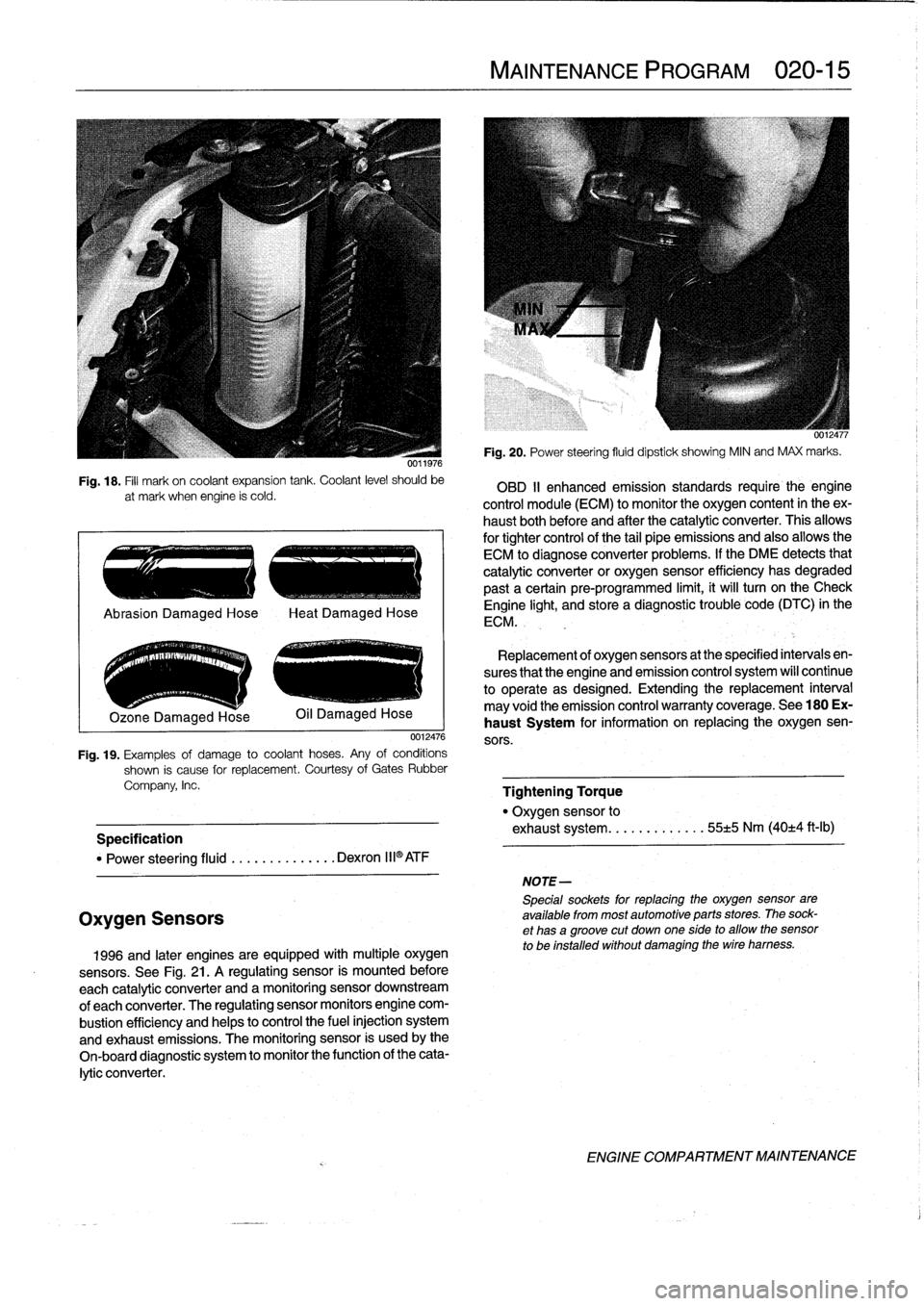
Fig
.
18
.
Fill
mark
on
coolant
expansion
tank
.
Coolant
level
should
be
at
mark
when
engine
ís
cold
.
.
..
e
..
.-
..
~
..
.-
.
Ozone
Damaged
Hose
0012476
Fig
.
19
.
Examples
of
damage
to
coolant
hoses
.
Any
of
conditions
shown
is
cause
for
replacement
.
Courtesy
of
Gates
Rubber
Company,
Inc
.
Specification
"
Power
steering
fluid
..........
.
...
Dexron
III®ATF
Oxygen
Sensors
1996
and
later
engines
are
equipped
withmultiple
oxygen
sensors
.
See
Fig
.
21
.
A
regulating
sensor
is
mounted
before
each
catalytic
converter
and
amonitoring
sensor
downstream
of
each
converter
.
The
regulating
sensor
monitors
engine
com-
bustion
efficiency
and
helps
to
control
the
fuel
injection
system
and
exhaust
emissions
.
The
monitoring
sensor
is
usedby
the
On-board
diagnostic
system
to
monitor
the
function
of
the
cata-
lytic
converter
.
MAINTENANCE
PROGRAM
020-
1
5
NOTE-
5pecialsockets
for
replacingthe
oxygen
sensor
are
available
from
most
automotive
parts
stores
.
The
sock-
et
has
agroove
cut
down
one
side
to
allow
the
sensor
to
be
installed
without
damaging
the
wire
hamess
.
Fig
.
20
.
Power
steering
fluid
dipstick
showing
MIN
and
MAX
marks
.
OBD
II
enhanced
emission
standards
require
the
engine
control
module
(ECM)
to
monitor
the
oxygen
content
in
theex-
haust
bothbefore
and
after
the
catalytic
converter
.
This
allows
for
tightercontrol
of
the
tail
pipe
emissions
and
also
allowsthe
ECM
to
diagnose
converter
problems
.
lf
the
DME
detects
that
catalytic
converter
or
oxygen
sensor
efficiency
has
degraded
past
a
certain
pre-programmed
limit,
it
will
turn
on
the
Check
Engine
light,
and
store
a
diagnostic
trouble
code
(DTC)
in
the
ECM
.
Replacement
of
oxygen
sensors
at
the
specified
intervals
en-
sures
that
the
engine
and
emission
control
system
wíll
continue
to
operate
as
designed
.
Extending
the
replacement
interval
may
void
the
emission
control
warranty
coverage
.
See
180
Ex-
haust
System
for
information
on
replacing
the
oxygen
sen-
sors
.
Tightening
Torque
"
Oxygen
sensor
to
exhaust
system
........
.
.
.
..
55±5
Nm
(40±4
ft-Ib)
ENGINE
COMPARTMENT
MAINTENANCE
Page 40 of 759
020-
1
8
MAINTENANCE
PROGRAM
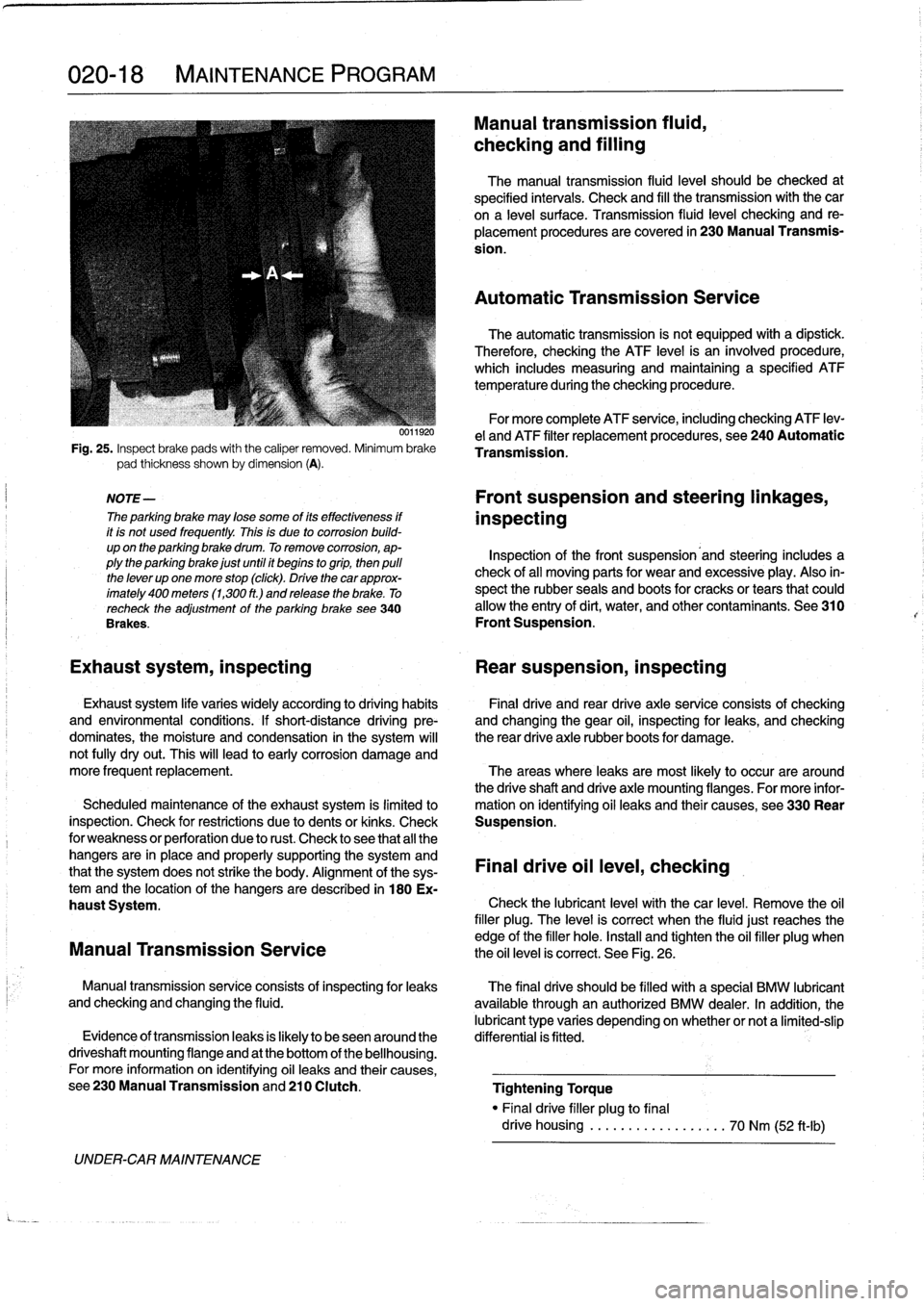
Fig
.
25
.
Inspect
brake
pads
with
the
caliper
removed
.
Minimum
brake
pad
thickness
shown
by
dimension
(A)
.
NOTE-
The
parking
brake
may
lose
some
of
its
effectiveness
if
it
is
not
used
frequently
.
This
is
due
to
corrosion
build-
up
on
the
parking
brake
drum
.
To
remove
corrosion,
ap-
plythe
parking
brake
just
until
it
begins
togrip,
then
pulí
the
lever
up
one
more
stop
(click)
.
Drive
thecar
approx-
imately
400
meters
(1,300
ft
.)
and
release
the
brake
.
To
recheck
the
adjustment
of
the
parking
brake
see340
Brakes
.
UNDER-CAR
MAINTENANCE
0011920
Manual
transmission
fluid,
checking
and
filling
The
manual
transmission
fluid
leve¡
should
be
checked
at
specified
intervals
.
Check
and
fill
the
transmission
with
the
car
ona
leve¡
surface
.
Transmission
(luid
leve¡
checking
and
re-
placement
procedures
are
covered
in
230
Manual
Transmis-
sion
.
Automatic
Transmission
Service
The
automatic
transmission
is
not
equipped
with
a
dipstíck
.
Therefore,
checking
the
ATF
level
is
an
ínvolved
procedure,
which
includes
measuring
and
maintaining
a
specified
ATF
temperature
during
the
checking
procedure
.
For
more
complete
ATF
service,
including
checking
ATF
lev-
e¡
and
ATF
filter
replacement
procedures,
see
240
Automatic
Transmission
.
Front
suspension
and
steering
linkages,
inspecting
Inspection
of
the
front
suspension'and
steering
includes
a
check
of
all
moving
parts
for
wear
and
excessive
play
.
Also
in-
spect
the
rubber
seals
and
boots
for
cracks
or
tears
that
could
allow
the
entry
of
dirt,
water,
and
other
contaminants
.
See
310
Front
Suspension
.
Exhaust
system,
inspecting
Rear
suspension,
inspecting
Exhaust
system
life
varies
widely
according
to
driving
habits
Final
drive
and
rear
drive
axle
service
consists
of
checking
and
environmental
conditions
.
If
short-distance
driving
pre-
and
changing
the
gear
oil,
inspecting
for
leaks,
and
checking
dominates,
the
moisture
and
condensation
in
the
system
will
the
rear
drive
axle
rubber
boots
for
damage
.
not
fully
dryout
.
This
will
lead
to
early
corrosion
damage
and
more
frequent
replacement
.
The
areas
where
leaks
are
most
likely
to
occur
are
around
the
driveshaft
and
drive
axle
mounting
flanges
.
For
more
infor
Scheduled
maintenance
of
the
exhaust
system
is
limitedlo
mation
on
ídentifying
oil
leaks
and
their
causes,
see330
Rear
inspection
.
Check
for
restrictions
due
to
dents
or
kinks
.
Check
Suspension
.
for
weakness
or
perforation
due
to
rust
.
Check
lo
see
that
all
the
hangers
are
in
place
and
properly
supporting
the
system
and
that
the
system
does
not
strike
the
body
.
Alignment
of
the
sys-
Final
drive
oil
leve¡,
checking
temand
the
location
of
the
hangers
aredescribed
in
180
Ex-
haust
System
.
Check
the
lubricant
leve¡
with
thecar
level
.
Remove
the
oil
filler
plug
.
The
leve¡
is
correct
when
the
fluidjust
reaches
the
edge
of
the
filler
hole
.
Install
and
tighten
the
oil
filler
plug
when
Manual
Transmission
Service
the
oil
level
is
correct
.
See
Fig
.
26
.
Manual
transmissionservice
consists
of
inspectingfor
leaks
The
final
drive
should
be
filled
with
a
special
BMW
lubricant
and
checking
and
changing
the
fluid
.
available
through
an
authorized
BMW
dealer
.
In
addition,
the
lubricant
type
varies
depending
onwhether
or
nota
limited-slip
Evidence
of
transmissionleaks
is
fkely
to
beseenaround
the
differential
is
fitted
.
driveshaft
mounting
flange
and
at
the
bottom
of
the
bellhousing
.
For
more
information
on
identifying
oil
leaks
and
their
causes,
see230ManualTransmissionand210
Clutch
.
Tightening
Torque
"
Finaldrive
filler
plug
to
final
drive
housing
..................
70
Nm
(52
ft-Ib)
Page 41 of 759
NOTE-
Use
a14
mm
or17
mm
alíen
bit
socket
to
remove
the
drain
plug
.
"
If
thecar
is
raised
in
the
air,
it
shouldbe
leve¡
.
Fuel
tank
and
fuel
fines,
inspecting
0012474
Inspect
the
fuel
tank,
fuel
lines,
and
fuel
system
for
damage
or
leaks
.
Check
for
fuel
leaks
in
the
engine
compartment
or
fuel
odors
in
the
passenger
compartment
.
Check
for
faultyfuel
lines
bybending
them
.
If
any
leaks
are
present,
fuel
should
be
expelled
.
Check
for
any
evaporative
emissions
hoses
that
may
have
become
disconnected,
checking
carefully
at
the
charcoal
canister
and
evaporative
emissionspurge
system
.
See130
Fuel
Injection
and
160
Fuel
Tank
and
Fuel
Pump
for
component
locations
and
additional
information
.
WARNING
-
When
checking
for
fuel
leaks,
the
engine
must
be
cold
.
A
hot
exhaust
manifold
or
exhaust
system
could
cause
the
fuel
to
ignite
or
explode
causing
se-
rious
personal
injury
.
Uentilate
the
workarea
and
clean
up
spilled
fuel
immediately
.
Clutch
fluid,
checking
The
hydraulic
clutch
and
the
brake
system
share
the
same
reservoir
and
the
same
brake
fluid
.
Clutch
fluid
leve¡
and
brake
fluid
level
are
checked
at
the
same
time
.
See340
Brakes
for
more
information
.
See210
Clutch
for
information
on
the
clutch
and
the
hydraulic
clutch
operating
system
.
MAINTENANCE
PROGRAM
020-19
Drive
axie
joint
boots,
inspecting
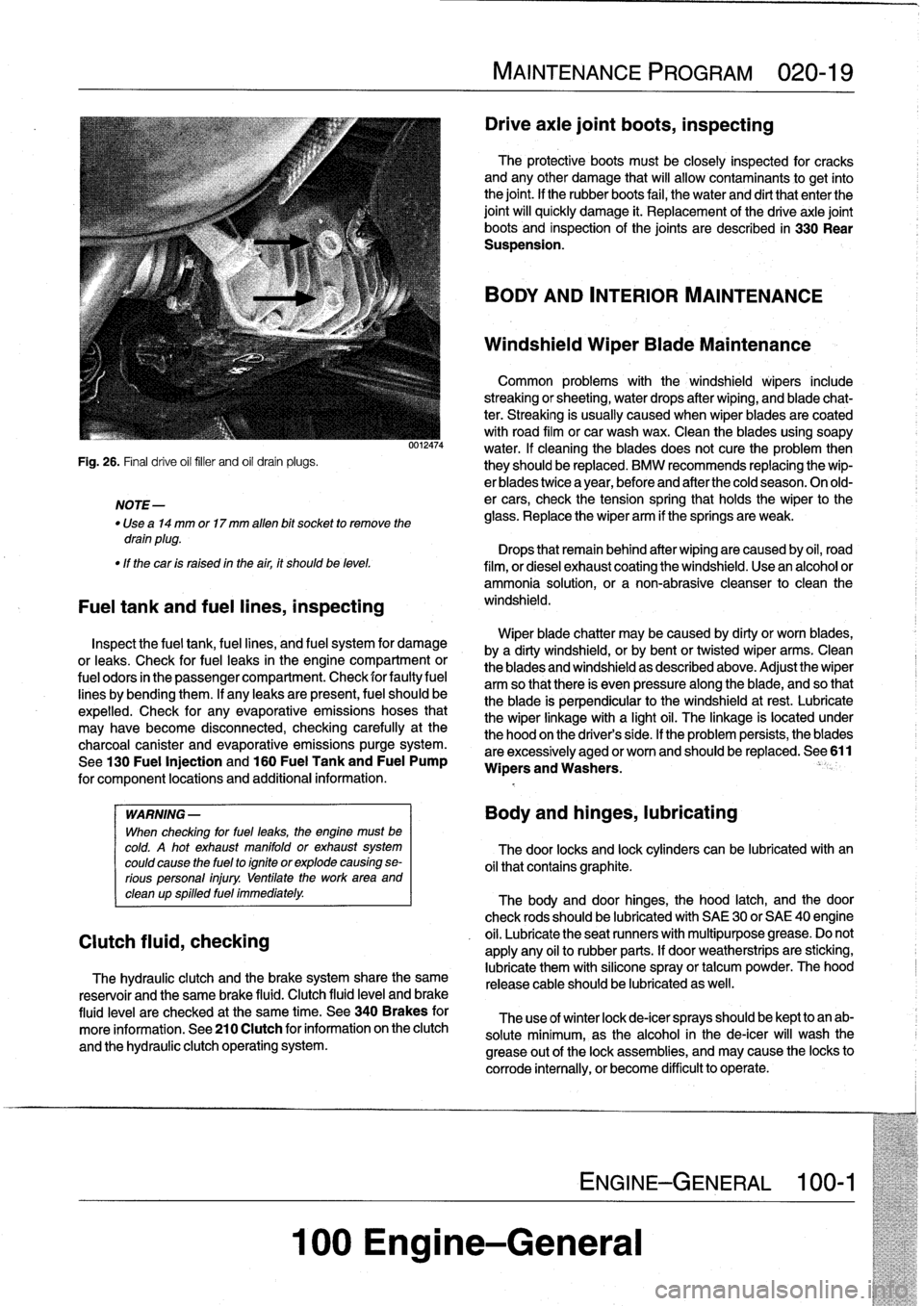
100
Engine-General
The
protective
boots
must
be
closely
inspected
for
cracks
andany
other
damage
that
will
allow
contaminants
to
get
ínto
the
joint
.
If
the
rubber
boots
faf
,
the
water
and
dirt
that
enter
the
joint
will
quickly
damage
¡t
.
Replacement
of
the
drive
axle
joint
boots
and
inspection
of
the
joints
are
described
in
330
Rear
Suspension
.
BODY
AND
INTERIOR
MAINTENANCE
Windshield
Wiper
Biade
Maintenance
Common
problems
with
the
windshield
wipers
include
streaking
or
sheeting,
water
drops
after
wiping,
and
blade
chat-
ter
.
Streaking
is
usually
caused
when
wiper
blades
are
coated
with
road
film
or
car
wash
wax
.
Clean
the
blades
using
soapy
water
.
If
cleaning
theblades
does
not
cure
the
problem
then
they
should
be
replaced
.
BMW
recommends
replacing
the
wip-
er
blades
twice
a
year,
before
and
after
the
cold
season
.
Onold-
er
cars,
check
the
tension
spring
that
holds
the
wiper
to
the
glass
.
Replace
the
wiper
arm
if
the
springs
are
weak
.
Drops
that
remainbehind
after
wipingare
caused
by
oil,
road
film,
or
diesel
exhaust
coating
the
windshield
.
Use
an
alcohol
or
ammonia
solution,
or
a
non-abrasive
cleanser
to
clean
the
windshield
.
Wiper
blade
chatter
may
be
caused
by
dirty
or
worn
blades,
bya
dirty
windshield,
or
by
bentor
twisted
wiper
arms
.
Clean
the
blades
and
windshield
as
described
above
.
Adjust
the
wiper
arm
so
that
there
is
even
pressure
along
the
blade,
and
so
that
the
blade
is
perpendicular
to
the
windshield
atrest
.
Lubricate
the
wiper
linkage
with
a
light
oil
.
The
linkage
is
located
under
the
hood
on
the
drivers
side
.
If
the
problem
persists,
theblades
are
excessively
aged
or
worn
and
should
be
replaced
.
See
611
Wipers
and
Washers
.
Body
and
hinges,
lubricating
The
door
locks
and
lock
cylinders
canbe
lubricated
with
an
oil
that
contains
graphite
.
The
body
and
door
hinges,
the
hood
latch,
and
the
door
check
rods
should
be
lubricated
with
SAE
30
or
SAE
40
engine
oil
.
Lubricate
the
seat
runners
with
multipurpose
grease
.
Do
not
apply
any
oil
to
rubber
parts
.
If
door
weatherstrips
are
sticking,
lubricate
them
with
silicone
spray
or
talcum
powder
.
The
hood
release
cable
should
be
lubricated
as
well
.
The
use
of
winter
lock
de-icer
spraysshould
be
kept
to
an
ab-
solute
minimum,
as
the
alcohol
in
the
de-icer
will
wash
the
grease
out
of
the
lock
assemblies,
and
may
cause
the
locks
to
corrode
internally,
or
become
difficult
to
operate
.
ENGINE-GENERAL
100-1
Page 46 of 759
100-4
ENGINE-GENERAL
'
TEMP
PRECAT
POST
CAT
OXYGENSENSOR
HEATING
#
.
THROTTLE
POSITION
FUEL
INJECTOR
CONTROL
(SEQUENTIAL)
OPERATING
POWER
00
CAMSHAFT
POSITION
SENSOR
ECM
I
MAIN
GROUND
RELAY
J_
-
AC
COMPRESSOR
RELAY
CONTROL
TERMINAL
15
MEMORY
POWER
FUEL
PUMP
RELAY
CONTROL
AUX
GROUND
P
CRANKSHAFT
POSITION
dESENSOR
INTAKE
AIR
ENGINE
COOLANT
TEMP
FUEL
TANK
PRESSURE
SENSOR
S-EML
S-MSR
ASC
S-ASC
VEHICLE
SPEED
LOW
FUEL
LEVEL
A/C
SWITCH
ON
(AC)
E36
IHKA
COMPRESSOR"ON"
SIGNAL
(KO)
INDIVIDUAL
SERIAL
NUMBER
MS41
.1
SECONDARY
AIR
1NJECTION
AIR
PUMP®
RELAY
CONTROL
IDLE
CONTROL
VALVE
'M
FUEL
INJECTION
(TI)
ENGINE
SPEED
(TD)
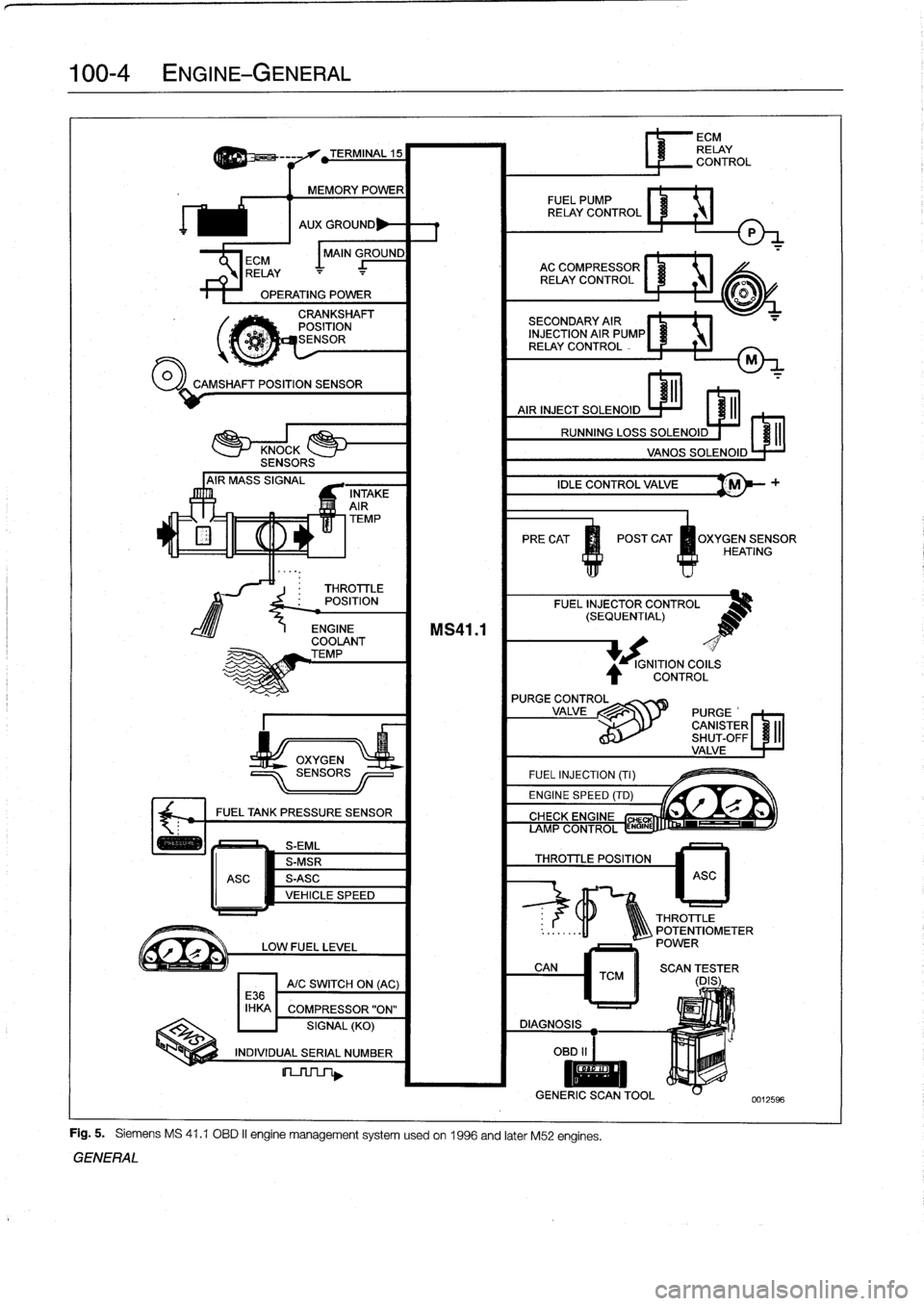
Fig
.
5
.
Siemens
MS
41
.1
OBD
II
engine
management
systemusedon
1996
and
later
M52
engines
.
GENERAL
IGNITION
COILS
CONTROL
L
r"Q
if~
CIYVFIYC
CHE
AMP
CONTROL
ENGINE
THROTTLE
POSITION
6
ECM
RELAY
CONTROL
ASC
THROTTLE
..
:
.
.
..
-11
1Q\\\
POTENTIOMETER
POWER
CAN
TCM
II
SCAN
(DES
;
ER
DIAGNOSIS
OBD
II
I
II
GENERIC
SCANTOOL
0012596
Page 53 of 759
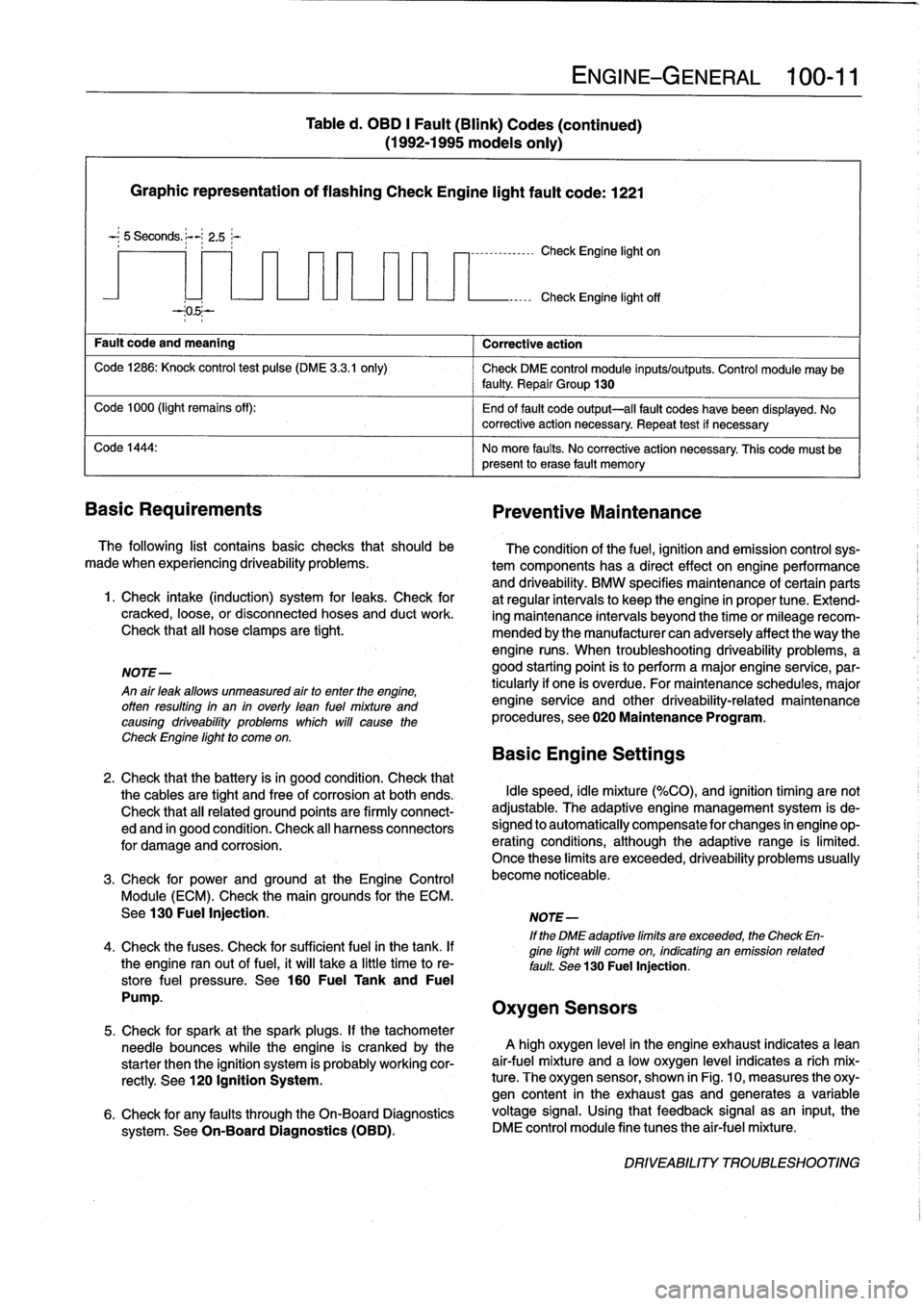
Graphic
representation
of
flashing
Check
Engine
light
fault
code
:
1221
-
;
5
Seconds
.
~-
2
.5;-
Fault
code
and
meaning
Corrective
action
Code
1286
:
Knock
control
test
pulse
(DME
3
.3
.1
only)
Check
DME
control
module
inputs/outputs
.
Control
module
may
be
faulty
Repair
Group
130
Code
1000
(light
remains
off)
:
End
of
fault
code
output-all
fault
codes
have
been
displayed
.
No
~
corrective
action
necessary
.
Repeat
test
if
necessary
Code
1444
:
No
more
faults
.
No
corrective
action
necessary
.
This
code
must
be
present
lo
erase
fault
memory
Basic
Requirements
Preventive
Maintenance
The
following
list
contains
basic
checks
that
should
be
made
when
experiencing
driveability
problems
.
1
.
Check
intake
(induction)
system
for
leaks
.
Check
for
cracked,
loose,
or
disconnected
hoses
and
duct
work
.
Check
that
all
hose
clamps
are
tight
.
NOTE-
An
air
leak
allows
unmeasured
airto
enter
the
engine,
offen
resulting
in
an
in
overly
lean
fuel
mixture
and
causing
driveability
problems
which
will
cause
the
Check
Engine
light
to
come
on
.
Table
d
.
OBD
I
Fault
(Blink)
Codes
(continued)
(1992-1995
models
only)
7
-
1
--------------
Check
Engine
light
on
ENGINE-GENERAL
100-
1
1
Check
Engine
light
off
The
condition
of
the
fuel,
ignition
and
emission
controlsys-
tem
components
has
a
directeffect
onengineperformance
and
driveability
.
BMW
specifies
maintenance
of
certain
parts
at
regular
intervals
lo
keep
the
engine
in
proper
tune
.
Extend-
ing
maintenance
intervals
beyond
the
time
or
mileagerecom-
mended
bythe
manufacturer
can
adversely
affect
the
way
the
engine
runs
.
When
troubleshooting
driveability
problems,
a
good
starting
point
is
to
perform
a
major
engine
service,par-
ticularly
if
one
is
overdue
.
For
maintenance
schedules,
major
engine
service
and
other
driveability-related
maintenance
procedures,
see020
Maintenance
Program
.
Basic
Engine
Settings
2
.
Check
that
the
battery
isin
good
condition
.
Check
that
the
cables
are
tight
and
free
of
corrosion
at
both
ends
.
Idle
speed,
idle
mixture
(%CO),
and
ignition
timing
are
not
Check
that
all
related
ground
points
are
firmly
connect-
adjustable
.
The
adaptive
engine
management
system
is
de-
ed
and
in
good
condition
.
Check
al¡
harness
connectors
signed
lo
automatically
compensate
for
changes
in
engine
op-
for
damage
and
corrosion
.
erating
conditions,
although
the
adaptive
range
is
limited
.
Once
these
limits
are
exceeded,
driveability
problems
usually
3
.
Check
for
prwer
and
ground
at
the
Engine
Control
become
noticeable
.
Module
(ECM)
.
Check
the
main
grounds
for
the
ECM
.
See130
Fuel
Injection
.
NOTE-
If
the
DME
adaptive
limits
are
exceeded,
the
Check
En-
4
.
Check
the
fuses
.
Check
for
sufficient
fuel
in
the
tank
.
If
gine
light
will
come
on,
indicating
an
emission
related
the
engine
ranout
of
fuel,
it
will
take
a
little
time
to
re-
fault
.
See
130
Fuel
Injection,
store
fuel
pressure
.
See
160
Fuel
Tank
and
Fuel
Pump
.
Oxygen
Sensors
5
.
Check
for
spark
at
the
spark
plugs
.
If
the
tachometer
needle
bounces
while
the
engine
is
crankedby
the
A
high
oxygen
level
in
the
engine
exhaust
indicates
a
lean
starter
then
the
ignition
system
is
probably
working
cor-
air-fuel
mixture
and
a
low
oxygen
level
indicates
a
rich
mix
rectly
.
See
120
Ignition
System
.
ture
.
The
oxygen
sensor,
shown
in
Fig
.
10,
measures
the
oxy-
gen
content
in
the
exhaust
gasand
generates
a
variable
6
.
Check
for
any
faults
through
the
On-Board
Diagnostics
voltage
signal
.
Using
that
feedback
signal
asan
input,
the
system
.
See
On-Board
Diagnostics
(OBD)
.
DME
control
module
fine
tunes
the
air-fuel
mixture
.
DRIVEABILITY
TROUBLESHOOTING
Page 61 of 759
14
.
Unbolt
power
steering
fluid
reservoir
from
íts
mounting
bracket
.
Use
stiff
wire
to
hang
reservoir
to
one
side
.
Do
not
disconnect
fluid
lines
.
15
.
Remove
power
steering
pump
drive
belt
and
remove
pump
from
its
mounting
bracket
.
Use
stiff
wire
to
hang
pump
from
body
.
16
.
On
cars
with
automatic
transmission
remove
front
and
rear
brackets
holding
automatic
transmission
cooler
linesto
engine
.
17
.
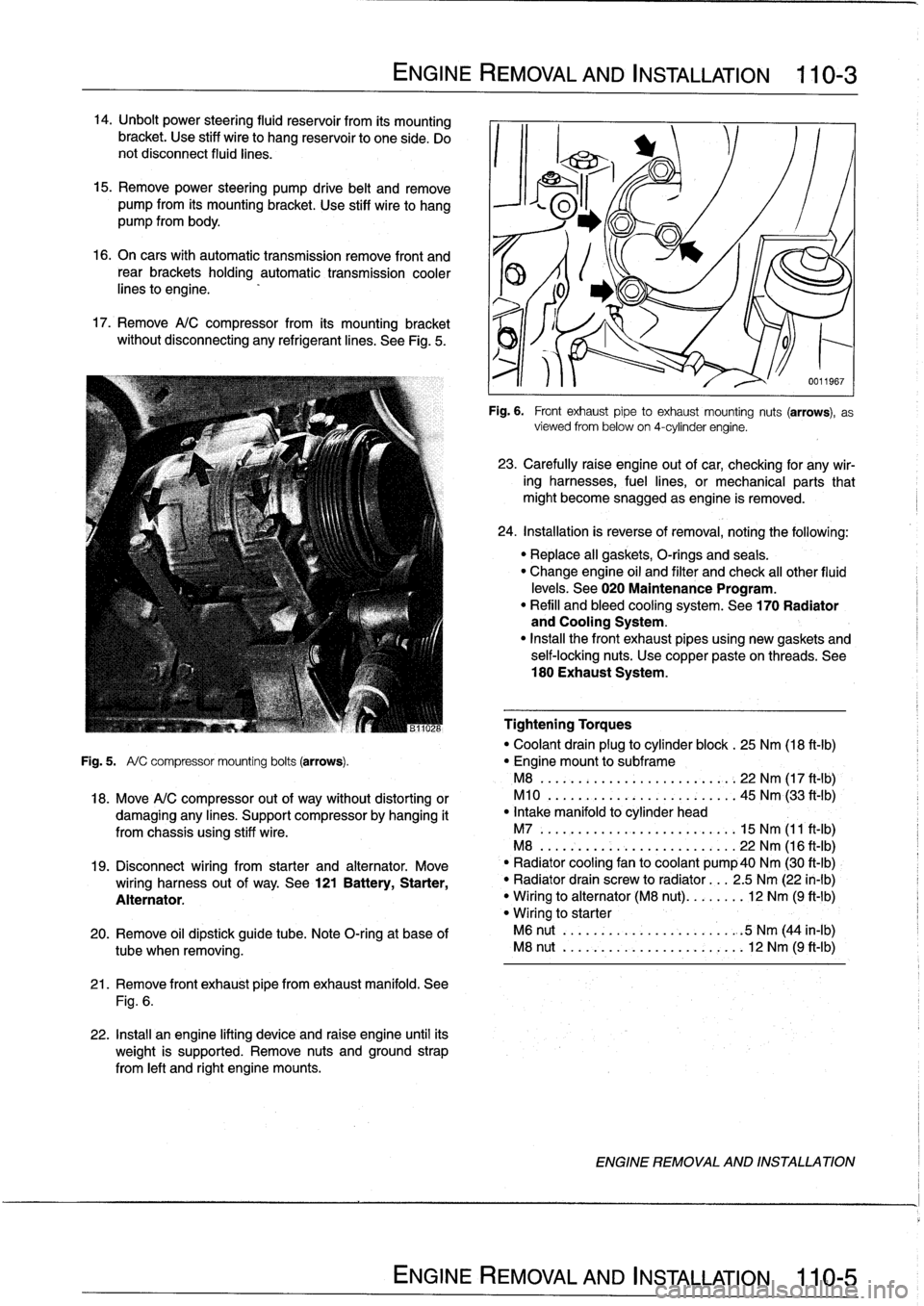
Remove
A/C
compressor
from
its
mounting
bracket
without
disconnecting
any
refrigerantlines
.
See
Fig
.
5
.
ENGINE
REMOVAL
AND
INSTALLATION
110-
3
21
.
Remove
front
exhaust
pipefrom
exhaust
manifold
.
See
Fig
.
6
.
22
.
Install
an
engine
lifting
device
and
raise
engine
until
its
weight
is
supported
.
Remove
nuts
and
ground
strap
from
left
and
right
engine
mounts
.
0011967
Fig
.
6
.
Front
exhaustpipe
to
exhaust
mounting
nuts
(arrows),
as
viewed
from
below
on
4-cylinder
engine
.
23
.
Carefully
raíse
engine
out
of
car,
checking
for
any
wir-
ing
harnesses,
fuel
lines,
or
mechanical
parts
that
might
become
snagged
as
engine
is
removed
.
24
.
Installation
is
reverse
of
removal,
noting
the
following
:
"
Replace
all
gaskets,
O-rings
and
seals
.
"
Change
engine
oil
and
filter
and
check
al¡
other
fluid
levels
.
See020
Maintenance
Program
.
"
Refill
and
bleed
cooling
system
.
See
170
Radiator
and
Cooling
System
.
"
Insta¡¡
the
front
exhaust
pipes
using
new
gaskets
and
self-locking
nuts
.
Use
copper
pasteon
threads
.
See
180
Exhaust
System
.
Tightening
Torques
"
Coolant
drain
plug
to
cylinder
block
.
25
Nm
(18
ft-Ib)
Fig
.
5
.
A/
C
compressor
mounting
bolts
(arrows)
.
"
Engine
mount
to
subframe
M8
......:...
..
..
..
......,:..
22
Nm
(17
ft
-
1b)
,
18
.
Move
A/C
compressor
out
of
way
without
distorting
or
M10
.
...
.
..
...
.
.
...........
45
Nm
(33
ft'-Ib)
damaging
any
lines
.
Support
compressor
by
hanging
it
"
Intake
manifold
to
cylinder
head
from
chassis
using
stiff
wire
.
M7
.....
.
..
...
..
..
...........
15
Nm
(11
ft-Ib)
M8
...
.
.
.
..
..
...
..
...........
22
Nm
(16
ft-Ib)
19
.
Disconnect
wiring
from
starter
and
alternator
.
Move
`
"
Radiator
cooling
fan
to
coolant
pump40
Nm
(30
ft-Ib)
wiring
harness
out
of
way
.
See
121
Battery,
Starter,
"
Radiator
drain
screw
to
radiator
...
2
.5
Nm
(22
in-lb)
Alternator
.
"
Wiring
to
alternator
(M8
nut)
........
12
Nm
(9
ft-1b)
"
Wiring
to
starter
20
.
Remove
oil
dipstick
guide
tube
.
Note
O-ring
at
base
of
M6
nut
..
.
..
..
...
..
...........
.
:5
Nm
(44
in-lb)
tube
when
removing
.
M8
nut
..
.
..
..
...
..
............
12
Nm
(9
ft-Ib)
ENGINE
REMOVAL
AND
INSTALLATION
Page 65 of 759
22
.
Move
A/C
compressor
out
of
the
way
without
distorting
26
.
Carefully
raise
engine
out
ofcar,
checking
for
any
wir-
or
damaging
any
lines
.
Support
compressor
by
hanging
ing,fuel
lines,
or
mechanical
parts
that
might
become
it
from
chassis
using
stiff
wire
.
snagged
as
engine
is
removed
.
23
.
Disconnect
wiring
from
starter
and
alternator
.
Move
27
.
Installation
is
reverse
of
removal,
noting
the
following
:
wiring
harness
out
of
the
way
.
See
121
Battery,
Start-
Replace
al¡
gaskets,
O-rings
and
seals
.
er,
Alternator
.
"
Change
engine
oil
and
filter
and
check
all
other
fluid
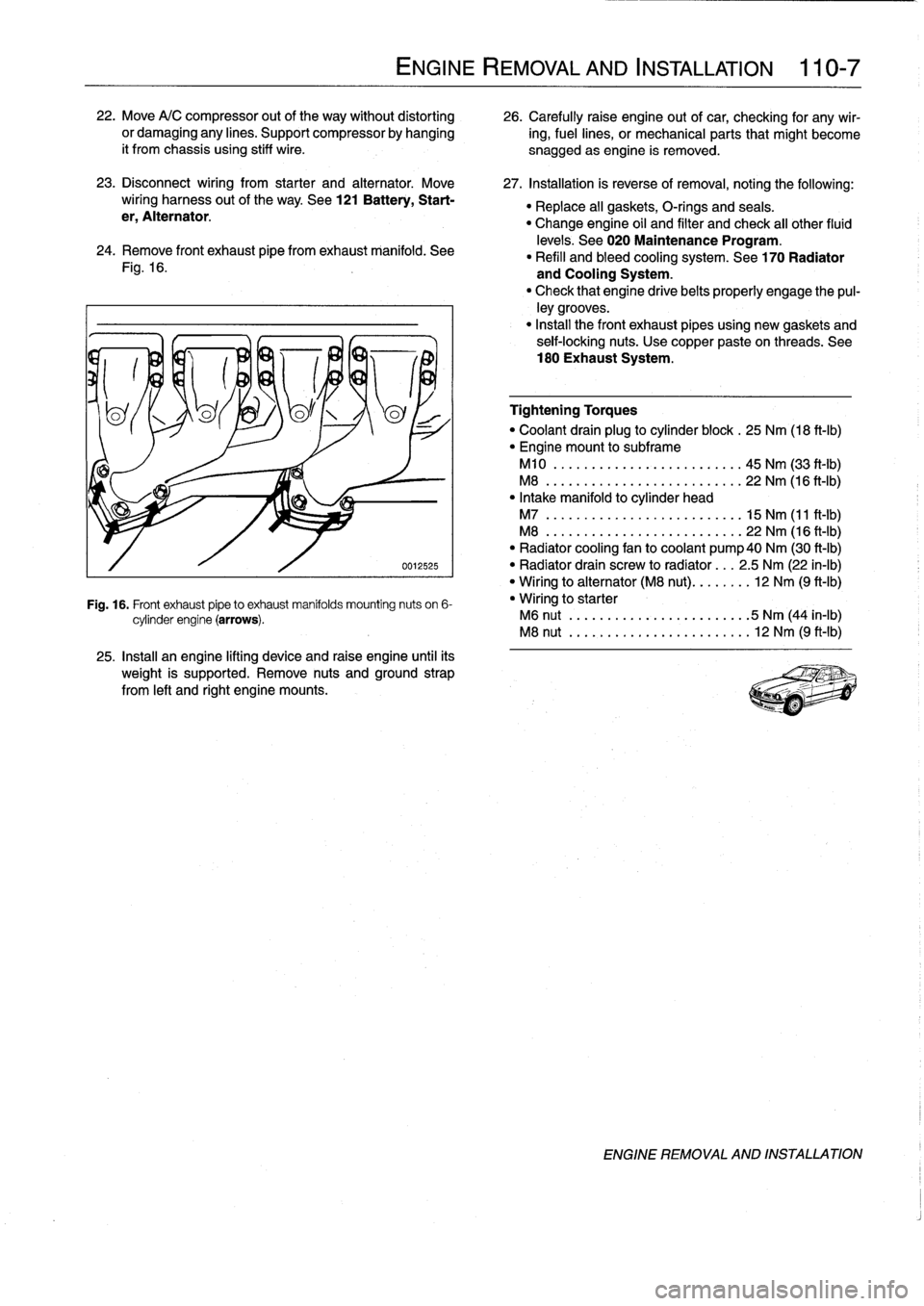
24
.
Remove
Fontexhaust
pipe
fromexhaust
manifold
.
See
levels
.
See
020
Maintenance
Program
.
"
Refill
and
bleed
cooling
system
.
See
170
Radiator
Fig
.
16
.
and
Cooling
System
.
"
Check
that
engine
drivebelts
properly
engage
the
pul-
ley
grooves
.
"
Install
the
Font
exhaust
pipesusing
new
gaskets
and
seif-locking
nuts
.
Use
copper
paste
on
threads
.
See
180
Exhaust
System
.
0012525
Fig
.
16
.
Front
exhaust
pipeto
exhaust
manifolds
mounting
nuts
on
6-
cylinder
engine
(arrows)
.
25
.
Install
an
engine
lifting
device
and
raise
engine
until
its
weight
is
supported
.
Remove
nuts
and
ground
strap
from
left
and
right
engine
mounts
.
ENGINE
REMOVAL
AND
INSTALLATION
110-
7
Tightening
Torques
"
Coolant
drain
plug
to
cylinder
block
.
25
Nm
(18
ft-Ib)
"
Engine
mount
to
subframe
M10
..
.
.
.
...
..............
..
.
45
Nm
(33
ft-Ib)
M8
..
..
.
..
................
...
22
Nm
(16
ft-Ib)
"
Intake
manifold
to
cylinder
head
M7
..
..
..
...
................
.
15
Nm
(11
ft-Ib)
M8
...
.
..
...
................
.
22
Nm
(16
ft-Ib)
"
Radiator
cooling
fan
to
coolant
pump40
Nm
(30
ft-Ib)
"
Radiator
drain
screw
to
radíator
...
2
.5
Nm
(22
in-lb)
"
Wiring
to
alternator
(M8
nut)
........
12
Nm
(9
ft-Ib)
"
Wiring
to
starter
M6
nut
.
..
...
..................
5
Nm
(44
in-lb)
M8
nut
.....
..
.
.
.
.
.............
12
Nm
(9
ft-Ib)
ENGINE
REMOVAL
AND
INSTALLATION
Page 92 of 759
116-
8
CYLINDER
HEAD
AND
VALVETRAIN
0012502
Fig
.
10
.
Location
of
camshaft
oil
sprayer
tube
sea¡
in
M44
cylinder
head
(arrow)
.
Hydraulic
valve
adjusters,
checking
and
replacing
(M44
engine)
The
M44
engine
uses
hydraulic
valveadjusters
(HVA)
to
keep
valve
clearances
within
a
limited
working
range
.
See
Fig
.
11
.
HVAs
are
sealed
units
and
require
no
maintenance
.
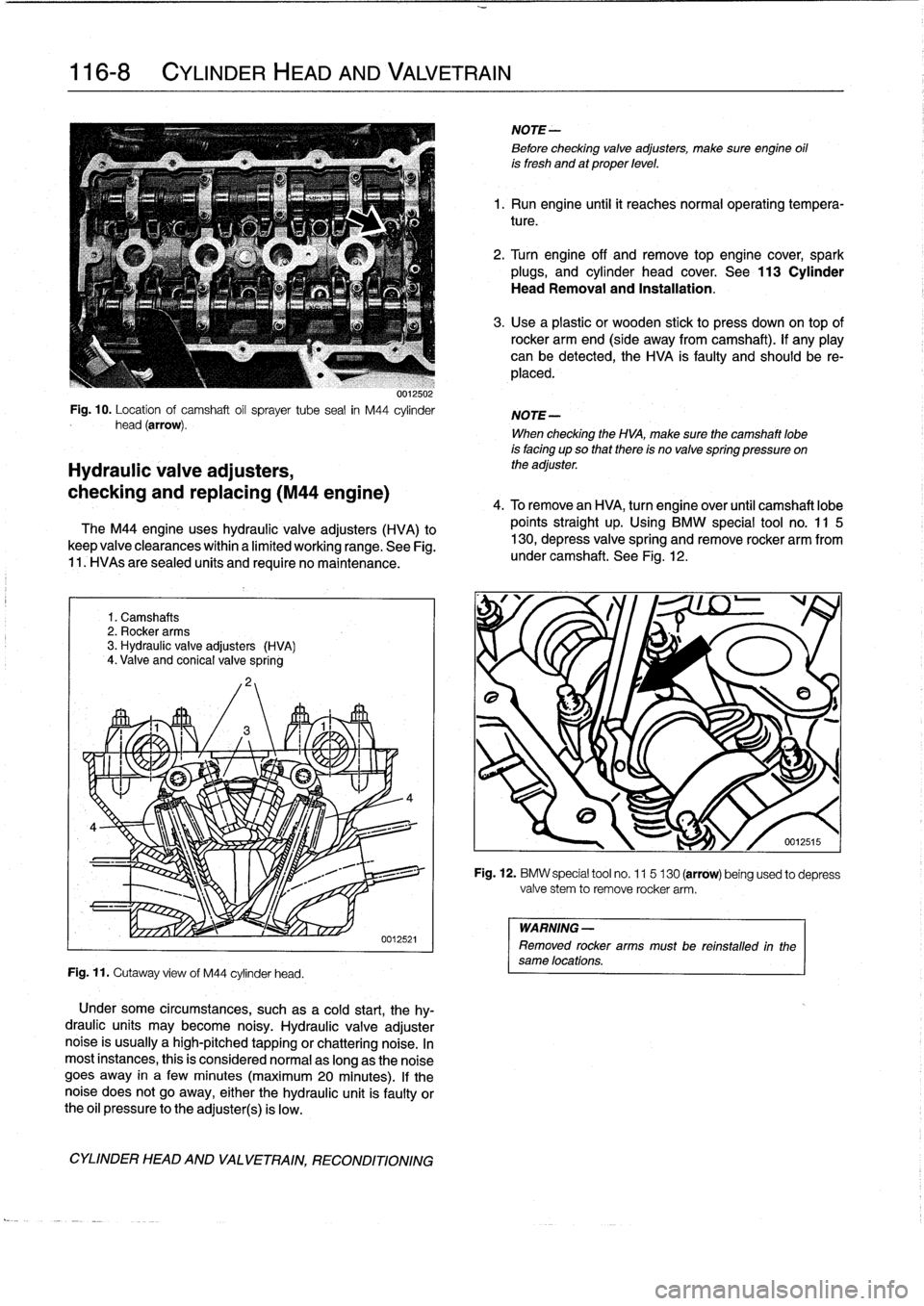
1
.
Camshafts
2
.
Rocker
arms
3
.
Hydraulic
valve
adjusters
(HVA)
4
.
Valve
and
conical
valve
spring
Fig
.
11
.
Cutaway
view
of
M44
cylinder
head
.
Under
some
circumstances,
such
as
a
cold
start,
thehy-
draulic
units
may
become
noisy
.
Hydraulic
valve
adjusternoise
is
usually
ahigh-pitched
tapping
or
chattering
noise
.
In
most
instances,
this
is
consídered
normal
aslong
as
the
noise
goes
away
in
a
few
minutes
(maximum20
minutes)
.
If
thenoise
does
not
go
away,
either
the
hydraulic
unit
is
faulty
orthe
oil
pressure
tothe
adjuster(s)
is
low
.
CYLINDER
HEAD
AND
VALVETRAIN,
RECONDITIONING
NOTE-
8efore
checking
valveadjusters,
make
sure
engine
oil
is
fresh
and
at
proper
level
.
1
.
Run
engine
until
it
reaches
normal
operating
tempera-
ture
.
2
.
Turn
engine
off
and
remove
top
engine
cover,
spark
plugs,
and
cylinder
head
cover
.
See
113
Cylinder
Head
Removal
and
Installation
.
3
.
Use
a
plastic
or
wooden
stick
to
press
down
on
top
of
rocker
armend
(side
away
from
camshaft)
.
If
any
play
can
be
detected,the
HVA
is
faulty
and
should
be
re-
placed
.
NOTE-
When
checking
the
HVA,
make
sure
the
camshaft
lobe
is
facing
upso
that
there
is
no
valve
spring
pressure
on
the
adjuster
.
4
.
To
remove
an
HVA,
turn
engine
over
until
camshaft
lobe
points
straight
up
.
Using
BMW
special
tool
no
.
11
5
130,
depress
valvespring
and
remove
rocker
arm
from
under
camshaft
.
See
Fig
.
12
.
Fig
.
12
.
BMW
special
tool
no
.
115
130
(arrow)
being
used
to
depress
valve
stem
to
remove
rocker
arm
.
WARNING
-
Removed
rocker
armsmustbe
reinstalled
in
the
same
locations
.
Page 93 of 759
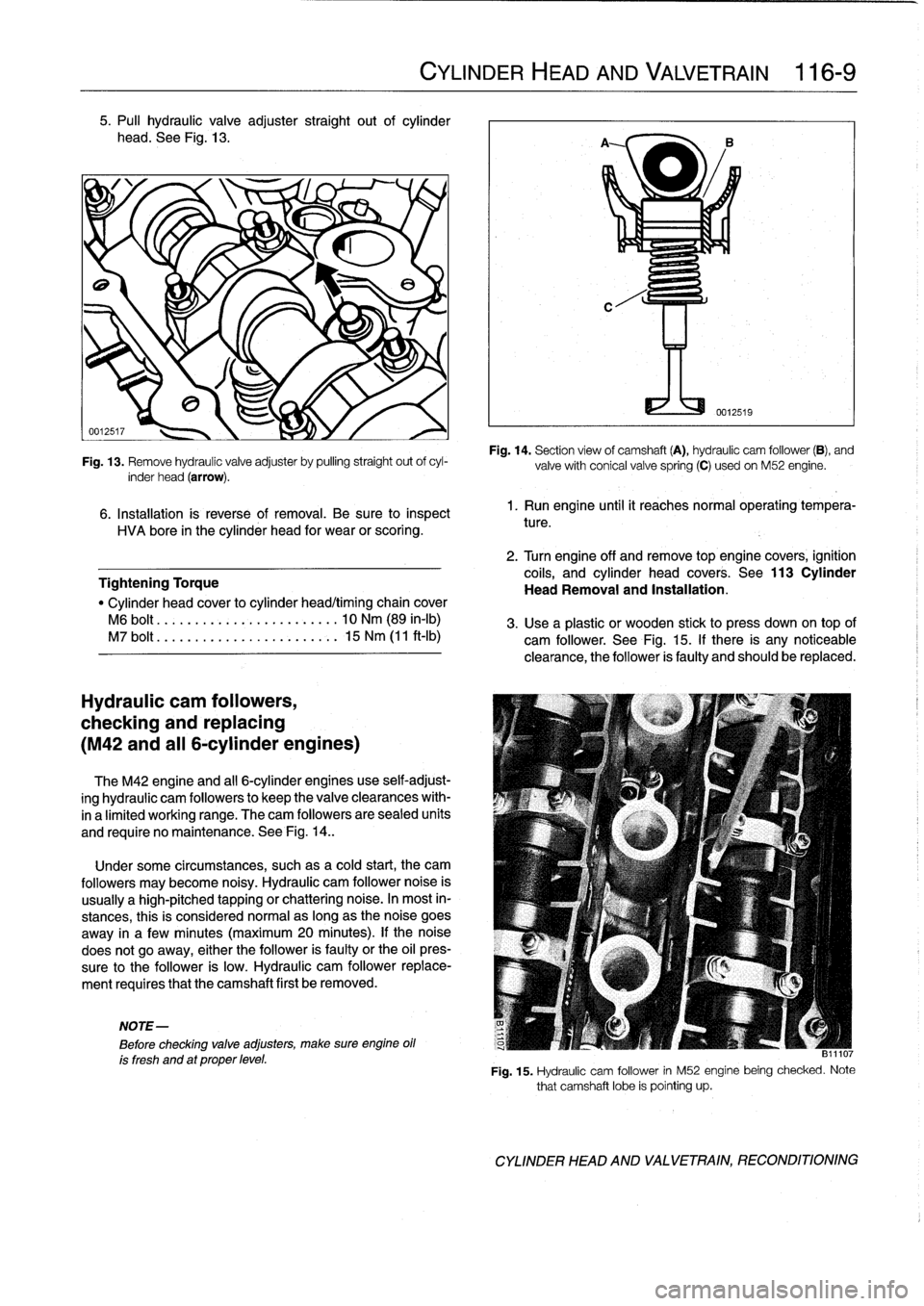
5
.
Pull
hydraulic
valve
adjuster
straight
out
of
cylinder
head
.
See
Fig
.
13
.
Fig
.
13
.
Remove
hydraulic
valve
adjuster
by
pulling
straight
out
ofcyl-
inder
head
(arrow)
.
6
.
Installation
is
reverse
of
removal
.
Be
sure
to
inspect
HVA
bore
in
the
cylinder
head
for
wear
or
scoring
.
Tightening
Torque
"
Cylinder
head
cover
to
cylinder
head/timing
chain
cover
M6
bolt
.........
..
..
...
........
10
Nm
(89
in-lb)
M7
bolt
.......
.
.
..
...
.
...
.
.....
15
Nm
(11
ft-Ib)
Hydraulic
cam
followers,
checking
and
replacing
(M42
and
al¡
6-cylinder
engines)
The
M42
engine
and
al¡
6-cylinder
engines
use
self-adjust-
ing
hydraulic
cam
followers
to
keep
the
valveclearances
with-
ina
limited
working
range
.
The
cam
followers
are
sealed
units
and
require
no
maintenance
.
See
Fig
.
14
.
.
Under
some
circumstances,
suchasa
cold
start,
the
cam
followers
may
become
noisy
.
Hydraulic
cam
follower
noise
is
usually
a
high-pitched
tapping
or
chattering
noise
.
In
most
in-
stances,
this
is
considered
normalas
long
as
the
noise
goes
away
in
a
fewminutes
(maximum
20
minutes)
.
lf
the
noise
does
not
go
away,
either
the
follower
is
faulty
or
the
oil
pres-
sure
to
the
follower
is
low
.
Hydraulic
cam
follower
replace-
ment
requires
that
the
camshaft
first
be
removed
.
NOTE-
Before
checking
valve
adjusters,
make
sure
engine
oil
ís
fresh
and
at
proper
level
.
CYLINDER
HEAD
AND
VALVETRAIN
116-
9
Fig
.
14
.
Section
view
of
camshaft
(A),
hydraulic
cam
follower
(B),
and
valvewith
conical
valvespring
(C)
usedon
M52
engine
.
1.
Run
engine
until
it
reachesnormal
operating
tempera-
ture
.
2
.
Turn
engine
off
and
remove
top
engine
covers,
ignition
coils,
and
cylinder
head
covers
.
See
113
Cylinder
Head
Removal
and
Installation
.
3
.
Use
a
plastic
or
wooden
stickto
press
down
on
top
of
cam
follower
.
See
Fig
.
15
.
If
there
is
any
noticeable
clearance,
the
follower
is
faulty
and
should
be
replaced
.
811107
Fig
.
15
.
Hydraulic
cam
follower
in
M52
enginebeing
checked
.
Note
that
camshaft
lobe
is
pointing
up
.
CYLINDER
HEAD
AND
VALVETRAIN,
RECONDITIONING
Page 95 of 759
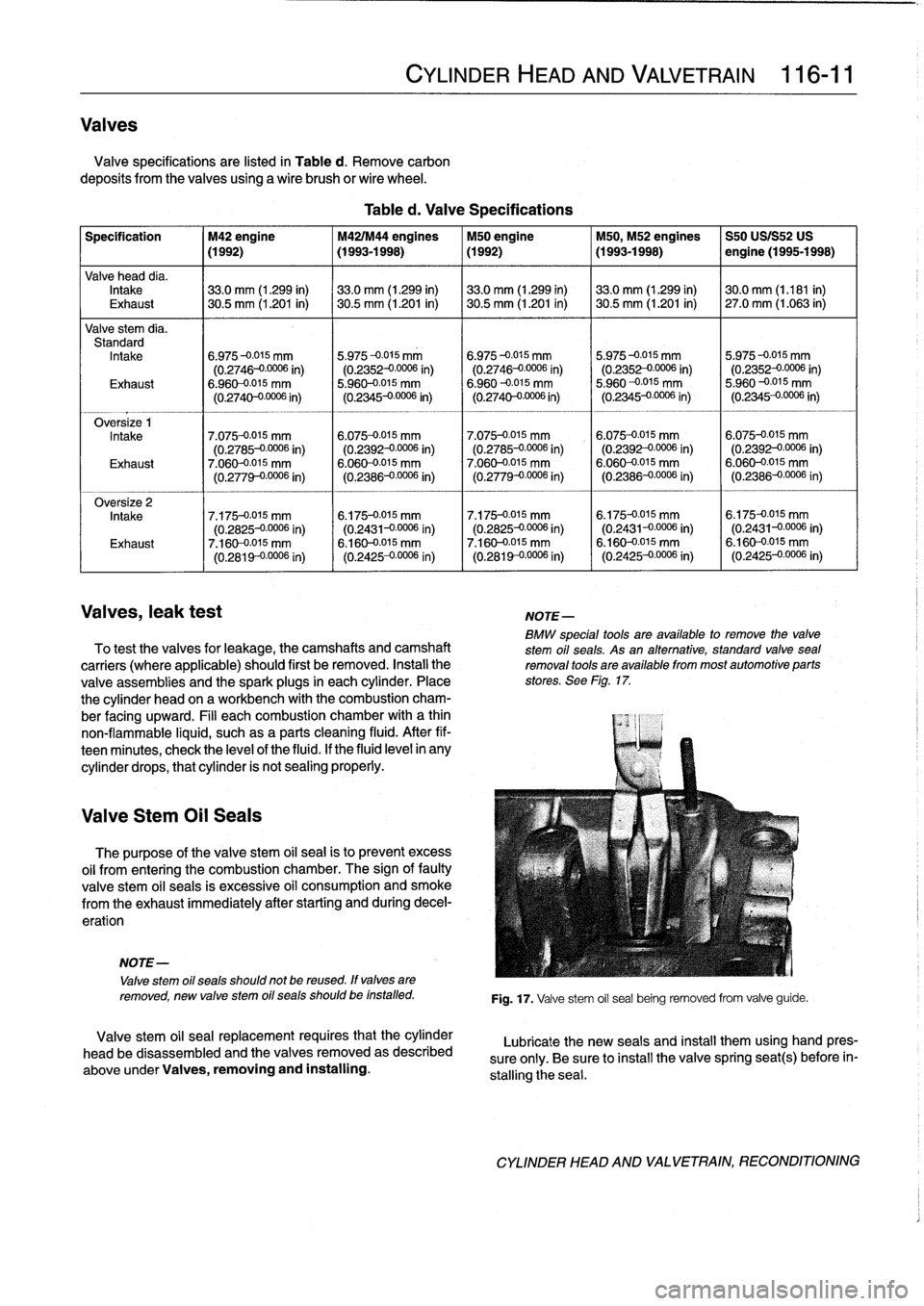
Valves
Valve
specifications
are
listed
in
Table
d
.
Remove
carbon
deposits
from
thevalves
using
a
wire
brush
or
wire
wheel
.
Specification
M42
engine
M42IM44
engines
M50
engine
M50,
M52
engines
S50
USIS52
US
(1992)
(1993-1998)
(1992)
(1993-1998)
I
engine
(1995-1998)
Valve
head
dia
.
Intake
133
.0
mm
(1
.299
in)
133
.0
mm
(1
.299
in)
33
.0
mm
(1
.299
in)
33
.0
mm
(1
.299
in)
130
.0
mm
(1
.181
in)
Exhaust
30
.5
mm
(1
.201
in)
30
.5
mm
(1
.201
in)
30
.5
mm
(1
.201
in)
~
30
.5
mm
(1
.201
in)
27
.0
mm
(1
.063
in)
Valve
stem
dia
.
Standard
Intake
6
.975-0
.015
mm
5
.975-0
.015
mm
6
.975-0
.015
mm
5
.975-0
.015
mm
5
.975-0015
mm
(0
.2746-00006
in)
(0
.2352-00006
in)
(0
.2746-00006
in)
(0
.2352-00006
in)
(0
.2352
-
00006
in)
Exhaust
6
.960-0015
mm
5
.960-0
.015
mm
6
.960
--0
.015
mm
5
.960
-0
.015
mm
5
.960-0
.015
mm
(0
.2740-00006
in)
(0
.2345-0
.0006
in)
(0
.2740--0
.0006
in)
(0
.2345-0
.0006
in)
(0
.2345-0
.0006
in)
Intake
7
.075-0
.015
mm
6
.075-0
.015
mm
7
.075-0
.015
mm
6
.075-0
.015
mm
6
.075-0
.015
mm
(0
.2785-00006
in)
(0
.2392-0
.0006
in)
(0
.2785-00006
in)
(0
.2392
-
00006
in)
(0
.2392-00006
in)
Exhaust
7
.060-0015
mm
6
.060-0015
mm
7
.060-0
.015
mm
6
.060-0015
mm
6
.060-0015
mm
(0
.
2779-0
.0006
in)
(0
.2386-00006
in)
(0
.2779-00006
in)
(0
.2386-00006
in)
(0
.2386-00006
in)
Oversize
2
Intake
7
.175-0
.015
mm
6
.175-0
.015
mm
7
.175-0
.015
mm
6
.175-0
.015
mm
6
.175-0
.015
mm
(0
.2825-00006
in)
(0
.2431-00006
in)
(0
.2825-00006
in)
(0
.2431--0
.0006
in)
(0
.2431-00006
in)
Exhaust
7
.160-0015
mm
6
.160-0015
mm
7
.160-0
.015
mm
6
.160-0015
mm
6
.160-0-015
mm
(0
.2819
-
00006
i
n
)
(0
.2425-00006
in)
(0
.2819-00006
in)
(0
.2425-00006
in)
(0
.2425-00006
in)
Valves,
leak
test
NOTE-
BMW
speclal
tools
are
available
to
remove
the
valve
To
test
thevalves
for
leakage,
the
camshafts
and
camshaft
stem
oil
seals
.
As
an
alternative,
standard
valvesea¡
carriers
(where
applicable)
should
first
be
removed
.
Instali
the
removal
tools
are
available
from
most
automotive
parts
valve
assemblies
and
the
spark
plugs
in
each
cylinder
.
Place
stores
.
See
Flg
.
17
.
the
cylinder
head
on
a
workbench
with
the
combustion
cham-
ber
facing
upward
.
Fill
each
combustion
chamber
with
a
thin
non-flammable
liquid,
suchas
a
parts
cleaning
fluid
.
After
fif-
teenminutes,
check
the
leve¡
of
the
fluid
.
If
the
fluid
level
in
any
cylinder
drops,
thatcylinder
is
not
sealing
properly
.
Valve
Stem
Oil
Seals
The
purpose
of
the
valve
stem
oil
sea¡
is
to
prevent
excess
oil
from
entering
the
combustion
chamber
.
The
sign
offautty
valve
stem
oil
seals
is
excessive
oil
consumption
and
smoke
from
the
exhaust
immediately
after
starting
and
during
decel-
erat¡on
NOTE-
Valve
stem
oil
seals
should
not
be
reused
.
ff
valves
are
removed,
new
valve
stem
oil
seals
should
be
installed
.
Valve
stem
oil
sea¡
replacement
requires
that
the
cylinder
head
be
disassembled
and
thevalves
removed
as
described
above
under
Valves,
removing
and
installing
.
CYLINDER
HEAD
AND
VALVETRAIN
116-
11
Table
d
.
Valve
Specifications
Fig
.
17
.
Valve
stem
oil
sea¡
being
removed
from
valve
guide
.
Lubricate
the
new
seals
and
insta¡]
them
using
hand
pres-
sure
only
.
Be
sure
to
install
the
valve
spring
seat(s)
before
in-
stalling
the
sea¡
.
CYLINDER
HEAD
AND
VALVETRAIN,
RECONDITIONING