traction control BMW 320i 2001 User Guide
[x] Cancel search | Manufacturer: BMW, Model Year: 2001, Model line: 320i, Model: BMW 320i 2001Pages: 211, PDF Size: 2.1 MB
Page 116 of 211

116n
To ensure that your vehicle provides
maximum economy throughout a long
service life, we request that you comply
with the following recommendations.
Engine and differentialUp to 1,200 miles (2,000 km):
Drive at varying engine speeds and
road speeds, but do not exceed
4,500 RPM or a road speed of 100 mph
(160 km/h) during this initial period.
Obey your local and state maximum
speed limits.
Do not apply full throttle and avoid
pressing the accelerator beyond the
kickdown point.
After 1,200 miles (2,000 km), you can
gradually increase the engine speed or
road speed.
Follow the same break-in procedure if
either the engine or the differential is
replaced in the future.
TiresDue to technical factors associated
with their manufacture, tires do not
achieve their full traction potential until
an initial break-in period has elapsed.
For this reason, drive cautiously during
the first 200 miles (300 km).
Obey your local and state maximum
speed limits.
When the vehicle is operated on
wet or slushy roads, a wedge of
water may form between the tire and
the road surface. This phenomenon is
referred to as aquaplaning, or hydro-
planing, and can lead to partial or
complete loss of traction, vehicle
control and braking effectiveness.
Reduce your speed on wet roads.<
Brake systemBrake pads and disks do not attain their
optimal wear patterns until after approx.
300 miles (500 km).
To break-in the separate parking brake
drums, apply the parking brake lightly
when coasting to a standstill (at a traffic
signal, for instance), provided that
traffic conditions allow you to do so.
To avoid corrosion, repeat this proce-
dure from time to time.
The brake lamps do not come on
when the parking brake is set.
Vacuum for the brake system servo unit
on your BMW is available only when the
engine is running. When you move the
vehicle with the engine off Ð when
towing, for example Ð substantially
higher levels of pedal force will be
required to brake the vehicle.
(500 km). Engage the gears carefully
during the break-in period.
Break-in procedures
Page 118 of 211

118n
Catalytic converter Antilock Brake System (ABS)
Be sure to comply with the
instructions above to prevent
unburned fuel from reaching the cata-
lytic convertor. If you do not, the cata-
lytic converter could respond by
overheating, leading to serious
damage.
Extreme temperatures occur at the
catalytic converter on this and every
catalyst-equipped vehicle. Heat shields
are installed adjacent to some sections
of the exhaust system. Never remove
these shields; do not apply under-
coating to their surfaces. When driving,
standing at idle, and parking the
vehicle, take extra care to avoid contact
between the exhaust system and flam-
mable materials (grass, hay, leaves,
etc.). Such contact could lead to a fire,
resulting in serious personal injury and
property damage.<
The concept ABS enhances active safety by helping
to prevent the wheels from locking
under braking. This is because locked
wheels are dangerous. When the front
wheels slide, the driver loses steering
control over the vehicle. Traction loss at
the rear wheels can cause the rear end
to break into an uncontrolled skid.
The system can achieve the shortest
braking distances possible under most
conditions (on straight-aways and in
curves, on asphalt, ice, wet road
surfaces, etc.).
ABS is designed to meet two essential
requirements during every brake appli-
cation:
>To help provide vehicle stability
>To help maintain steering control and
maneuverability Ð on all types of road
surfaces (asphalt, concrete, mud, wet
road surfaces, snow, ice).Braking with ABSThe system becomes operative once
the vehicle exceeds a speed of approx.
6 mph (10 km/h). Below approx. 4 mph
(6 km/h), it is once again deactivated.
This means that the wheels can lock in
the final phase of a panic stop Ð a factor
of no significance in actual use.If you are in a situation that requires full
braking, you will exploit the full benefits
of the ABS system if you apply
maximum brake pressure ("panic
stop"). Since the vehicle maintains
steering responsiveness, you can avoid
possible obstacles with a minimum of
steering effort, despite the full brake
application.
The ABS system closed-loop control
circuit cycles in fractions of a second. A
pulsation at the brake pedal, together
with the sounds associated with the
hydraulic controls, tells you that the
brake system is within its maximum
limit range and reminds you that you
should adapt road speed to the road
conditions.
On road surfaces that have a loose
surface layer on a firm base with good
traction (on gravel or snow, for
example), or when snow chains are
mounted, braking distances may be
longer than with locked wheels.
However, ABS continues to provide
enhanced vehicle stability and steering
response under these conditions.
Information for your safetyNot even ABS can suspend the laws of
physics. ABS cannot prevent the
Page 122 of 211

122n
Winter operationThe onset of winter is often accompa-
nied by rapid changes in weather.
Adaptations in driving style should be
accompanied by preparations on the
vehicle itself to ensure that your
progress through the winter remains
safe and trouble-free.CoolantBe sure that the coolant mixture
contains the year-round ratio of 50:50
water and extended-duty antifreeze/
corrosion protection. This mixture
provides protection against freezing
down to approx. -34 7 (-37 6).
Replace the coolant every four years.LocksBMW door lock deicer can be used to
free them if frozen. This deicer also
contains lubricant.
After its use, treatment with BMW lock
barrel grease is recommended.Rubber seals and components To prevent the weather-stripping from
freezing, apply a spray-on rubber treat-
ment or silicone spray to the door, hood
and luggage compartment lid seals.A full range of car care products is
available from your BMW center.<
Snow chains BMW snow chains can be mounted on
both summer and winter tires. Mount
them in pairs on the rear wheels only
and comply with the manufacturer's
safety precautions. Do not exceed a
maximum speed of 30 mph (50 km/h).
In this situation, it may be appropriate
to deactivate the ASC+T/DSC for a
short period of time. Refer to page 80.
BMW 325xi, 330xi: in a worst-case
scenario, if your vehicle is stuck on one
side or you cannot access one tire, then
a chain may be attached to one rear
wheel for a short period of time.Starting offWhen starting from a full stop in deep
snow or for "rocking" the vehicle to free
it, it may be effective to deactivate the
ASC+T/DSC system. Refer to page 80.Driving on low-traction road
surfacesUse smooth, gentle pressure to control
the accelerator pedal. Avoid excessive
engine speeds and shift to the next
higher gear at an early point. On down-
grades or slopes, shift down to the next
lower gear at an early point. Maintain an
adequate distance between yourself
and the vehicle ahead.BrakesWinter road conditions substantially
reduce the traction available between
the tires and the road surface.
Remember that braking distances will
be significantly longer as a result.
ABS is intended to prevent the wheels
from locking during brake applications,
thus helping to maintain vehicle stability
and steering response.
If the ABS does not respond in a critical
braking situation and the wheels lock:
Reduce the pressure on the brake pedal
until the wheels just start to roll again
while still maintaining enough force to
continue braking.
Following that, increase pedal pressure
again. Reduce the pressure as the
wheels lock, then reapply pressure.
Repeat this procedure. This type of
staggered braking will reduce the
braking distance, and the vehicle still
remains responsive to steering. It allows
you to steer around hazards once you
have reduced the pressure on the brake
pedal.
Page 123 of 211

123n
IndexDataTechnologyRepairsCar careControlsOverview
Winter operation Power steering
Do not shift down on slick road
surfaces. Doing so could cause
the rear wheels to lose traction and
skid, resulting in a loss of vehicle
control.<
Depress the clutch during hard
braking on road surfaces that
provide only poor or uneven traction.<
Skid control Depress the clutch and release the
accelerator pedal, or place the selector
lever of the automatic transmission into
the "Neutral" position. Countersteer
carefully and attempt to regain control
of the vehicle.
ParkingEngage 1st or reverse gear. If your
vehicle is equipped with an automatic
transmission, place the selector lever in
Park. On vehicles with manual trans-
mission, also apply the parking brake
when parking on inclined surfaces. In
order to prevent the parking brake
linings from locking due to frost or
corrosion, dry them by gently applying
the parking brake as the vehicle is
coming to a stop. Make sure that
following traffic is not endangered.
The brake lamps do not light up
when the parking brake is
applied.<
If the steering response changes, e.g.
high steering effort:
Contact a BMW center to have this
system inspected.
If the power steering fails,
increased effort will be required to
steer the vehicle.<
Page 126 of 211

126n
To maintain good handling and vehicle
response, use only tires of a single
tread configuration from a single manu-
facturer. BMW tests and approves
wheel/tire combinations, beginning on
page 130.
DOT Quality GradesTreadwear
Traction AA A B C
Temperature A B C
All passenger vehicle tires must
conform to Federal Safety
Requirements in addition to these
grades.
when tested under controlled condi-
tions on a specified government test
course.
For example, a tire graded 150 would
wear one and one-half (1g) times as
well on the government course as a tire
graded 100. The relative performance
of tires depends upon the actual condi-
tions of their use, however, and may
depart significantly from the norm due
to variations in driving habits, service
practices and differences in road char-
acteristics and climate.
TractionThe traction grades, from highest to
lowest, are AA, A, B and C.
Those grades represent the tire's ability
to stop on wet pavement as measured
under controlled conditions on speci-
fied government test surfaces of
asphalt and concrete. A tire marked C
may have poor traction performance.
The traction grade assigned to
this tire is based on straight-
ahead braking traction tests, and does
not include acceleration, cornering,
hydroplaning, or peak traction charac-
teristics.
tire's resistance to the generation of
heat and its ability to dissipate heat
when tested under controlled condi-
tions on a specified indoor laboratory
test wheel.
Sustained high temperature can cause
the material of the tire to degenerate
and reduce tire life, and excessive
temperature can lead to sudden tire
failure. The grade C corresponds to a
level of performance which all
passenger vehicle tires must meet
under the Federal Motor Vehicle Safety
Standard No. 109. Grades B and A
represent higher levels of performance
on the laboratory test wheel than the
minimum required by law.
The temperature grade for this tire
is established for a tire that is
properly inflated and not overloaded.
Excessive speed, underinflation, or
excessive loading, either separately or
in combination, can cause heat buildup
and possible tire failure.
tread shoulder and maximum section
width. For example:
Treadwear 200 Traction AA
Temperature A
Do not use retreaded tires. Driving
safety may be impaired by their
use. This is due to the possible varia-
tions in casing structures and, in some
cases, to their extreme age, factors that
can lead to a decrease in their dura-
bility.<
Tire replacement
Page 129 of 211

129n
IndexDataTechnologyRepairsCar careControlsOverview
Winter tires
Choosing the right tire
BMW recommends winter tires (M+S
radial tires) for driving in adverse winter
road conditions. Although all-season
M+S tires provide better winter traction
than standard summer tires with H, V,
W, Y and ZR speed ratings, they gener-
ally fail to provide the same levels of
performance as standard snow tires in
winter driving.
In the interest of safe tracking and
steering response, install winter tires
made by the same manufacturer having
the same tread configuration on all four
wheels.
Mount only winter tires approved by
BMW. Any BMW center will be glad to
provide you with information on the
best winter tires for your particular
driving conditions.
Do not exceed specified
maximum speeds
Never exceed the maximum speed
for which the tires are rated.
Unprofessional attempts by laymen to
service tires can lead to damage and
accidents.
Have this work performed by skilled
professionals only. Any BMW center
has the required technical knowledge
and the proper equipment and will be
happy to assist you.
<
Tire condition, tire pressure
Winter tires display a perceptible loss in
their ability to cope with winter driving
conditions once the tread wears to
below 0.16 inches (4 mm), and should
thus be replaced.
Comply with the specified tire inflation
pressures Ð and be sure to have the
wheel and tire assemblies balanced
every time you change the tires.
Storage
Always store tires in a cool, dry place.
Store them away from light whenever
possible. Protect the tires against
contact with oil, grease and fuel.
Snow chains
*
The use of narrow-link BMW snow
chains on winter tires is approved only
in pairs and only on the rear wheels.
BMW 325xi, 330xi: in a worst-case
scenario, if your vehicle is stuck on one
side or you cannot access one tire, then
a chain may be attached to one rear
wheel for a short period of time.
Comply with all manufacturer's safety
precautions when mounting the chains.
Page 177 of 211
Overview
Controls and features
Operation, care
and maintenance
Owner service procedures
Technical data
Index Advanced technology
177n
IndexDataTechnologyRepairsCar careControlsOverview
Adaptive Transmission Control
(ATC)178
Airbags179
Automatic Stability Control plus
Traction (ASC+T)/Dynamic
Stability Control (DSC)180
Radio reception181
Four-wheel drive182
Safety belt tensioner183
Interior rearview mirror
with automatic dimming
feature184
Rain sensor185
Tire Pressure Control (RDC)186
Self-diagnostics187
Xenon lamps188
Technol-
Page 182 of 211
182n
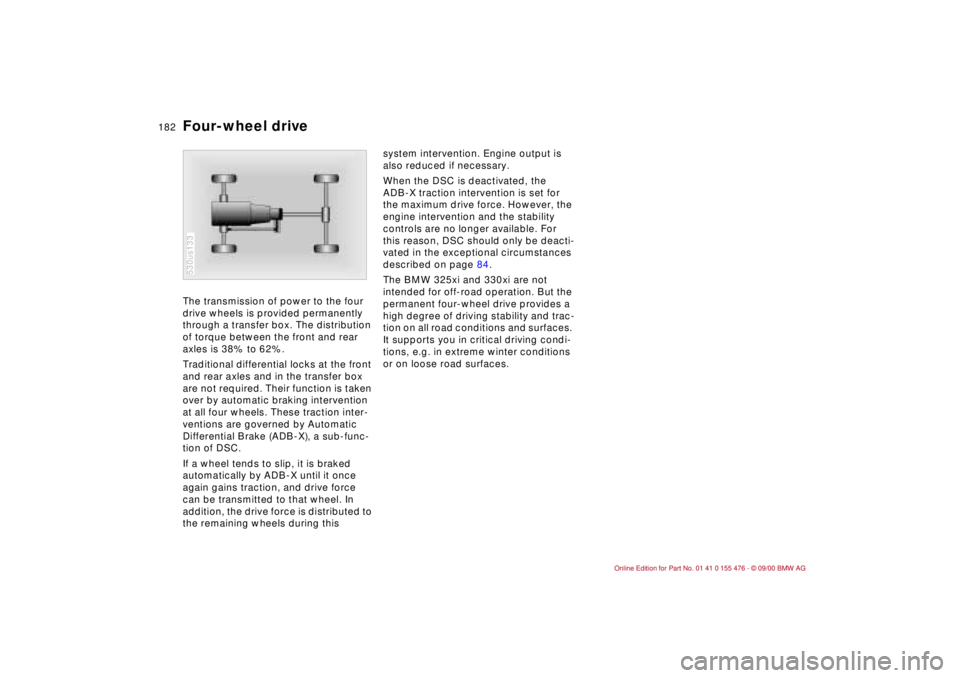
Four-wheel driveThe transmission of power to the four
drive wheels is provided permanently
through a transfer box. The distribution
of torque between the front and rear
axles is 38% to 62%.
Traditional differential locks at the front
and rear axles and in the transfer box
are not required. Their function is taken
over by automatic braking intervention
at all four wheels. These traction inter-
ventions are governed by Automatic
Differential Brake (ADB-X), a sub-func-
tion of DSC.
If a wheel tends to slip, it is braked
automatically by ADB-X until it once
again gains traction, and drive force
can be transmitted to that wheel. In
addition, the drive force is distributed to
the remaining wheels during this 530us133
system intervention. Engine output is
also reduced if necessary.
When the DSC is deactivated, the
ADB-X traction intervention is set for
the maximum drive force. However, the
engine intervention and the stability
controls are no longer available. For
this reason, DSC should only be deacti-
vated in the exceptional circumstances
described on page 84.
The BMW 325xi and 330xi are not
intended for off-road operation. But the
permanent four-wheel drive provides a
high degree of driving stability and trac-
tion on all road conditions and surfaces.
It supports you in critical driving condi-
tions, e.g. in extreme winter conditions
or on loose road surfaces.
Page 200 of 211

Everything from A to ZA
ABS (Antilock Brake
System)22,118
Accessories6
Activated-charcoal
filter102,171
Adaptive Transmission
Control (ATC)66,178
Adding engine oil139
Adding washer
fluid138,195
Adjusting the backrest48
Adjusting the steering
wheel51
Adjusting the
temperature94
Adjusting the thigh support
area49
Air conditioner92
Air distribution94,100
Air nozzles92,98
Air outlets92,98
ventilation92,98
Air pressure125
Air supply94,101
Airbags21,55,151,179
Alarm system42
Antenna124
Antenna, Diversity181
Antifreeze142
radiator122 Antilock Brake System
(ABS)22,118
Anti-theft alarm system42
Aquaplaning117,125
Armrest105
ASC+T (Automatic Stability
Control plus Traction)22
Ashtray107
front107
rear108
ATC (Adaptive Transmission
Control)66,178
Attach car vacuum
cleaner108
AUC (Automatic
recirculated-air
control)101
Automatic car washes146
Automatic climate
control98
removing condensation
from the windows101
Automatic cruise control72
Automatic dimming, interior
rearview mirror53
Automatic recirculated-air
control (AUC)101
Automatic Stability Control
plus Traction (ASC+T)22
Automatic transmission with
Steptronic21,66 Automatic windshield
washer70
Average consumption78
Average speed78
Axle loads194
B
Backrest, adjusting48
Backup lamps65
bulb replacement161
Battery168,196
capacity196
charge170
discharged173
removal and
installation169
Battery charge current20
Battery safety terminal169
Belts54
Beverage holder105
Blower94,101
BMW High Performance
Synthetic Oils140
BMW sports seat49
Bore192
Brake fluid143
Brake hydraulic system20
Brake lamps, bulb
replacement161
Brake pads22
Brake system121 Brakes120
malfunctions121
Break-in procedures116
Bulb replacement158
C
California Proposition
65 Warning153
Capacities195
Car Memory53
Car radio124
refer also to the separate
Owner's Manual
Car radio
reception124,181
Car vacuum cleaner,
connecting108
Car wash146
Care
exterior147
interior150
Care of upholstery150
Care of wool velour150
Cargo loading112
Caring for the vehicle
finish148
Catalytic converter117
CBC (Cornering Brake
Control)21,119
Cellular phone107,124
refer also to the separate
Owner's Manual
A-Z
Page 205 of 211

Everything from A to Z
205n
IndexDataTechnologyRepairsCar careControlsOverview
Tire inflation
pressure28,125
Tire pressure
checking28
Tire Pressure Control
(RDC)86,186
Tire pressure
monitoring86,186
Tire Quality Grading126
Tire replacement126,127
Tire rotation127
Tire specifications130
Tire tread125
To switch on the interior
lamps36
Tools158
Torque192
Tow fittings174
Tow starting174
Towing174
Track193
Traction Control System,
refer to DSC80
Transmission65
Transporting children
safely59
Tread depth, tires125
Trip odometer74
Trunk39
Trunk lid, refer to luggage
compartment lid39 Turn signal
indicator23,69,160
bulb replacement160
Turning radius193
Two-way radios124
U
Uniform Tire Quality
Grading126
Used batteries170 V
Vacuum cleaner108
Vacuum cleaner,
connecting108
Vanity mirror52
bulb replacement164
V-belts196
Vehicle battery168,196
Vehicle care
exterior147
interior150
Vehicle Identification
Number (VIN)144
Vehicle immobilizer33
Vehicle painting147
Vehicle storage152 Vehicle weight194
Ventilation92,95,98
draft-free95,102
Vinyl care149
Voice recognition24,25
W
Warning lamp "Please fasten
safety belts"21
Warning lamps20
Warning messages76
Warranty and Service Guide
Booklet145
Washer fluids138
Washer nozzles138
Washer reservoir, filling138
Washing your car146
Water on roadways
deep water117
Waxing, paintwork148
Weights194
Wheel changing165
Wheel rims128
Wheelbase193
Wheels and tires128,130
Width193
Windows, convenience
operation34
Windshield washer nozzle
adjustment138
Windshield washer reservoir,
filling138,195 Windshield washer,
automatic70
Windshield wiper69
Windshield wiper blade
replacement158
Winter operation122
Winter tires128,129
Wiper blade
replacement158
Wiper system69
Work in the engine
compartment134
X
Xenon lamps159,188