ECO mode BMW 320i 2001 Owner's Manual
[x] Cancel search | Manufacturer: BMW, Model Year: 2001, Model line: 320i, Model: BMW 320i 2001Pages: 211, PDF Size: 2.1 MB
Page 103 of 211
103n
IndexDataTechnologyRepairsCar careControlsOverview
Seat heating
*
Roller sun blind
*
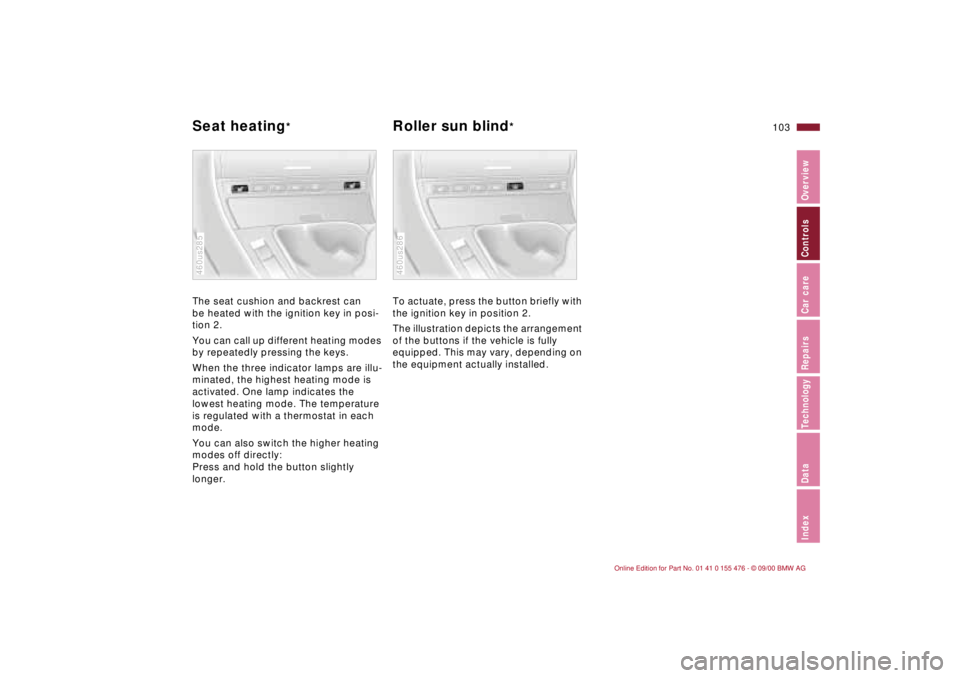
The seat cushion and backrest can
be heated with the ignition key in posi-
tion 2.
You can call up different heating modes
by repeatedly pressing the keys.
When the three indicator lamps are illu-
minated, the highest heating mode is
activated. One lamp indicates the
lowest heating mode. The temperature
is regulated with a thermostat in each
mode.
You can also switch the higher heating
modes off directly:
Press and hold the button slightly
longer.460us285
To actuate, press the button briefly with
the ignition key in position 2.
The illustration depicts the arrangement
of the buttons if the vehicle is fully
equipped. This may vary, depending on
the equipment actually installed.460us286
Page 119 of 211
119n
IndexDataTechnologyRepairsCar careControlsOverview
Antilock Brake System (ABS)consequences of brake applications
with inadequate clearances for safety
between vehicles, when exceeding the
speed limit, or the risks involved when
aquaplaning occurs. Responsibility for
these types of situations remains in the
hands (and at the feet) of the driver. You
should never allow the added safety of
ABS to mislead you into taking
increased risks.
Do not make any modifications to
the ABS system. Service proce-
dures on ABS are to be performed by
authorized technicians only.
opment of ABS. When braking during
cornering with high lateral accelera-
tion, or when braking during a lane
change, vehicle stability is improved
and the steering response is enhanced.In the event of a fault
If the ABS in the instrument
cluster lights up, refer to
page 22. The brake system then
reverts to conventional operation as on
vehicles without ABS. However, have
the brake system checked by your
BMW center as soon as possible. To
prevent undetected defects and cumu-
lative faults from adversely affecting the
brake system, refer any problems to
your BMW center at the earliest oppor-
tunity.
ABS warning lamp for Canadian
models.
If the brake warning lamp
comes on together with the indi-
cator lamps for ABS and
ASC+T/DSC, refer to page 21,
the entire ABS, CBC and
ASC+T/DSC control system has
failed. Continue driving
cautiously and defensively.
Avoid full brake applications. This could
cause the vehicle to lose stability and
you might no longer be able to control
it.
Have the system checked as soon as
possible by your BMW center.
CBC, ABS and ASC+T/DSC
and
ADB/ADB-X/DBC indicator and
warning lamps for Canadian
models.
Dynamic Brake Control (DBC)*DBC is included in the DSC, refer to
information beginning on page 84.
If you step on the brake rapidly, this
system automatically produces
maximum braking force boost and thus
helps to achieve the shortest possible
braking distance during "panic stops."
All of the benefits of the ABS system
are exploited under these circum-
stances.
Do not reduce the pressure on the
brake pedal for the duration of the
brake application. When the brake
pedal is released, the DBC is deacti-
vated.
In the event of a malfunction,
the yellow brake warning lamp
comes on. Normal braking effi-
ciency and ABS are still fully available.
Have the system checked and repaired
at your BMW center as soon as
possible.
Please observe the section "Infor-
mation for your safety" concerning
the ABS system, which also applies to
the DSC system.<
Page 121 of 211
121n
IndexDataTechnologyRepairsCar careControlsOverview
Brake systemBrake fluid level
If the brake warning lamp
comes on and the parking brake
has been released:
The brake fluid level is too low in the
reservoir (refer to page 143).
If the brake fluid level is too low and
brake pedal travel has become notice-
ably longer, there may be a defect in
one of the hydraulic circuits of the brake
system.
Brake warning lamp for Cana-
dian models.
Proceed to the nearest BMW
center. Higher brake application
pressure may be necessary under these
conditions, and brake pedal travel may
be significantly longer. Please
remember to adapt your driving style
accordingly.<
Brake pads
If the warning lamp for the brake
pads lights up:
The brake pads have reached
their minimum pad thickness. Proceed
to the nearest BMW center as soon as
possible to have the pads replaced.
For your own safety: use only
brake pads that BMW has
approved for your particular vehicle
model. BMW cannot evaluate non-
approved brake pads to determine if
they are suited for use, and therefore
cannot ensure the operating safety of
the vehicle if they are installed.<
Page 125 of 211
125n
IndexDataTechnologyRepairsCar careControlsOverview
Information for your safetyThe factory-approved radial tires are
matched to the vehicle and have been
selected to provide optimum safety and
driving comfort on your vehicle.
It is not merely the tire's service life, but
also driving comfort and Ð above all else
Ð driving safety that depend on the
condition of the tires and the mainte-
nance of the specified tire pressure.
Incorrect inflation pressure is a frequent
cause of tire damage. It also signifi-
cantly influences the roadholding ability
of your BMW.
Check tire inflation pressures
regularly Ð include the space-
saver spare tire or spare tire Ð at least
twice a month and before beginning a
longer trip (refer to page 29). If this is
not done, incorrect tire pressures can
cause driving instability and tire
damage, ultimately resulting in an acci-
dent.<
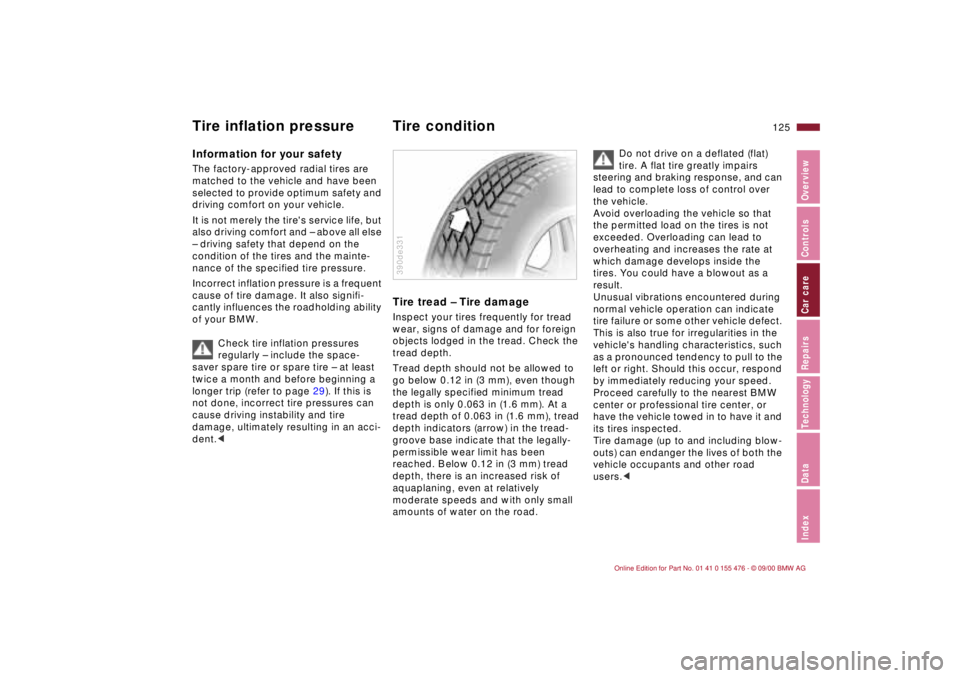
Tire tread Ð Tire damageInspect your tires frequently for tread
wear, signs of damage and for foreign
objects lodged in the tread. Check the
tread depth.
Tread depth should not be allowed to
go below 0.12 in (3 mm), even though
the legally specified minimum tread
depth is only 0.063 in (1.6 mm). At a
tread depth of 0.063 in (1.6 mm), tread
depth indicators (arrow) in the tread-
groove base indicate that the legally-
permissible wear limit has been
reached. Below 0.12 in (3 mm) tread
depth, there is an increased risk of
aquaplaning, even at relatively
moderate speeds and with only small
amounts of water on the road.390de331
Do not drive on a deflated (flat)
tire. A flat tire greatly impairs
steering and braking response, and can
lead to complete loss of control over
the vehicle.
Avoid overloading the vehicle so that
the permitted load on the tires is not
exceeded. Overloading can lead to
overheating and increases the rate at
which damage develops inside the
tires. You could have a blowout as a
result.
Unusual vibrations encountered during
normal vehicle operation can indicate
tire failure or some other vehicle defect.
This is also true for irregularities in the
vehicle's handling characteristics, such
as a pronounced tendency to pull to the
left or right. Should this occur, respond
by immediately reducing your speed.
Proceed carefully to the nearest BMW
center or professional tire center, or
have the vehicle towed in to have it and
its tires inspected.
Tire damage (up to and including blow-
outs) can endanger the lives of both the
vehicle occupants and other road
users.<
Tire inflation pressure Tire condition
Page 143 of 211
143n
IndexDataTechnologyRepairsCar careControlsOverview
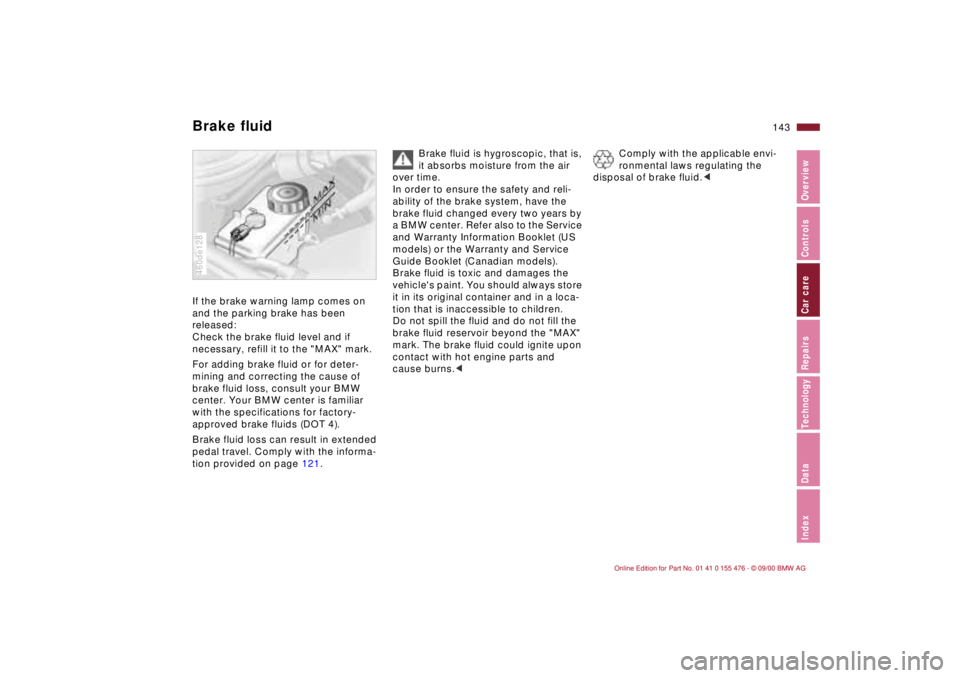
Brake fluidIf the brake warning lamp comes on
and the parking brake has been
released:
Check the brake fluid level and if
necessary, refill it to the "MAX" mark.
For adding brake fluid or for deter-
mining and correcting the cause of
brake fluid loss, consult your BMW
center. Your BMW center is familiar
with the specifications for factory-
approved brake fluids (DOT 4).
Brake fluid loss can result in extended
pedal travel. Comply with the informa-
tion provided on page 121.460de128
Brake fluid is hygroscopic, that is,
it absorbs moisture from the air
over time.
In order to ensure the safety and reli-
ability of the brake system, have the
brake fluid changed every two years by
a BMW center. Refer also to the Service
and Warranty Information Booklet (US
models) or the Warranty and Service
Guide Booklet (Canadian models).
Brake fluid is toxic and damages the
vehicle's paint. You should always store
it in its original container and in a loca-
tion that is inaccessible to children.
Do not spill the fluid and do not fill the
brake fluid reservoir beyond the "MAX"
mark. The brake fluid could ignite upon
contact with hot engine parts and
cause burns.<
Comply with the applicable envi-
ronmental laws regulating the
disposal of brake fluid.<
Page 145 of 211
145n
IndexDataTechnologyRepairsCar careControlsOverview
The BMW Maintenance System has
been designed as a reliable means of
providing maximum driving and operat-
ing safety Ð and as cost-effectively as
possible for you.
Please keep in mind that regular main-
tenance is not only necessary for the
safety of your vehicle, but also plays a
significant role in maintaining the resale
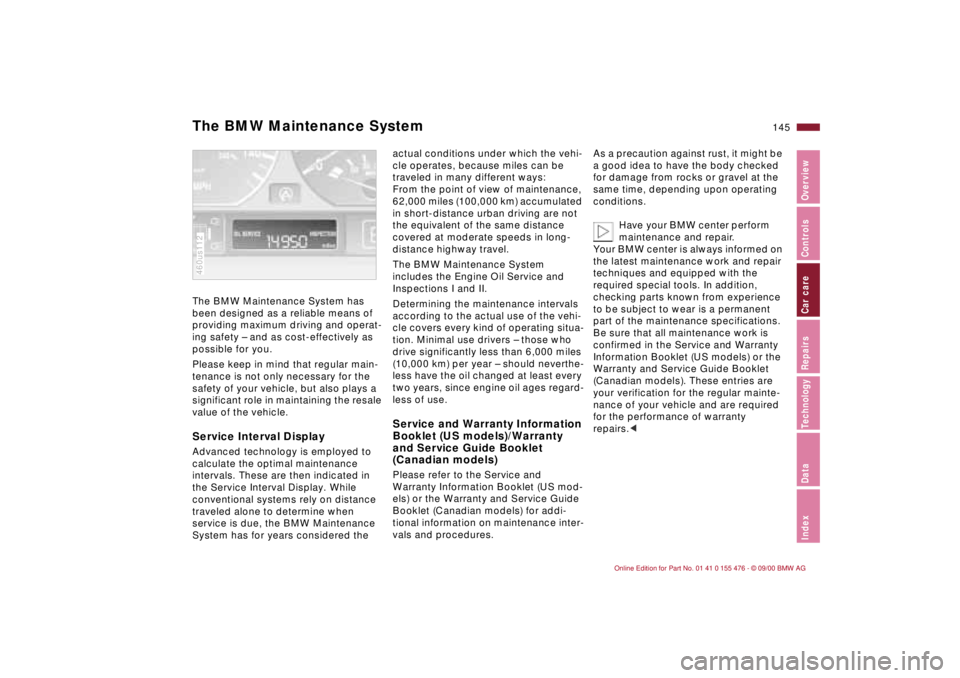
value of the vehicle. Service Interval DisplayAdvanced technology is employed to
calculate the optimal maintenance
intervals. These are then indicated in
the Service Interval Display. While
conventional systems rely on distance
traveled alone to determine when
service is due, the BMW Maintenance
System has for years considered the 460us112
actual conditions under which the vehi-
cle operates, because miles can be
traveled in many different ways:
From the point of view of maintenance,
62,000 miles (100,000 km) accumulated
in short-distance urban driving are not
the equivalent of the same distance
covered at moderate speeds in long-
distance highway travel.
The BMW Maintenance System
includes the Engine Oil Service and
Inspections I and II.
Determining the maintenance intervals
according to the actual use of the vehi-
cle covers every kind of operating situa-
tion. Minimal use drivers Ð those who
drive significantly less than 6,000 miles
(10,000 km) per year Ð should neverthe-
less have the oil changed at least every
two years, since engine oil ages regard-
less of use.Service and Warranty Information
Booklet (US models)/Warranty
and Service Guide Booklet
(Canadian models) Please refer to the Service and
Warranty Information Booklet (US mod-
els) or the Warranty and Service Guide
Booklet (Canadian models) for addi-
tional information on maintenance inter-
vals and procedures.As a precaution against rust, it might be
a good idea to have the body checked
for damage from rocks or gravel at the
same time, depending upon operating
conditions.
Have your BMW center perform
maintenance and repair.
Your BMW center is always informed on
the latest maintenance work and repair
techniques and equipped with the
required special tools. In addition,
checking parts known from experience
to be subject to wear is a permanent
part of the maintenance specifications.
Be sure that all maintenance work is
confirmed in the Service and Warranty
Information Booklet (US models) or the
Warranty and Service Guide Booklet
(Canadian models). These entries are
your verification for the regular mainte-
nance of your vehicle and are required
for the performance of warranty
repairs.<
The BMW Maintenance System
Page 167 of 211
167n
IndexDataTechnologyRepairsCar careControlsOverview
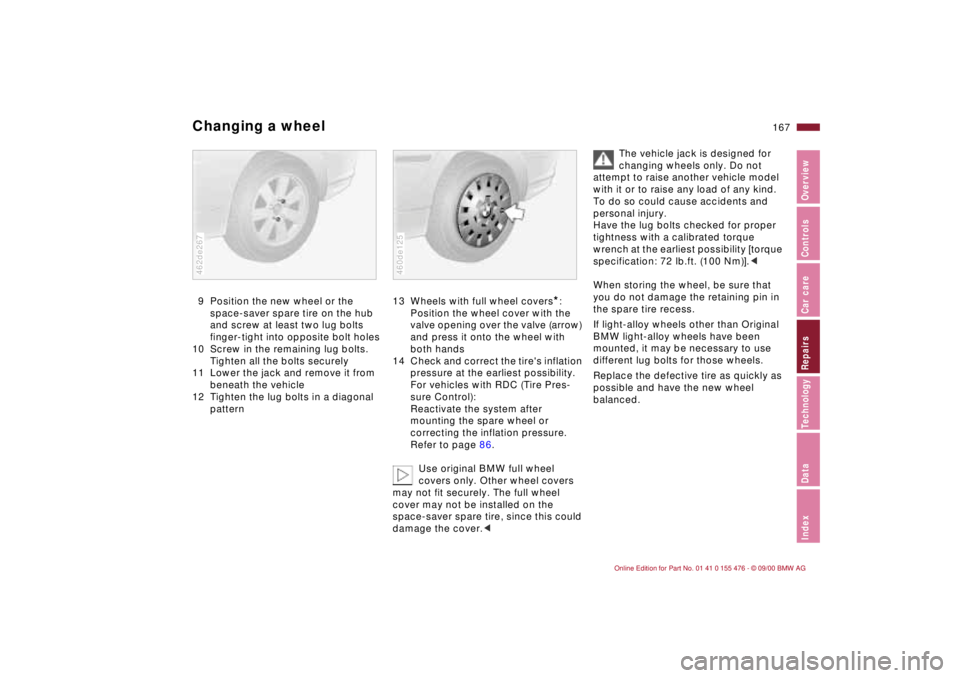
Changing a wheel9 Position the new wheel or the
space-saver spare tire on the hub
and screw at least two lug bolts
finger-tight into opposite bolt holes
10 Screw in the remaining lug bolts.
Tighten all the bolts securely
11 Lower the jack and remove it from
beneath the vehicle
12 Tighten the lug bolts in a diagonal
pattern462de267
13 Wheels with full wheel covers
*:
Position the wheel cover with the
valve opening over the valve (arrow)
and press it onto the wheel with
both hands
14 Check and correct the tire's inflation
pressure at the earliest possibility.
For vehicles with RDC (Tire Pres-
sure Control):
Reactivate the system after
mounting the spare wheel or
correcting the inflation pressure.
Refer to page 86.
Use original BMW full wheel
covers only. Other wheel covers
may not fit securely. The full wheel
cover may not be installed on the
space-saver spare tire, since this could
damage the cover.<
460de125
The vehicle jack is designed for
changing wheels only. Do not
attempt to raise another vehicle model
with it or to raise any load of any kind.
To do so could cause accidents and
personal injury.
Have the lug bolts checked for proper
tightness with a calibrated torque
wrench at the earliest possibility [torque
specification: 72 lb.ft. (100 Nm)].<
When storing the wheel, be sure that
you do not damage the retaining pin in
the spare tire recess.
If light-alloy wheels other than Original
BMW light-alloy wheels have been
mounted, it may be necessary to use
different lug bolts for those wheels.
Replace the defective tire as quickly as
possible and have the new wheel
balanced.
Page 169 of 211
169n
IndexDataTechnologyRepairsCar careControlsOverview
BatteryBattery careThe battery is absolutely maintenance-
free, that is, the original electrolyte will
normally last for the service life of the
battery under moderate climatic condi-
tions.
For all questions that regard the
battery, please consult your BMW
center. Since the battery is mainte-
nance-free, the following is for your
information only.
please comply with the corresponding
precautions whenever you work with or
near the battery.
Before handling the battery,
please read the following infor-
mation.
Wear eye protection. Do not
allow particles containing
battery acid or lead to come into
contact with your eyes, your skin, or
your clothing.
Battery acid is extremely corro-
sive. Wear eye protection and
protective gloves. Do not tip the
battery. Battery acid can leak from the
ventilation openings.
Do not allow children access to
batteries and battery acid.
Never allow sparks or open
flame in the vicinity of the
battery. Avoid sparks from elec-
trical cables or electrical equipment.
Turn the key to position 0 in the
steering lock when disconnecting or
connecting the battery. Do not short-
circuit the battery terminals. This
creates a risk of injury from high-energy
sparks.
A highly explosive gas is gener-
ated when the battery is charged.
If battery acid is splashed into
your eyes, immediately rinse
them with clear water for
15 minutes. Consult a physician imme-
diately. If your skin or clothing are
splashed by acid, rinse immediately
with ample clear water. If battery acid is
accidentally swallowed, consult a
physician immediately.
In order to protect the battery
case from ultraviolet radiation,
do not place it in direct sunlight.
A discharged battery can freeze. Store
the battery in areas where temperature
remains above freezing.
Removal and installation
Do not disconnect the battery
when the engine is running. If you
do so, the ensuing voltage surge will
damage the vehicle's onboard elec-
tronics.
Do not make any modifications in the
wires to the positive terminal. If you do
so, the protective function of the safety
battery terminal is no longer ensured.
Repair and disposal must be performed
by trained technicians only.<
When removing the battery, disconnect
the cable on the negative terminal first,
then the cable on the positive terminal.
Loosen the center adjusting screw on
the battery retaining strap (use the
screwdriver included with the onboard
tool kit) and disconnect the strap.
When installing a battery, connect the
positive terminal first, then connect the
negative terminal.
When installing a battery, be sure
that it is mounted properly and
that the retaining bracket is installed
with the center adjustment screw. If this
is not done, the battery will not be
adequately secured in case of an acci-
dent.<
Page 203 of 211

Everything from A to Z
203n
IndexDataTechnologyRepairsCar careControlsOverview
Louvers92,98
Low beam headlamps88
Low beams, bulb
replacement159
Lug bolts166
Lug wrench165
Luggage compartment41
capacity194
floor mat41
floor panel41
remote control37
Luggage compartment
lamps, bulb
replacement164
Luggage compartment
lid39
emergency release39
securing separately39
Luggage compartment
lighting39
Luggage rack113
Lumbar support49 M
M+S tires129
Maintenance75,145
Malfunction displays76
Manual transmission65
Manually controlled
recirculated-air101
Memory50 MFL (Multifunction steering
wheel)24
Microfilter95,171
Mirror memory50
Mirrors52
Mobile phone124
Modifications,
technical6,153
Motion sensor, interior42
Multifunction steering wheel
(MFL)24
N
Neckrest48 O
OBD interface socket154
Obstruction protection44
Odometer74
Oil
capacity195
consumption139
dipstick139
quality140
specifications140
viscosity140
Oil additives139
Oil change intervals, see the
Service and Warranty
Information Booklet
Oil filter change195 Oil level
check139
indicator lamp20
Oil pressure, indicator
lamp20
OILSERVICE75
Onboard tool kit158
Opening and closing Ð from
the inside38
Opening and closing Ð from
the outside34
Outside temperature
display77
Owner service
procedures206
P
Paint blemishes147
Paint, care147
Paintwork, minor
repairs148
Paintwork, waxing148
Park Distance Control
(PDC)79
Parking brake64
Parking help79
Parking lamps89
Parking, winter123
PDC (Park Distance
Control)79
Performance192
Phone, mobile124 Pocket flashlight104
Pollen95,102
Power seat49
Power steering123
Power windows44
safety switch45
Pressure monitoring,
tires86,186
Pressure, tires28,125
R
Radiator195
Radio Data System
(RDS)181
Radio reception124,181
Radio, refer to the separate
Owner's Manual
Rain sensor69,185
RDC (Tire Pressure
Control)86,186
RDS (Radio Data
System)181
Reading lamps90
Rear backrest, folding109
Rear lamps161
Rear window
defroster71,94,102
Rearview mirror52
Recirculated air mode94
Reclining seat47
Refueling27
Remote control35