light BMW 320i 2001 Owner's Guide
[x] Cancel search | Manufacturer: BMW, Model Year: 2001, Model line: 320i, Model: BMW 320i 2001Pages: 211, PDF Size: 2.1 MB
Page 119 of 211
119n
IndexDataTechnologyRepairsCar careControlsOverview
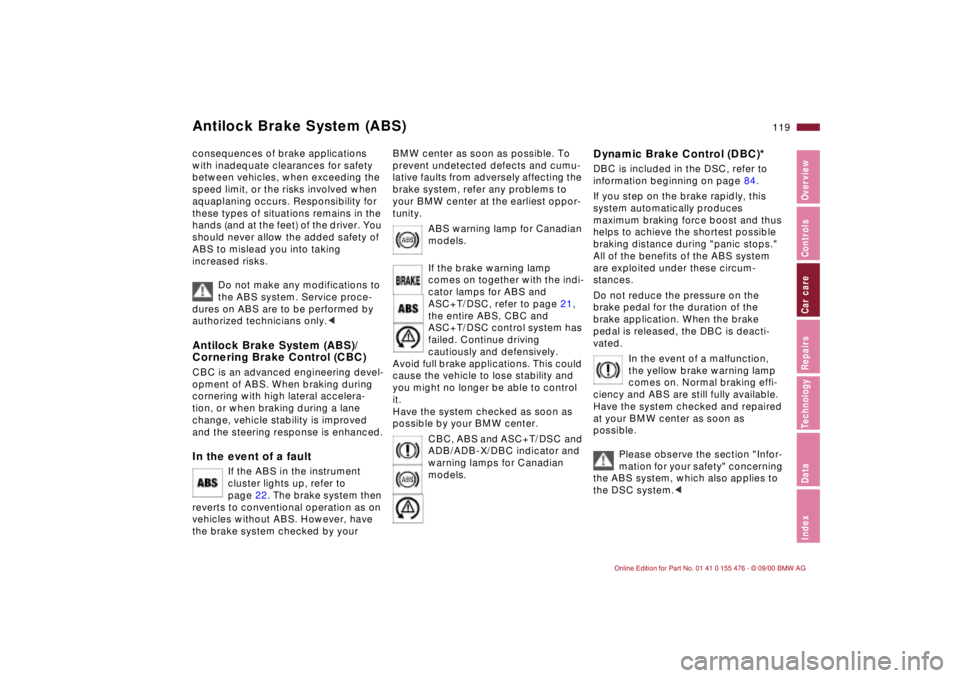
Antilock Brake System (ABS)consequences of brake applications
with inadequate clearances for safety
between vehicles, when exceeding the
speed limit, or the risks involved when
aquaplaning occurs. Responsibility for
these types of situations remains in the
hands (and at the feet) of the driver. You
should never allow the added safety of
ABS to mislead you into taking
increased risks.
Do not make any modifications to
the ABS system. Service proce-
dures on ABS are to be performed by
authorized technicians only.
opment of ABS. When braking during
cornering with high lateral accelera-
tion, or when braking during a lane
change, vehicle stability is improved
and the steering response is enhanced.In the event of a fault
If the ABS in the instrument
cluster lights up, refer to
page 22. The brake system then
reverts to conventional operation as on
vehicles without ABS. However, have
the brake system checked by your
BMW center as soon as possible. To
prevent undetected defects and cumu-
lative faults from adversely affecting the
brake system, refer any problems to
your BMW center at the earliest oppor-
tunity.
ABS warning lamp for Canadian
models.
If the brake warning lamp
comes on together with the indi-
cator lamps for ABS and
ASC+T/DSC, refer to page 21,
the entire ABS, CBC and
ASC+T/DSC control system has
failed. Continue driving
cautiously and defensively.
Avoid full brake applications. This could
cause the vehicle to lose stability and
you might no longer be able to control
it.
Have the system checked as soon as
possible by your BMW center.
CBC, ABS and ASC+T/DSC
and
ADB/ADB-X/DBC indicator and
warning lamps for Canadian
models.
Dynamic Brake Control (DBC)*DBC is included in the DSC, refer to
information beginning on page 84.
If you step on the brake rapidly, this
system automatically produces
maximum braking force boost and thus
helps to achieve the shortest possible
braking distance during "panic stops."
All of the benefits of the ABS system
are exploited under these circum-
stances.
Do not reduce the pressure on the
brake pedal for the duration of the
brake application. When the brake
pedal is released, the DBC is deacti-
vated.
In the event of a malfunction,
the yellow brake warning lamp
comes on. Normal braking effi-
ciency and ABS are still fully available.
Have the system checked and repaired
at your BMW center as soon as
possible.
Please observe the section "Infor-
mation for your safety" concerning
the ABS system, which also applies to
the DSC system.<
Page 120 of 211

120n
Disc brakesDisc brakes furnish optimum decelera-
tion and braking control and greater
fade resistance under heavy use.
When the vehicle is driven only occa-
sionally, during extended periods when
the vehicle is not used at all, and in oper-
ating conditions where brake applica-
tions are less frequent, there is an
increased tendency for corrosion of the
discs and accumulation of contamina-
tion on the brake pads. This occurs
because the minimal pressure that must
be exerted by the pads to clean the
discs by brake applications is not
reached.
If the brake discs are corroded, they will
tend to respond to braking with a
pulsating effect that even extended
brake applications will fail to cure.
For your own safety: use only
brake pads that BMW has
approved for your particular vehicle
model. BMW cannot evaluate non-
approved brake pads to determine if
they are suited for use, and therefore
cannot ensure the operating safety of
the vehicle if they are installed.<
Driving notesWhen driving in wet conditions and in
heavy rain, it is effective to apply light
pressure to the brakes every few miles
or kilometers. Be aware of traffic condi-
tions to ensure that this maneuver does
not endanger other road users. The
heat that is generated by the brake
applications helps to dry the brake
pads and discs.
Maximum braking force is obtained
while the wheels are not locked, but
rather when they are still barely turning
immediately prior to locking. ABS main-
tains this state automatically. If the ABS
fails, you should revert to the staggered
braking technique described on
page 122.
Extended or steep mountain descents
should be driven in the gear in which
only minimal periodic brake application
is required. This avoids excessive strain
on the brakes and possible
impairment of the braking effect.
The braking effect of the engine can be
further increased by downshifting, into
first gear, if necessary. In the manual
mode of the automatic transmission,
you can also downshift into first gear.
Refer to page 66.Should engine braking prove inade-
quate, you should still avoid extended,
continuous braking. Instead of main-
taining low to moderate pressure over
an extended period of time, you should
decelerate by applying more substantial
pressure to the brake pedal (watch for
following traffic), releasing the pedal,
and then repeating the application
(staggered braking). The cooling
phases between active braking inter-
vals prevent the brakes from over-
heating, thus ensuring that full braking
capacity remains available at all times.
Do not coast with the clutch
depressed or with the shift lever
or selector lever in neutral. Do not drive
with the engine shut off. The engine
provides no braking effect when the
clutch is depressed or the transmission
is in neutral, and there is no power-
assist for braking or steering when the
engine is not running.
BMW 325xi, 330xi: have brake inspec-
tions performed at a BMW center only.
If you do not, parts of the four-wheel
drive system could be damaged.
Do not allow floor mats, carpets or any
other objects to protrude into the area
around the brake pedal, the clutch or
the accelerator which could obstruct
their freedom of movement.<
Page 121 of 211

121n
IndexDataTechnologyRepairsCar careControlsOverview
Brake systemBrake fluid level
If the brake warning lamp
comes on and the parking brake
has been released:
The brake fluid level is too low in the
reservoir (refer to page 143).
If the brake fluid level is too low and
brake pedal travel has become notice-
ably longer, there may be a defect in
one of the hydraulic circuits of the brake
system.
Brake warning lamp for Cana-
dian models.
Proceed to the nearest BMW
center. Higher brake application
pressure may be necessary under these
conditions, and brake pedal travel may
be significantly longer. Please
remember to adapt your driving style
accordingly.<
Brake pads
If the warning lamp for the brake
pads lights up:
The brake pads have reached
their minimum pad thickness. Proceed
to the nearest BMW center as soon as
possible to have the pads replaced.
For your own safety: use only
brake pads that BMW has
approved for your particular vehicle
model. BMW cannot evaluate non-
approved brake pads to determine if
they are suited for use, and therefore
cannot ensure the operating safety of
the vehicle if they are installed.<
Page 123 of 211

123n
IndexDataTechnologyRepairsCar careControlsOverview
Winter operation Power steering
Do not shift down on slick road
surfaces. Doing so could cause
the rear wheels to lose traction and
skid, resulting in a loss of vehicle
control.<
Depress the clutch during hard
braking on road surfaces that
provide only poor or uneven traction.<
Skid control Depress the clutch and release the
accelerator pedal, or place the selector
lever of the automatic transmission into
the "Neutral" position. Countersteer
carefully and attempt to regain control
of the vehicle.
ParkingEngage 1st or reverse gear. If your
vehicle is equipped with an automatic
transmission, place the selector lever in
Park. On vehicles with manual trans-
mission, also apply the parking brake
when parking on inclined surfaces. In
order to prevent the parking brake
linings from locking due to frost or
corrosion, dry them by gently applying
the parking brake as the vehicle is
coming to a stop. Make sure that
following traffic is not endangered.
The brake lamps do not light up
when the parking brake is
applied.<
If the steering response changes, e.g.
high steering effort:
Contact a BMW center to have this
system inspected.
If the power steering fails,
increased effort will be required to
steer the vehicle.<
Page 128 of 211

128n
Wheel and tire combinations The right choice Use only BMW-approved tires. Refer to
page 130.
Due to the high speeds this vehicle can
reach, the use of specific brands, spec-
ifications and sizes is mandatory.
Consult any BMW center for details.
Comply with local/national regulations.
The correct wheel-tire combina-
tion affects different systems such
as ABS, ATC and ASC+T/DSC. The
function of these systems is impaired if
improper wheel-tire combinations are
used.
For this reason, use only tires of the
same brand and tread pattern. In the
event of a flat tire, for example, remount
the approved wheel-tire combination as
soon as possible.<
Codes on tires and wheels The tire codes will aid you in selecting
the correct tire.
The codes on radial tires:
The speed rating indicates the approved
maximum speed for the tire.
Summer tires:
S = up to 112 mph (180 km/h)
T = up to 118 mph (190 km/h)
H = up to 130 mph (210 km/h)
V = up to 150 mph (240 km/h)
W = up to 167 mph (270 km/h)
Y = up to 187 mph (300 km/h)
ZR = above 150 mph (240 km/h) Example:
Nominal width
in mm
Aspect ratio in %
Radial tire ID code
Rim diameter in inches
Load rating
(not on ZR tires)
Speed rating
(before R on ZR tires)
205/60 R
1591W
Winter tires and all-season tires:
Q M+S = up to 100 mph (160 km/h)
T M+S = up to 118 mph (190 km/h)
H M+S = up to 130 mph (210 km/h)
Codes stamped on light-alloy wheels:
Protect tire valve from dirt by using
screw-on valve stem caps. Dirt in the
valves frequently leads to slow leaks. Example:
Rim width
in inches
Code letter for
flange type
Symbol for full-drop
center rim
Rim diameter in inches
Hump on the 2 rim shoulders
7 x 15 H 2
J
Page 129 of 211

129n
IndexDataTechnologyRepairsCar careControlsOverview
Winter tires
Choosing the right tire
BMW recommends winter tires (M+S
radial tires) for driving in adverse winter
road conditions. Although all-season
M+S tires provide better winter traction
than standard summer tires with H, V,
W, Y and ZR speed ratings, they gener-
ally fail to provide the same levels of
performance as standard snow tires in
winter driving.
In the interest of safe tracking and
steering response, install winter tires
made by the same manufacturer having
the same tread configuration on all four
wheels.
Mount only winter tires approved by
BMW. Any BMW center will be glad to
provide you with information on the
best winter tires for your particular
driving conditions.
Do not exceed specified
maximum speeds
Never exceed the maximum speed
for which the tires are rated.
Unprofessional attempts by laymen to
service tires can lead to damage and
accidents.
Have this work performed by skilled
professionals only. Any BMW center
has the required technical knowledge
and the proper equipment and will be
happy to assist you.
<
Tire condition, tire pressure
Winter tires display a perceptible loss in
their ability to cope with winter driving
conditions once the tread wears to
below 0.16 inches (4 mm), and should
thus be replaced.
Comply with the specified tire inflation
pressures Ð and be sure to have the
wheel and tire assemblies balanced
every time you change the tires.
Storage
Always store tires in a cool, dry place.
Store them away from light whenever
possible. Protect the tires against
contact with oil, grease and fuel.
Snow chains
*
The use of narrow-link BMW snow
chains on winter tires is approved only
in pairs and only on the rear wheels.
BMW 325xi, 330xi: in a worst-case
scenario, if your vehicle is stuck on one
side or you cannot access one tire, then
a chain may be attached to one rear
wheel for a short period of time.
Comply with all manufacturer's safety
precautions when mounting the chains.
Page 130 of 211

130n
Approved wheel and tire specifications Tire specifications Steel rim Alu-wheel
(black)Light-alloy
wheel
BMW 320i
All season tires
195/65 R 15 91 H M+S
205/55 R 16 91 H M+S
205/50 R 17 93 V M+S extra load6.5Jx15
7Jx16
7Jx176.5Jx15
Ð
Ð6.5Jx15
7Jx16
7Jx17
Summer tires
195/65 R 15 91 H Ð Ð 6,5Jx15
205/60 R 15 91 H Ð Ð 6.5Jx15
7Jx15
205/55 R 16 91 H
225/50 R 16 92 W
225/50 ZR 16Ð Ð 7Jx16
205/50 R 17 93 W extra load Ð Ð 7Jx17
225/45 R 17 91 W Ð Ð 8Jx17
Front: 225/45 ZR 17 Ð Ð 7.5Jx17
Rear: 245/40 ZR 17 Ð Ð 8.5Jx17
Page 131 of 211

131n
IndexDataTechnologyRepairsCar careControlsOverview
Approved wheel and tire specifications Tire specifications Steel rim Alu-wheel
(black)Light-alloy
wheel
Winter tires
195/65 R 15 91 Q M+S 6.5Jx15 6.5Jx15 6.5Jx15
205/60 R 15 91 Q M+S 6.5Jx15 6.5Jx15
Ð6.5Jx15
7Jx15
205/55 R 16 91 Q M+S
225/50 R 16 92 Q M+S7Jx16 7Jx16
205/50 R 17 93 Q M+S extra load Ð 7Jx17
225/45 R 17 91 Q M+S Ð Ð 8Jx17
Space-saver spare tire Ð
T 125/90 R 15 96 M 3.5Bx15 Ð Ð
T 115/90 R 16 92 M 3.0Bx16 Ð Ð
T 125/90 R 16 98 M 3.5Bx16 Ð Ð
T 125/80 R 17 99 M 3.5Bx17 Ð Ð
Comply with the specifications for tires and wheels in the vehicle's manuals.
If you install tire sizes not approved by the manufacturer, an entry in the
vehicle documents may be necessary.
Snow chains
*
You cannot mount snow chains with
the following tires:
225/50 R 16 92 W
225/50 ZR 16
225/45 R 17 91 W
245/40 ZR 17
225/50 R 16 92 Q M+S
225/45 R 17 91 Q M+SMixed tiresFor details concerning tire manufac-
turers for mixed tires, refer to the
vehicle documents.
Page 132 of 211

132n
Approved wheel and tire specificationsTire specifications Steel rim Light-alloy wheel
BMW 325i/330xi
All season tires
205/55 R 16 91 H M+S 7Jx16 7Jx16
205/50 R 17 93 V M+S extra load 7Jx17 7Jx17
Summer tires
205/55 R 16 91 V
225/50 R 16 92 W (not on 325xi)
225/50 ZR 16 (not on 325xi)Ð 7Jx16
205/50 R 17 93 W extra load Ð 7Jx17
225/45 R 17 91 W Ð 8Jx17
Front: 225/45 ZR 17
Rear: 245/40 ZR 17Ð
Ð7.5Jx17
8.5Jx17
Winter tires205/55 R 16 91 Q M+S
225/50 R 16 92 Q M+S (not on 325xi)
7Jx16 7Jx16
205/50 R 17 93 Q M+S extra load Ð 7Jx17
225/45 R 17 91 Q M+S Ð 8Jx17
Space-saver spare tire
T 115/90 R 16 92 M 3.0Bx16 Ð
T 125/90 R 16 98 M 3.5Bx16 Ð
T 125/80 R 17 99 M 3.5Bx17 Ð
Comply with the specifications for tires and wheels in the vehicle's manuals.
If you install tire sizes not approved by the manufacturer, an entry in the vehicle
documents may be necessary.
BMW 325xiFor all tires, only light-alloy wheels must
be used.Snow chains
*
You cannot mount snow chains
with the following tires:
225/50 R 16 92 W
225/50 ZR 16 92 Q M+S
225/50 ZR 16
225/45 R 17 91 W
225/45 R 17 91 Q M+S
245/40 ZR 17Mixed tiresFor details concerning tire manufac-
turers for mixed tires, refer to the
vehicle documents.
Page 133 of 211

133n
IndexDataTechnologyRepairsCar careControlsOverview
Tire specifications Steel rim Light-alloy wheel
BMW 330i/330xi
All season tires
205/50 R 17 93 V M+S extra load 7Jx17 7Jx17
Summer tires
205/50 R 17 93 W extra load Ð 7Jx17
225/45 R 17 91 W Ð 8Jx17
Front: 225/45 ZR 17
Rear: 245/40 ZR 17Ð
Ð7.5Jx17
8.5Jx17
Winter tires
205/50 R 17 93 Q M+S extra load Ð 7Jx17
225/45 R 17 91 Q M+S Ð 8Jx17
Space-saver spare tire
T 125/80 R 17 99 M 3.5Bx17 Ð
Comply with the specifications for tires and wheels in the vehicle's manuals.
If you install tire sizes not approved by the manufacturer, an entry in the vehicle
documents may be necessary.
Snow chains
*
You cannot mount snow chains with the
following tires:
225/45 R 17 91 W
245/40 ZR 17
225/45 R 17 91 Q M+SMixed tiresFor details concerning tire manufac-
turers for mixed tires, refer to the
vehicle documents.