door lock BMW 320i 2002 User Guide
[x] Cancel search | Manufacturer: BMW, Model Year: 2002, Model line: 320i, Model: BMW 320i 2002Pages: 155, PDF Size: 2.24 MB
Page 38 of 155
38n
Electric power windowsAfter the ignition has been switched off:
You can still use the electric power
windows for up to 15 minutes, as long
as no one opens any of the front doors.
When leaving the vehicle, always
remove the ignition key from the
lock and remember to close the doors
to prevent children from operating the
power windows and injuring them-
selves, etc.<
For the convenience mode via the
remote control or the door lock, refer to
pages 30 or 31.
Safety feature A contact strip is located on the inside
upper frame of each of the front
windows. If pressure is exerted against
this contact strip while a window is
being raised, the system will respond
by stopping the window and then
retracting it a small distance.
Despite this safety feature, be
extremely careful to ensure that
the closing path of the window is not
obstructed. Some types of objects
might fail to trigger the contact strip in
some situations (very thin objects, for
instance).
You can override this safety feature by
pressing the switch beyond the resis-
tance point and holding it.<
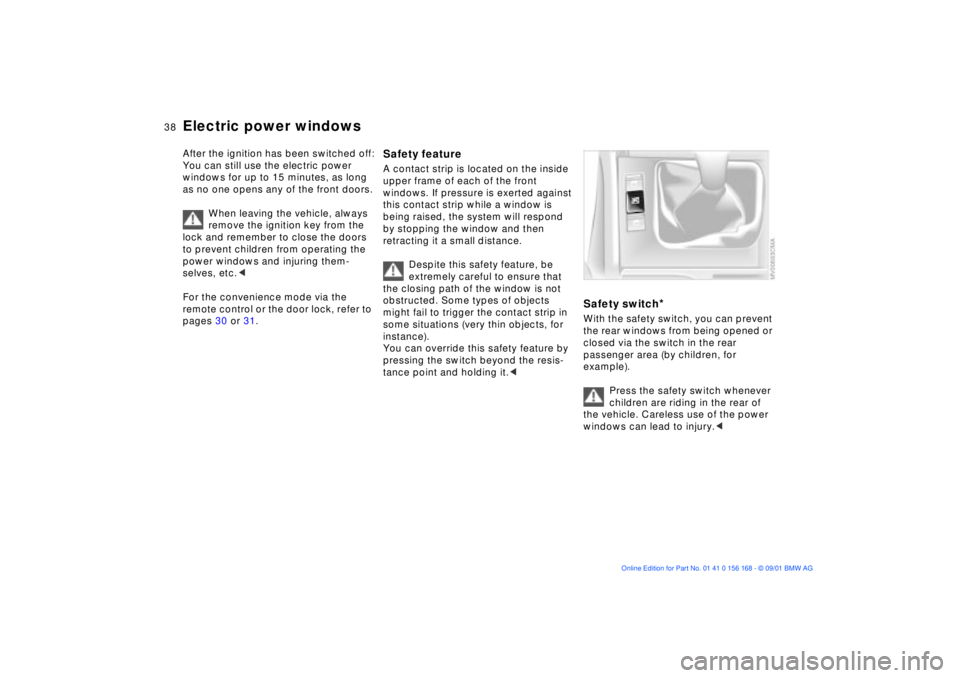
Safety switch
*
With the safety switch, you can prevent
the rear windows from being opened or
closed via the switch in the rear
passenger area (by children, for
example).
Press the safety switch whenever
children are riding in the rear of
the vehicle. Careless use of the power
windows can lead to injury.<
Page 39 of 155
39n
OverviewControlsMaintenanceRepairsDataIndex
Sliding/tilt sunroof
*
To prevent injuries, exercise care
when closing the sliding/tilt
sunroof and keep it in your field of
vision until it is shut.
When leaving the vehicle, always
extract the ignition key from the lock
and remember to close the doors to
prevent children from operating the
sliding/tilt sunroof and injuring them-
selves, etc.<
Raising Ð opening Ð closingWith ignition key in position 1 or 2.
After the ignition has been switched off,
you can still operate the sliding/tilt
sunroof for up to 15 minutes as long as
neither of the front doors has been
opened.
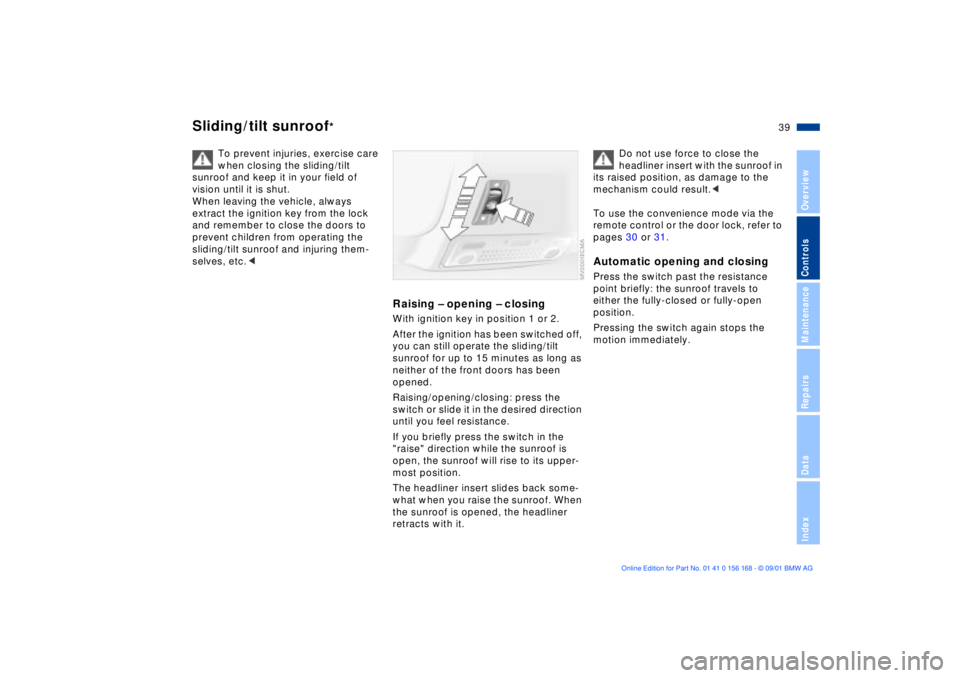
Raising/opening/closing: press the
switch or slide it in the desired direction
until you feel resistance.
If you briefly press the switch in the
"raise" direction while the sunroof is
open, the sunroof will rise to its upper-
most position.
The headliner insert slides back some-
what when you raise the sunroof. When
the sunroof is opened, the headliner
retracts with it.
Do not use force to close the
headliner insert with the sunroof in
its raised position, as damage to the
mechanism could result.<
To use the convenience mode via the
remote control or the door lock, refer to
pages 30 or 31.
Automatic opening and closingPress the switch past the resistance
point briefly: the sunroof travels to
either the fully-closed or fully-open
position.
Pressing the switch again stops the
motion immediately.
Page 46 of 155
46n
Seat and mirror memory
*
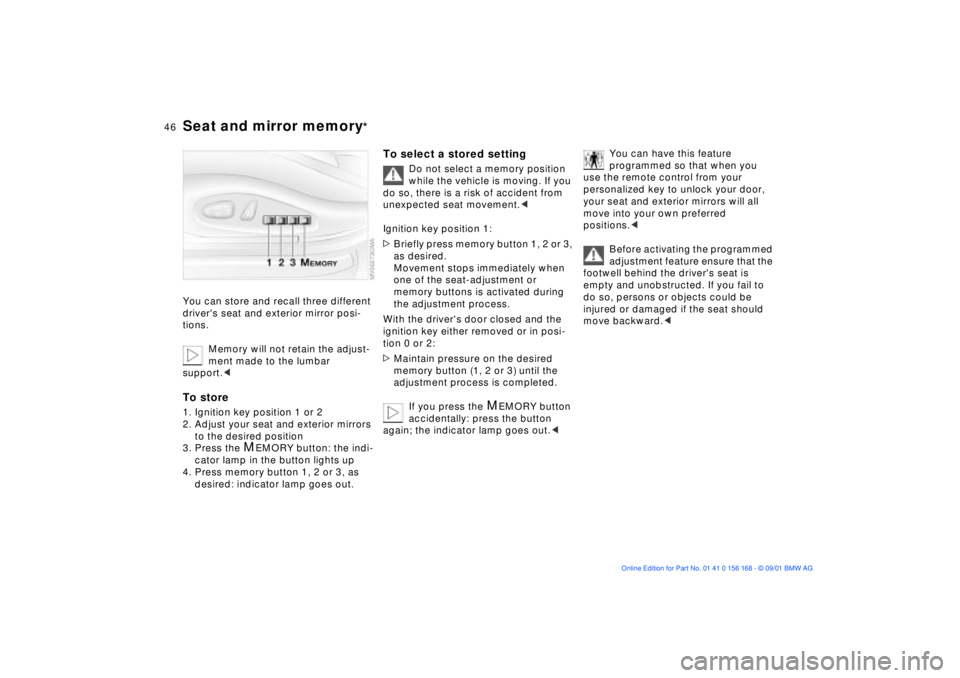
You can store and recall three different
driver's seat and exterior mirror posi-
tions.
Memory will not retain the adjust-
ment made to the lumbar
support.
to the desired position
3. Press the
M
EMORY button: the indi-
cator lamp in the button lights up
4. Press memory button 1, 2 or 3, as
desired: indicator lamp goes out.
To select a stored setting
Do not select a memory position
while the vehicle is moving. If you
do so, there is a risk of accident from
unexpected seat movement.<
Ignition key position 1:
>Briefly press memory button 1, 2 or 3,
as desired.
Movement stops immediately when
one of the seat-adjustment or
memory buttons is activated during
the adjustment process.
With the driver's door closed and the
ignition key either removed or in posi-
tion 0 or 2:
>Maintain pressure on the desired
memory button (1, 2 or 3) until the
adjustment process is completed.
If you press the
M
EMORY button
accidentally: press the button
again; the indicator lamp goes out.<
You can have this feature
programmed so that when you
use the remote control from your
personalized key to unlock your door,
your seat and exterior mirrors will all
move into your own preferred
positions.<
Before activating the programmed
adjustment feature ensure that the
footwell behind the driver's seat is
empty and unobstructed. If you fail to
do so, persons or objects could be
injured or damaged if the seat should
move backward.<
Page 50 of 155

50n
Airbags
The side airbags in the rear
passenger area
* of your vehicle
may already have been deactivated,
either at the time of manufacture or by a
BMW center. You may have them acti-
vated if you desire to do so. Please
contact your BMW center for additional
information.<
The airbags do not deploy in
response to minor collisions, rear
impacts and certain kinds of vehicle
rollover.<
For your safety, comply with the
following instructions for the
airbags. If you do not, the airbags may
not be able to provide their maximum
protection. All passengers in the vehicle
should be aware of and comply with
these directions:
The airbags are supplemental restraint
devices designed to provide extra
protection; they are not a substitute for
safety belts. Wear your safety belt at all
times. The airbags will not be triggered
in the event of a minor accident, a
vehicle roll-over, or collisions from the
rear. In these instances, the safety belt
provides optimal protection.
Airbags are located under cover panels
in the steering wheel, in the dashboard,
in the side trim panels in the front and
rear
*, in the roof panels, and in the
sides of the inside roof lining.
Adjust your seat to a position that
provides maximum distance between
you and the steering wheel, the instru-
ment panel and the door while still
allowing comfortable and safe access
to all vehicle controls.
To avoid sustaining hand and arm inju-
ries, always grasp the steering wheel
on the rim with the hands at the 9 and
3 o'clock positions. Do not place your
hands on the center pad.
Never allow any objects to obstruct the
area between the airbag and an occu-
pant.
Do not use the cover panel above the
passenger-side airbag as a storage
area.
Do not apply adhesive materials to the
cover panels of the airbags, cover them
or modify them in any other way.
Do not install a rear-facing child-
restraint system in the front passenger
seat of this vehicle.
Children under 13 years of age and less
than 5 ft (150 cm) tall should ride only in
the rear seat.
Infants or small children should never
be held on the lap of a passenger.
If your vehicle is equipped with side airbags in the rear passenger area
*, be
sure that child restraints are mounted
correctly with the greatest-possible
distance between them and the airbags
in the side trim panels. Do not allow
children to lean out of the child's seat in
the direction of the side trim panels. If
they do so, serious injuries can occur if
the airbag is triggered.<
At all times, occupants should sit
upright and be properly restrained
(infants and small children in appro-
priate child-restraint systems; larger
children and adults using the safety
belts). Never let an occupant's head
rest near or on a side airbag because
the inflating airbag could cause a
serious or fatal injury. Please note that
the word Airbag imprinted on the door
trim panel indicates the airbag's loca-
tion.
Accident research shows that the
safest place for children in an
automobile is in the rear seat. However,
a child sitting in the rear seat and not
properly restrained may place his or her
head on or near the airbag, if so
equipped. For example, a child Ñ even
though belted Ñ may fall asleep with his
or her head against the side airbag. It
may be difficult for a driver to ensure
Page 52 of 155
52n
Transporting children safelyLATCH child-restraint mounting
system
*
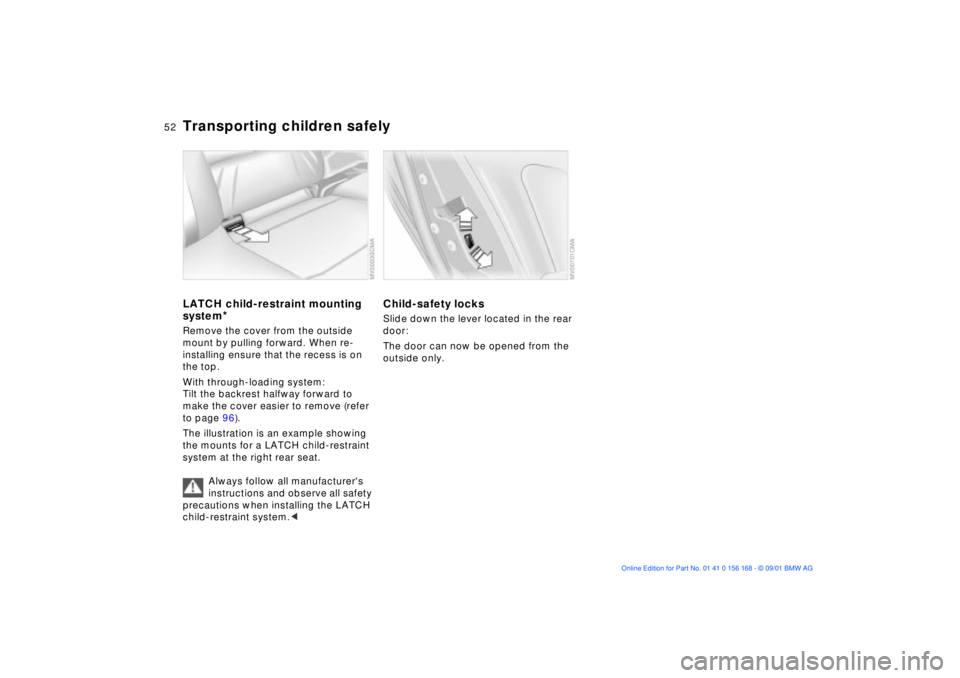
Remove the cover from the outside
mount by pulling forward. When re-
installing ensure that the recess is on
the top.
With through-loading system:
Tilt the backrest halfway forward to
make the cover easier to remove (refer
to page 96).
The illustration is an example showing
the mounts for a LATCH child-restraint
system at the right rear seat.
Always follow all manufacturer's
instructions and observe all safety
precautions when installing the LATCH
child-restraint system.<
Child-safety locksSlide down the lever located in the rear
door:
The door can now be opened from the
outside only.
Page 55 of 155
55n
OverviewControlsMaintenanceRepairsDataIndex
Vehicle Memory, Key Memory How the system functionsNo doubt you have reflected at one
time or another on how great it would
be if you could permanently configure
your vehicle's various features and
adjustments to mirror your own indi-
vidual preferences. In engineering your
vehicle, BMW has incorporated a
number of options for personal adjust-
ment that can be programmed into your
vehicle at your BMW center.
The available configuration data fall into
two categories, according to whether
their primary orientation is the vehicle
(Vehicle Memory) or the individual (Key
Memory). Provided that each person
has a separate remote-control key, you
can have your BMW center enter
adjustment data for as many as four
different individuals into the system.
The system then relies on a bilateral
data exchange to identify the individual
user and dial in the selected settings
whenever the remote control unit is
used to disengage the door locks.
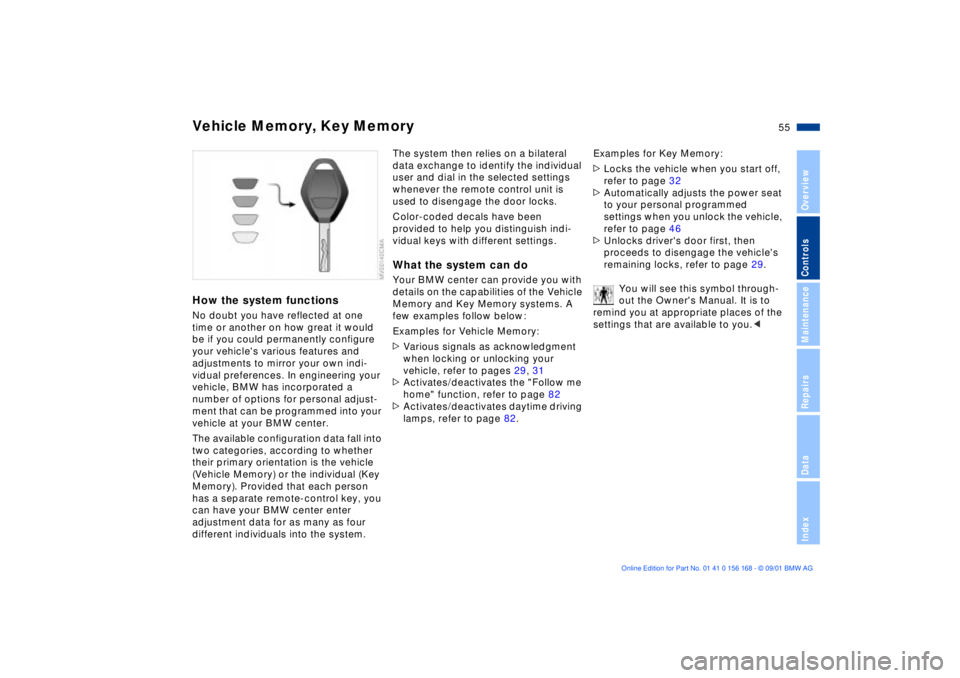
Color-coded decals have been
provided to help you distinguish indi-
vidual keys with different settings.What the system can doYour BMW center can provide you with
details on the capabilities of the Vehicle
Memory and Key Memory systems. A
few examples follow below:
Examples for Vehicle Memory:
>Various signals as acknowledgment
when locking or unlocking your
vehicle, refer to pages 29, 31
>Activates/deactivates the "Follow me
home" function, refer to page 82
>Activates/deactivates daytime driving
lamps, refer to page 82.Examples for Key Memory:
>Locks the vehicle when you start off,
refer to page 32
>Automatically adjusts the power seat
to your personal programmed
settings when you unlock the vehicle,
refer to page 46
>Unlocks driver's door first, then
proceeds to disengage the vehicle's
remaining locks, refer to page 29.
You will see this symbol through-
out the Owner's Manual. It is to
remind you at appropriate places of the
settings that are available to you.<
Page 68 of 155

68n
Check Control ClockWhen you turn the ignition key to posi-
tion 2, any of the following symbols may
appear to call your attention to problem
areas; the symbols remain in the
display panel until the problem is
corrected:
1 Check the low beam and high beam
headlamps, as well as the parking
lamps
2 Door open
3 Luggage compartment lid open
4 Check brake and tail lamps
When you open the driver's door after
completing a journey, an acoustic
warning signal will sound if you have
forgotten to turn off the headlamps.
If you wish to have a permanent time
display, you can make this adjustment
in the radio display (refer to the Radio
Owner's Manual).
You can adjust the clock and the time
display in the car radio as follows.
AdjustmentsWith ignition key in position 1or 2 and
time displayed in the instrument cluster.
To set ahead: turn the button to the
right.
To set back: turn the button to the left.
The adjustment speed will increase the
longer you continue to hold the button.
To change the display mode: press the
button briefly.
Every time you press the button, the
clock display alternates between the
12-hour or 24-hour mode.
In ignition key position 0: the time is
displayed for a few seconds after you
press the left button, refer to Odometer
on page 66.
Page 92 of 155

92n
Glove compartment Storage compartmentsTo openPull the handle. The lamp in the glove
compartment comes on.To closeFold the cover up.
To prevent injury in the event of an
accident, close the glove
compartment immediately after use.<
To lockLock with one of the master keys. A
master key will also be required to
unlock the glove compartment.
If you turn over only your door and
ignition key for valet parking, refer
to page 28, access to the glove
compartment is not possible.
The flashlight is located on the left side
of the glove compartment.
It features integral overload-protection,
so it can be left in its holder continu-
ously.
To avoid completely discharging
and possibly damaging the lamp,
always ensure that it is switched off
before inserting it in the socket.<
Front center armrest To release: press the button (arrow) and
lift upward.Additional compartments and
nets
*
You will find additional storage
compartments in the front doors and in
the center console. Storage nets are on
the front seat backrests.
Page 147 of 155
Everything from A to Z
147n
OverviewControlsMaintenanceRepairsDataIndex
C
California Proposition
65 Warning120
Capacities143
Car care, refer to the "Caring
for your vehicle" manual
Car key28
Car phone94
refer also to the separate
"Owner's Manual"
Car wash systems, refer to
the "Caring for your
vehicle" manual
Care of upholstery materials,
refer to the "Caring for your
vehicle" manual
Cargo loading99
Cassette operation, refer to
the "Radio Owner's
Manual"
CBC (Cornering Brake
Control)18, 73
CD operation, refer to the
"Radio Owner's Manual"
Cellular phone94
refer also to the separate
"Owner's Manual"94 Center (high-mount) brake
lamp128
Center armrest92
Central locking system28
button32
Changing a wheel/tire129
Check Control68
Checking coolant level117
Checking engine oil
level115
Child-restraint systems52
Clean the headlamps63
Cleaning windshield63
Clock68
refer to the "Radio Owner's
Manual"
Cockpit14
Coin box93
Compartments92
Compression ratio140
Computer69
refer also to the "Onboard
Computer Owner's
Manual"69
Configuring individual
settings via Vehicle and
Key Memory55 Consumption70
display67
Convenience operation via
the door lock
sliding/tilt sunroof31
windows31
Coolant117
add117
capacity143
checking level117
Coolant temperature
gauge67
Cooling system including
heater circuit,
capacity143
Copyright4
Cornering Brake Control
(CBC)18, 73
Correct sitting posture41
Cover, sun blinds91
Cruise control64
Cruising range70
Cup holder, refer to
beverage holder93
Curb monitor47
Curb weight142
Current check indicator17
D
Data
dimensions141
engine140
weights142
Daytime driving lamps82
DBC (Dynamic Brake
Control)73, 74
Deep water105
Defrost windows and
remove
condensation87, 89
Defroster, rear
window86, 90
Digital clock68
Dimensions141
Dipstick, engine oil115
Displacement140
Display lighting83
Displays15
Distance warning71
Divided rear-seat
backrest96
Door key28
Page 148 of 155
Everything from A to ZDoor mirror48
Doors
electrical malfunction31
locking and unlocking29
manual operation31
DOT Quality Grades108
Draft-free ventilation87, 90
Drive belt17
defect17
Driving notes105
DSC (Dynamic Stability
Control)73
indicator lamp19
Dynamic Brake Control
(DBC)73, 74
Dynamic Stability Control
(DSC)73
indicator lamp19 E
Electric power windows37
Electrical malfunction
doors31
fuel filler door22
luggage compartment
lid33
sliding/tilt sunroof40 Elements of operation14
Emergency release of
luggage compartment lid
from luggage
compartment's interior35
Energy control66
Engine compartment
essentials113
Engine coolant, refer to
Coolant117
Engine data140
Engine oil
add115
capacity143
consumption115
level19
level, check115
level, indicator lamp17
pressure17
pressure, indicator
lamp17
Engine, starting56
Engine, switching off57
Exterior mirrors48
F
Failure messages68
Filling capacities143
Fittings, tow starting and
towing135
Flat tire132
Flat Tire
Monitor80, 109, 132
warning lamp17
Flat tires107, 129
Fog lamps83
Follow me home lamps82
Front seat adjustment41
Fuel consumption70
display67
Fuel filler door22
electrical malfunction22
manual operation22
Fuel gauge67
Fuel reserve indicator
lamp67
Fuel specifications23
Fuel tank capacity143
Fuel tank gauge67
Fuel-injection system140
Fuses133
G
Gasoline gauge67
Glove compartment92
Grilles88
Gross vehicle weight142 H
Handbrake58
Hands-free system94
Hazard warning triangle22
HDC (Hill Descent
Control)77
Head restraints44
Headlamp flasher61, 83
Headlamp washer
system114
Headlight control82
Headrests44
Heated seats47
Heavy cargo99
Height141
High beams20, 61, 83
bulb replacement125
Hill Descent Control
(HDC)77
Holder for canned
beverages93
Hood112
Horn14