steering BMW 320i 2002 User Guide
[x] Cancel search | Manufacturer: BMW, Model Year: 2002, Model line: 320i, Model: BMW 320i 2002Pages: 155, PDF Size: 2.24 MB
Page 69 of 155
69n
OverviewControlsMaintenanceRepairsDataIndex
Computer
*
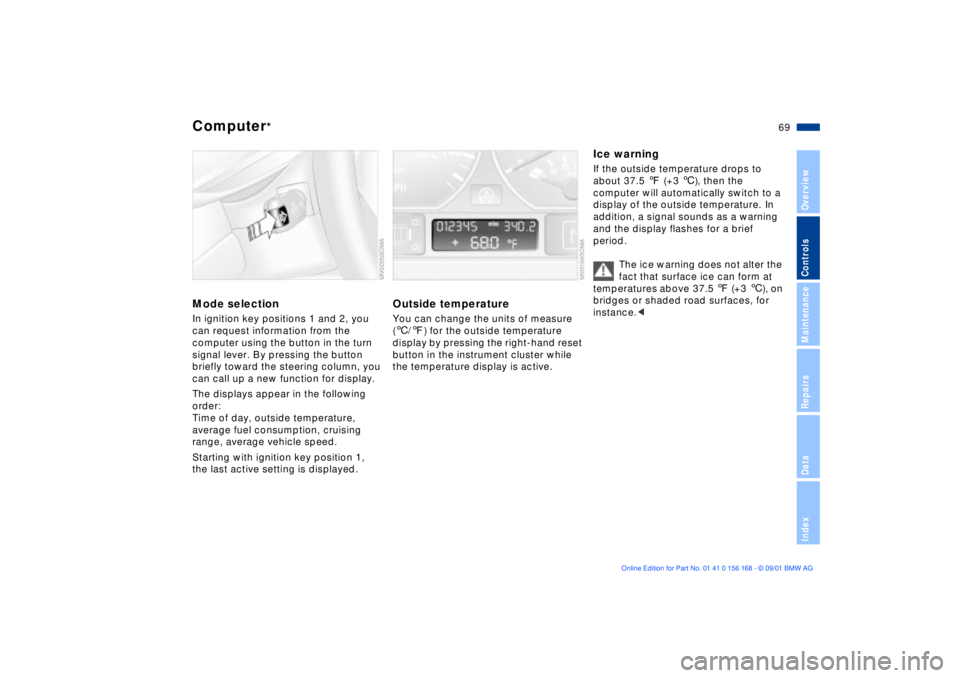
Mode selectionIn ignition key positions 1 and 2, you
can request information from the
computer using the button in the turn
signal lever. By pressing the button
briefly toward the steering column, you
can call up a new function for display.
The displays appear in the following
order:
Time of day, outside temperature,
average fuel consumption, cruising
range, average vehicle speed.
Starting with ignition key position 1,
the last active setting is displayed.
Outside temperatureYou can change the units of measure
(6/7) for the outside temperature
display by pressing the right-hand reset
button in the instrument cluster while
the temperature display is active.
Ice warningIf the outside temperature drops to
about 37.5 7 (+3 6), then the
computer will automatically switch to a
display of the outside temperature. In
addition, a signal sounds as a warning
and the display flashes for a brief
period.
The ice warning does not alter the
fact that surface ice can form at
temperatures above 37.5 7 (+3 6), on
bridges or shaded road surfaces, for
instance.<
Page 73 of 155
73n
OverviewControlsMaintenanceRepairsDataIndex
ASC+T DSC
* Ð BMW 320i, 325i, 330i
To switch ASC+T back onPress the button again; the indicator
lamp goes out.
The laws of physics cannot be
repealed, even with ASC+T. An
appropriate driving style always
remains the responsibility of the driver.
We therefore urge you to avoid using
the additional safety margin of the
system as an excuse for taking risks.<
The conceptThe Dynamic Stability Control (DSC)
maintains vehicle stability, even in crit-
ical driving situations.
The system optimizes vehicle stability
during acceleration and when starting
from a full stop, as well as optimizing
traction. In addition, it recognizes
unstable vehicle conditions, such as
under- or oversteering, and, as far as is
possible within the laws of physics,
helps keeping the vehicle on a steady
course by reducing the rpms and brake
applications to the individual wheels.
DSC is operational every time you start
the engine. DSC incorporates the func-
tionality of the Automatic Differential
Brake (ADB) and the Cornering Brake
Control (CBC).
ADB relies on selective braking applica-
tions at the drive wheels to furnish the
functionality of a conventional limited-
slip differential for enhanced traction in
critical driving conditions such as those
encountered on snow-covered road
surfaces, etc.
The ADB is operational when DSC is
switched off.
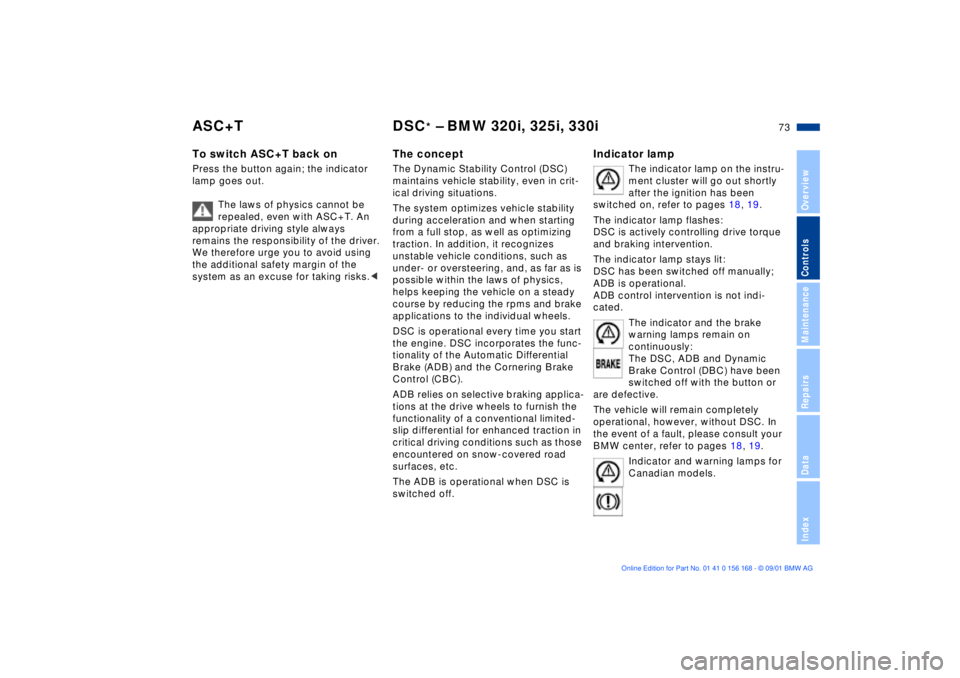
Indicator lamp
The indicator lamp on the instru-
ment cluster will go out shortly
after the ignition has been
switched on, refer to pages 18, 19.
The indicator lamp flashes:
DSC is actively controlling drive torque
and braking intervention.
The indicator lamp stays lit:
DSC has been switched off manually;
ADB is operational.
ADB control intervention is not indi-
cated.
The indicator and the brake
warning lamps remain on
continuously:
The DSC, ADB and Dynamic
Brake Control (DBC) have been
switched off with the button or
are defective.
The vehicle will remain completely
operational, however, without DSC. In
the event of a fault, please consult your
BMW center, refer to pages 18, 19.
Indicator and warning lamps for
Canadian models.
Page 75 of 155
75n
OverviewControlsMaintenanceRepairsDataIndex
DSC Ð BMW 325xi, 330xiThe conceptThe Dynamic Stability Control (DSC)
maintains vehicle stability, even in crit-
ical driving situations.
The system optimizes vehicle stability
during acceleration and when starting
from a full stop, as well as optimizing
traction. In addition, it recognizes
unstable vehicle conditions, such as
under- or oversteering, and, as far as is
possible within the laws of physics,
helps keeping the vehicle on a steady
course by reducing the rpms and brake
applications to the individual wheels.
The DSC is operational every time you
start the engine. DSC includes the
functions of ADB-X and CBC.
The Automatic Differential Brake
(ADB-X) enhances traction in critical
situations (such as those encountered
on snow-covered roads) by using
selective braking intervention to replace
the limited-slip functions executed by
the differential and transfer case in
conventional drivetrains.
Indicator lamp
The indicator lamp on the instru-
ment cluster will go out shortly
after the ignition has been
switched on, refer to pages 18, 19.
The indicator lamp flashes:
DSC is actively controlling drive torque
and braking intervention.
The indicator lamp stays lit:
DSC has been switched off manually;
ADB-X is operational.
ADB-X control intervention is not indi-
cated.
If the indicator lamp fails to go out
when you press the DSC button,
this indicates a malfunction in the DSC
and ADB-X systems; the system is
deactivated, and the stability enhance-
ment functions described on the left are
no longer available.<
The vehicle will remain completely
operational, however, without DSC. In
the event of a fault, please consult your
BMW center, refer to pages 18, 19.
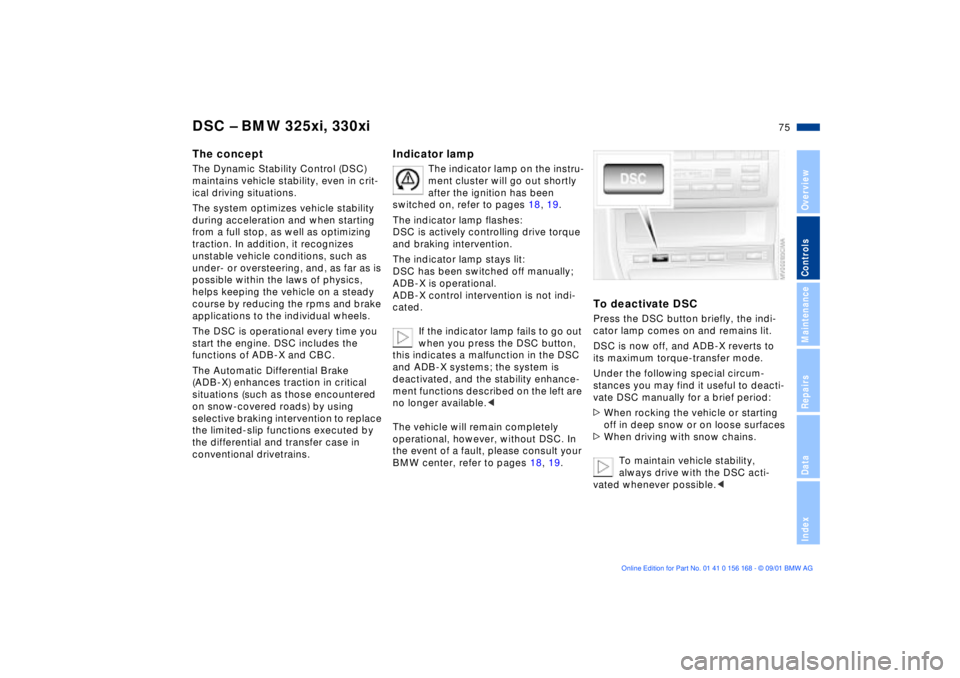
To deactivate DSCPress the DSC button briefly, the indi-
cator lamp comes on and remains lit.
DSC is now off, and ADB-X reverts to
its maximum torque-transfer mode.
Under the following special circum-
stances you may find it useful to deacti-
vate DSC manually for a brief period:
>When rocking the vehicle or starting
off in deep snow or on loose surfaces
>When driving with snow chains.
To maintain vehicle stability,
always drive with the DSC acti-
vated whenever possible.<
Page 77 of 155
77n
OverviewControlsMaintenanceRepairsDataIndex
Hill Descent Control (HDC)* Ð BMW 325xi, 330xiThe conceptBy reducing the vehicle's speed on
steep downhill stretches, HDC main-
tains predictable vehicle handling
response to provide you with even
greater control of your BMW during
extreme descents.
The vehicle slows to a pace just slightly
faster than walking speed.
HDC is available for activation at
vehicle speeds below approx. 22 mph
(35 km/h). When driving down steep
hills, the vehicle reduces speed auto-
matically down to slightly more than
double walking speed (approx. 8 mph/
12 km/h) and then maintains this speed
at a constant.
You can use the accelerator or brakes
to vary this automatically controlled
speed within a range extending from
approx. 3 mph (5 km/h) to 15 mph
(25 km/h).
In conjunction with the multifunction
steering wheel, you can use the
+/Ð button to set the cruise control to a
target speed in the range from approx.
3 mph (5 km/h) to 15 mph (25 km/h).
HDC is automatically deactivated once
vehicle speed again exceeds approx.
35 mph (60 km/h).
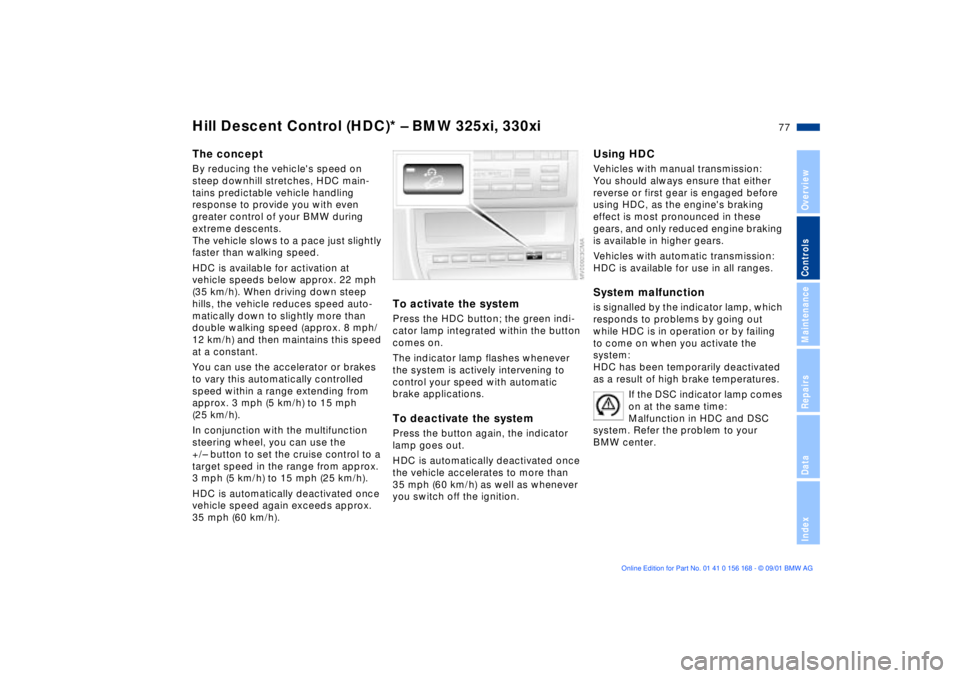
To activate the systemPress the HDC button; the green indi-
cator lamp integrated within the button
comes on.
The indicator lamp flashes whenever
the system is actively intervening to
control your speed with automatic
brake applications.To deactivate the systemPress the button again, the indicator
lamp goes out.
HDC is automatically deactivated once
the vehicle accelerates to more than
35 mph (60 km/h) as well as whenever
you switch off the ignition.
Using HDCVehicles with manual transmission:
You should always ensure that either
reverse or first gear is engaged before
using HDC, as the engine's braking
effect is most pronounced in these
gears, and only reduced engine braking
is available in higher gears.
Vehicles with automatic transmission:
HDC is available for use in all ranges.System malfunctionis signalled by the indicator lamp, which
responds to problems by going out
while HDC is in operation or by failing
to come on when you activate the
system:
HDC has been temporarily deactivated
as a result of high brake temperatures.
If the DSC indicator lamp comes
on at the same time:
Malfunction in HDC and DSC
system. Refer the problem to your
BMW center.
Page 100 of 155
100n
Cargo loading Roof-mounted luggage rack
*
Always position and secure the
load correctly. If you do not, it can
endanger the passengers during
braking or evasive maneuvers.
Do not exceed the approved gross
weight or the approved maximum axle
loads, refer to page 142, otherwise the
vehicle's operating safety is no longer
assured and you are in violation of the
law.
Do not stow heavy or hard objects in
the passenger compartment without
securing them. Otherwise they would
be thrown around during braking and
evasive maneuvers and endanger the
passengers.<
A special roof-rack system is available
as an optional extra for your BMW.
Please observe the precautions
included with the installation instruc-
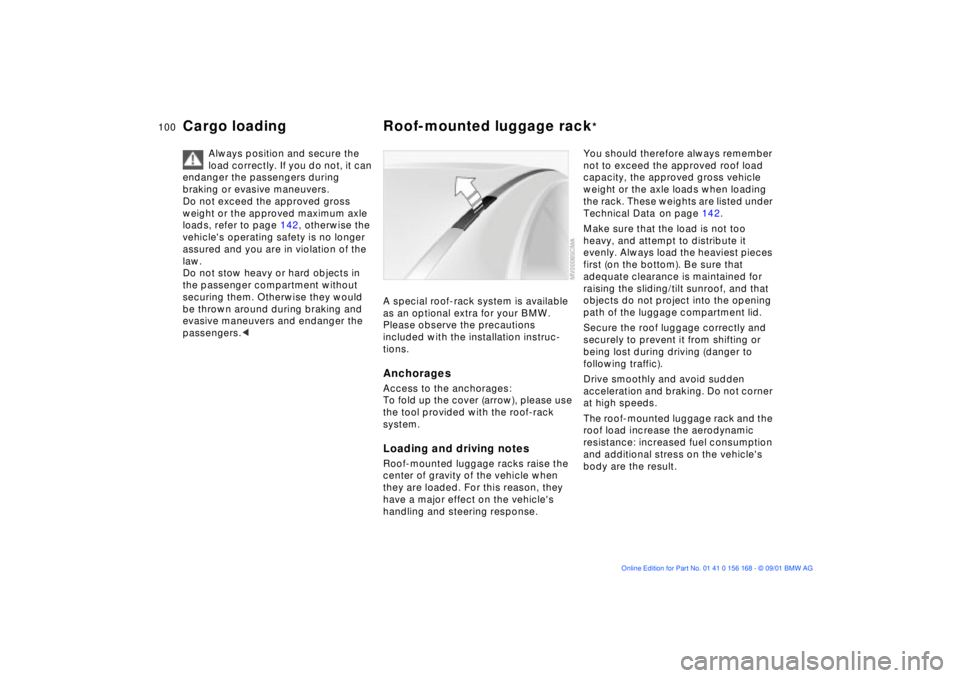
tions.AnchoragesAccess to the anchorages:
To fold up the cover (arrow), please use
the tool provided with the roof-rack
system.Loading and driving notesRoof-mounted luggage racks raise the
center of gravity of the vehicle when
they are loaded. For this reason, they
have a major effect on the vehicle's
handling and steering response.
You should therefore always remember
not to exceed the approved roof load
capacity, the approved gross vehicle
weight or the axle loads when loading
the rack. These weights are listed under
Technical Data on page 142.
Make sure that the load is not too
heavy, and attempt to distribute it
evenly. Always load the heaviest pieces
first (on the bottom). Be sure that
adequate clearance is maintained for
raising the sliding/tilt sunroof, and that
objects do not project into the opening
path of the luggage compartment lid.
Secure the roof luggage correctly and
securely to prevent it from shifting or
being lost during driving (danger to
following traffic).
Drive smoothly and avoid sudden
acceleration and braking. Do not corner
at high speeds.
The roof-mounted luggage rack and the
roof load increase the aerodynamic
resistance: increased fuel consumption
and additional stress on the vehicle's
body are the result.
Page 105 of 155

105n
OverviewControlsMaintenanceRepairsDataIndex
Driving notes Antilock Brake System
Brakes: do not drive with your foot
resting on the brake pedal. Even
light but consistent pedal pressure can
lead to high temperatures, brake wear
and possibly even brake failure.
Aquaplaning: when driving on wet or
slushy roads, reduce vehicle speed. If
you do not, a wedge of water may form
between the tires and the road surface.
This phenomenon can lead to partial or
complete loss of contact between the
tires and road surface, vehicle control
and braking ability.
Driving through water: do not drive
through water on the road if it is deeper
than 1 ft (30 cm), and then only at
walking speed. Otherwise, the vehicle's
engine, the electrical systems and the
transmission may be damaged.
Rear tray: never use it to store heavy or
hard objects, as otherwise occupants
could be injured during braking maneu-
vers.
Clothes hooks: when hanging clothing
from the hooks, be sure that they will
not obstruct the driver's vision. Do not
hang heavy objects on the hooks. If you
do so, they could cause personal injury
during braking or evasive maneuvers.<
The conceptThe Antilock Brake System (ABS) keeps
the wheels from locking during braking,
thereby enhancing active driving safety.Braking with ABSIf you are in a situation that requires full
braking, you will exploit the full benefits
of the ABS system if you apply
maximum pedal pressure ("panic stop").
Since the vehicle maintains steering
responsiveness, you can avoid possible
obstacles with a minimum of steering
effort, despite the full brake application.
Pulsation at the brake pedal combined
with sounds from the hydraulic circuits
indicates to the driver that ABS is in its
active mode.
Page 106 of 155

106n
Brake systemBrake fluid level If the brake fluid level is too low and
brake pedal travel has become longer,
there may be a defect in one of the
brake system's hydraulic circuits.
Proceed to the nearest BMW
center. It may be necessary to
apply higher levels of pressure to the
pedal when stopping and braking
distances may also be longer. Please
remember to adapt your driving style
accordingly.
and operating conditions in which
braking is restricted to gentle, low-
pressure applications will all increase
the tendency for corrosion to form on
the rotors; this is often accompanied by
a simultaneous accumulation of
contamination on the brake pads. The
pads must exert a certain minimal level
of pressure against the rotors for the
disc brakes' inherent self-cleaning
effect to remain effective; the pressure
available under the above conditions
may not provide adequate cleansing.
If the brake rotors are corroded, they
will tend to respond to braking with a
pulsating effect that even extended
brake applications will fail to cure.
When driving in heavy rain and on wet
roads it is a good idea to apply light
pressure to the brake pedal every few
miles. Monitor traffic conditions to
ensure that this maneuver does not
pose a hazard to you or to other road
users. The heat generated in this
process helps dry the pads and rotors
to ensure that your brake system will
respond with undiminished efficiency
when you need it.
When descending steep hills and
extended grades, downshift to a gear
that will allow you to continue safely
with only a minimal amount of braking.
By minimizing the loads placed on the
brake system, this strategy helps
ensure that optimal brake system
response will remain available at all
times. Use care to avoid exceeding the
approved engine-speed range, refer to
page 66.Do not coast with the clutch
depressed or with the transmis-
sion in neutral. Do not coast with the
engine shut off. The engine provides no
braking effect when the clutch is
depressed and there is no power-assist
for braking or steering when the engine
is not running.
BMW 325xi, 330xi: always refer all
brake inspection and service work to
your BMW center, as failure to observe
the special procedures could result in
damage to brake system components.
Never allow floor mats, carpets or any
other objects to protrude into the area
around the accelerator, clutch and
brake pedals and obstruct their move-
ment.<
Brake pads
For your own safety: use only
brake pads that the manufacturer
has released for your particular vehicle
model. The manufacturer cannot eval-
uate non-approved brake pads to
determine if they are suited for use, and
therefore cannot ensure the operating
safety of the vehicle if they are
installed.<
Page 107 of 155

107n
OverviewControlsMaintenanceRepairsDataIndex
Information for your safetyThe factory-approved radial tires are
matched to the vehicle and have been
selected to provide optimum safety and
driving comfort.
It is not merely the tire's service life, but
also driving comfort and Ð above all else
Ð driving safety that depend on the
condition of the tires and the mainte-
nance of the specified tire pressure.
Incorrect tire inflation pressure is
a frequent cause of tire damage.
Tire pressure also has a major effect on
your BMW's handling response. Be
sure to check the tire inflation pressure,
including the space-saver spare tire or
the spare tire, on a regular basis, at
least twice a month and before every
extended journey, refer to page 24.
Otherwise, incorrect tire pressure can
lead to poor handling, to tire damage
and accidents.<
Tire tread Ð tire damageInspect your tires frequently for tread
wear, signs of damage and for foreign
objects lodged in the tread. Check the
tread depth.
Tread depth should not be allowed to go
below 0.12 in (3 mm), even though the
legally specified minimum tread depth is
0.063 in (1.6 mm). Tread wear indicators
(arrow) are embedded in the base of the
tire's tread. Their locations are indicated
by the legend TWI Ð Tread Wear Indicator
Ð at various points on the tire's shoulder.
When the tread reaches a depth of
0.063 in (1.6 mm), these indicators
appear to signal that the tires have worn
to the minimum legal level. Below 0.12 in
(3 mm) tread depth, there is an increased
risk of aquaplaning, even at relatively
moderate speeds and with only small
amounts of water on the road.
Do not drive on a deflated (flat)
tire. A flat tire greatly impairs
steering and braking response, and can
lead to complete loss of control over
the vehicle.
Avoid overloading the vehicle so that
the permitted load on the tires is not
exceeded. Overloading leads to over-
heating and causes damage inside the
tires. The ultimate result can assume
the form of a sudden air loss.
Unusual vibrations encountered during
normal vehicle operation can indicate a
flat tire or some other vehicle malfunc-
tion. The type of problem can be
caused by contact with curbs, etc. This
is also true for irregularities in the
vehicle's handling characteristics, such
as a pronounced tendency to pull to the
left or right. Should this occur, respond
by immediately reducing your speed.
Proceed carefully to the nearest BMW
center or professional tire center, or
have the vehicle towed in to have it, its
wheels and tires inspected.
Tire inflation pressures
Tire condition
Page 111 of 155

111n
OverviewControlsMaintenanceRepairsDataIndex
Winter tiresChoosing the right tireBMW recommends winter tires (M+S
radial tires) for operation under
inclement winter driving conditions.
While all-season tires (M+S designa-
tion) provide better winter traction than
summer tires with the load ratings H, V,
W, Y and ZR, they generally do not
achieve the performance of winter tires.
In the interest of safe tracking and
steering response, install winter tires
made by the same manufacturer having
the same tread configuration on all four
wheels.
Never exceed the maximum
speed for which the winter tires
are rated.
Unprofessional attempts by laymen to
service tires can lead to damage and
accidents.
Have this work performed by trained
professionals only. Any BMW center
has the required technical knowledge
and the proper equipment and will be
happy to assist you.<
Tire condition, tire pressureOnce the tire wears to below 0.16 in
(4 mm), winter tires display a percep-
tible decrease in their ability to cope
with winter driving conditions, and
should be replaced in the interest of
safety.
Comply with the specified tire inflation
pressures Ñ and be sure to have the
wheel and tire assemblies balanced
every time you change the tires.StorageStore tires in a cool, dry place,
protecting them against light whenever
possible. Protect the tires against
contact with oil, grease and fuel.
Snow chains
*
BMW narrow-link snow chains are
intended for mounting on summer or
winter tires in pairs at the rear wheels
only.
BMW 325xi, 330xi: in an extreme emer-
gency Ð for instance, with the vehicle
stuck on one side, or when obstruc-
tions make it impossible to reach one
tire Ð a chain may also be mounted on
just one tire for the limited period
needed to resolve the problem.
Comply with all manufacturer's safety
precautions when mounting the chains.
You cannot mount snow chains on the
following tires:
225/50 R 16 92
225/45 R 17 91
245/40 ZR 17
Page 115 of 155
115n
OverviewControlsMaintenanceRepairsDataIndex
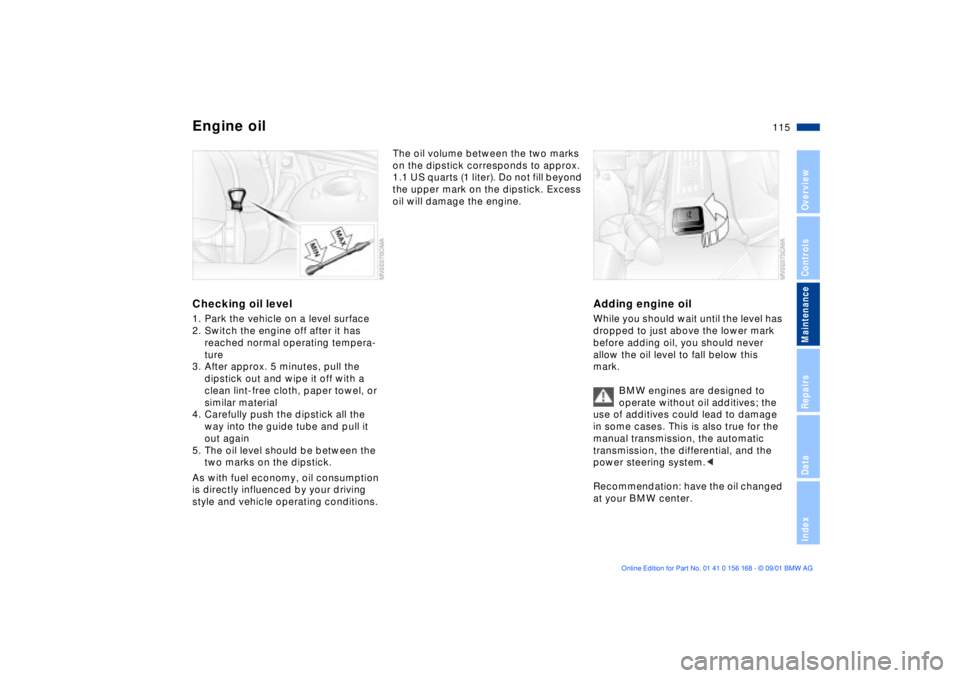
Engine oilChecking oil level1. Park the vehicle on a level surface
2. Switch the engine off after it has
reached normal operating tempera-
ture
3. After approx. 5 minutes, pull the
dipstick out and wipe it off with a
clean lint-free cloth, paper towel, or
similar material
4. Carefully push the dipstick all the
way into the guide tube and pull it
out again
5. The oil level should be between the
two marks on the dipstick.
As with fuel economy, oil consumption
is directly influenced by your driving
style and vehicle operating conditions.
The oil volume between the two marks
on the dipstick corresponds to approx.
1.1 US quarts (1 liter). Do not fill beyond
the upper mark on the dipstick. Excess
oil will damage the engine.
Adding engine oilWhile you should wait until the level has
dropped to just above the lower mark
before adding oil, you should never
allow the oil level to fall below this
mark.
BMW engines are designed to
operate without oil additives; the
use of additives could lead to damage
in some cases. This is also true for the
manual transmission, the automatic
transmission, the differential, and the
power steering system.<
Recommendation: have the oil changed
at your BMW center.