tires BMW 320i 2004 User Guide
[x] Cancel search | Manufacturer: BMW, Model Year: 2004, Model line: 320i, Model: BMW 320i 2004Pages: 182, PDF Size: 2.76 MB
Page 124 of 182
124Wheels and tires
Tire inflation pressureInformation for your safetyThe factory-approved tires are matched
to your vehicle and have been selected
to provide optimum safety and driving
comfort when used properly.
It is not merely the tire's service life, but
also driving comfort and – above all else
– driving safety that depend on the con-
dition of the tires and the maintenance
of the specified tire inflation pressure.
Incorrect tire inflation pressure is a fre-
quent cause of tire damage. Tire pres-
sure also has a major effect on your
BMW's handling response.
Be sure to check the tire inflation
pressure, including the space-
saver spare tire or the spare tire, on a
regular basis, at least twice a month
and before every extended journey,
refer to page 25. If this is not done,
incorrect tire pressures can cause driv-
ing instability and tire damage, ulti-
mately resulting in accidents.<
Tire conditionTire tread – tire damageInspect your tires frequently for tread
wear, signs of damage and for foreign
objects lodged in the tread. Check the
tread depth.
Tread depth should not be allowed to
go below 1/8 in / 3 mm, even though
the legally specified minimum tread
depth is 1/16 in / 1.6 mm.
Below 1/8 in / 3 mm tread depth, there
is a great risk of hydroplaning, even at
relatively moderate speeds and with
only small amounts of water on the
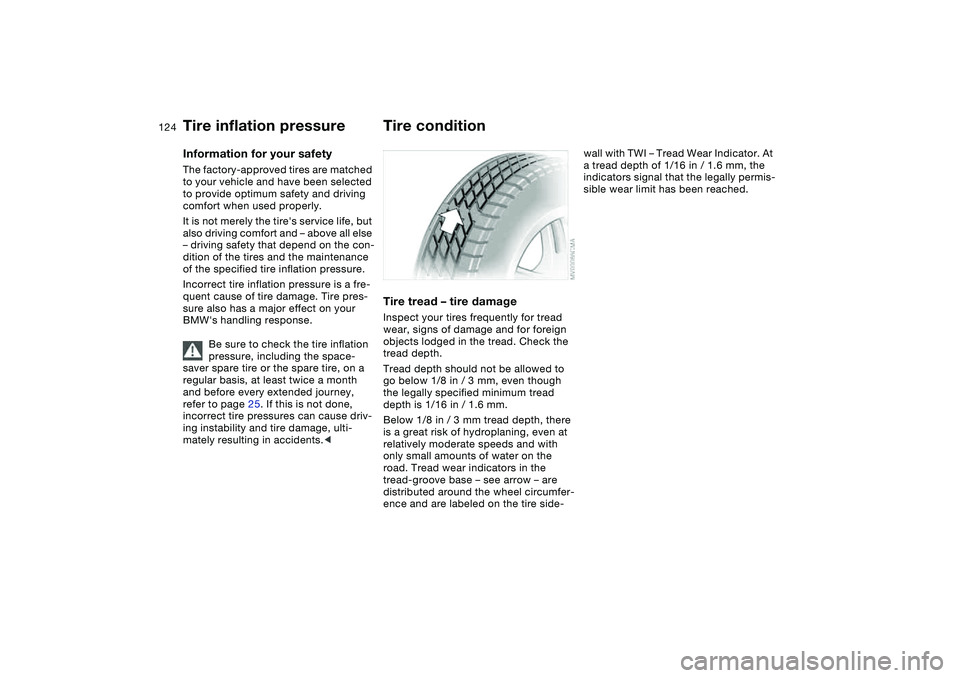
road. Tread wear indicators in the
tread-groove base – see arrow – are
distributed around the wheel circumfer-
ence and are labeled on the tire side-
wall with TWI – Tread Wear Indicator. At
a tread depth of 1/16 in / 1.6 mm, the
indicators signal that the legally permis-
sible wear limit has been reached.
Page 125 of 182
125
Do not drive on a flat tire unless
your vehicle is equipped with Run
Flat tires. A flat tire greatly impairs
steering and braking response, and can
lead to complete loss of control over
the vehicle. Avoid overloading the vehi-
cle so that the permitted load on the
tires is not exceeded. Overloading can
lead to overheating and internal tire
damage.
The ultimate result can assume the
form of a sudden air loss.
Unusual vibrations encountered during
normal vehicle operation can indicate a
flat tire or some other vehicle malfunc-
tion. This type of problem can be
caused by contact with curbs, etc. This
is also true for abnormalities in the vehi-
cle's handling characteristics, such as a
pronounced tendency to pull to the left
or right. Should this occur, respond by
immediately reducing your speed. Pro-
ceed carefully to the nearest BMW cen-
ter or professional tire center, or have
the vehicle towed in to have it, its
wheels or its tires inspected.
Tire damage up to and including sud-
den and complete air loss can endan-
ger the lives of both the vehicle occu-
pants and other road users.<
Tire replacementTo maintain good handling and vehicle
response, use only tires of a single
tread configuration from a single manu-
facturer.
Comply with the specified tire inflation
pressures — and be sure to have the
wheel and tire assembly balanced
every time you change a tire or wheel.DOT quality gradesTread wear
Traction AA A B C
Temperature A B C
All passenger car tires must con-
form to Federal Safety Require-
ments in addition to these grades.
when tested under controlled condi-
tions on a specified government test
course.
For example, a tire graded 150 would
wear one and one-half – 1
1/2 – times as
well on the government course as a tire
graded 100. The relative performance
of tires depends upon the actual condi-
tions of their use, however, and may
depart significantly from the norm due
to variations in driving habits, service
practices and differences in road char-
acteristics and climate.TractionThe traction grades, from highest to
lowest, are AA, A, B, and C.
Those grades represent the tire's ability
to stop on wet pavement as measured
under controlled conditions on speci-
fied government test surfaces of
asphalt and concrete. A tire marked C
may have poor traction.
The traction grade assigned to
this tire is based on straight-
ahead braking traction tests, and does
not include acceleration, cornering,
hydroplaning, or peak traction charac-
teristics.
tire's resistance to the generation of
heat and its ability to dissipate heat
when tested under controlled condi-
tions on a specified indoor laboratory
test wheel.
Tire condition
OverviewControlsMaintenanceRepairsDataIndex
Page 126 of 182
126
Sustained high temperature can cause
the material of the tire to degenerate
and reduce tire life, and excessive tem-
perature can lead to sudden tire failure.
The grade C corresponds to a level of
performance which all passenger car
tires must meet under the Federal
Motor Vehicle Safety Standard No. 109.
Grades B and A represent higher levels
of performance on the laboratory test
wheel than the minimum required by
law.
The temperature grade for this tire
is established for a tire that is
properly inflated and not overloaded.
Excessive speed, underinflation, or
excessive loading, either separately or
in combination, can cause heat buildup
and possible tire failure.
tread shoulder and maximum section
width. For example:
Tread wear 200
Traction AA
Temperature A
BMW advises against using
retreaded tires, since driving
safety may be impaired. This is due to
the possible variations in casing struc-
tures and, in some cases, to their
extreme age, which can lead to a
decrease in their durability.<
Tire ageThe date on which the tire was manu-
factured is indicated by the code on the
sidewall:
DOT... 3603 indicates that the tire was
manufactured in week 36 of the year
2003.
BMW recommends the replacement of
all tires – including the spare tire* –
when the tires are no more than 6 years
old, even if a tire life of 10 years is pos-
sible.Run Flat tires*Before purchasing tires, check if your
BMW is equipped with Run Flat tires.
These are indicated by a circular sym-
bol containing the letters RSC on the
tire sidewall, refer to Changing a wheel.
In this case, use only Run Flat tires,
since no spare wheel is available in the
event of a flat.
For more information on Run Flat tires,
refer to page 150.
Run Flat tires are available only in
combination with the Flat Tire
Monitor.<
Tire replacement
Page 127 of 182
127
Wheel and tire combinationsThe right choice
BMW recommends using only
wheels and tires that have been
approved by BMW for use on your par-
ticular model. Although other wheels
and tires may theoretically have the
same dimensions, variations in factors
such as manufacturing tolerances can
result in contact between tire and body-
work, ultimately leading to serious acci-
dents. BMW cannot evaluate all tires
and wheels on the market, and is thus
unable to guarantee that the vehicle will
continue to perform safely if unap-
proved tires and/or wheels are
mounted.<
For each tire size, BMW has assessed
the safe performance of specific tire
brands and approved them for use.
Consult any BMW center for details.
Comply with any local/national regula-
tions, for example by recording the tire
type in the vehicle documents.
The correct wheel and tire combi-
nation affects various systems
that would otherwise be impaired, for
example ABS, DSC and ADB-X/DBC.
For this reason, use only tires of the
same manufacture and tread configura-
tion. In the event of a flat tire, for exam-
ple, remount the approved wheel and
tire combination as soon as possible.<
StorageAlways store tires in a cool, dry place.
Store them away from light whenever
possible. Protect the tires against con-
tact with oil, grease and fuel.
Do not exceed the maximum tire infla-
tion pressures specified on the tire
sidewall.
Winter tiresChoosing the right tireBMW recommends the use of winter
tires for operation under winter road
conditions. While all-season tires – with
M+S designation – provide better winter
traction than the corresponding sum-
mer tires, they generally do not achieve
the performance of winter tires.
In the interest of safe tracking and
steering response, install winter tires
made by the same manufacturer and
having the same tread configuration on
all four wheels.
Never exceed the maximum
speed for which the winter tires
are rated.
Unprofessional attempts by laymen to
service tires can lead to damage and
accidents.
Have this work performed by trained
professionals only. Any BMW center
has the required technical knowledge
and the proper equipment and will be
happy to assist you.
tires. These are indicated by a circular
symbol containing the letters RSC on
OverviewControlsMaintenanceRepairsDataIndex
Page 128 of 182
128
the tire sidewall, refer to Changing a
wheel. In this case, use only Run Flat
winter tires, since no spare tire is pro-
vided in the event of a flat tire.Tire condition, tire pressureAt tread depths below approx. 3/16 in /
4 mm, winter tires display a perceptible
decrease in their ability to cope with
winter driving conditions, and should be
replaced in the interest of safety.
Comply with the specified tire inflation
pressures — and be sure to have the
wheel and tire assembly balanced
every time you change a tire or wheel.Snow chains*Only certain snow chains have been
tested by BMW and determined and
approved as roadworthy. Consult any
BMW center for details. BMW recom-
mends using only these approved fine-
link snow chains. Use them in pairs on
either summer or winter tires, but only
on both rear wheels.325xi, 330xi: only in an emergency – for
instance, with the vehicle stuck on one
side, or when obstructions make it
impossible to reach one tire – a chain
may also be mounted on just one tire
for the limited period needed to resolve
the problem.
Comply with all manufacturer's safety
precautions when mounting the chains.
Do not exceed a speed of 30 mph /
50 km/h when using snow chains.
You cannot mount snow chains on the
following tires:
225/50 R 16
225/45 R 17
225/40 R 18
245/40 R 17
255/35 R 18
Do not initialize the Flat Tire Moni-
tor after mounting snow chains to
the tires.
When driving with snow chains, it may
be useful to turn off the DSC for a short
time, refer to page 88 or 89.
Page 150 of 182
150
Do not attempt to install the full
wheel cover on the space-saver
spare tire, since this could damage the
cover.<
The vehicle jack is designed for
changing wheels only. Do not
attempt to raise another vehicle model
with it or to raise any other type of load.
To do so could cause accidents and
personal injury.
To ensure continued safety, have the
tightness of the torque bolts checked
with a calibrated lug wrench – torque
specification: 88.5 lb ft/120 Nm – at the
earliest opportunity.<
When storing a wheel in the spare tire
recess, take care to avoid bending the
threaded rod.
If light-alloy wheels other than original
BMW light-alloy wheels have been
mounted, it may be necessary to use
different lug bolts for those wheels.
Replace the defective tire as soon as
possible and have the new wheel/tire
balanced.
Driving with the space-saver
spare tireDrive cautiously. Do not exceed a
speed of 50 mph / 80 km/h.
Be aware that vehicle handling may be
altered. Anticipate, e.g., reduced track-
ing during braking, longer braking dis-
tances, and changed steering charac-
teristics when approaching limit
conditions. These handling characteris-
tics will be even more pronounced if
winter tires are mounted.
Only one space-saver spare tire
may be mounted at one time.
Mount a wheel and tire of the original
size at the earliest possible opportu-
nity.
tions, the size of the spare tire will
differ from that of the remaining tires.
The spare tire is fully functional at all
loads and speeds. However, the spare
tire should be replaced at the earliest
possible opportunity in order to achieve
the original operating conditions.<
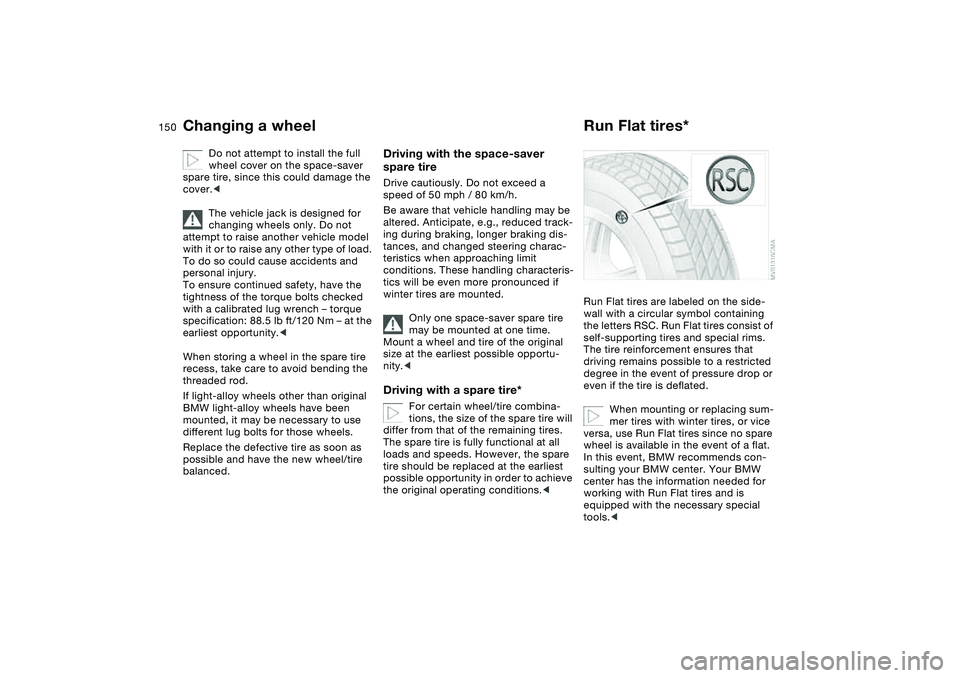
Run Flat tires*Run Flat tires are labeled on the side-
wall with a circular symbol containing
the letters RSC. Run Flat tires consist of
self-supporting tires and special rims.
The tire reinforcement ensures that
driving remains possible to a restricted
degree in the event of pressure drop or
even if the tire is deflated.
When mounting or replacing sum-
mer tires with winter tires, or vice
versa, use Run Flat tires since no spare
wheel is available in the event of a flat.
In this event, BMW recommends con-
sulting your BMW center. Your BMW
center has the information needed for
working with Run Flat tires and is
equipped with the necessary special
tools.<
Changing a wheel
Page 151 of 182
151
Driving with a damaged tireDepending on the cargo load, Run Flat
tires allow you to continue driving at a
maximum speed of 50 mph / 80 km/h. If
there is a total loss of tire inflation pres-
sure, 0 psi/0 kPa, or obvious tire dam-
age, you can determine the distance
you may continue driving based on the
following values:
>With a light load:
1 to 2 persons without luggage:
approx. 150 miles/250 km
>With a medium load:
2 persons, luggage compartment full;
or 5 persons without luggage:
approx. 100 miles/150 km
>With a full load:
5 persons, luggage compartment full:
approx. 30 miles/50 km.
Drive cautiously. Do not exceed a
speed of 50 mph / 80 km/h. Be
aware that vehicle handling will be
altered when there is a loss in inflation
pressure. Anticipate, e.g., reduced
tracking during braking, longer braking
distances and changed steering char-
acteristics.
For safety reasons, BMW recommends
not having damaged Run Flat tires
repaired. In this case, consult your
BMW center.<
BatteryMaintenanceThe battery is maintenance-free, that is,
the original electrolyte will normally last
for the service life of the battery under
moderate climatic conditions.
Please consult your BMW center
whenever you have any questions
concerning the battery.
Connect the charge cables to the termi-
nals in the engine compartment. For
terminal locations, refer to Jump-start-
ing on page 153.Disposal
Return used batteries to a recy-
cling point or your BMW center.
Maintain the battery in an upright posi-
tion for transport and storage. Secure
the battery against tilting during trans-
port.<
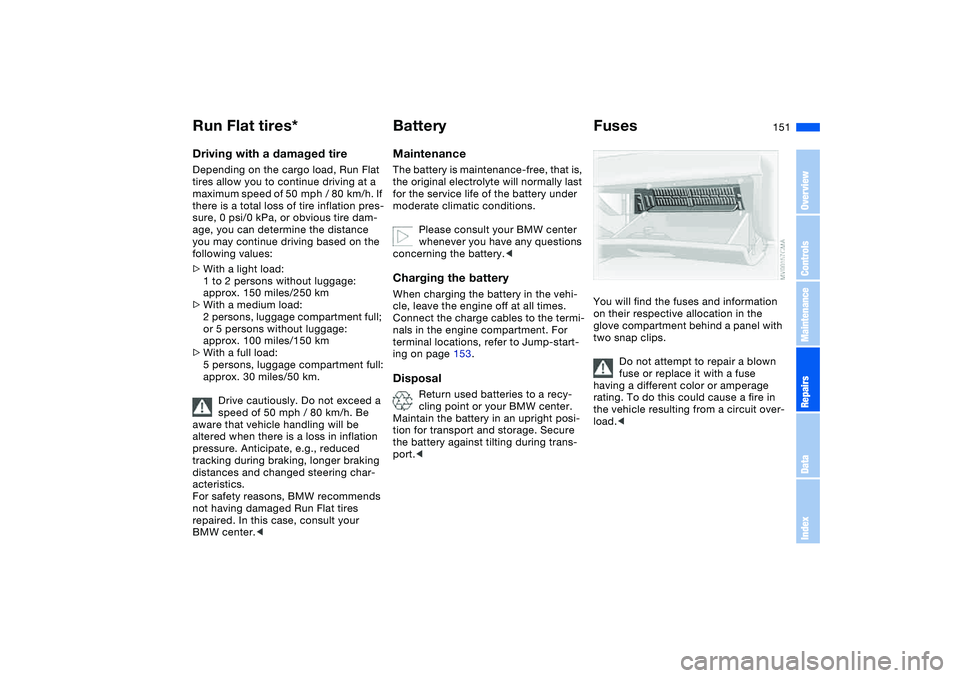
FusesYou will find the fuses and information
on their respective allocation in the
glove compartment behind a panel with
two snap clips.
Do not attempt to repair a blown
fuse or replace it with a fuse
having a different color or amperage
rating. To do this could cause a fire in
the vehicle resulting from a circuit over-
load.<
Run Flat tires*
OverviewControlsMaintenanceRepairsDataIndex
Page 166 of 182
Everything from A to ZA
ABS Antilock Brake
System 121
indicator lamp 18
Acceleration assistant 72
Accessories, refer to For
your own safety 5
Accident, refer to Emer-
gency call 152
Activated-charcoal filter 106
ADB-X Automatic Differen-
tial Brake, all-wheel 89
Adding brake fluid 134
Additional sources of infor-
mation 4
Air conditioning 98
Air conditioning mode 100
automatic climate
control 104
Air distribution
air conditioning 100
automatic climate
control 104
Air distribution,
individual 104
Air outlets, refer to Ventila-
tion 98, 102
Air pressure, refer to Tire
inflation pressure 25, 124
Air recirculation, refer to
Recirculated-air mode
100, 105Air supply
air conditioning 100
automatic climate
control 104
Air, drying, refer to Air con-
ditioning mode 100, 104
Airbags 57
indicator lamp 18, 59
sitting safely 47
Airing out, refer to Ventila-
tion 98, 102
Alarm system 41
avoiding unintentional
alarms 42
All-season tires, refer to
Winter tires 127
Antifreeze 134
coolant 134
washer fluid 132
Antilock Brake System
(ABS) 121
indicator lamp 18
Anti-theft system 32
Anti-theft warning system,
refer to Alarm system 41
Approved axle loads, refer
to Weights 162
Approved gross weight,
refer to Weights 162
Armrest
front 108
rear 109Artificial leather, refer to the
Caring for your vehicle
brochure
Ashtray
front 110
rear 111
Assistant systems, refer to
Dynamic Stability Control
(DSC) 87
AUC Automatic recircu-
lated-air control 105
AUTO program, refer
to Automatic air distribu-
tion 104
Automatic
air distribution 104
air supply 104
cruise control 78
headlamp control 94
Automatic car wash, refer to
the Caring for your vehicle
brochure
Automatic climate
control 102
Automatic curb monitor 54
Automatic Differential Brake,
all-wheel ADB-X 89
Automatic dimming, interior
rearview mirror 56
Automatic recirculated-air
control (AUC) 105Automatic transmission with
Steptronic 73
indicator lamp 19, 75
interlock 65
selector lever lock 73
shiftlock 73
Automatic windshield
washer, refer to Rain sen-
sor 77
Average fuel
consumption 85
Average speed 85
Avoiding unintentional
alarms 42
Axle loads, refer to
Weights 162
B
Backrest, adjusting 49
Backrest, refer to Seat
adjustment 48, 50
Backup lamps 68
bulb replacement 145
Bandages, refer to First-aid
kit 23
Battery 151
charge 151
disposal 151
indicator lamp 18
jump-starting 153
remote control 32, 33
Battery charge current 18
Page 168 of 182
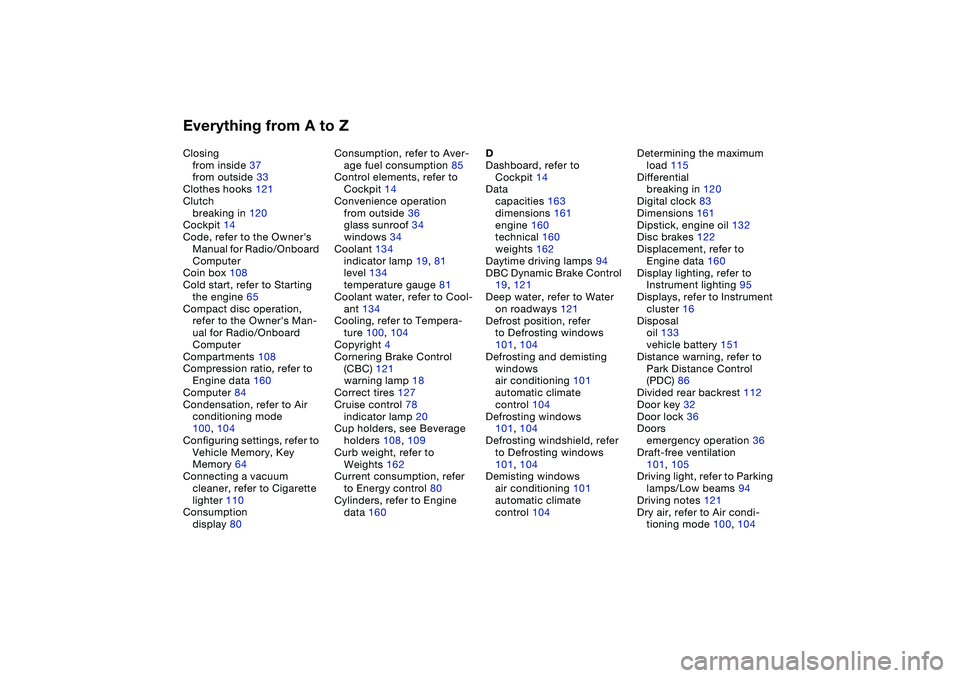
Everything from A to ZClosing
from inside 37
from outside 33
Clothes hooks 121
Clutch
breaking in 120
Cockpit 14
Code, refer to the Owner's
Manual for Radio/Onboard
Computer
Coin box 108
Cold start, refer to Starting
the engine 65
Compact disc operation,
refer to the Owner's Man-
ual for Radio/Onboard
Computer
Compartments 108
Compression ratio, refer to
Engine data 160
Computer 84
Condensation, refer to Air
conditioning mode
100, 104
Configuring settings, refer to
Vehicle Memory, Key
Memory 64
Connecting a vacuum
cleaner, refer to Cigarette
lighter 110
Consumption
display 80Consumption, refer to Aver-
age fuel consumption 85
Control elements, refer to
Cockpit 14
Convenience operation
from outside 36
glass sunroof 34
windows 34
Coolant 134
indicator lamp 19, 81
level 134
temperature gauge 81
Coolant water, refer to Cool-
ant 134
Cooling, refer to Tempera-
ture 100, 104
Copyright 4
Cornering Brake Control
(CBC) 121
warning lamp 18
Correct tires 127
Cruise control 78
indicator lamp 20
Cup holders, see Beverage
holders 108, 109
Curb weight, refer to
Weights 162
Current consumption, refer
to Energy control 80
Cylinders, refer to Engine
data 160D
Dashboard, refer to
Cockpit 14
Data
capacities 163
dimensions 161
engine 160
technical 160
weights 162
Daytime driving lamps 94
DBC Dynamic Brake Control
19, 121
Deep water, refer to Water
on roadways 121
Defrost position, refer
to Defrosting windows
101, 104
Defrosting and demisting
windows
air conditioning 101
automatic climate
control 104
Defrosting windows
101, 104
Defrosting windshield, refer
to Defrosting windows
101, 104
Demisting windows
air conditioning 101
automatic climate
control 104Determining the maximum
load 115
Differential
breaking in 120
Digital clock 83
Dimensions 161
Dipstick, engine oil 132
Disc brakes 122
Displacement, refer to
Engine data 160
Display lighting, refer to
Instrument lighting 95
Displays, refer to Instrument
cluster 16
Disposal
oil 133
vehicle battery 151
Distance warning, refer to
Park Distance Control
(PDC) 86
Divided rear backrest 112
Door key 32
Door lock 36
Doors
emergency operation 36
Draft-free ventilation
101, 105
Driving light, refer to Parking
lamps/Low beams 94
Driving notes 121
Dry air, refer to Air condi-
tioning mode 100, 104
Page 171 of 182
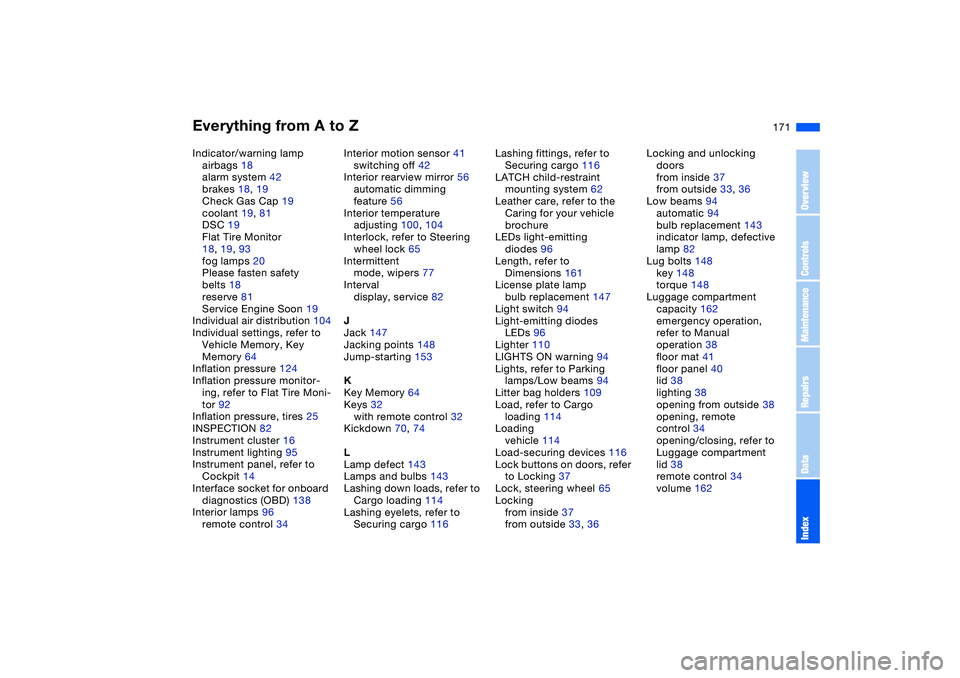
Everything from A to Z
171
Indicator/warning lamp
airbags 18
alarm system 42
brakes 18, 19
Check Gas Cap 19
coolant 19, 81
DSC 19
Flat Tire Monitor
18, 19, 93
fog lamps 20
Please fasten safety
belts 18
reserve 81
Service Engine Soon 19
Individual air distribution 104
Individual settings, refer to
Vehicle Memory, Key
Memory 64
Inflation pressure 124
Inflation pressure monitor-
ing, refer to Flat Tire Moni-
tor 92
Inflation pressure, tires 25
INSPECTION 82
Instrument cluster 16
Instrument lighting 95
Instrument panel, refer to
Cockpit 14
Interface socket for onboard
diagnostics (OBD) 138
Interior lamps 96
remote control 34Interior motion sensor 41
switching off 42
Interior rearview mirror 56
automatic dimming
feature 56
Interior temperature
adjusting 100, 104
Interlock, refer to Steering
wheel lock 65
Intermittent
mode, wipers 77
Interval
display, service 82
J
Jack 147
Jacking points 148
Jump-starting 153
K
Key Memory 64
Keys 32
with remote control 32
Kickdown 70, 74
L
Lamp defect 143
Lamps and bulbs 143
Lashing down loads, refer to
Cargo loading 114
Lashing eyelets, refer to
Securing cargo 116Lashing fittings, refer to
Securing cargo 116
LATCH child-restraint
mounting system 62
Leather care, refer to the
Caring for your vehicle
brochure
LEDs light-emitting
diodes 96
Length, refer to
Dimensions 161
License plate lamp
bulb replacement 147
Light switch 94
Light-emitting diodes
LEDs 96
Lighter 110
LIGHTS ON warning 94
Lights, refer to Parking
lamps/Low beams 94
Litter bag holders 109
Load, refer to Cargo
loading 114
Loading
vehicle 114
Load-securing devices 116
Lock buttons on doors, refer
to Locking 37
Lock, steering wheel 65
Locking
from inside 37
from outside 33, 36Locking and unlocking
doors
from inside 37
from outside 33, 36
Low beams 94
automatic 94
bulb replacement 143
indicator lamp, defective
lamp 82
Lug bolts 148
key 148
torque 148
Luggage compartment
capacity 162
emergency operation,
refer to Manual
operation 38
floor mat 41
floor panel 40
lid 38
lighting 38
opening from outside 38
opening, remote
control 34
opening/closing, refer to
Luggage compartment
lid 38
remote control 34
volume 162
OverviewControlsMaintenanceRepairsDataIndex