Fuel BMW 320i SEDAN 2002 E46 User Guide
[x] Cancel search | Manufacturer: BMW, Model Year: 2002, Model line: 320i SEDAN, Model: BMW 320i SEDAN 2002 E46Pages: 155, PDF Size: 2.24 MB
Page 67 of 155
67n
OverviewControlsMaintenanceRepairsDataIndex
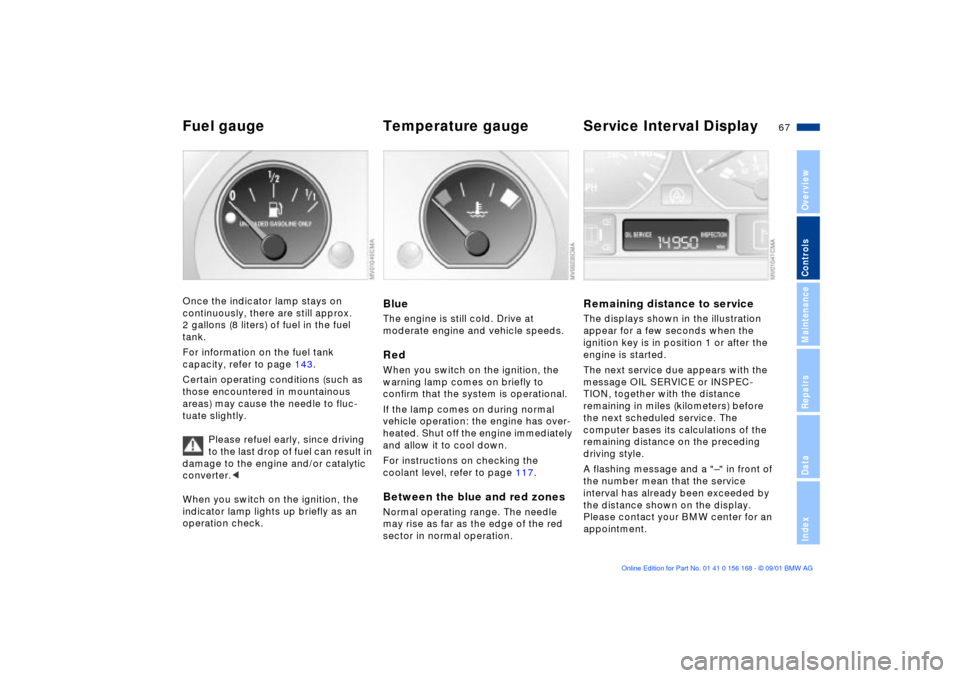
Fuel gauge Temperature gauge Service Interval DisplayOnce the indicator lamp stays on
continuously, there are still approx.
2 gallons (8 liters) of fuel in the fuel
tank.
For information on the fuel tank
capacity, refer to page 143.
Certain operating conditions (such as
those encountered in mountainous
areas) may cause the needle to fluc-
tuate slightly.
Please refuel early, since driving
to the last drop of fuel can result in
damage to the engine and/or catalytic
converter.<
When you switch on the ignition, the
indicator lamp lights up briefly as an
operation check.
BlueThe engine is still cold. Drive at
moderate engine and vehicle speeds.RedWhen you switch on the ignition, the
warning lamp comes on briefly to
confirm that the system is operational.
If the lamp comes on during normal
vehicle operation: the engine has over-
heated. Shut off the engine immediately
and allow it to cool down.
For instructions on checking the
coolant level, refer to page 117.Between the blue and red zonesNormal operating range. The needle
may rise as far as the edge of the red
sector in normal operation.
Remaining distance to serviceThe displays shown in the illustration
appear for a few seconds when the
ignition key is in position 1 or after the
engine is started.
The next service due appears with the
message OIL SERVICE or INSPEC-
TION, together with the distance
remaining in miles (kilometers) before
the next scheduled service. The
computer bases its calculations of the
remaining distance on the preceding
driving style.
A flashing message and a "Ð" in front of
the number mean that the service
interval has already been exceeded by
the distance shown on the display.
Please contact your BMW center for an
appointment.
Page 69 of 155
69n
OverviewControlsMaintenanceRepairsDataIndex
Computer
*
Mode selectionIn ignition key positions 1 and 2, you
can request information from the
computer using the button in the turn
signal lever. By pressing the button
briefly toward the steering column, you
can call up a new function for display.
The displays appear in the following
order:
Time of day, outside temperature,
average fuel consumption, cruising
range, average vehicle speed.
Starting with ignition key position 1,
the last active setting is displayed.
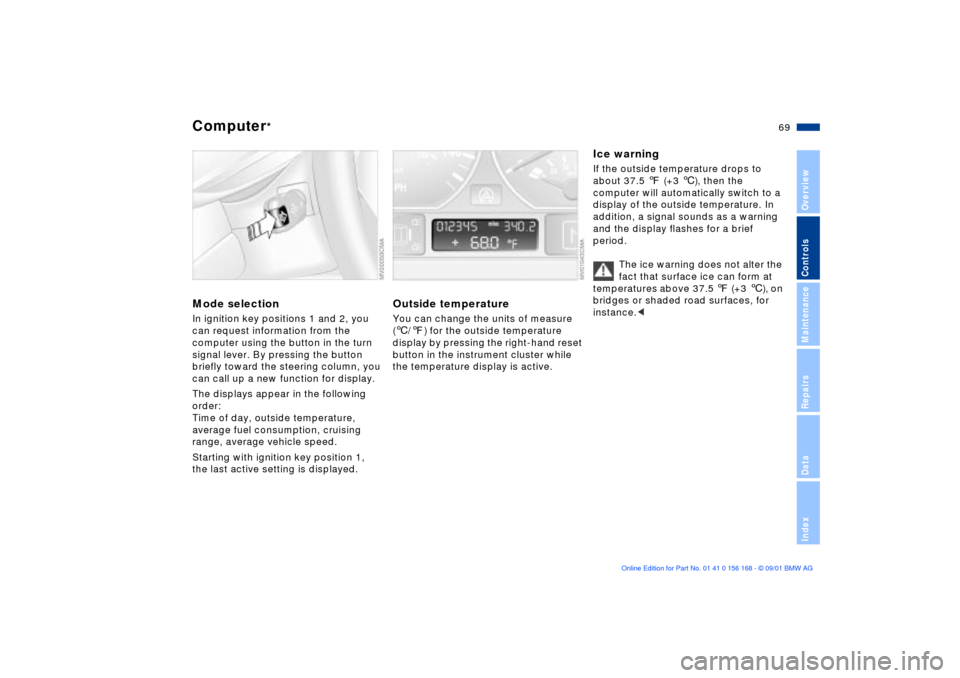
Outside temperatureYou can change the units of measure
(6/7) for the outside temperature
display by pressing the right-hand reset
button in the instrument cluster while
the temperature display is active.
Ice warningIf the outside temperature drops to
about 37.5 7 (+3 6), then the
computer will automatically switch to a
display of the outside temperature. In
addition, a signal sounds as a warning
and the display flashes for a brief
period.
The ice warning does not alter the
fact that surface ice can form at
temperatures above 37.5 7 (+3 6), on
bridges or shaded road surfaces, for
instance.<
Page 70 of 155
70n
Computer
*
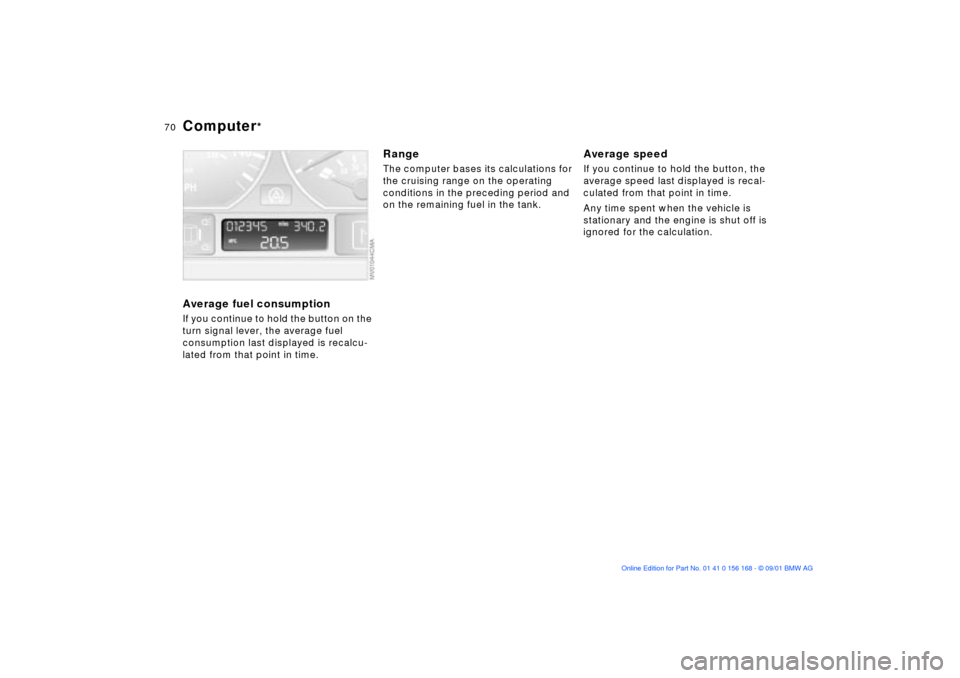
Average fuel consumptionIf you continue to hold the button on the
turn signal lever, the average fuel
consumption last displayed is recalcu-
lated from that point in time.
RangeThe computer bases its calculations for
the cruising range on the operating
conditions in the preceding period and
on the remaining fuel in the tank.
Average speedIf you continue to hold the button, the
average speed last displayed is recal-
culated from that point in time.
Any time spent when the vehicle is
stationary and the engine is shut off is
ignored for the calculation.
Page 100 of 155
100n
Cargo loading Roof-mounted luggage rack
*
Always position and secure the
load correctly. If you do not, it can
endanger the passengers during
braking or evasive maneuvers.
Do not exceed the approved gross
weight or the approved maximum axle
loads, refer to page 142, otherwise the
vehicle's operating safety is no longer
assured and you are in violation of the
law.
Do not stow heavy or hard objects in
the passenger compartment without
securing them. Otherwise they would
be thrown around during braking and
evasive maneuvers and endanger the
passengers.<
A special roof-rack system is available
as an optional extra for your BMW.
Please observe the precautions
included with the installation instruc-
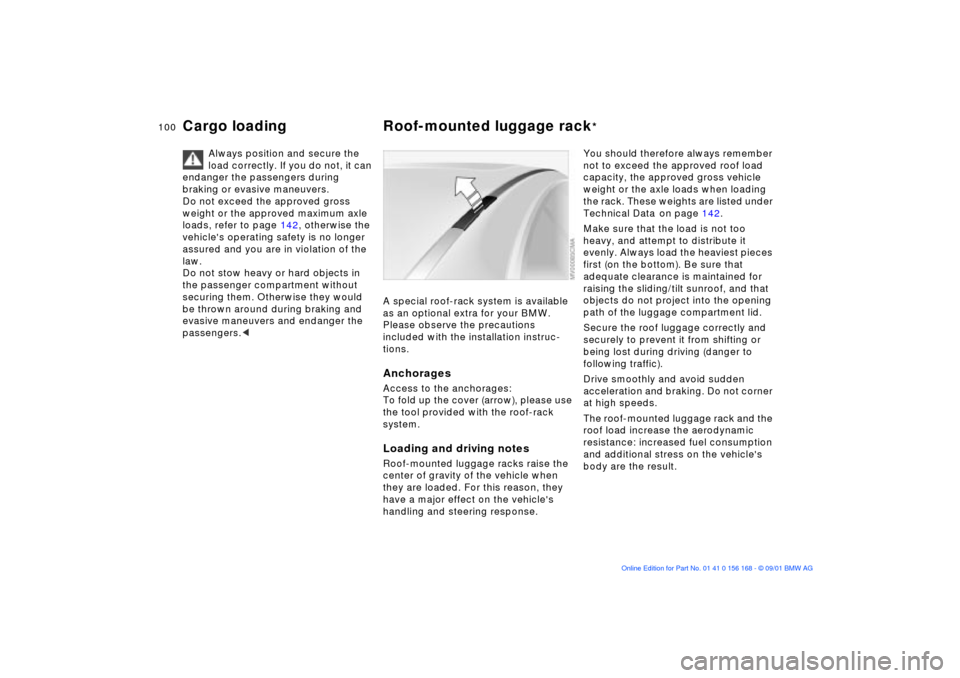
tions.AnchoragesAccess to the anchorages:
To fold up the cover (arrow), please use
the tool provided with the roof-rack
system.Loading and driving notesRoof-mounted luggage racks raise the
center of gravity of the vehicle when
they are loaded. For this reason, they
have a major effect on the vehicle's
handling and steering response.
You should therefore always remember
not to exceed the approved roof load
capacity, the approved gross vehicle
weight or the axle loads when loading
the rack. These weights are listed under
Technical Data on page 142.
Make sure that the load is not too
heavy, and attempt to distribute it
evenly. Always load the heaviest pieces
first (on the bottom). Be sure that
adequate clearance is maintained for
raising the sliding/tilt sunroof, and that
objects do not project into the opening
path of the luggage compartment lid.
Secure the roof luggage correctly and
securely to prevent it from shifting or
being lost during driving (danger to
following traffic).
Drive smoothly and avoid sudden
acceleration and braking. Do not corner
at high speeds.
The roof-mounted luggage rack and the
roof load increase the aerodynamic
resistance: increased fuel consumption
and additional stress on the vehicle's
body are the result.
Page 111 of 155

111n
OverviewControlsMaintenanceRepairsDataIndex
Winter tiresChoosing the right tireBMW recommends winter tires (M+S
radial tires) for operation under
inclement winter driving conditions.
While all-season tires (M+S designa-
tion) provide better winter traction than
summer tires with the load ratings H, V,
W, Y and ZR, they generally do not
achieve the performance of winter tires.
In the interest of safe tracking and
steering response, install winter tires
made by the same manufacturer having
the same tread configuration on all four
wheels.
Never exceed the maximum
speed for which the winter tires
are rated.
Unprofessional attempts by laymen to
service tires can lead to damage and
accidents.
Have this work performed by trained
professionals only. Any BMW center
has the required technical knowledge
and the proper equipment and will be
happy to assist you.<
Tire condition, tire pressureOnce the tire wears to below 0.16 in
(4 mm), winter tires display a percep-
tible decrease in their ability to cope
with winter driving conditions, and
should be replaced in the interest of
safety.
Comply with the specified tire inflation
pressures Ñ and be sure to have the
wheel and tire assemblies balanced
every time you change the tires.StorageStore tires in a cool, dry place,
protecting them against light whenever
possible. Protect the tires against
contact with oil, grease and fuel.
Snow chains
*
BMW narrow-link snow chains are
intended for mounting on summer or
winter tires in pairs at the rear wheels
only.
BMW 325xi, 330xi: in an extreme emer-
gency Ð for instance, with the vehicle
stuck on one side, or when obstruc-
tions make it impossible to reach one
tire Ð a chain may also be mounted on
just one tire for the limited period
needed to resolve the problem.
Comply with all manufacturer's safety
precautions when mounting the chains.
You cannot mount snow chains on the
following tires:
225/50 R 16 92
225/45 R 17 91
245/40 ZR 17
Page 115 of 155
115n
OverviewControlsMaintenanceRepairsDataIndex
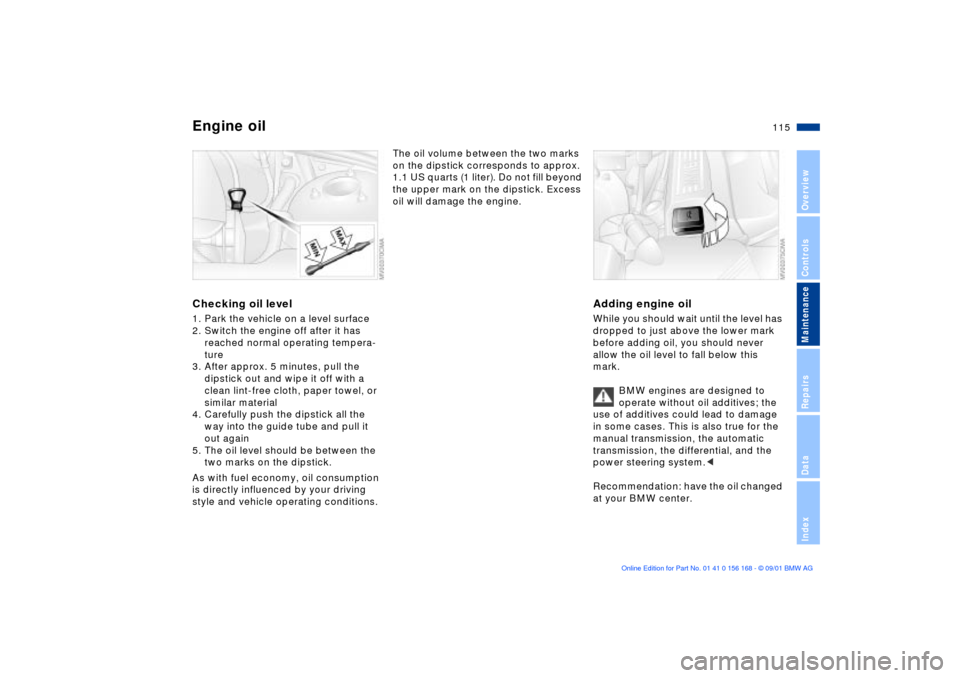
Engine oilChecking oil level1. Park the vehicle on a level surface
2. Switch the engine off after it has
reached normal operating tempera-
ture
3. After approx. 5 minutes, pull the
dipstick out and wipe it off with a
clean lint-free cloth, paper towel, or
similar material
4. Carefully push the dipstick all the
way into the guide tube and pull it
out again
5. The oil level should be between the
two marks on the dipstick.
As with fuel economy, oil consumption
is directly influenced by your driving
style and vehicle operating conditions.
The oil volume between the two marks
on the dipstick corresponds to approx.
1.1 US quarts (1 liter). Do not fill beyond
the upper mark on the dipstick. Excess
oil will damage the engine.
Adding engine oilWhile you should wait until the level has
dropped to just above the lower mark
before adding oil, you should never
allow the oil level to fall below this
mark.
BMW engines are designed to
operate without oil additives; the
use of additives could lead to damage
in some cases. This is also true for the
manual transmission, the automatic
transmission, the differential, and the
power steering system.<
Recommendation: have the oil changed
at your BMW center.
Page 121 of 155
121n
OverviewControlsMaintenanceRepairsDataIndex
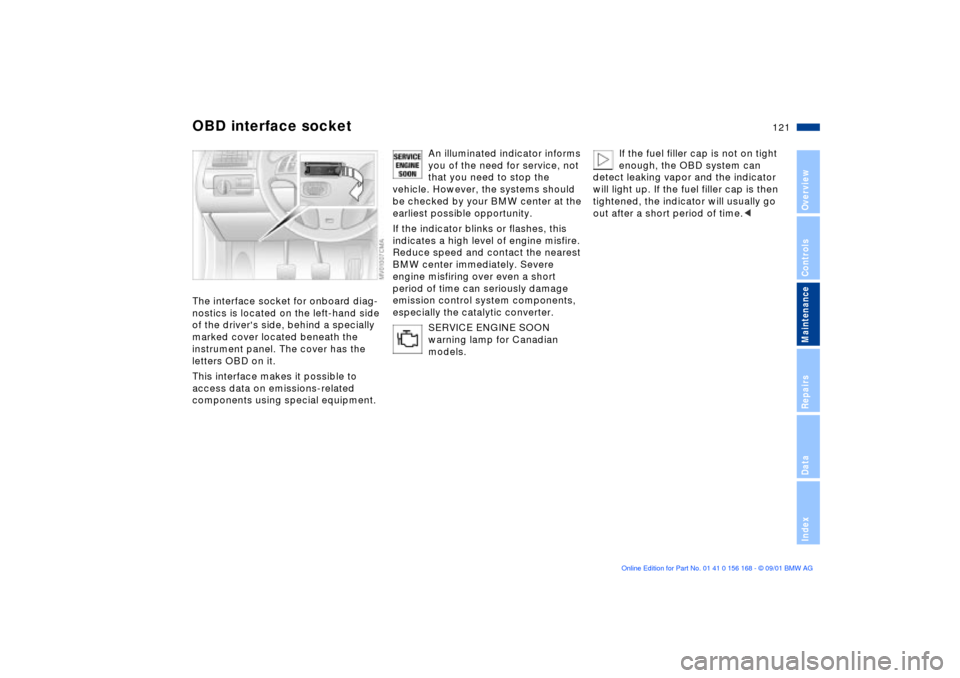
OBD interface socketThe interface socket for onboard diag-
nostics is located on the left-hand side
of the driver's side, behind a specially
marked cover located beneath the
instrument panel. The cover has the
letters OBD on it.
This interface makes it possible to
access data on emissions-related
components using special equipment.
An illuminated indicator informs
you of the need for service, not
that you need to stop the
vehicle. However, the systems should
be checked by your BMW center at the
earliest possible opportunity.
If the indicator blinks or flashes, this
indicates a high level of engine misfire.
Reduce speed and contact the nearest
BMW center immediately. Severe
engine misfiring over even a short
period of time can seriously damage
emission control system components,
especially the catalytic converter.
SERVICE ENGINE SOON
warning lamp for Canadian
models.
If the fuel filler cap is not on tight
enough, the OBD system can
detect leaking vapor and the indicator
will light up. If the fuel filler cap is then
tightened, the indicator will usually go
out after a short period of time.<
Page 140 of 155

140n
BMW 320i BMW 325i/325xi BMW 330i/330xi
Displacement
Number of cylinderscu in (cmm) 132.5 (2,171)
6152.2 (2,494)
6181.8 (2,979)
6
Maximum power
at engine speedhp (kW)
rpm168 (124)
6,100184 (135)
6,000225 (165)
5,900
Max. torque
at engine speedlb-ft (Nm)
rpm155 (210)
3,500175 (237)
3,500214 (290)
3,500
Compression ratioe
10.8 10.5 10.2
Stroke
Borein (mm)
in (mm)2.83 (72)
3.15 (80)2.95 (75)
3.31 (84)3.53 (89.6)
3.31 (84)
Fuel-injection system Digital electronic engine-management system (DME)
BMW 325xi, 330xi: a specially-equipped chassis dynamometer is required for stationary performance testing; never
attempt to measure output at the wheels on a conventional dynamometer.
Engine data
Page 142 of 155

142n
Weights
BMW 320i BMW 325i BMW 325xi BMW 330i BMW 330xi
Curb weight (with one person, ready for operation, full tank of fuel, options not included)
with manual transmission
with automatic transmissionlbs. (kg)
lbs. (kg)3,142 (1,425)
3,219 (1,460)3,219 (1,460)
3,307 (1,500)3,461 (1,570)
3,527 (1,600)3,285 (1,490)
3,362 (1,525)3,483 (1,580)
3,538 (1,605)
Approved gross vehicle weight
with manual transmission
with automatic transmissionlbs. (kg)
lbs. (kg)4,200 (1,905)
4,277 (1,940)4,277 (1,940)
4,365 (1,980)4,520 (2,050)
4,586 (2,080)4,343 (1,970)
4,420 (2,005)4,541 (2,060)
4,597 (2,085)
Approved front axle weight lbs. (kg) 1,973 (895) 1,984 (900) 2,183 (990) 2,006 (910) 2,161 (980)
Approved rear axle weight lbs. (kg) 2,359 (1,070) 2,425 (1,100) 2,469 (1,120) 2,469 (1,120) 2,491 (1,130)
Approved roof load capacity lbs. (kg) 165 (75) 165 (75) 165 (75) 165 (75) 165 (75)
Luggage compartment capacity cu ft (l) 15.5 (440) 15.5 (440) 15.5 (440) 15.5 (440) 15.5 (440)
Never exceed either the approved axle weights or the approved gross vehicle weight.
Page 143 of 155

143n
OverviewControlsMaintenanceRepairsDataIndex
Capacities
Notes
Fuel tank
Reserve gal. (liters)
gal. (liters)approx. 16.6 (approx. 63)
approx. 2.1 (approx. 8)Fuel specification, refer to
page 23
Windshield/
Headlamp washer reservoir quarts (liters) approx. 5.6 (approx. 5.3)Specifications, refer to
page 114
Cooling system including
heater circuitquarts (liters) approx. 8.9 (approx. 8.4) Specifications, refer to
page 117
Engine oil and filter change quarts (liters) 320i, 325i, 330i:
approx. 6.9 (approx. 6.5)
325xi, 330xi:
approx. 7.9 (approx. 7.5)BMW High Performance
Synthetic Oil
Specifications, refer to
page 115
Manual and automatic transmission,
transfer box and differential.Ð Lifetime lubricant, no oil change
required