brake light BMW 323Ci 2000 User Guide
[x] Cancel search | Manufacturer: BMW, Model Year: 2000, Model line: 323Ci, Model: BMW 323Ci 2000Pages: 189, PDF Size: 1.68 MB
Page 110 of 189

108n
Disc brakesDisc brakes furnish optimum decelera-
tion and braking control and greater
fade resistance under heavy use.
When the vehicle is driven only occa-
sionally, during extended periods when
the vehicle is not used at all, and in op-
erating conditions where brakes appli-
cations are less frequent, there is an in-
creased tendency for corrosion of the
rotors and accumulation of contamina-
tion on the brake pads. This occurs be-
cause the minimal pressure that must
be exerted by the pads to clean the
rotors by brake applications is not
reached.
If the brake rotors are corroded, they
will tend to respond to braking with a
pulsating effect that even extended
brake applications will fail to cure.
For your own safety: Only use
brake linings that BMW has re-
leased for your particular vehicle model.
BMW cannot vouch for driving safety or
the suitability of brake linings other than
those they have released.<
Driving notesWhile driving in wet conditions and in
heavy rain, it is effective to apply light
pressure to the brake pedal every few
miles (kilometers). Watch traffic condi-
tions to ensure that this maneuver does
not endanger other road users. The
heat that is generated by the brake ap-
plications helps to dry the brake pads
and rotors.
Maximum braking force is obtained
while the wheels continue to rotate,
peaking when the wheels remain on the
verge of locking without actually doing
so. ABS maintains this state automati-
cally. If the ABS fails, you should revert
to the staggered braking technique
described on page 110.
Long or steep mountain descents do
not necessarily lead to reduced braking
efficiency if you drive downhill with the
transmission in a gear that allows mini-
mal brake applications (or, with an auto-
matic transmission, in an appropriate
lower range).
You can further increase the engine's
braking effect by selecting a lower gear,
downshifting as far as first gear or plac-
ing the selector lever in position (1).Should engine braking prove inade-
quate, you should still avoid extended,
continuous braking. Instead of main-
taining low to moderate pressure over
an extended period of time, you should
decelerate the vehicle by applying more
substantial force on the pedal (watch
for following traffic!) and then pausing
before repeating the application. This
staggered braking technique allows the
brakes to cool in the intervals between
active braking phases, preventing over-
heating and ensuring that full braking
capacity remains available at all times.
Do not coast with the clutch de-
pressed or with the transmission
or selector lever in neutral. Do not drive
with the engine shut off. The engine
provides no braking effect when the
clutch pedal is depressed or the trans-
mission is in neutral, and there is no
power-assist for brakes and steering
when the engine is not running.
Never allow floor mats, carpets or any
other objects to protrude into the area
around the accelerator, clutch and
brake pedals and obstruct their move-
ment.<
Page 111 of 189
109n
RepairsIndexOverview Controls Car care Technology Data
Brake systemBrake fluid level
If the brake-warning lamp
comes on with the parking brake
released:
The brake fluid level is too low in the
reservoir (refer to page 127).
If the brake fluid level is too low and
brake pedal travel has become notice-
ably longer, there may be a defect in
one of the brake system's hydraulic
circuits.
Brake-warning lamp for Cana-
dian model.
Proceed to the nearest authorized
BMW center. Higher brake appli-
cation pressure may be necessary un-
der these conditions, and brake pedal
travel may be significantly longer.
Please remember to adapt your driving
style accordingly.<
Brake pads
If the warning lamp for the brake
pads lights up:
The brake pads have reached
their minimum pad thickness. Proceed
to the nearest authorized BMW center
as soon as possible to have the pads
replaced.
For your own safety: Only use
brake linings that BMW has re-
leased for your particular vehicle model.
BMW cannot vouch for driving safety or
the suitability of brake linings other than
those they have released.<
Page 113 of 189
111n
RepairsIndexOverview Controls Car care Technology Data
Winter operation
Do not shift down on slick road
surfaces. Doing so could cause
the rear wheels to lose traction and
skid, that could result in the loss of
vehicle control.<
Depress the clutch during hard
braking on road surfaces that pro-
vide only poor or uneven traction.<
Skid control Depress the clutch and release the
accelerator pedal, or place the selector
lever of the automatic transmission into
the "Neutral" position. Countersteer
carefully and attempt to regain control
of the vehicle.
ParkingEngage 1st or reverse gear. If your car
is equipped with an automatic transmis-
sion, place the selector lever in "Park".
On vehicles with manual transmission,
also apply the parking brake when
parking on inclined surfaces. In order to
prevent the parking brake linings from
locking due to frost or corrosion, dry
them by gently applying the parking
brake as the vehicle is coming to a
stop. Make sure that following traffic is
not endangered.
The brake lamps do not light up
when the parking brake is ap-
plied.<
Page 129 of 189
127n
RepairsIndexOverview Controls Car care Technology Data
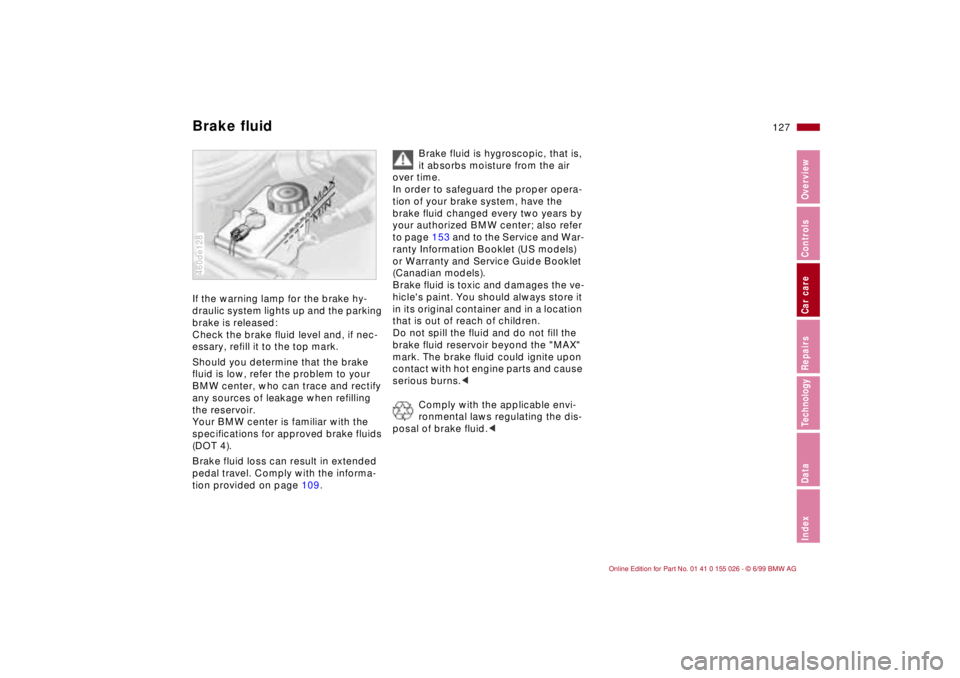
Brake fluidIf the warning lamp for the brake hy-
draulic system lights up and the parking
brake is released:
Check the brake fluid level and, if nec-
essary, refill it to the top mark.
Should you determine that the brake
fluid is low, refer the problem to your
BMW center, who can trace and rectify
any sources of leakage when refilling
the reservoir.
Your BMW center is familiar with the
specifications for approved brake fluids
(DOT 4).
Brake fluid loss can result in extended
pedal travel. Comply with the informa-
tion provided on page 109.460de128
Brake fluid is hygroscopic, that is,
it absorbs moisture from the air
over time.
In order to safeguard the proper opera-
tion of your brake system, have the
brake fluid changed every two years by
your authorized BMW center; also refer
to page 153 and to the Service and War-
ranty Information Booklet (US models)
or Warranty and Service Guide Booklet
(Canadian models).
Brake fluid is toxic and damages the ve-
hicle's paint. You should always store it
in its original container and in a location
that is out of reach of children.
Do not spill the fluid and do not fill the
brake fluid reservoir beyond the "MAX"
mark. The brake fluid could ignite upon
contact with hot engine parts and cause
serious burns.<
Comply with the applicable envi-
ronmental laws regulating the dis-
posal of brake fluid.<
Page 132 of 189

130n
Washing your car Right from the start, you can wash your
new BMW in an automatic car wash.
Car wash systems that do not employ
brushes are preferable.
Wipe away tough dirt and loosen and
remove dead insects before washing
the car.
To prevent spots, avoid washing when
the hood is still warm, or immediately
after and during exposure to strong
sunlight.
When using an automatic car wash, be
sure that:
>The car wash system is suited for the
dimensions of your vehicle
>No damage will occur on vehicles
with attached body accessories (such
as spoilers or antennas). Consult the
car wash operator if necessary
>The wheels and tires of your vehicle
cannot be damaged by the convey-
ance devices of the car wash system
>The vehicle is cleaned with minimum
brush pressure, and that ample water
is available for washing and rinsing.Vehicles with rain sensor:
Clean the windshield regularly. Wax
from car washes or the presence of
dead insects can cause rain sensor
malfunctions.
Switch the rain sensor off when
the vehicle passes through the car
wash (refer to page 70). Damage could
occur by an undesired actuation of the
wipers if the system is not deacti-
vated.<
Parts of the car that are inaccessible
to the automatic washer – such as door
sills, door and hood edges, etc. –
should be cleaned by hand.
In the winter months, it is especially im-
portant to ensure that the car is washed
on a regular basis. Large quantities of
dirt and road salt are difficult to remove,
and they also cause damage to the ve-
hicle.
If spray wands or high-pressure
washers are used, be sure to
maintain an adequate distance between
the spray source and the vehicle's sur-
face. Inadequate distance and exces-
sive pressure can damage or weaken
the finish, making it more susceptible to
subsequent attack. In addition, mois-
ture could penetrate to vehicle compo-
nents, leading to long-term damage.<
When cleaning the headlamps,
please observe the following:
>Do not rub dry. Never use abrasives
or strong cleaning agents to clean the
covers
>Remove dirt and contamination
(such as insects) by soaking with
BMW Car Shampoo and then rinsing
with plenty of water
>Always use a deicer spray to remove
accumulated ice and snow – never
use a scraper.<
After washing the car, apply the
brakes briefly to dry them. Braking
efficiency might otherwise be reduced
by the moisture and the brake rotors
could also be corroded.<
Caring for your car
Page 133 of 189

131n
RepairsIndexOverview Controls Car care Technology Data
Caring for your carExterior finish To provide effective corrosion protec-
tion, multilayer paintwork is applied at
the factory. Cataphoretic immersion
priming techniques are supplemented
using special body-cavity protectants,
with the application of specially-devel-
oped and extensively tested materials.
A layer of flexible PVC is first applied to
the undercarriage. Following this, a
comprehensive undercoating treatment
with a wax-based protectant is applied.
Regular maintenance makes an impor-
tant contribution to maintaining the
safety and resale value of your vehicle.
Increasing awareness of the effects of
harmful environmental factors on vehi-
cle finishes have led paint and vehicle
manufacturers to initiate ongoing pro-
grams designed to further improve the
durability of their finishes. Despite this,
environmental factors that occur locally
or regionally can have negative effects
on the finish of your vehicle. These
should guide you in determining the fre-
quency and extent of your efforts to
maintain the vehicle finish.
Depending upon material and type
of impact (perforation of paint layer),
physical stresses from sand, road salt,
gravel, etc., can cause corrosion to
start extending beneath the finish, start-
ing at the point of impact.Road dirt, tar spots, dead insects, ani-
mal droppings (strong alkali concentra-
tion) and tree excretions (resins and
pollen) all contain substances capable
of causing damage when allowed to re-
main on the finish of your car for any
period of time (spots, etching, flaking,
separation in the top coat).
In industrial areas, deposits of flue dust,
lime, oily soot, precipitation containing
sulfur-dioxide (acid rain) and other envi-
ronmental pollutants will damage the
car's finish unless adequate care is pro-
vided – even though this generally lim-
ited to the outside horizontal surfaces.
In coastal regions, high levels of atmo-
spheric salt and humidity promote cor-
rosion.
In tropical zones temperatures of over
1007 (406) in the shade prevail, in
addition to heavy ultraviolet radiation
and high humidity. Under those circum-
stances light colored paints reach tem-
peratures of up to 1807 (806) and
dark paints up to 2507 (1206).
Caring for the vehicle finish Regular washing is a preventive mea-
sure against long-term effects from
substances that are harmful to the vehi-
cle's finish, especially if you drive your
vehicle in areas with high levels of air
pollution or aggressive natural sub-
stances (tree resins, pollen).
Nevertheless, you should immediately
remove especially aggressive sub-
stances. Failure to do so can lead to
changes in the paint's chemical struc-
ture or to discoloration. Gasoline spilled
during refueling, oil, grease and brake
fluid should always be cleaned away
immediately, as should bird droppings.
All of these substances cause damage
to the finish.
Any contamination remaining on the
surface of the vehicle will be especially
conspicuous after washing. Use clean-
ing fluid or alcohol with a clean cloth or
cotton pad to remove. Remove tar
spots with tar remover. After cleaning,
the affected areas should be waxed to
ensure continued protection.
A full range of car-care products is
available from your BMW center.<
Page 147 of 189
145n
RepairsIndexOverview Controls Car care Technology Data
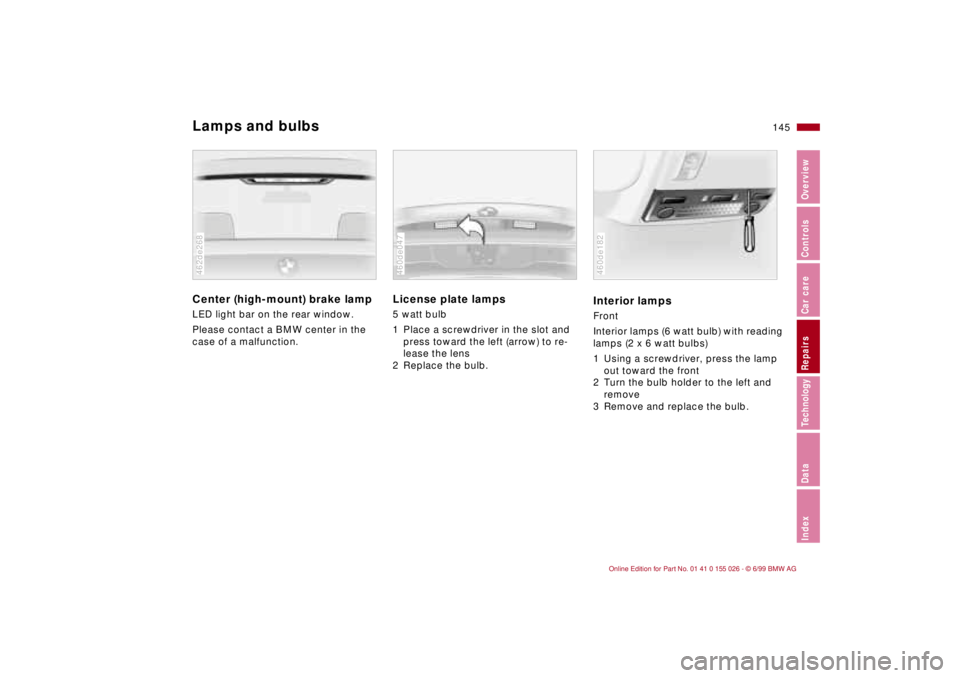
Lamps and bulbsCenter (high-mount) brake lamp
LED light bar on the rear window.
Please contact a BMW center in the
case of a malfunction.462de268
License plate lamps5 watt bulb
1 Place a screwdriver in the slot and
press toward the left (arrow) to re-
lease the lens
2 Replace the bulb.460de047
Interior lamps Front
Interior lamps (6 watt bulb) with reading
lamps (2 x 6 watt bulbs)
1 Using a screwdriver, press the lamp
out toward the front
2 Turn the bulb holder to the left and
remove
3 Remove and replace the bulb.460de182
Page 153 of 189
151n
RepairsIndexOverview Controls Car care Technology Data
Changing tires Battery Driving with the space-saver
spare tire
*
Drive cautiously and do not exceed a
speed of 45 mph (80 km/h).
Be aware that vehicle handling will be
altered. Slower brake response time,
longer braking distances and changed
steering characteristics may be antici-
pated when approaching limit condi-
tions.
The changes in handling characteristics
will be even more pronounced in con-
junction with winter tires.
Only one space-saver spare tire
may be mounted. Mount a wheel
and tire with the same size and specifi-
cations as the others at the earliest
possible opportunity. Maintain correct
tire pressures. Refer to page 28.<
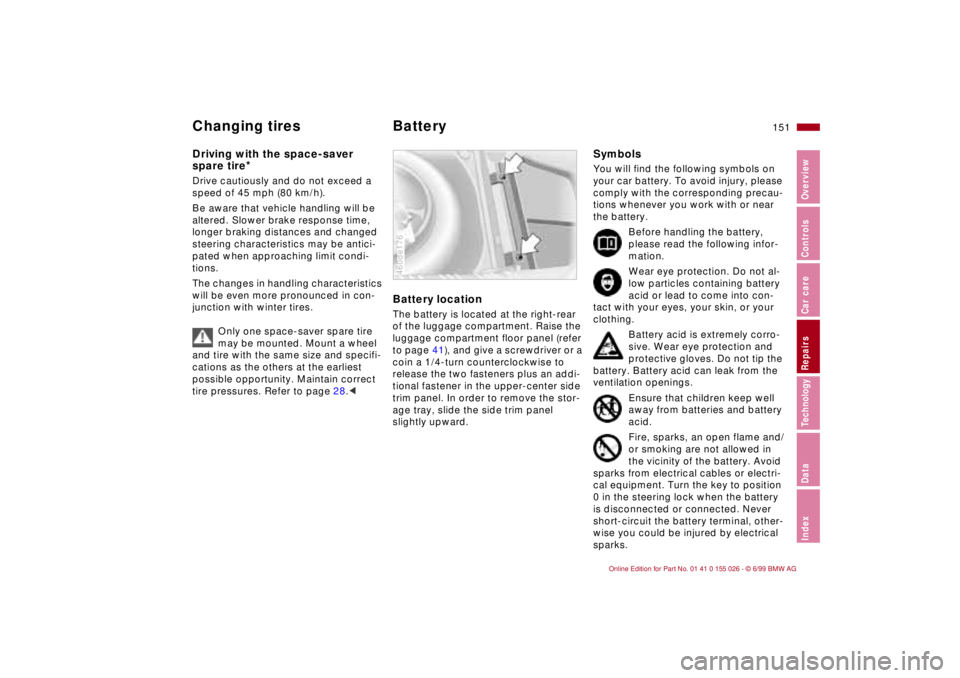
Battery location The battery is located at the right-rear
of the luggage compartment. Raise the
luggage compartment floor panel (refer
to page 41), and give a screwdriver or a
coin a 1/4-turn counterclockwise to
release the two fasteners plus an addi-
tional fastener in the upper-center side
trim panel. In order to remove the stor-
age tray, slide the side trim panel
slightly upward.460de176
SymbolsYou will find the following symbols on
your car battery. To avoid injury, please
comply with the corresponding precau-
tions whenever you work with or near
the battery.
Before handling the battery,
please read the following infor-
mation.
Wear eye protection. Do not al-
low particles containing battery
acid or lead to come into con-
tact with your eyes, your skin, or your
clothing.
Battery acid is extremely corro-
sive. Wear eye protection and
protective gloves. Do not tip the
battery. Battery acid can leak from the
ventilation openings.
Ensure that children keep well
away from batteries and battery
acid.
Fire, sparks, an open flame and/
or smoking are not allowed in
the vicinity of the battery. Avoid
sparks from electrical cables or electri-
cal equipment. Turn the key to position
0 in the steering lock when the battery
is disconnected or connected. Never
short-circuit the battery terminal, other-
wise you could be injured by electrical
sparks.
Page 180 of 189

Everything from A to ZAABS (Antilock Brake
System) 22, 106
Accessories 6
Activated charcoal
filter 93, 154
Adaptive Transmission
Control (ATC) 66, 160
Adding engine oil 123
Adding washer fluid 173
Adjust the backrest 47
Adjust the temperature 90
Adjust the thigh support
area 49
Adjusting steering wheel 51
Air distribution 90
Air outlets 88
Air pressure 113
Air supply 91
Airbags 21, 57, 135, 161
Alarm system 42
Antenna 112
Antenna, Diversity 162
Antifreeze 126
Antifreeze, radiator 110
Antilock Brake System
(ABS) 22, 106
Anti-theft alarm system 42
Aquaplaning 104, 113
Armrest 95
Ashtray 96
Assisted rear entry 49AUC (Automatic
recirculated-air
control) 91
Automatic car washes 130
Automatic climate
control 88
remove window
condensation 91
Automatic recirculated-air
control (AUC) 91
Automatic speed control 72
Automatic transmission with
Steptronic 22, 66
Average consumption 78
Average speed 79
Avoiding unwanted
alarm 43
Axle loads 172
BBackrest
release 49
Backup lamps 65
bulb replacement 143
Battery 151, 174
capacity 174
charge 153
discharged 156
removal and
installation 152
Battery charge current 20
Belts 55Blower 91
BMW High Performance
Synthetic Oil 124
BMW Sports Seat 49
Bore 170
Brake fluid 127
Brake hydraulic system 20
Brake lamps
bulb replacement 143
Brake pads 22
Brake-in procedure 104
Brakes 108
Brakes, brake faults 109
Breaking in the vehicle 104
Bulb replacement 140
CCar Memory 54
Car phone, please refer to
the manufacturer's
operating instructions
Car radio 112
reception 112, 162
refer also to the car radio
operating instructions
Car vacuum cleaner,
connecting 96
Car wash 130
Care
exterior 131
interior 132
Care of upholstery 133Care of wool velour 133
Cargo loading 100
Caring for the vehicle
finish 131
Cassette operation, refer to
the radio operating
instructions
Catalytic converter 105
CBC (Cornering Brake
Control) 21, 107
CD mode, refer to the radio
operating instructions
Cellular phones 95, 112
Center (high-mount) brake
lamp 145
Center armrest 95
Central locking system 34
key 38
Changing tires 148
Check air pressure 27
Check Control 77
Child restraint
systems 56, 60
Child seat 56, 60
Cigarette lighter 96
Clock 77
refer also to the onboard
computer operating
instructions
Clothes hooks 97
Cockpit 16
Page 181 of 189

Everything from A to Z
179n
RepairsIndexOverview Controls Car care Technology Data
Code, refer to the radio
operating instructions
Coin holder, cup holder 95
Combination switch 69
Compression 170
Computer 77
Configure settings 54
Consumption 78
Consumption display 75
Coolant 110, 126, 173
Coolant thermometer 75
Coolant, antifreeze 110
Cooling system 173
Cornering Brake Control
(CBC) 21, 107
Cruise control 72
Cruising range 79
Curb weight 172
Current check indicator 20DDashboard 16
Data
dimensions 171
engine 170
technical 170
weights 172
Daytime-driving light
switch 84
Defrost setting 91
Defrost windows 91
Defroster, rear window 92Digital clock 77
Dimensions 171
Dipstick 123
Disc brakes 108
Displacement 170
Display lighting 84
Displays 18
Distance warning 80
Diversity, antenna 162
Divided rear backrest 98
Door key 32
Door locks, care 110
Doors
emergency actuation 34
remote control 35
unlocking and locking 34
Drawbar load 172
Drive belts 174
Driving hints 104
Driving lamps 84
DSC (Dynamic Stability
Control) 22, 81, 161
Dynamic Stability Control
(DSC) 22, 81, 161
EElectric power seat 50
Electric power windows 44
Electrical accessories,
failure 153
Electrical system 174Electronic vehicle
immobilizer 33
Elements of operation 16
Emergency actuation
doors 34
tank cover 155
Energy Control 74
Engage 62
Engine
engage 62
Engine compartment 120
Engine coolant 126, 173
Engine data 170
Engine oil
filling capacity 173
quality 124
viscosity 124
Engine oil consumption 123
Engine oil level 21
check 123
Engine oil pressure 20
Engine oil
specifications 124
Engine speed 170
Entry from the rear 49
Exterior mirrors 52
FFailure messages 77
Fault
ABS 107
Fault displays 77Filler cap cover 26
Filling capacities 173
Filling the washer
reservoir 173
First aid 25
First aid kit 25
Fittings, towing 157
Flashlight 94
Flat tire 113, 148
Fog lamps 85
bulb replacement 143
Fog lights 85
Folding rear backrest 98
Follow-Me-Home lamps 84
Footbrake 108
Footwell lamps 85
bulb replacement 146
Front seat adjustment 47
Frost protection,
radiator 126
Fuel 26
preparation 170
Fuel consumption 78
Fuel consumption
display 75
Fuel gauge 75
Fuel quality 26
Fuel tank capacity 173
Fuel tank gauge 75
Functional status 166
Fuses 153