service BMW 323Ci 2000 User Guide
[x] Cancel search | Manufacturer: BMW, Model Year: 2000, Model line: 323Ci, Model: BMW 323Ci 2000Pages: 189, PDF Size: 1.68 MB
Page 78 of 189
76n
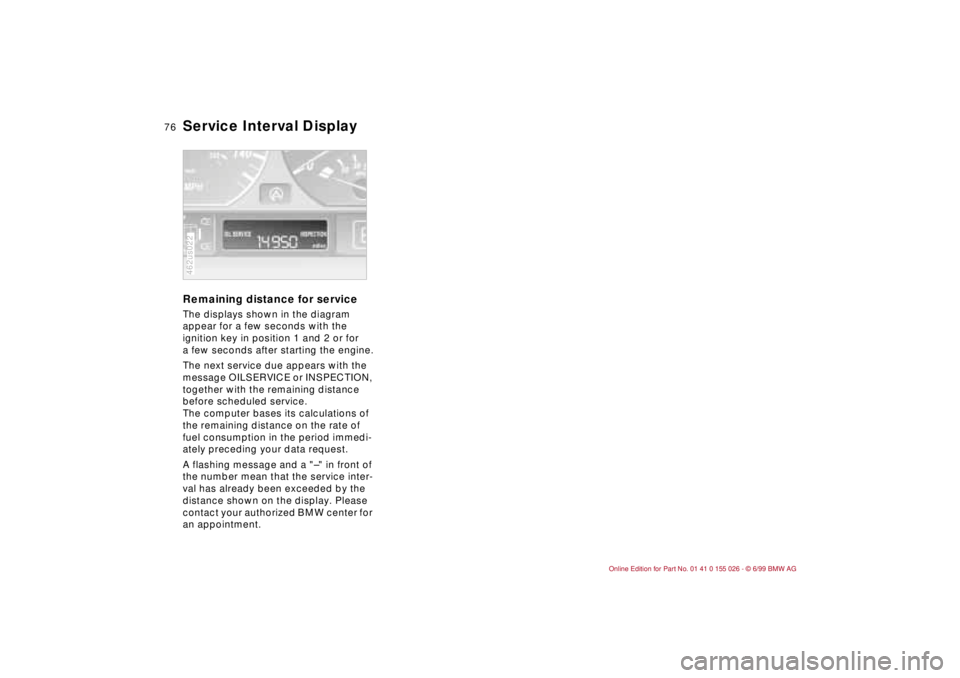
Service Interval Display Remaining distance for serviceThe displays shown in the diagram
appear for a few seconds with the
ignition key in position 1 and 2 or for
a few seconds after starting the engine.
The next service due appears with the
message OILSERVICE or INSPECTION,
together with the remaining distance
before scheduled service.
The computer bases its calculations of
the remaining distance on the rate of
fuel consumption in the period immedi-
ately preceding your data request.
A flashing message and a "–" in front of
the number mean that the service inter-
val has already been exceeded by the
distance shown on the display. Please
contact your authorized BMW center for
an appointment.462us022
Page 105 of 189
Overview
Controls and features
Operation, care
and maintenance
Owner service procedures
Technical data
Index Advanced technology
103n
RepairsIndexOverview Controls Car care Technology Data
Special operating instructions:
Break-in procedures104
Driving notes104
Catalytic converter105
Antilock Brake System
(ABS)106
Disc brakes108
Brake system109
Winter operation110
Power steering112
Cellular phones112
Radio reception112
Wheels and tires:
Tire inflation pressures113
Tire condition113
Tire replacement114
Tire rotation114
Wheel and tire
combinations115
Winter tires116
Snow chains116
Approved wheel and tire
specifications117Under the hood:
Hood119
Engine compartment120
Washer fluids122
Washer nozzles122
Engine oil123
Coolant126
Brake fluid127
Vehicle Identification
Number128
Care and maintenance:
The BMW Maintenance
System129
Caring for your car130
Airbags135
Vehicle storage136
Laws and regulations:
Technical modifications to the
vehicle136
OBD connector137
Page 106 of 189

104n
To ensure that your vehicle provides
maximum economy throughout a long
service life, we request that you ob-
serve the following:
Engine and differentialUp to 1,200 miles (2,000 km):
Drive at varying engine speeds and
road speeds, but do not exceed the fol-
lowing engine or road speeds at this
time: 4,500/min or 100 mph (160 km/h).
Refrain from using full throttle and avoid
pressing the accelerator beyond the
kickdown point.
After 1,200 miles (2,000 km), you can
gradually increase the engine speed or
road speed.
You should also observe these break-in
procedures if the engine or differential
is replaced later in the course of the
vehicle service life.
TiresDue to technical factors associated with
their manufacture, tires do not achieve
their full traction potential until an initial
break-in period has elapsed. For this
reason, drive cautiously during the first
200 miles (300 km).Brake systemBrake pads and disks do not attain their
optimal wear patterns until after approx.
300 miles (500 km).
To break-in the separate parking brake
drums, apply the parking brake lightly
when coasting to a standstill (at a traffic
signal, for instance), provided that traf-
fic conditions allow you to do so.
To avoid corrosion, repeat this proce-
dure from time to time.
The brake lamps do not come on
when the parking brake is set.
Vacuum for the brake system servo unit
on your BMW is available only when the
engine is running. When you move the
car with the engine off – when towing,
for example – substantially higher levels
of pedal force will be required to brake
the vehicle.<
Brakes:
Do not drive with your foot resting
on the brake pedal. Even light but con-
sistent pedal pressure can lead to high
temperatures, brake wear, and possibly
to brake failure.
Aquaplaning:
A wedge of water can form between the
tires and the road surface when you op-
erate the vehicle on wet or slushy roads.
This phenomenon is referred to as
aquaplaning or hydroplaning. It is char-
acterized by a partial or complete loss
of contact between the tires and the
road surface. The ultimate results are
loss of steering and braking control.
Driving through water:
Do not drive through water more than
1 ft (30 cm) deep. Drive only at walking
speed, otherwise damage to the engine,
the electrical system and the transmis-
sion can occur.
Rear parcel tray:
Never use the rear parcel tray to store
heavy or bulky objects. They could pose
a danger to the occupants when the car
is braked heavily.
Break-in procedures Driving notes
Page 108 of 189

106n
Antilock Brake System (ABS)The concept ABS enhances active safety by helping
to prevent the wheels from locking dur-
ing brake applications. Locked wheels
are dangerous. When the front wheels
slide, the driver loses steering control
over the vehicle. Traction loss at the
rear wheels can cause the rear end to
break into an uncontrolled skid.
The system can achieve the shortest
braking distances possible under most
conditions (on straight-aways and in
curves, on asphalt, ice, wet road sur-
faces, etc.).
ABS is designed to meet two essential
requirements during every brake appli-
cation:
>To help provide vehicle stability
>To help maintain steering control and
maneuverability – on all types of road
surfaces (asphalt, concrete, mud,
wet, snow, ice).
Braking with ABSThe system becomes operative once
the vehicle exceeds a speed of approx.
6 mph (10 km/h). Below approx. 3 mph
(6 km/h), it is once again deactivated.
This means that the wheels can lock in
the final phase of a panic stop – a factor
of no significance in actual use.
If you are in a situation that requires full
braking, you will exploit the full benefits
of the ABS system if you apply maxi-
mum brake pressure ("panic stop").
Since the vehicle maintains steering re-
sponsiveness, you can avoid possible
obstacles with a minimum of steering
effort, despite the full brake application.
The ABS system closed-loop control
circuit cycles in fractions of a second.
A pulsation at the brake pedal indicates
to the driver that ABS is active, that is,
that the vehicle is within its maximum
braking range. In addition, a pulsation –
a result of the control function cycles –
indicates to the driver that vehicle
speed should be reduced to adapt to
road surface conditions when there is
reduced traction and grip between tires
and road surface (slippery road sur-
face).
In driving conditions where there is a
loose upper surface together with a
subsurface that provides good traction (on gravel or snow, for instance), or with
snow chains, the braking distance may
also be longer than when the wheels
are locked. However, ABS continues to
provide enhanced vehicle stability and
steering response under these condi-
tions.
Information for your safetyNot even ABS can suspend the laws
of physics. ABS cannot prevent the
consequences of brake applications
with inadequate clearances for safety
between vehicles, when exceeding the
speed limit in curves, or the risks in-
volved when aquaplaning occurs. Re-
sponsibility for these types of situations
remains in the hands (and at the feet) of
the driver.
You should never allow the added
safety of ABS to lull you into a false
sense of security, or mislead you into
taking increased risks that could affect
your own safety and that of others.
Do not make any modifications to
the ABS system.
Service procedures on ABS are to be
performed by authorized technicians
only.<
Page 115 of 189
113n
RepairsIndexOverview Controls Car care Technology Data
Information for your safetyThe factory-approved radial tires are
matched to the car and have been se-
lected to provide optimum safety and
driving comfort on your car.
It is not merely the tire's service life, but
also driving comfort and – above all
else – driving safety that depend on the
condition of the tires and the mainte-
nance of the specified tire pressure.
Incorrect inflation pressure is a frequent
cause of tire damage. It also signifi-
cantly influences the roadholding ability
of your BMW.
Check tire inflation pressure regu-
larly — including the space-saver
and/or the spare tire — at least twice a
month and before beginning a longer
road trip. Incorrect tire pressure can
otherwise lead to tire damage and acci-
dents.<
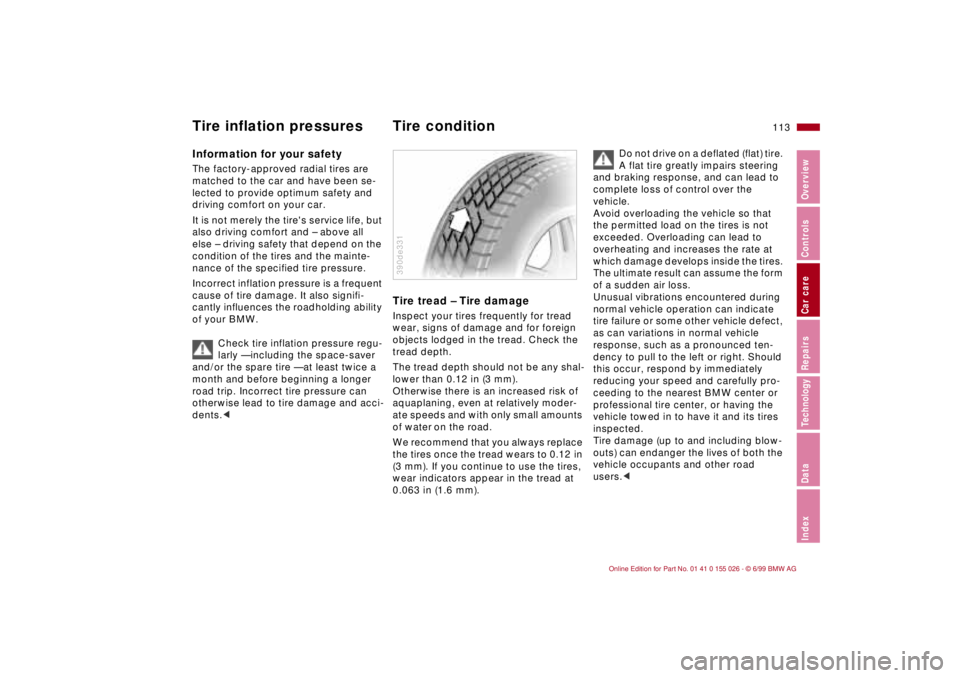
Tire tread – Tire damageInspect your tires frequently for tread
wear, signs of damage and for foreign
objects lodged in the tread. Check the
tread depth.
The tread depth should not be any shal-
lower than 0.12 in (3 mm).
Otherwise there is an increased risk of
aquaplaning, even at relatively moder-
ate speeds and with only small amounts
of water on the road.
We recommend that you always replace
the tires once the tread wears to 0.12 in
(3 mm). If you continue to use the tires,
wear indicators appear in the tread at
0.063 in (1.6 mm).390de331
Do not drive on a deflated (flat) tire.
A flat tire greatly impairs steering
and braking response, and can lead to
complete loss of control over the
vehicle.
Avoid overloading the vehicle so that
the permitted load on the tires is not
exceeded. Overloading can lead to
overheating and increases the rate at
which damage develops inside the tires.
The ultimate result can assume the form
of a sudden air loss.
Unusual vibrations encountered during
normal vehicle operation can indicate
tire failure or some other vehicle defect,
as can variations in normal vehicle
response, such as a pronounced ten-
dency to pull to the left or right. Should
this occur, respond by immediately
reducing your speed and carefully pro-
ceeding to the nearest BMW center or
professional tire center, or having the
vehicle towed in to have it and its tires
inspected.
Tire damage (up to and including blow-
outs) can endanger the lives of both the
vehicle occupants and other road
users.<
Tire inflation pressures Tire condition
Page 116 of 189

114n
To maintain good handling and vehicle
response, use only tires of a single
tread configuration from a single manu-
facturer. BMW tests and approves
wheel/tire combinations. Refer to
page 117.
Do not use retreaded tires, since
driving safety may be impaired by
their use. This due to the possible varia-
tions in casing structures and, in some
cases, to their extreme age, that can
lead to a decrease in their durability.<
Tire ageThe date on which the tire was manu-
factured is indicated by the code on the
sidewall:
DOT ... 129 indicates that the tire was
manufactured in Week 12 of 1999.
BMW recommends the replacement of
all tires when the tires are no more than
6 years old, even if a tire life of 10 years
is possible.
Spare tires over 6 years old should be
used only in case of emergency. Such
a tire should be replaced by a new tire
immediately, and should not be fitted
together with new tires.
Between the axlesThe tread wear patterns at the front end
differ from those at the rear – the actual
patterns will vary according to individ-
ual driving conditions. In the interests of
safety and maintaining optimal handling
characteristics, tire rotation is not rec-
ommended.
If a proposed interaxle rotation of tires
is based on economic considerations,
one should consider whether the costs
for the rotation are likely to be recap-
tured by any increase in the service life
of the tires which might be realized.
In principle, interaxle rotation should be
performed in short intervals, with a
maximum of 3,000 miles (5,000 km).
Consult your authorized BMW center
for more information.
Should you decide to rotate the tires, it
is essential to comply with the following:
Rotate tires on the same side only, since
braking characteristics and road grip
could otherwise be adversely affected.
Following rotation, correct the tire infla-
tion pressure.
If different tire sizes are mounted
on the front and rear axles (refer to
page 117), the wheels may not be ro-
tated from one axle to the other.<
Tire replacement Tire rotation
Page 118 of 189

116n
Winter tiresChoosing the right tireBMW recommends winter tires (M+S
radial tires) for driving in adverse winter
road conditions. Although all-season
M+S tires provide better winter traction
than standard summer tires with H, V,
W, Y and ZR speed ratings, they gener-
ally fail to provide the same levels of
performance as standard snow tires in
winter driving.
For of safe tracking and steering re-
sponse, install winter tires made by the
same manufacturer having the same
tread configuration on all four wheels.
Mount only winter tires approved by
BMW. Any BMW center will be glad to
provide you with information on the
best winter tires for your particular driv-
ing conditions.Never exceed the maximum speed
for that the tires are rated.
Unprofessional attempts by laymen to
service tires can lead to damage and
accidents.
Have this work performed by skilled
professionals only. Your BMW center
will be glad to assist you with both their
expertise and the proper equipment for
your vehicle.<
Tire condition, tire pressureWinter tires display a perceptible loss in
their ability to cope with winter driving
conditions once the tread wears to be-
low 0.16 in (4 mm), and should thus be
replaced.
Comply with the specified tire inflation
pressures – and be sure to have the
wheel and tire assemblies balanced
every time you change the tires.
StorageStore tires in a cool, dry place, away
from light whenever possible. Protect
the tires against contact with oil, grease
and fuel.Snow chains
*
Use narrow-link BMW snow chains on
summer or winter tires only in pairs and
only on the rear wheels. Comply with all
manufacturer's safety precautions when
mounting the chains.
Page 121 of 189
119n
RepairsIndexOverview Controls Car care Technology Data
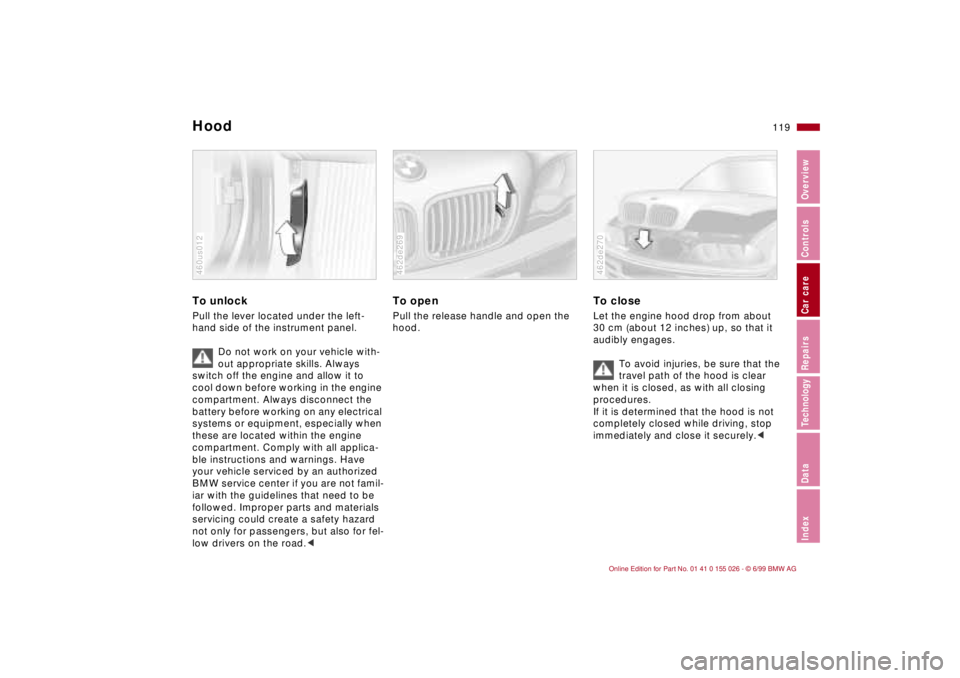
To unlock Pull the lever located under the left-
hand side of the instrument panel.
Do not work on your vehicle with-
out appropriate skills. Always
switch off the engine and allow it to
cool down before working in the engine
compartment. Always disconnect the
battery before working on any electrical
systems or equipment, especially when
these are located within the engine
compartment. Comply with all applica-
ble instructions and warnings. Have
your vehicle serviced by an authorized
BMW service center if you are not famil-
iar with the guidelines that need to be
followed. Improper parts and materials
servicing could create a safety hazard
not only for passengers, but also for fel-
low drivers on the road.<460us012
To openPull the release handle and open the
hood.462de269
To closeLet the engine hood drop from about
30 cm (about 12 inches) up, so that it
audibly engages.
To avoid injuries, be sure that the
travel path of the hood is clear
when it is closed, as with all closing
procedures.
If it is determined that the hood is not
completely closed while driving, stop
immediately and close it securely.<462de270
Hood
Page 129 of 189
127n
RepairsIndexOverview Controls Car care Technology Data
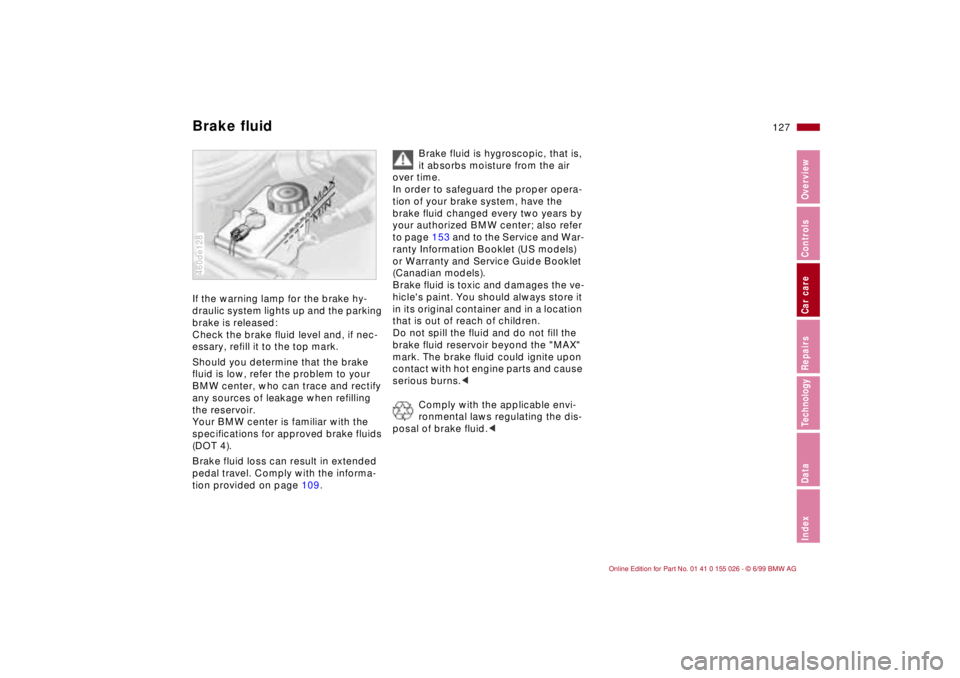
Brake fluidIf the warning lamp for the brake hy-
draulic system lights up and the parking
brake is released:
Check the brake fluid level and, if nec-
essary, refill it to the top mark.
Should you determine that the brake
fluid is low, refer the problem to your
BMW center, who can trace and rectify
any sources of leakage when refilling
the reservoir.
Your BMW center is familiar with the
specifications for approved brake fluids
(DOT 4).
Brake fluid loss can result in extended
pedal travel. Comply with the informa-
tion provided on page 109.460de128
Brake fluid is hygroscopic, that is,
it absorbs moisture from the air
over time.
In order to safeguard the proper opera-
tion of your brake system, have the
brake fluid changed every two years by
your authorized BMW center; also refer
to page 153 and to the Service and War-
ranty Information Booklet (US models)
or Warranty and Service Guide Booklet
(Canadian models).
Brake fluid is toxic and damages the ve-
hicle's paint. You should always store it
in its original container and in a location
that is out of reach of children.
Do not spill the fluid and do not fill the
brake fluid reservoir beyond the "MAX"
mark. The brake fluid could ignite upon
contact with hot engine parts and cause
serious burns.<
Comply with the applicable envi-
ronmental laws regulating the dis-
posal of brake fluid.<
Page 131 of 189
129n
RepairsIndexOverview Controls Car care Technology Data
The BMW Maintenance System has
been designed as a reliable means of
providing maximum driving and operat-
ing safety – and as cost-effectively as
possible for you. With respect to the
previous version, maintenance costs
can clearly be reduced due to technical
innovations.
Please keep in mind that regular main-
tenance is not only necessary for the
safety of your vehicle, but also plays a
significant role in maintaining the resale
value of the vehicle. 462us022
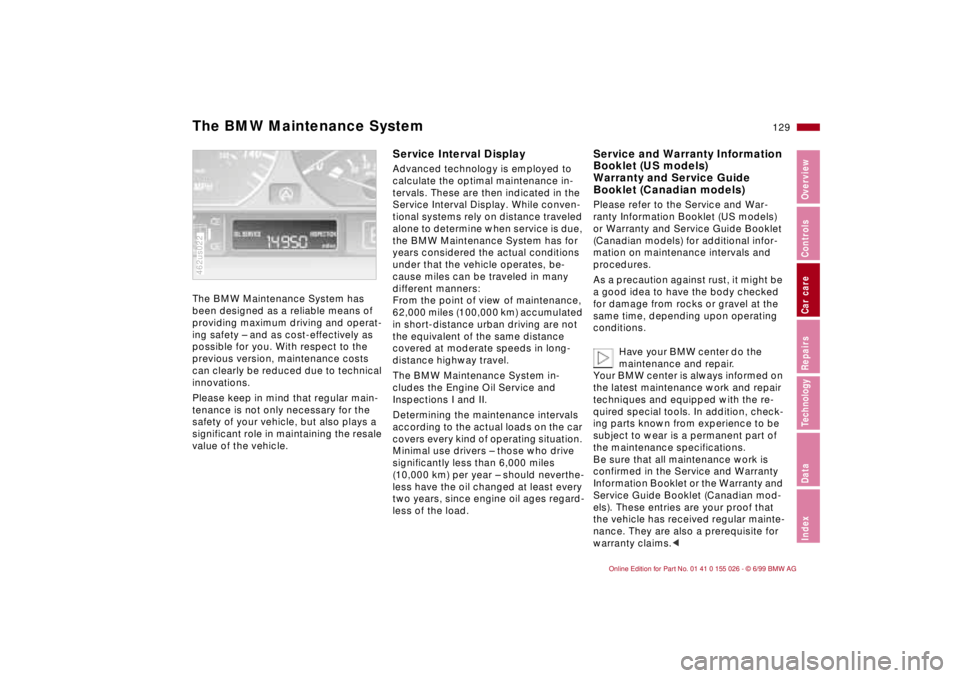
Service Interval DisplayAdvanced technology is employed to
calculate the optimal maintenance in-
tervals. These are then indicated in the
Service Interval Display. While conven-
tional systems rely on distance traveled
alone to determine when service is due,
the BMW Maintenance System has for
years considered the actual conditions
under that the vehicle operates, be-
cause miles can be traveled in many
different manners:
From the point of view of maintenance,
62,000 miles (100,000 km) accumulated
in short-distance urban driving are not
the equivalent of the same distance
covered at moderate speeds in long-
distance highway travel.
The BMW Maintenance System in-
cludes the Engine Oil Service and
Inspections I and II.
Determining the maintenance intervals
according to the actual loads on the car
covers every kind of operating situation.
Minimal use drivers – those who drive
significantly less than 6,000 miles
(10,000 km) per year – should neverthe-
less have the oil changed at least every
two years, since engine oil ages regard-
less of the load.
Service and Warranty Information
Booklet (US models)
Warranty and Service Guide
Booklet (Canadian models)Please refer to the Service and War-
ranty Information Booklet (US models)
or Warranty and Service Guide Booklet
(Canadian models) for additional infor-
mation on maintenance intervals and
procedures.
As a precaution against rust, it might be
a good idea to have the body checked
for damage from rocks or gravel at the
same time, depending upon operating
conditions.
Have your BMW center do the
maintenance and repair.
Your BMW center is always informed on
the latest maintenance work and repair
techniques and equipped with the re-
quired special tools. In addition, check-
ing parts known from experience to be
subject to wear is a permanent part of
the maintenance specifications.
Be sure that all maintenance work is
confirmed in the Service and Warranty
Information Booklet or the Warranty and
Service Guide Booklet (Canadian mod-
els). These entries are your proof that
the vehicle has received regular mainte-
nance. They are also a prerequisite for
warranty claims.<
The BMW Maintenance System