steering wheel BMW 323Ci 2000 User Guide
[x] Cancel search | Manufacturer: BMW, Model Year: 2000, Model line: 323Ci, Model: BMW 323Ci 2000Pages: 189, PDF Size: 1.68 MB
Page 64 of 189
62n
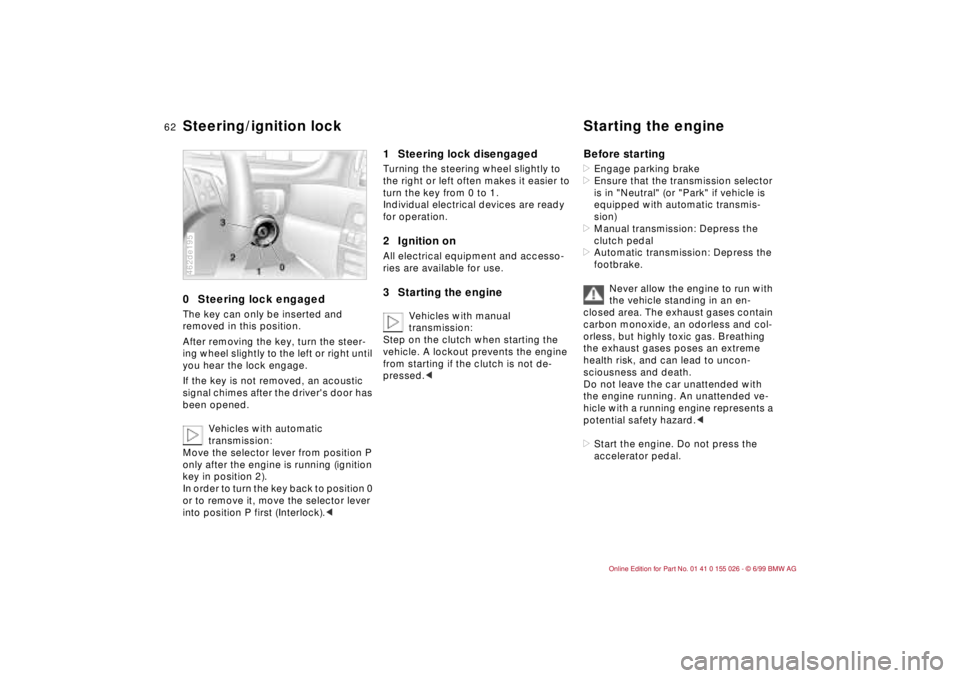
0 Steering lock engaged The key can only be inserted and
removed in this position.
After removing the key, turn the steer-
ing wheel slightly to the left or right until
you hear the lock engage.
If the key is not removed, an acoustic
signal chimes after the driver's door has
been opened.
Vehicles with automatic
transmission:
Move the selector lever from position P
only after the engine is running (ignition
key in position 2).
In order to turn the key back to position 0
or to remove it, move the selector lever
into position P first (Interlock).<462de195
1 Steering lock disengaged Turning the steering wheel slightly to
the right or left often makes it easier to
turn the key from 0 to 1.
Individual electrical devices are ready
for operation.2 Ignition onAll electrical equipment and accesso-
ries are available for use.3 Starting the engine
Vehicles with manual
transmission:
Step on the clutch when starting the
vehicle. A lockout prevents the engine
from starting if the clutch is not de-
pressed.c
Before starting>Engage parking brake
>Ensure that the transmission selector
is in "Neutral" (or "Park" if vehicle is
equipped with automatic transmis-
sion)
>Manual transmission: Depress the
clutch pedal
>Automatic transmission: Depress the
footbrake.
Never allow the engine to run with
the vehicle standing in an en-
closed area. The exhaust gases contain
carbon monoxide, an odorless and col-
orless, but highly toxic gas. Breathing
the exhaust gases poses an extreme
health risk, and can lead to uncon-
sciousness and death.
Do not leave the car unattended with
the engine running. An unattended ve-
hicle with a running engine represents a
potential safety hazard.<
>Start the engine. Do not press the
accelerator pedal.
Steering/ignition lock Starting the engine
Page 105 of 189
Overview
Controls and features
Operation, care
and maintenance
Owner service procedures
Technical data
Index Advanced technology
103n
RepairsIndexOverview Controls Car care Technology Data
Special operating instructions:
Break-in procedures104
Driving notes104
Catalytic converter105
Antilock Brake System
(ABS)106
Disc brakes108
Brake system109
Winter operation110
Power steering112
Cellular phones112
Radio reception112
Wheels and tires:
Tire inflation pressures113
Tire condition113
Tire replacement114
Tire rotation114
Wheel and tire
combinations115
Winter tires116
Snow chains116
Approved wheel and tire
specifications117Under the hood:
Hood119
Engine compartment120
Washer fluids122
Washer nozzles122
Engine oil123
Coolant126
Brake fluid127
Vehicle Identification
Number128
Care and maintenance:
The BMW Maintenance
System129
Caring for your car130
Airbags135
Vehicle storage136
Laws and regulations:
Technical modifications to the
vehicle136
OBD connector137
Page 108 of 189

106n
Antilock Brake System (ABS)The concept ABS enhances active safety by helping
to prevent the wheels from locking dur-
ing brake applications. Locked wheels
are dangerous. When the front wheels
slide, the driver loses steering control
over the vehicle. Traction loss at the
rear wheels can cause the rear end to
break into an uncontrolled skid.
The system can achieve the shortest
braking distances possible under most
conditions (on straight-aways and in
curves, on asphalt, ice, wet road sur-
faces, etc.).
ABS is designed to meet two essential
requirements during every brake appli-
cation:
>To help provide vehicle stability
>To help maintain steering control and
maneuverability – on all types of road
surfaces (asphalt, concrete, mud,
wet, snow, ice).
Braking with ABSThe system becomes operative once
the vehicle exceeds a speed of approx.
6 mph (10 km/h). Below approx. 3 mph
(6 km/h), it is once again deactivated.
This means that the wheels can lock in
the final phase of a panic stop – a factor
of no significance in actual use.
If you are in a situation that requires full
braking, you will exploit the full benefits
of the ABS system if you apply maxi-
mum brake pressure ("panic stop").
Since the vehicle maintains steering re-
sponsiveness, you can avoid possible
obstacles with a minimum of steering
effort, despite the full brake application.
The ABS system closed-loop control
circuit cycles in fractions of a second.
A pulsation at the brake pedal indicates
to the driver that ABS is active, that is,
that the vehicle is within its maximum
braking range. In addition, a pulsation –
a result of the control function cycles –
indicates to the driver that vehicle
speed should be reduced to adapt to
road surface conditions when there is
reduced traction and grip between tires
and road surface (slippery road sur-
face).
In driving conditions where there is a
loose upper surface together with a
subsurface that provides good traction (on gravel or snow, for instance), or with
snow chains, the braking distance may
also be longer than when the wheels
are locked. However, ABS continues to
provide enhanced vehicle stability and
steering response under these condi-
tions.
Information for your safetyNot even ABS can suspend the laws
of physics. ABS cannot prevent the
consequences of brake applications
with inadequate clearances for safety
between vehicles, when exceeding the
speed limit in curves, or the risks in-
volved when aquaplaning occurs. Re-
sponsibility for these types of situations
remains in the hands (and at the feet) of
the driver.
You should never allow the added
safety of ABS to lull you into a false
sense of security, or mislead you into
taking increased risks that could affect
your own safety and that of others.
Do not make any modifications to
the ABS system.
Service procedures on ABS are to be
performed by authorized technicians
only.<
Page 110 of 189

108n
Disc brakesDisc brakes furnish optimum decelera-
tion and braking control and greater
fade resistance under heavy use.
When the vehicle is driven only occa-
sionally, during extended periods when
the vehicle is not used at all, and in op-
erating conditions where brakes appli-
cations are less frequent, there is an in-
creased tendency for corrosion of the
rotors and accumulation of contamina-
tion on the brake pads. This occurs be-
cause the minimal pressure that must
be exerted by the pads to clean the
rotors by brake applications is not
reached.
If the brake rotors are corroded, they
will tend to respond to braking with a
pulsating effect that even extended
brake applications will fail to cure.
For your own safety: Only use
brake linings that BMW has re-
leased for your particular vehicle model.
BMW cannot vouch for driving safety or
the suitability of brake linings other than
those they have released.<
Driving notesWhile driving in wet conditions and in
heavy rain, it is effective to apply light
pressure to the brake pedal every few
miles (kilometers). Watch traffic condi-
tions to ensure that this maneuver does
not endanger other road users. The
heat that is generated by the brake ap-
plications helps to dry the brake pads
and rotors.
Maximum braking force is obtained
while the wheels continue to rotate,
peaking when the wheels remain on the
verge of locking without actually doing
so. ABS maintains this state automati-
cally. If the ABS fails, you should revert
to the staggered braking technique
described on page 110.
Long or steep mountain descents do
not necessarily lead to reduced braking
efficiency if you drive downhill with the
transmission in a gear that allows mini-
mal brake applications (or, with an auto-
matic transmission, in an appropriate
lower range).
You can further increase the engine's
braking effect by selecting a lower gear,
downshifting as far as first gear or plac-
ing the selector lever in position (1).Should engine braking prove inade-
quate, you should still avoid extended,
continuous braking. Instead of main-
taining low to moderate pressure over
an extended period of time, you should
decelerate the vehicle by applying more
substantial force on the pedal (watch
for following traffic!) and then pausing
before repeating the application. This
staggered braking technique allows the
brakes to cool in the intervals between
active braking phases, preventing over-
heating and ensuring that full braking
capacity remains available at all times.
Do not coast with the clutch de-
pressed or with the transmission
or selector lever in neutral. Do not drive
with the engine shut off. The engine
provides no braking effect when the
clutch pedal is depressed or the trans-
mission is in neutral, and there is no
power-assist for brakes and steering
when the engine is not running.
Never allow floor mats, carpets or any
other objects to protrude into the area
around the accelerator, clutch and
brake pedals and obstruct their move-
ment.<
Page 112 of 189

110n
Winter operationThe onset of winter is often accompa-
nied by rapid changes in weather. Adap-
tations in driving style should be accom-
panied by preparations on the vehicle
itself to ensure that your progress
through the winter remains safe and
trouble-free.CoolantBe sure that the coolant mixture is kept
at the year-round ratio of 50:50 of water
and antifreeze/corrosion protection.
This mixture provides protection against
freezing down to approx. – 347
(– 376). Replace the coolant every four
years.LocksBMW door lock deicer can be used to
free them if frozen. This deicer also
contains lubricant.
After using deicer, treatment with BMW
lock barrel grease is recommended.Rubber seals and components To prevent the weather-stripping from
freezing, apply a spray-on rubber treat-
ment or silicone spray to the door, hood
and luggage compartment lid seals.
A full range of car-care products is
available from your BMW center.<
Snow chains BMW snow chains
* can be mounted on
both summer and winter tires. Mount
them in pairs on the rear wheels only
and comply with the manufacturer's
safety precautions. Do not exceed a
maximum speed of 30 mph (50 km/h).
In this situation (snow chains mounted),
deactivate the DSC. Refer to page 81.
Starting offWe recommend that you use the man-
ual control switch to deactivate DSC
when starting off in deep snow or when
rocking the car to free it (refer to
page 81).Driving on low-traction road
surfacesUse smooth, gentle pressure to control
the accelerator pedal. Avoid excessive
engine speeds and shift to the next
higher gear at an early point. Adapt
your speed and driving style when ap-
proaching grades or slopes. Maintain
an adequate distance between yourself
and the car ahead.
BrakesWinter road conditions substantially
reduce the traction available between
the tires and the road surface.
Remember that braking distances will
be significantly longer as a result.
ABS is intended to prevent the wheels
from locking during brake applications,
thus helping to maintain vehicle stability
and steering response.
If the ABS does not respond in a critical
braking situation and the wheels lock:
Reduce the pressure on the brake
pedal until the wheels just start to roll
again while still maintaining enough
force to continue braking. Then in-
crease the pressure, reduce the pres-
sure when the wheels lock, reapply
pressure etc.
This staggered braking procedure will
reduce stopping distances while help-
ing you maintain steering control.
You can then attempt to steer around
hazards after you have reduced pres-
sure on the brake pedal.
Page 118 of 189

116n
Winter tiresChoosing the right tireBMW recommends winter tires (M+S
radial tires) for driving in adverse winter
road conditions. Although all-season
M+S tires provide better winter traction
than standard summer tires with H, V,
W, Y and ZR speed ratings, they gener-
ally fail to provide the same levels of
performance as standard snow tires in
winter driving.
For of safe tracking and steering re-
sponse, install winter tires made by the
same manufacturer having the same
tread configuration on all four wheels.
Mount only winter tires approved by
BMW. Any BMW center will be glad to
provide you with information on the
best winter tires for your particular driv-
ing conditions.Never exceed the maximum speed
for that the tires are rated.
Unprofessional attempts by laymen to
service tires can lead to damage and
accidents.
Have this work performed by skilled
professionals only. Your BMW center
will be glad to assist you with both their
expertise and the proper equipment for
your vehicle.<
Tire condition, tire pressureWinter tires display a perceptible loss in
their ability to cope with winter driving
conditions once the tread wears to be-
low 0.16 in (4 mm), and should thus be
replaced.
Comply with the specified tire inflation
pressures – and be sure to have the
wheel and tire assemblies balanced
every time you change the tires.
StorageStore tires in a cool, dry place, away
from light whenever possible. Protect
the tires against contact with oil, grease
and fuel.Snow chains
*
Use narrow-link BMW snow chains on
summer or winter tires only in pairs and
only on the rear wheels. Comply with all
manufacturer's safety precautions when
mounting the chains.
Page 137 of 189
135n
RepairsIndexOverview Controls Car care Technology Data
Caring for your car Airbags
Cleaning agents can contain sub-
stances that are dangerous or
pose health risks. Therefore always
comply with the warnings and danger
notices on the package.
Open the doors or windows on your
vehicle when cleaning the interior.
Never clean your vehicle with solvents
or other materials not specifically in-
tended for this application.<
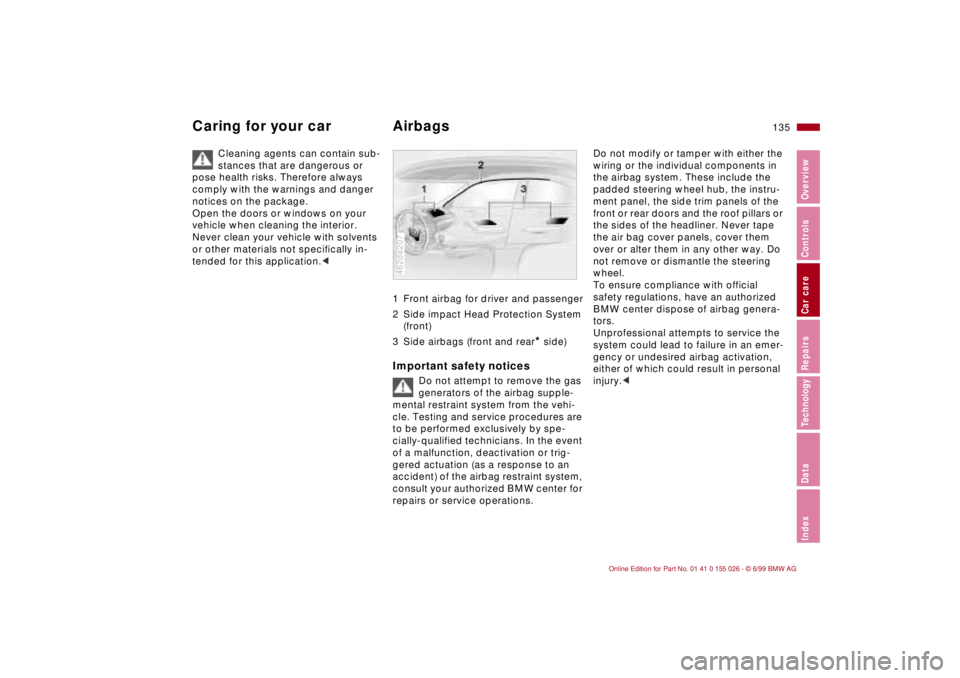
1 Front airbag for driver and passenger
2 Side impact Head Protection System
(front)
3 Side airbags (front and rear
* side)
Important safety notices
Do not attempt to remove the gas
generators of the airbag supple-
mental restraint system from the vehi-
cle. Testing and service procedures are
to be performed exclusively by spe-
cially-qualified technicians. In the event
of a malfunction, deactivation or trig-
gered actuation (as a response to an
accident) of the airbag restraint system,
consult your authorized BMW center for
repairs or service operations.
462de207
Do not modify or tamper with either the
wiring or the individual components in
the airbag system. These include the
padded steering wheel hub, the instru-
ment panel, the side trim panels of the
front or rear doors and the roof pillars or
the sides of the headliner. Never tape
the air bag cover panels, cover them
over or alter them in any other way. Do
not remove or dismantle the steering
wheel.
To ensure compliance with official
safety regulations, have an authorized
BMW center dispose of airbag genera-
tors.
Unprofessional attempts to service the
system could lead to failure in an emer-
gency or undesired airbag activation,
either of which could result in personal
injury.<
Page 150 of 189
148n
Changing tires
Take these precautionary mea-
sures if you have either a flat tire
or are changing the tire:
Park the vehicle as far from the flow of
traffic as possible and on firm ground.
Switch on the hazard flashers. Turn the
steering wheel to the straight-ahead
position, remove the key and engage
the steering lock. Shift into 1st or re-
verse (selector lever in "Park" with auto-
matic) and engage the parking brake.
All passengers should be outside the
car and well away from your immediate
working area (behind the guardrail, for
instance).
If a warning triangle or portable hazard
warning lamp is available, set it up on
the roadside at an appropriate distance
from the rear of the vehicle. Comply
with all safety guidelines and regula-
tions.
Change the wheel only on a level, firm
surface that is not slippery. Avoid jack-
ing the car on a soft or slippery support
surface (snow, ice, loose gravel, etc.),
as it could slide sideways.
Ensure that the jack is positioned on a
solid support surface.
Do not place wooden blocks or similar
objects under the jack. If this done, the
jack might not be able to reach its full
support capacity because of the limited
height.
Do not lie under the vehicle or start the
engine when the vehicle is supported
by the jack – risk of fatal injury.<
Your BMW has either a spare
* or
space-saver tire
* for temporary use and
to ensure your mobility.
Take the luggage compartment
floor panel completely out to
remove the spare tire
* (refer to
page 41).<
You will the need the followingIn order to avoid rattling noises later,
note the position of the tools when you
remove them and return them to their
original position when you are through
using them.
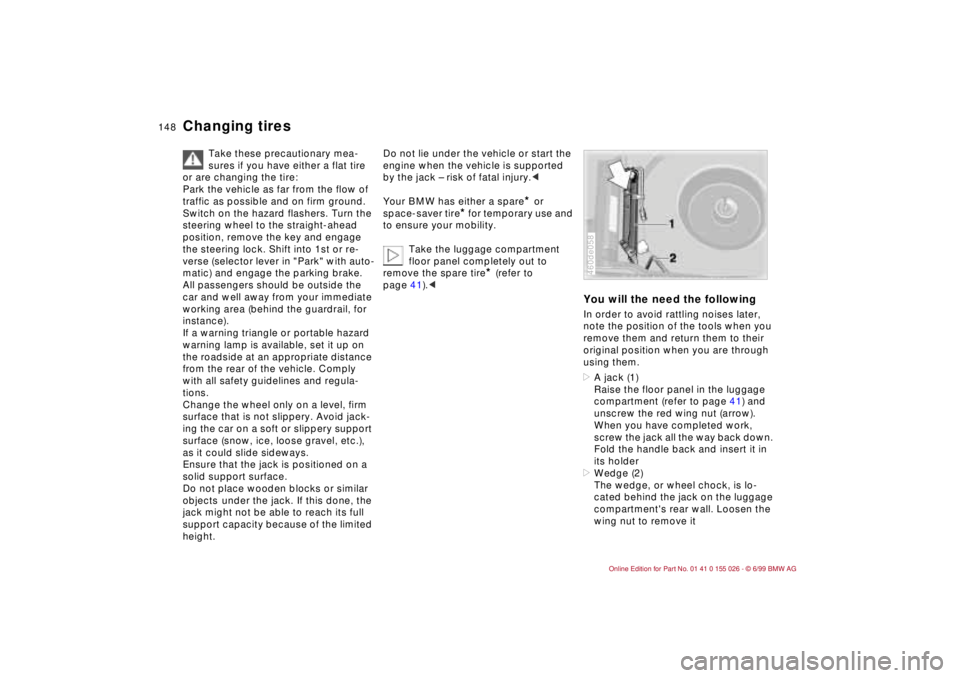
>A jack (1)
Raise the floor panel in the luggage
compartment (refer to page 41) and
unscrew the red wing nut (arrow).
When you have completed work,
screw the jack all the way back down.
Fold the handle back and insert it in
its holder
>Wedge (2)
The wedge, or wheel chock, is lo-
cated behind the jack on the luggage
compartment's rear wall. Loosen the
wing nut to remove it460de058
Page 153 of 189
151n
RepairsIndexOverview Controls Car care Technology Data
Changing tires Battery Driving with the space-saver
spare tire
*
Drive cautiously and do not exceed a
speed of 45 mph (80 km/h).
Be aware that vehicle handling will be
altered. Slower brake response time,
longer braking distances and changed
steering characteristics may be antici-
pated when approaching limit condi-
tions.
The changes in handling characteristics
will be even more pronounced in con-
junction with winter tires.
Only one space-saver spare tire
may be mounted. Mount a wheel
and tire with the same size and specifi-
cations as the others at the earliest
possible opportunity. Maintain correct
tire pressures. Refer to page 28.<
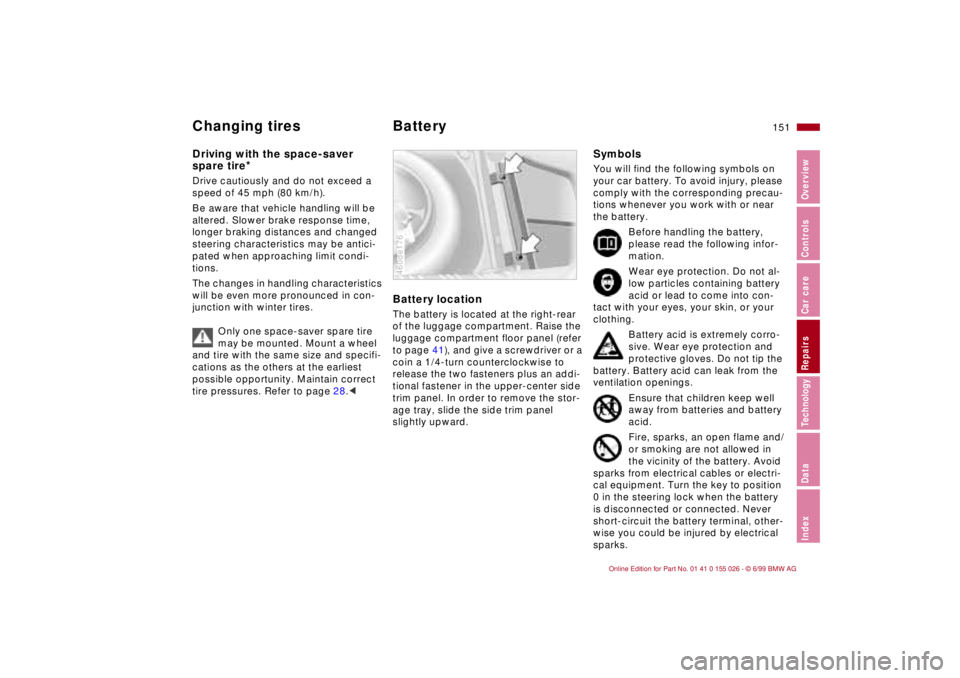
Battery location The battery is located at the right-rear
of the luggage compartment. Raise the
luggage compartment floor panel (refer
to page 41), and give a screwdriver or a
coin a 1/4-turn counterclockwise to
release the two fasteners plus an addi-
tional fastener in the upper-center side
trim panel. In order to remove the stor-
age tray, slide the side trim panel
slightly upward.460de176
SymbolsYou will find the following symbols on
your car battery. To avoid injury, please
comply with the corresponding precau-
tions whenever you work with or near
the battery.
Before handling the battery,
please read the following infor-
mation.
Wear eye protection. Do not al-
low particles containing battery
acid or lead to come into con-
tact with your eyes, your skin, or your
clothing.
Battery acid is extremely corro-
sive. Wear eye protection and
protective gloves. Do not tip the
battery. Battery acid can leak from the
ventilation openings.
Ensure that children keep well
away from batteries and battery
acid.
Fire, sparks, an open flame and/
or smoking are not allowed in
the vicinity of the battery. Avoid
sparks from electrical cables or electri-
cal equipment. Turn the key to position
0 in the steering lock when the battery
is disconnected or connected. Never
short-circuit the battery terminal, other-
wise you could be injured by electrical
sparks.
Page 163 of 189
161n
RepairsIndexOverview Controls Car care Technology Data
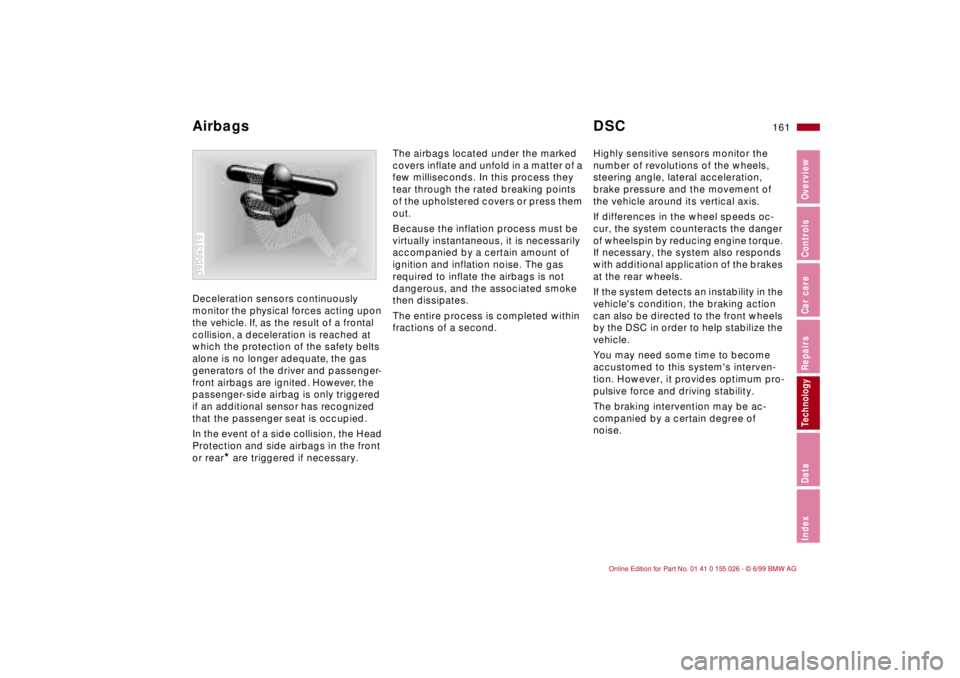
Deceleration sensors continuously
monitor the physical forces acting upon
the vehicle. If, as the result of a frontal
collision, a deceleration is reached at
which the protection of the safety belts
alone is no longer adequate, the gas
generators of the driver and passenger-
front airbags are ignited. However, the
passenger-side airbag is only triggered
if an additional sensor has recognized
that the passenger seat is occupied.
In the event of a side collision, the Head
Protection and side airbags in the front
or rear
* are triggered if necessary.
390de319
The airbags located under the marked
covers inflate and unfold in a matter of a
few milliseconds. In this process they
tear through the rated breaking points
of the upholstered covers or press them
out.
Because the inflation process must be
virtually instantaneous, it is necessarily
accompanied by a certain amount of
ignition and inflation noise. The gas
required to inflate the airbags is not
dangerous, and the associated smoke
then dissipates.
The entire process is completed within
fractions of a second.Highly sensitive sensors monitor the
number of revolutions of the wheels,
steering angle, lateral acceleration,
brake pressure and the movement of
the vehicle around its vertical axis.
If differences in the wheel speeds oc-
cur, the system counteracts the danger
of wheelspin by reducing engine torque.
If necessary, the system also responds
with additional application of the brakes
at the rear wheels.
If the system detects an instability in the
vehicle's condition, the braking action
can also be directed to the front wheels
by the DSC in order to help stabilize the
vehicle.
You may need some time to become
accustomed to this system's interven-
tion. However, it provides optimum pro-
pulsive force and driving stability.
The braking intervention may be ac-
companied by a certain degree of
noise.
Airbags DSC