tires BMW 323Ci 2000 User Guide
[x] Cancel search | Manufacturer: BMW, Model Year: 2000, Model line: 323Ci, Model: BMW 323Ci 2000Pages: 189, PDF Size: 1.68 MB
Page 115 of 189
113n
RepairsIndexOverview Controls Car care Technology Data
Information for your safetyThe factory-approved radial tires are
matched to the car and have been se-
lected to provide optimum safety and
driving comfort on your car.
It is not merely the tire's service life, but
also driving comfort and – above all
else – driving safety that depend on the
condition of the tires and the mainte-
nance of the specified tire pressure.
Incorrect inflation pressure is a frequent
cause of tire damage. It also signifi-
cantly influences the roadholding ability
of your BMW.
Check tire inflation pressure regu-
larly — including the space-saver
and/or the spare tire — at least twice a
month and before beginning a longer
road trip. Incorrect tire pressure can
otherwise lead to tire damage and acci-
dents.<
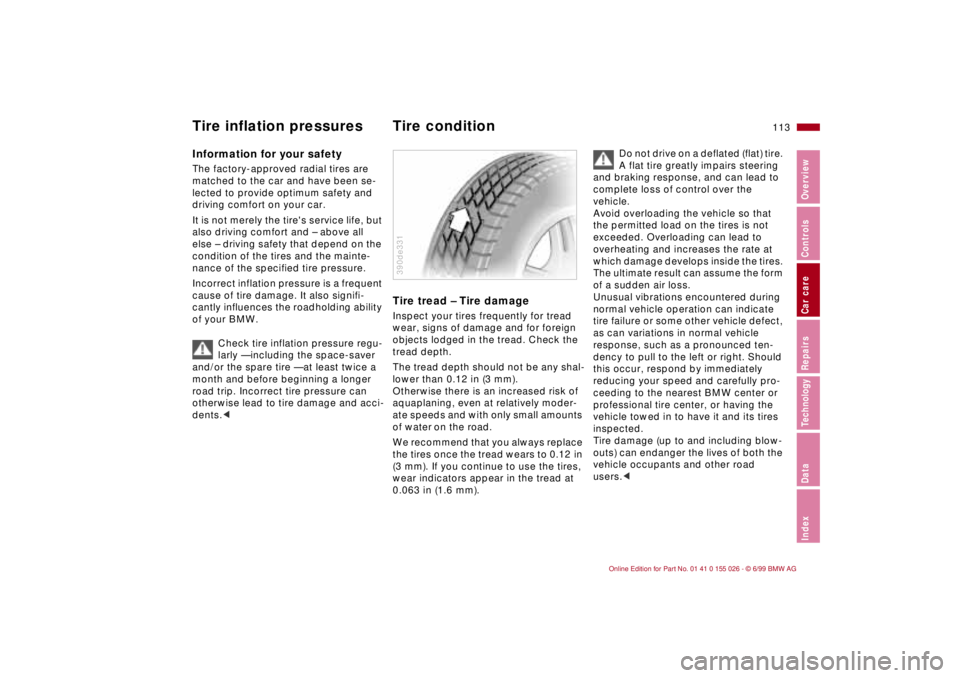
Tire tread – Tire damageInspect your tires frequently for tread
wear, signs of damage and for foreign
objects lodged in the tread. Check the
tread depth.
The tread depth should not be any shal-
lower than 0.12 in (3 mm).
Otherwise there is an increased risk of
aquaplaning, even at relatively moder-
ate speeds and with only small amounts
of water on the road.
We recommend that you always replace
the tires once the tread wears to 0.12 in
(3 mm). If you continue to use the tires,
wear indicators appear in the tread at
0.063 in (1.6 mm).390de331
Do not drive on a deflated (flat) tire.
A flat tire greatly impairs steering
and braking response, and can lead to
complete loss of control over the
vehicle.
Avoid overloading the vehicle so that
the permitted load on the tires is not
exceeded. Overloading can lead to
overheating and increases the rate at
which damage develops inside the tires.
The ultimate result can assume the form
of a sudden air loss.
Unusual vibrations encountered during
normal vehicle operation can indicate
tire failure or some other vehicle defect,
as can variations in normal vehicle
response, such as a pronounced ten-
dency to pull to the left or right. Should
this occur, respond by immediately
reducing your speed and carefully pro-
ceeding to the nearest BMW center or
professional tire center, or having the
vehicle towed in to have it and its tires
inspected.
Tire damage (up to and including blow-
outs) can endanger the lives of both the
vehicle occupants and other road
users.<
Tire inflation pressures Tire condition
Page 116 of 189

114n
To maintain good handling and vehicle
response, use only tires of a single
tread configuration from a single manu-
facturer. BMW tests and approves
wheel/tire combinations. Refer to
page 117.
Do not use retreaded tires, since
driving safety may be impaired by
their use. This due to the possible varia-
tions in casing structures and, in some
cases, to their extreme age, that can
lead to a decrease in their durability.<
Tire ageThe date on which the tire was manu-
factured is indicated by the code on the
sidewall:
DOT ... 129 indicates that the tire was
manufactured in Week 12 of 1999.
BMW recommends the replacement of
all tires when the tires are no more than
6 years old, even if a tire life of 10 years
is possible.
Spare tires over 6 years old should be
used only in case of emergency. Such
a tire should be replaced by a new tire
immediately, and should not be fitted
together with new tires.
Between the axlesThe tread wear patterns at the front end
differ from those at the rear – the actual
patterns will vary according to individ-
ual driving conditions. In the interests of
safety and maintaining optimal handling
characteristics, tire rotation is not rec-
ommended.
If a proposed interaxle rotation of tires
is based on economic considerations,
one should consider whether the costs
for the rotation are likely to be recap-
tured by any increase in the service life
of the tires which might be realized.
In principle, interaxle rotation should be
performed in short intervals, with a
maximum of 3,000 miles (5,000 km).
Consult your authorized BMW center
for more information.
Should you decide to rotate the tires, it
is essential to comply with the following:
Rotate tires on the same side only, since
braking characteristics and road grip
could otherwise be adversely affected.
Following rotation, correct the tire infla-
tion pressure.
If different tire sizes are mounted
on the front and rear axles (refer to
page 117), the wheels may not be ro-
tated from one axle to the other.<
Tire replacement Tire rotation
Page 117 of 189

115n
RepairsIndexOverview Controls Car care Technology Data
Wheel and tire combinations The right choice Use only BMW-approved tires, refer to
page 117.
Due to the high speeds this vehicle can
achieve, the use of specific tire brands,
specifications and dimensions is man-
datory.
Consult any BMW center for details.
Comply with local/national regulations.
The correct wheel/tire combinaton
affects different sytems, such as
ABS, ATC, DSC. The function of these
systems can be impaired if the correct
combinaton is not used.
Therefore, only use tires of the same
brand and tread pattern. Replace a flat
tire with an approved wheel/tire combi-
nation as soon as possible.<
Codes on the tires and wheels The tire codes will aid you in selecting
the correct tire.
Codes on radial tires:
The speed rating indicates the ap-
proved maximum speed for the tire.
Summer tires:
S = up to 112 mph (180 km/h)
T = up to 118 mph (190 km/h)
H = up to 130 mph (210 km/h)
V = up to 150 mph (240 km/h)
W = up to 167 mph (270 km/h)
Y = above 167 mph (270 km/h)
ZR = above 150 mph (240 km/h) Example:
Nominal width
in mm
Aspect ratio in %
Radial tire code
Rim diameter in inches
Load rating
(not on ZR tires)
Speed rating
(before R on ZR tires)
225/50 R
1692W
Winter tires:
Q M+S = up to 100 mph (160 km/h)
T M+S = up to 118 mph (190 km/h)
H M+S = up to 130 mph (210 km/h)
Codes stamped on light-alloy wheels:
Protect valve inserts against dirt using
screw-on valve stem caps. Dirt in the
valves frequently leads to slow leaks. Example:
Rim width
in inches
Code letter for
flange type
Symbol for full-drop
center rim
Rim diameter in inches
Hump on the 2 rim shoulders
7 x 16 H 2
J
Page 118 of 189

116n
Winter tiresChoosing the right tireBMW recommends winter tires (M+S
radial tires) for driving in adverse winter
road conditions. Although all-season
M+S tires provide better winter traction
than standard summer tires with H, V,
W, Y and ZR speed ratings, they gener-
ally fail to provide the same levels of
performance as standard snow tires in
winter driving.
For of safe tracking and steering re-
sponse, install winter tires made by the
same manufacturer having the same
tread configuration on all four wheels.
Mount only winter tires approved by
BMW. Any BMW center will be glad to
provide you with information on the
best winter tires for your particular driv-
ing conditions.Never exceed the maximum speed
for that the tires are rated.
Unprofessional attempts by laymen to
service tires can lead to damage and
accidents.
Have this work performed by skilled
professionals only. Your BMW center
will be glad to assist you with both their
expertise and the proper equipment for
your vehicle.<
Tire condition, tire pressureWinter tires display a perceptible loss in
their ability to cope with winter driving
conditions once the tread wears to be-
low 0.16 in (4 mm), and should thus be
replaced.
Comply with the specified tire inflation
pressures – and be sure to have the
wheel and tire assemblies balanced
every time you change the tires.
StorageStore tires in a cool, dry place, away
from light whenever possible. Protect
the tires against contact with oil, grease
and fuel.Snow chains
*
Use narrow-link BMW snow chains on
summer or winter tires only in pairs and
only on the rear wheels. Comply with all
manufacturer's safety precautions when
mounting the chains.
Page 119 of 189

117n
RepairsIndexOverview Controls Car care Technology Data
Approved wheel and tire specifications Tire specifications Steel rim (wheel rim) Light-alloy wheel
BMW 323Ci
All-Season
195/65 R 15 91 H – 6.5Jx15
Summer tires
195/65 R 15 91 H – 6.5Jx15
205/60 R 15 91 H – 6.5Jx15
7Jx15
205/55 R 16 91 H
225/50 R 16 92 W
225/50 ZR 16– 7Jx16
225/45 R 17 91 W – 8Jx17
Front: 225/45 ZR 17 – 7.5Jx17
Rear: 245/40 ZR 17 – 8.5Jx17
Winter tires
195/65 R 15 91 Q M+S 6.5Jx15 6.5Jx15
205/60 R 15 91 Q M+S 6.5Jx15 6.5Jx15
7Jx15
205/55 R 16 91 Q M + S
225/50 R 16 92 Q M + S7Jx16 7Jx16
225/45 R 17 91 Q M + S – 8Jx17
Space-saver spare tire
T 125/90 R 15 96 M 3.5Bx15 –
T 125/90 R 16 98 M 3.5Bx16 –
Pay attention to the specifications for tires and wheels in the vehicle's
manuals. If you install tire sizes not approved by the manufacturer,
you are required to enter this in the vehicle documents.
Snow chains
*
Snow chains cannot be mounted on the
following tires:
225/50 R 16 92 W
225/50 ZR 16
225/45 R 17 91 W
225/50 R 16 92 Q/T/H
225/45 R 17 91 Q/T/HMixed tiresFor details concerning tire manufactur-
ers for mixed tires, refer to the original-
equipment specifications.
Page 120 of 189

118n
Approved wheel and tire specifications Tire specifications Steel rim (wheel rim) Light-alloy wheel
BMW 328Ci
All-Season
205/55 R 16 91 H – 7Jx16
Summer tires
205/55 R 16 91 H
225/50 R 16 92 H
225/50 ZR 16– 7Jx16
225/45 R 17 91 H – 8Jx17
Front: 225/45 ZR 17 – 7.5Jx17
Rear: 245/40 ZR 17 – 8.5Jx17
Winter tires
205/55 R 16 91 Q M + S
225/50 R 16 92 Q M + S7Jx16 7Jx16
225/45 R 17 91 Q M + S – 8Jx17
Space-saver spare tire
T 125/90 R 16 98 M 3.5Bx16 –
Pay attention to the specifications for tires and wheels in the vehicle's
manuals. If you install tire sizes not approved by the manufacturer, you
are required to enter this in the vehicle documents.
Snow chains
*
Snow chains cannot be mounted on the
following tires:
225/50 R 16 92 W
225/50 ZR 16
225/45 R 17 91 W
225/50 R 16 92 Q/T/H
225/45 R 17 91 Q/T/HMixed tiresFor details concerning tire manufactur-
ers for mixed tires, refer to the original-
equipment specifications.
Page 132 of 189

130n
Washing your car Right from the start, you can wash your
new BMW in an automatic car wash.
Car wash systems that do not employ
brushes are preferable.
Wipe away tough dirt and loosen and
remove dead insects before washing
the car.
To prevent spots, avoid washing when
the hood is still warm, or immediately
after and during exposure to strong
sunlight.
When using an automatic car wash, be
sure that:
>The car wash system is suited for the
dimensions of your vehicle
>No damage will occur on vehicles
with attached body accessories (such
as spoilers or antennas). Consult the
car wash operator if necessary
>The wheels and tires of your vehicle
cannot be damaged by the convey-
ance devices of the car wash system
>The vehicle is cleaned with minimum
brush pressure, and that ample water
is available for washing and rinsing.Vehicles with rain sensor:
Clean the windshield regularly. Wax
from car washes or the presence of
dead insects can cause rain sensor
malfunctions.
Switch the rain sensor off when
the vehicle passes through the car
wash (refer to page 70). Damage could
occur by an undesired actuation of the
wipers if the system is not deacti-
vated.<
Parts of the car that are inaccessible
to the automatic washer – such as door
sills, door and hood edges, etc. –
should be cleaned by hand.
In the winter months, it is especially im-
portant to ensure that the car is washed
on a regular basis. Large quantities of
dirt and road salt are difficult to remove,
and they also cause damage to the ve-
hicle.
If spray wands or high-pressure
washers are used, be sure to
maintain an adequate distance between
the spray source and the vehicle's sur-
face. Inadequate distance and exces-
sive pressure can damage or weaken
the finish, making it more susceptible to
subsequent attack. In addition, mois-
ture could penetrate to vehicle compo-
nents, leading to long-term damage.<
When cleaning the headlamps,
please observe the following:
>Do not rub dry. Never use abrasives
or strong cleaning agents to clean the
covers
>Remove dirt and contamination
(such as insects) by soaking with
BMW Car Shampoo and then rinsing
with plenty of water
>Always use a deicer spray to remove
accumulated ice and snow – never
use a scraper.<
After washing the car, apply the
brakes briefly to dry them. Braking
efficiency might otherwise be reduced
by the moisture and the brake rotors
could also be corroded.<
Caring for your car
Page 141 of 189
Overview
Controls and features
Operation, care
and maintenance
Owner service procedures
Technical data
Index Advanced technology
139n
RepairsIndexOverview Controls Car care Technology Data
Replacement procedures:
Onboard tool kit140
Windshield wiper blades140
Lamps and bulbs140
Remote control147
Changing tires148
Battery151
Fuses153
Microfilter154
In case of electrical
malfunction:
Fuel filler door155
Sliding/tilt sunroof155
Assistance, giving and
receiving:
Jump-starting156
Towing the vehicle157
Page 150 of 189
148n
Changing tires
Take these precautionary mea-
sures if you have either a flat tire
or are changing the tire:
Park the vehicle as far from the flow of
traffic as possible and on firm ground.
Switch on the hazard flashers. Turn the
steering wheel to the straight-ahead
position, remove the key and engage
the steering lock. Shift into 1st or re-
verse (selector lever in "Park" with auto-
matic) and engage the parking brake.
All passengers should be outside the
car and well away from your immediate
working area (behind the guardrail, for
instance).
If a warning triangle or portable hazard
warning lamp is available, set it up on
the roadside at an appropriate distance
from the rear of the vehicle. Comply
with all safety guidelines and regula-
tions.
Change the wheel only on a level, firm
surface that is not slippery. Avoid jack-
ing the car on a soft or slippery support
surface (snow, ice, loose gravel, etc.),
as it could slide sideways.
Ensure that the jack is positioned on a
solid support surface.
Do not place wooden blocks or similar
objects under the jack. If this done, the
jack might not be able to reach its full
support capacity because of the limited
height.
Do not lie under the vehicle or start the
engine when the vehicle is supported
by the jack – risk of fatal injury.<
Your BMW has either a spare
* or
space-saver tire
* for temporary use and
to ensure your mobility.
Take the luggage compartment
floor panel completely out to
remove the spare tire
* (refer to
page 41).<
You will the need the followingIn order to avoid rattling noises later,
note the position of the tools when you
remove them and return them to their
original position when you are through
using them.
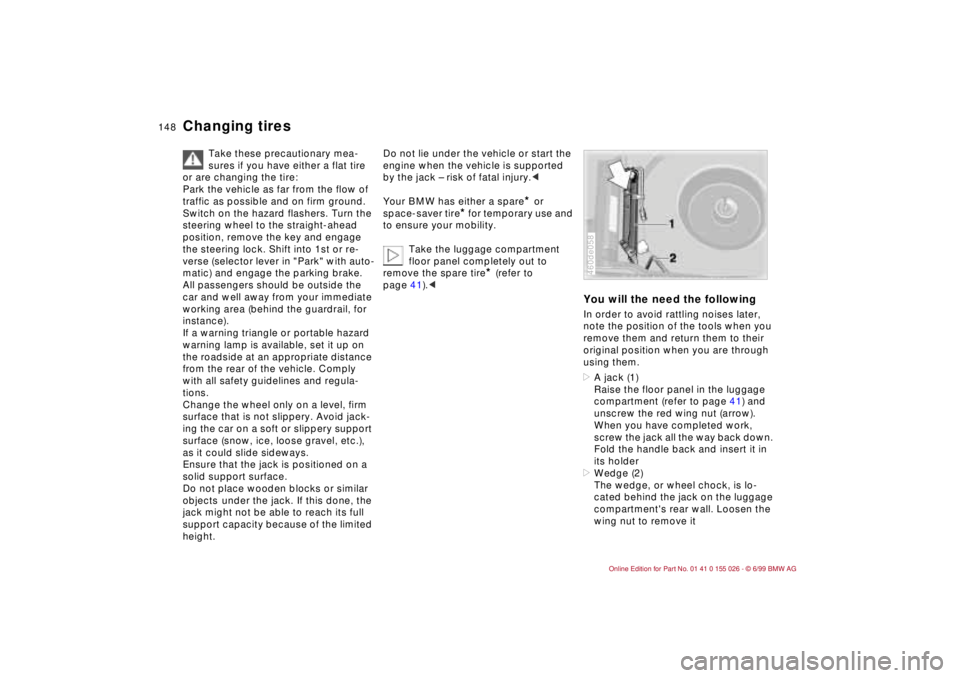
>A jack (1)
Raise the floor panel in the luggage
compartment (refer to page 41) and
unscrew the red wing nut (arrow).
When you have completed work,
screw the jack all the way back down.
Fold the handle back and insert it in
its holder
>Wedge (2)
The wedge, or wheel chock, is lo-
cated behind the jack on the luggage
compartment's rear wall. Loosen the
wing nut to remove it460de058
Page 151 of 189
149n
RepairsIndexOverview Controls Car care Technology Data
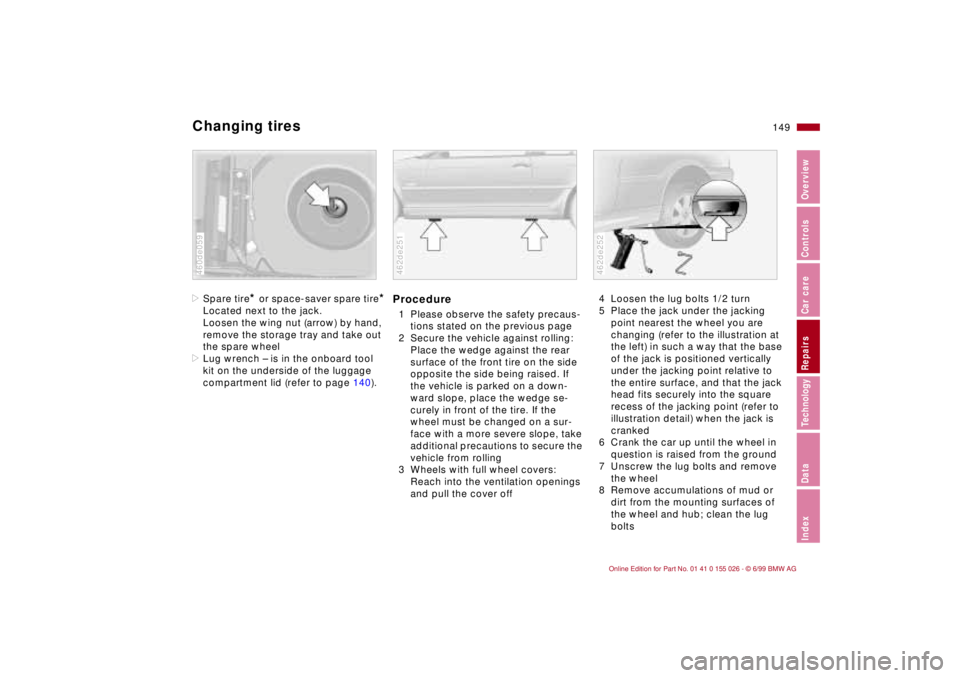
Changing tires>Spare tire
* or space-saver spare tire
*
Located next to the jack.
Loosen the wing nut (arrow) by hand,
remove the storage tray and take out
the spare wheel
>Lug wrench – is in the onboard tool
kit on the underside of the luggage
compartment lid (refer to page 140).460de059
Procedure1 Please observe the safety precaus-
tions stated on the previous page
2 Secure the vehicle against rolling:
Place the wedge against the rear
surface of the front tire on the side
opposite the side being raised. If
the vehicle is parked on a down-
ward slope, place the wedge se-
curely in front of the tire. If the
wheel must be changed on a sur-
face with a more severe slope, take
additional precautions to secure the
vehicle from rolling
3 Wheels with full wheel covers:
Reach into the ventilation openings
and pull the cover off462de251
4 Loosen the lug bolts 1/2 turn
5 Place the jack under the jacking
point nearest the wheel you are
changing (refer to the illustration at
the left) in such a way that the base
of the jack is positioned vertically
under the jacking point relative to
the entire surface, and that the jack
head fits securely into the square
recess of the jacking point (refer to
illustration detail) when the jack is
cranked
6 Crank the car up until the wheel in
question is raised from the ground
7 Unscrew the lug bolts and remove
the wheel
8 Remove accumulations of mud or
dirt from the mounting surfaces of
the wheel and hub; clean the lug
bolts462de252