transmission BMW 323Ci 2000 User Guide
[x] Cancel search | Manufacturer: BMW, Model Year: 2000, Model line: 323Ci, Model: BMW 323Ci 2000Pages: 189, PDF Size: 1.68 MB
Page 68 of 189
66n
Automatic transmission with Steptronic
*
You have the option of driving a normal
automatic transmission or switching to
manual.
Whenever you shift the selector lever
out of position D toward the left and
into the M/S gate, the automatic trans-
mission's sports-emphasized shift pro-
gram activates. As soon as you even
begin to move the selector lever in the
direction "+" or "–", Steptronic shifts the
gear and manual operation becomes
active. Whenever you want to use auto-
matic again, just shift the selector lever
toward the right to position D.
The Steptronic automatic transmission
is equipped with ATC (Adaptive Trans-
mission Control). ATC reacts with preci-
sion to your individual driving style and
the current driving conditions. This is
the reason why various shift programs
are used.
For details concerning ATC, please
refer to the chapter "Advanced Tech-
nology" on page 160.
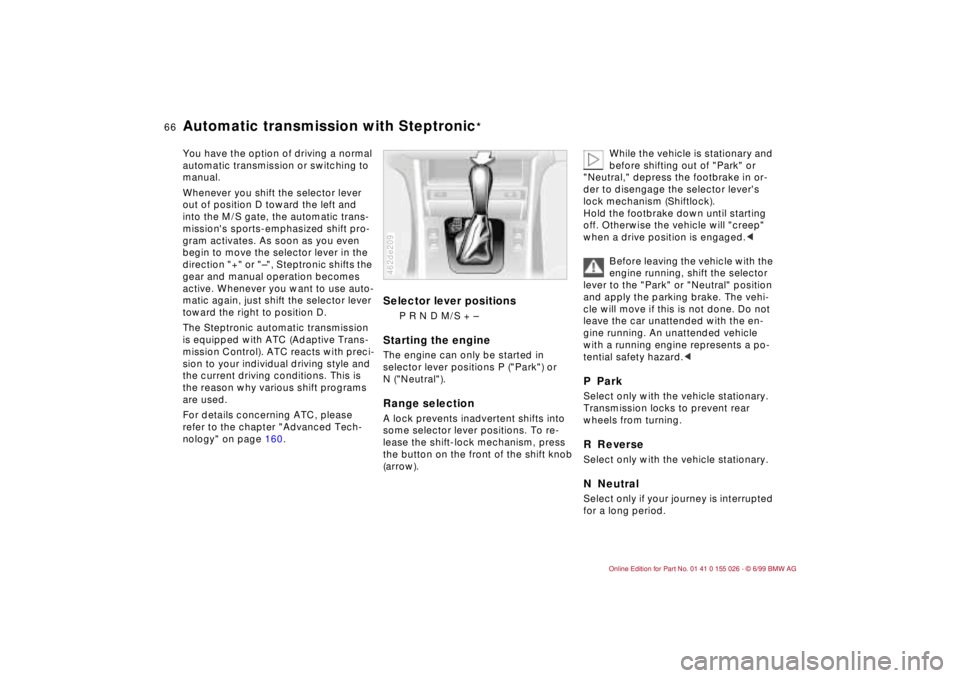
Selector lever positions
P R N D M/S + –
Starting the engineThe engine can only be started in
selector lever positions P ("Park") or
N ("Neutral").Range selectionA lock prevents inadvertent shifts into
some selector lever positions. To re-
lease the shift-lock mechanism, press
the button on the front of the shift knob
(arrow).462de209
While the vehicle is stationary and
before shifting out of "Park" or
"Neutral," depress the footbrake in or-
der to disengage the selector lever's
lock mechanism (Shiftlock).
Hold the footbrake down until starting
off. Otherwise the vehicle will "creep"
when a drive position is engaged.<
Before leaving the vehicle with the
engine running, shift the selector
lever to the "Park" or "Neutral" position
and apply the parking brake. The vehi-
cle will move if this is not done. Do not
leave the car unattended with the en-
gine running. An unattended vehicle
with a running engine represents a po-
tential safety hazard.<
P ParkSelect only with the vehicle stationary.
Transmission locks to prevent rear
wheels from turning.R ReverseSelect only with the vehicle stationary.N NeutralSelect only if your journey is interrupted
for a long period.
Page 69 of 189
67n
RepairsIndexOverview Controls Car care Technology Data
Automatic transmission with Steptronic
*
D Drive (automatic shift program)This position is designed for driving un-
der all normal operating conditions. All
forward gears are available, the Adap-
tive Transmission Control (ATC) is fully
operational."Kickdown" (automatic downshift)In the "Kickdown" mode, you achieve
maximum performance.
To activate this mode, depress the ac-
celerator pedal beyond the full-throttle
position, at which a resistance point
must be overcome.
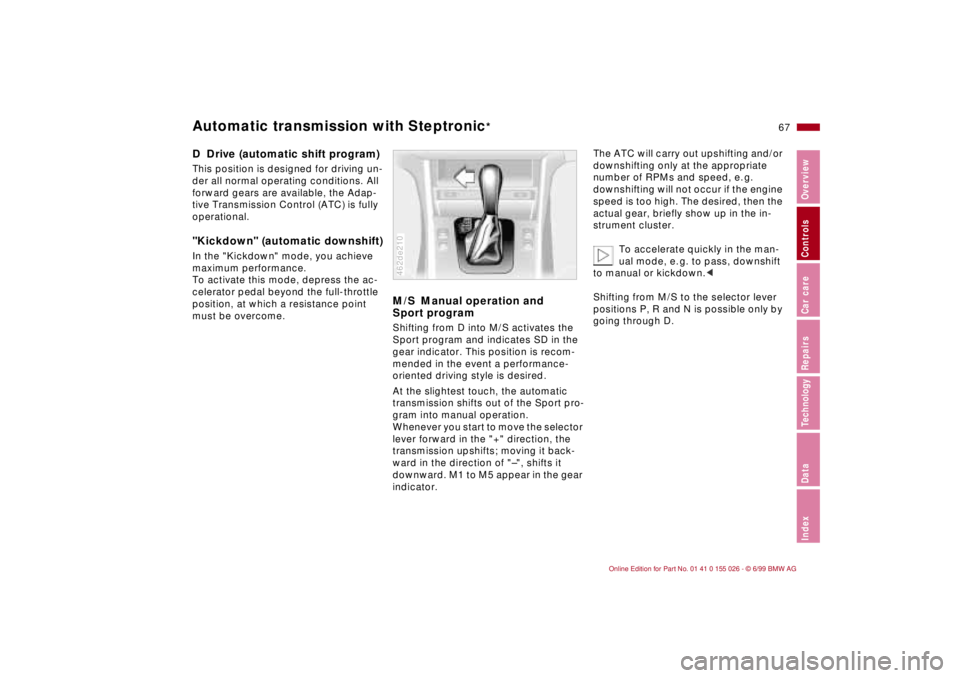
M/S Manual operation and
Sport programShifting from D into M/S activates the
Sport program and indicates SD in the
gear indicator. This position is recom-
mended in the event a performance-
oriented driving style is desired.
At the slightest touch, the automatic
transmission shifts out of the Sport pro-
gram into manual operation.
Whenever you start to move the selector
lever forward in the "+" direction, the
transmission upshifts; moving it back-
ward in the direction of "–", shifts it
downward. M1 to M5 appear in the gear
indicator.462de210
The ATC will carry out upshifting and/or
downshifting only at the appropriate
number of RPMs and speed, e. g.
downshifting will not occur if the engine
speed is too high. The desired, then the
actual gear, briefly show up in the in-
strument cluster.
To accelerate quickly in the man-
ual mode, e. g. to pass, downshift
to manual or kickdown.<
Shifting from M/S to the selector lever
positions P, R and N is possible only by
going through D.
Page 70 of 189
68n
Automatic transmission with Steptronic
*
The Steptronic will "think" for you in the
following situations:
>In order to keep the engine from
overrevving, it will automatically shift
into the next higher gear shortly be-
fore the governed speed.
>If you do not do anything to interfere,
it will automatically downshift at
lower speeds.
>In kickdown, it will downshift into the
lowest gear possible, depending on
the engine speed.
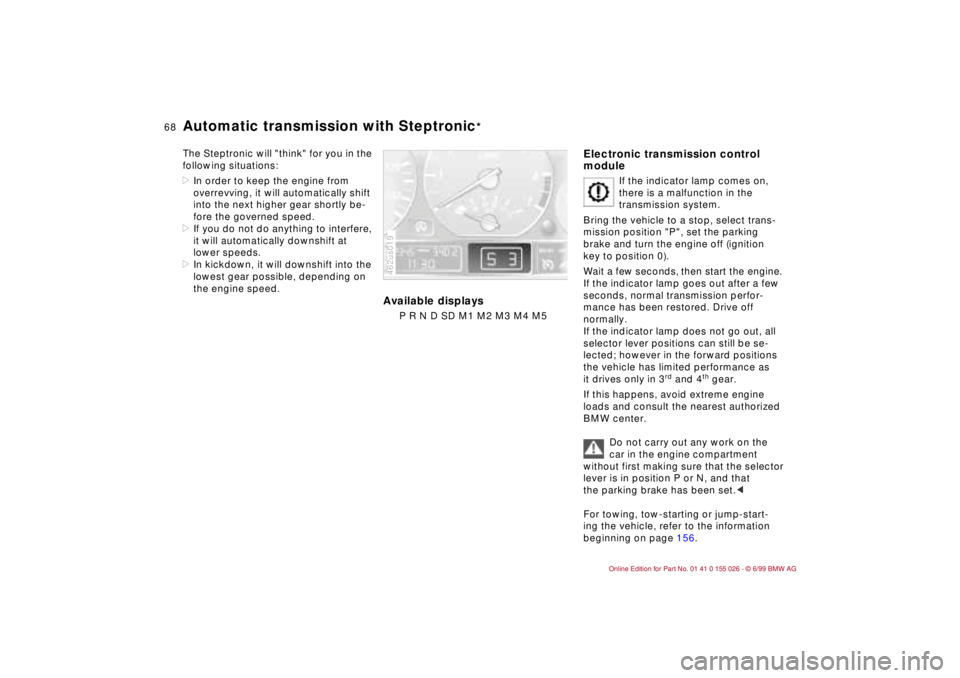
Available displays
P R N D SD M1 M2 M3 M4 M5462us019
Electronic transmission control
module
If the indicator lamp comes on,
there is a malfunction in the
transmission system.
Bring the vehicle to a stop, select trans-
mission position "P", set the parking
brake and turn the engine off (ignition
key to position 0).
Wait a few seconds, then start the engine.
If the indicator lamp goes out after a few
seconds, normal transmission perfor-
mance has been restored. Drive off
normally.
If the indicator lamp does not go out, all
selector lever positions can still be se-
lected; however in the forward positions
the vehicle has limited performance as
it drives only in 3
rd and 4
th gear.
If this happens, avoid extreme engine
loads and consult the nearest authorized
BMW center.
Do not carry out any work on the
car in the engine compartment
without first making sure that the selector
lever is in position P or N, and that
the parking brake has been set.<
For towing, tow-starting or jump-start-
ing the vehicle, refer to the information
beginning on page 156.
Page 75 of 189

73n
RepairsIndexOverview Controls Car care Technology Data
Cruise control In addition, cruise control is canceled
automatically:
>if the brakes are applied
>if the clutch is depressed or the auto-
matic transmission selector lever is
moved from "Drive" to "Neutral"
>if the cruise speed is either exceeded
or not met for an extended length of
time, e. g., when you step on the
accelerator pedal.
To resume the stored settingPress button 4:
The vehicle accelerates to and main-
tains the last speed stored. When you
turn the ignition key to position 0, the
stored speed is deleted from the sys-
tem's memory and the system is deacti-
vated.To deactivate the system When the cruise control has been can-
celed, press button 1 again. The indica-
tor lamp goes out and the stored speed
is deleted.Do not use cruise control on twist-
ing roads, when high traffic density
prevents driving at a constant speed,
when the road surface is slick (snow,
rain, ice), or when the road surface is
loose (rocks, sand).<
Page 110 of 189

108n
Disc brakesDisc brakes furnish optimum decelera-
tion and braking control and greater
fade resistance under heavy use.
When the vehicle is driven only occa-
sionally, during extended periods when
the vehicle is not used at all, and in op-
erating conditions where brakes appli-
cations are less frequent, there is an in-
creased tendency for corrosion of the
rotors and accumulation of contamina-
tion on the brake pads. This occurs be-
cause the minimal pressure that must
be exerted by the pads to clean the
rotors by brake applications is not
reached.
If the brake rotors are corroded, they
will tend to respond to braking with a
pulsating effect that even extended
brake applications will fail to cure.
For your own safety: Only use
brake linings that BMW has re-
leased for your particular vehicle model.
BMW cannot vouch for driving safety or
the suitability of brake linings other than
those they have released.<
Driving notesWhile driving in wet conditions and in
heavy rain, it is effective to apply light
pressure to the brake pedal every few
miles (kilometers). Watch traffic condi-
tions to ensure that this maneuver does
not endanger other road users. The
heat that is generated by the brake ap-
plications helps to dry the brake pads
and rotors.
Maximum braking force is obtained
while the wheels continue to rotate,
peaking when the wheels remain on the
verge of locking without actually doing
so. ABS maintains this state automati-
cally. If the ABS fails, you should revert
to the staggered braking technique
described on page 110.
Long or steep mountain descents do
not necessarily lead to reduced braking
efficiency if you drive downhill with the
transmission in a gear that allows mini-
mal brake applications (or, with an auto-
matic transmission, in an appropriate
lower range).
You can further increase the engine's
braking effect by selecting a lower gear,
downshifting as far as first gear or plac-
ing the selector lever in position (1).Should engine braking prove inade-
quate, you should still avoid extended,
continuous braking. Instead of main-
taining low to moderate pressure over
an extended period of time, you should
decelerate the vehicle by applying more
substantial force on the pedal (watch
for following traffic!) and then pausing
before repeating the application. This
staggered braking technique allows the
brakes to cool in the intervals between
active braking phases, preventing over-
heating and ensuring that full braking
capacity remains available at all times.
Do not coast with the clutch de-
pressed or with the transmission
or selector lever in neutral. Do not drive
with the engine shut off. The engine
provides no braking effect when the
clutch pedal is depressed or the trans-
mission is in neutral, and there is no
power-assist for brakes and steering
when the engine is not running.
Never allow floor mats, carpets or any
other objects to protrude into the area
around the accelerator, clutch and
brake pedals and obstruct their move-
ment.<
Page 113 of 189
111n
RepairsIndexOverview Controls Car care Technology Data
Winter operation
Do not shift down on slick road
surfaces. Doing so could cause
the rear wheels to lose traction and
skid, that could result in the loss of
vehicle control.<
Depress the clutch during hard
braking on road surfaces that pro-
vide only poor or uneven traction.<
Skid control Depress the clutch and release the
accelerator pedal, or place the selector
lever of the automatic transmission into
the "Neutral" position. Countersteer
carefully and attempt to regain control
of the vehicle.
ParkingEngage 1st or reverse gear. If your car
is equipped with an automatic transmis-
sion, place the selector lever in "Park".
On vehicles with manual transmission,
also apply the parking brake when
parking on inclined surfaces. In order to
prevent the parking brake linings from
locking due to frost or corrosion, dry
them by gently applying the parking
brake as the vehicle is coming to a
stop. Make sure that following traffic is
not endangered.
The brake lamps do not light up
when the parking brake is ap-
plied.<
Page 125 of 189
123n
RepairsIndexOverview Controls Car care Technology Data
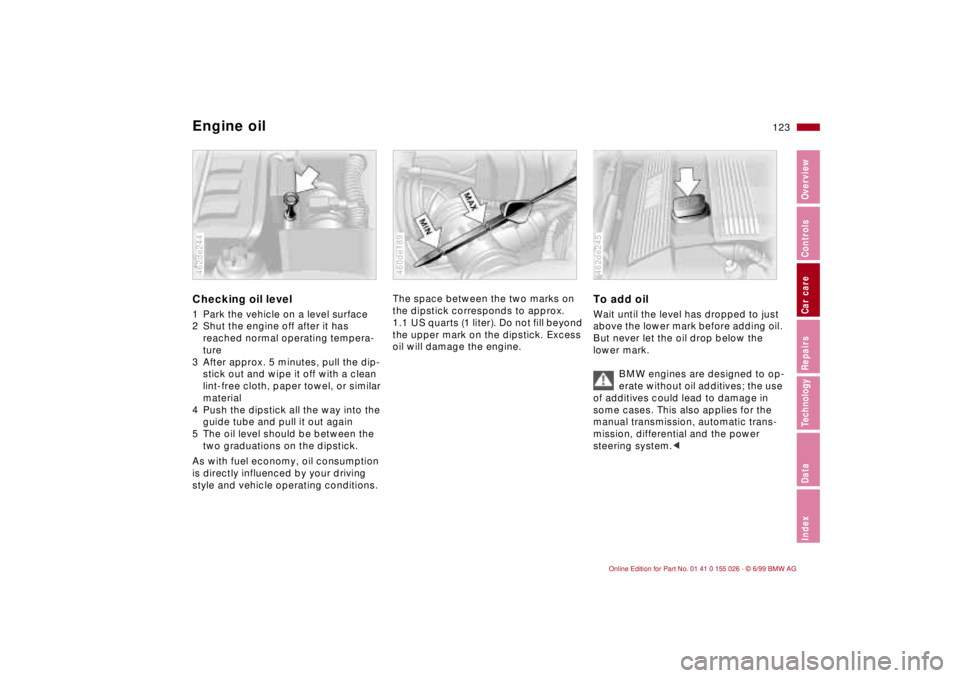
Engine oilChecking oil level 1 Park the vehicle on a level surface
2 Shut the engine off after it has
reached normal operating tempera-
ture
3 After approx. 5 minutes, pull the dip-
stick out and wipe it off with a clean
lint-free cloth, paper towel, or similar
material
4 Push the dipstick all the way into the
guide tube and pull it out again
5 The oil level should be between the
two graduations on the dipstick.
As with fuel economy, oil consumption
is directly influenced by your driving
style and vehicle operating conditions.462de244
The space between the two marks on
the dipstick corresponds to approx.
1.1 US quarts (1 liter). Do not fill beyond
the upper mark on the dipstick. Excess
oil will damage the engine.460de189
To add oil Wait until the level has dropped to just
above the lower mark before adding oil.
But never let the oil drop below the
lower mark.
BMW engines are designed to op-
erate without oil additives; the use
of additives could lead to damage in
some cases. This also applies for the
manual transmission, automatic trans-
mission, differential and the power
steering system.<462de245
Page 161 of 189
Overview
Controls and features
Operation, care
and maintenance
Owner service procedures
Technical data
Index Advanced technology
159n
RepairsIndexOverview Controls Car care Technology Data
Adaptive Transmission Control
(ATC)160
Airbags161
Dynamic Stability Control
(DSC)161
Radio reception162
Safety belt tensioner162
Rearview mirror with automatic
dimmer163
Tire Pressure Control (RDC)164
Rain sensor165
Self-diagnostics166
Xenon lamp167
Page 162 of 189
160n
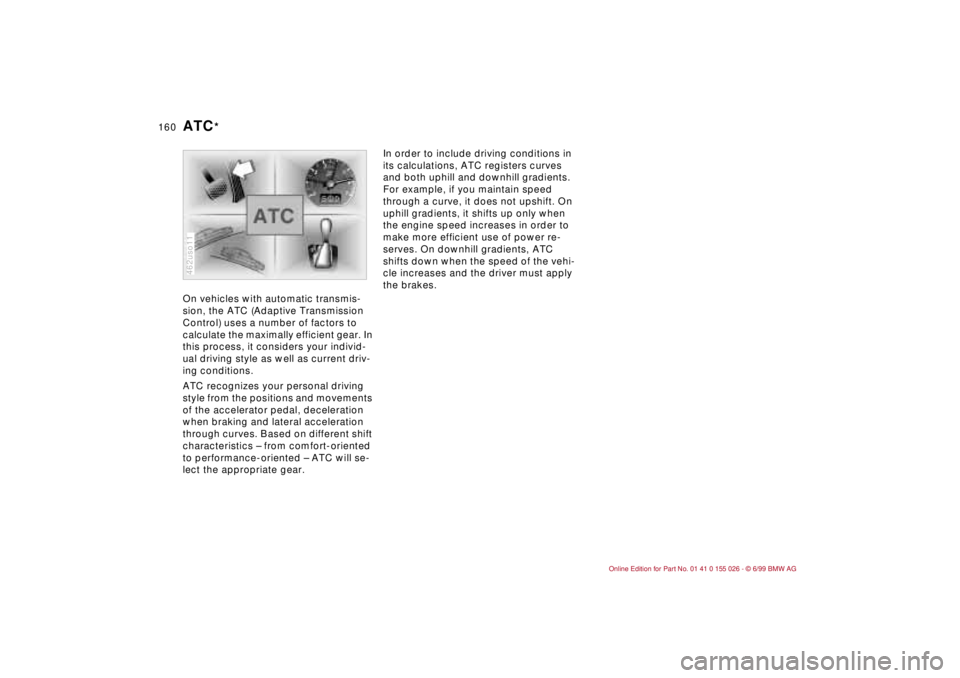
On vehicles with automatic transmis-
sion, the ATC (Adaptive Transmission
Control) uses a number of factors to
calculate the maximally efficient gear. In
this process, it considers your individ-
ual driving style as well as current driv-
ing conditions.
ATC recognizes your personal driving
style from the positions and movements
of the accelerator pedal, deceleration
when braking and lateral acceleration
through curves. Based on different shift
characteristics – from comfort-oriented
to performance-oriented – ATC will se-
lect the appropriate gear.
462uso11
In order to include driving conditions in
its calculations, ATC registers curves
and both uphill and downhill gradients.
For example, if you maintain speed
through a curve, it does not upshift. On
uphill gradients, it shifts up only when
the engine speed increases in order to
make more efficient use of power re-
serves. On downhill gradients, ATC
shifts down when the speed of the vehi-
cle increases and the driver must apply
the brakes.
ATC
*
Page 174 of 189

172n
Weights
BMW 323Ci BMW 328Ci
Curb weight (with one person, ready for operation, full tank of fuel, options not included)
with manual transmission
with automatic transmissionlbs (kg)
lbs (kg)3,153 (1,430)
3,213 (1,457)3,197 (1,450)
3,256 (1,477)
Approved gross vehicle weight
with manual transmission
with automatic transmissionlbs (kg)
lbs (kg)4,211 (1,910)
4,255 (1,930)4,270 (1,937)
4,314 (1,957)
Approved front axle weight lbs (kg) 1,962 (890) 1,973 (895)
Approved rear axle weight lbs (kg) 2,348 (1,065) 2,370 (1,075)
Approved roof load capacity lbs (kg) 165 (75) 165 (75)
Luggage compartment capacity cu ft (liters) 14.5 (410) 14.5 (410)
Never exceed either the approved axle weights or the gross vehicle weight.