steering BMW 323Ci 2000 Owner's Manual
[x] Cancel search | Manufacturer: BMW, Model Year: 2000, Model line: 323Ci, Model: BMW 323Ci 2000Pages: 189, PDF Size: 1.68 MB
Page 112 of 189

110n
Winter operationThe onset of winter is often accompa-
nied by rapid changes in weather. Adap-
tations in driving style should be accom-
panied by preparations on the vehicle
itself to ensure that your progress
through the winter remains safe and
trouble-free.CoolantBe sure that the coolant mixture is kept
at the year-round ratio of 50:50 of water
and antifreeze/corrosion protection.
This mixture provides protection against
freezing down to approx. – 347
(– 376). Replace the coolant every four
years.LocksBMW door lock deicer can be used to
free them if frozen. This deicer also
contains lubricant.
After using deicer, treatment with BMW
lock barrel grease is recommended.Rubber seals and components To prevent the weather-stripping from
freezing, apply a spray-on rubber treat-
ment or silicone spray to the door, hood
and luggage compartment lid seals.
A full range of car-care products is
available from your BMW center.<
Snow chains BMW snow chains
* can be mounted on
both summer and winter tires. Mount
them in pairs on the rear wheels only
and comply with the manufacturer's
safety precautions. Do not exceed a
maximum speed of 30 mph (50 km/h).
In this situation (snow chains mounted),
deactivate the DSC. Refer to page 81.
Starting offWe recommend that you use the man-
ual control switch to deactivate DSC
when starting off in deep snow or when
rocking the car to free it (refer to
page 81).Driving on low-traction road
surfacesUse smooth, gentle pressure to control
the accelerator pedal. Avoid excessive
engine speeds and shift to the next
higher gear at an early point. Adapt
your speed and driving style when ap-
proaching grades or slopes. Maintain
an adequate distance between yourself
and the car ahead.
BrakesWinter road conditions substantially
reduce the traction available between
the tires and the road surface.
Remember that braking distances will
be significantly longer as a result.
ABS is intended to prevent the wheels
from locking during brake applications,
thus helping to maintain vehicle stability
and steering response.
If the ABS does not respond in a critical
braking situation and the wheels lock:
Reduce the pressure on the brake
pedal until the wheels just start to roll
again while still maintaining enough
force to continue braking. Then in-
crease the pressure, reduce the pres-
sure when the wheels lock, reapply
pressure etc.
This staggered braking procedure will
reduce stopping distances while help-
ing you maintain steering control.
You can then attempt to steer around
hazards after you have reduced pres-
sure on the brake pedal.
Page 114 of 189

112n
Power steering Cellular phones
* Radio reception
High steering effort:
Please contact a BMW center.
High steering effort during sudden tran-
sitions:
Have your authorized BMW center in-
spect this system as soon as possible.
If the power steering fails, in-
creased effort will be required to
steer the vehicle.<
Mobile communications systems (cellu-
lar phone, two-way radios, etc.) are only
allowed a power output of up to 10 Watt.
Mobile communications devices not
specifically designed for use in your car
may trigger malfunctions while operat-
ing your vehicle. BMW can neither test
nor assume responsibility for every indi-
vidual product being offered on the mar-
ket. We recommend that you consult
your BMW center before purchasing any
device of this kind.
To ensure that your BMW continues to
provide reliable and trouble-free opera-
tion, refrain from using a mobile phone
or other radio device with an antenna
located inside the passenger compart-
ment. The antenna should always be
fitted on the outside of the vehicle.
Before loading the vehicle on a
car-carrier train or driving it
through a car-wash, remove the an-
tenna.<
The reception and sound quality ob-
tained from mobile radios varies ac-
cording to a variety of factors, including
the broadcast range of the transmitter
and the directional orientation of the
antenna. Interference factors such as
high-tension power lines, buildings and
natural obstructions can all lead to un-
avoidable reception interference, re-
gardless of how well the vehicle's sound
system is operating.
Climatic factors such as intense solar
radiation, fog, rain and snow can also
interfere with reception.
Car telephones or cellular phones not
approved by BMW can also cause in-
terference in the radio during a tele-
phone call. This phenomenon assumes
the form of a low-pitched hum emanat-
ing from the speaker system.
Please refer to the supplementary oper-
ating instructions provided with your
sound system for detailed information
on its use.
Page 115 of 189
113n
RepairsIndexOverview Controls Car care Technology Data
Information for your safetyThe factory-approved radial tires are
matched to the car and have been se-
lected to provide optimum safety and
driving comfort on your car.
It is not merely the tire's service life, but
also driving comfort and – above all
else – driving safety that depend on the
condition of the tires and the mainte-
nance of the specified tire pressure.
Incorrect inflation pressure is a frequent
cause of tire damage. It also signifi-
cantly influences the roadholding ability
of your BMW.
Check tire inflation pressure regu-
larly — including the space-saver
and/or the spare tire — at least twice a
month and before beginning a longer
road trip. Incorrect tire pressure can
otherwise lead to tire damage and acci-
dents.<
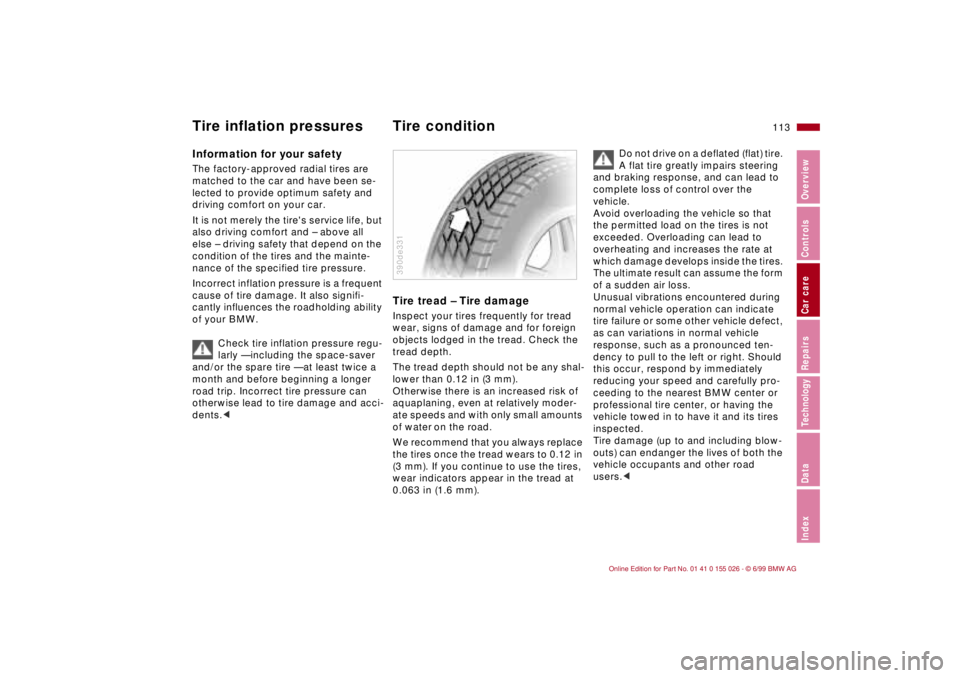
Tire tread – Tire damageInspect your tires frequently for tread
wear, signs of damage and for foreign
objects lodged in the tread. Check the
tread depth.
The tread depth should not be any shal-
lower than 0.12 in (3 mm).
Otherwise there is an increased risk of
aquaplaning, even at relatively moder-
ate speeds and with only small amounts
of water on the road.
We recommend that you always replace
the tires once the tread wears to 0.12 in
(3 mm). If you continue to use the tires,
wear indicators appear in the tread at
0.063 in (1.6 mm).390de331
Do not drive on a deflated (flat) tire.
A flat tire greatly impairs steering
and braking response, and can lead to
complete loss of control over the
vehicle.
Avoid overloading the vehicle so that
the permitted load on the tires is not
exceeded. Overloading can lead to
overheating and increases the rate at
which damage develops inside the tires.
The ultimate result can assume the form
of a sudden air loss.
Unusual vibrations encountered during
normal vehicle operation can indicate
tire failure or some other vehicle defect,
as can variations in normal vehicle
response, such as a pronounced ten-
dency to pull to the left or right. Should
this occur, respond by immediately
reducing your speed and carefully pro-
ceeding to the nearest BMW center or
professional tire center, or having the
vehicle towed in to have it and its tires
inspected.
Tire damage (up to and including blow-
outs) can endanger the lives of both the
vehicle occupants and other road
users.<
Tire inflation pressures Tire condition
Page 118 of 189

116n
Winter tiresChoosing the right tireBMW recommends winter tires (M+S
radial tires) for driving in adverse winter
road conditions. Although all-season
M+S tires provide better winter traction
than standard summer tires with H, V,
W, Y and ZR speed ratings, they gener-
ally fail to provide the same levels of
performance as standard snow tires in
winter driving.
For of safe tracking and steering re-
sponse, install winter tires made by the
same manufacturer having the same
tread configuration on all four wheels.
Mount only winter tires approved by
BMW. Any BMW center will be glad to
provide you with information on the
best winter tires for your particular driv-
ing conditions.Never exceed the maximum speed
for that the tires are rated.
Unprofessional attempts by laymen to
service tires can lead to damage and
accidents.
Have this work performed by skilled
professionals only. Your BMW center
will be glad to assist you with both their
expertise and the proper equipment for
your vehicle.<
Tire condition, tire pressureWinter tires display a perceptible loss in
their ability to cope with winter driving
conditions once the tread wears to be-
low 0.16 in (4 mm), and should thus be
replaced.
Comply with the specified tire inflation
pressures – and be sure to have the
wheel and tire assemblies balanced
every time you change the tires.
StorageStore tires in a cool, dry place, away
from light whenever possible. Protect
the tires against contact with oil, grease
and fuel.Snow chains
*
Use narrow-link BMW snow chains on
summer or winter tires only in pairs and
only on the rear wheels. Comply with all
manufacturer's safety precautions when
mounting the chains.
Page 125 of 189
123n
RepairsIndexOverview Controls Car care Technology Data
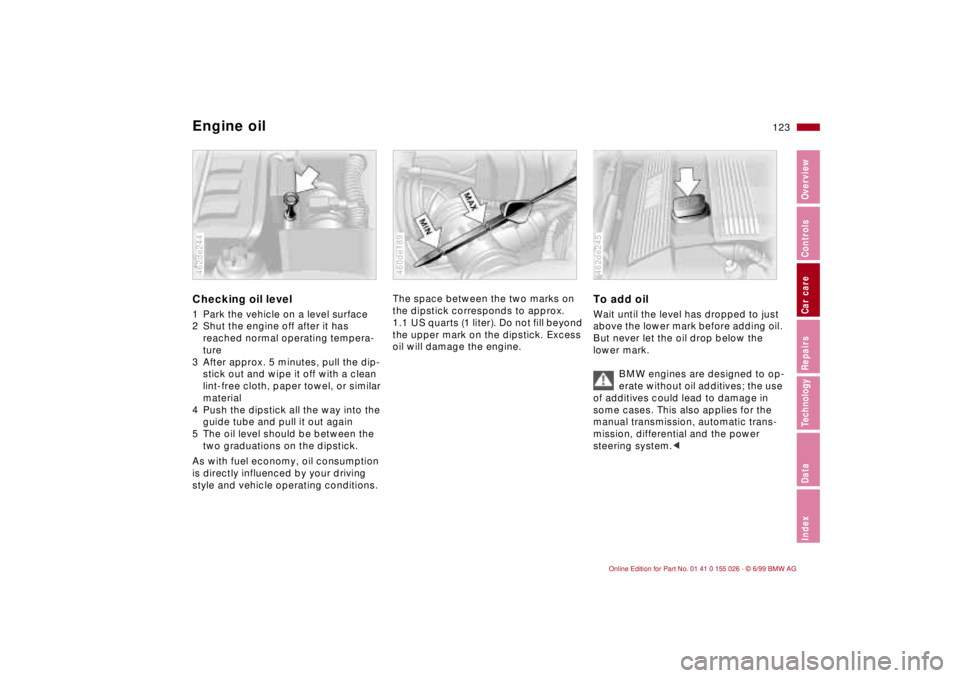
Engine oilChecking oil level 1 Park the vehicle on a level surface
2 Shut the engine off after it has
reached normal operating tempera-
ture
3 After approx. 5 minutes, pull the dip-
stick out and wipe it off with a clean
lint-free cloth, paper towel, or similar
material
4 Push the dipstick all the way into the
guide tube and pull it out again
5 The oil level should be between the
two graduations on the dipstick.
As with fuel economy, oil consumption
is directly influenced by your driving
style and vehicle operating conditions.462de244
The space between the two marks on
the dipstick corresponds to approx.
1.1 US quarts (1 liter). Do not fill beyond
the upper mark on the dipstick. Excess
oil will damage the engine.460de189
To add oil Wait until the level has dropped to just
above the lower mark before adding oil.
But never let the oil drop below the
lower mark.
BMW engines are designed to op-
erate without oil additives; the use
of additives could lead to damage in
some cases. This also applies for the
manual transmission, automatic trans-
mission, differential and the power
steering system.<462de245
Page 137 of 189
135n
RepairsIndexOverview Controls Car care Technology Data
Caring for your car Airbags
Cleaning agents can contain sub-
stances that are dangerous or
pose health risks. Therefore always
comply with the warnings and danger
notices on the package.
Open the doors or windows on your
vehicle when cleaning the interior.
Never clean your vehicle with solvents
or other materials not specifically in-
tended for this application.<
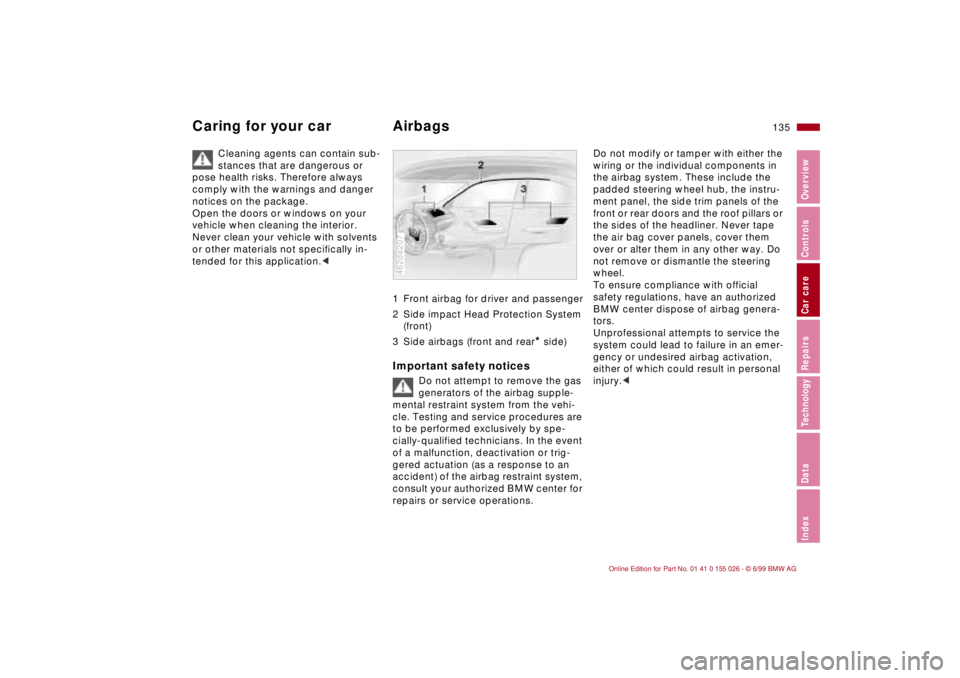
1 Front airbag for driver and passenger
2 Side impact Head Protection System
(front)
3 Side airbags (front and rear
* side)
Important safety notices
Do not attempt to remove the gas
generators of the airbag supple-
mental restraint system from the vehi-
cle. Testing and service procedures are
to be performed exclusively by spe-
cially-qualified technicians. In the event
of a malfunction, deactivation or trig-
gered actuation (as a response to an
accident) of the airbag restraint system,
consult your authorized BMW center for
repairs or service operations.
462de207
Do not modify or tamper with either the
wiring or the individual components in
the airbag system. These include the
padded steering wheel hub, the instru-
ment panel, the side trim panels of the
front or rear doors and the roof pillars or
the sides of the headliner. Never tape
the air bag cover panels, cover them
over or alter them in any other way. Do
not remove or dismantle the steering
wheel.
To ensure compliance with official
safety regulations, have an authorized
BMW center dispose of airbag genera-
tors.
Unprofessional attempts to service the
system could lead to failure in an emer-
gency or undesired airbag activation,
either of which could result in personal
injury.<
Page 150 of 189
148n
Changing tires
Take these precautionary mea-
sures if you have either a flat tire
or are changing the tire:
Park the vehicle as far from the flow of
traffic as possible and on firm ground.
Switch on the hazard flashers. Turn the
steering wheel to the straight-ahead
position, remove the key and engage
the steering lock. Shift into 1st or re-
verse (selector lever in "Park" with auto-
matic) and engage the parking brake.
All passengers should be outside the
car and well away from your immediate
working area (behind the guardrail, for
instance).
If a warning triangle or portable hazard
warning lamp is available, set it up on
the roadside at an appropriate distance
from the rear of the vehicle. Comply
with all safety guidelines and regula-
tions.
Change the wheel only on a level, firm
surface that is not slippery. Avoid jack-
ing the car on a soft or slippery support
surface (snow, ice, loose gravel, etc.),
as it could slide sideways.
Ensure that the jack is positioned on a
solid support surface.
Do not place wooden blocks or similar
objects under the jack. If this done, the
jack might not be able to reach its full
support capacity because of the limited
height.
Do not lie under the vehicle or start the
engine when the vehicle is supported
by the jack – risk of fatal injury.<
Your BMW has either a spare
* or
space-saver tire
* for temporary use and
to ensure your mobility.
Take the luggage compartment
floor panel completely out to
remove the spare tire
* (refer to
page 41).<
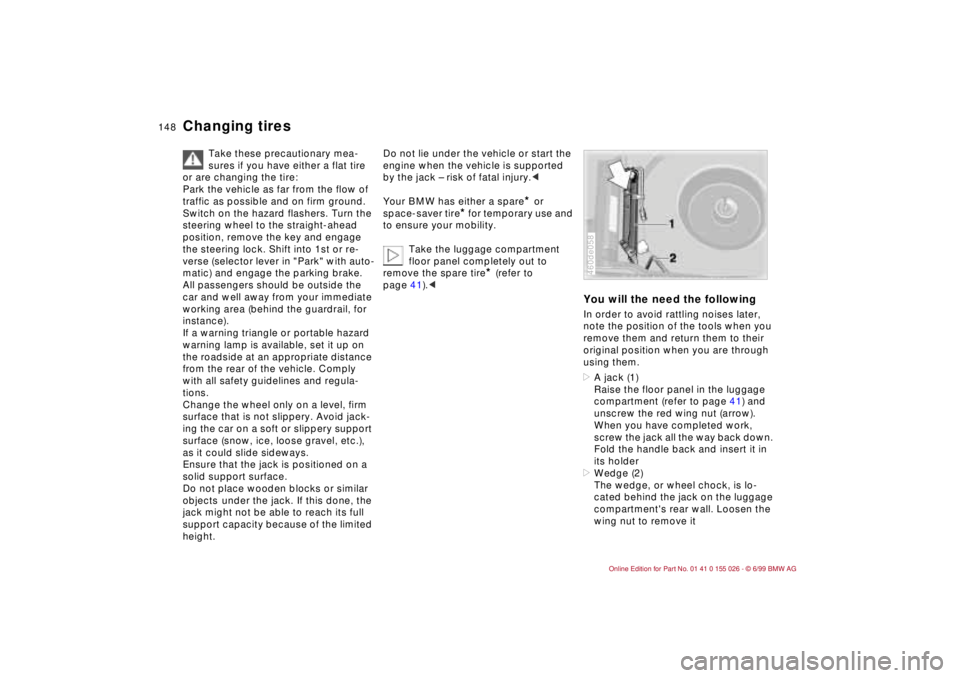
You will the need the followingIn order to avoid rattling noises later,
note the position of the tools when you
remove them and return them to their
original position when you are through
using them.
>A jack (1)
Raise the floor panel in the luggage
compartment (refer to page 41) and
unscrew the red wing nut (arrow).
When you have completed work,
screw the jack all the way back down.
Fold the handle back and insert it in
its holder
>Wedge (2)
The wedge, or wheel chock, is lo-
cated behind the jack on the luggage
compartment's rear wall. Loosen the
wing nut to remove it460de058
Page 153 of 189
151n
RepairsIndexOverview Controls Car care Technology Data
Changing tires Battery Driving with the space-saver
spare tire
*
Drive cautiously and do not exceed a
speed of 45 mph (80 km/h).
Be aware that vehicle handling will be
altered. Slower brake response time,
longer braking distances and changed
steering characteristics may be antici-
pated when approaching limit condi-
tions.
The changes in handling characteristics
will be even more pronounced in con-
junction with winter tires.
Only one space-saver spare tire
may be mounted. Mount a wheel
and tire with the same size and specifi-
cations as the others at the earliest
possible opportunity. Maintain correct
tire pressures. Refer to page 28.<
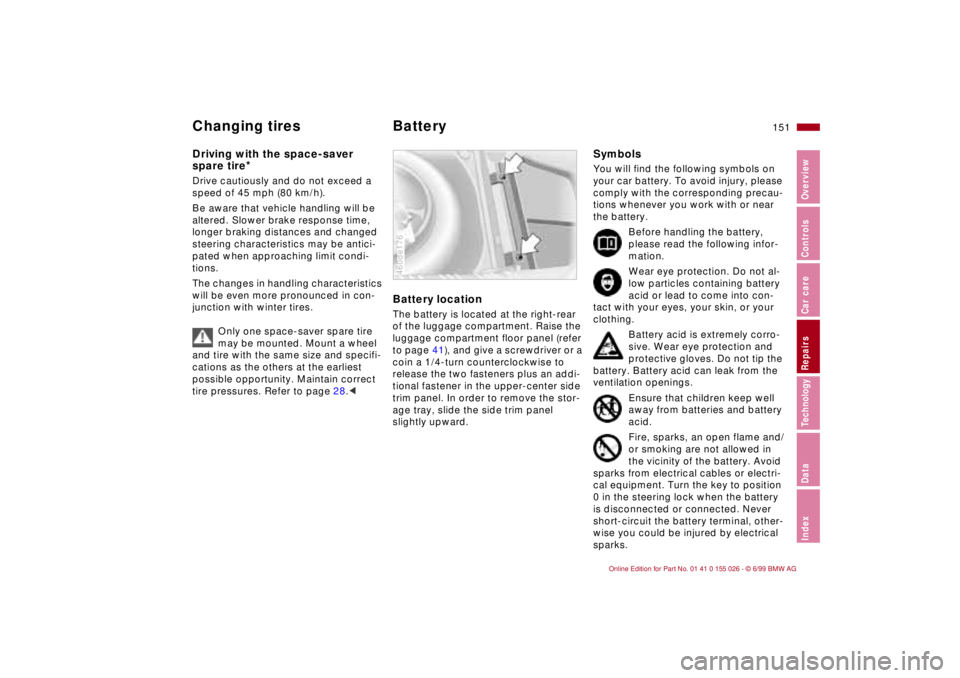
Battery location The battery is located at the right-rear
of the luggage compartment. Raise the
luggage compartment floor panel (refer
to page 41), and give a screwdriver or a
coin a 1/4-turn counterclockwise to
release the two fasteners plus an addi-
tional fastener in the upper-center side
trim panel. In order to remove the stor-
age tray, slide the side trim panel
slightly upward.460de176
SymbolsYou will find the following symbols on
your car battery. To avoid injury, please
comply with the corresponding precau-
tions whenever you work with or near
the battery.
Before handling the battery,
please read the following infor-
mation.
Wear eye protection. Do not al-
low particles containing battery
acid or lead to come into con-
tact with your eyes, your skin, or your
clothing.
Battery acid is extremely corro-
sive. Wear eye protection and
protective gloves. Do not tip the
battery. Battery acid can leak from the
ventilation openings.
Ensure that children keep well
away from batteries and battery
acid.
Fire, sparks, an open flame and/
or smoking are not allowed in
the vicinity of the battery. Avoid
sparks from electrical cables or electri-
cal equipment. Turn the key to position
0 in the steering lock when the battery
is disconnected or connected. Never
short-circuit the battery terminal, other-
wise you could be injured by electrical
sparks.
Page 163 of 189
161n
RepairsIndexOverview Controls Car care Technology Data
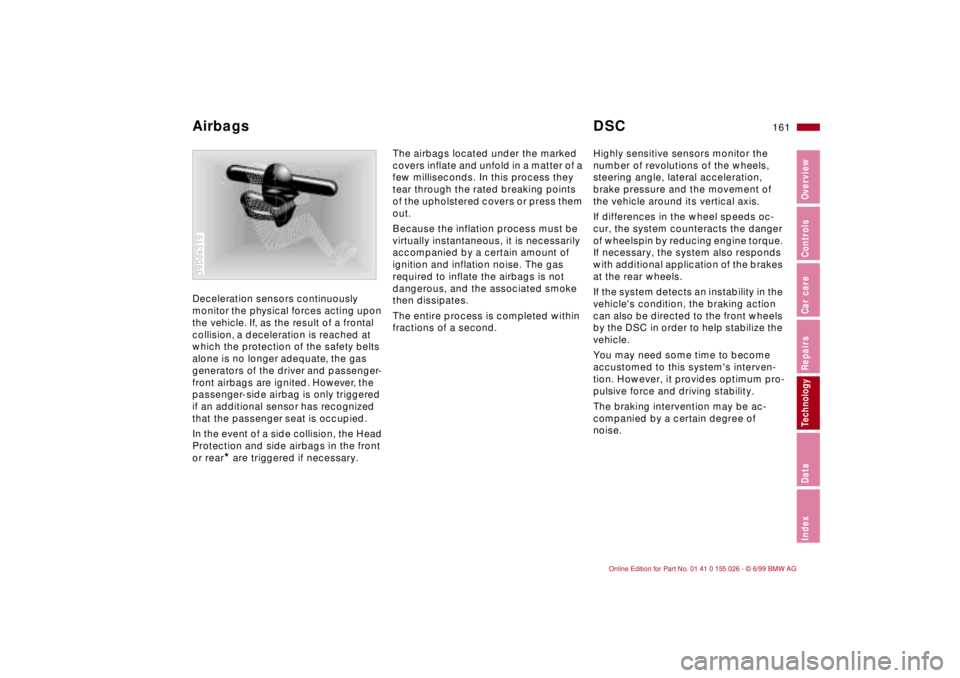
Deceleration sensors continuously
monitor the physical forces acting upon
the vehicle. If, as the result of a frontal
collision, a deceleration is reached at
which the protection of the safety belts
alone is no longer adequate, the gas
generators of the driver and passenger-
front airbags are ignited. However, the
passenger-side airbag is only triggered
if an additional sensor has recognized
that the passenger seat is occupied.
In the event of a side collision, the Head
Protection and side airbags in the front
or rear
* are triggered if necessary.
390de319
The airbags located under the marked
covers inflate and unfold in a matter of a
few milliseconds. In this process they
tear through the rated breaking points
of the upholstered covers or press them
out.
Because the inflation process must be
virtually instantaneous, it is necessarily
accompanied by a certain amount of
ignition and inflation noise. The gas
required to inflate the airbags is not
dangerous, and the associated smoke
then dissipates.
The entire process is completed within
fractions of a second.Highly sensitive sensors monitor the
number of revolutions of the wheels,
steering angle, lateral acceleration,
brake pressure and the movement of
the vehicle around its vertical axis.
If differences in the wheel speeds oc-
cur, the system counteracts the danger
of wheelspin by reducing engine torque.
If necessary, the system also responds
with additional application of the brakes
at the rear wheels.
If the system detects an instability in the
vehicle's condition, the braking action
can also be directed to the front wheels
by the DSC in order to help stabilize the
vehicle.
You may need some time to become
accustomed to this system's interven-
tion. However, it provides optimum pro-
pulsive force and driving stability.
The braking intervention may be ac-
companied by a certain degree of
noise.
Airbags DSC
Page 176 of 189

174n
Electrical system Ribbed V-belt Battery 12 V, 80 AhSpark plugs NGK BKR 6 EQUP
Bosch FGR 7 DQP (under development)Water pump – AC generator – Power
steering
Ribbed V-belt 6 PK x 1538
A/C compressor
Ribbed V-belt 5 PK x 863You can obtain Original BMW
Parts and Accessories, as well as
professional advice from your autho-
rized BMW center.<