wheel BMW 323Ci 2000 Owner's Manual
[x] Cancel search | Manufacturer: BMW, Model Year: 2000, Model line: 323Ci, Model: BMW 323Ci 2000Pages: 189, PDF Size: 1.68 MB
Page 112 of 189

110n
Winter operationThe onset of winter is often accompa-
nied by rapid changes in weather. Adap-
tations in driving style should be accom-
panied by preparations on the vehicle
itself to ensure that your progress
through the winter remains safe and
trouble-free.CoolantBe sure that the coolant mixture is kept
at the year-round ratio of 50:50 of water
and antifreeze/corrosion protection.
This mixture provides protection against
freezing down to approx. – 347
(– 376). Replace the coolant every four
years.LocksBMW door lock deicer can be used to
free them if frozen. This deicer also
contains lubricant.
After using deicer, treatment with BMW
lock barrel grease is recommended.Rubber seals and components To prevent the weather-stripping from
freezing, apply a spray-on rubber treat-
ment or silicone spray to the door, hood
and luggage compartment lid seals.
A full range of car-care products is
available from your BMW center.<
Snow chains BMW snow chains
* can be mounted on
both summer and winter tires. Mount
them in pairs on the rear wheels only
and comply with the manufacturer's
safety precautions. Do not exceed a
maximum speed of 30 mph (50 km/h).
In this situation (snow chains mounted),
deactivate the DSC. Refer to page 81.
Starting offWe recommend that you use the man-
ual control switch to deactivate DSC
when starting off in deep snow or when
rocking the car to free it (refer to
page 81).Driving on low-traction road
surfacesUse smooth, gentle pressure to control
the accelerator pedal. Avoid excessive
engine speeds and shift to the next
higher gear at an early point. Adapt
your speed and driving style when ap-
proaching grades or slopes. Maintain
an adequate distance between yourself
and the car ahead.
BrakesWinter road conditions substantially
reduce the traction available between
the tires and the road surface.
Remember that braking distances will
be significantly longer as a result.
ABS is intended to prevent the wheels
from locking during brake applications,
thus helping to maintain vehicle stability
and steering response.
If the ABS does not respond in a critical
braking situation and the wheels lock:
Reduce the pressure on the brake
pedal until the wheels just start to roll
again while still maintaining enough
force to continue braking. Then in-
crease the pressure, reduce the pres-
sure when the wheels lock, reapply
pressure etc.
This staggered braking procedure will
reduce stopping distances while help-
ing you maintain steering control.
You can then attempt to steer around
hazards after you have reduced pres-
sure on the brake pedal.
Page 113 of 189

111n
RepairsIndexOverview Controls Car care Technology Data
Winter operation
Do not shift down on slick road
surfaces. Doing so could cause
the rear wheels to lose traction and
skid, that could result in the loss of
vehicle control.<
Depress the clutch during hard
braking on road surfaces that pro-
vide only poor or uneven traction.<
Skid control Depress the clutch and release the
accelerator pedal, or place the selector
lever of the automatic transmission into
the "Neutral" position. Countersteer
carefully and attempt to regain control
of the vehicle.
ParkingEngage 1st or reverse gear. If your car
is equipped with an automatic transmis-
sion, place the selector lever in "Park".
On vehicles with manual transmission,
also apply the parking brake when
parking on inclined surfaces. In order to
prevent the parking brake linings from
locking due to frost or corrosion, dry
them by gently applying the parking
brake as the vehicle is coming to a
stop. Make sure that following traffic is
not endangered.
The brake lamps do not light up
when the parking brake is ap-
plied.<
Page 116 of 189

114n
To maintain good handling and vehicle
response, use only tires of a single
tread configuration from a single manu-
facturer. BMW tests and approves
wheel/tire combinations. Refer to
page 117.
Do not use retreaded tires, since
driving safety may be impaired by
their use. This due to the possible varia-
tions in casing structures and, in some
cases, to their extreme age, that can
lead to a decrease in their durability.<
Tire ageThe date on which the tire was manu-
factured is indicated by the code on the
sidewall:
DOT ... 129 indicates that the tire was
manufactured in Week 12 of 1999.
BMW recommends the replacement of
all tires when the tires are no more than
6 years old, even if a tire life of 10 years
is possible.
Spare tires over 6 years old should be
used only in case of emergency. Such
a tire should be replaced by a new tire
immediately, and should not be fitted
together with new tires.
Between the axlesThe tread wear patterns at the front end
differ from those at the rear – the actual
patterns will vary according to individ-
ual driving conditions. In the interests of
safety and maintaining optimal handling
characteristics, tire rotation is not rec-
ommended.
If a proposed interaxle rotation of tires
is based on economic considerations,
one should consider whether the costs
for the rotation are likely to be recap-
tured by any increase in the service life
of the tires which might be realized.
In principle, interaxle rotation should be
performed in short intervals, with a
maximum of 3,000 miles (5,000 km).
Consult your authorized BMW center
for more information.
Should you decide to rotate the tires, it
is essential to comply with the following:
Rotate tires on the same side only, since
braking characteristics and road grip
could otherwise be adversely affected.
Following rotation, correct the tire infla-
tion pressure.
If different tire sizes are mounted
on the front and rear axles (refer to
page 117), the wheels may not be ro-
tated from one axle to the other.<
Tire replacement Tire rotation
Page 117 of 189

115n
RepairsIndexOverview Controls Car care Technology Data
Wheel and tire combinations The right choice Use only BMW-approved tires, refer to
page 117.
Due to the high speeds this vehicle can
achieve, the use of specific tire brands,
specifications and dimensions is man-
datory.
Consult any BMW center for details.
Comply with local/national regulations.
The correct wheel/tire combinaton
affects different sytems, such as
ABS, ATC, DSC. The function of these
systems can be impaired if the correct
combinaton is not used.
Therefore, only use tires of the same
brand and tread pattern. Replace a flat
tire with an approved wheel/tire combi-
nation as soon as possible.<
Codes on the tires and wheels The tire codes will aid you in selecting
the correct tire.
Codes on radial tires:
The speed rating indicates the ap-
proved maximum speed for the tire.
Summer tires:
S = up to 112 mph (180 km/h)
T = up to 118 mph (190 km/h)
H = up to 130 mph (210 km/h)
V = up to 150 mph (240 km/h)
W = up to 167 mph (270 km/h)
Y = above 167 mph (270 km/h)
ZR = above 150 mph (240 km/h) Example:
Nominal width
in mm
Aspect ratio in %
Radial tire code
Rim diameter in inches
Load rating
(not on ZR tires)
Speed rating
(before R on ZR tires)
225/50 R
1692W
Winter tires:
Q M+S = up to 100 mph (160 km/h)
T M+S = up to 118 mph (190 km/h)
H M+S = up to 130 mph (210 km/h)
Codes stamped on light-alloy wheels:
Protect valve inserts against dirt using
screw-on valve stem caps. Dirt in the
valves frequently leads to slow leaks. Example:
Rim width
in inches
Code letter for
flange type
Symbol for full-drop
center rim
Rim diameter in inches
Hump on the 2 rim shoulders
7 x 16 H 2
J
Page 118 of 189

116n
Winter tiresChoosing the right tireBMW recommends winter tires (M+S
radial tires) for driving in adverse winter
road conditions. Although all-season
M+S tires provide better winter traction
than standard summer tires with H, V,
W, Y and ZR speed ratings, they gener-
ally fail to provide the same levels of
performance as standard snow tires in
winter driving.
For of safe tracking and steering re-
sponse, install winter tires made by the
same manufacturer having the same
tread configuration on all four wheels.
Mount only winter tires approved by
BMW. Any BMW center will be glad to
provide you with information on the
best winter tires for your particular driv-
ing conditions.Never exceed the maximum speed
for that the tires are rated.
Unprofessional attempts by laymen to
service tires can lead to damage and
accidents.
Have this work performed by skilled
professionals only. Your BMW center
will be glad to assist you with both their
expertise and the proper equipment for
your vehicle.<
Tire condition, tire pressureWinter tires display a perceptible loss in
their ability to cope with winter driving
conditions once the tread wears to be-
low 0.16 in (4 mm), and should thus be
replaced.
Comply with the specified tire inflation
pressures – and be sure to have the
wheel and tire assemblies balanced
every time you change the tires.
StorageStore tires in a cool, dry place, away
from light whenever possible. Protect
the tires against contact with oil, grease
and fuel.Snow chains
*
Use narrow-link BMW snow chains on
summer or winter tires only in pairs and
only on the rear wheels. Comply with all
manufacturer's safety precautions when
mounting the chains.
Page 119 of 189

117n
RepairsIndexOverview Controls Car care Technology Data
Approved wheel and tire specifications Tire specifications Steel rim (wheel rim) Light-alloy wheel
BMW 323Ci
All-Season
195/65 R 15 91 H – 6.5Jx15
Summer tires
195/65 R 15 91 H – 6.5Jx15
205/60 R 15 91 H – 6.5Jx15
7Jx15
205/55 R 16 91 H
225/50 R 16 92 W
225/50 ZR 16– 7Jx16
225/45 R 17 91 W – 8Jx17
Front: 225/45 ZR 17 – 7.5Jx17
Rear: 245/40 ZR 17 – 8.5Jx17
Winter tires
195/65 R 15 91 Q M+S 6.5Jx15 6.5Jx15
205/60 R 15 91 Q M+S 6.5Jx15 6.5Jx15
7Jx15
205/55 R 16 91 Q M + S
225/50 R 16 92 Q M + S7Jx16 7Jx16
225/45 R 17 91 Q M + S – 8Jx17
Space-saver spare tire
T 125/90 R 15 96 M 3.5Bx15 –
T 125/90 R 16 98 M 3.5Bx16 –
Pay attention to the specifications for tires and wheels in the vehicle's
manuals. If you install tire sizes not approved by the manufacturer,
you are required to enter this in the vehicle documents.
Snow chains
*
Snow chains cannot be mounted on the
following tires:
225/50 R 16 92 W
225/50 ZR 16
225/45 R 17 91 W
225/50 R 16 92 Q/T/H
225/45 R 17 91 Q/T/HMixed tiresFor details concerning tire manufactur-
ers for mixed tires, refer to the original-
equipment specifications.
Page 120 of 189

118n
Approved wheel and tire specifications Tire specifications Steel rim (wheel rim) Light-alloy wheel
BMW 328Ci
All-Season
205/55 R 16 91 H – 7Jx16
Summer tires
205/55 R 16 91 H
225/50 R 16 92 H
225/50 ZR 16– 7Jx16
225/45 R 17 91 H – 8Jx17
Front: 225/45 ZR 17 – 7.5Jx17
Rear: 245/40 ZR 17 – 8.5Jx17
Winter tires
205/55 R 16 91 Q M + S
225/50 R 16 92 Q M + S7Jx16 7Jx16
225/45 R 17 91 Q M + S – 8Jx17
Space-saver spare tire
T 125/90 R 16 98 M 3.5Bx16 –
Pay attention to the specifications for tires and wheels in the vehicle's
manuals. If you install tire sizes not approved by the manufacturer, you
are required to enter this in the vehicle documents.
Snow chains
*
Snow chains cannot be mounted on the
following tires:
225/50 R 16 92 W
225/50 ZR 16
225/45 R 17 91 W
225/50 R 16 92 Q/T/H
225/45 R 17 91 Q/T/HMixed tiresFor details concerning tire manufactur-
ers for mixed tires, refer to the original-
equipment specifications.
Page 132 of 189

130n
Washing your car Right from the start, you can wash your
new BMW in an automatic car wash.
Car wash systems that do not employ
brushes are preferable.
Wipe away tough dirt and loosen and
remove dead insects before washing
the car.
To prevent spots, avoid washing when
the hood is still warm, or immediately
after and during exposure to strong
sunlight.
When using an automatic car wash, be
sure that:
>The car wash system is suited for the
dimensions of your vehicle
>No damage will occur on vehicles
with attached body accessories (such
as spoilers or antennas). Consult the
car wash operator if necessary
>The wheels and tires of your vehicle
cannot be damaged by the convey-
ance devices of the car wash system
>The vehicle is cleaned with minimum
brush pressure, and that ample water
is available for washing and rinsing.Vehicles with rain sensor:
Clean the windshield regularly. Wax
from car washes or the presence of
dead insects can cause rain sensor
malfunctions.
Switch the rain sensor off when
the vehicle passes through the car
wash (refer to page 70). Damage could
occur by an undesired actuation of the
wipers if the system is not deacti-
vated.<
Parts of the car that are inaccessible
to the automatic washer – such as door
sills, door and hood edges, etc. –
should be cleaned by hand.
In the winter months, it is especially im-
portant to ensure that the car is washed
on a regular basis. Large quantities of
dirt and road salt are difficult to remove,
and they also cause damage to the ve-
hicle.
If spray wands or high-pressure
washers are used, be sure to
maintain an adequate distance between
the spray source and the vehicle's sur-
face. Inadequate distance and exces-
sive pressure can damage or weaken
the finish, making it more susceptible to
subsequent attack. In addition, mois-
ture could penetrate to vehicle compo-
nents, leading to long-term damage.<
When cleaning the headlamps,
please observe the following:
>Do not rub dry. Never use abrasives
or strong cleaning agents to clean the
covers
>Remove dirt and contamination
(such as insects) by soaking with
BMW Car Shampoo and then rinsing
with plenty of water
>Always use a deicer spray to remove
accumulated ice and snow – never
use a scraper.<
After washing the car, apply the
brakes briefly to dry them. Braking
efficiency might otherwise be reduced
by the moisture and the brake rotors
could also be corroded.<
Caring for your car
Page 134 of 189

132n
Caring for your carWaxing your car Protect the finish using carnauba or
synthetic-based waxes only.
The best way to determine when the
finish needs to be waxed is by noting
when water stops beading on the sur-
face.
You can use a glass cleaner to remove
any wax or silicone that may have been
left on the windows during waxing.
A full range of car-care products is
available from your BMW center.<
Paint damageYou can touch up small areas of paint
damage with a BMW spray paint or a
BMW touch-up stick.
The paint color code for your car is pro-
vided on a sticker located next to the
type plate and on the first page of your
Service and Warranty Information
Booklet.
Damage caused by flying stones,
scratches, etc., must be touched up
without delay to prevent rust from form-
ing.
If corrosion has started to form in an
area with paint damage, remove all rust
and clean the area. Then prime the area
with a BMW Primer Stick. Finally, apply
the finish coat. Wait a few days, then
polish the repaired area. Finish by ap-
plying a wax preservative.
More extensive paint damage should be
professionally repaired in accordance
with the manufacturer's instructions.
Your BMW center uses original BMW
finish materials in accordance with offi-
cial repair procedures.
Caring for other vehicle
components and materials Light-alloy wheels should be treated
with alloy wheel cleaner, especially dur-
ing the winter months. However, do not
use aggressive products containing ac-
ids, strong alkalis or abrasives. Do not
use steam cleaners operating at tem-
peratures above 1407 (606). Follow
the manufacturer's instructions.
If your vehicle has chrome parts
* such
as the window frames and door handles,
be especially careful about cleaning
them with plenty of water and possibly a
shampoo supplement as well after the
roads have been salted. Use chrome
polish as an additional treatment.
You can use window and glass cleaner
to clean inside window surfaces and
mirrors without smearing and streaking.
Never use polishing pastes or abrasive
(quartz) cleansers on mirror lenses.
Page 137 of 189
135n
RepairsIndexOverview Controls Car care Technology Data
Caring for your car Airbags
Cleaning agents can contain sub-
stances that are dangerous or
pose health risks. Therefore always
comply with the warnings and danger
notices on the package.
Open the doors or windows on your
vehicle when cleaning the interior.
Never clean your vehicle with solvents
or other materials not specifically in-
tended for this application.<
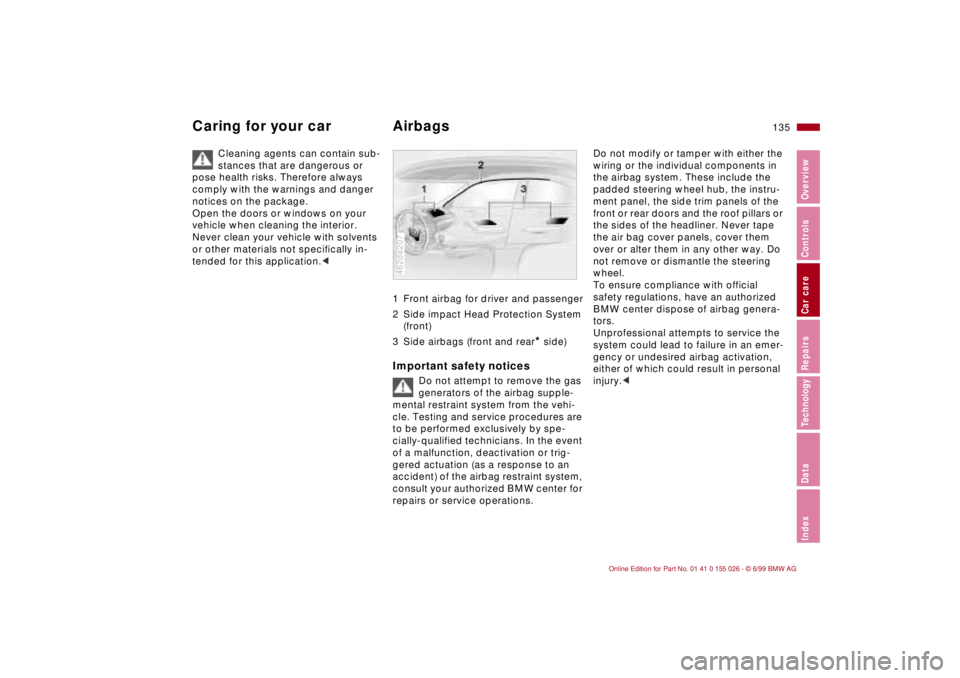
1 Front airbag for driver and passenger
2 Side impact Head Protection System
(front)
3 Side airbags (front and rear
* side)
Important safety notices
Do not attempt to remove the gas
generators of the airbag supple-
mental restraint system from the vehi-
cle. Testing and service procedures are
to be performed exclusively by spe-
cially-qualified technicians. In the event
of a malfunction, deactivation or trig-
gered actuation (as a response to an
accident) of the airbag restraint system,
consult your authorized BMW center for
repairs or service operations.
462de207
Do not modify or tamper with either the
wiring or the individual components in
the airbag system. These include the
padded steering wheel hub, the instru-
ment panel, the side trim panels of the
front or rear doors and the roof pillars or
the sides of the headliner. Never tape
the air bag cover panels, cover them
over or alter them in any other way. Do
not remove or dismantle the steering
wheel.
To ensure compliance with official
safety regulations, have an authorized
BMW center dispose of airbag genera-
tors.
Unprofessional attempts to service the
system could lead to failure in an emer-
gency or undesired airbag activation,
either of which could result in personal
injury.<