towing BMW 323Ci 2000 Owners Manual
[x] Cancel search | Manufacturer: BMW, Model Year: 2000, Model line: 323Ci, Model: BMW 323Ci 2000Pages: 189, PDF Size: 1.68 MB
Page 14 of 189
Contents
Owner service procedures
Advanced technology
Technical data
Replacement procedures:
Onboard tool kit140
Windshield wiper blades140
Lamps and bulbs140
Remote control147
Changing tires148
Battery151
Fuses153
Microfilter154
In case of electrical
malfunction:
Fuel filler door155
Sliding/tilt sunroof155
Assistance, giving and
receiving:
Jump-starting156
Towing the vehicle157Adaptive Transmission Control
(ATC)160
Airbags161
Dynamic Stability Control
(DSC)161
Radio reception162
Safety belt tensioner162
Inside rearview mirror with
automatic dimmer163
Tire Pressure Control (RDC)164
Rain sensor165
Self-diagnostics166
Xenon lamp167Engine data170
Dimensions171
Weights172
Capacities173
Electrical system174
Ribbed V-belt174
Page 29 of 189
27n
RepairsIndexOverview Controls Car care Technology Data
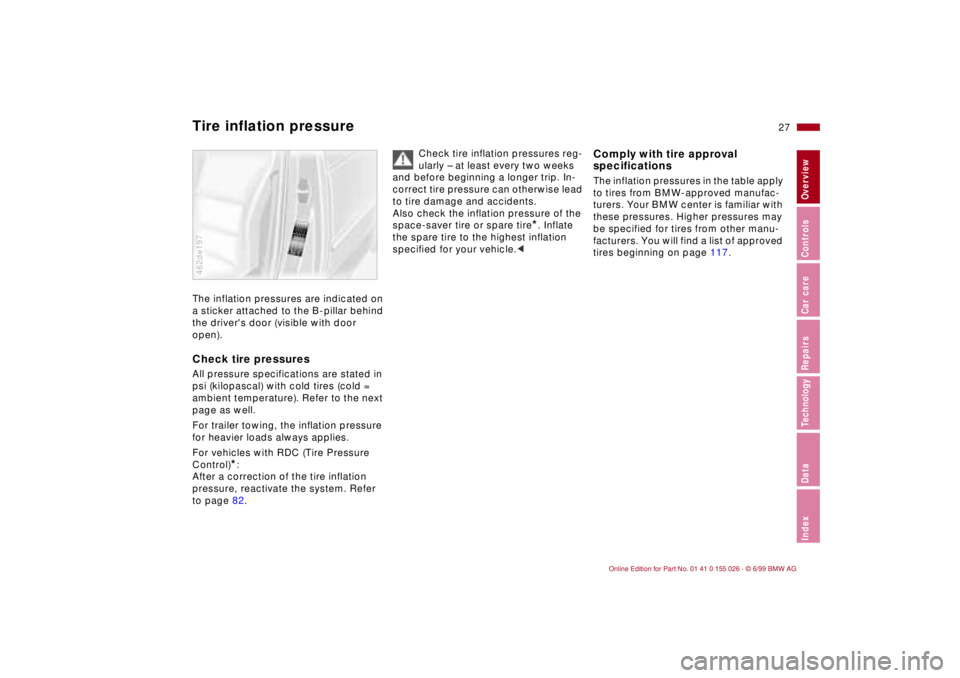
Tire inflation pressure The inflation pressures are indicated on
a sticker attached to the B-pillar behind
the driver's door (visible with door
open).Check tire pressuresAll pressure specifications are stated in
psi (kilopascal) with cold tires (cold =
ambient temperature). Refer to the next
page as well.
For trailer towing, the inflation pressure
for heavier loads always applies.
For vehicles with RDC (Tire Pressure
Control)
*:
After a correction of the tire inflation
pressure, reactivate the system. Refer
to page 82.
462de197
Check tire inflation pressures reg-
ularly – at least every two weeks
and before beginning a longer trip. In-
correct tire pressure can otherwise lead
to tire damage and accidents.
Also check the inflation pressure of the
space-saver tire or spare tire
*. Inflate
the spare tire to the highest inflation
specified for your vehicle.<
Comply with tire approval
specificationsThe inflation pressures in the table apply
to tires from BMW-approved manufac-
turers. Your BMW center is familiar with
these pressures. Higher pressures may
be specified for tires from other manu-
facturers. You will find a list of approved
tires beginning on page 117.
Page 44 of 189
42n
Alarm system
*
The conceptThe vehicle's alarm system responds:
>When a door, the hood or the lug-
gage compartment lid is opened
>To motion within the passenger com-
partment (interior motion sensor)
>To a change in the inclination of the
vehicle, e. g. during an attempted
wheel theft of unauthorized towing
>To interruption of battery voltage.
The alarm system signals unauthorized
access to the vehicle or an attempted
theft in different ways:
>Sounding an acoustical alarm for
30 seconds
>Activating the hazard warning flash-
ers for approx. five minutes
*.
To activate and deactivate the
alarm systemWhen the vehicle is locked or unlocked
by using a key or with the remote con-
trol, the alarm system is also simulta-
neously armed or disarmed.
The interior motion sensor is activated
approx. 30 seconds after you have fin-
ished locking the car.
If the alarm system has been armed
correctly, the hazard warning flashers
cycle once. An acoustic warning signal
sounds at the same time.
You can have various confirmation
messages set to inform you that
the alarm system has been armed or
disarmed.<
You can also open the luggage com-
partment lid when the system is armed
by pressing button 3 of the remote con-
trol (refer to page 37). When it is closed,
the lid is once again secured.
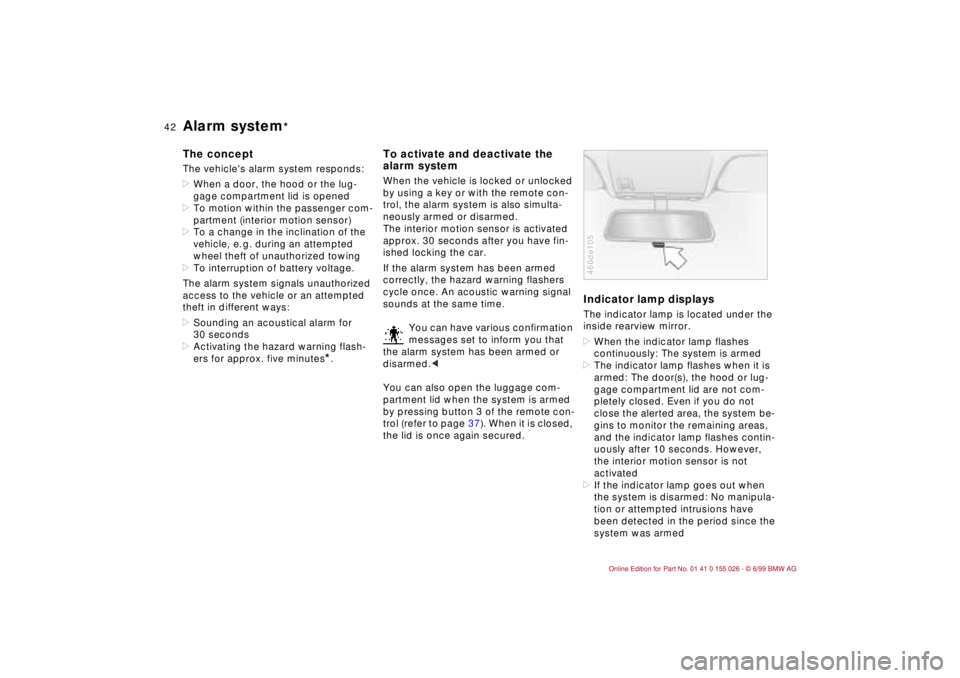
Indicator lamp displaysThe indicator lamp is located under the
inside rearview mirror.
>When the indicator lamp flashes
continuously: The system is armed
>The indicator lamp flashes when it is
armed: The door(s), the hood or lug-
gage compartment lid are not com-
pletely closed. Even if you do not
close the alerted area, the system be-
gins to monitor the remaining areas,
and the indicator lamp flashes contin-
uously after 10 seconds. However,
the interior motion sensor is not
activated
>If the indicator lamp goes out when
the system is disarmed: No manipula-
tion or attempted intrusions have
been detected in the period since the
system was armed460de105
Page 70 of 189
68n
Automatic transmission with Steptronic
*
The Steptronic will "think" for you in the
following situations:
>In order to keep the engine from
overrevving, it will automatically shift
into the next higher gear shortly be-
fore the governed speed.
>If you do not do anything to interfere,
it will automatically downshift at
lower speeds.
>In kickdown, it will downshift into the
lowest gear possible, depending on
the engine speed.
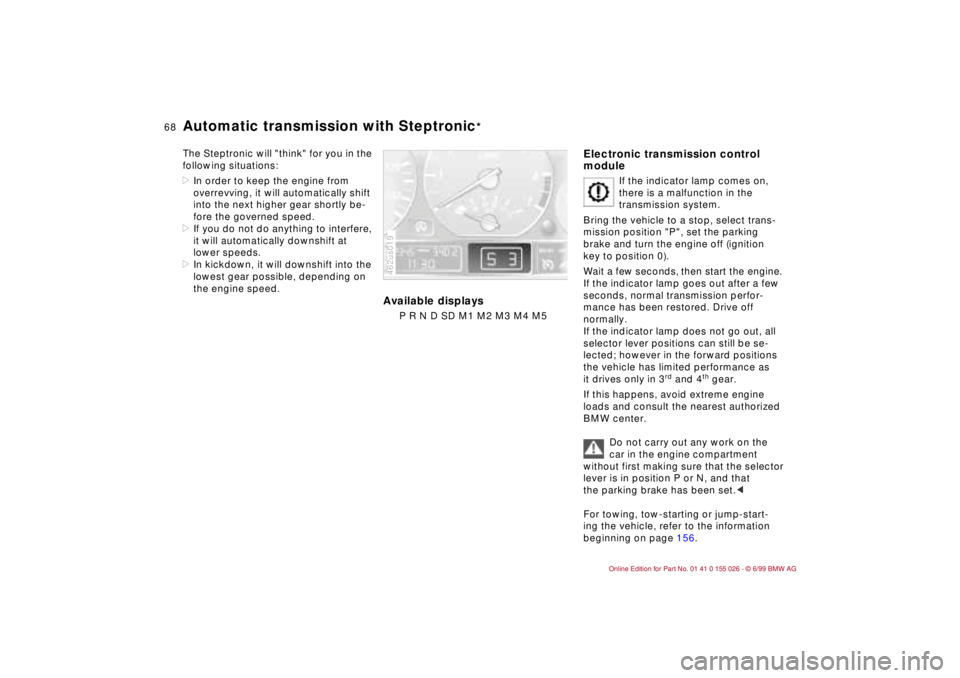
Available displays
P R N D SD M1 M2 M3 M4 M5462us019
Electronic transmission control
module
If the indicator lamp comes on,
there is a malfunction in the
transmission system.
Bring the vehicle to a stop, select trans-
mission position "P", set the parking
brake and turn the engine off (ignition
key to position 0).
Wait a few seconds, then start the engine.
If the indicator lamp goes out after a few
seconds, normal transmission perfor-
mance has been restored. Drive off
normally.
If the indicator lamp does not go out, all
selector lever positions can still be se-
lected; however in the forward positions
the vehicle has limited performance as
it drives only in 3
rd and 4
th gear.
If this happens, avoid extreme engine
loads and consult the nearest authorized
BMW center.
Do not carry out any work on the
car in the engine compartment
without first making sure that the selector
lever is in position P or N, and that
the parking brake has been set.<
For towing, tow-starting or jump-start-
ing the vehicle, refer to the information
beginning on page 156.
Page 102 of 189
100n
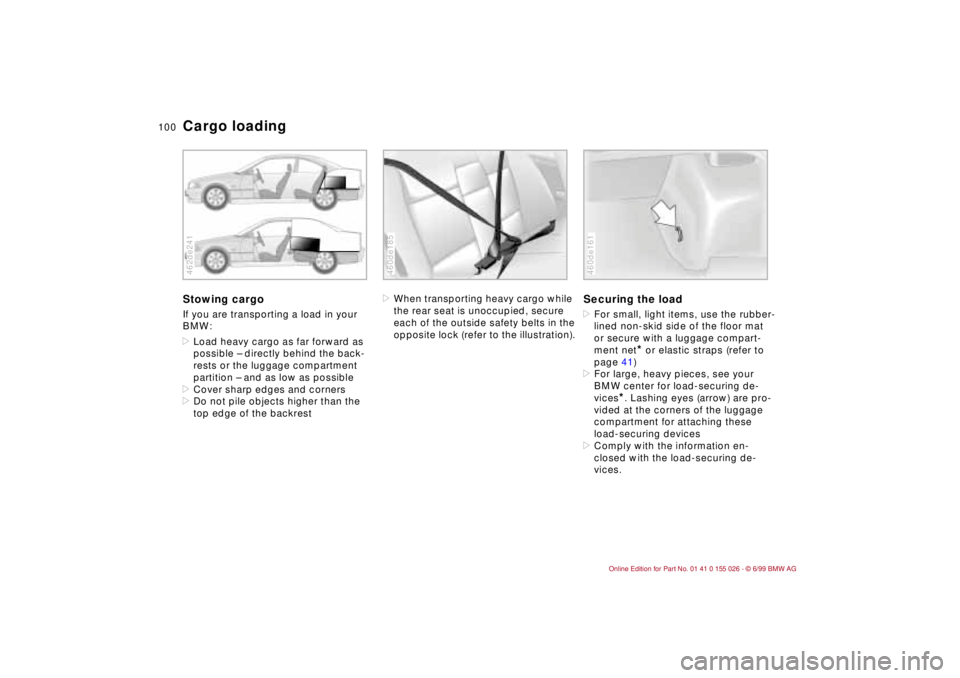
Cargo loadingStowing cargo If you are transporting a load in your
BMW:
>Load heavy cargo as far forward as
possible – directly behind the back-
rests or the luggage compartment
partition – and as low as possible
>Cover sharp edges and corners
>Do not pile objects higher than the
top edge of the backrest462de241
>When transporting heavy cargo while
the rear seat is unoccupied, secure
each of the outside safety belts in the
opposite lock (refer to the illustration).460de185
Securing the load >For small, light items, use the rubber-
lined non-skid side of the floor mat
or secure with a luggage compart-
ment net
* or elastic straps (refer to
page 41)
>For large, heavy pieces, see your
BMW center for load-securing de-
vices
*. Lashing eyes (arrow) are pro-
vided at the corners of the luggage
compartment for attaching these
load-securing devices
>Comply with the information en-
closed with the load-securing de-
vices.
460de161
Page 106 of 189

104n
To ensure that your vehicle provides
maximum economy throughout a long
service life, we request that you ob-
serve the following:
Engine and differentialUp to 1,200 miles (2,000 km):
Drive at varying engine speeds and
road speeds, but do not exceed the fol-
lowing engine or road speeds at this
time: 4,500/min or 100 mph (160 km/h).
Refrain from using full throttle and avoid
pressing the accelerator beyond the
kickdown point.
After 1,200 miles (2,000 km), you can
gradually increase the engine speed or
road speed.
You should also observe these break-in
procedures if the engine or differential
is replaced later in the course of the
vehicle service life.
TiresDue to technical factors associated with
their manufacture, tires do not achieve
their full traction potential until an initial
break-in period has elapsed. For this
reason, drive cautiously during the first
200 miles (300 km).Brake systemBrake pads and disks do not attain their
optimal wear patterns until after approx.
300 miles (500 km).
To break-in the separate parking brake
drums, apply the parking brake lightly
when coasting to a standstill (at a traffic
signal, for instance), provided that traf-
fic conditions allow you to do so.
To avoid corrosion, repeat this proce-
dure from time to time.
The brake lamps do not come on
when the parking brake is set.
Vacuum for the brake system servo unit
on your BMW is available only when the
engine is running. When you move the
car with the engine off – when towing,
for example – substantially higher levels
of pedal force will be required to brake
the vehicle.<
Brakes:
Do not drive with your foot resting
on the brake pedal. Even light but con-
sistent pedal pressure can lead to high
temperatures, brake wear, and possibly
to brake failure.
Aquaplaning:
A wedge of water can form between the
tires and the road surface when you op-
erate the vehicle on wet or slushy roads.
This phenomenon is referred to as
aquaplaning or hydroplaning. It is char-
acterized by a partial or complete loss
of contact between the tires and the
road surface. The ultimate results are
loss of steering and braking control.
Driving through water:
Do not drive through water more than
1 ft (30 cm) deep. Drive only at walking
speed, otherwise damage to the engine,
the electrical system and the transmis-
sion can occur.
Rear parcel tray:
Never use the rear parcel tray to store
heavy or bulky objects. They could pose
a danger to the occupants when the car
is braked heavily.
Break-in procedures Driving notes
Page 141 of 189
Overview
Controls and features
Operation, care
and maintenance
Owner service procedures
Technical data
Index Advanced technology
139n
RepairsIndexOverview Controls Car care Technology Data
Replacement procedures:
Onboard tool kit140
Windshield wiper blades140
Lamps and bulbs140
Remote control147
Changing tires148
Battery151
Fuses153
Microfilter154
In case of electrical
malfunction:
Fuel filler door155
Sliding/tilt sunroof155
Assistance, giving and
receiving:
Jump-starting156
Towing the vehicle157
Page 159 of 189
157n
RepairsIndexOverview Controls Car care Technology Data
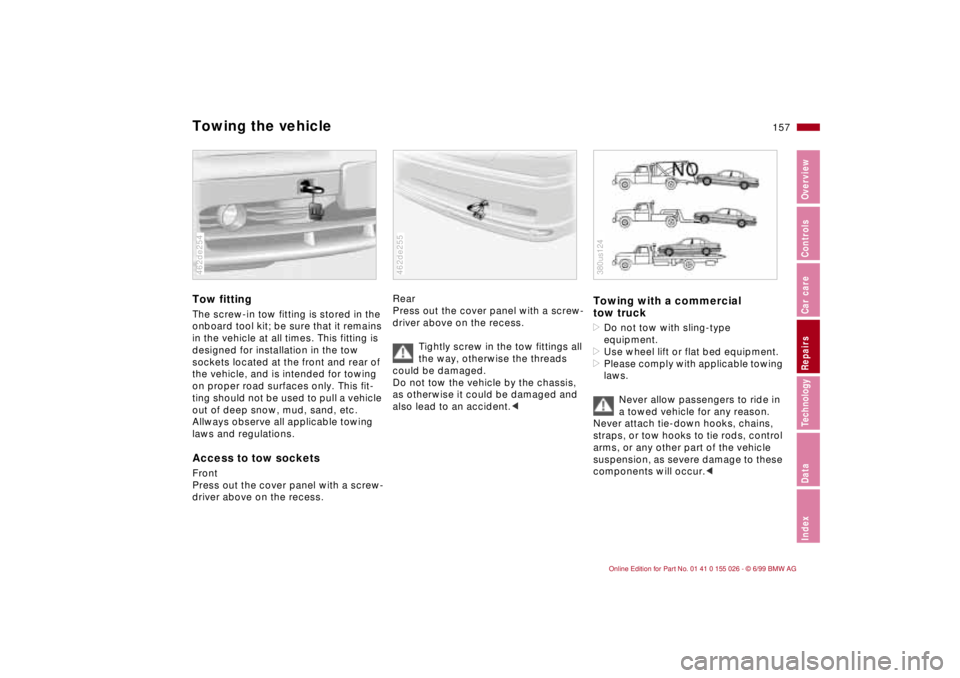
Towing the vehicleTow fittingThe screw-in tow fitting is stored in the
onboard tool kit; be sure that it remains
in the vehicle at all times. This fitting is
designed for installation in the tow
sockets located at the front and rear of
the vehicle, and is intended for towing
on proper road surfaces only. This fit-
ting should not be used to pull a vehicle
out of deep snow, mud, sand, etc.
Allways observe all applicable towing
laws and regulations.Access to tow socketsFront
Press out the cover panel with a screw-
driver above on the recess.462de254
Rear
Press out the cover panel with a screw-
driver above on the recess.
Tightly screw in the tow fittings all
the way, otherwise the threads
could be damaged.
Do not tow the vehicle by the chassis,
as otherwise it could be damaged and
also lead to an accident.<462de255
Towing with a commercial
tow truck>Do not tow with sling-type
equipment.
>Use wheel lift or flat bed equipment.
>Please comply with applicable towing
laws.
Never allow passengers to ride in
a towed vehicle for any reason.
Never attach tie-down hooks, chains,
straps, or tow hooks to tie rods, control
arms, or any other part of the vehicle
suspension, as severe damage to these
components will occur.c380us124
Page 181 of 189
Everything from A to Z
179n
RepairsIndexOverview Controls Car care Technology Data
Code, refer to the radio
operating instructions
Coin holder, cup holder 95
Combination switch 69
Compression 170
Computer 77
Configure settings 54
Consumption 78
Consumption display 75
Coolant 110, 126, 173
Coolant thermometer 75
Coolant, antifreeze 110
Cooling system 173
Cornering Brake Control
(CBC) 21, 107
Cruise control 72
Cruising range 79
Curb weight 172
Current check indicator 20DDashboard 16
Data
dimensions 171
engine 170
technical 170
weights 172
Daytime-driving light
switch 84
Defrost setting 91
Defrost windows 91
Defroster, rear window 92Digital clock 77
Dimensions 171
Dipstick 123
Disc brakes 108
Displacement 170
Display lighting 84
Displays 18
Distance warning 80
Diversity, antenna 162
Divided rear backrest 98
Door key 32
Door locks, care 110
Doors
emergency actuation 34
remote control 35
unlocking and locking 34
Drawbar load 172
Drive belts 174
Driving hints 104
Driving lamps 84
DSC (Dynamic Stability
Control) 22, 81, 161
Dynamic Stability Control
(DSC) 22, 81, 161
EElectric power seat 50
Electric power windows 44
Electrical accessories,
failure 153
Electrical system 174Electronic vehicle
immobilizer 33
Elements of operation 16
Emergency actuation
doors 34
tank cover 155
Energy Control 74
Engage 62
Engine
engage 62
Engine compartment 120
Engine coolant 126, 173
Engine data 170
Engine oil
filling capacity 173
quality 124
viscosity 124
Engine oil consumption 123
Engine oil level 21
check 123
Engine oil pressure 20
Engine oil
specifications 124
Engine speed 170
Entry from the rear 49
Exterior mirrors 52
FFailure messages 77
Fault
ABS 107
Fault displays 77Filler cap cover 26
Filling capacities 173
Filling the washer
reservoir 173
First aid 25
First aid kit 25
Fittings, towing 157
Flashlight 94
Flat tire 113, 148
Fog lamps 85
bulb replacement 143
Fog lights 85
Folding rear backrest 98
Follow-Me-Home lamps 84
Footbrake 108
Footwell lamps 85
bulb replacement 146
Front seat adjustment 47
Frost protection,
radiator 126
Fuel 26
preparation 170
Fuel consumption 78
Fuel consumption
display 75
Fuel gauge 75
Fuel quality 26
Fuel tank capacity 173
Fuel tank gauge 75
Functional status 166
Fuses 153
Page 184 of 189

Everything from A to ZService and Warranty
Information Booklet 129
Service Interval
Display 76, 129
Shiftlock 66
Side airbags 57
Side impact Head Protection
System 57
Ski bag 99
Sliding 111
Sliding/tilt sunroof 45
closing after electrical
fault 155
ease of use actuation 34
remote control 35
Slippery roads 110
Snow chains 110, 117
Space-saver spare tire 148
Spare key 32
Spare key with radio remote
control 32
Spare tire 148
Spark plugs 174
Special oils 124
Speed control 72
Speedometer 18
Sports Seat 49
Start 62
Starting problems 105, 156
Steel wheels 117
Steering 112
Steering wheel lock 62Steptronic 66
Stopping the vehicle 63
Storage shelf 95
Stroke 170
Summer tires 115
Sun roller blind 93
Sun visors 52
Switching off the engine 63
Symbols 4, 151
TTachometer 74
Tail lamps 143
bulb replacement 143
Tank capacity 173
Tank cover
unlock in case of electrical
fault 155
Technical data 170
Technical
modifications 6, 136
Telephone prep 95
Telephone, please refer to
the manufacturer's
operating instructions
Temperature display
outside temperature 78
Temperature gauge
engine coolant 75
Temperature
stratification 92
Third brake lamp 145Through-loading facility 98
Tilt alarm 36
Tilt sensor alarm
system 36, 43
Tire codes 115
Tire damages 113
Tire inflation
pressure 27, 113
Tire Pressure Control
(RDC) 82, 164
Tire pressure
monitoring 82, 164
Tire replacement 114
Tire specifications 117
Tire tread 113
Tools 140
Top off washer fluid
reservoir 122
Top off windshield washer
fluid reservoir 122
Torque 170
Tow fittings 157
Tow starting 157
Towing 157
Track 171
Trailer loads 172
Transmission 65
Tread depth, tires 113
Trip odometer 74
Trunk 39
capacity 172
locking separately 39Trunk lamps
bulb replacement 146
Trunk lid, refer to luggage
compartment lid 39
Turn signal 23
bulb replacement 142
Turn signals 69
Turning radius 171
Two-way radios 112
UUsed batteries 153VVacuum cleaner,
connecting 96
Vanity mirror 52
bulb replacement 146
Vehicle
engage 62
Vehicle battery 151, 174
Vehicle care
exterior 131
interior 132
Vehicle identification 128
Vehicle Identification
Number (VIN) 128
Vehicle immobilizer 33
Vehicle painting 131
Vehicle removal from
service 136
Vehicle weight 172