ECO mode BMW 323Ci CONVERTIBLE 2000 E46 User Guide
[x] Cancel search | Manufacturer: BMW, Model Year: 2000, Model line: 323Ci CONVERTIBLE, Model: BMW 323Ci CONVERTIBLE 2000 E46Pages: 199, PDF Size: 1.77 MB
Page 85 of 199
85n
IndexDataTechnologyRepairsCar careControlsOverview
Onboard computer
*
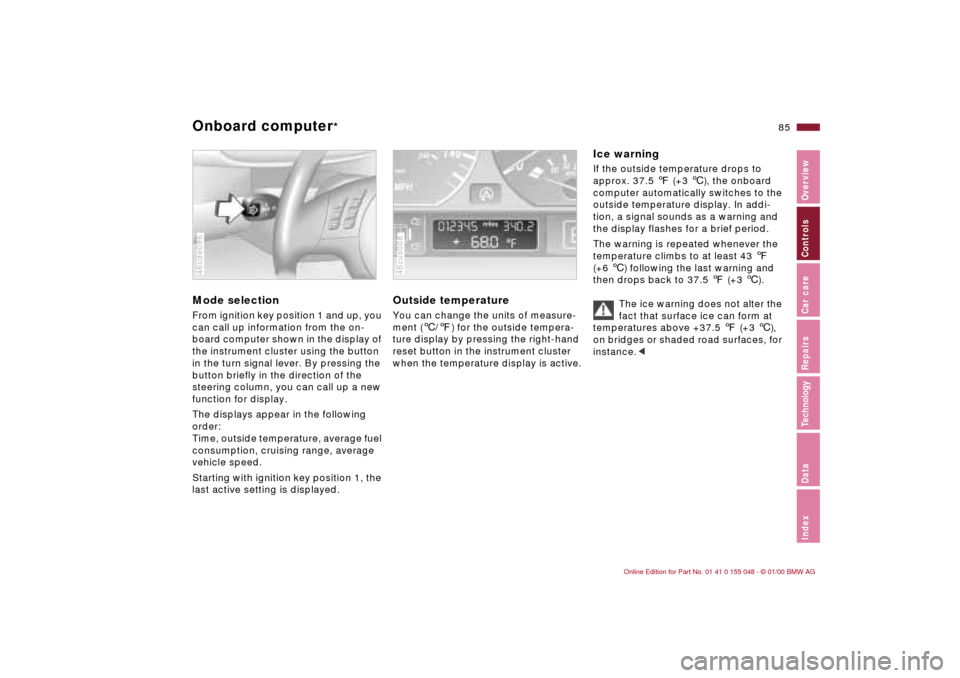
Mode selectionFrom ignition key position 1 and up, you
can call up information from the on-
board computer shown in the display of
the instrument cluster using the button
in the turn signal lever. By pressing the
button briefly in the direction of the
steering column, you can call up a new
function for display.
The displays appear in the following
order:
Time, outside temperature, average fuel
consumption, cruising range, average
vehicle speed.
Starting with ignition key position 1, the
last active setting is displayed.46cde096
Outside temperature You can change the units of measure-
ment (6/7) for the outside tempera-
ture display by pressing the right-hand
reset button in the instrument cluster
when the temperature display is active. 46cus008
Ice warning If the outside temperature drops to
approx. 37.5 7 (+3 6), the onboard
computer automatically switches to the
outside temperature display. In addi-
tion, a signal sounds as a warning and
the display flashes for a brief period.
The warning is repeated whenever the
temperature climbs to at least 43 7
(+6 6) following the last warning and
then drops back to 37.5 7 (+3 6).
The ice warning does not alter the
fact that surface ice can form at
temperatures above +37.5 7 (+3 6),
on bridges or shaded road surfaces, for
instance.<
Page 88 of 199
88n
Dynamic Stability Control (DSC) The conceptDSC helps maintain vehicle stability,
even in critical driving situations.
The system optimizes vehicle stability
during acceleration and when starting
from a full stop, as well as optimizing
traction. In addition, the system recog-
nizes unstable vehicle conditions (un-
dersteering or oversteering, for exam-
ple) and helps hold the vehicle on a
sure course by intervening via the
engine and by braking intervention at
the individual wheels.
The system activates automatically
each time you start the engine.46cus012
Indicator lamp
The indicator lamp in the instru-
ment cluster goes out shortly
after you switch on the ignition.
Refer to pages 21 and 22.
Indicator lamp flashes:
The system is active and governs drive
force and braking force.
If the indicator lamp fails to go out after
the engine is started, or if it comes on
during normal driving and stays on:
There is a system malfunction or the
system was deactivated with the but-
ton. You can continue to drive the vehi-
cle normally, but without DSC. Please
consult your BMW center for repairs.
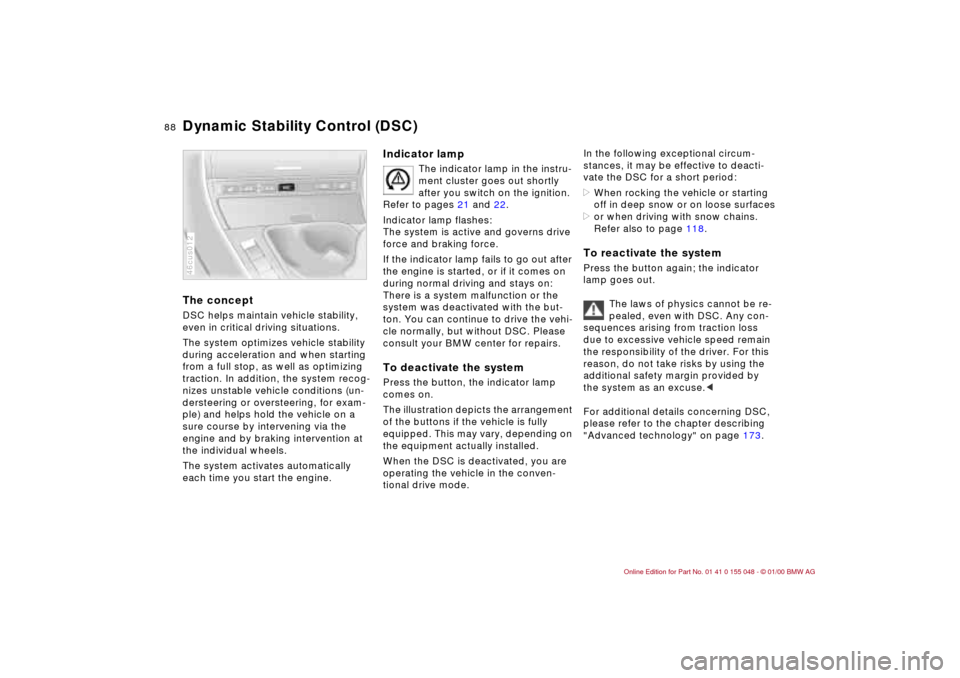
To deactivate the systemPress the button, the indicator lamp
comes on.
The illustration depicts the arrangement
of the buttons if the vehicle is fully
equipped. This may vary, depending on
the equipment actually installed.
When the DSC is deactivated, you are
operating the vehicle in the conven-
tional drive mode.
In the following exceptional circum-
stances, it may be effective to deacti-
vate the DSC for a short period:
>When rocking the vehicle or starting
off in deep snow or on loose surfaces
>or when driving with snow chains.
Refer also to page 118.To reactivate the systemPress the button again; the indicator
lamp goes out.
The laws of physics cannot be re-
pealed, even with DSC. Any con-
sequences arising from traction loss
due to excessive vehicle speed remain
the responsibility of the driver. For this
reason, do not take risks by using the
additional safety margin provided by
the system as an excuse.<
For additional details concerning DSC,
please refer to the chapter describing
"Advanced technology" on page 173.
Page 95 of 199

95n
IndexDataTechnologyRepairsCar careControlsOverview
Automatic climate control 1 Air onto the windshield and the side
windows
2 Air flow toward the upper body
The side rotary dials provide infi-
nitely variable regulation of the air
supply, while the levers change the
air flow direction. The center rotary
dial controls the temperature of the
air as it flows out, refer to page 98
3 Front footwell ventilation
There are corresponding air vents in
the rear footwell as well
4 Recirculated air mode/Automatic
recirculated air control (AUC)97
5 Air supply97
6 Temperature96
7 Automatic air distribution96
8 Individual air distribution96
9 Air grill for interior temperature
sensor – please keep clear and
unobstructed
10 Display for temperature and air
supply96
11 Defrost the windshield and side
windows97
12 Air conditioner97
13 Rear window defroster79, 98
Page 97 of 199
97n
IndexDataTechnologyRepairsCar careControlsOverview
Automatic climate controlAir supply
By pressing the left or right half
of the button, you can vary the
air supply. By doing this, you switch off
the automatic control for the air supply.
Nevertheless, the automatic air distri-
bution remains unchanged.
When you set the lowest blower speed
by pressing the left half of the button,
all of the displays are canceled: the
blower, heater and air conditioner are
switched off, and the air supply stops.
You can reactivate the system by
pressing any button of the automatic
climate control.
Defrost the windshield and side
windows
This program quickly removes
ice and condensation from the
windshield and side windows.
Air conditioner
The air is cooled and dehumidi-
fied and – depending on the tem-
perature setting – rewarmed when the
air conditioner system is switched on.
Depending on the weather, the wind-
shield may fog over briefly when the
engine is started.
Use the button to switch the air condi-
tioner off when outside air temperatures
are below approx. 41 7 (+5 6). This
will help to prevent the windows from
fogging over.
If the windows fog over after switching
the air conditioner off, switch it back on.
Condensation forms in the air
conditioner system during opera-
tion, which then exits under the vehicle.
Traces of condensed water of this kind
are thus normal.<
Automatic recirculated air
control (AUC)
If there are unpleasant odors or
pollutants in the outside air, you
can temporarily block the air flow from
the outside. The system then recircu-
lates the air already within the vehicle.
By repeated actuation of the button,
you can select three different operating
modes.
>Indicator lamps off: fresh air flows
into the vehicle
>Left-hand indicator lamp on – AUC
mode: the system detects pollutants
in the outside air and responds by
deactivating the outside air flow as
required. The system then recircu-
lates the air already within the vehicle.
Depending on air quality require-
ments, the system automatically
switches between outside air supply
and recirculation of the air already
within the vehicle
>Right-hand indicator lamp on: the
flow of outside air is permanently
blocked. The system recirculates the
air already within the vehicle.
If the windows fog over in the
recirculated air mode, switch this
mode off and increase the air supply
as required.<
Page 99 of 199
99n
IndexDataTechnologyRepairsCar careControlsOverview
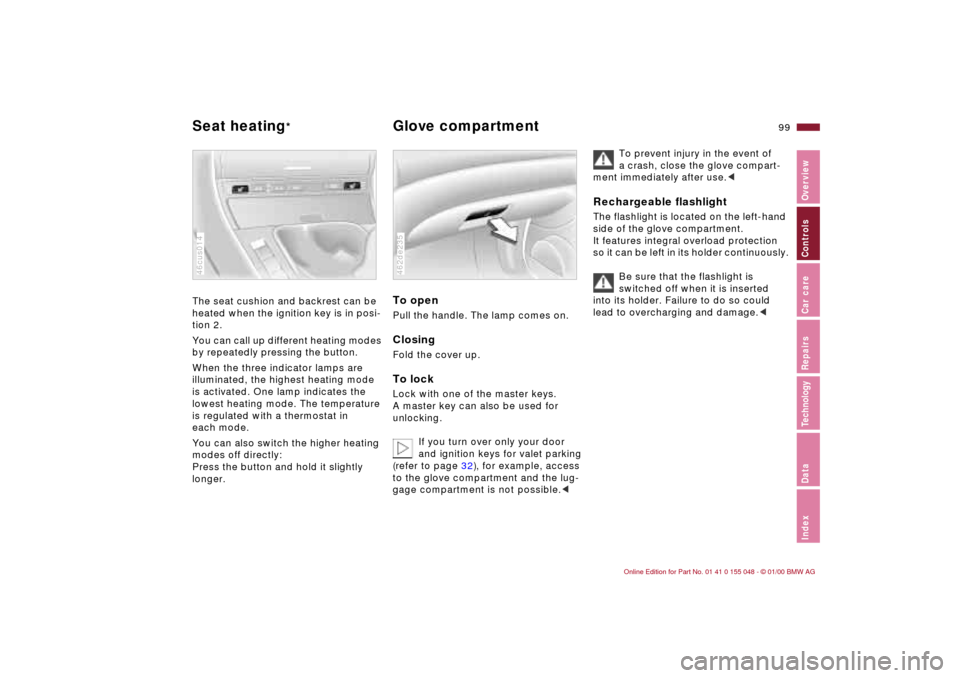
The seat cushion and backrest can be
heated when the ignition key is in posi-
tion 2.
You can call up different heating modes
by repeatedly pressing the button.
When the three indicator lamps are
illuminated, the highest heating mode
is activated. One lamp indicates the
lowest heating mode. The temperature
is regulated with a thermostat in
each mode.
You can also switch the higher heating
modes off directly:
Press the button and hold it slightly
longer.46cus014
To open Pull the handle. The lamp comes on.ClosingFold the cover up.To lockLock with one of the master keys.
A master key can also be used for
unlocking.
If you turn over only your door
and ignition keys for valet parking
(refer to page 32), for example, access
to the glove compartment and the lug-
gage compartment is not possible.<462de235
To prevent injury in the event of
a crash, close the glove compart-
ment immediately after use.<
Rechargeable flashlight The flashlight is located on the left-hand
side of the glove compartment.
It features integral overload protection
so it can be left in its holder continuously.
Be sure that the flashlight is
switched off when it is inserted
into its holder. Failure to do so could
lead to overcharging and damage.<
Seat heating
*
Glove compartment
Page 115 of 199
115n
IndexDataTechnologyRepairsCar careControlsOverview
Antilock Brake System (ABS)Antilock Brake System (ABS)/
Cornering Brake Control (CBC) CBC is an advanced engineering de-
sign of the ABS. When braking while
cornering at high speed or braking dur-
ing high lateral acceleration, or when
braking during a lane change, vehicle
stability is improved and steering re-
sponse is enhanced.
In the event of a malfunction
If the ABS warning lamp in the
instrument cluster lights up,
refer to page 22. The brake
system then reverts to conventional
operation as on vehicles without ABS.
However, have the brake system
checked by your BMW center as soon
as possible, to prevent undetected
defects and cumulative faults from
adversely affecting the brake system.
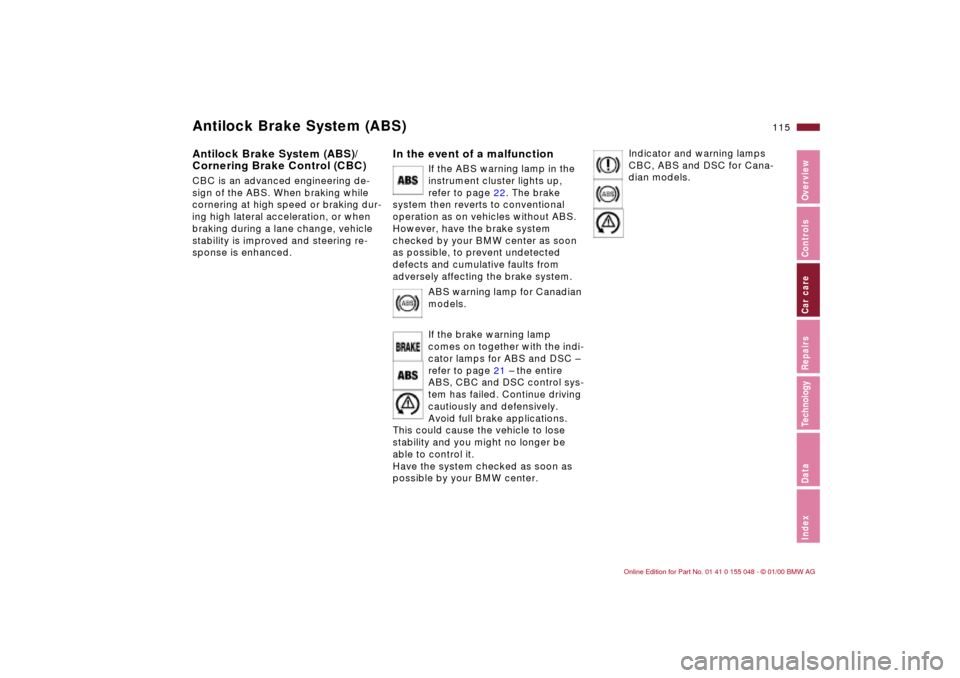
ABS warning lamp for Canadian
models.
If the brake warning lamp
comes on together with the indi-
cator lamps for ABS and DSC –
refer to page 21 – the entire
ABS, CBC and DSC control sys-
tem has failed. Continue driving
cautiously and defensively.
Avoid full brake applications.
This could cause the vehicle to lose
stability and you might no longer be
able to control it.
Have the system checked as soon as
possible by your BMW center.
Indicator and warning lamps
CBC, ABS and DSC for Cana-
dian models.
Page 117 of 199

117n
IndexDataTechnologyRepairsCar careControlsOverview
Brake systemBrake fluid level
If the warning lamp for the brake
system comes on with the park-
ing brake released:
The brake fluid level is too low in the
reservoir (refer to page 136).
If the brake fluid level is too low and
brake pedal travel has become notice-
ably longer, there may be a defect in
one of the hydraulic circuits of the
brake system.
Warning lamps or the brake
system for Canadian models.
Proceed to the nearest BMW
center. Increased brake applica-
tion pressure may be necessary under
these conditions, and brake pedal
travel may be significantly longer.
Please remember to adapt your driving
style accordingly.<
Brake linings
If the warning lamp for the brake
pads lights up:
The brake pads have reached
their minimum pad thickness. Proceed
to the nearest BMW center as soon as
possible to have the pads replaced.
For your own safety: use only
BMW approved brake pads for
your particular vehicle model. BMW
cannot evaluate non-approved brake
pads to determine if they are suited for
use, and therefore cannot ensure the
operating safety of the vehicle if they
are installed.<
Page 123 of 199
123n
IndexDataTechnologyRepairsCar careControlsOverview
Information for your safetyThe factory approved radial tires are
matched to the vehicle and have been
selected to provide optimum safety and
driving comfort.
It is not merely the tire's service life, but
also driving comfort and – above all else
– driving safety that depend on the con-
dition of the tires and the maintenance
of the specified tire pressure.
Incorrect inflation pressure is a frequent
cause of tire damage. It also signifi-
cantly influences the roadholding ability
of your BMW.
Check tire inflation pressures reg-
ularly – including the space-saver
spare tire – at least twice a month and
before beginning a longer trip (see
page 27). If this is not done, incorrect
tire pressures can cause driving insta-
bility and tire damage, ultimately result-
ing in accidents.<
Tire tread – tire damageInspect your tires frequently for tread
wear, signs of damage and for foreign
objects lodged in the tread. Check the
tread depth.
Tread depth should not be allowed to
go below 0.12 in (3 mm), even though
the legally specified minimum tread
depth is only 0.063 in (1.6 mm). At a
tread depth of 0.063 in (1.6 mm), tread
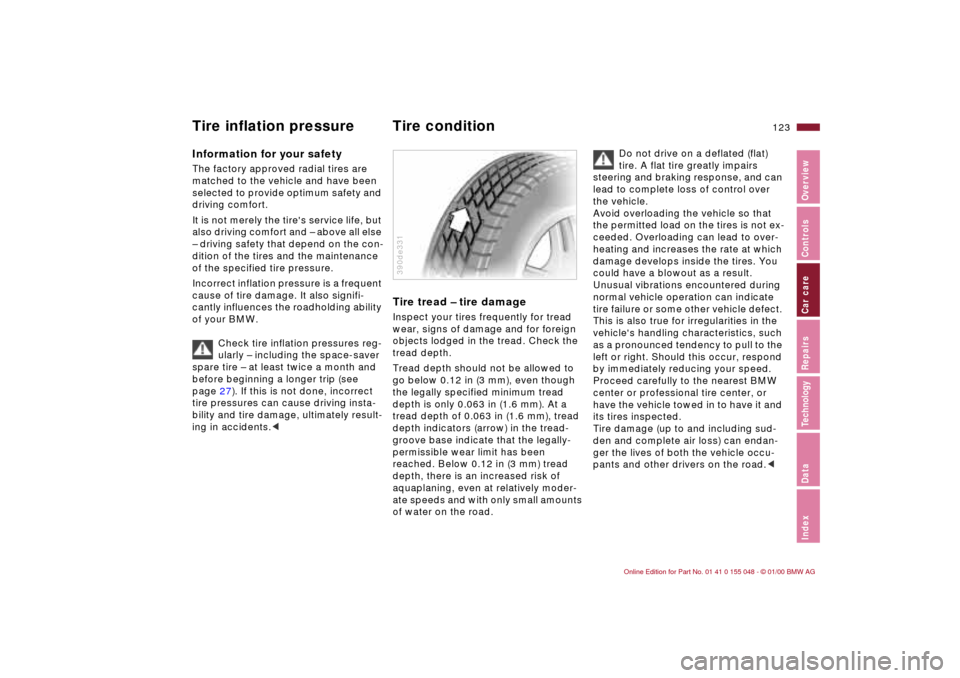
depth indicators (arrow) in the tread-
groove base indicate that the legally-
permissible wear limit has been
reached. Below 0.12 in (3 mm) tread
depth, there is an increased risk of
aquaplaning, even at relatively moder-
ate speeds and with only small amounts
of water on the road.390de331
Do not drive on a deflated (flat)
tire. A flat tire greatly impairs
steering and braking response, and can
lead to complete loss of control over
the vehicle.
Avoid overloading the vehicle so that
the permitted load on the tires is not ex-
ceeded. Overloading can lead to over-
heating and increases the rate at which
damage develops inside the tires. You
could have a blowout as a result.
Unusual vibrations encountered during
normal vehicle operation can indicate
tire failure or some other vehicle defect.
This is also true for irregularities in the
vehicle's handling characteristics, such
as a pronounced tendency to pull to the
left or right. Should this occur, respond
by immediately reducing your speed.
Proceed carefully to the nearest BMW
center or professional tire center, or
have the vehicle towed in to have it and
its tires inspected.
Tire damage (up to and including sud-
den and complete air loss) can endan-
ger the lives of both the vehicle occu-
pants and other drivers on the road.<
Tire inflation pressure Tire condition
Page 141 of 199

141n
IndexDataTechnologyRepairsCar careControlsOverview
Caring for your vehicleWaxing your vehicle Protect the finish using only carnauba
or synthetic-based waxes.
The best way to determine when the
finish needs to be waxed is by noting
when water stops beading on the
surface.
You can use a glass cleaner to remove
any wax or silicone that may have been
left on the windows during waxing.
Use the cleaning and car-care
products available at your BMW
center.<
Paint damageYou can touch up small areas of paint
damage with a BMW spray paint or a
BMW touchup stick.
The paint color code for your vehicle is
provided on a sticker located on the
right hand side under the hood and on
the first page of your Service and War-
ranty Information Booklet (US models)
or Warranty and Service Guide (Cana-
dian models).
Damage caused by flying stones,
scratches, etc., must be touched up
without delay to prevent rust from
forming.
If corrosion has started to form in an
area with paint damage, remove all rust
and clean the area. Then prime the area
with a BMW Primer Stick. Finally, apply
the finish coat. Wait a few days, then
polish the repaired area. Finish by ap-
plying a wax preservative.
More extensive paint damage should
be repaired professionally in accor-
dance with the manufacturer's instruc-
tions. Your BMW center uses original
BMW finish materials in accordance
with approved repair procedures.
Caring for other vehicle
components and materials Light-alloy wheels should be treated
with alloy wheel cleaner, especially dur-
ing the winter months. However, do not
use aggressive products containing ac-
ids, strong alkalis or abrasives. Do not
use steam cleaners operating at tem-
peratures above 140 7 (+60 6). Fol-
low the manufacturer's instructions.
If your vehicle has chrome parts
*, such
as the window frames and door han-
dles, clean these parts carefully with
ample clean water and a shampoo sup-
plement if desired, especially if they
have an accumulation of road salt.
Use a chrome polish for an additional
treatment.
You can use window and glass cleaner
to clean inside window surfaces and
mirrors without smearing and streaking.
Never use polishing pastes or abrasive
(quartz) cleansers on mirror lenses.
Page 147 of 199

147n
IndexDataTechnologyRepairsCar careControlsOverview
Vehicle storage
If you intend to store the vehicle
for more than three months, have
the maintenance operations described
on this page performed.<
Preparations for storageHave your BMW center perform the fol-
lowing procedures:
1 Clean and apply a rustproofing agent
or other treatment to the engine,
engine compartment, undercarriage,
axles and major components in ac-
cordance with approved repair pro-
cedures. Washing the vehicle, any in-
terior cleaning and subsequent paint-
and chrome care, and cleaning any
rubber seals for the hood and doors,
should be carried out in compliance
with approved procedures as well
2 Change engine oil and oil filter at op-
erating temperature. As an additional
corrosion protection measure, an an-
ticorrosive agent can be added to the
engine when refueling in accordance
with the manufacturer's instructions
3 Check the coolant level and concen-
tration and top off if necessary
4 Fill the fuel tank completely to pre-
vent the formation of condensation
5 Increase the tire inflation pressure to
51 psi (350 kPa).
Before parking the vehicle1 Dry the parking brake and footbrakes
completely to keep the brake discs
and drums from corroding
2 Park the vehicle in a covered, dry,
and well-ventilated space. Place the
transmission in first gear or set the
selector lever to the "P" position.
Chock the wheels to prevent the ve-
hicle from rolling if necessary. Do not
apply the parking brake
3 Remove the battery, charge it com-
pletely and store it in a cool (but
frost-free) room
4 Remove the hardtop
* and store it
separately. Refer to page 121
5 Close the convertible top.
During storageRecharge the battery every six months.
If it is not recharged, it will not be ser-
viceable. Every time the battery drains,
especially over extended periods, its
service life is reduced.
Removing the vehicle from
storageRecharge the battery if the "Magic
Eye"
* turns black. Refer to page 162.
Then have Inspection I performed by
your BMW center, including a brake
fluid replacement if necessary. Refer to
the Service and Warranty Information
Booklet (US models) or the Warranty
and Service Guide (Canadian models).