tires BMW 323Ci CONVERTIBLE 2000 E46 User Guide
[x] Cancel search | Manufacturer: BMW, Model Year: 2000, Model line: 323Ci CONVERTIBLE, Model: BMW 323Ci CONVERTIBLE 2000 E46Pages: 199, PDF Size: 1.77 MB
Page 123 of 199
123n
IndexDataTechnologyRepairsCar careControlsOverview
Information for your safetyThe factory approved radial tires are
matched to the vehicle and have been
selected to provide optimum safety and
driving comfort.
It is not merely the tire's service life, but
also driving comfort and – above all else
– driving safety that depend on the con-
dition of the tires and the maintenance
of the specified tire pressure.
Incorrect inflation pressure is a frequent
cause of tire damage. It also signifi-
cantly influences the roadholding ability
of your BMW.
Check tire inflation pressures reg-
ularly – including the space-saver
spare tire – at least twice a month and
before beginning a longer trip (see
page 27). If this is not done, incorrect
tire pressures can cause driving insta-
bility and tire damage, ultimately result-
ing in accidents.<
Tire tread – tire damageInspect your tires frequently for tread
wear, signs of damage and for foreign
objects lodged in the tread. Check the
tread depth.
Tread depth should not be allowed to
go below 0.12 in (3 mm), even though
the legally specified minimum tread
depth is only 0.063 in (1.6 mm). At a
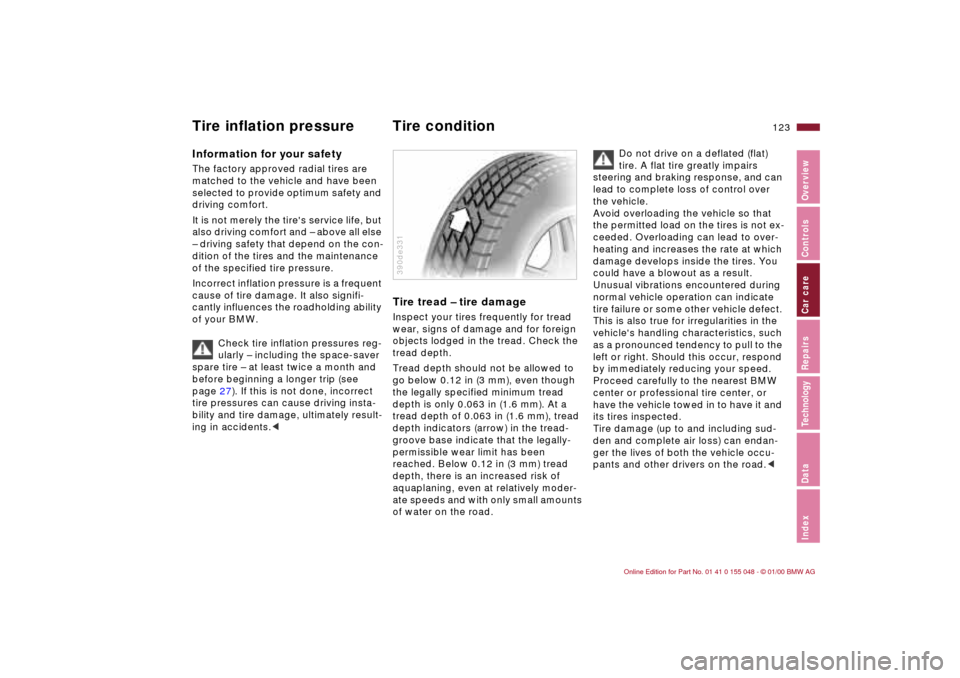
tread depth of 0.063 in (1.6 mm), tread
depth indicators (arrow) in the tread-
groove base indicate that the legally-
permissible wear limit has been
reached. Below 0.12 in (3 mm) tread
depth, there is an increased risk of
aquaplaning, even at relatively moder-
ate speeds and with only small amounts
of water on the road.390de331
Do not drive on a deflated (flat)
tire. A flat tire greatly impairs
steering and braking response, and can
lead to complete loss of control over
the vehicle.
Avoid overloading the vehicle so that
the permitted load on the tires is not ex-
ceeded. Overloading can lead to over-
heating and increases the rate at which
damage develops inside the tires. You
could have a blowout as a result.
Unusual vibrations encountered during
normal vehicle operation can indicate
tire failure or some other vehicle defect.
This is also true for irregularities in the
vehicle's handling characteristics, such
as a pronounced tendency to pull to the
left or right. Should this occur, respond
by immediately reducing your speed.
Proceed carefully to the nearest BMW
center or professional tire center, or
have the vehicle towed in to have it and
its tires inspected.
Tire damage (up to and including sud-
den and complete air loss) can endan-
ger the lives of both the vehicle occu-
pants and other drivers on the road.<
Tire inflation pressure Tire condition
Page 124 of 199

124n
To maintain good handling and vehicle
response, use only tires of a single
tread configuration from a single manu-
facturer. BMW tests and approves
wheel/tire combinations. Refer to
page 128.
DOT Quality GradesTreadwear
Traction AA A B C
Temperature A B C
In addition to the tire grades listed
above, all passenger car tires must
conform to Federal Safety Require-
ments as well.< TreadwearThe treadwear grade is a comparative
rating based on the wear rate of the tire
when tested under controlled condi-
tions on a specified government test
course.
For example, a tire graded 150 would
wear one and one-half (1-1/2) times as
well on the government course as a tire
graded 100. The relative performance
of tires depends upon the actual condi-
tions of their use, however, and may
depart significantly from the norm due
to variations in driving habits, service
practices and differences in road
characteristics and climate.TractionThe traction grades, from highest to
lowest, are AA, A, B, and C.
Those grades represent the tire's ability
to stop on wet pavement as measured
under controlled conditions on speci-
fied government test surfaces of as-
phalt and concrete. A tire marked C
may have poor traction performance.
The traction grade assigned to
this tire is based on straight-
ahead braking traction tests, and
does not include acceleration, corner-
ing, hydroplaning, or peak traction
characteristics.< TemperatureThe temperature grades are A (the high-
est), B, and C, representing the tire's re-
sistance to the generation of heat and
its ability to dissipate heat when tested
under controlled conditions on a speci-
fied indoor laboratory test wheel.
Sustained high temperature can cause
the tire material to degenerate and re-
duce tire life, and excessive tempera-
ture can lead to sudden tire failure. The
Grade C corresponds to a level of per-
formance which all passenger car tires
must meet under the Federal Motor
Vehicle Safety Standard No. 109.
Grades B and A represent higher levels
of performance on the laboratory test
wheel than the minimum required by law.
The temperature grade for this tire
is established for a tire that is prop-
erly inflated and not overloaded. Exces-
sive speed, underinflation, or excessive
loading, either separately or in combina-
tion, can cause heat buildup and possi-
ble tire failure.< Uniform Tire Quality Grading Quality grades can be found where
applicable on the tire sidewall between
tread shoulder and maximum section
width. For example:
Tread wear 200 Traction AA
Temperature A
Do not use retreaded tires ("caps").
Driving safety may be impaired by
their use. This due to the possible varia-
tions in casing structures and, in some
cases, to their extreme age, factors
which can lead to a decrease in their
durability.<
Tire replacement
Page 125 of 199

125n
IndexDataTechnologyRepairsCar careControlsOverview
Tire replacement Tire rotationTire ageThe date on which the tire was manu-
factured is indicated by the code on the
sidewall:
DOT ... 150 indicates that the tire was
manufactured during week 15 of the
year 2000.
BMW recommends the replacement of
all tires when the tires are no more than
6 years old, even if a tire life of 10 years
is possible.
Spare tires over 6 years old should be
used only in case of emergency. A tire
in this condition should be replaced by
a new tire immediately, and should not
be mounted together with new tires.
Between the axlesThe tread wear patterns at the front
end differ from those at the rear – the
actual patterns will vary according to
individual driving conditions. In the
interests of safety and maintaining opti-
mal handling characteristics, tire rota-
tion is not recommended.
If a proposed interaxle rotation of tires
is based on economic considerations,
one should consider whether the costs
for the rotation are likely to be recap-
tured by any increase in the service life
of the tires that might be realized. Rota-
tion should always be carried out at
short intervals, with a maximum of
3,000 miles (5,000 km). Consult your
BMW center for more information.
Should you decide to rotate the tires, it
is essential to comply with the following:
Rotate tires on the same side only, since
braking characteristics and road grip
could otherwise be adversely affected.
Following rotation, the tire inflation
pressure should always be corrected.If different tire sizes are mounted
on the front and rear axles (refer
to page 12 8), the wheels may not be
rotated from one axle to the other.<
Page 126 of 199

126n
Wheel and tire combinations The right choice Use only tires approved by BMW.
Refer to the information beginning on
page 128.
Due to the high speeds this vehicle can
reach, the use of specific brands, spec-
ifications and sizes is mandatory. Con-
sult any BMW center for details.
Comply with local/national regulations.
The correct wheel-tire combina-
tion affects different systems, e.g.
ABS, ATC
* and DSC, whose function
would otherwise be impaired if im-
proper wheel-tire combinations are
used.
For this reason, use only tires of the
same brand and tread pattern. In the
event of a flat tire, for example, remount
the approved wheel-tire combination as
soon as possible.<
Codes on tires and wheels The tire codes will aid you in selecting
the correct tire.
The codes on radial tires:
The speed rating indicates the ap-
proved maximum speed for the tire.
Summer tires:
S = up to 112 mph (180 km/h)
T = up to 118 mph (190 km/h)
H = up to 130 mph (210 km/h)
V = up to 150 mph (240 km/h)
W = up to 167 mph (270 km/h)
Y = over 167 mph (270 km/h)
ZR = over 150 mph (240 km/h) For example:
Nominal width
in mm
Aspect ratio in X
Radial tire code
Rim diameter in inches
Load rating
(not on ZR tires)
Speed rating
(before R on ZR tires)
225/50 R
1692W
Winter tires:
Q M+S = up to 100 mph (160 km/h)
T M+S = up to 118 mph (190 km/h)
H M+S = up to 130 mph (210 km/h)
Codes stamped on light-alloy wheels:
Protect tire valves from dirt by using
screw-on valve stem caps. Dirt in the
valves frequently leads to slow leaks. For example:
Rim width
in inches
Code letter for
flange type
Symbol for full-drop
center rim
Rim diameter in inches
Hump on the 2 rim shoulders
7 x 16 H 2
J
Page 127 of 199

127n
IndexDataTechnologyRepairsCar careControlsOverview
Do not exceed specified
maximum speeds
Never exceed the maximum speed
for which winter tires are rated.
Unprofessional attempts by laymen to
service tires can lead to damage and
accidents.
Have this work performed by skilled
professionals only. Any BMW center
has the required technical knowledge
and the proper equipment and will be
happy to assist you.<
Tire condition, tire pressureOnce the tire wears to a tread depth
below 0.16 in (4 mm), winter tires dis-
play a perceptible decrease in their
ability to cope with winter driving condi-
tions, and should be replaced in the
interest of safety.
Comply with the specified tire inflation
pressures – and be sure to have the
wheel and tire assemblies balanced
every time you change the tires.
Winter tiresChoosing the right tireBMW recommends winter tires (M+S
radial tires) for driving in adverse winter
road conditions. Although all-season
tires with the M+S identification provide
better winter traction than summer tires
with H, V, W Y and ZR speed ratings,
they generally fail to provide the same
levels of performance as standard
winter tires.
In the interests of safe tracking and
steering response, install winter tires
made by the same manufacturer having
the same tread configuration on all four
wheels.
Mount only winter tires which have
been approved by BMW. Any BMW
center will be glad to provide you with
information on the best winter tires for
your particular driving conditions.
StorageAlways store tires in a cool, dry place.
Store them away from light whenever
possible. Protect the tires against con-
tact with oil, grease and fuel.Snow chains
*
The use of narrow-link BMW snow
chains on summer or winter tires is
approved only in pairs and only on the
rear wheels. Comply with all manufac-
turer's safety precautions when mount-
ing the chains.
Page 128 of 199

128n
Approved wheel and tire specifications Tire specifications Steel rim
(wheel rim)Light-alloy
wheel
Summer tires
205/55 R 16 91 H
225/50 R 16 92 W
225/50 ZR 16 –
–
–7Jx16
7Jx16
7Jx16
205/50 R 17 93 W extra load – 7Jx17
225/45 R 17 91 W – 8Jx17
Front: 225/40 ZR 18 – 8Jx18
Rear: 255/35 ZR 18 – 8.5Jx18
Winter tires (M+S)
205/55 R 16 91 Q/T/H
225/50 R 16 92 Q/T/H–
7Jx167Jx16
7Jx16
205/50 R 17 93 Q/T/H extra load – 7Jx17
225/45 R 17 91 Q/T/H – 8Jx17
Space-saver spare tire
T 115/90 R 16 92 M 3.0Bx16 –
T 125/90 R 16 98 M 3.5Bx16 –
T 125/80 R 17 99 M 3.5Bx17 –
Comply with the specifications for tires and wheels in the
vehicle's documents.
If you install tire sizes not approved by the manufacturer, you
may have to enter this information in the vehicle documents.
Only light-alloy wheels are to be used
for summer tires.Snow chains
*
You cannot mount snow chains on the
following tires:
225/50 R 16 92 W
225/50 ZR 16
225/40 ZR 18
255/35 ZR 18
225/45 R 17 91 W
225/50 R 16 92 Q/T/H
225/45 R 17 91 Q/T/HMixed tiresFor details concerning tire manufactur-
ers for mixed tires, refer to the specifi-
cations in the vehicle documents.
Page 139 of 199

139n
IndexDataTechnologyRepairsCar careControlsOverview
Washing your vehicle You can wash your BMW at an auto-
matic car wash, even when it is new.
Brushless systems are preferable (refer
to page 144 as well).
Wipe away tough dirt and loosen and
remove dead insects before washing
the vehicle.
In order to avoid spots, do not wash the
vehicle when the hood is warm, or dur-
ing or immediately after exposure to
strong sunlight.
When using an automatic car wash, be
sure that:
>The car wash system is suited for the
dimensions of your vehicle
>No damage will occur to vehicles
with attached body accessories (such
as spoilers or antennas). Consult the
car wash operator if necessary
>The wheels and tires of your vehicle
cannot be damaged by the convey-
ance devices of the car wash system
>The vehicle is cleaned with minimum
brush pressure, and that ample water
is available for washing and rinsing.Vehicles with rain sensor
*:
Clean the windshield regularly. Wax
from automatic car washes or insects
can cause the rain sensor* to malfunc-
tion.
Turn the rain sensor* off (refer to
page 78) when passing through an
automatic car wash. Failure to do so
could result in damage caused by unin-
tended wiper activation.<
Parts of the vehicle that are inaccessi-
ble to the automatic washer – such as
door sills, door and hood edges, etc. –
should be cleaned by hand.
In the winter months, it is especially im-
portant to ensure that the vehicle is
washed on a regular basis. Large quan-
tities of dirt and road salt are difficult to
remove, and they also damage the
vehicle.
If spray wands or high-pressure
washers are used, be sure to
maintain an adequate distance between
the spray source and the vehicle's sur-
face. Inadequate distance and exces-
sive pressure can damage or weaken
the finish, making it more susceptible to
subsequent attack. In addition, mois-
ture could penetrate to vehicle compo-
nents, leading to long-term damage.<
When cleaning the headlamps,
please observe the following:
Do not clean by wiping with a dry cloth
(scratches). Never use abrasives or
strong solvents to clean the covers.
Remove dirt and contamination (such
as insects) by soaking with BMW Car
Shampoo and then rinsing with plenty
of water. Always use a deicer spray to
remove accumulated ice and snow –
never use a scraper.<
After washing the vehicle, apply
the brakes briefly to dry them.
Braking efficiency might otherwise be
reduced by the moisture and the brake
rotors could also corrode.<
Caring for your vehicle
Page 162 of 199
162n
Changing a wheel Battery Driving with the space-saver
spare tireDrive cautiously. Do not exceed a speed
of 45 mph (80 km/h).
You can anticipate changes in vehicle
handling such as delayed braking re-
sponse, longer braking distances and
changes in self-steering properties
when approaching stability limits.
The changes in handling characteristics
will be even more pronounced in con-
junction with winter tires.
Only one space-saver spare tire
may be mounted at one time. Re-
install wheels and tires of the same size
and specification as soon as possible.
Maintain correct tire pressures. Refer to
page 28.<
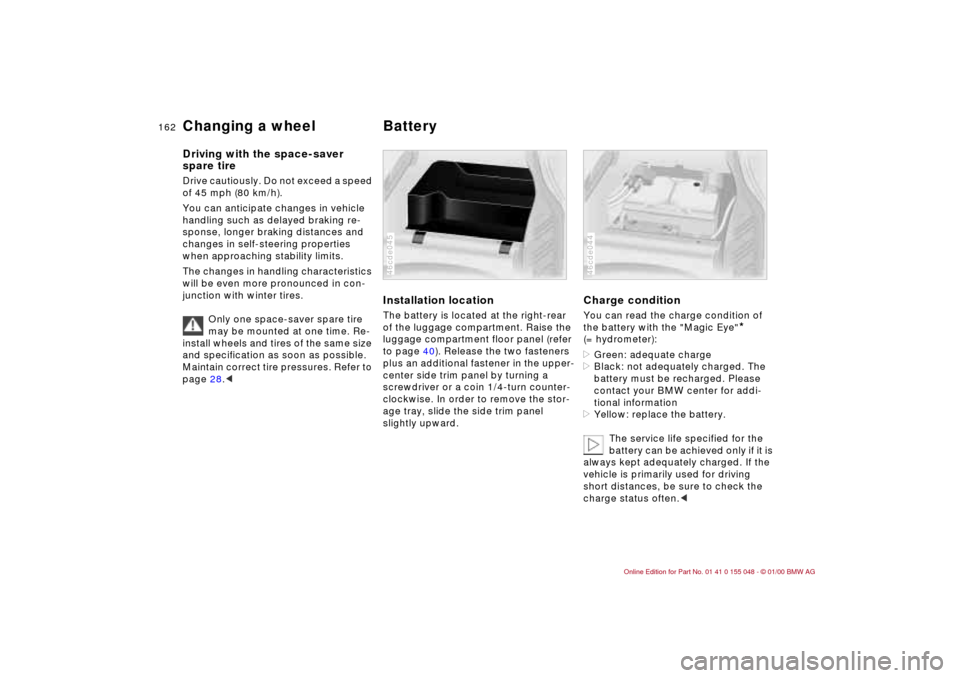
Installation locationThe battery is located at the right-rear
of the luggage compartment. Raise the
luggage compartment floor panel (refer
to page 40). Release the two fasteners
plus an additional fastener in the upper-
center side trim panel by turning a
screwdriver or a coin 1/4-turn counter-
clockwise. In order to remove the stor-
age tray, slide the side trim panel
slightly upward.46cde045
Charge conditionYou can read the charge condition of
the battery with the "Magic Eye"
*
(= hydrometer):
>Green: adequate charge
>Black: not adequately charged. The
battery must be recharged. Please
contact your BMW center for addi-
tional information
>Yellow: replace the battery.
The service life specified for the
battery can be achieved only if it is
always kept adequately charged. If the
vehicle is primarily used for driving
short distances, be sure to check the
charge status often.<
46cde044
Page 177 of 199
177n
IndexDataTechnologyRepairsCar careControlsOverview
Tire Pressure Control (RDC)
*
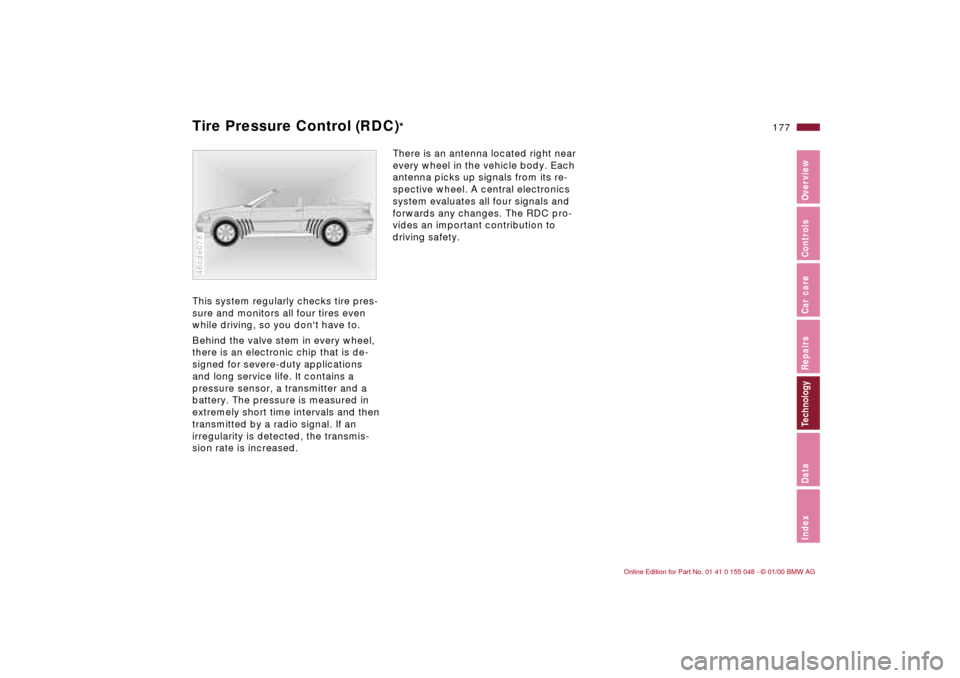
This system regularly checks tire pres-
sure and monitors all four tires even
while driving, so you don't have to.
Behind the valve stem in every wheel,
there is an electronic chip that is de-
signed for severe-duty applications
and long service life. It contains a
pressure sensor, a transmitter and a
battery. The pressure is measured in
extremely short time intervals and then
transmitted by a radio signal. If an
irregularity is detected, the transmis-
sion rate is increased. 46cde078
There is an antenna located right near
every wheel in the vehicle body. Each
antenna picks up signals from its re-
spective wheel. A central electronics
system evaluates all four signals and
forwards any changes. The RDC pro-
vides an important contribution to
driving safety.
Page 190 of 199

Everything from A to ZAABS (Antilock Brake
System)22, 114
Accessories6
Activated charcoal filter98
Adaptive Transmission
Control (ATC)74, 172
Adding engine oil133
Adding washer
fluid132, 185
Adjust seats53
Adjust the temperature96
Adjusting the steering
wheel58
Air distribution96
Air outlets94
Air pressure123
Air supply97
Airbags21, 63, 146, 173
sitting properly with64
Alarm system42
Antenna120
Antenna, Diversity174
Antifreeze135
Antifreeze, radiator118
Antilock Brake System
(ABS)22, 114
Anti-theft alarm system42
Aquaplaning113, 123
Armrest102
Ashtray
front103
rear104Assisted rear entry56
ATC (Adaptive Transmission
Control)74, 172
Attaching vehicle vacuum
cleaner104
AUC (Automatic recirculated
air control)97
Automatic car washes139
Automatic climate
control94
remove window
condensation97
Automatic cruise control80
Automatic dimming, interior
rearview mirror59
Automatic recirculated air
control (AUC)97
Automatic transmission with
Steptronic22, 74
Automatic windshield
washer78
Average consumption86
Average speed86
Avoiding unwanted
alarm43
Axle loads184
BBackrest
release56
Backup lamps73
bulb replacement155Battery162, 186
capacity186
charge164
charge current20
drained168
removal and
installation164
Belts61
Blower97
BMW High Performance
Synthetic Oils134
BMW Sports Seat55
BMW Universal
Transmitter100
Bore182
Brake fluid136
Brake hydraulic system20
Brake lamps
bulb replacement155
Brake pads22
Brakes116
malfunctions117
Break-in procedure112
Breaking in the vehicle112
Bulb replacement152
CCapacities185
Car Memory60
Car radio120
refer also to the separate
Owner's ManualCar radio
reception120, 174
Car wash139
Care
convertible top144
exterior140
interior141
Care of upholstery142
Cargo loading106
Caring for the vehicle
finish140
Caring for wool velour142
Cassette operation, refer to
the Radio Owner's Manual
Catalytic converter113
CBC (Cornering Brake
Control)21, 115
CD operation, refer to the
Radio Owner's Manual
Cellular phone103, 120
refer also to the separate
Owner's Manual
Center armrest102
Center brake lamp157
Central locking system34
key38
Changing tires159
Check Control84
Child restraint
systems61, 66, 67
installation67
Child's seat61, 66
Everything from A to Z