tow BMW 323Ci CONVERTIBLE 2000 E46 User Guide
[x] Cancel search | Manufacturer: BMW, Model Year: 2000, Model line: 323Ci CONVERTIBLE, Model: BMW 323Ci CONVERTIBLE 2000 E46Pages: 199, PDF Size: 1.77 MB
Page 95 of 199

95n
IndexDataTechnologyRepairsCar careControlsOverview
Automatic climate control 1 Air onto the windshield and the side
windows
2 Air flow toward the upper body
The side rotary dials provide infi-
nitely variable regulation of the air
supply, while the levers change the
air flow direction. The center rotary
dial controls the temperature of the
air as it flows out, refer to page 98
3 Front footwell ventilation
There are corresponding air vents in
the rear footwell as well
4 Recirculated air mode/Automatic
recirculated air control (AUC)97
5 Air supply97
6 Temperature96
7 Automatic air distribution96
8 Individual air distribution96
9 Air grill for interior temperature
sensor – please keep clear and
unobstructed
10 Display for temperature and air
supply96
11 Defrost the windshield and side
windows97
12 Air conditioner97
13 Rear window defroster79, 98
Page 96 of 199

96n
Automatic climate controlTips for pleasant drivingUse the automatic system (switch on
AUTO button 7). Select an interior tem-
perature that is comfortable for you –
we recommend 72 7 (+22 6). When
the outside temperature is above 41 7
(+5 6), you can also use the air condi-
tioner 12. This will dry the air as well as
preventing condensation on the win-
dow surfaces – if there are passengers
with damp clothing, for example. Set
the outlets 2 so that the air flows past
you and is not directed straight at you.
Set the rotary dial between the air out-
lets 2 for the upper body to a medium
position, since air that is somewhat
cooler promotes driving without fatigue.
Detailed setting options are described
for you in the following section.
When you unlock the vehicle
using your personalized remote
control key, your vehicle is set up so
that it will retrieve and initiate your
customized setting for the automatic
climate control.<
Automatic air distribution
The AUTO program assumes
the adjustment of the air distri-
bution and the air supply for you and
adapts the temperature to external influ-
ences (summer, winter) to meet prefer-
ences you can specify. This program
maintains a comfortable in-car climate
regardless of the season. Select an inte-
rior temperature that is comfortable for
you – we recommend 72 7 (+22 6).
The temperature selected and AUTO
for the air flow appear in the display 10
(refer to the overview on page 94). Open
the air outlets for the upper body area.
Switch on the air conditioner in warm
weather. The maximum cooling capac-
ity is achieved when you set rotary dial 3
(refer to page 98) to cold.
Individual air distribution
You can cancel the AUTO pro-
gram by selecting specific dis-
tribution patterns to suit your
own individual requirements.
You can direct air to flow onto the win-
dows toward the upper body , and
into the footwell .
Temperature
The figures in the display pro-
vide a general indication of inte-
rior temperature. We recommend 72 7
(+22 6) as a comfortable setting,
whether the air conditioner is operating
or not. When you start the vehicle, the
system ensures that the selected tem-
perature is reached as quickly as possi-
ble. The system then maintains this
temperature, regardless of the season.
Set rotary dial 3 (refer to "Draft-free
ventilation" on page 98) to a medium
setting, since air that is somewhat
cooler promotes driving without fatigue.
You can use this setting for mixing air to
make minor comfort modifications.
You can set uncontrolled heater
output up to 90 7 (+32 6).
At 60 7 (+16 6), full cooling output
is available from an activated air
conditioner.<
Page 106 of 199
106n
Ski bag
*
Cargo loading
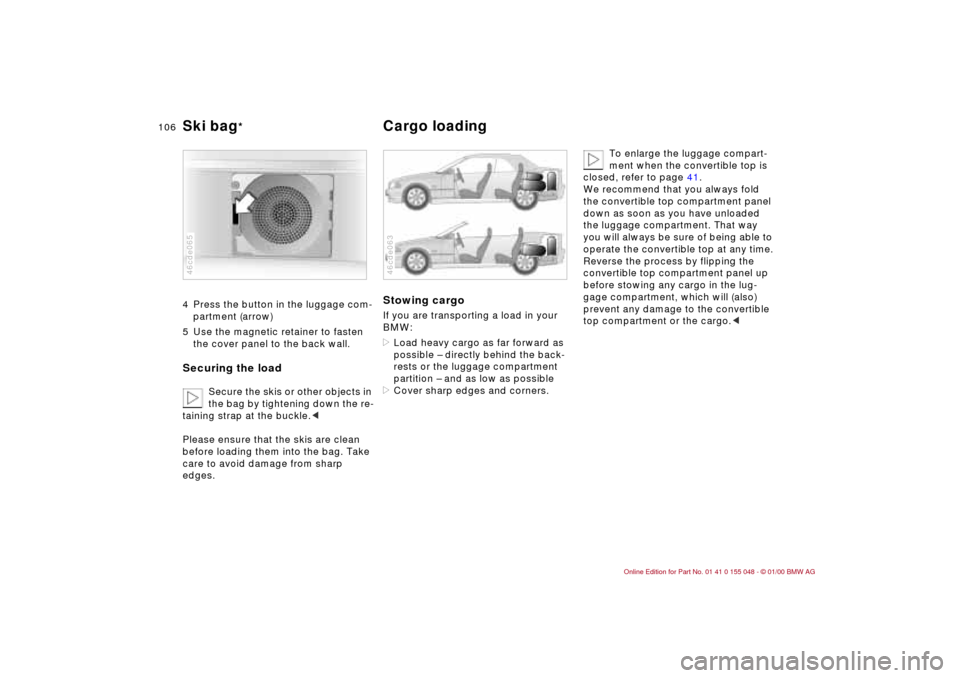
4 Press the button in the luggage com-
partment (arrow)
5 Use the magnetic retainer to fasten
the cover panel to the back wall.Securing the load
Secure the skis or other objects in
the bag by tightening down the re-
taining strap at the buckle.<
Please ensure that the skis are clean
before loading them into the bag. Take
care to avoid damage from sharp
edges.
46cde065
Stowing cargo If you are transporting a load in your
BMW:
>Load heavy cargo as far forward as
possible – directly behind the back-
rests or the luggage compartment
partition – and as low as possible
>Cover sharp edges and corners.46cde063
To enlarge the luggage compart-
ment when the convertible top is
closed, refer to page 41.
We recommend that you always fold
the convertible top compartment panel
down as soon as you have unloaded
the luggage compartment. That way
you will always be sure of being able to
operate the convertible top at any time.
Reverse the process by flipping the
convertible top compartment panel up
before stowing any cargo in the lug-
gage compartment, which will (also)
prevent any damage to the convertible
top compartment or the cargo.<
Page 112 of 199

112n
To ensure that your vehicle provides
maximum economy throughout a long
service life, we request that you comply
with the following recommendations.
Engine and differentialUp to 1,200 miles (2,000 km):
Drive at varying engine and road
speeds, but do not exceed 4,500 rpm
or 100 mph (160 km/h) during this time.
Obey your local and state maximum
speed limits.
Refrain from using full throttle and avoid
pressing the accelerator beyond the
"kickdown" point.
After you have driven 1,200 miles
(2,000 km), you can gradually increase
the engine and road speed.
You should also comply with these
break-in procedures if the engine or
differential is replaced at a later point.
TiresDue to technical factors associated
with their manufacture, tires do not
achieve their full traction potential until
an initial break-in period has elapsed.
Thus, drive with extra care during the
initial 200 miles (300 km).
Obey your local and state maximum
speed limits.
When the vehicle is operated on
wet or slushy roads, a wedge of
water may form between the tire and
the road surface. This phenomenon is
referred to as aquaplaning, or hydro-
planing, and can lead to partial or com-
plete loss of traction, vehicle control
and braking effectiveness. Reduce your
speed on wet roads.
tact patterns until you have driven
approx. 300 miles (500 km).
To break in the separate parking brake
drums, apply the parking brake lightly
when coasting to a standstill (at a traffic
signal, for instance), provided that traf-
fic conditions allow you to do so.
To avoid corrosion, repeat this proce-
dure from time to time.
The brake lamps do not come on
when the parking brake is applied.
Vacuum for the brake system servo unit
on your BMW is available only when the
engine is running. When you move the
vehicle with the engine shut off – when
towing, for example – substantially
higher levels of pedal force will be
required to brake the vehicle.<
Break-in procedures
Page 113 of 199

113n
IndexDataTechnologyRepairsCar careControlsOverview
Brakes:
Do not drive with your foot resting
on the brake pedal. Even light but con-
sistent pedal pressure can lead to high
temperatures, brake wear, and possibly
to brake failure.
Aquaplaning:
When driving on wet or slushy roads,
reduce vehicle speed. If you do not, a
wedge of water may form between the
tires and the road surface. This phe-
nomenon is referred to as aquaplaning
or hydroplaning. It is characterized by a
partial or complete loss of contact be-
tween the tires and the road surface.
The ultimate results are loss of steering
and braking control.
Driving through water:
Do not drive through water over the
road if it is deeper than 1 ft (30 cm), and
then only at walking speed, otherwise
the engine, electrical system and trans-
mission could be damaged.
Clothes hooks (when hardtop
* is
mounted):
When suspending clothing from the
hooks, ensure that they will not obstruct
the driver's vision. Do not hang heavy
objects on the hooks. If you do, they
could cause personal injury during
braking or evasive maneuvers.<
The catalytic converter reduces harmful
exhaust emissions. It is designed for
use with unleaded fuel only.
Even minute quantities of lead would be
enough to permanently damage both
the catalytic converter and the system
oxygen sensor.To ensure efficient, trouble-free engine
operation and to avoid potential damage:>Be sure to comply with the scheduled
maintenance requirements
>Fill the fuel tank well before it is
empty
>Tow-start only when the engine is
cold. If you attempt to tow-start with
a warm engine, unburned residual
fuel in the catalytic converter could
ignite and cause damage. It is better
to jump-start the vehicle with outside
assistance
>Avoid other situations in which the
fuel is not burned, or burns incom-
pletely, such as engaging the starter
frequently or for extended periods, or
repeated start attempts in which the
engine does not start (stopping and
restarting an engine which is running
properly does not present a problem).
Never allow the engine to run with
any of the spark plug cables
disconnected.Be sure to observe the instruc-
tions above to prevent unburned
fuel from reaching the catalytic con-
verter, otherwise, the catalytic con-
verter could overheat and be damaged.
High temperatures occur in every vehi-
cle equipped with a catalytic converter.
Heat shields are installed adjacent to
some sections of the exhaust system.
Never remove these shields; do not
apply undercoating to their surfaces.
When driving, standing at idle, and
parking the vehicle, take extra care to
avoid contact between the exhaust sys-
tem and flammable materials (grass,
hay, leaves, etc.). Such contact could
lead to a fire, resulting in serious per-
sonal injury and property damage.<
Driving notes Catalytic converter
Page 121 of 199
121n
IndexDataTechnologyRepairsCar careControlsOverview
Hardtop*It is not necessary to remove the fabric
top even in the winter, when the hard-
top is generally in constant use. But you
can take it off at any time with no prob-
lem. Before the fabric top is stored in
the convertible top compartment, it
must be absolutely dry in order to keep
water and mildew from forming.
The hardtop offers reading lamps as
well as clothes hooks in the rear, which
can be used simply by pressing on
them. In addition, a luggage rack sys-
tem can also be mounted on the hard-
top. If you have a problem in this re-
gard, please contact your BMW center.
When suspending clothing from
the hooks, ensure that they will
not obstruct the driver's vision. Do not
hang heavy objects on the hooks. If you
do so, they could cause personal injury
during braking or evasive maneuvers.<
Two persons are required for installing
or removing the hardtop. Work with
extreme caution in order to avoid paint
damage and damage to the body or
hardtop.
To facilitate the installation or removal of
the hardtop, you can purchase either a
specially designed hardtop lift
* or hard-
top roller carrier
* at your BMW center.
Storage
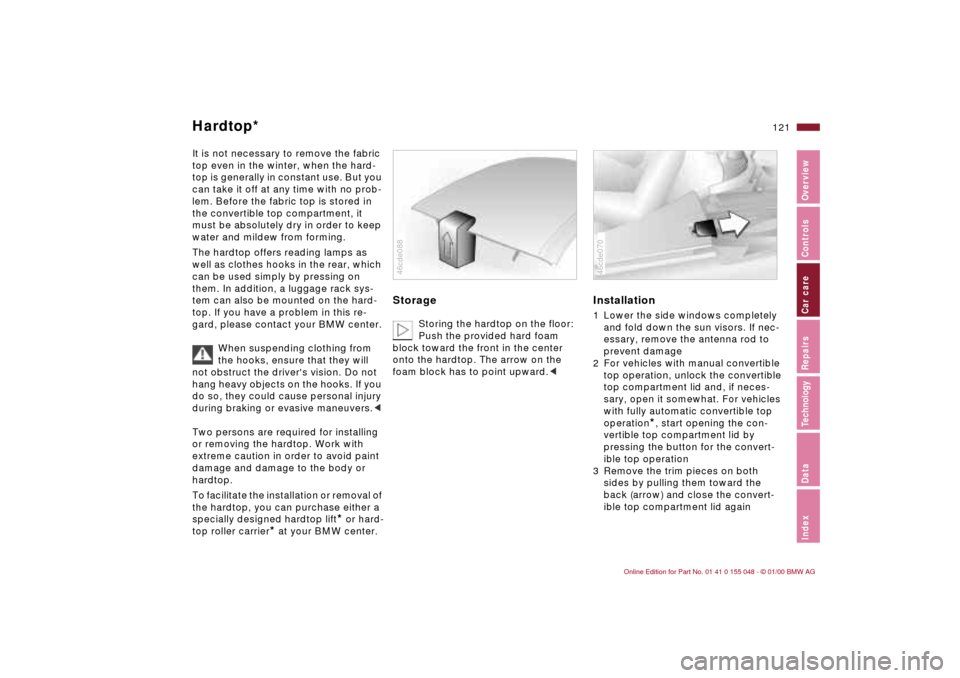
Storing the hardtop on the floor:
Push the provided hard foam
block toward the front in the center
onto the hardtop. The arrow on the
foam block has to point upward.<
46cde088
Installation1 Lower the side windows completely
and fold down the sun visors. If nec-
essary, remove the antenna rod to
prevent damage
2 For vehicles with manual convertible
top operation, unlock the convertible
top compartment lid and, if neces-
sary, open it somewhat. For vehicles
with fully automatic convertible top
operation
*, start opening the con-
vertible top compartment lid by
pressing the button for the convert-
ible top operation
3 Remove the trim pieces on both
sides by pulling them toward the
back (arrow) and close the convert-
ible top compartment lid again
46cde070
Page 123 of 199
123n
IndexDataTechnologyRepairsCar careControlsOverview
Information for your safetyThe factory approved radial tires are
matched to the vehicle and have been
selected to provide optimum safety and
driving comfort.
It is not merely the tire's service life, but
also driving comfort and – above all else
– driving safety that depend on the con-
dition of the tires and the maintenance
of the specified tire pressure.
Incorrect inflation pressure is a frequent
cause of tire damage. It also signifi-
cantly influences the roadholding ability
of your BMW.
Check tire inflation pressures reg-
ularly – including the space-saver
spare tire – at least twice a month and
before beginning a longer trip (see
page 27). If this is not done, incorrect
tire pressures can cause driving insta-
bility and tire damage, ultimately result-
ing in accidents.<
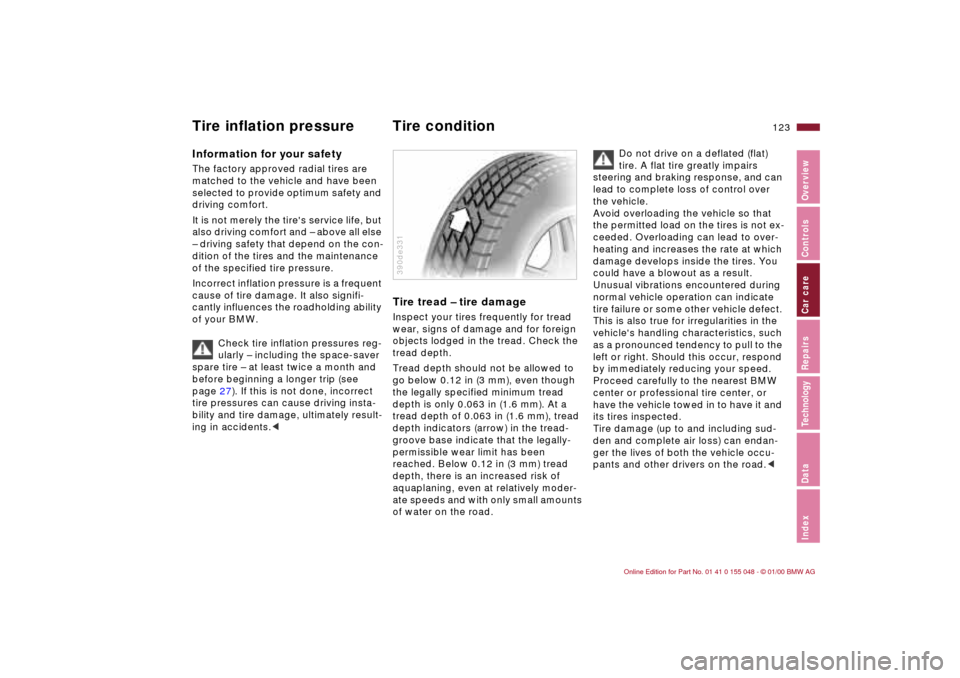
Tire tread – tire damageInspect your tires frequently for tread
wear, signs of damage and for foreign
objects lodged in the tread. Check the
tread depth.
Tread depth should not be allowed to
go below 0.12 in (3 mm), even though
the legally specified minimum tread
depth is only 0.063 in (1.6 mm). At a
tread depth of 0.063 in (1.6 mm), tread
depth indicators (arrow) in the tread-
groove base indicate that the legally-
permissible wear limit has been
reached. Below 0.12 in (3 mm) tread
depth, there is an increased risk of
aquaplaning, even at relatively moder-
ate speeds and with only small amounts
of water on the road.390de331
Do not drive on a deflated (flat)
tire. A flat tire greatly impairs
steering and braking response, and can
lead to complete loss of control over
the vehicle.
Avoid overloading the vehicle so that
the permitted load on the tires is not ex-
ceeded. Overloading can lead to over-
heating and increases the rate at which
damage develops inside the tires. You
could have a blowout as a result.
Unusual vibrations encountered during
normal vehicle operation can indicate
tire failure or some other vehicle defect.
This is also true for irregularities in the
vehicle's handling characteristics, such
as a pronounced tendency to pull to the
left or right. Should this occur, respond
by immediately reducing your speed.
Proceed carefully to the nearest BMW
center or professional tire center, or
have the vehicle towed in to have it and
its tires inspected.
Tire damage (up to and including sud-
den and complete air loss) can endan-
ger the lives of both the vehicle occu-
pants and other drivers on the road.<
Tire inflation pressure Tire condition
Page 133 of 199
133n
IndexDataTechnologyRepairsCar careControlsOverview
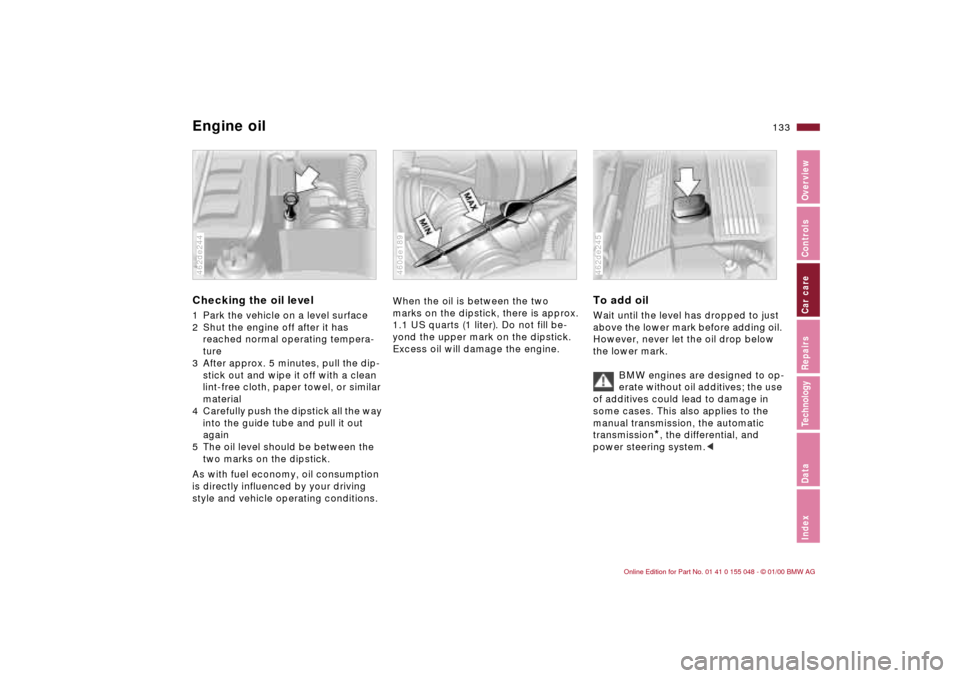
Engine oilChecking the oil level 1 Park the vehicle on a level surface
2 Shut the engine off after it has
reached normal operating tempera-
ture
3 After approx. 5 minutes, pull the dip-
stick out and wipe it off with a clean
lint-free cloth, paper towel, or similar
material
4 Carefully push the dipstick all the way
into the guide tube and pull it out
again
5 The oil level should be between the
two marks on the dipstick.
As with fuel economy, oil consumption
is directly influenced by your driving
style and vehicle operating conditions.462de244
When the oil is between the two
marks on the dipstick, there is approx.
1.1 US quarts (1 liter). Do not fill be-
yond the upper mark on the dipstick.
Excess oil will damage the engine.460de189
To add oil Wait until the level has dropped to just
above the lower mark before adding oil.
However, never let the oil drop below
the lower mark.
BMW engines are designed to op-
erate without oil additives; the use
of additives could lead to damage in
some cases. This also applies to the
manual transmission, the automatic
transmission
*, the differential, and
power steering system.<
462de245
Page 151 of 199
Overview
Controls and features
Operation, care
and maintenance
Owner service procedures
Technical data
Index Advanced technology
151n
IndexDataTechnologyRepairsCar careControlsOverview
Replacement procedures:
Onboard tool kit152
Windshield wiper blades152
Lamps and bulbs152
Changing a wheel159
Battery162
Fuses165
In case of electrical
malfunction:
Fuel filler door165
Fully automatic convertible
top166
Assistance, giving and
receiving:
Jump-starting168
Towing the vehicle169
Repairs
Page 152 of 199
152n
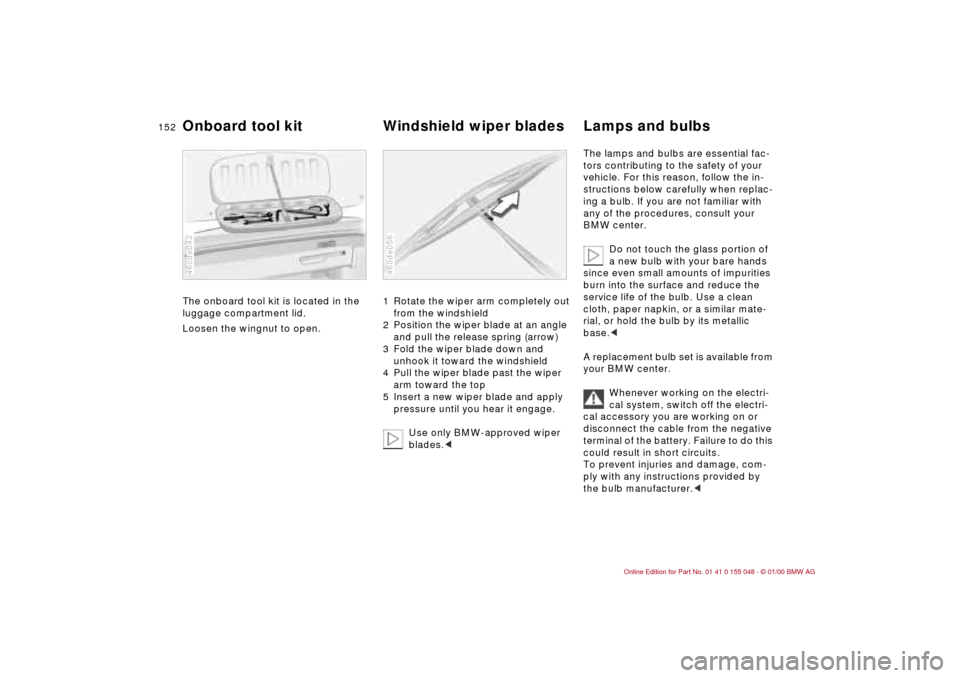
The onboard tool kit is located in the
luggage compartment lid.
Loosen the wingnut to open.
46cde042
1 Rotate the wiper arm completely out
from the windshield
2 Position the wiper blade at an angle
and pull the release spring (arrow)
3 Fold the wiper blade down and
unhook it toward the windshield
4 Pull the wiper blade past the wiper
arm toward the top
5 Insert a new wiper blade and apply
pressure until you hear it engage.
Use only BMW-approved wiper
blades.<460de056
The lamps and bulbs are essential fac-
tors contributing to the safety of your
vehicle. For this reason, follow the in-
structions below carefully when replac-
ing a bulb. If you are not familiar with
any of the procedures, consult your
BMW center.
Do not touch the glass portion of
a new bulb with your bare hands
since even small amounts of impurities
burn into the surface and reduce the
service life of the bulb. Use a clean
cloth, paper napkin, or a similar mate-
rial, or hold the bulb by its metallic
base.<
A replacement bulb set is available from
your BMW center.
Whenever working on the electri-
cal system, switch off the electri-
cal accessory you are working on or
disconnect the cable from the negative
terminal of the battery. Failure to do this
could result in short circuits.
To prevent injuries and damage, com-
ply with any instructions provided by
the bulb manufacturer.<
Onboard tool kit Windshield wiper blades Lamps and bulbs