transmission BMW 323Ci CONVERTIBLE 2000 E46 User Guide
[x] Cancel search | Manufacturer: BMW, Model Year: 2000, Model line: 323Ci CONVERTIBLE, Model: BMW 323Ci CONVERTIBLE 2000 E46Pages: 199, PDF Size: 1.77 MB
Page 74 of 199
74n
Automatic transmission with Steptronic
*
You have the option of driving with a
normal automatic transmission or
switching to manual.
When you move the selector lever from
the "D" position to the left into the M/S
range, the performance-oriented shift
programs of the automatic transmission
are engaged. As soon as you briefly
touch the selector lever in the "+" or "–"
direction, Steptronic changes the gear.
The manual mode is engaged. When-
ever you want to use automatic again,
just shift the selector lever toward the
right to position "D".
The automatic transmission with Step-
tronic is equipped with ATC (Adaptive
Transmission Control). ATC reacts with
precision to your individual driving style
and the current driving conditions. To
achieve this, different shift programs
are engaged.
For additional details concerning ATC,
please refer to the chapter describing
"Advanced technology" on page 172.
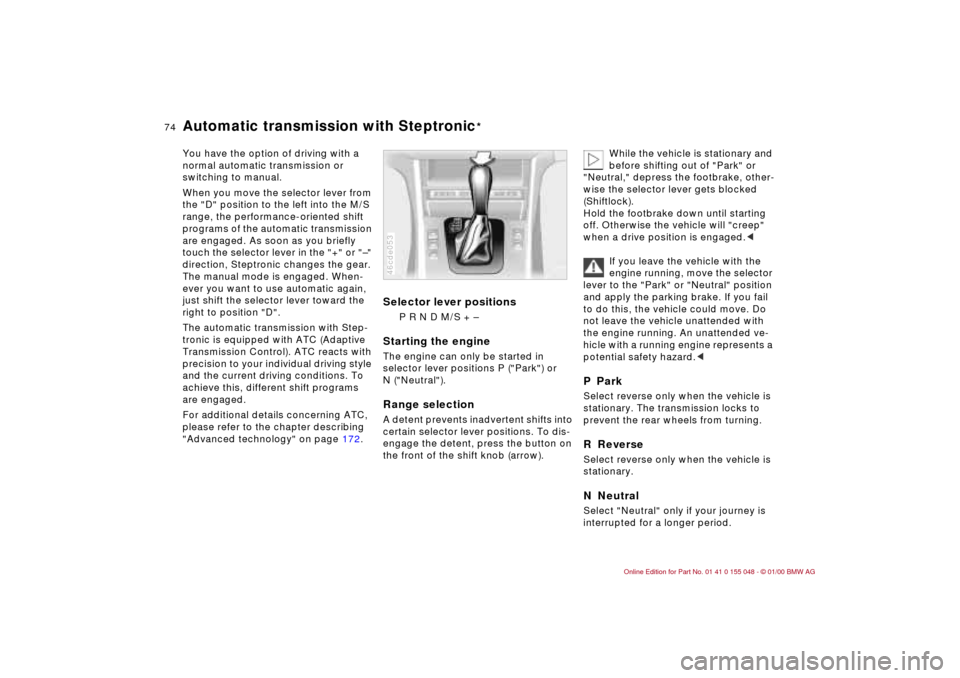
Selector lever positions
P R N D M/S + –
Starting the engineThe engine can only be started in
selector lever positions P ("Park") or
N ("Neutral").Range selectionA detent prevents inadvertent shifts into
certain selector lever positions. To dis-
engage the detent, press the button on
the front of the shift knob (arrow).46cde053
While the vehicle is stationary and
before shifting out of "Park" or
"Neutral," depress the footbrake, other-
wise the selector lever gets blocked
(Shiftlock).
Hold the footbrake down until starting
off. Otherwise the vehicle will "creep"
when a drive position is engaged.<
If you leave the vehicle with the
engine running, move the selector
lever to the "Park" or "Neutral" position
and apply the parking brake. If you fail
to do this, the vehicle could move. Do
not leave the vehicle unattended with
the engine running. An unattended ve-
hicle with a running engine represents a
potential safety hazard.<
P ParkSelect reverse only when the vehicle is
stationary. The transmission locks to
prevent the rear wheels from turning.R ReverseSelect reverse only when the vehicle is
stationary.N NeutralSelect "Neutral" only if your journey is
interrupted for a longer period.
Page 75 of 199
75n
IndexDataTechnologyRepairsCar careControlsOverview
Automatic transmission with Steptronic
*
D Drive (automatic shift program)This position is designed for driving un-
der all normal operating conditions. All
forward gears are available."Kickdown" In the "Kickdown" mode, you achieve
maximum performance and the top
speed in position "D".
To activate this mode, depress the ac-
celerator pedal beyond the full-throttle
position, going beyond the point of re-
sistance.
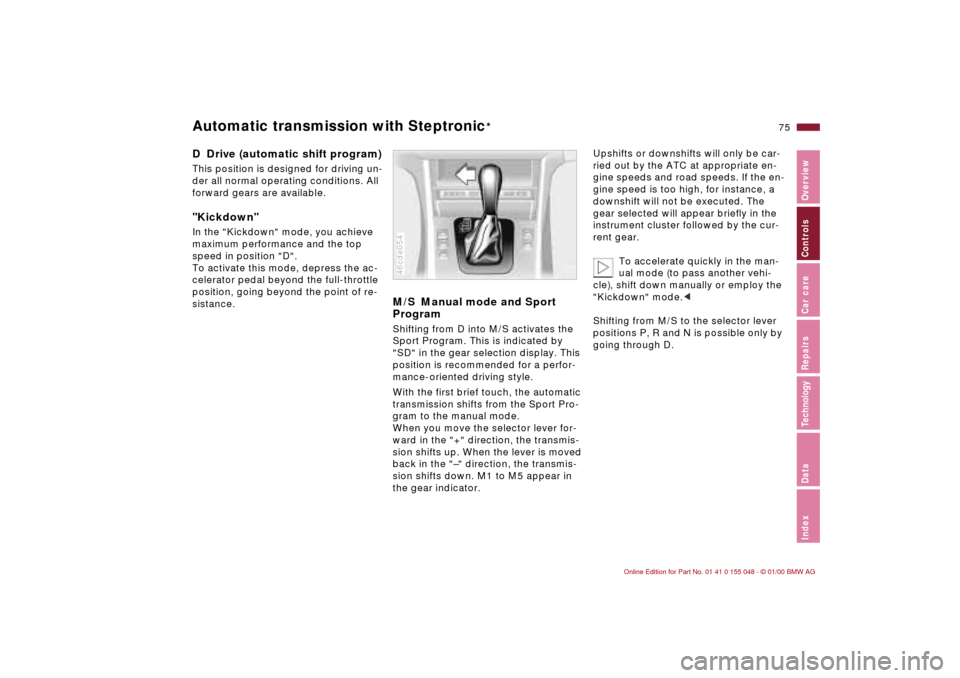
M/S Manual mode and Sport
ProgramShifting from D into M/S activates the
Sport Program. This is indicated by
"SD" in the gear selection display. This
position is recommended for a perfor-
mance-oriented driving style.
With the first brief touch, the automatic
transmission shifts from the Sport Pro-
gram to the manual mode.
When you move the selector lever for-
ward in the "+" direction, the transmis-
sion shifts up. When the lever is moved
back in the "–" direction, the transmis-
sion shifts down. M1 to M5 appear in
the gear indicator.46cde054
Upshifts or downshifts will only be car-
ried out by the ATC at appropriate en-
gine speeds and road speeds. If the en-
gine speed is too high, for instance, a
downshift will not be executed. The
gear selected will appear briefly in the
instrument cluster followed by the cur-
rent gear.
To accelerate quickly in the man-
ual mode (to pass another vehi-
cle), shift down manually or employ the
"Kickdown" mode.<
Shifting from M/S to the selector lever
positions P, R and N is possible only by
going through D.
Page 76 of 199
76n
Automatic transmission with Steptronic
*
In the following situations, the Step-
tronic "thinks" for you in the manual
mode:
>In order to prevent the engine from
overrevving, the transmission shifts
automatically to the next higher gear
just before the RPM cutoff point
>If you do not do anything to inter-
vene, it will automatically downshift
at lower speeds
>In the "Kickdown" mode, the trans-
mission shifts down to the lowest
gear which is possible, depending on
the engine speed
>Depending on the situation – when
driving in adverse winter conditions,
for example – you may also start out
in 2nd or 3rd gear.
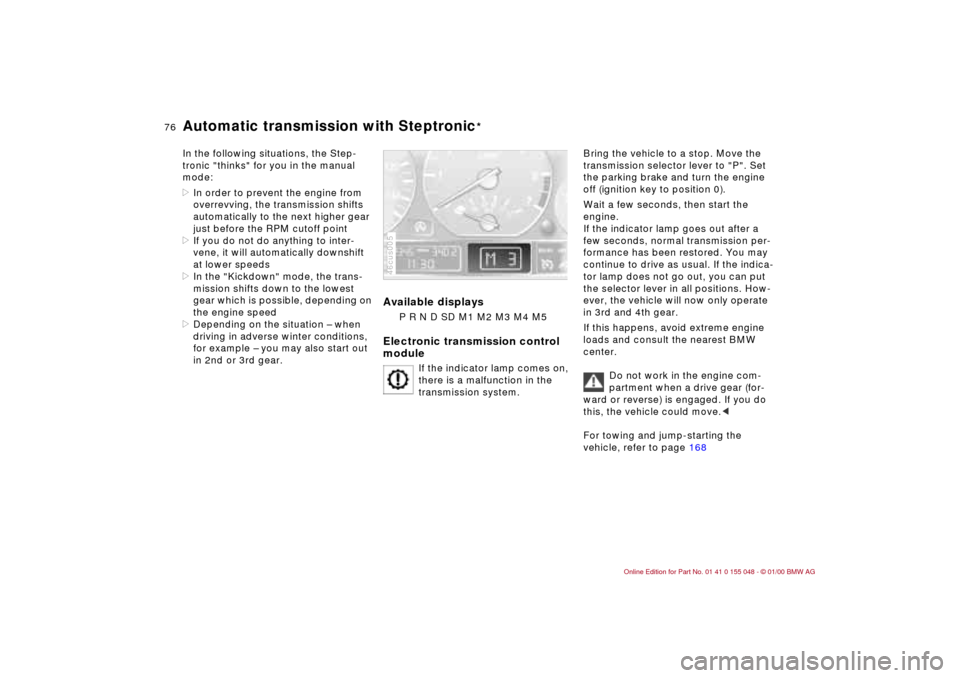
Available displays
P R N D SD M1 M2 M3 M4 M5
Electronic transmission control
module
If the indicator lamp comes on,
there is a malfunction in the
transmission system.
46cus005
Bring the vehicle to a stop. Move the
transmission selector lever to "P". Set
the parking brake and turn the engine
off (ignition key to position 0).
Wait a few seconds, then start the
engine.
If the indicator lamp goes out after a
few seconds, normal transmission per-
formance has been restored. You may
continue to drive as usual. If the indica-
tor lamp does not go out, you can put
the selector lever in all positions. How-
ever, the vehicle will now only operate
in 3rd and 4th gear.
If this happens, avoid extreme engine
loads and consult the nearest BMW
center.
Do not work in the engine com-
partment when a drive gear (for-
ward or reverse) is engaged. If you do
this, the vehicle could move.<
For towing and jump-starting the
vehicle, refer to page 168
Page 81 of 199

81n
IndexDataTechnologyRepairsCar careControlsOverview
Cruise controlTo cancel the cruise control When the system is activated, press
button 1. The indicator lamp stays on.
You can use the cruise control again as
required.
In addition, cruise control is canceled
automatically:
>If the brakes are applied
>If the clutch pedal is depressed or
the automatic transmission
* selector
lever is moved from "D" to "N"
>If you exceed or fall below the pro-
grammed speed for an extended pe-
riod, for example by depressing the
accelerator.
To resume the stored settingPress button 4:
The vehicle accelerates to and main-
tains the last speed stored. When you
turn the ignition key to position 0, the
stored speed is deleted and the system
is deactivated.
To deactivate the system When the cruise control has been can-
celed, press button 1 again. The indica-
tor lamp goes out and the stored speed
is deleted.
Do not use cruise control on twist-
ing roads, when high traffic den-
sity prevents driving at a constant
speed, when the road surface is slick
(snow, rain, ice), or when the road sur-
face is loose (rocks, sand).<
Page 100 of 199

100n
BMW Universal Transmitter
*
The concept The BMW Universal Transmitter re-
places up to three hand-held transmit-
ters for different devices such as ga-
rage-door openers, alarm systems, or
door-locking systems. The BMW Uni-
versal Transmitter recognizes and
"learns" the transmitted signal of each
of the original hand-held transmitters.
The signal of an original hand-held
transmitter can be programmed on one
of the three channel keys. Following
that, each of the devices can be actu-
ated with the appropriately pro-
grammed channel key. The indicator
lamp flashes to confirm transmission
of the signal.
If the vehicle is sold, the memory of the
channel keys should be cleared as de-
scribed on page 102.
During programming and before
every remote actuation of a pro-
grammed device by the BMW Universal
Transmitter, check to be sure that there
are no persons, animals or objects
within the actuation range of the device
in order to prevent possible injuries or
damage. Also, comply with the safety
precautions of the original hand-held
transmitter.<
To Canadian residents:
During programming, your hand-
held transmitter may automatically stop
transmitting after two seconds. This
may not be long enough to program the
BMW Universal Transmitter. If you are
programming from one of these hand-
held transmitters, the Universal Trans-
mitter's light may begin to flash in a
series of double-blinks. If this occurs,
continue to hold the button of the Uni-
versal Transmitter while you reactivate
your hand-held transmitter. You may
have to repeat this function several
times while programming.<
Before programming, read the
"User information" section on
page 102.<
Original hand-held transmitter
If this symbol is present on the
packaging or in the instructions
of the original hand-held trans-
mitter, it may be assumed that this
hand-held transmitter is compatible
with the BMW Universal Transmitter.
Checking for the conversion code To determine whether the original
hand-held transmitter has a conver-
sion-code system, you may either read
the instructions for the original hand-
held transmitter or program a channel
key as described on the next page (left-
hand column under "Programming").
Then press and hold the programmed
channel key of the BMW Universal
Transmitter. If the indicator lamp of
the BMW Universal Transmitter flashes
for two seconds and then stays on
steadily, the original hand-held trans-
mitter is equipped with a conversion-
code system. Using the conversion-
code system, program the channel keys
as described on the next page (right-
hand column under "Programming a
hand-held transmitter using conversion
code").
If you have additional questions,
please consult your BMW center
or call 1-800-355-3515.
You can also visit this website:
www.bmwusa.com.<
Page 101 of 199
101n
IndexDataTechnologyRepairsCar careControlsOverview
BMW Universal Transmitter
*
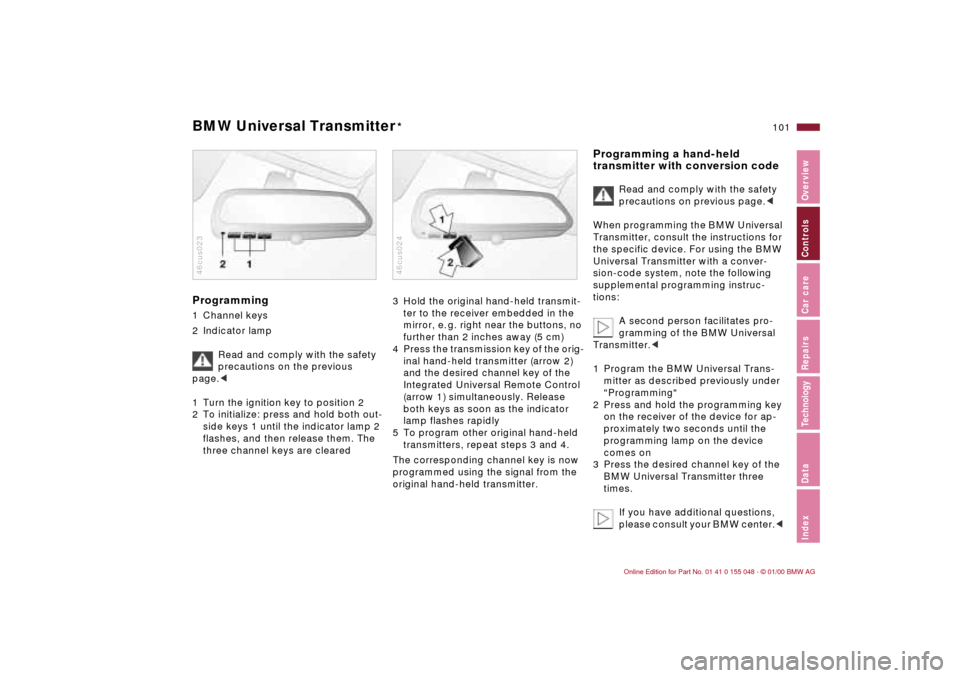
Programming 1 Channel keys
2 Indicator lamp
Read and comply with the safety
precautions on the previous
page.<
1 Turn the ignition key to position 2
2 To initialize: press and hold both out-
side keys 1 until the indicator lamp 2
flashes, and then release them. The
three channel keys are cleared46cus023
3 Hold the original hand-held transmit-
ter to the receiver embedded in the
mirror, e. g. right near the buttons, no
further than 2 inches away (5 cm)
4 Press the transmission key of the orig-
inal hand-held transmitter (arrow 2)
and the desired channel key of the
Integrated Universal Remote Control
(arrow 1) simultaneously. Release
both keys as soon as the indicator
lamp flashes rapidly
5 To program other original hand-held
transmitters, repeat steps 3 and 4.
The corresponding channel key is now
programmed using the signal from the
original hand-held transmitter. 46cus024
Programming a hand-held
transmitter with conversion code
Read and comply with the safety
precautions on previous page.<
When programming the BMW Universal
Transmitter, consult the instructions for
the specific device. For using the BMW
Universal Transmitter with a conver-
sion-code system, note the following
supplemental programming instruc-
tions:
A second person facilitates pro-
gramming of the BMW Universal
Transmitter.<
1 Program the BMW Universal Trans-
mitter as described previously under
"Programming"
2 Press and hold the programming key
on the receiver of the device for ap-
proximately two seconds until the
programming lamp on the device
comes on
3 Press the desired channel key of the
BMW Universal Transmitter three
times.
If you have additional questions,
please consult your BMW center.<
Page 116 of 199

116n
Disc brakesDisc brakes furnish optimum decelera-
tion and braking control and greater
fade resistance under heavy use.
When the vehicle is driven only occa-
sionally, during extended periods when
the vehicle is not used at all, and in
operating conditions where brake appli-
cations are less frequent, there is an
increased tendency for corrosion of the
rotors and accumulation of contamina-
tion on the brake pads. This occurs
because the minimal pressure that
must be exerted by the pads to clean
the rotors by brake applications is
not reached.
If the brake rotors are corroded, they
will tend to respond to braking with a
pulsating effect that even extended
brake applications will fail to cure.
For your own safety: use only
brake pads that BMW has ap-
proved for your particular vehicle
model. BMW cannot evaluate non-ap-
proved brake pads to determine if they
are suited for use, and therefore cannot
ensure the operating safety of the vehi-
cle if they are installed.<
Driving notesWhen driving in wet conditions and in
heavy rain, it is advisable to apply light
pressure to the brake pedal every few
miles or kilometers. Watch traffic condi-
tions to ensure that this maneuver does
not endanger other drivers. The heat
which is generated by the brake appli-
cations helps to dry the brake pads and
rotors.
Maximum braking force is obtained
while the wheels continue to rotate, but
rather when they are still barely turning
immediately prior to locking. ABS main-
tains this state automatically. If the ABS
fails, you should revert to the staggered
braking technique described on
page 119.
Extended or steep mountain descents
do not necessarily lead to reduced
braking efficiency if you drive downhill
with the transmission in a gear that
allows minimal brake applications (or,
with automatic transmission
*, in an
appropriate lower gear).
You can further increase the engine's
braking effect by selecting a lower gear,
downshifting as far as first gear or plac-
ing the selector lever in position 1.If engine braking should prove to be
inadequate, you should still avoid ex-
tended, continuous braking. Instead of
maintaining low to moderate pressure
over an extended period of time, you
should decelerate by applying more
substantial pressure to the brake pedal
(watch for following traffic), releasing
the pedal, and then repeating the appli-
cation (staggered braking). The cooling
phases between active braking inter-
vals prevent the brakes from overheat-
ing, thus ensuring that full braking
capacity remains available at all times.
Do not coast with the clutch de-
pressed or with the shift lever or
selector lever in "Neutral". Do not drive
with the engine shut off. The engine
provides no braking effect when the
clutch is depressed or the transmission
is in "Neutral", and there is no power
assist for braking or steering when the
engine is not running.
Do not allow floor mats, carpets or any
other objects to protrude into the area
around the brake pedal, the clutch or
the accelerator, which could obstruct
their freedom of movement.<
Page 119 of 199

119n
IndexDataTechnologyRepairsCar careControlsOverview
Winter operationBrakesWinter road conditions substantially
reduce the amount of traction available
between the tires and the road surface.
Keep this in mind, because the braking
distance increases substantially.
ABS is intended to prevent the wheels
from locking during brake applications,
thus helping to maintain vehicle stability
and steering response.
If the ABS does not respond in a critical
braking situation and the wheels lock,
reduce the pressure on the brake pedal
until the wheels just start to roll again
while still maintaining enough force to
continue braking. Then increase the
pressure, reduce the pressure when the
wheels lock, reapply pressure, etc.
This staggered braking procedure will
reduce stopping distances while help-
ing you maintain steering control.
You can then attempt to steer around
hazards after you have reduced pres-
sure on the brake pedal.Do not shift down on slick road
surfaces. Doing so could cause
the rear wheels to lose traction and
skid, which could result in the loss of
vehicle control.<
Depress the clutch during hard
braking on road surfaces that pro-
vide only poor or uneven traction.<
Skid control Depress the clutch and release the ac-
celerator pedal, or place the selector
lever of the automatic transmission into
the "Neutral" position. Countersteer
carefully and attempt to regain control
of the vehicle.
ParkingEngage first or reverse gear. If your
vehicle is equipped with an automatic
transmission, place the selector lever in
Park. On vehicles with manual trans-
mission, also apply the parking brake
when parking on inclined surfaces. In
order to prevent the parking brake pads
from locking due to frost or corrosion,
dry them by gently applying the parking
brake as the vehicle is coming to a
stop. Make sure that following traffic
is not endangered.
The brake lamps do not come
on when the parking brake
is applied.<
Page 133 of 199
133n
IndexDataTechnologyRepairsCar careControlsOverview
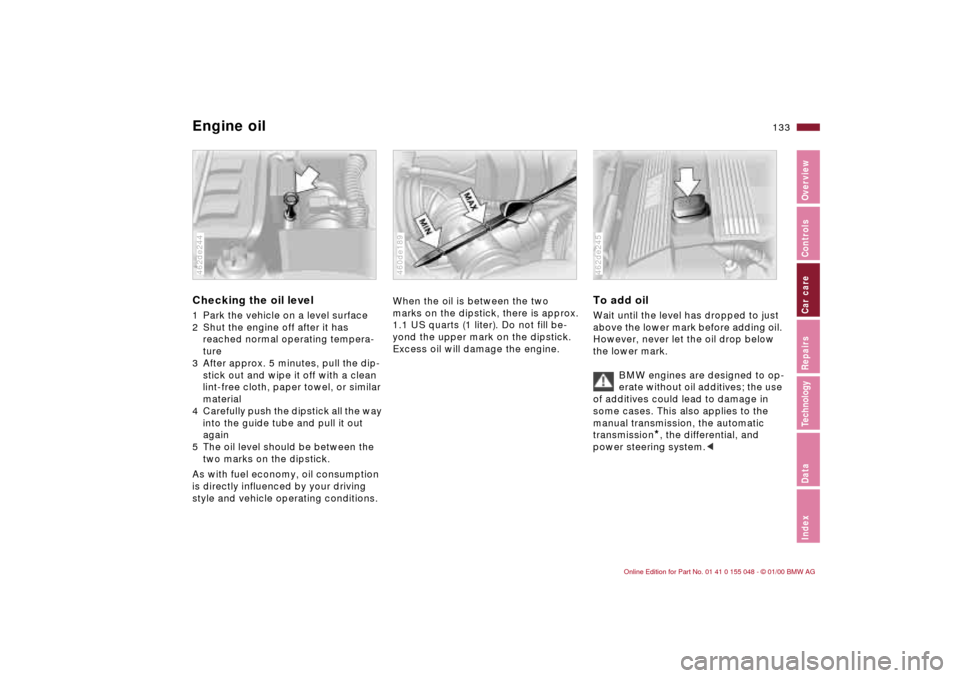
Engine oilChecking the oil level 1 Park the vehicle on a level surface
2 Shut the engine off after it has
reached normal operating tempera-
ture
3 After approx. 5 minutes, pull the dip-
stick out and wipe it off with a clean
lint-free cloth, paper towel, or similar
material
4 Carefully push the dipstick all the way
into the guide tube and pull it out
again
5 The oil level should be between the
two marks on the dipstick.
As with fuel economy, oil consumption
is directly influenced by your driving
style and vehicle operating conditions.462de244
When the oil is between the two
marks on the dipstick, there is approx.
1.1 US quarts (1 liter). Do not fill be-
yond the upper mark on the dipstick.
Excess oil will damage the engine.460de189
To add oil Wait until the level has dropped to just
above the lower mark before adding oil.
However, never let the oil drop below
the lower mark.
BMW engines are designed to op-
erate without oil additives; the use
of additives could lead to damage in
some cases. This also applies to the
manual transmission, the automatic
transmission
*, the differential, and
power steering system.<
462de245
Page 147 of 199

147n
IndexDataTechnologyRepairsCar careControlsOverview
Vehicle storage
If you intend to store the vehicle
for more than three months, have
the maintenance operations described
on this page performed.<
Preparations for storageHave your BMW center perform the fol-
lowing procedures:
1 Clean and apply a rustproofing agent
or other treatment to the engine,
engine compartment, undercarriage,
axles and major components in ac-
cordance with approved repair pro-
cedures. Washing the vehicle, any in-
terior cleaning and subsequent paint-
and chrome care, and cleaning any
rubber seals for the hood and doors,
should be carried out in compliance
with approved procedures as well
2 Change engine oil and oil filter at op-
erating temperature. As an additional
corrosion protection measure, an an-
ticorrosive agent can be added to the
engine when refueling in accordance
with the manufacturer's instructions
3 Check the coolant level and concen-
tration and top off if necessary
4 Fill the fuel tank completely to pre-
vent the formation of condensation
5 Increase the tire inflation pressure to
51 psi (350 kPa).
Before parking the vehicle1 Dry the parking brake and footbrakes
completely to keep the brake discs
and drums from corroding
2 Park the vehicle in a covered, dry,
and well-ventilated space. Place the
transmission in first gear or set the
selector lever to the "P" position.
Chock the wheels to prevent the ve-
hicle from rolling if necessary. Do not
apply the parking brake
3 Remove the battery, charge it com-
pletely and store it in a cool (but
frost-free) room
4 Remove the hardtop
* and store it
separately. Refer to page 121
5 Close the convertible top.
During storageRecharge the battery every six months.
If it is not recharged, it will not be ser-
viceable. Every time the battery drains,
especially over extended periods, its
service life is reduced.
Removing the vehicle from
storageRecharge the battery if the "Magic
Eye"
* turns black. Refer to page 162.
Then have Inspection I performed by
your BMW center, including a brake
fluid replacement if necessary. Refer to
the Service and Warranty Information
Booklet (US models) or the Warranty
and Service Guide (Canadian models).