Air condition BMW 323Ci CONVERTIBLE 2000 E46 Owner's Guide
[x] Cancel search | Manufacturer: BMW, Model Year: 2000, Model line: 323Ci CONVERTIBLE, Model: BMW 323Ci CONVERTIBLE 2000 E46Pages: 199, PDF Size: 1.77 MB
Page 173 of 199
173n
IndexDataTechnologyRepairsCar careControlsOverview
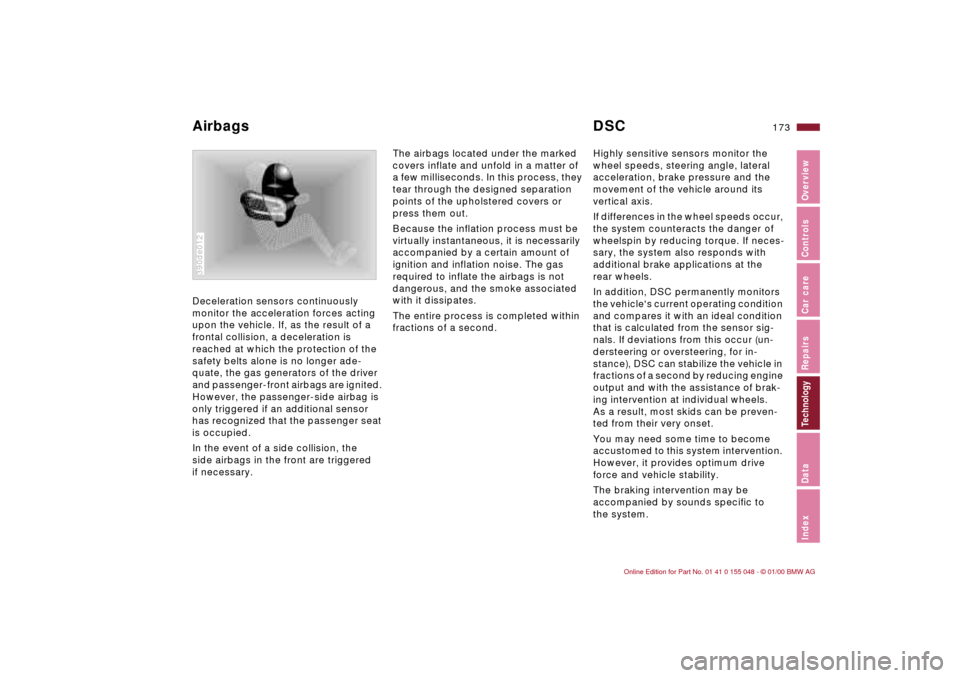
Deceleration sensors continuously
monitor the acceleration forces acting
upon the vehicle. If, as the result of a
frontal collision, a deceleration is
reached at which the protection of the
safety belts alone is no longer ade-
quate, the gas generators of the driver
and passenger-front airbags are ignited.
However, the passenger-side airbag is
only triggered if an additional sensor
has recognized that the passenger seat
is occupied.
In the event of a side collision, the
side airbags in the front are triggered
if necessary. 390de012
The airbags located under the marked
covers inflate and unfold in a matter of
a few milliseconds. In this process, they
tear through the designed separation
points of the upholstered covers or
press them out.
Because the inflation process must be
virtually instantaneous, it is necessarily
accompanied by a certain amount of
ignition and inflation noise. The gas
required to inflate the airbags is not
dangerous, and the smoke associated
with it dissipates.
The entire process is completed within
fractions of a second.Highly sensitive sensors monitor the
wheel speeds, steering angle, lateral
acceleration, brake pressure and the
movement of the vehicle around its
vertical axis.
If differences in the wheel speeds occur,
the system counteracts the danger of
wheelspin by reducing torque. If neces-
sary, the system also responds with
additional brake applications at the
rear wheels.
In addition, DSC permanently monitors
the vehicle's current operating condition
and compares it with an ideal condition
that is calculated from the sensor sig-
nals. If deviations from this occur (un-
dersteering or oversteering, for in-
stance), DSC can stabilize the vehicle in
fractions of a second by reducing engine
output and with the assistance of brak-
ing intervention at individual wheels.
As a result, most skids can be preven-
ted from their very onset.
You may need some time to become
accustomed to this system intervention.
However, it provides optimum drive
force and vehicle stability.
The braking intervention may be
accompanied by sounds specific to
the system.
Airbags DSC
Page 175 of 199
175n
IndexDataTechnologyRepairsCar careControlsOverview
Interior rearview mirror with automatic dimmer
*
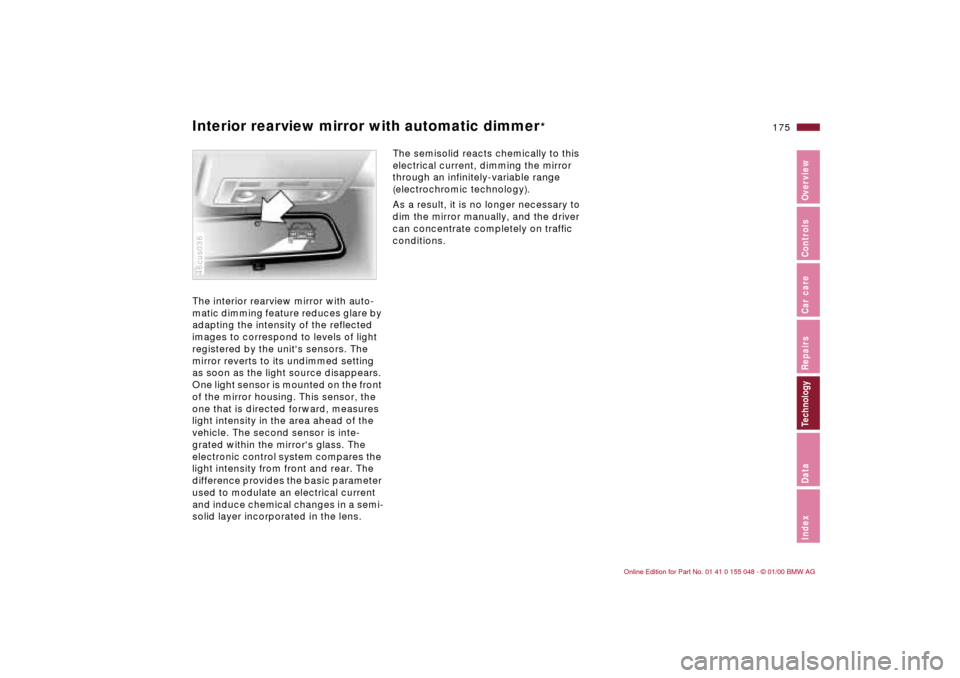
The interior rearview mirror with auto-
matic dimming feature reduces glare by
adapting the intensity of the reflected
images to correspond to levels of light
registered by the unit's sensors. The
mirror reverts to its undimmed setting
as soon as the light source disappears.
One light sensor is mounted on the front
of the mirror housing. This sensor, the
one that is directed forward, measures
light intensity in the area ahead of the
vehicle. The second sensor is inte-
grated within the mirror's glass. The
electronic control system compares the
light intensity from front and rear. The
difference provides the basic parameter
used to modulate an electrical current
and induce chemical changes in a semi-
solid layer incorporated in the lens.46cus036
The semisolid reacts chemically to this
electrical current, dimming the mirror
through an infinitely-variable range
(electrochromic technology).
As a result, it is no longer necessary to
dim the mirror manually, and the driver
can concentrate completely on traffic
conditions.
Page 179 of 199
179n
IndexDataTechnologyRepairsCar careControlsOverview
Rollover protection syste
m
Xenon lamps
*
The rollover protection system offers
additional protection apart from the air-
bags and safety belts. The system has
highly sensitive sensors that react im-
mediately upon detecting an unstable
vehicle condition, i.e. when the vehicle
is tilted to a critical degree, or if the
wheels are not making proper ground
contact. In this kind of situation, the
protective bar in each rear head
restraint is triggered.
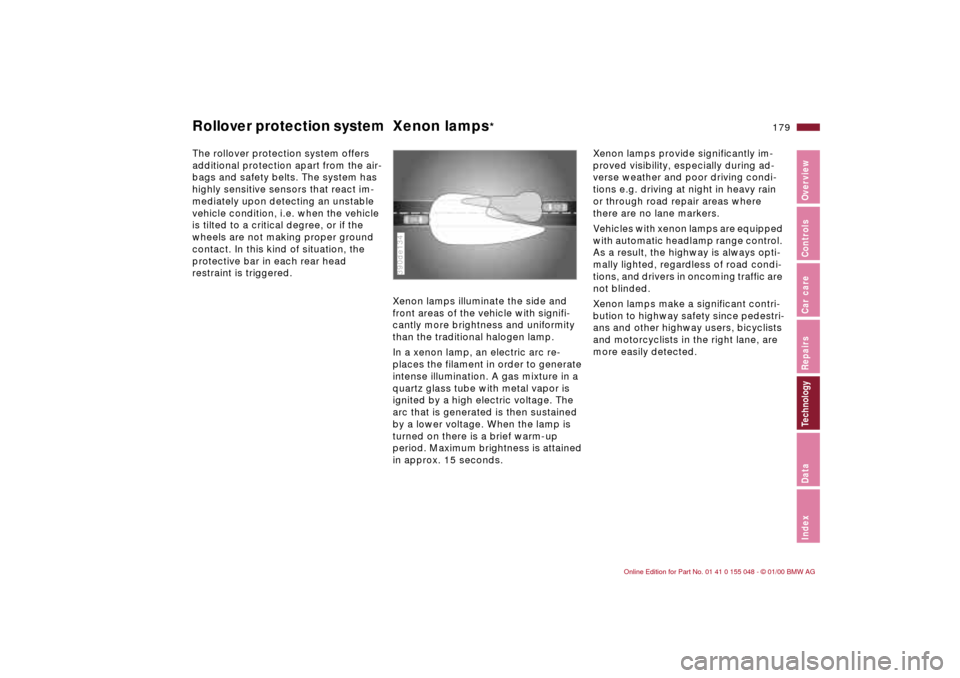
Xenon lamps illuminate the side and
front areas of the vehicle with signifi-
cantly more brightness and uniformity
than the traditional halogen lamp.
In a xenon lamp, an electric arc re-
places the filament in order to generate
intense illumination. A gas mixture in a
quartz glass tube with metal vapor is
ignited by a high electric voltage. The
arc that is generated is then sustained
by a lower voltage. When the lamp is
turned on there is a brief warm-up
period. Maximum brightness is attained
in approx. 15 seconds.
390de134
Xenon lamps provide significantly im-
proved visibility, especially during ad-
verse weather and poor driving condi-
tions e.g. driving at night in heavy rain
or through road repair areas where
there are no lane markers.
Vehicles with xenon lamps are equipped
with automatic headlamp range control.
As a result, the highway is always opti-
mally lighted, regardless of road condi-
tions, and drivers in oncoming traffic are
not blinded.
Xenon lamps make a significant contri-
bution to highway safety since pedestri-
ans and other highway users, bicyclists
and motorcyclists in the right lane, are
more easily detected.