steering BMW 323Ci CONVERTIBLE 2000 E46 Owner's Guide
[x] Cancel search | Manufacturer: BMW, Model Year: 2000, Model line: 323Ci CONVERTIBLE, Model: BMW 323Ci CONVERTIBLE 2000 E46Pages: 199, PDF Size: 1.77 MB
Page 114 of 199

114n
Antilock Brake System (ABS)The concept ABS enhances active driving safety
by helping to prevent the wheels from
locking while braking. This is because
locked wheels are dangerous. When
the front wheels slide, the driver loses
steering control over the vehicle.
Traction loss at the rear wheels can
cause the rear end to break into an
uncontrolled skid.
ABS is designed to meet two essential
requirements during every brake appli-
cation:
>To help provide vehicle stability
>To help maintain steering control and
maneuverability – on all types of road
surfaces (asphalt, concrete, mud, wet
road surfaces, snow, ice).
The system can achieve the shortest
braking distances possible under most
conditions (on straight aways and in
curves, on asphalt, ice, wet road sur-
faces, etc.).
Braking with ABSThe system is operative once the vehi-
cle exceeds a speed of approx. 6 mph
(10 km/h). It is deactivated once again
below approx. 4 mph (6 km/h). This
means that the wheels can lock in the
final phase of a panic stop – a factor of
no significance in actual use.
If you are in a situation that requires full
braking, you will exploit the full benefits
of the ABS system if you apply maxi-
mum brake pressure ("panic stop").
Since the vehicle maintains steering
responsiveness, you can nevertheless
avoid possible obstacles with a mini-
mum of steering effort.
The ABS closed-loop control circuit
cycles in fractions of a second. A pulsa-
tion at the brake pedal, together with
the sounds associated with the hydrau-
lic controls, tells you that the brake sys-
tem is within its maximum limit range,
and reminds you that you should adapt
road speed to the road conditions.
On road surfaces that have a loose
surface layer on a firm base with good
traction (on gravel or snow, for exam-
ple), or when snow chains are mounted,
braking distances may be longer than
with locked wheels. However, ABS continues to provide
enhanced vehicle stability and steering
response under these conditions.
Information for your safetyNot even ABS can suspend the laws of
physics. ABS cannot prevent the conse-
quences of brake applications with inad-
equate clearances for safety between
vehicles, when exceeding the speed
limit in curves, or the risks involved
when aquaplaning occurs. Responsibil-
ity for these types of situations remains
in the hands (and at the feet) of the
driver. You should never allow the
added safety of ABS to lull you into a
false sense of security, or mislead you
into taking increased risks that could
affect your own safety and that of others.
Do not make any modifications to
the ABS system.
Service procedures on ABS are to be
performed by authorized technicians
only.<
Page 115 of 199
115n
IndexDataTechnologyRepairsCar careControlsOverview
Antilock Brake System (ABS)Antilock Brake System (ABS)/
Cornering Brake Control (CBC) CBC is an advanced engineering de-
sign of the ABS. When braking while
cornering at high speed or braking dur-
ing high lateral acceleration, or when
braking during a lane change, vehicle
stability is improved and steering re-
sponse is enhanced.
In the event of a malfunction
If the ABS warning lamp in the
instrument cluster lights up,
refer to page 22. The brake
system then reverts to conventional
operation as on vehicles without ABS.
However, have the brake system
checked by your BMW center as soon
as possible, to prevent undetected
defects and cumulative faults from
adversely affecting the brake system.
ABS warning lamp for Canadian
models.
If the brake warning lamp
comes on together with the indi-
cator lamps for ABS and DSC –
refer to page 21 – the entire
ABS, CBC and DSC control sys-
tem has failed. Continue driving
cautiously and defensively.
Avoid full brake applications.
This could cause the vehicle to lose
stability and you might no longer be
able to control it.
Have the system checked as soon as
possible by your BMW center.
Indicator and warning lamps
CBC, ABS and DSC for Cana-
dian models.
Page 116 of 199

116n
Disc brakesDisc brakes furnish optimum decelera-
tion and braking control and greater
fade resistance under heavy use.
When the vehicle is driven only occa-
sionally, during extended periods when
the vehicle is not used at all, and in
operating conditions where brake appli-
cations are less frequent, there is an
increased tendency for corrosion of the
rotors and accumulation of contamina-
tion on the brake pads. This occurs
because the minimal pressure that
must be exerted by the pads to clean
the rotors by brake applications is
not reached.
If the brake rotors are corroded, they
will tend to respond to braking with a
pulsating effect that even extended
brake applications will fail to cure.
For your own safety: use only
brake pads that BMW has ap-
proved for your particular vehicle
model. BMW cannot evaluate non-ap-
proved brake pads to determine if they
are suited for use, and therefore cannot
ensure the operating safety of the vehi-
cle if they are installed.<
Driving notesWhen driving in wet conditions and in
heavy rain, it is advisable to apply light
pressure to the brake pedal every few
miles or kilometers. Watch traffic condi-
tions to ensure that this maneuver does
not endanger other drivers. The heat
which is generated by the brake appli-
cations helps to dry the brake pads and
rotors.
Maximum braking force is obtained
while the wheels continue to rotate, but
rather when they are still barely turning
immediately prior to locking. ABS main-
tains this state automatically. If the ABS
fails, you should revert to the staggered
braking technique described on
page 119.
Extended or steep mountain descents
do not necessarily lead to reduced
braking efficiency if you drive downhill
with the transmission in a gear that
allows minimal brake applications (or,
with automatic transmission
*, in an
appropriate lower gear).
You can further increase the engine's
braking effect by selecting a lower gear,
downshifting as far as first gear or plac-
ing the selector lever in position 1.If engine braking should prove to be
inadequate, you should still avoid ex-
tended, continuous braking. Instead of
maintaining low to moderate pressure
over an extended period of time, you
should decelerate by applying more
substantial pressure to the brake pedal
(watch for following traffic), releasing
the pedal, and then repeating the appli-
cation (staggered braking). The cooling
phases between active braking inter-
vals prevent the brakes from overheat-
ing, thus ensuring that full braking
capacity remains available at all times.
Do not coast with the clutch de-
pressed or with the shift lever or
selector lever in "Neutral". Do not drive
with the engine shut off. The engine
provides no braking effect when the
clutch is depressed or the transmission
is in "Neutral", and there is no power
assist for braking or steering when the
engine is not running.
Do not allow floor mats, carpets or any
other objects to protrude into the area
around the brake pedal, the clutch or
the accelerator, which could obstruct
their freedom of movement.<
Page 119 of 199

119n
IndexDataTechnologyRepairsCar careControlsOverview
Winter operationBrakesWinter road conditions substantially
reduce the amount of traction available
between the tires and the road surface.
Keep this in mind, because the braking
distance increases substantially.
ABS is intended to prevent the wheels
from locking during brake applications,
thus helping to maintain vehicle stability
and steering response.
If the ABS does not respond in a critical
braking situation and the wheels lock,
reduce the pressure on the brake pedal
until the wheels just start to roll again
while still maintaining enough force to
continue braking. Then increase the
pressure, reduce the pressure when the
wheels lock, reapply pressure, etc.
This staggered braking procedure will
reduce stopping distances while help-
ing you maintain steering control.
You can then attempt to steer around
hazards after you have reduced pres-
sure on the brake pedal.Do not shift down on slick road
surfaces. Doing so could cause
the rear wheels to lose traction and
skid, which could result in the loss of
vehicle control.<
Depress the clutch during hard
braking on road surfaces that pro-
vide only poor or uneven traction.<
Skid control Depress the clutch and release the ac-
celerator pedal, or place the selector
lever of the automatic transmission into
the "Neutral" position. Countersteer
carefully and attempt to regain control
of the vehicle.
ParkingEngage first or reverse gear. If your
vehicle is equipped with an automatic
transmission, place the selector lever in
Park. On vehicles with manual trans-
mission, also apply the parking brake
when parking on inclined surfaces. In
order to prevent the parking brake pads
from locking due to frost or corrosion,
dry them by gently applying the parking
brake as the vehicle is coming to a
stop. Make sure that following traffic
is not endangered.
The brake lamps do not come
on when the parking brake
is applied.<
Page 120 of 199

120n
Power steering Cellular phone* Radio reception Changes in steering response, e.g. high
steering effort:
Consult a BMW center to have the sys-
tem checked.
If the power steering fails, in-
creased effort will be required to
steer the vehicle.<
Only mobile communications systems
(cellular phone, two-way radios, etc.)
with an output up to 10 watts are per-
mitted. Mobile communications devices
not specifically designed for use in your
vehicle may trigger malfunctions while
operating your vehicle. BMW can nei-
ther test nor assume responsibility for
every individual product being offered
on the market. We recommend that you
consult your BMW center before pur-
chasing any device of this kind.
To ensure that your BMW continues to
provide reliable and trouble-free opera-
tion, do not use a cellular phone or
other radio device with an antenna
located inside the passenger compart-
ment. The antenna should always be
mounted on the outside of the vehicle.
Before loading the vehicle on
a car-carrier train or driving it
through a car-wash, remove the
antenna.<
The reception and sound quality
obtained from mobile radios varies
according to a variety of factors, includ-
ing the broadcast range of the transmit-
ter and the directional orientation of the
antenna. Interference factors such as
high-tension power lines, structural or
natural obstructions can all lead to un-
avoidable reception interference, re-
gardless of how well the vehicle sound
system is operating.
Climatic factors such as intense solar
radiation, fog, rain and snow can also
interfere with reception.
Car telephones or cellular phones not
approved by BMW can also cause in-
terference in the radio during a tele-
phone call. This phenomenon assumes
the form of a low-pitched hum emanat-
ing from the speaker system.
Please refer to the supplementary
Owner's Manual provided with your car
radio
* for detailed information on its
use.
Page 123 of 199
123n
IndexDataTechnologyRepairsCar careControlsOverview
Information for your safetyThe factory approved radial tires are
matched to the vehicle and have been
selected to provide optimum safety and
driving comfort.
It is not merely the tire's service life, but
also driving comfort and – above all else
– driving safety that depend on the con-
dition of the tires and the maintenance
of the specified tire pressure.
Incorrect inflation pressure is a frequent
cause of tire damage. It also signifi-
cantly influences the roadholding ability
of your BMW.
Check tire inflation pressures reg-
ularly – including the space-saver
spare tire – at least twice a month and
before beginning a longer trip (see
page 27). If this is not done, incorrect
tire pressures can cause driving insta-
bility and tire damage, ultimately result-
ing in accidents.<
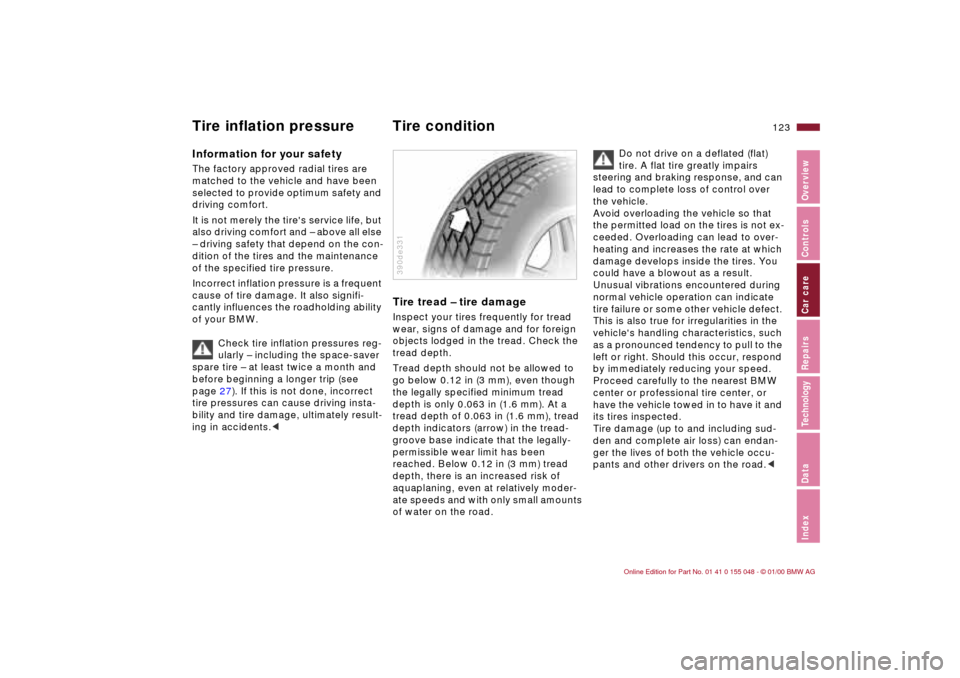
Tire tread – tire damageInspect your tires frequently for tread
wear, signs of damage and for foreign
objects lodged in the tread. Check the
tread depth.
Tread depth should not be allowed to
go below 0.12 in (3 mm), even though
the legally specified minimum tread
depth is only 0.063 in (1.6 mm). At a
tread depth of 0.063 in (1.6 mm), tread
depth indicators (arrow) in the tread-
groove base indicate that the legally-
permissible wear limit has been
reached. Below 0.12 in (3 mm) tread
depth, there is an increased risk of
aquaplaning, even at relatively moder-
ate speeds and with only small amounts
of water on the road.390de331
Do not drive on a deflated (flat)
tire. A flat tire greatly impairs
steering and braking response, and can
lead to complete loss of control over
the vehicle.
Avoid overloading the vehicle so that
the permitted load on the tires is not ex-
ceeded. Overloading can lead to over-
heating and increases the rate at which
damage develops inside the tires. You
could have a blowout as a result.
Unusual vibrations encountered during
normal vehicle operation can indicate
tire failure or some other vehicle defect.
This is also true for irregularities in the
vehicle's handling characteristics, such
as a pronounced tendency to pull to the
left or right. Should this occur, respond
by immediately reducing your speed.
Proceed carefully to the nearest BMW
center or professional tire center, or
have the vehicle towed in to have it and
its tires inspected.
Tire damage (up to and including sud-
den and complete air loss) can endan-
ger the lives of both the vehicle occu-
pants and other drivers on the road.<
Tire inflation pressure Tire condition
Page 127 of 199

127n
IndexDataTechnologyRepairsCar careControlsOverview
Do not exceed specified
maximum speeds
Never exceed the maximum speed
for which winter tires are rated.
Unprofessional attempts by laymen to
service tires can lead to damage and
accidents.
Have this work performed by skilled
professionals only. Any BMW center
has the required technical knowledge
and the proper equipment and will be
happy to assist you.<
Tire condition, tire pressureOnce the tire wears to a tread depth
below 0.16 in (4 mm), winter tires dis-
play a perceptible decrease in their
ability to cope with winter driving condi-
tions, and should be replaced in the
interest of safety.
Comply with the specified tire inflation
pressures – and be sure to have the
wheel and tire assemblies balanced
every time you change the tires.
Winter tiresChoosing the right tireBMW recommends winter tires (M+S
radial tires) for driving in adverse winter
road conditions. Although all-season
tires with the M+S identification provide
better winter traction than summer tires
with H, V, W Y and ZR speed ratings,
they generally fail to provide the same
levels of performance as standard
winter tires.
In the interests of safe tracking and
steering response, install winter tires
made by the same manufacturer having
the same tread configuration on all four
wheels.
Mount only winter tires which have
been approved by BMW. Any BMW
center will be glad to provide you with
information on the best winter tires for
your particular driving conditions.
StorageAlways store tires in a cool, dry place.
Store them away from light whenever
possible. Protect the tires against con-
tact with oil, grease and fuel.Snow chains
*
The use of narrow-link BMW snow
chains on summer or winter tires is
approved only in pairs and only on the
rear wheels. Comply with all manufac-
turer's safety precautions when mount-
ing the chains.
Page 133 of 199
133n
IndexDataTechnologyRepairsCar careControlsOverview
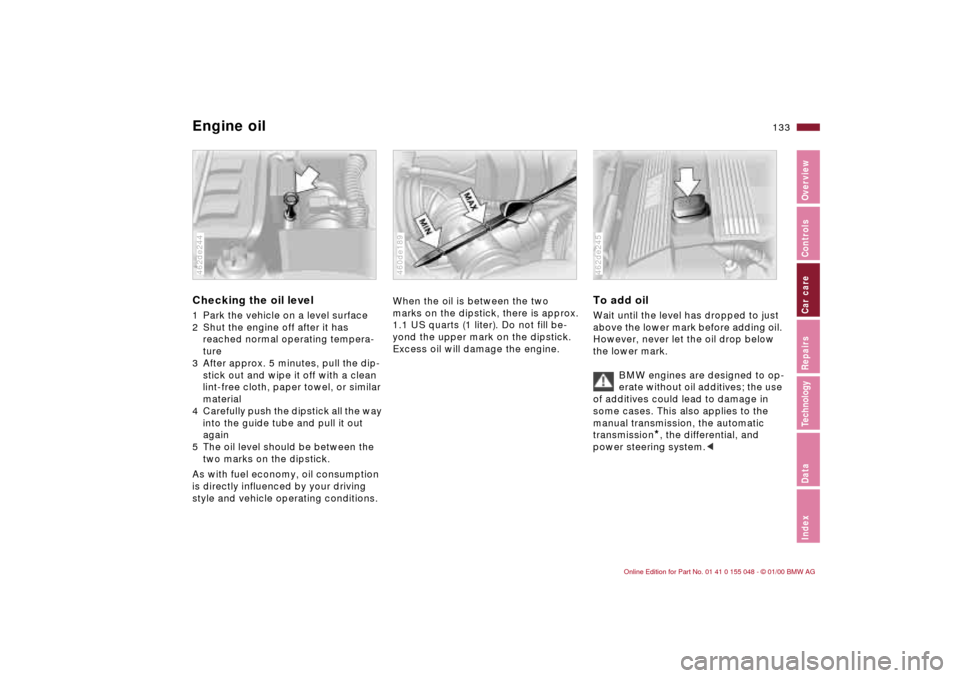
Engine oilChecking the oil level 1 Park the vehicle on a level surface
2 Shut the engine off after it has
reached normal operating tempera-
ture
3 After approx. 5 minutes, pull the dip-
stick out and wipe it off with a clean
lint-free cloth, paper towel, or similar
material
4 Carefully push the dipstick all the way
into the guide tube and pull it out
again
5 The oil level should be between the
two marks on the dipstick.
As with fuel economy, oil consumption
is directly influenced by your driving
style and vehicle operating conditions.462de244
When the oil is between the two
marks on the dipstick, there is approx.
1.1 US quarts (1 liter). Do not fill be-
yond the upper mark on the dipstick.
Excess oil will damage the engine.460de189
To add oil Wait until the level has dropped to just
above the lower mark before adding oil.
However, never let the oil drop below
the lower mark.
BMW engines are designed to op-
erate without oil additives; the use
of additives could lead to damage in
some cases. This also applies to the
manual transmission, the automatic
transmission
*, the differential, and
power steering system.<
462de245
Page 146 of 199
146n
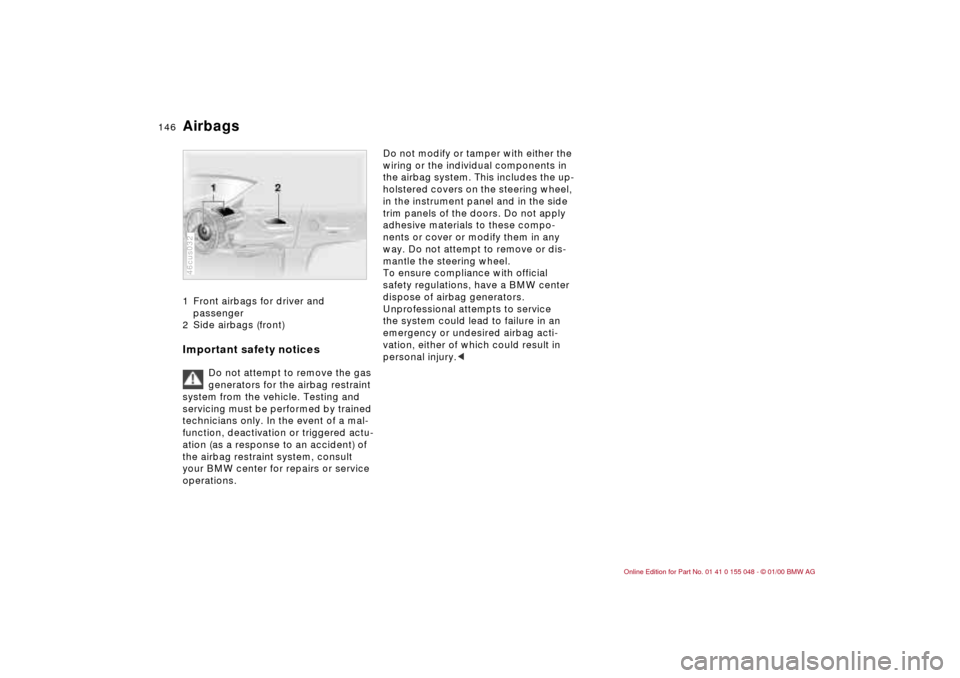
Airbags 1 Front airbags for driver and
passenger
2 Side airbags (front)Important safety notices
Do not attempt to remove the gas
generators for the airbag restraint
system from the vehicle. Testing and
servicing must be performed by trained
technicians only. In the event of a mal-
function, deactivation or triggered actu-
ation (as a response to an accident) of
the airbag restraint system, consult
your BMW center for repairs or service
operations.
46cus032
Do not modify or tamper with either the
wiring or the individual components in
the airbag system. This includes the up-
holstered covers on the steering wheel,
in the instrument panel and in the side
trim panels of the doors. Do not apply
adhesive materials to these compo-
nents or cover or modify them in any
way. Do not attempt to remove or dis-
mantle the steering wheel.
To ensure compliance with official
safety regulations, have a BMW center
dispose of airbag generators.
Unprofessional attempts to service
the system could lead to failure in an
emergency or undesired airbag acti-
vation, either of which could result in
personal injury.<
Page 159 of 199
159n
IndexDataTechnologyRepairsCar careControlsOverview
Changing a wheel
Safety measures in the event of a
flat tire or wheel change:
Stop the vehicle as far as possible from
passing traffic. Park on a firm, flat sur-
face. Switch on the hazard flashers.
Turn the steering wheel to the straight-
ahead position, remove the key and en-
gage the steering lock. Shift into 1st or
reverse (selector lever in "Park" with au-
tomatic transmission) and engage the
parking brake.
Have all passengers leave the vehicle
and remain well away from your immedi-
ate working area (behind a guardrail, for
instance).
If a warning triangle
* or portable hazard
warning lamp is available, set it up on
the roadside at an appropriate distance
from the rear of the vehicle. Comply with
all safety guidelines and regulations.
Change the wheel only on a level, firm
surface that is not slippery. Avoid jack-
ing the vehicle on a soft or slippery sup-
port surface (snow, ice, loose gravel,
etc.), as it could slide sideways.
Position the jack on a firm support sur-
face.
Do not place wooden blocks or similar
objects under the jack, otherwise, the
jack might not be able to reach its full
support capacity because of the limited
height.
Do not lie under the vehicle or start the
engine when the vehicle is supported by
the jack. Failure to comply with this cre-
ates a risk of fatal injury.<
Your BMW has a space-saver spare
tire for temporary use to ensure your
mobility.
To remove the space-saver spare
tire, lift the floor panel in the lug-
gage compartment completely out
(refer to page 41).<
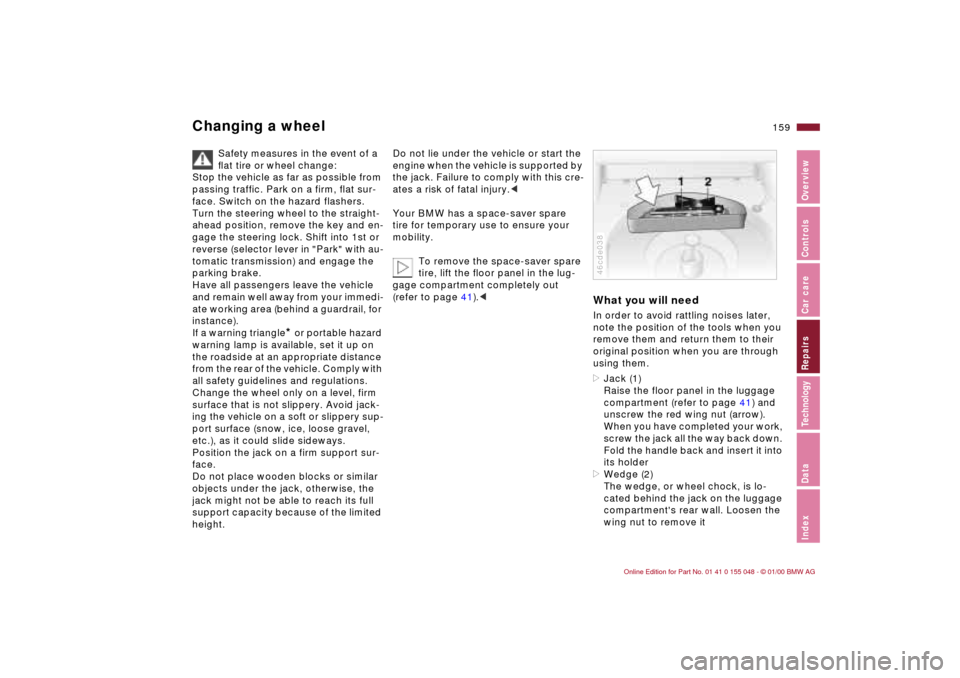
What you will needIn order to avoid rattling noises later,
note the position of the tools when you
remove them and return them to their
original position when you are through
using them.
>Jack (1)
Raise the floor panel in the luggage
compartment (refer to page 41) and
unscrew the red wing nut (arrow).
When you have completed your work,
screw the jack all the way back down.
Fold the handle back and insert it into
its holder
>Wedge (2)
The wedge, or wheel chock, is lo-
cated behind the jack on the luggage
compartment's rear wall. Loosen the
wing nut to remove it46cde038