fuel cap BMW 323i 1993 E36 Owner's Manual
[x] Cancel search | Manufacturer: BMW, Model Year: 1993, Model line: 323i, Model: BMW 323i 1993 E36Pages: 759
Page 186 of 759
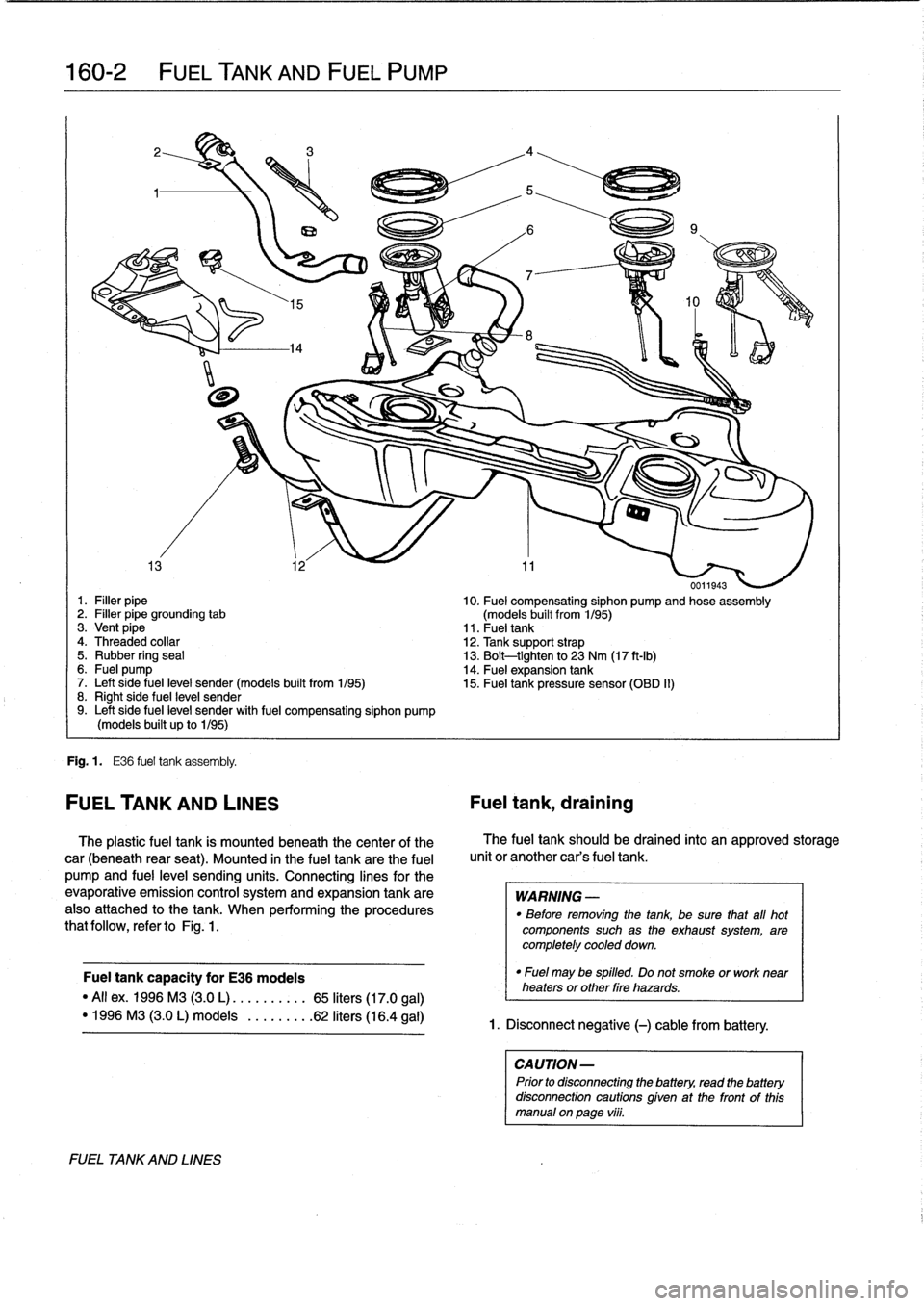
160-2
FUEL
TANK
AND
FUEL
PUMP
0011943
1
.
Filler
pipe
10
.
Fuel
compensating
siphon
pump
and
hose
assembly
2
.
Filler
pipe
grounding
tab
(models
built
from
1/95)
3
.
Vent
pipe
11
.
Fueltank
4
.
Threaded
collar
12
.
Tank
support
strap
5
.
Rubber
ring
seal
13
.
Bolt-tighten
to
23
Nm
(17
ft-Ib)
6
.
Fuel
pump
14
.
Fuel
expansion
tank
7
.
Left
side
fuel
leve¡
sender(models
built
from
1/95)
15
.
Fuel
tank
pressure
sensor
(OBD
II)
8
.
Right
side
fuel
leve¡
sender9
.
Left
side
fuel
leve¡
sender
with
fuel
compensating
siphon
pump
(models
built
up
to
1/95)
Fig
.
1
.
E36
fuel
tank
assembly
.
FUEL
TANK
AND
LINES
Fuel
tank,
draining
The
plastic
fuel
tank
is
mounted
beneath
the
center
of
the
car
(beneath
rear
seat)
.
Mounted
in
the
fuel
tank
are
the
fuel
pump
and
fuel
leve¡
sending
units
.
Connecting
lines
for
the
evaporative
emission
control
systemand
expansion
tank
are
also
attached
to
the
tank
.
When
performing
the
procedures
that
follow,
refer
toFig
.
1
.
Fuel
tank
capacity
for
E36
modeis
"All
ex
.
1996
M3
(3
.0
L)
.....
.
..
..
65
liters
(17
.0
gal)
"
1996
M3
(3.0L)
modeis
.
...
.
..
.
.62
liters
(16
.4
gal)
FUEL
TA
NKAND
LINES
The
fuel
tank
should
be
drained
into
an
approved
storage
unit
or
another
car's
fuel
tank
.
WARNING
-
"
Before
removing
the
tank,
be
sure
that
afl
hot
components
such
as
the
exhaust
system,
are
completely
cooled
down
.
"
Fuel
may
be
spilled
.
Do
not
smoke
or
worknear
heaters
or
other
Pire
hazards
.
1
.
Disconnect
negative
(-)
cable
from
battery
.
CAUTION-
Prior
to
disconnectiog
the
battery,
read
the
battery
disconnection
cautions
given
at
the
front
of
this
manual
on
paga
vi¡¡
.
Page 187 of 759
2
.
Remove
fuel
tank
filler
cap
.
3
.
Remove
rearseat
cushion
and
pull
back
insulation
mats
to
expose
fuel
tank
access
covers
.
See
Fig
.
2
.
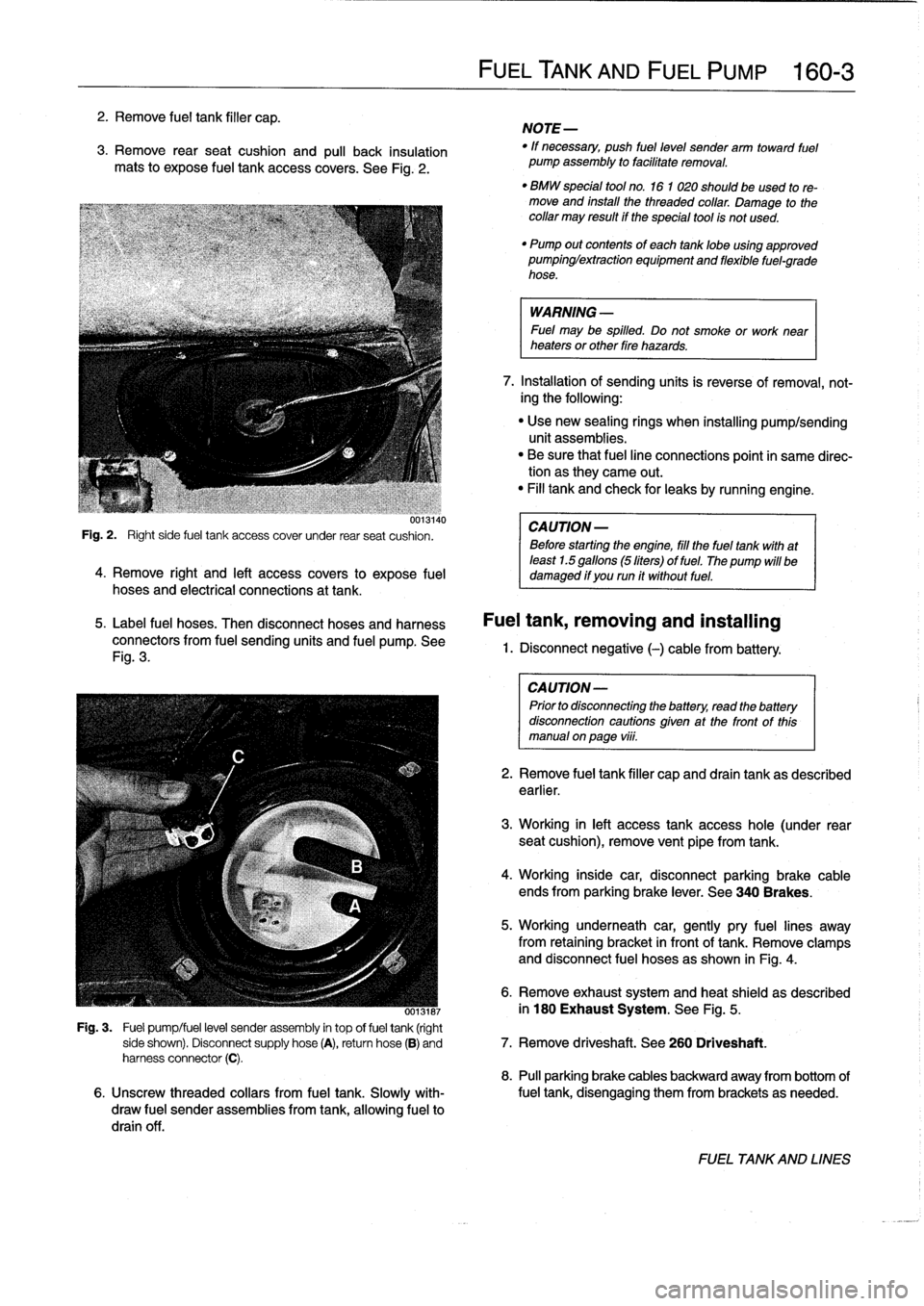
uui3140
Fig
.
2
.
Right
side
fuel
tank
access
cover
under
rear
seat
cushion
.
4
.
Remove
right
and
left
access
covers
to
expose
fuel
hoses
and
electrical
connections
at
tank
.
5
.
Label
fuel
hoses
.
Then
disconnect
hoses
and
harness
connectors
from
fuel
sending
units
and
fuel
pump
.
See
Fig
.
3
.
FUELTANK
AND
FUEL
PUMP
160-
3
NOTE-
"
If
necessary,
push
fuel
level
sender
arm
toward
fuel
pump
assembly
to
facilitate
removal
.
"
BMW
special
tool
no
.
16
1
020
should
beused
tore-
move
and
install
the
threaded
collar
.
Damage
to
thecollar
may
result
if
the
special
tool
is
not
used
.
"
Pump
out
contents
of
each
tanklobe
using
approved
pumpinglextraction
equipment
and
flexible
fuel-grade
hose
.
WARNING
-
Fuel
may
be
spilled
.
Do
not
smoke
or
work
near
heaters
or
other
fire
hazards
.
7
.
Installation
of
sending
units
is
reverse
of
removal,
not-
ing
the
following
:
"
Use
new
sealing
rings
when
installing
pump/sending
unit
assemblies
.
"
Be
sure
that
fuel
line
connections
point
in
same
direc-tion
as
they
carne
out
.
"
Fill
tank
and
check
for
leaks
by
running
engine
.
CA
UTION-
Before
starting
the
engine,
fill
the
fuel
tank
with
at
least
1.5
gallons
(5liters)
of
fuel
.
The
pump
will
be
damaged
if
you
run
it
without
fuel
.
Fuel
tank,
removing
and
installing
1.
Disconnect
negative
(-)cablefrom
battery
:
CAUTION-
Prior
to
disconnectiog
the
battery,
read
the
battery
disconnection
cautions
given
at
the
front
of
this
manual
onpage
viii
.
2
.
Remove
fuel
tank
filler
capand
drain
tank
as
described
earlier
.
3
.
Working
in
left
access
tank
access
hole
(under
rear
seat
cushion),
remove
vent
pipe
fromtank
.
4
.
Working
inside
car,
disconnectparking
brake
cable
ends
from
parking
brake
lever
.
See
340
Brakes
.
5
.
Working
underneath
car,
gently
pry
fuel
lines
away
from
retaining
bracket
in
front
of
tank
.
Remove
clamps
and
disconnect
fuel
hoses
as
shown
in
Fig
.
4
.
6
.
Remove
exhaust
system
and
heat
shield
as
described
ooisiai
in
180
Exhaust
System
.
See
Fig
.
5
.
Fig
.
3
.
Fuel
pump/fuel
level
sender
assembly
in
top
offuel
tank
(right
side
shown)
.
Disconnect
supply
hose
(A),
return
hose
(B)
and
7
.
Remove
driveshaft
.
See
260
Driveshaft
.
harness
connector
(C)
.
8
.
Pull
parking
brake
cables
backward
away
from
bottom
of
6
.
Unscrew
threaded
collars
from
fuel
tank
.
Slowly
with-
fuel
tank,
disengaging
them
from
brackets
as
needed
.
draw
fuel
sender
assemblies
from
tank,allowing
fuel
to
drain
off
.
FUEL
TANKAND
LINES
Page 189 of 759
Fuel
leve¡
senders,
testing
Fuel
leve¡
sender
(right
side)
The
left
and
right
fuelleve¡
sending
units
are
wired
in
series
.
and
fuel
pump,
removing
and
installing
The
fuel
gauge
receives
a
signal
that
is
the
average
of
the
two
1
.
Disconnect
negative
(-)
cable
from
battery
.
input
values
.
1
.
Remove
rear
seat
cushion,
lift
up
insulation
mats,
andremove
both
fuel
tank
access
covers
.
2
.
Disconnect
white
plug
on
each
sending
unit
.
See
Fig
.
6
.
3
.
Check
resistance
value
of
eachsending
unit
.
Values
should
be
the
same
.
5
.
If
valuesare
different,
remove
sending
units
as
described
below,
and
check
resistance
valuésacross
terminals
.
Table
a
lists
resistance
values
for
senders
at
various
float
positions
.
Table
a
.
Fuel
Leve¡
Sender
Resistances
Float
position
Test
result
(ohms)
Right
side
empty
10
ohm
t2
Right
side
full
250
ohm
±
5
Left
side
empty
10
ohm
t
2
Left
side
fui¡
250
ohm
±
5
FUEL
TANK
AND
FUEL
PUMP
160-
5
CAUTION
-
Prior
to
disconnecting
the
battery,
read
the
battery
disconnection
cautionsglven
at
the
front
of
this
manual
onpage
viii
.
2
.
Drain
fuel
from
tank
as
described
earlier
.
WARNING
-
Always
unscrew
the
fuel
tank
cap
to
release
pres-
sure
in
the
tank
before
working
on
the
tank
or
fines
.
3
.
Remove
rear
seat
cushion
and
pull
back
insulation
pad
under
right
side
.
4
.
Remove
screws
holding
rightfuel
tank
accesscover
.
Remove
cover
.
5
.
Label
fuel
hoses
.
Disconnect
hoses
and
harness
con-
nectors
from
fuel
sending
unit
and
fuel
pump
.
6
.
Unscrew
threaded
collar
from
fuel
pumplfuel
leve¡
sender
.
Slowly
withdraw
assembly
from
tank,allowing
fuelto
drain
off
.
See
Fig
.
7
.
0013187
&
0013194
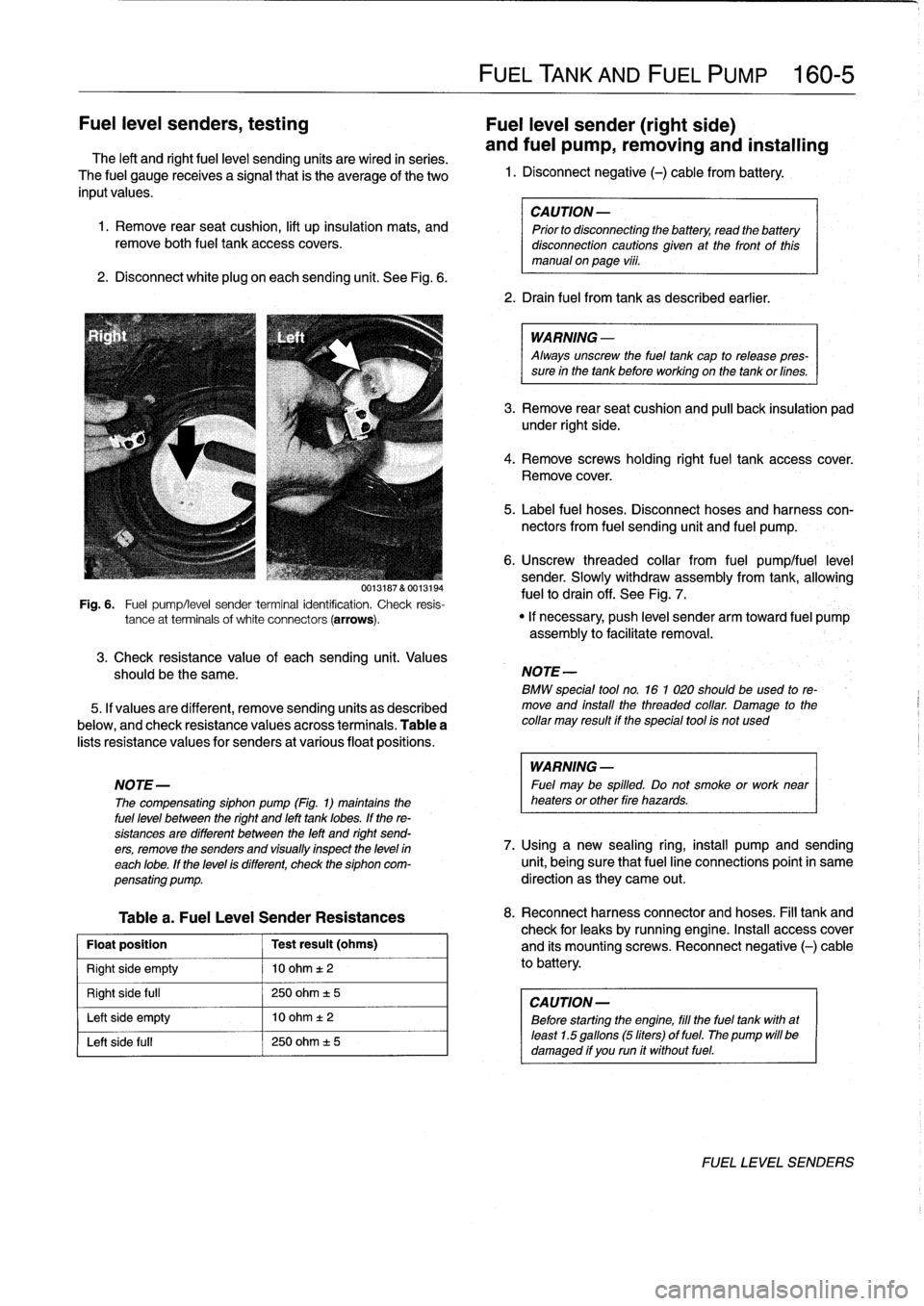
Fig
.
6
.
Fuel
pump/leve¡
sender
terminal
identification
.
Check
resis-
tance
at
terminals
of
white
connectors
(arrows)
.
"
If
necessary,
push
leve¡
sender
arm
toward
fuel
pump
assembly
to
facilitate
removal
.
NOTE
-
BMW
special
tool
no
.
16
1
020
should
beused
to
re-
move
and
install
the
threaded
collar
.
Damage
to
the
collar
may
result
if
the
special
tool
is
not
used
WARNING
-
NOTE-
Fuel
may
be
spilled
.
Do
not
smoke
or
work
near
The
compensating
siphon
pump
(Fig
.
1)
maintains
the
heaters
or
other
fire
hazards
.
fuel
leve¡
between
the
right
and
left
tank
lobes
.
If
the
re-
sistances
are
different
between
the
left
and
right
send-
ers,
remove
the
senders
and
visually
inspect
the
leve)
in
7
.
Using
a
new
sealing
ring,
install
pump
and
sending
each
lobe
.
If
the
leve¡
is
different,
check
the
siphon
com-
unit,
being
sure
that
fuel
line
connections
point
in
same
pensating
pump
.
direction
as
they
carne
out
.
8
.
Reconnect
harnessconnector
and
hoses
.
Fill
tank
and
check
for
leaks
by
running
engine
.
Insta¡¡
access
cover
and
its
mountingscrews
.
Reconnect
negative
(-)
cable
to
battery
.
CAUTION
-
Before
starting
the
engine,
fill
the
fuel
tank
with
at
least
1
.5
gallons
(5liters)
of
fuel
.
The
pump
will
be
damaged
if
you
run
it
without
fuel
.
FUEL
LEVEL
SENDERS
Page 193 of 759
NOTE-
NOTE
-
On
1996
and
later
4-cylinder
cars,
use
BMW
special
"
Use
BMW
pressure
gauge
Part
No
.
133
060,or
an
tool
13
6051
(hose
with
quick
release
coupling)
toat-
equivalent
.
The
fuel
pressure
gauge
should
have
a
tach
pressure
gauge
to
Shraeder
valve
fitting
on
top
of
rangeof
0
to
5bar
(0
to
75
psi)
and
mustbe
securely
the
M44
fuel
rail
.
See
Fig
.
13
.
connected
to
prevent
it
from
coming
loose
under
pres-
sure
.
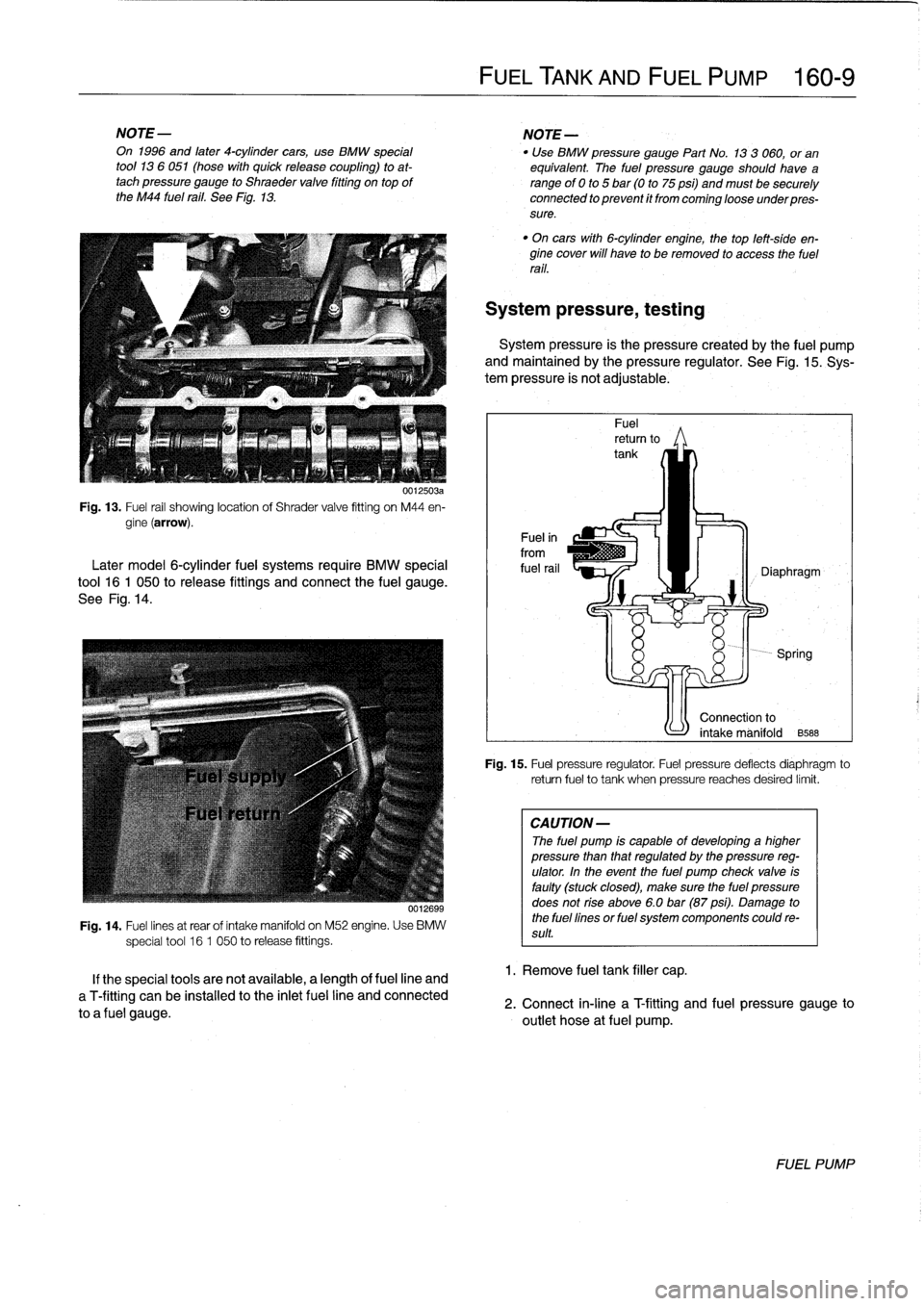
u012503a
Fig
.
13
.
Fuel
rail
showing
location
of
Shrader
valve
fitting
on
M44
en-
gine
(arrow)
.
Later
model
6-cylinder
fuel
systems
require
BMW
specíal
tool
16
1
050
to
release
fittings
and
connect
the
fuel
gauge
.
See
Fig
.
14
.
0012699
Fig
.
14
.
Fuel
lines
at
rear
of
íntake
manifold
on
M52
engine
.
Use
BMW
special
tool
16
1
050
to
release
fittings
.
If
the
special
tools
arenot
available,
a
length
offuel
line
and
a
T-fitting
can
be
installed
tothe
inlet
fuel
line
and
connected
to
a
fuel
gauge
.
FUEL
TANK
AND
FUEL
PUMP
160-
9
"
On
cars
with
6-cylinder
engine,
thetop
left-side
en-
Bine
cover
will
have
to
be
removed
to
access
the
fuel
rail
.
System
pressure,
testing
System
pressure
is
the
pressure
created
by
the
fuel
pump
and
maintained
by
the
pressure
regulator
.
See
Fig
.
15
.
Sys-
tem
pressure
is
not
adjustable
.
1
.
Remove
fuel
tank
filler
cap
.
Fig
.
15
.
Fuel
pressure
regulator
.
Fuel
pressure
deflects
diaphragm
to
retum
fuel
to
tank
when
pressure
reaches
desired
limit
.
CA
UTION-
The
fuel
pump
is
capable
of
developing
a
higher
pressure
than
that
regulated
by
the
pressure
reg-
ulator
.
In
the
event
the
fuel
pump
check
valve
is
faulty
(stuck
closed),
make
sure
the
fuel
pressure
does
not
rise
aboye
6
.0
bar(87
psi)
.
Damage
to
the
fuel
fines
or
fuel
system
components
could
re-
sult
.
2
.
Connect
in-fine
a
Tfitting
and
fuel
pressure
gauge
to
outlet
hose
atfuel
pump
.
FUEL
PUMP
Page 194 of 759
160-
1
0
FUEL
TANK
AND
FUEL
PUMP
3
.
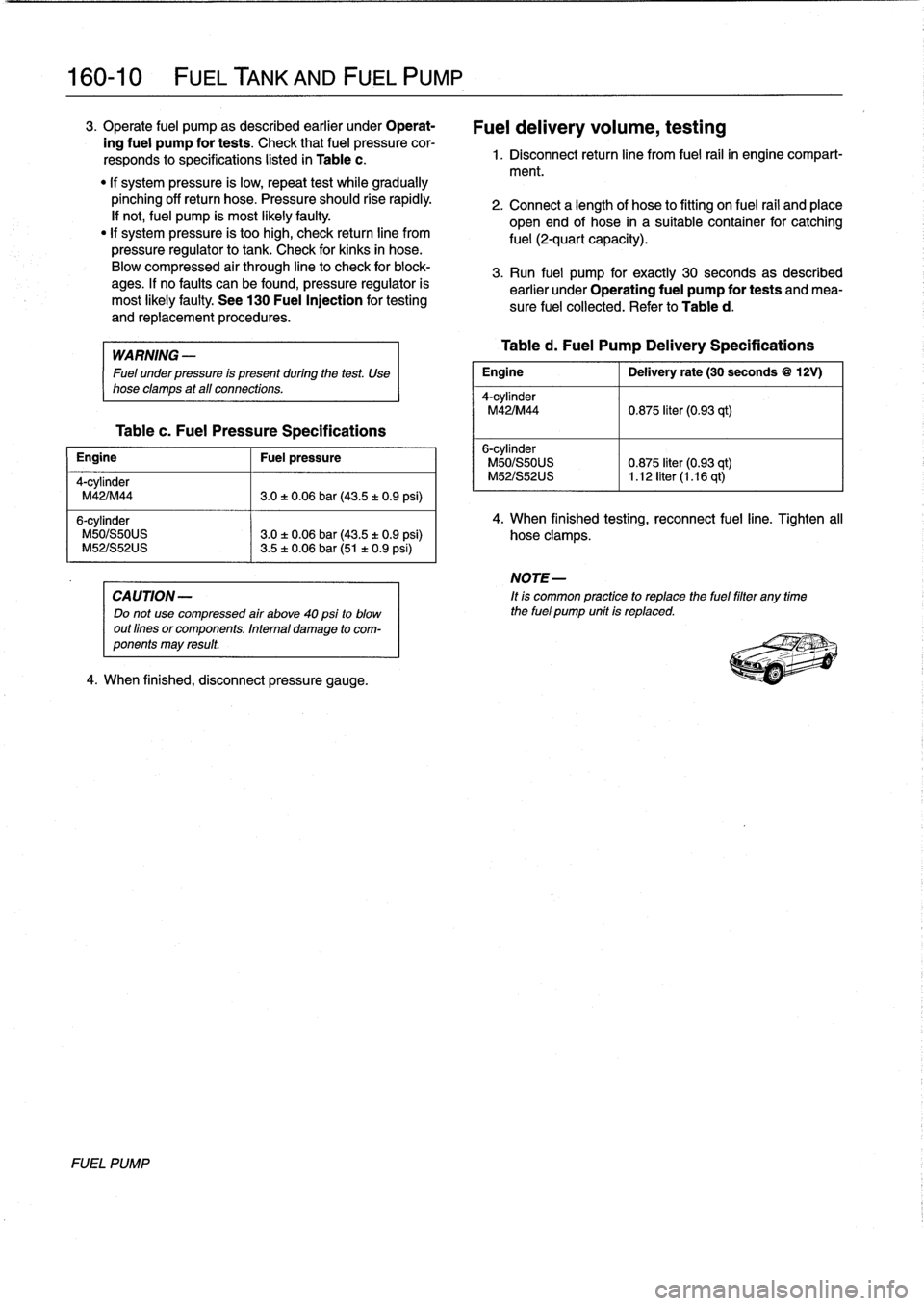
Operate
fuel
pump
as
described
earlier
under
Operat-
ing
fuel
pump
for
tests
.
Check
that
fuel
pressure
cor-
responds
to
specifications
listed
in
Table
c
.
"
If
system
pressure
is
low,
repeat
test
whilegradually
pinching
off
return
hose
.
Pressure
should
rise
rapidly
.
If
not,fuel
pump
is
most
likely
faulty
.
"
If
system
pressure
is
too
high,
check
return
line
from
pressure
regulator
to
tank
.
Check
for
kinks
in
hose
.
Blow
compressed
air
through
line
to
check
for
block-
ages
.
If
no
faulty
canbe
found,
pressure
regulator
is
most
likely
faulty
.
See
130
Fuel
Injection
for
testing
and
replacementprocedures
.
Table
c
.
Fuel
Pressure
Specifications
Engine
1
Fuel
pressure
4-cylinder
M42/M44
3
.0
:e
0
.06
bar(43
.5
±0
.9
psi)
6-cylinder
M50/S50US
3
.0
:j-
0
.06bar(43
.5
t0
.9
psi)
M52/S52US
3
.5
t
0
.06
bar
(51
t0
.9psi)
CA
UTION-
Do
not
use
compressed
air
above
40
psi
to
blow
out
fines
or
components
.
Interna¡
damage
to
com-
ponents
may
result
.
4
.
When
finished,
disconnect
pressure
gauge
.
FUEL
PUMP
Fuel
delivery
volume,
testing
1
.
Disconnect
return
line
from
fuel
rail
in
engine
compart-
ment
.
2
.
Connect
a
length
of
hose
to
fitting
on
fuel
rail
and
place
open
end
of
hose
in
a
suitable
container
for
catching
fuel
(2-quart
capacity)
.
3
.
Run
fuel
pump
for
exactly
30
seconds
as
described
earlier
under
Operating
fuel
pump
for
tests
and
mea-
sure
fuel
collected
.
Refer
to
Table
d
.
WARNING-
Table
d
.
Fuel
Pump
Delivery
Specifications
Fuel
under
pressure
is
present
duringthe
test
.
Use
I
Engine
Delivery
rate
(30
seconds
@
12V)
hose
clamps
at
all
connections
.
4-cylinder
M42/M44
0
.875
fter
(0
.93
qt)
6-cylinder
M50/S50US
0
.875
fter(0
.93
qt)
M52/S52US
~
1
.12
liter
(1
.16
qt)
4
.
When
finished
testing,
reconnect
fuel
line
.
Tighten
all
hose
clamps
.
NOTE-
It
is
common
practice
to
replace
the
fuel
filter
any
time
the
fuel
pump
unit
is
replaced
.
Page 197 of 759
Cooling
System
Pressure
Test
If
the
engine
overheats
and
no
other
cooling
system
testsindicate
trouble,
the
radiator
may
have
some
pluggedpassag-
A
cooling
system
pressure
test
is
used
to
check
for
internal
es
that
are
restricting
coolant
flow
.
leaks
.
Some
of
the
common
sources
ofinternal
leaks
are
a
faulty
cylinder
head
gasket,
a
cracked
cylinder
head,
or
a
Temperature
Gauge
Quick
Check
cracked
cylinder
block
.
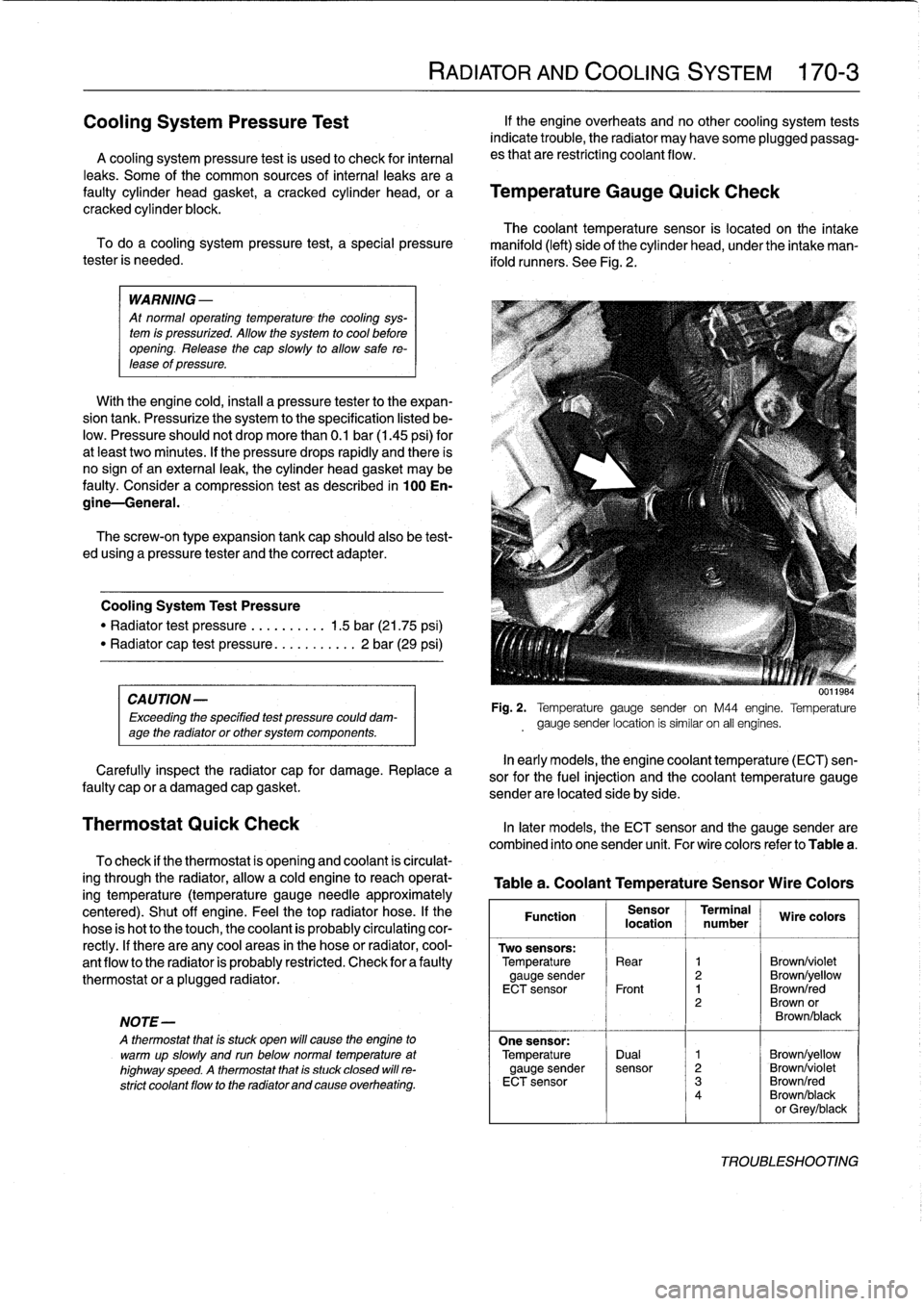
The
coolant
temperature
sensor
is
located
on
the
intake
To
doa
cooling
system
pressure
test,
a
special
pressure
manifold
(left)
side
of
the
cylinder
head,
under
the
intake
man-
tester
is
needed
.
ifold
runners
.
See
Fig
.
2
.
WARNING
-
At
normal
operating
temperature
-
the
cooling
sys-
tem
is
pressurized
.
Allow
the
system
to
cool
before
opening
.
Release
the
cap
slowly
to
allow
sale
re-
tease
of
pressure
.
With
the
engine
cold,instan
a
pressure
tester
to
the
expan-
sion
tank
.
Pressurize
thesystem
to
the
specification
listed
be-
low
.
Pressure
should
not
drop
more
than
0
.1
bar
(1
.45
psi)
for
at
leakt
two
minutes
.
If
the
pressure
drops
rapidly
and
there
is
no
sign
of
an
externa¡
leak,
the
cylinder
head
gasket
may
be
faulty
.
Considera
compression
test
as
described
in
100
En-
gine-General
.
The
screw-on
type
expansion
tank
cap
should
also
be
test-
ed
using
a
pressure
tester
and
the
correct
adapter
.
Cooling
System
Test
Pressure
"
Radiator
test
pressure
.........
.
1
.5
bar
(21
.75
psi)
"
Radiator
cap
test
pressure
..
.
........
2
bar
(29
psi)
CA
UTION-
Exceeding
the
speclfied
test
pressure
could
dam-
age
the
radiatoror
other
system
components
.
Carefully
inspect
the
radiator
cap
for
damage
.
Replace
a
faulty
cap
or
a
damaged
cap
gasket
.
Thermostat
Quick
Check
In
later
models,
the
ECT
sensor
and
the
gauge
sender
are
combined
into
one
sender
unit
.
For
wire
colors
refer
to
Table
a
.
To
check
if
the
thermostat
is
opening
and
coolant
is
circulat-
ing
through
the
radiator,
allow
a
cold
engine
to
reach
operat-
ing
temperature
(temperature
gauge
needieapproximately
centered)
.
Shut
off
engine
.
Feel
the
top
radiator
hose
.
If
the
hose
is
hot
to
the
touch,
the
coolant
is
probably
circulating
cor-
rectly
.
If
there
are
any
cool
areas
in
the
hose
or
radiator,
cool-
ant
flow
to
the
radiator
is
probably
restricted
.
Check
for
a
faulty
thermostat
or
aplugged
radiator
.
NOTE-
A
thermostat
that
is
stuck
open
will
cause
the
engine
to
warmup
slowly
and
run
belownormal
temperature
at
highway
speed
.
A
thermostat
that
is
stuck
closed
will
re-
strict
coolant
flow
to
the
radiator
and
cause
overheating
.
RADIATOR
AND
COOLING
SYSTEM
170-
3
U
.¡ig
.v
Fig
.
2
.
Temperature
gauge
sender
on
M44
engine
.
Temperature
gauge
sender
location
is
similar
on
al]
engines
.
In
early
models,
the
engine
coolant
temperature
(ECT)
sen-
sor
for
the
fuel
injection
and
the
coolant
temperature
gauge
sender
are
located
side
by
side
.
Table
a
.
Coolant
Temperature
Sensor
Wire
Colors
Function
Sensor
Terminal
Wire
colors
location
number
Two
sensors
:
Temperature
Rear
1
Brown/violet
gauge
sender
2
Brown/yellow
ECT
sensor
Front
1
Brown/red
2
Brown
or
Brown/black
One
sensor
:
Temperature
Dual
1
Brown/yellow
gauge
sender
sensor
2
Brown/violet
ECT
sensor
3
Brown/red
4
Brown/black
or
Grey/black
TROUBLESHOOTING
Page 447 of 759
GENERAL
E36
cars
are
equipped
with
integrated
automatic
heating
and
air
conditioning
systems
.
Many
of
the
procedures
given
in
this
repair
group
require
that
the
A/C
refrigerant
charge
be
evacuated
using
specialized
equipment
.
See
A/C
System
Warningsand
Cautions
later
in
this
repair
group
.
HEATER
AND
CONTROLS
Blower
motor,
removing
and
installing
NOTE-
On
6-cylinder
cars,
the
plastic
top
enginecover
and
fuel
rail
covermustbe
removed
.
The
fuel
injectorhamess
re-
taining
screws
must
be
removed
and
the
harness
set
aside
.
The
engine
control
module
(ECM)
cover
must
be
removed,
the
control
unit
connectors
unplugged
and
the
harness
pulled
out
of
the
way
.
See
130
Fuel
Injection
.
1
.
Disconnect
negative
(-)
cable
from
battery
.
2
.
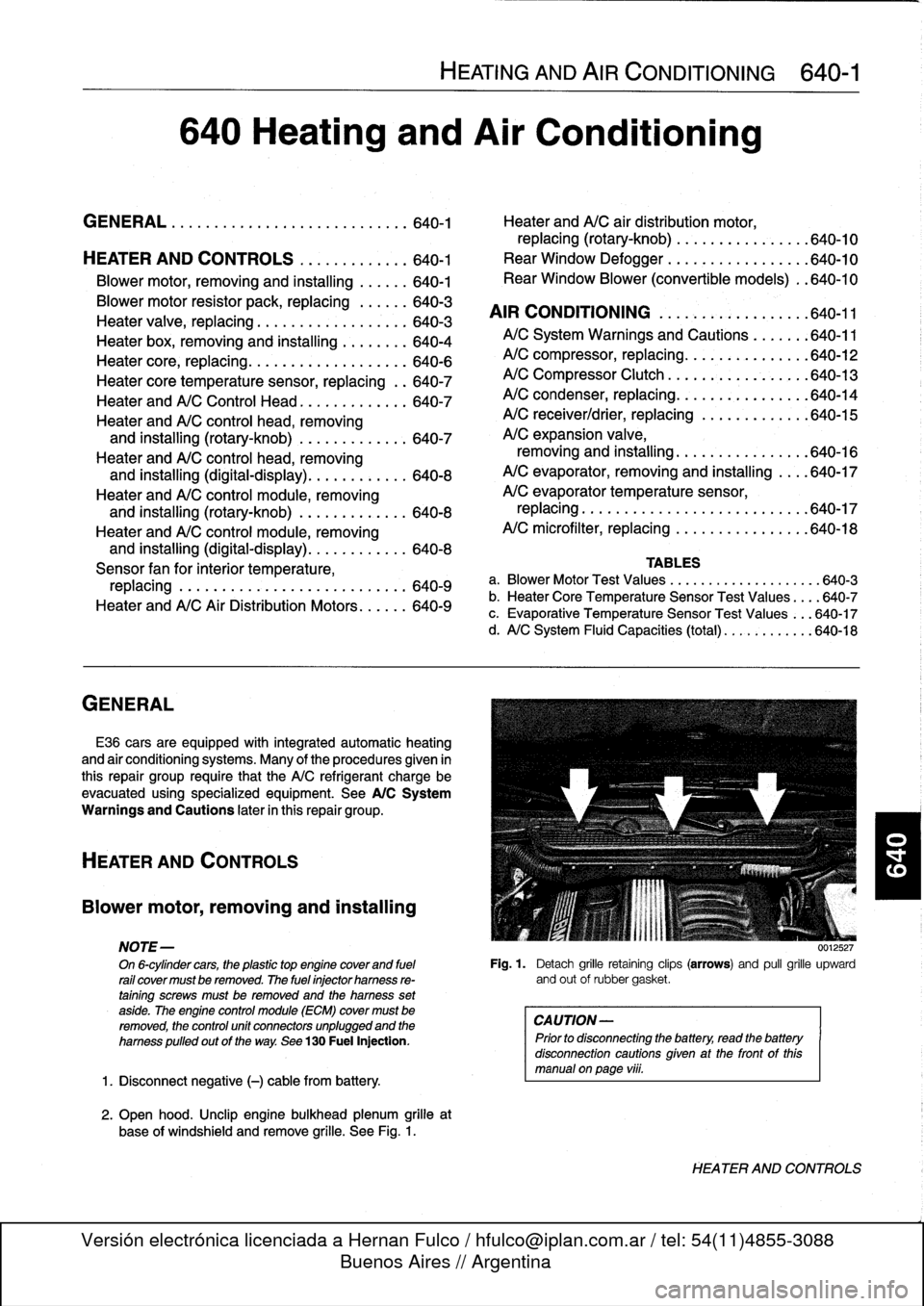
Open
hood
.
Unclip
engine
bulkhead
plenum
grille
at
base
of
windshíeld
and
remove
grille
.
See
Fig
.
1
.
HEATING
AND
AIR
CONDITIONING
640-1
640
Heating
and
Air
Conditioning
GENERAL
.
...
.
....
.
.
.
.
.
.
.
.
.
.......
.
.
.
640-1
Heater
andA/C
air
distribution
motor,
replacing(rotary-knob)
.
.
...
.
.
.
.......
.
640-10
HEATER
AND
CONTROLS
.
.....
.
.
.
.
.
.
.640-1
Rear
Window
Defogger
.
.
.
.
.
.
.
.
.
.
...
.
.
.
640-10
Blower
motor,
removing
and
installing
.
.
.
.
.
.
640-1
Rear
Window
Blower
(convertible
models)
.
.640-10
Blowermotor
resistor
pack,
replacing
.
.
.
.
.
.
640-3
AIR
CONDITIONING
.
.
.
.
.
.
.
.
.
.
.
.
.
.
.
.
.
.
640-11
Heater
valve,
replacing
...........
.
.
.
.
.
.
.
640-3
Heater
box,
removing
and
installing
.
.
.
.
.
.
.
.
640-4
A/CSystem
Warnings
and
Cautions
.
.
.
.
.
.
:640-11
Heater
core,
replacing
.....
.
.
:
....
.
.
.
.
.
.
.
640-6
A/C
compressor,
replacing
.
.
::.
:
:
.
.
.
.
.
.
.
.640-12
Heater
core
temperature
sensor,
replacing
.
.
640-7
A/C
Compressor
Clutch
.
.
.
.
.
.
.
:
.
.
.
.
.
.
.
.
.
640-13
Heater
andA/C
Control
Head
.
.
....
.
.....
.
640-7
A/C
condenser,
replacing
.
.
.
.
.
.
.
.
.
.
.
.
.
.
.
.
640-14
Heater
andA/C
control
head,
removing
A/C
receiver/drier,
replacing
.
.
.
.
.
.
.
.
.
.
.
.
.
640-15
and
installing
(rotary-knob)
.
.
....
.
......
640-7
A/C
expansion
valve,
Heater
andA/C
control
head,
removing
removing
and
installing
...
.
.....
.
.
.
.
.
.
.
640-16
and
installing
(digital-display)
.
.....
.
.....
640-8
A/C
evaporator,
removing
and
installing
.
.
..
640-17
Heater
andA/C
control
module,removing
A/C
evaporator
temperature
sensor,
and
installing
(rotary-knob)
.
.
...
.
.
.
.
.
.
.
.
640-8
replacing
.
.
.
.
.
.
..............
.
.
.
.
.
..
640-17
Heater
andA/C
control
module,removing
A/C
microfilter,
replacing
......
.
....
.
.
.
..
640-18
and
installing
(digital-display)
.
...
.
.
.
.
.
...
640-8
Sensor
fan
for
interior
temperature,
TABLES
replacing
.
.
.
....
.
.
.
.
.
.
.
.
.
.
.
.
.
.
.
.
.
.
.
.
640-9
a
.
Blower
Motor
Test
Values
.........
...
.
.
......
640-3
Heater
andA/C
AirDistribution
Motors
.
.
.
.
.
.
640-9
b
.
Heater
Core
Temperature
Sensor
Test
Values
...
.640-7
c
.
Evaporative
Temperature
Sensor
Test
Values
...
640-17
d
.
A/C
System
Fluid
Capacities
(total)
..
..........
640-18
0012527
Fig
.
1
.
Detach
grille
retaining
clips
(arrows)
and
pull
grille
upward
and
out
of
rubbergasket
.
CAUTION-
Prior
to
disconnectiog
the
battery,
read
the
battery
disconnection
cautionsgiven
at
the
front
of
this
manual
onpage
viii
.
HEATER
AND
CONTROLS
Page 585 of 759
DATA
LINK
CONNECTOR
1$
,A
WHTT/VIO
COMPUTER
DATA
1~
'
LINES
SYS7EM
1
WH7/~
"
8
R1/
.
.N
r
EGSWARNINGLJ
INSTRUMENTLLUSTER
%16
1
VIO
SHIFT
LK
SOL
AUTO
MODE
SI
G
89077
~\3
IG7IMINGIN7
14
BRN/GRV
HOTATALL
TIMES
r
~
Ea
r
I
~
I
-
"
(
JUNCTION
L
L
JFOIN7
ELECTRICAL
WIRING
DIAGRAMS
ELE--101
Transmission
Electronics
1995
318ti
HOTINRUNHOTINRUN&START&START
r
FUSE
I
~
F28
L3r-
0
-__
2
I
16
FRONT
POWER
F
ELS
28
E
(DISTRIBUTION
BOX
'-_J
xLOeLz
GRN/
BEN/
RED
WHTGRV
EGSA4S310R
N
'1
003004
G201
D
0
1010
1
300
11
2
1
0
111
00
1
0
g
GRV/RED
2OUTPUT
_JDIMMER
r'`
0
GRV(
--
I
bi
:
RED
INTERIORLIGHTS
I.c2
L
SYSTEM
~N53
I
4BRN
SOLGNDCTRLI
r
-
q
-
--
BRN/GRN
h
~
85
-
I
FUELPUMPRELAV
I
I
COMPRESSOR
I
CONTROLRELAY
I
"
REOIW
TI
87A
I
-
SOLENOIDSOLENOID
VALVE1
BR
N
"
DEG
S
NCA
SPIN
I
SOLENOID
,8
GRN
B
I
NCA
VA
L
E2
GRRNGSIGL3
BLU/WHT
6723
>-
TIMEASSIG(FL)
9
WH7/BLK
A-PROG
IND
10
YEL/BLU
FLPMPPLYCTRL
11
BRN/GRN
M-PROGIND
12
YELIWNT
RED
9
I
T
.DDATALK
13
WH7/VIO
OUTPUT
SPD
()14
BLK
-fl
----
DRY
1-
BKSWTESTSIG5BRN/GRV
BRN/GRV3
(N
OT
USE
D),10
X0
77
CLR
VIO
2
I
OILTEMP
SIG
SPDSENSSHD
18
NCA
19
BRN
GND
20
YEL
T
-
I
OUTPUTBPD(r)
I
A/CCOMPON
16LK/BLU~-
.'BLU
7
44
I
2BLK
BIN
8
OIL7PSIG(a)
11
1
ELK
3
Ir
NCA
__
.
'27
XB52L
SPEED
'
BATTERYVOLT
e
RED
1
-
-~
VEL
1
NCA
SENSOR
FAULTINDSIG
9GRY/BRN
T
~~
BLK
2
NCA
30
GRV/VEL
y
KICK-DO
WN
SIG
1
I
I
1
1
I
MAN
MODESIG
1
YEL/WHT
X
32
l3
BRN/WHT
_
Ft
GRRNGSIGL4
,34
r
ON-BOARD
I
S
BRNIVIO
WHTIBLK41
COMPUTER
SNIFTLKGND
6
BRN/ORG
J(CENTER
GND
%1071
---
VOLTSUPPLY
7
RED/WHT
TLCSOLCTRL
38
BLU
_j
I
BR
BKPD
N/
-
gBLU/RED
VIO
2
NCA
SHIFT
LOCK
L
POSIT
.
HYDCTRL(a)
40
RED
4
HVDCTRL
1
GRV
(-)
~42
VIO
1
NOASOLVAL2CT
43
GRN
RL
t
%851fi
TRANSMISSION
VALVE
UNIT
BRN/ORG
11~IEL
PMPRLYCTRL
I
~WHT/BLK
.
17,
I
DKV
I
BLK%BLU
QB
IFUELCONSUMPTION
I
BRNIA/OCOMPCTRL
I
IIGNTIMINGINT
GRN/GRY
BRN/WHT
8
BRN/BLK
I
ENGINECONTROL
I
MODULERELAY
BRN
RY/I
l
O
RG
EGHOS
B
f
LU~YEL
ALTO
GRV/
YEL(
I
I
BEN
1
E%L
I
I
'
G
RED
RNIWHT
G
BLU/
/
SYSTEM
CLOSEOIN
G123R
ED
ELK
REVERSE
FRONTP0WER
DISTRIBUTION
BOX
IDRIVERANGEP/N~
-
ENGINECONTROL
MODULE
LOME)
O
~
L3
BLU/-
WHT
1-
20
WHT/VIO
SLKIBLU
-
AUTO
\'~
2,1,
T
TRANSMISSION
BLK(
HNI
BLUIVEL
BLU/VEL
PU
I
>I71UN
I
OFF
POSITION
JJJ/
...
BBLK
S
%1a
1
AUTOMATIC
M
I
D
7
26
TRANSMISSION
AN
INDICATOR
1
YEL/WHT
KICK
LIGHT
I
I
~I
(N
OT
US
ED)
I
I
RAN
GE
SWITCH
GOWNBRN
1
SWITCH
I
II
I
II
"
BRNj
MAN
"
CONTROL
CRU
OL
CHIMEMODULE
NCAPROGRAMSWITCH
BENBRN(
MODULE
MODULE
1
1
(TEMPOMAT)