Stall BMW 323i 1996 E36 Workshop Manual
[x] Cancel search | Manufacturer: BMW, Model Year: 1996, Model line: 323i, Model: BMW 323i 1996 E36Pages: 759
Page 370 of 759
540-
4
SUNROOF
3
.
Disconnect
harness
connector
from
motor
and
remove
motor
.
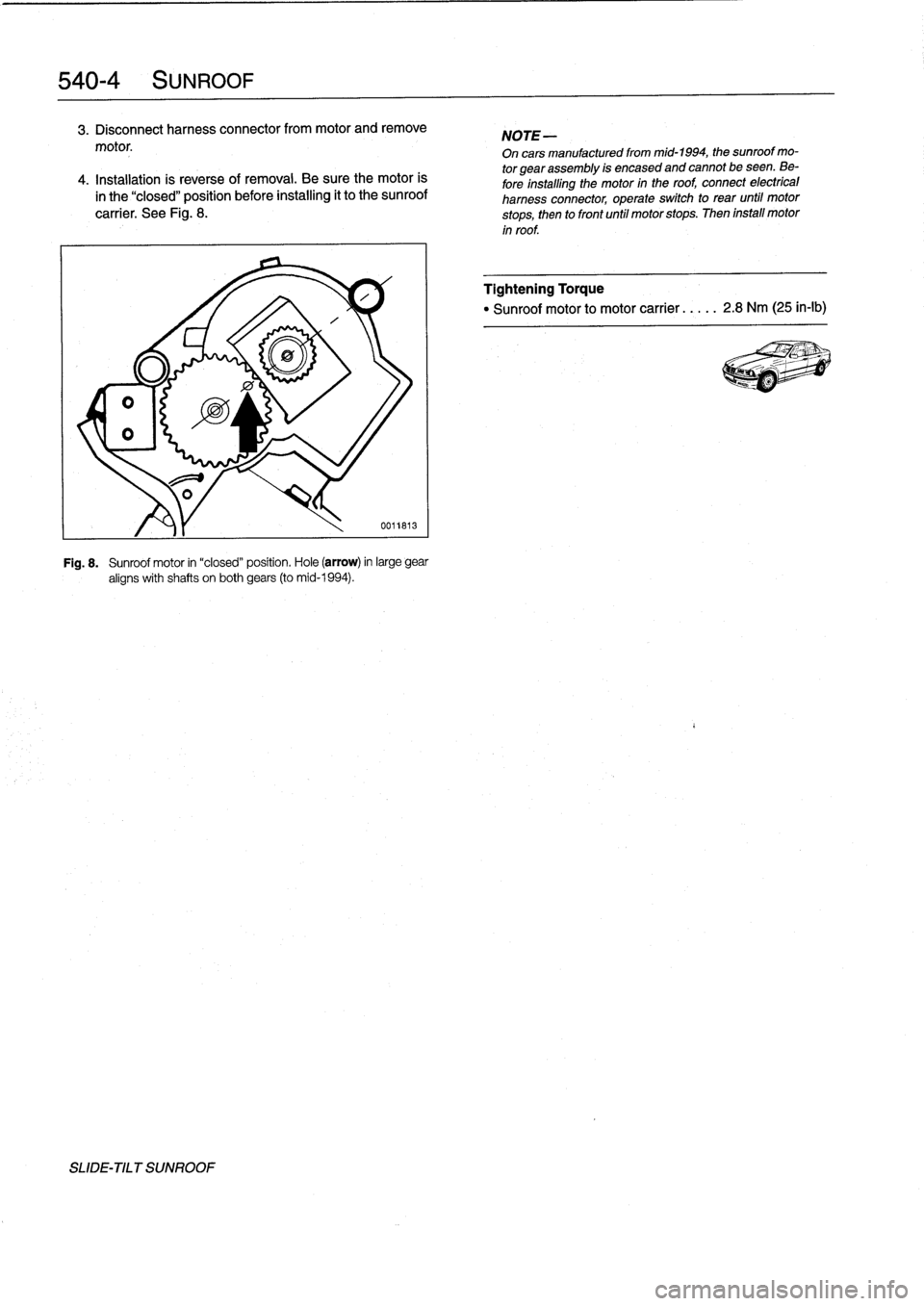
4
.
Installation
is
reverse
of
removal
.
Be
sure
the
motor
is
in
the
"closed"
position
before
installing
it
to
the
sunroof
carrier
.
See
Fig
.
8
.
SLIDE-TILT
SUNROOF
0011813
Fig
.
8
.
Sunroof
motor
in
"closed"
position
.
Hole
(arrow)
in
large
gear
aligns
with
shafts
on
both
gears
(to
mid-1994)
.
NOTE-
On
cars
manufacturedfrom
mid-1994,
the
sunroof
mo-
tor
gearassembly
is
encased
and
cannot
be
seen
.
Be-
fore
installing
the
motor
in
the
roof,
connect
electrical
harness
connector,
operate
switch
to
rear
until
motor
stops,
then
to
front
until
motor
stops
.
Then
install
motor
in
roof
.
Tightening
Torque
"
Sunroof
motor
to
motor
carrier
.
.
.
.
.
2
.8
Nm
(25
in-lb)
Page 372 of 759
541-2
CONVERTIBLE
TOP
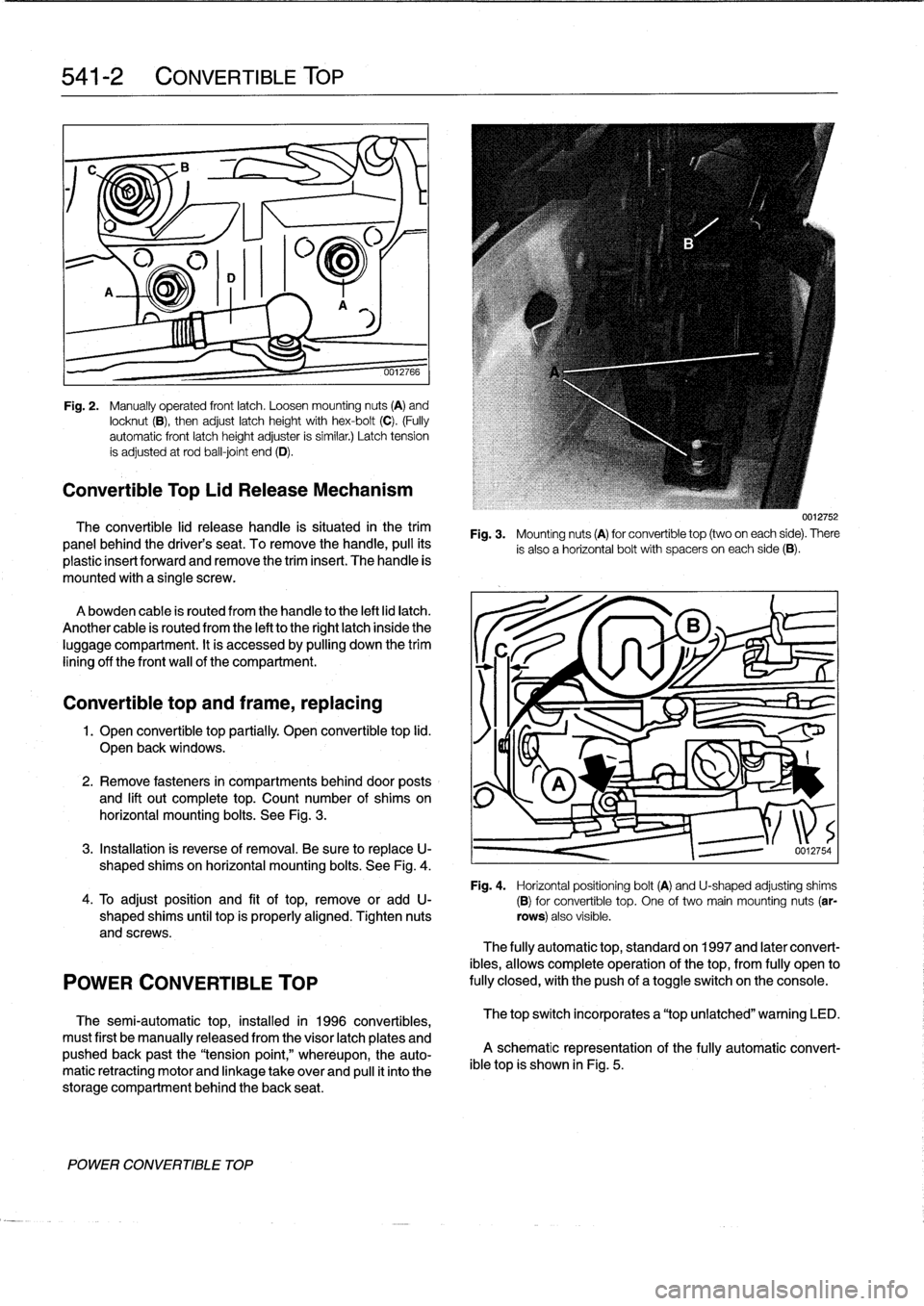
Fig
.
2
.
Manually
operated
frontlatch
.
Loosen
mounting
nuts
(A)
and
locknut
(B),
then
adjust
latch
height
with
hex-bolt
(C)
.
(Fully
automatic
front
latch
height
adjuster
is
similar
.)
Latch
tension
ís
adjusted
at
rod
ball-joint
end
(D)
.
Convertible
Top
Lid
Release
Mechanism
The
convertible
lid
release
handle
is
situated
in
the
trim
panel
behind
the
driver's
seat
.
To
remove
thehandle,
pull
its
plastic
insert
forward
and
remove
the
triminsert
.
The
handle
is
mounted
with
a
single
screw
.
Abowden
cable
is
routed
from
the
handle
to
the
left
lid
latch
.
Another
cable
is
routed
from
the
left
tothe
right
latch
inside
the
luggage
compartment
.
It
is
accessed
by
pulling
down
the
trim
lining
off
the
front
wall
of
the
compartment
.
Convertible
top
and
frame,
replacing
1
.
Open
convertible
top
partially
.
Open
convertible
top
lid
.
J
I~I~KX
Open
back
windows
.
_
v
2
.
Remove
fasteners
in
compartments
behind
door
posts
and
lift
out
complete
top
.
Count
number
of
shims
on
horizontal
mounting
bolts
.
See
Fig
.
3
.
3
.
Installation
is
reverse
of
removal
.
Be
sure
to
replaceU-
shaped
shims
on
horizontal
mounting
bolts
.
See
Fig
.
4
.
Fig
.
4
.
Horizontal
positioning
bolt(A)
and
U-shaped
adjusting
shims4
.
To
adjust
position
and
fit
oftop,
remove
or
add
U-
(B)for
convertible
top
.
One
of
two
main
mounting
nuts
(ar
shaped
shims
until
top
is
properly
aligned
.
Tighten
nuts
rows)
also
visible
.
and
screws
.
POWER
CONVERTIBLE
TOP
The
semi-automatic
top,
installed
in
1996
convertibles,
must
first
be
manually
released
from
the
visor
latch
plates
and
pushed
back
past
the
"tension
point,"
wheréupon,
the
auto-
matic
retracting
motor
and
linkage
take
over
and
pull
it
into
the
storage
compartment
behind
the
back
seat
.
POWER
CONVERTIBLE
TOP
Fig
.
3
.
Mounting
nuts
(A)
for
convertible
top
(two
oneach
side)
.
There
is
also
a
horizontal
bolt
with
spacers
oneach
side
(B)
.
0012754
The
fully
automatic
top,
standard
on
1997
and
later
convert-
ibles,
allows
complete
operation
of
the
top,
from
fully
open
to
fully
closed,withthe
push
of
atoggleswitch
on
the
console
.
The
top
switch
incorporates
a
"top
unlatched"
warning
LED
.
A
schematic
representation
of
the
fully
automatic
convert-
ible
top
is
shown
in
Fig
.
5
.
Page 374 of 759
541-
4
CONVERTIBLE
TOP
Folding
roof
Frontlatches
Convertible
topframe
i
Lower
mounting
pata
Horizontal
positioning
~~-
bolt
Manual
front
8
e
latch
1
handle
~
O
Visor
latchplata
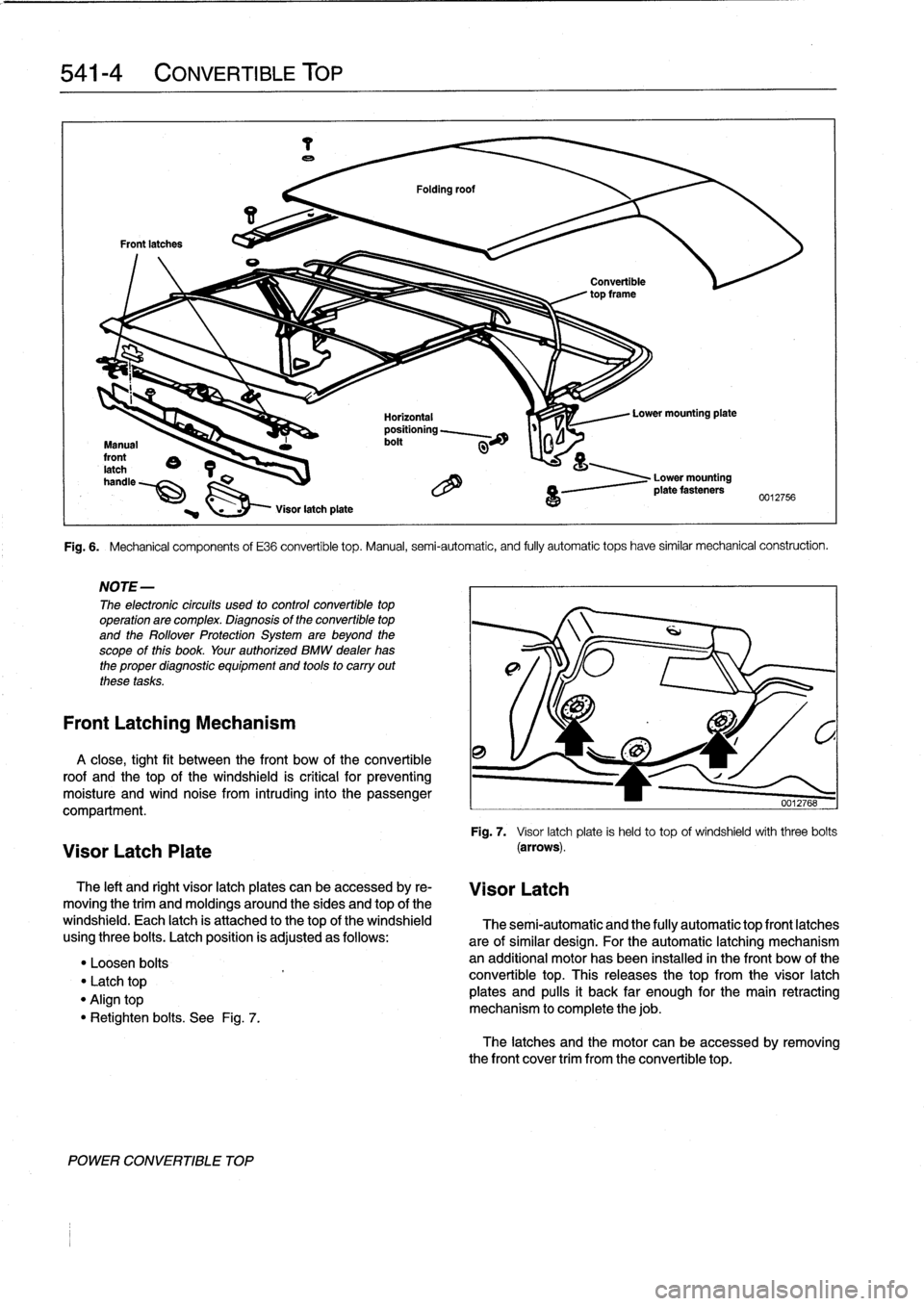
Fig
.
6
.
Mechanical
components
of
E36
convertible
top
.
Manual,
semi-automatic,
and
fully
automatic
tops
have
similar
mechanical
construction
.
NOTE-
The
electronic
circuits
used
to
controlconvertible
top
operation
arecomplex
.
Diagnosis
of
the
convertible
top
and
the
Rollover
Protection
System
are
beyond
the
scope
of
this
book
.
Your
authorized
BMW
dealer
has
the
proper
diagnostic
equipment
and
tools
to
carry
out
these
tasks
.
Front
Latching
Mechanism
A
close,
tight
fit
between
the
front
bow
of
the
convertible
roof
and
the
top
of
the
windshield
is
critical
for
preventing
moisture
and
wind
noise
from
intruding
into
the
passenger
compartment
.
Visor
Latch
Plate
The
left
and
right
visor
latch
plates
can
be
accessed
by
re-
moving
the
trim
and
moldings
aroundthe
sides
and
top
of
the
windshield
.
Each
latch
is
attached
to
thetop
of
the
windshield
using
three
bolts
.
Latch
position
is
adjusted
as
follows
:
"
Loosen
bolts
Latch
top
"
Align
top
"
Retighten
bolts
.
See
Fig
.
7
.
POWER
CONVERTIBLE
TOP
4
a
0012756
Visor
Latch
0012768
Fig
.
7
.
Visor
latchplate
is
heldto
top
of
windshieldwiththreebolts
(arrows)
.
The
semi-automatic
and
the
fully
automatic
top
front
latches
are
of
similar
design
.
For
the
automatic
latching
mechanism
an
additional
motor
has
been
installed
in
the
front
bow
of
the
convertible
top
.
This
releases
the
top
from
the
visor
latch
plates
and
pulís
it
back
far
enough
for
the
main
retracting
mechanism
to
complete
thejob
.
The
latches
and
the
motor
can
be
accessed
byremovingthe
front
cover
trim
from
the
convertible
top
.
Page 375 of 759
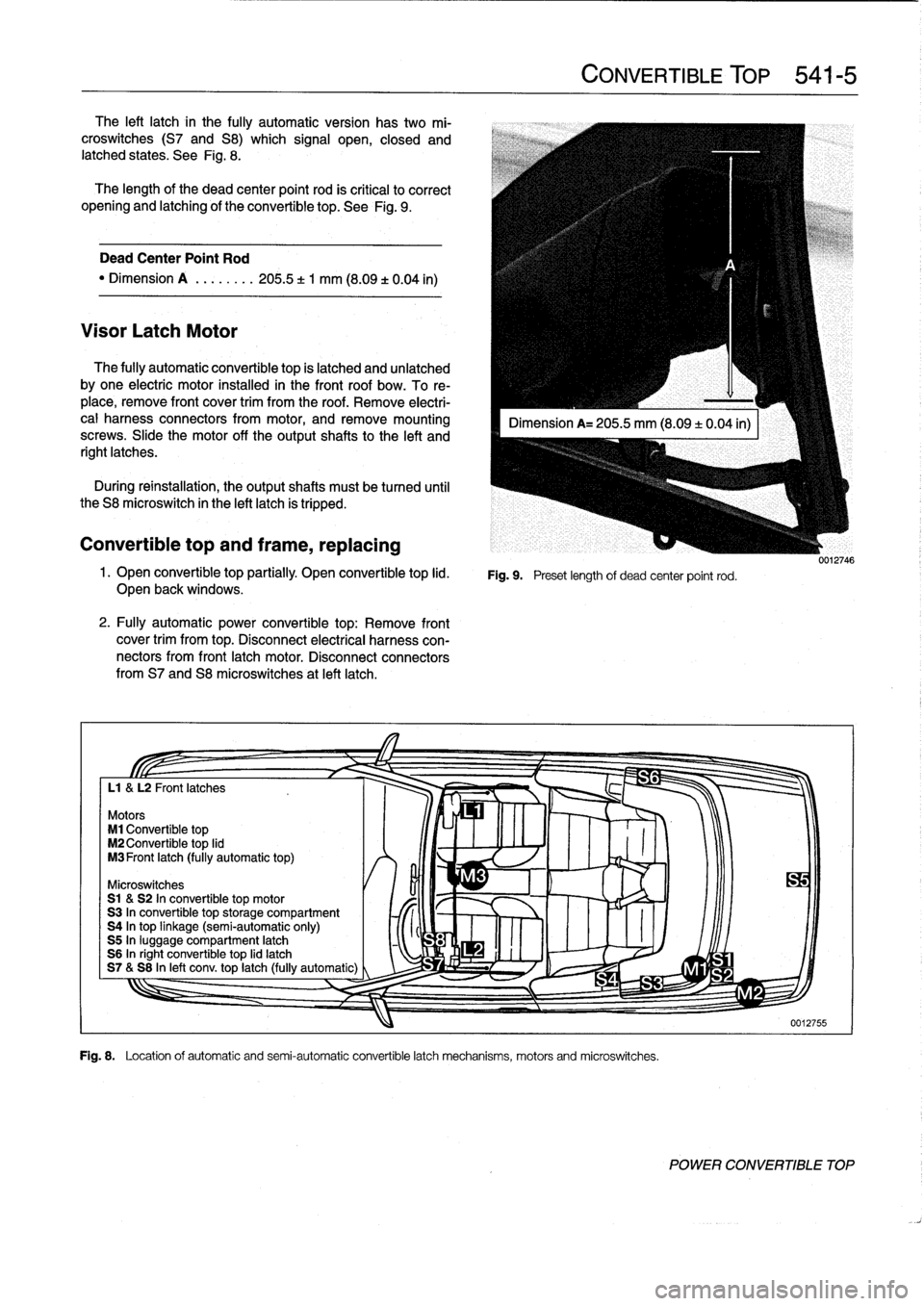
The
left
latch
in
the
fully
automatic
version
hastwo
mi-
croswitches
(S7
and
S8)which
signal
open,
closed
and
latched
states
.
See
Fig
.
8
.
The
length
of
the
dead
center
point
rod
is
critica¡
lo
correct
opening
and
latching
of
the
convertible
top
.
See
Fig
.
9
.
Dead
Center
Point
Rod
"
Dimension
A
........
205
.5
f
1
mm
(8
.09
t0
.04
in)
Visor
Latch
Motor
The
fully
automatic
convertible
top
is
latched
and
unlatched
by
one
electric
motor
installed
in
the
front
roof
bow
.
To
re-
place,
remove
front
cover
trim
from
the
roof
.
Remove
electri-
cal
harness
connectors
from
motor,
andremove
mounting
screws
.
Slide
the
motor
off
the
output
shafts
to
the
left
and
right
latches
.
During
reinstallation,
theoutput
shafts
must
be
tumed
until
the
S8
microswitch
in
the
left
latch
is
tripped
.
Convertible
top
and
frame,
replacing
1
.
Open
convertible
top
partially
.
Open
convertible
top
lid
.
Fig
.
9
.
Preset
lengthof
dead
centerpoint
rod
.
Open
back
windows
.
2
.
Fully
automatic
power
convertible
top
:
Remove
front
cover
trim
from
top
.
Disconnect
electrical
harness
con-
nectors
from
frontlatch
motor
.
Disconnect
connectors
from
S7
and
S8
microswitches
at
left
latch
.
Motors
M1
Convertible
top
M2
Convertible
top
lid
M3Front
latch
(fully
automatic
top)
Microswitches
S1
&S2
In
convertible
top
motor
S3
In
convertible
top
storage
compartment
S4
In
top
linkage
(semi-automatic
only)
S5
In
luggage
compartment
latch
S6
In
right
convertible
top
lid
latch
S7&S8
In
left
conv
.
top
latch
(fully
automatic)
Fig
.
8
.
Locationof
automatic
and
semi-automatic
convertible
latch
mechanisms,
motors
and
microswitches
.
CONVERTIBLE
TOP
541-5
POWER
CONVERTIBLE
TOP
Page 376 of 759
541-
6
CONVERTIBLE
TOP
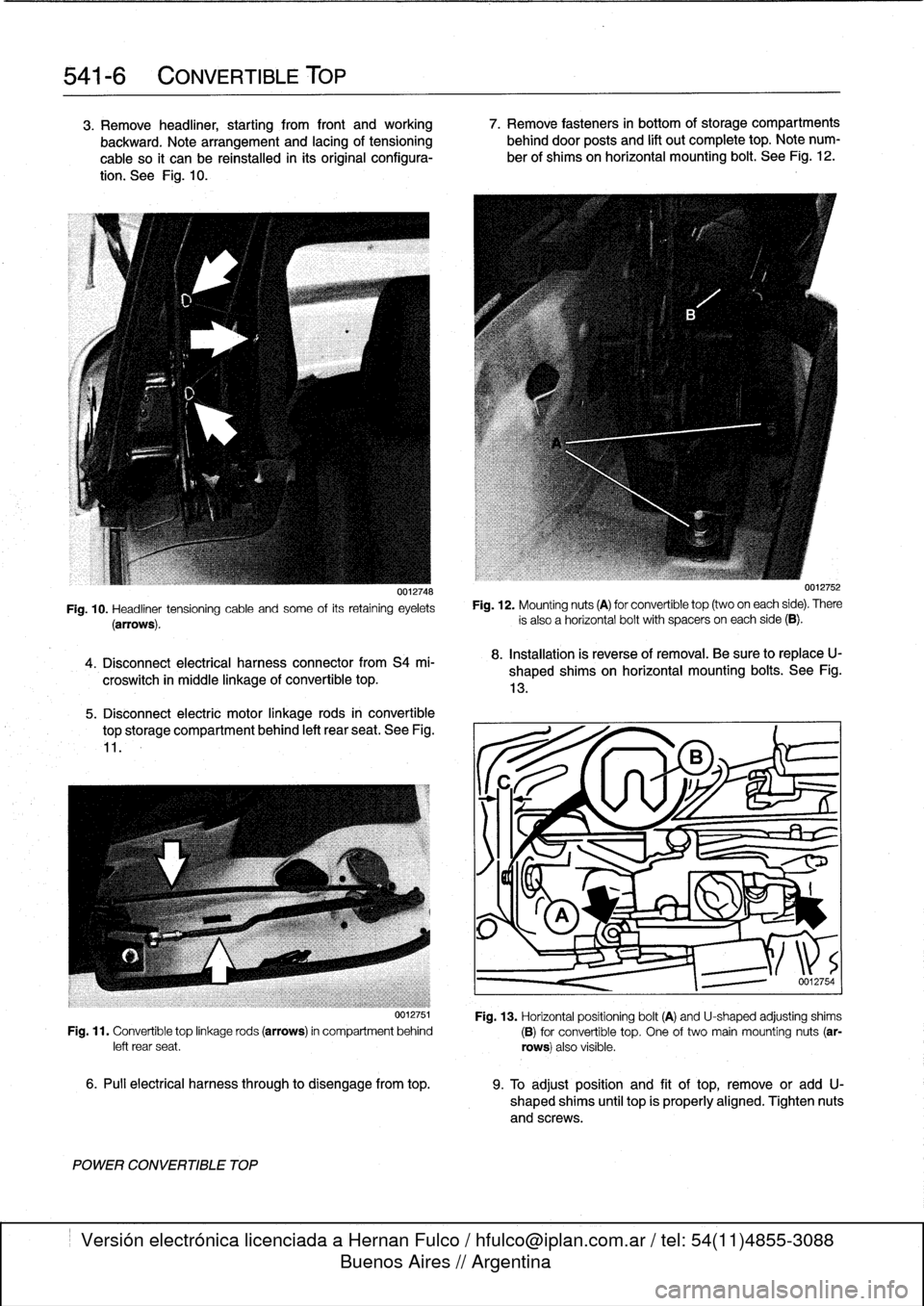
3
.
Remove
headliner,
starting
from
front
and
working
7
.
Remove
fasteners
in
bottom
of
storage
compartments
backward
.
Note
arrangement
and
lacing
of
tensioning
behind
door
posts
and
lift
out
complete
top
.
Note
num
cable
so
it
can
be
reinstalled
in
its
original
configura-
ber
of
shims
on
horizontal
mounting
bolt
.
See
Fig
.
12
.
tion
.
See
Fig
.
10
.
0012748
Fig
.
10
.
Headliner
tensioning
cable
and
some
of
its
retaining
eyelets
(arrows)
.
4
.
Disconnect
electrical
harness
connector
from
S4
mi-
croswitch
in
middle
linkage
of
convertible
top
.
5
.
Disconnect
electric
motor
linkage
rods
in
convertible
top
storage
compartment
behind
left
rearseat
.
See
Fig
.
Vizib1
Fig
.
11
.
Convertible
top
linkage
rods(arrows)
in
compartment
behind
left
rear
seat
.
POWER
CONVERTIBLE
TOP
8
.
Installation
is
reverse
of
removal
.
Be
sure
to
replace
U-
shaped
shims
on
horizontal
mounting
bolts
.
See
Fig
.
13
.
0012754
Fig
.
13
.
Horizontalpositioning
bolt
(A)
and
U-shaped
adjusting
shims
(B)
for
convertible
top
.
One
of
two
main
mounting
nuts
(ar-
rows)
also
visible
.
6
.
Pull
electrical
harness
through
to
disengage
from
top
.
9
.
To
adjust
position
and
fit
oftop,
Rmove
or
add
U-
shaped
shims
until
top
is
properly
aligned
.
Tighten
nuts
and
screws
.
Page 377 of 759
Convertible
top
drive
motor,
replacing
5
.
Working
in
convertible
top
storage
compartment
be-
hind
driver's
seat,
remove
convertible
top
linkage
rods
1
.
Open
convertible
top
partially,
stopping
when
convert-
from
top
of
motor
.
Refer
to
Fig
.
11
.
ible
top
lid
is
fully
upen
.
Remove
lid
.
2
.
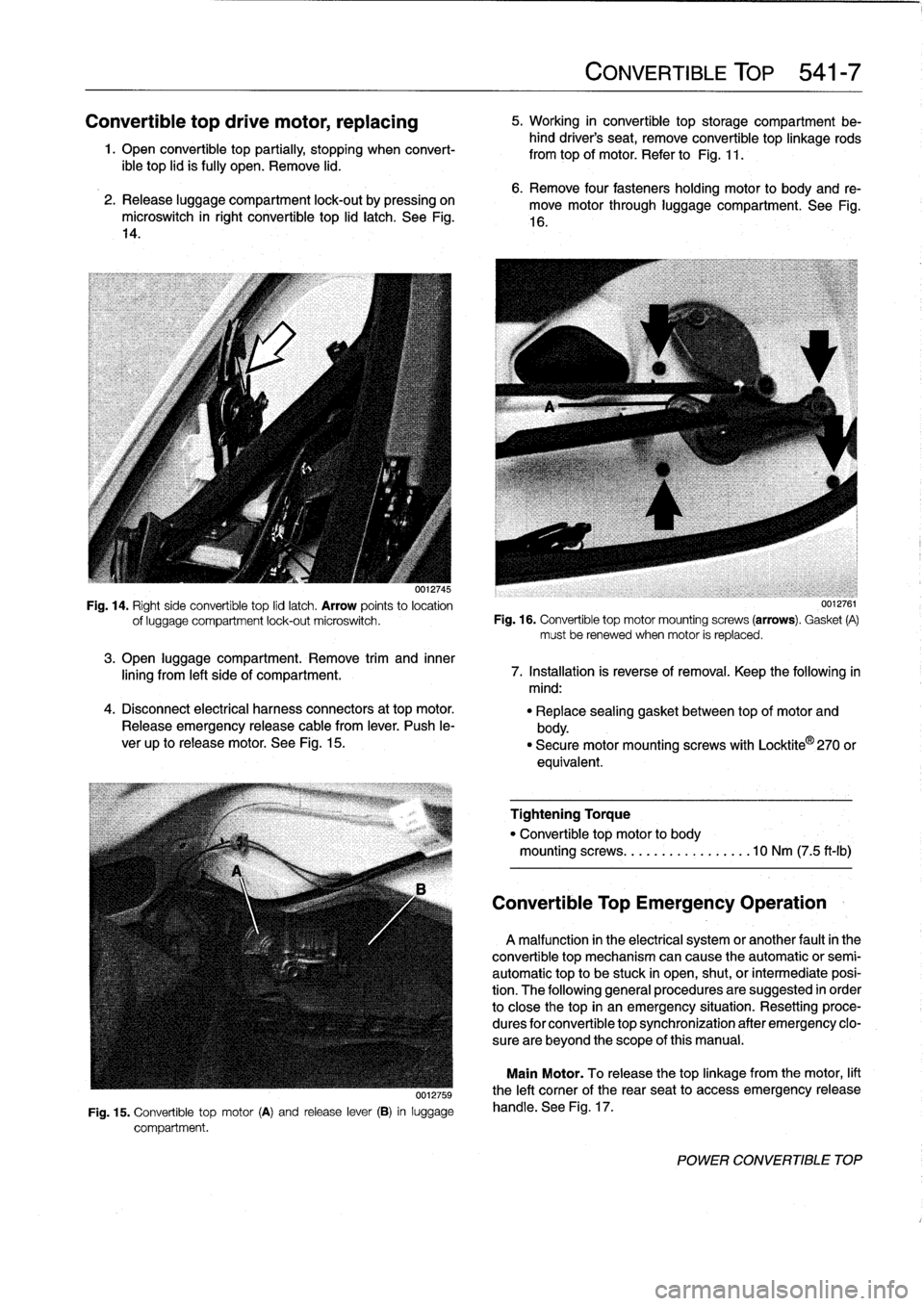
Release
luggage
compartment
lock-out
by
pressing
on
microswitch
in
right
convertible
top
lid
latch
.
See
Fig
.
14
.
0012745
Fig
.
14
.
Rightside
convertible
top
lid
latch
.
Arrow
points
to
location
of
luggage
compartment
lock-out
microswitch
.
3
.
Open
luggage
compartment
.
Remove
trim
and
inner
lining
from
left
side
of
compartment
.
4
.
Disconnect
electrical
harness
connectors
at
top
motor
.
Release
emergency
release
cable
from
lever
.
Push
le-
ver
up
to
release
motor
.
See
Fig
.
15
.
uu12759
Fig
.
15
.
Convertible
top
motor
(A)
and
release
lever
(B)
in
luggage
compartment
.
CONVERTIBLE
TOP
541-
7
6
.
Remove
four
fastenersholding
motor
to
body
and
re-
move
motor
through
luggage
compartment
.
See
Fig
.
16
.
0012761
Fig
.
16
.
Convertible
top
motor
mountingscrews
(arrows)
.
Gasket
(A)
mustbe
renewed
when
motor
is
replaced
.
7
.
Installation
is
reverse
of
removal
.
Keep
the
following
in
mind
:
"
Replace
sealing
gasket
between
top
of
motor
and
body
.
"
Securemotormountingscrews
with
Locktite
®
270
or
equivalent
.
Tightening
Torque
"
Convertible
top
motor
to
body
mountingscrews
...
...
.
.
.........
10
Nm
(7
.5
ft-Ib)
Convertible
Top
Emergency
Operation
A
malfunction
in
the
electrical
system
or
another
fault
in
the
convertible
top
mechanism
can
cause
the
automatic
or
semi-
automatic
top
to
be
stuck
in
open,
shut,
or
intermediate
posi-
tion
.
The
following
general
procedures
are
suggested
in
order
to
close
the
top
in
an
emergency
situation
.
Resetting
proce-
dures
for
convertible
top
synchronization
after
emergency
clo-
sure
are
beyond
the
scope
of
this
manual
.
Main
Motor
.
To
release
thetop
linkage
from
the
motor,
lift
the
left
comer
of
the
rearseat
to
access
emergency
release
handle
.
See
Fig
.
17
.
POWER
CONVERTIBLE
TOP
Page 379 of 759
Convertible
Top
Lid
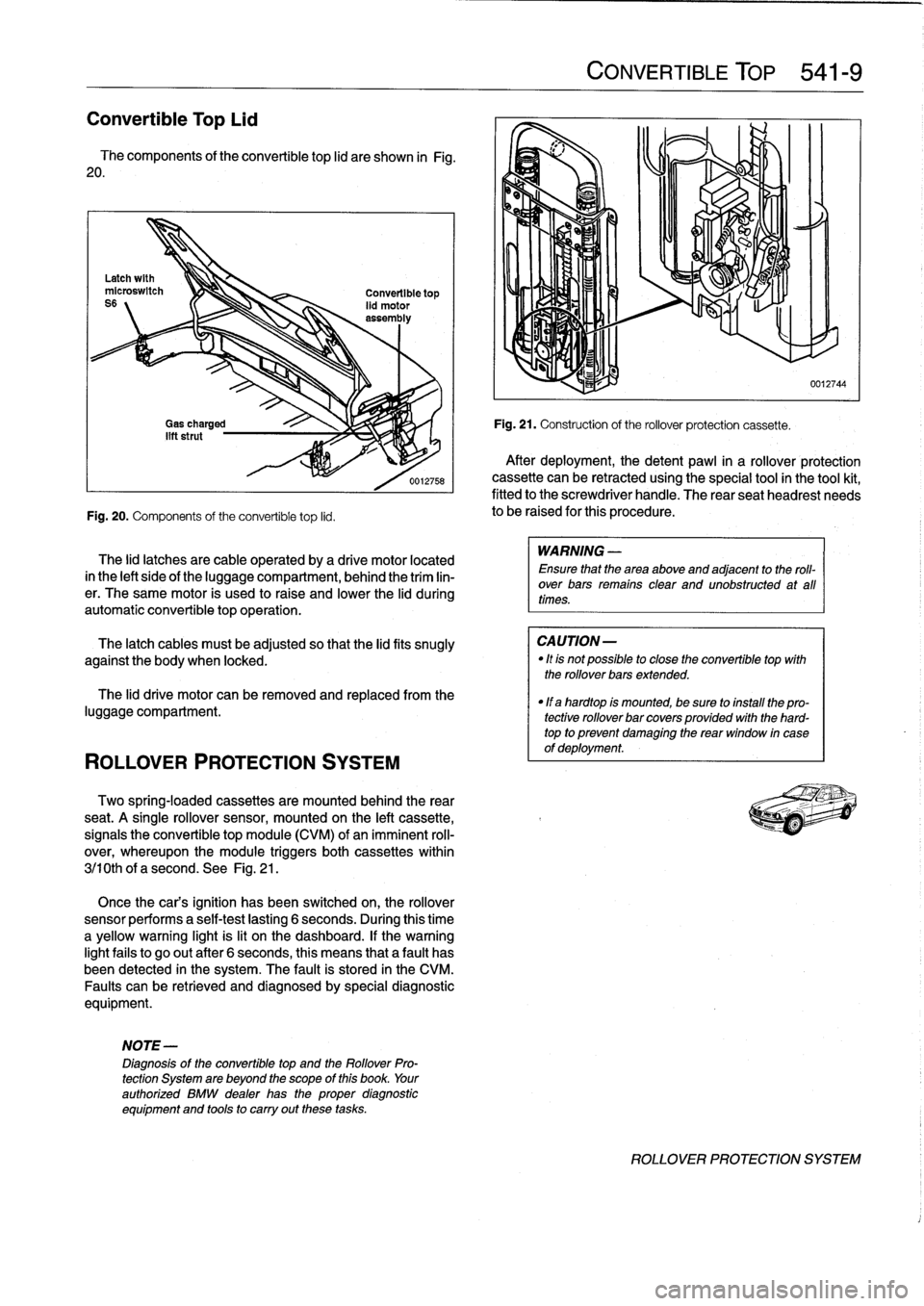
The
components
of
the
convertible
top
lid
are
shown
in
Fig
.
20
.
Fig
.
20
.
Components
of
the
convertible
top
lid
.
ROLLOVER
PROTECTION
SYSTEM
The
lid
latches
are
cable
operated
by
a
drive
motor
located
in
the
left
sideof
the
luggagecompartment,
behind
the
trim
lin-
er
.
The
same
motor
is
used
to
raise
and
lower
the
lid
during
automatic
convertible
topoperation
.
The
latch
cables
must
be
adjusted
so
that
the
lidfits
snugly
against
the
body
when
locked
.
The
lid
drive
motor
can
be
removed
and
replaced
from
the
luggage
compartment
.
Two
spring-locaed
cassettes
are
mounted
behind
the
rear
seat
.
A
single
rollover
sensor,
mounted
on
the
left
cassette,
signals
the
convertible
top
module
(CVM)
of
animminent
roll-
over,
whereupon
the
module
triggers
both
cassettes
within
3j10th
of
a
second
.
See
Fig
.
21
.
Once
the
cars
ignition
has
been
switched
on,
the
rollover
sensor
performs
a
self-test
lasting
6
seconds
.
During
this
time
a
yellow
warning
light
is
lit
on
the
dashboard
.
If
thewarning
lightfails
to
go
out
after
6
seconds,
this
means
that
a
fault
has
been
detected
in
the
system
.
The
fault
is
stored
in
the
CM
Faults
canbe
retrieved
and
diagnosedby
special
diagnostic
equipment
.
NOTE-
Diagnosis
of
the
convertible
top
and
the
Rollover
Pro-
tection
System
are
beyond
the
scope
of
this
book
.
Your
authorized
BMW
dealer
has
the
proper
diagnostic
equipment
and
tools
to
carry
out
these
tasks
.
CONVERTIBLE
TOP
541-
9
Fig
.
21
.
Construction
of
the
rollover
protection
cassette
.
After
deployment,
thedetent
pawl
in
a
rollover
protection
cassette
can
be
retracted
using
the
special
tool
in
the
tool
kit,
fitted
to
the
screwdriver
handle
.
The
rear
seatheadrest
needs
to
be
raised
for
this
procedure
.
WARNING
-
Ensure
that
the
area
above
and
adjacent
to
the
roll-
over
bars
remains
clear
and
unobstructed
at
all
times
.
CAUTION-
"
Itis
not
possible
to
close
the
convertible
top
with
the
rollover
bars
extended
.
"
If
a
hardtop
is
mounted,
be
sure
to
install
the
pro-
tective
rollover
bar
covers
provided
with
the
hard-
top
to
prevent
damaglng
the
rear
window
in
case
of
deployment
.
0012744
ROLLOVER
PROTECTION
SYSTEM
Page 383 of 759
NOTE
-
Sometimes
the
color
of
en
installed
wire
may
be
differ-
ent
than
the
one
on
the
wiring
diagram
.
Don't
be
con-
cerned
.
Just
be
sure
lo
confirm
that
the
wire
connects
lo
the
proper
terminals
.
Wire
color
codes
"
BLU
.........
.
..
..
...
.
.................
Blue
"
BRN
....:....
.
..
..
...
..
...............
Brown
"
YEL
.........
.
..
..
...................
.Yellow
"
GRN
.........
.
..
..
...
.
................
creen
"
G
RY
.......
.
.
.
..
..
.....................
G
ray
"
ORG
.........
.
..
..
...
.
..............
.Orange
"
RED
......
...
.
.
..
.....................
.Red
"
BLK
.........
.
..
..
...
.
................
Black
"
VIO
..........
.
..
...
..
..
.......
.
.......
Violet
"
WHT
.........
.
.
....
.
...
:..............
White
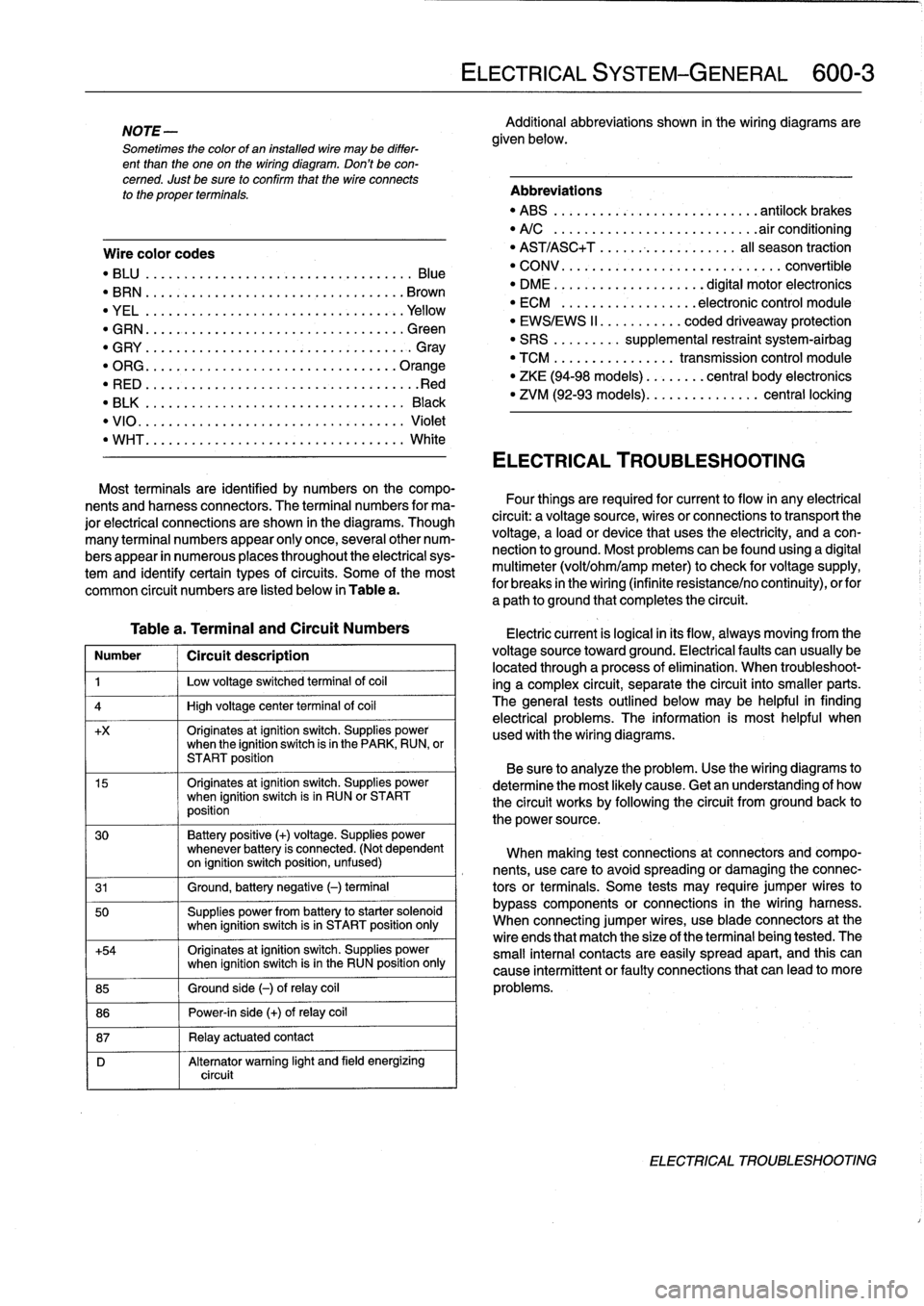
Table
a
.
Terminal
and
Circuit
Numbers
Number
1
Circuít
description
1
j
Low
voltage
switched
terminal
of
coi¡
4
1
High
voltage
center
termina¡
of
coi¡
+x
Originates
atignition
switch
.
Supplies
powerwhen
the
ignition
switch
is
in
the
PARK,
RUN,
or
START
position
15
Originates
atignition
switch
.
Supplies
powerwhen
ignition
switch
is
in
RUN
or
START
position
30
Battery
positive
(+)
voltage
.
Supplies
power
whenever
battery
is
connected
.
(Not
dependent
on
ignition
switch
position,
unfused)
31
1
Ground,
battery
negative
(-)
terminal
50
Supplies
power
from
battery
to
starter
solenoid
when
ignition
switch
isin
START
position
only
+54
Originates
atignition
switch
.
Supplies
power
when
ignition
switch
isin
the
RUN
position
only
85
1
Ground
side
(-)
ofrelay
coil
86
1
Power-in
side
(+)
ofrelay
coil
87
1
Relay
actuatedcontact
D
Alternator
warning
light
and
field
energizing
circuit
ELECTRICAL
SYSTEM-GENERAL
600-
3
Additional
abbreviations
shown
in
the
wiring
diagrams
are
given
below
.
Abbreviations
"
ABS
........
.
...
.
...
.
..........
antilock
brakes
"
A/C
........
.
...
..
..
.
.........
.airconditioning
"
AST/ASC+T
.......
...
.
.
.......
al¡
season
traction
"
CONV
.......
.
.
...
.................
convertible
"
DME
........
.
.
...
.......
digital
motor
electronics
"
ECM
.......
.
...
..
..
.
..
electronic
control
module
"
EWS/EWS
II
......
...
.
.
coded
driveaway
protection
"
SRS
........
.
supplemental
restraint
system-airbag
"
TCM
........
.
..
....
.
transmission
control
module
"
ZKE
(94-98
models)
..
..
.
...
central
body
electronics
"
ZVM
(92-93
models)
...
.
.
..
.
.......
central
locking
ELECTRICAL
TROUBLESHOOTING
Most
terminals
are
identified
by
numbers
on
the
compo-
nents
and
harness
connectors
.
The
terminal
numbers
for
ma-
Four
things
are
required
for
current
toflow
in
any
electrical
jor
electrical
connections
are
shown
in
the
diagrams
.
Though
circuit
:
a
voltagesource,
wires
or
connections
to
transport
the
many
terminal
numbers
appear
only
once,
severa¡other
num-
voltage,
a
load
or
device
that
uses
the
electricity,
and
a
con-
bers
appear
in
numerous
places
throughout
the
electrical
sys-
nection
to
ground
.
Most
problemscanbefound
using
a
digital
tem
and
identify
certain
types
ofcircuits
.
Some
of
the
most
multimeter
(volt/ohm/amp
meter)to
check
for
voltage
supply,
common
circuit
numbers
are
listed
below
in
Table
a
.
for
breaks
in
the
wiring
(infinite
resistance/no
continuity),
orfor
a
path
to
ground
that
completesthe
circuit
.
Electric
current
is
logical
in
its
flow,
always
moving
from
the
voltage
sourcetoward
ground
.
Electricalfaults
can
usually
be
located
through
a
process
of
elimination
.
When
troubleshoot-
ing
a
complex
circuit,
separate
the
circuit
into
smaller
parts
.
The
general
testsoutlined
below
may
be
helpful
in
finding
electrical
problems
.
The
information
is
most
helpful
when
used
with
the
wiring
diagrams
.
Be
sure
to
analyze
the
problem
.
Use
the
wiring
diagrams
to
determine
the
most
likely
cause
.
Getan
understanding
of
how
the
circuit
works
by
following
the
circuit
from
groundback
to
the
power
source
.
When
making
test
connections
at
connectors
andcompo-
nents,
use
care
to
avoidspreading
or
damaging
the
connec-
tors
or
terminals
.
Some
tests
may
require
jumper
wires
to
bypass
components
or
connections
in
the
wiring
harness
.
When
connecting
jumper
wires,
use
bladeconnectors
at
the
wire
ends
that
match
the
size
of
the
terminal
being
tested
.
The
small
interna¡
contacts
are
easily
spread
apart,
and
this
can
cause
intermittent
or
faultyconnections
that
can
leadto
more
problems
.
ELECTRICAL
TROUBLESHOOTING
Page 387 of 759
610
Electrical
Component
Locations
GENERAL
...........
.
.
.
.
.
.
.
.
.
........
610-1
FOSE
POSITION
TABLES
..
.
.
.
.
.
.....
.
610-19
FUSE
AND
RELAY
POSITIONS
.
...
.
.
.
.
.
610-1
Fuse
Positions
.
.
.
................
.
.
.
.
.
610-1
Relay
Positions
.
.
.
.....
.
.
.
........
.
.
.
.
.
610-2
Auxiliary
RelayPanel
.....
.
...
.
........
.
610-2
SplicePanel,
Left
.
.
.
...
.
.
.
...
.
........
.
610-2
SplicePanel,
Right
.
.
.
.
.
.
.
.
...
.
.........
610-3
COMPONENT
LOCATIONS
.
.
.
.
.......
.
.610-3
Component
Location
Table
.
.
.
.
.
.
.........
610-9
GENERAL
FUSE
AND
RELAY
POSITIONS
This
repair
group
covers
f
use,
relay,
and
control
module
lo-
The
front
power
distribution
box,
an
auxiliary
relay
panel,cation
information
.
Electrical
equipment
and
accessories
in-
and
two
auxiliary
splice
panels
contain
most
of
the
fuses
and
stalled
varies
depending
on
model
and
model
year
.
Always
relays
in
E36
vehicles
.
Refer
to
the
component
location
later
confirm
that
the
proper
electrical
component
has
been
identi-
in
this
section,
as
well
as
the
tables
at
the
end
of
this
repair
fied
by
using
the
electrical
wiring
diagrams
.
group
for
electrical
component
location
.
WARNING
-
On
cars
equipped
with
airbags,
special
precautionsapply
to
any
electrical
system
testing
orrepair
.
Air-
bag
units
areexplosive
devices
and
mustbe
han-
dled
with
extremecare
.
Before
starting
any
work
onan
airbag
equipped
car,
refer
to
the
wamings
and
cautions
in
721
Airbag
System
(SRS)
.
CAUTION
-
"
Prior
to
disconnectiog
the
battery,
read
the
bat-
tery
disconnection
cautions
given
at
the
front
of
this
manual
on
page
viii
.
"
Relay
and
fuse
positions
are
subject
to
changeand
may
varyfrom
car
to
car
.
If
questions
arise,
an
authorized
BMW
dealer
is
the
best
source
for
the
most
accurate
and
up-to-date
information
.
"
A
good
way
to
verify
a
relay
position
isto
com-
pare
the
wiring
colors
at
the
relay
socket
to
thecolors
indicated
on
the
wiring
diagrams
located
at
the
rear
of
this
manual
.
"
Always
switchthe
ignition
off
and
disconnect
the
negative
(-)
battery
cable
before
removing
any
electrical
components
.
"
Connect
and
disconnect
ignition
system
wires,
multiple
connectors,
and
ignition
test
equipment
leads
only
while
the
ignition
is
switched
off
.
"
Only
usea
digital
multimeter
for
electrical
tests
.
ELECTRICAL
COMPONENT
LOCATIONS
610-1
TABLES
a
.
E36Component
Locations
...........
.
.
..
...
610-10b
.
1992
E36
Fuse
Positions
..........
..
.
.
.....
610-20c
.
1993
E36
Fuse
Positions
..........
..
..
.
....
610-22d
.
1994
E36
Fuse
Positions
.........
...
.......
610-24e
.
1995
E36
Fuse
Positions
.........
...
.......
610-26
f
.
1996
E36
Fuse
Positions
.........
...
.......
610-28g
.
1997-1998
E36
Fuse
Positions
..
.
..
...
.......
610-30
Fuse
Positions
CAUTION
-
"
Replace
fuses
with
those
of
the
same
rating
.
In-
stalling
a
fuse
with
higher
rating
can
lead
to
cir-
cuit
failure
and
may
also
start
a
fire
.
"
Relay/fuse
positions
vary
by
model
and
equip-
ment
.
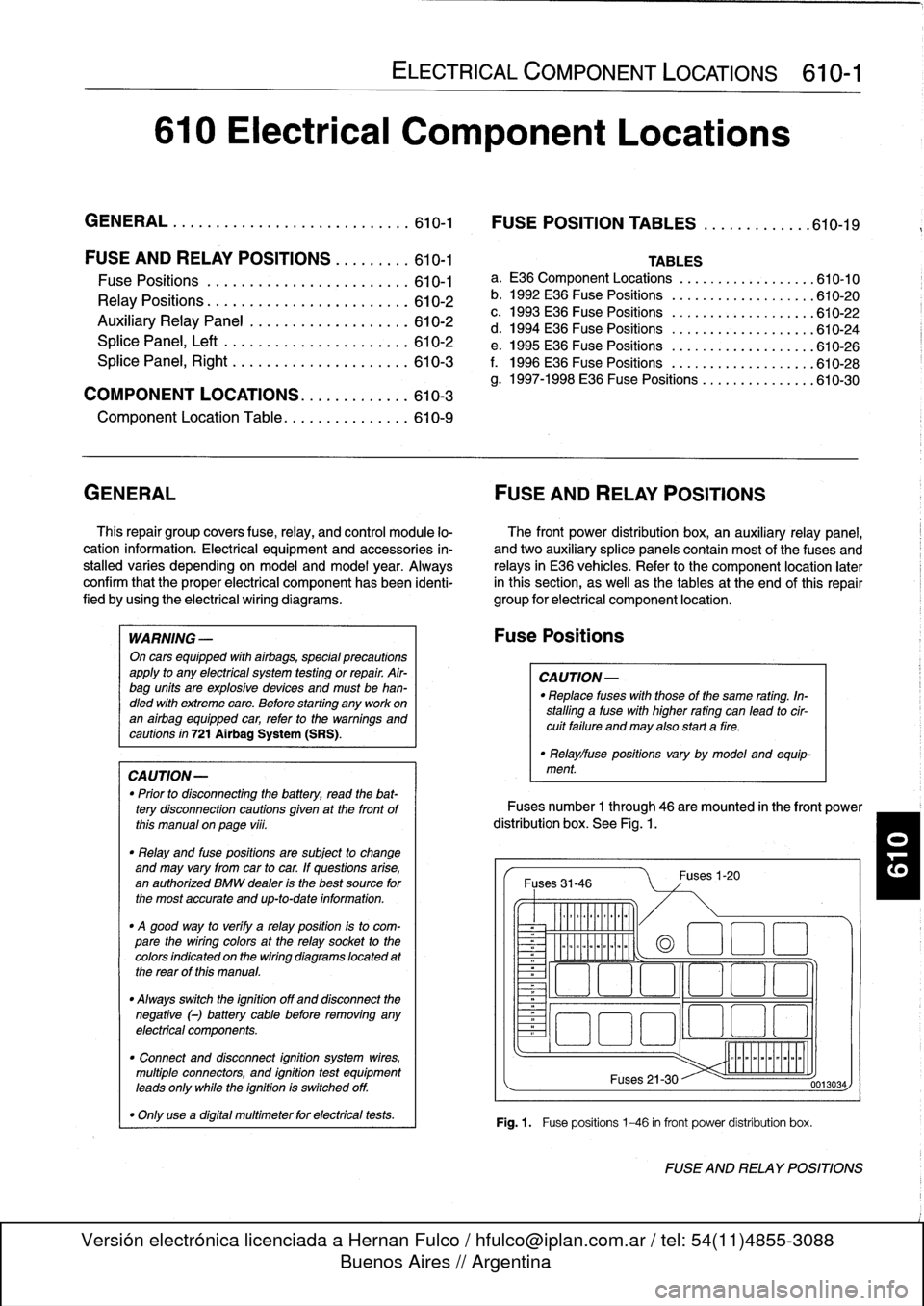
Fuses
number
1
through
46
are
mounted
in
the
front
power
distribution
box
.
See
Fig
.
1.
Fuses
31-46
~
Illlllllllll
°
-
Ilmmlmomlmoi
Fuses
1-20
(a
1
:1
E
El
~
~O!7
L~~n
4~
i
Fuses
21-30
Fig
.1.
Fuse
positions
1-46
in
front
power
distribution
box
.
0013034
FUSE
AND
RELAY
POSITIONS
Page 388 of 759
610-2
ELECTRICAL
COMPONENT
LOCATIONS
Fuses
number47
and
50are
mounted
on
the
left
side
splice
panel
.
Refer
lo
Fig
.
5
.
Fuse48
is
mounted
on
the
auxiliary
relay
panel
.
Refer
to
Fig
.
3
.
Fuse
49
is
mounted
in
the
right
side
of
the
luggage
compart-
ment
behind
the
trim
cover
.
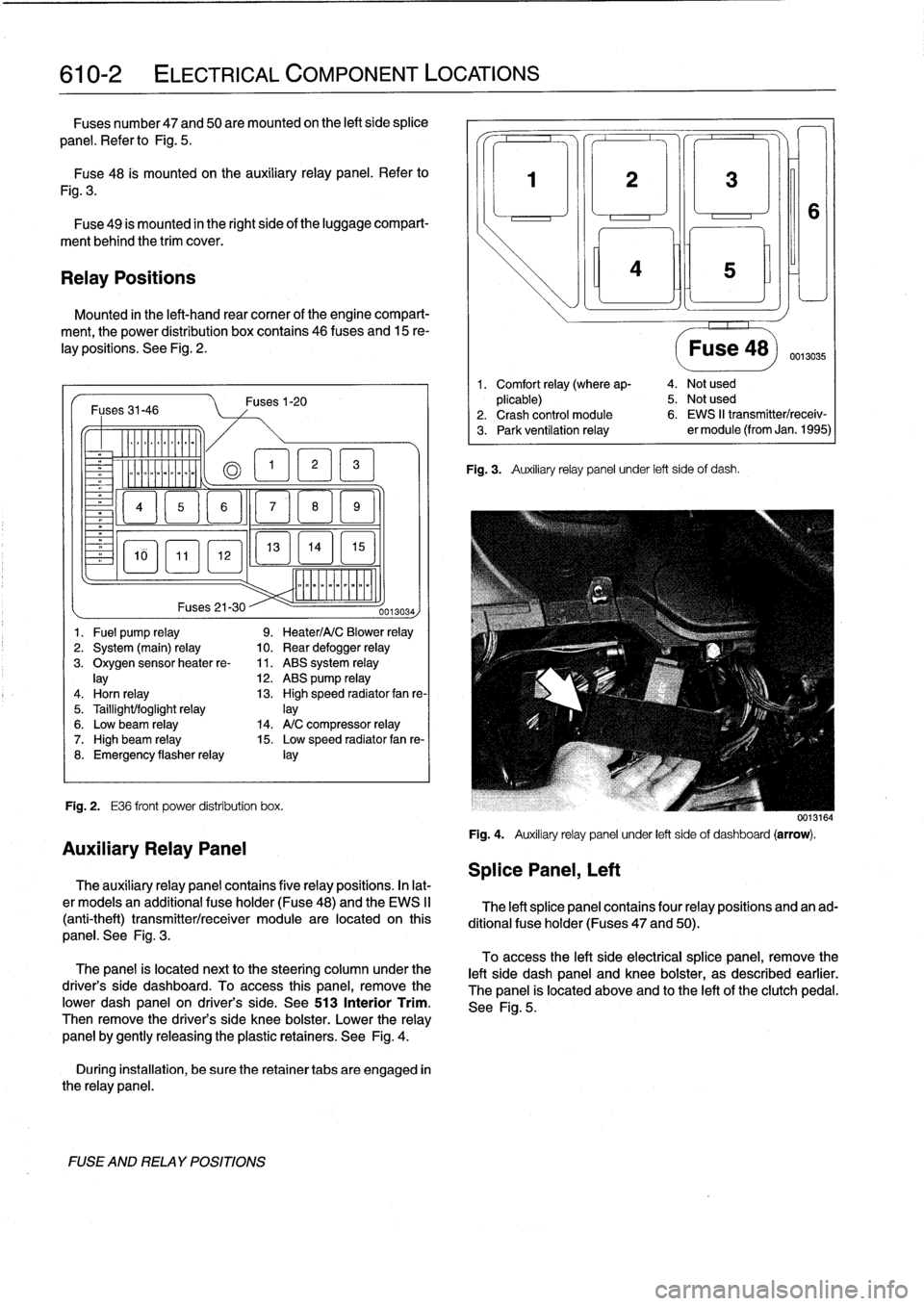
Relay
Positions
Mounted
in
the
left-hand
rear
comer
of
the
engine
compart-
ment,
the
power
distribution
box
contains
46
(uses
and
15
re-
lay
positions
.
See
Fig
.
2
.
Fuses31-46
-
Er
a
&QT
MM
~
Fig
.
2
.
E36
front
power
distribution
box
.
FUSE
AND
RELAY
POSITIONS
Fuses1-20
13
EL1
5
]
mmmmmmmmmm
Fuses
21-30
--
0013034)
1
.
Fuel
pump
relay
9
.
Heater/A/C
Blower
relay
2
.
System
(main)
relay
10
.
Rear
defogger
relay
3
.
Oxygen
sensorheater
re-
11
.
ABS
system
relay
lay
12
.
ABS
pump
relay
4
.
Horn
relay
13
.
High
speed
radiator
fan
re-
5
.
Taillight/foglight
relay
]ay
6
.
Low
beam
relay
14
.
A/C
compressor
relay
7
.
High
beam
relay
15
.
Low
speed
radiator
fan
re-
8
.
Emergency
flasherrelay
¡ay
Auxiliary
Relay
Panel
The
auxiliary
relay
panel
contains
five
relay
positions
.
In
lat-
er
modeis
an
additional
fuse
holder
(Fuse48)
and
the
EWS
II
(anti-theft)
transmitter/receiver
module
are
located
on
this
panel
.
See
Fig
.
3
.
The
panel
is
located
nextto
the
steering
column
under
the
driver's
side
dashboard
.
To
access
this
panel,
remove
the
pwer
dash
panel
on
driver's
side
.
See513
Interior
Trim
.
Then
remove
the
driver's
side
knee
bolster
.
Lower
the
relay
panel
by
gently
releasing
the
plastic
retainers
.
See
Fig
.
4
.
During
installation,
be
sure
the
retainer
tabs
are
engaged
in
the
relay
panel
.
Splice
Panel,
Left
3
¡ni
Fig
.
3
.
Auxiliary
relay
panel
under
left
side
of
dash
.
Fuse
48)
0013035
1
.
Comfort
relay
(where
ap-
4
.
Not
used
plicable)
5
.
Not
used
2
.
Crash
control
module
6
.
EWS
II
transmitter/receiv-
3
.
Park
ventilation
relay
er
module
(from
Jan
.
1995)
0013164
Fig
.
4
.
Auxiliary
relay
panel
under
left
sideof
dashboard
(arrow)
.
The
left
splice
panel
contains
four
relay
positions
and
an
ad-
ditional
fuse
holder
(Fuses
47
and
50)
.
To
access
the
left
side
electrical
splice
panel,
remove
the
left
side
dash
panel
and
knee
bolster,
as
described
earlier
.
The
panel
is
located
above
and
lo
the
left
of
the
clutch
pedal
.
See
Fig
.
5
.