door lock BMW 323i 2000 User Guide
[x] Cancel search | Manufacturer: BMW, Model Year: 2000, Model line: 323i, Model: BMW 323i 2000Pages: 189, PDF Size: 1.81 MB
Page 44 of 189
44n
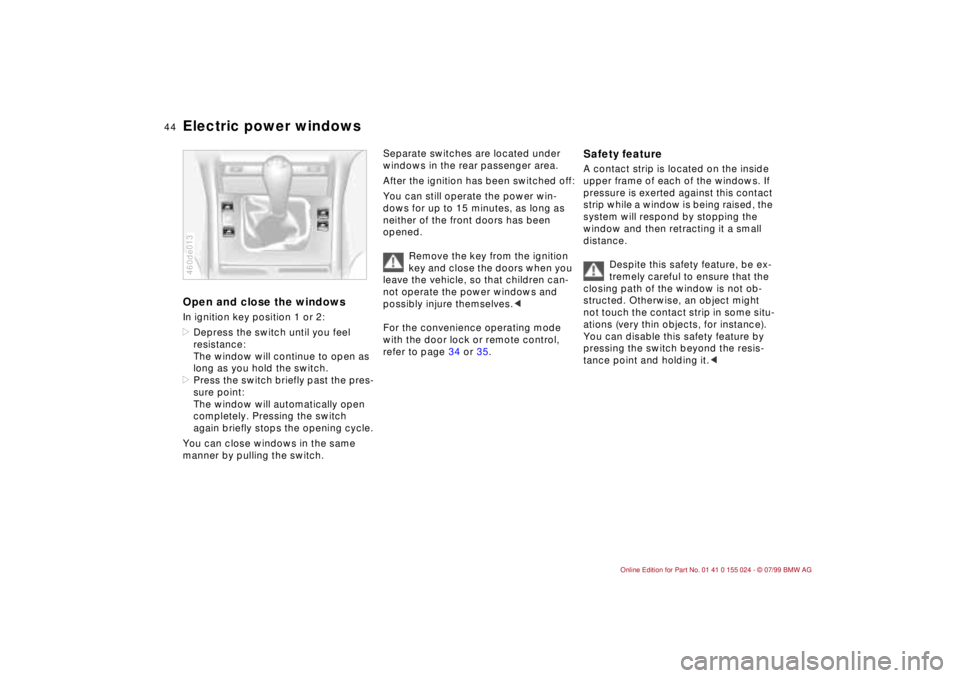
Electric power windowsOpen and close the windowsIn ignition key position 1 or 2:
>Depress the switch until you feel
resistance:
The window will continue to open as
long as you hold the switch.
>Press the switch briefly past the pres-
sure point:
The window will automatically open
completely. Pressing the switch
again briefly stops the opening cycle.
You can close windows in the same
manner by pulling the switch.460de013
Separate switches are located under
windows in the rear passenger area.
After the ignition has been switched off:
You can still operate the power win-
dows for up to 15 minutes, as long as
neither of the front doors has been
opened.
Remove the key from the ignition
key and close the doors when you
leave the vehicle, so that children can-
not operate the power windows and
possibly injure themselves.<
For the convenience operating mode
with the door lock or remote control,
refer to page 34 or 35.
Safety feature A contact strip is located on the inside
upper frame of each of the windows. If
pressure is exerted against this contact
strip while a window is being raised, the
system will respond by stopping the
window and then retracting it a small
distance.
Despite this safety feature, be ex-
tremely careful to ensure that the
closing path of the window is not ob-
structed. Otherwise, an object might
not touch the contact strip in some situ-
ations (very thin objects, for instance).
You can disable this safety feature by
pressing the switch beyond the resis-
tance point and holding it.<
Page 45 of 189
45n
IndexDataTechnologyRepairsCar careControlsOverview
Electric power windows Sliding/Tilt sunroof
*
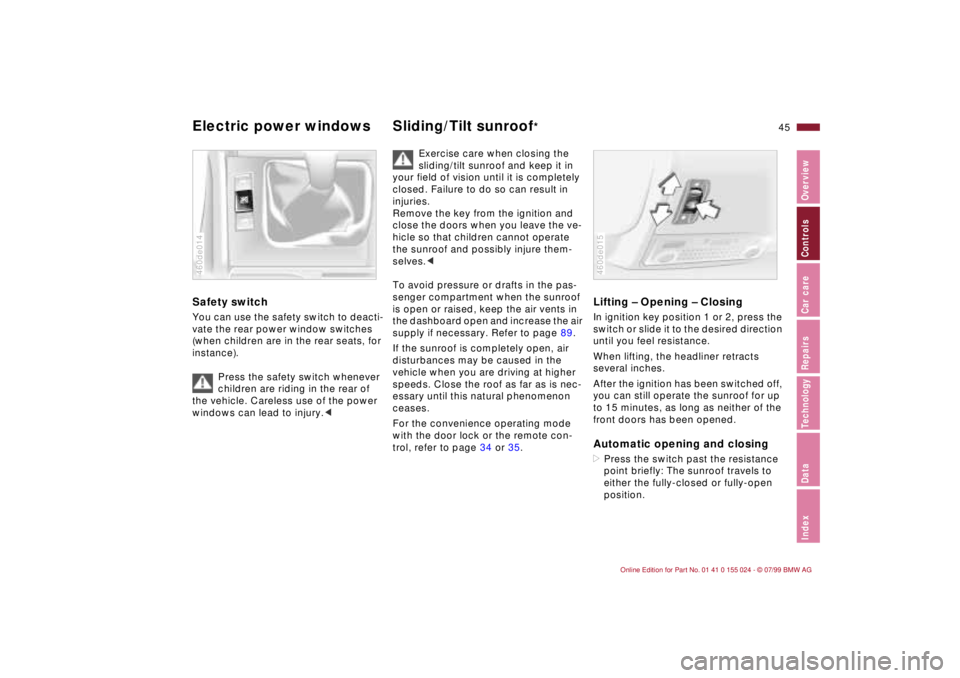
Safety switch You can use the safety switch to deacti-
vate the rear power window switches
(when children are in the rear seats, for
instance).
Press the safety switch whenever
children are riding in the rear of
the vehicle. Careless use of the power
windows can lead to injury.<460de014
Exercise care when closing the
sliding/tilt sunroof and keep it in
your field of vision until it is completely
closed. Failure to do so can result in
injuries.
Remove the key from the ignition and
close the doors when you leave the ve-
hicle so that children cannot operate
the sunroof and possibly injure them-
selves.<
To avoid pressure or drafts in the pas-
senger compartment when the sunroof
is open or raised, keep the air vents in
the dashboard open and increase the air
supply if necessary. Refer to page 89.
If the sunroof is completely open, air
disturbances may be caused in the
vehicle when you are driving at higher
speeds. Close the roof as far as is nec-
essary until this natural phenomenon
ceases.
For the convenience operating mode
with the door lock or the remote con-
trol, refer to page 34 or 35.
Lifting Ð Opening Ð ClosingIn ignition key position 1 or 2, press the
switch or slide it to the desired direction
until you feel resistance.
When lifting, the headliner retracts
several inches.
After the ignition has been switched off,
you can still operate the sunroof for up
to 15 minutes, as long as neither of the
front doors has been opened.Automatic opening and closing>Press the switch past the resistance
point briefly: The sunroof travels to
either the fully-closed or fully-open
position.460de015
Page 50 of 189
50n
Power seat
*
Seat and mirror memory
*
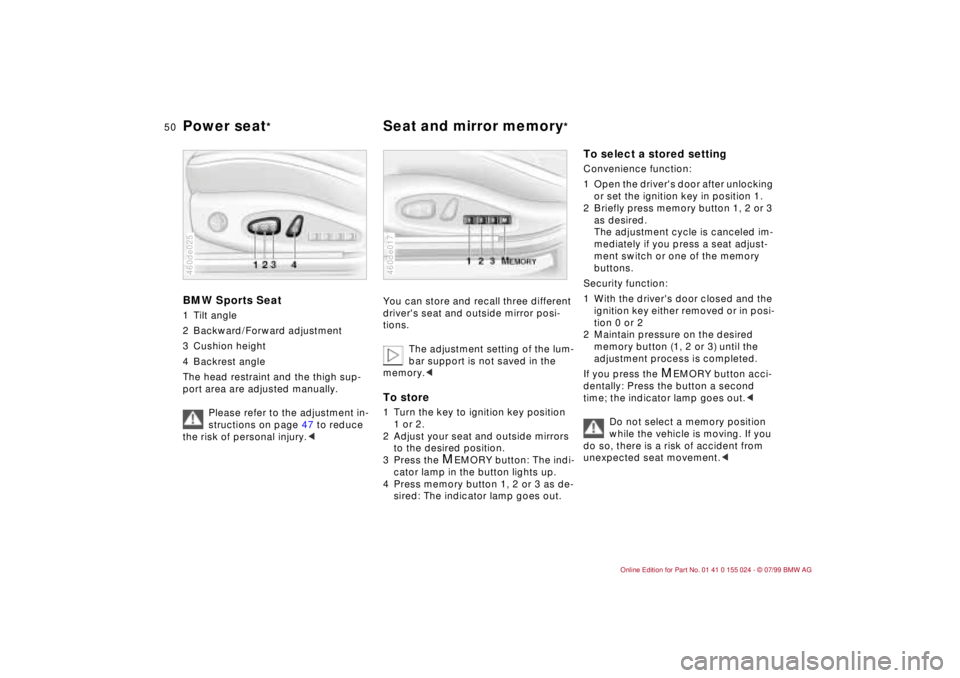
BMW Sports Seat1 Tilt angle
2 Backward/Forward adjustment
3 Cushion height
4 Backrest angle
The head restraint and the thigh sup-
port area are adjusted manually.
Please refer to the adjustment in-
structions on page 47 to reduce
the risk of personal injury.<460de025
You can store and recall three different
driver's seat and outside mirror posi-
tions.
The adjustment setting of the lum-
bar support is not saved in the
memory.
2 Adjust your seat and outside mirrors
to the desired position.
3 Press the
M
EMORY button: The indi-
cator lamp in the button lights up.
4 Press memory button 1, 2 or 3 as de-
sired: The indicator lamp goes out.
460de017
To select a stored setting Convenience function:
1 Open the driver's door after unlocking
or set the ignition key in position 1.
2 Briefly press memory button 1, 2 or 3
as desired.
The adjustment cycle is canceled im-
mediately if you press a seat adjust-
ment switch or one of the memory
buttons.
Security function:
1 With the driver's door closed and the
ignition key either removed or in posi-
tion 0 or 2
2 Maintain pressure on the desired
memory button (1, 2 or 3) until the
adjustment process is completed.
If you press the
M
EMORY button acci-
dentally: Press the button a second
time; the indicator lamp goes out.<
Do not select a memory position
while the vehicle is moving. If you
do so, there is a risk of accident from
unexpected seat movement.<
Page 56 of 189
56n
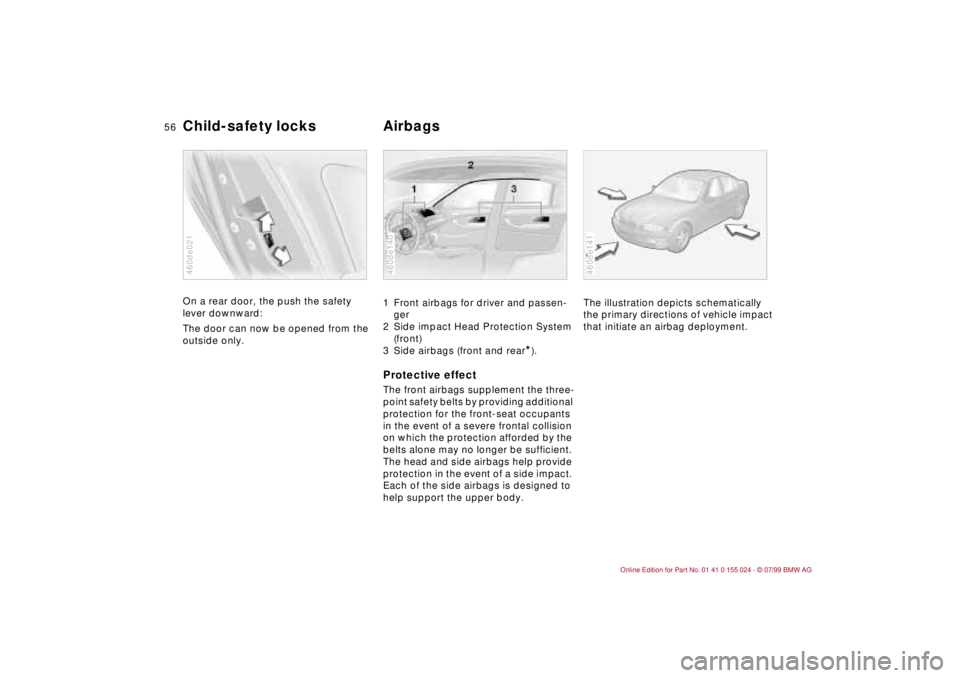
Child-safety locks Airbags On a rear door, the push the safety
lever downward:
The door can now be opened from the
outside only.460de021
1 Front airbags for driver and passen-
ger
2 Side impact Head Protection System
(front)
3 Side airbags (front and rear
*).
Protective effectThe front airbags supplement the three-
point safety belts by providing additional
protection for the front-seat occupants
in the event of a severe frontal collision
on which the protection afforded by the
belts alone may no longer be sufficient.
The head and side airbags help provide
protection in the event of a side impact.
Each of the side airbags is designed to
help support the upper body.460de140
The illustration depicts schematically
the primary directions of vehicle impact
that initiate an airbag deployment.460de141
Page 57 of 189
57n
IndexDataTechnologyRepairsCar careControlsOverview
AirbagsIndicator lamp
The indicator lamp displays the
operational status of the airbag
system when the ignition key is
in position 1 and higher.
System operational:
>The indicator lamp comes on briefly
then goes out.
System malfunction:
>The indicator lamp fails to come on.
>The indicator lamp comes on briefly
before going out, and then lights up
again.
If there is a system malfunction, there is
a risk that the airbags will not be trig-
gered within their normal response
range, even if the level of impact would
normally have triggered them.
Have your BMW center inspect and
repair the system immediately.
The airbag indicator lamp also
comes on if the safety belt ten-
sioners have been triggered.<
For your own safety, please com-
ply with the following precautions
concerning airbags. If you do not, their
protective function may be impaired
and your personal safety endangered.
The following information pertains to all
occupants:
The airbags are supplemental restraint
devices designed to provide extra pro-
tection; they are not a substitute for
safety belts. Wear your safety belt at all
times. The airbags will not be triggered
in the event of a minor accident, a vehi-
cle roll-over, or collisions from the rear.
In these instances, the safety belt offers
the best protection.
Airbags are located under the cover
panels in the steering wheel, in the in-
strument panel, in the side trim panels
in the front and rear
*, in the roof panels,
and in the sides of the inside roof lining.
Select a seat position that is comfort-
able and allows the greatest possible
distance from each of the applicable air-
bags. Hold the steering wheel at the rim
(hands at the "9 o'clock and 3 o'clock"
positions) in order to avoid injuries to
your hands or arms if the airbag is trig-
gered.
Never allow any objects to obstruct the
area between the airbag and an occu-
pant.
Do not use the cover panel above the
front passenger airbag as a storage
area.
Never tape the airbag cover panels,
cover them over or alter them in any
other way.
Never install a rear-facing child restraint
device on the front passenger seat. Chil-
dren under 13 years of age and children
who are smaller than 5 feet (150 cm),
should only travel in the rear seat.
If your vehicle is equipped with side air-
bags in the rear, be sure that child seats
are installed correctly and with the
greatest possible distance from the side
trim panels. Do not allow children to
lean out of the child's seat in the direc-
tion of the side trim panels. Otherwise,
serious injuries could occur if the airbag
is triggered.
At all times, occupants should sit up-
right and be properly restrained (infants
and small children in appropriate child
restraint systems; larger children and
adults using the safety belts). Never let
an occupant's head rest near or on a
side airbag because the inflating airbag
could cause a serious or fatal injury.
Please note that the word "Airbag" im-
printed on the door trim panel indicates
the airbag's location.
Page 61 of 189
61n
IndexDataTechnologyRepairsCar careControlsOverview
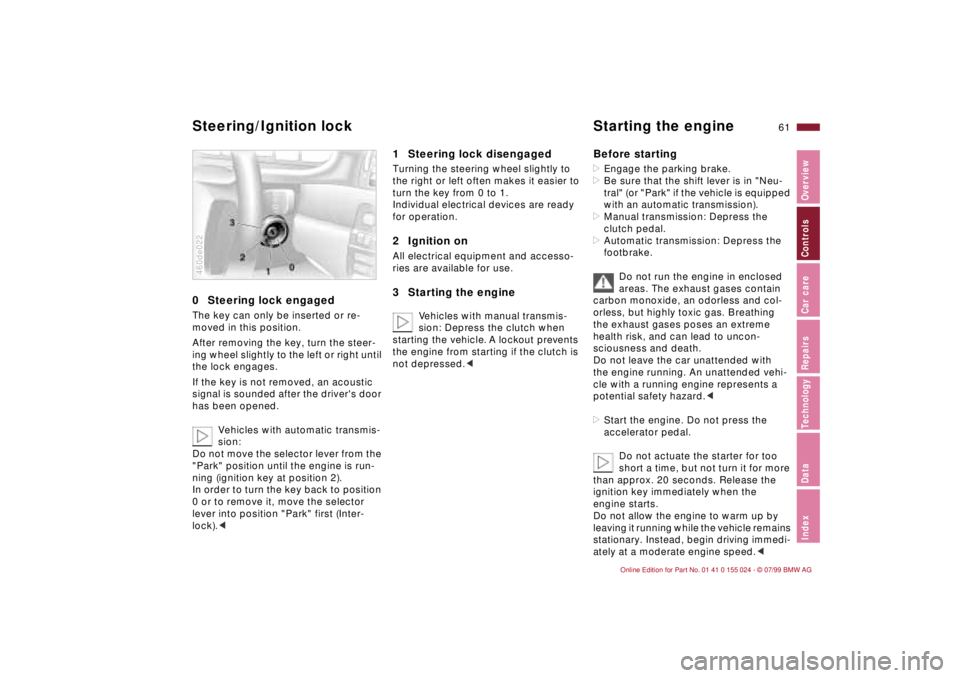
0 Steering lock engaged The key can only be inserted or re-
moved in this position.
After removing the key, turn the steer-
ing wheel slightly to the left or right until
the lock engages.
If the key is not removed, an acoustic
signal is sounded after the driver's door
has been opened.
Vehicles with automatic transmis-
sion:
Do not move the selector lever from the
"Park" position until the engine is run-
ning (ignition key at position 2).
In order to turn the key back to position
0 or to remove it, move the selector
lever into position "Park" first (Inter-
lock).<460de022
1 Steering lock disengaged Turning the steering wheel slightly to
the right or left often makes it easier to
turn the key from 0 to 1.
Individual electrical devices are ready
for operation.2 Ignition onAll electrical equipment and accesso-
ries are available for use.3 Starting the engine
Vehicles with manual transmis-
sion: Depress the clutch when
starting the vehicle. A lockout prevents
the engine from starting if the clutch is
not depressed.c
Before starting>Engage the parking brake.
>Be sure that the shift lever is in "Neu-
tral" (or "Park" if the vehicle is equipped
with an automatic transmission).
>Manual transmission: Depress the
clutch pedal.
>Automatic transmission: Depress the
footbrake.
Do not run the engine in enclosed
areas. The exhaust gases contain
carbon monoxide, an odorless and col-
orless, but highly toxic gas. Breathing
the exhaust gases poses an extreme
health risk, and can lead to uncon-
sciousness and death.
Do not leave the car unattended with
the engine running. An unattended vehi-
cle with a running engine represents a
potential safety hazard.<
>Start the engine. Do not press the
accelerator pedal.
Do not actuate the starter for too
short a time, but not turn it for more
than approx. 20 seconds. Release the
ignition key immediately when the
engine starts.
Do not allow the engine to warm up by
leaving it running while the vehicle remains
stationary. Instead, begin driving immedi-
ately at a moderate engine speed.<
Steering/Ignition lock Starting the engine
Page 75 of 189
75n
IndexDataTechnologyRepairsCar careControlsOverview
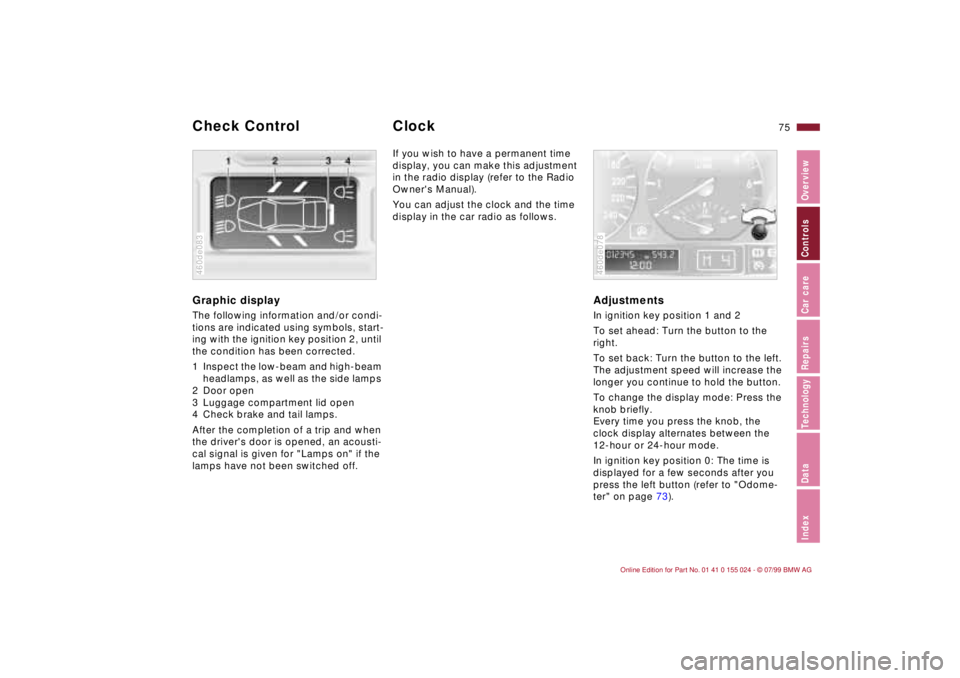
Graphic display The following information and/or condi-
tions are indicated using symbols, start-
ing with the ignition key position 2, until
the condition has been corrected.
1 Inspect the low-beam and high-beam
headlamps, as well as the side lamps
2 Door open
3 Luggage compartment lid open
4 Check brake and tail lamps.
After the completion of a trip and when
the driver's door is opened, an acousti-
cal signal is given for "Lamps on" if the
lamps have not been switched off.460de083
If you wish to have a permanent time
display, you can make this adjustment
in the radio display (refer to the Radio
Owner's Manual).
You can adjust the clock and the time
display in the car radio as follows.
AdjustmentsIn ignition key position 1 and 2
To set ahead: Turn the button to the
right.
To set back: Turn the button to the left.
The adjustment speed will increase the
longer you continue to hold the button.
To change the display mode: Press the
knob briefly.
Every time you press the knob, the
clock display alternates between the
12-hour or 24-hour mode.
In ignition key position 0: The time is
displayed for a few seconds after you
press the left button (refer to "Odome-
ter" on page 73).460de078
Check Control Clock
Page 92 of 189
92n
HiFi system Ð harman kardonSpecial acoustical effects are activated
or deactivated every time you press the
button.
When the system is activated, the im-
pression of a significantly larger pas-
senger compartment is created at all
seating areas, together with an im-
provement of the stereo effect.
When reception is weak, the system
frequently switches between stereo and
mono operation. Switch the feature off
if this occurs.460us287
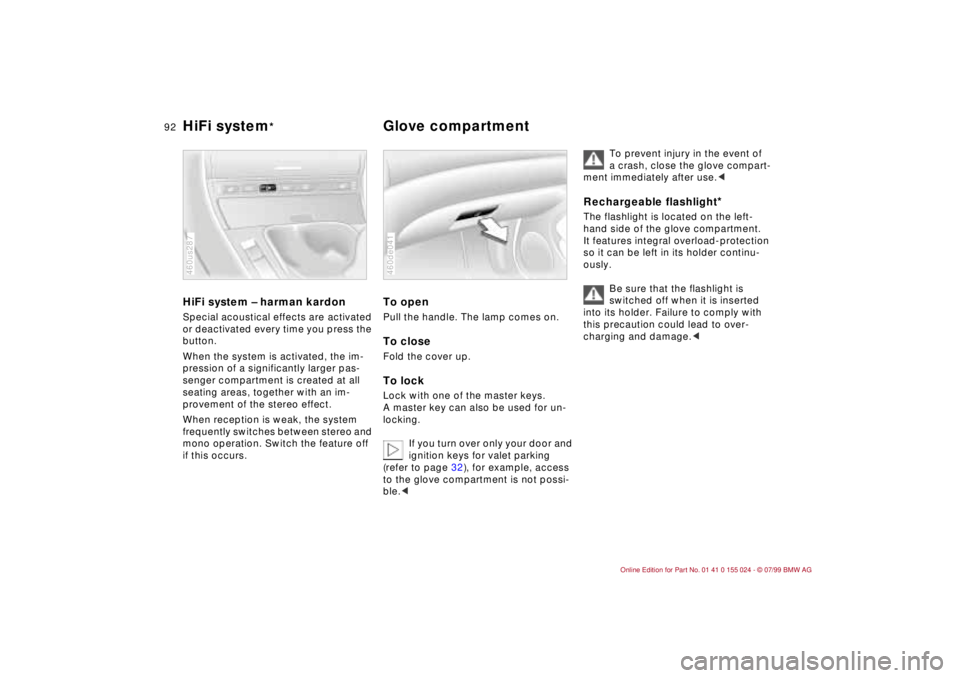
To openPull the handle. The lamp comes on.To closeFold the cover up.To lockLock with one of the master keys.
A master key can also be used for un-
locking.
If you turn over only your door and
ignition keys for valet parking
(refer to page 32), for example, access
to the glove compartment is not possi-
ble.<460de041
To prevent injury in the event of
a crash, close the glove compart-
ment immediately after use.<
Rechargeable flashlight
*
The flashlight is located on the left-
hand side of the glove compartment.
It features integral overload-protection
so it can be left in its holder continu-
ously.
Be sure that the flashlight is
switched off when it is inserted
into its holder. Failure to comply with
this precaution could lead to over-
charging and damage.<
HiFi system
* Glove compartment
Page 110 of 189

110n
Winter operationThe onset of winter is often accompa-
nied by rapid changes in weather.
Adaptations in driving style should be
accompanied by preparations on the
vehicle itself to ensure that your
progress through the winter remains
safe and trouble-free.CoolantBe sure that the coolant mixture con-
tains the year-round ratio of 50:50
water and extended-duty antifreeze/
corrosion protection. This mixture pro-
vides protection against freezing down
to approx. Ð 34 7 (Ð 37 6). Replace
the coolant every four years.LocksBMW door lock deicer can be used to
free them if frozen. This deicer also
contains lubricant.
After its use, treatment with BMW lock
barrel grease is recommended.Rubber seals and components To prevent the weather-stripping from
freezing, apply a spray-on rubber treat-
ment or silicone spray to the door, hood
and luggage compartment lid seals.
A full range of car care products is
available from your BMW center.<
Snow chains BMW snow chains
* can be mounted on
both summer and winter tires. Mount
them in pairs on the rear wheels only
and comply with the manufacturer's
safety precautions. Do not exceed a
maximum speed of 30 mph (50 km/h).
For best performance, deactivate the
DSC when snow chains are mounted.
Refer to page 79.
Starting offWhen starting from a full stop in deep
snow or for "rocking" the vehicle to free
it, we recommend that you deactivate
the DSC system. Refer to page 79.Driving on low-traction road
surfacesUse smooth, gentle pressure to control
the accelerator pedal. Avoid excessive
engine speeds and shift to the next
higher gear at an early point. On down-
grades or slopes, shift down to the next
lower gear at an early point. Maintain an
adequate distance between yourself
and the car ahead.
BrakesWinter road conditions substantially re-
duce the traction available between the
tires and the road surface. Remember
that braking distances will be signifi-
cantly longer as a result.
ABS is intended to prevent the wheels
from locking during brake applications,
thus helping to maintain vehicle stability
and steering response.
If the ABS does not respond in a critical
braking situation and the wheels lock:
Reduce the pressure on the brake pedal
until the wheels just start to roll again
while still maintaining enough force to
continue braking.
Following that, increase pedal pressure
again. Reduce the pressure as the
wheels lock, then reapply pressure.
Repeat this procedure. This type of
staggered braking will reduce the brak-
ing distance, and the vehicle still re-
mains responsive to steering. It allows
you to steer around hazards once you
have reduced the pressure on the brake
pedal.
Page 181 of 189
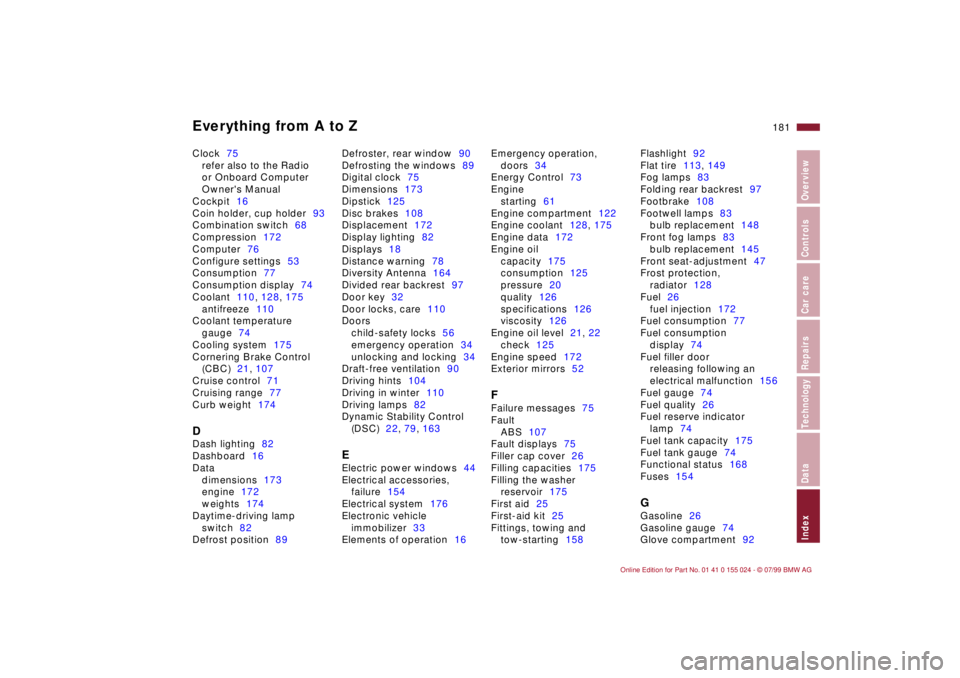
Everything from A to Z
181n
IndexDataTechnologyRepairsCar careControlsOverview
Clock75
refer also to the Radio
or Onboard Computer
Owner's Manual
Cockpit16
Coin holder, cup holder93
Combination switch68
Compression172
Computer76
Configure settings53
Consumption77
Consumption display74
Coolant110, 128, 175
antifreeze110
Coolant temperature
gauge74
Cooling system175
Cornering Brake Control
(CBC)21, 107
Cruise control71
Cruising range77
Curb weight174DDash lighting82
Dashboard16
Data
dimensions173
engine172
weights174
Daytime-driving lamp
switch82
Defrost position89Defroster, rear window90
Defrosting the windows89
Digital clock75
Dimensions173
Dipstick125
Disc brakes108
Displacement172
Display lighting82
Displays18
Distance warning78
Diversity Antenna164
Divided rear backrest97
Door key32
Door locks, care110
Doors
child-safety locks56
emergency operation34
unlocking and locking34
Draft-free ventilation90
Driving hints104
Driving in winter110
Driving lamps82
Dynamic Stability Control
(DSC)22, 79, 163
EElectric power windows44
Electrical accessories,
failure154
Electrical system176
Electronic vehicle
immobilizer33
Elements of operation16Emergency operation,
doors34
Energy Control73
Engine
starting61
Engine compartment122
Engine coolant128, 175
Engine data172
Engine oil
capacity175
consumption125
pressure20
quality126
specifications126
viscosity126
Engine oil level21, 22
check125
Engine speed172
Exterior mirrors52
FFailure messages75
Fault
ABS107
Fault displays75
Filler cap cover26
Filling capacities175
Filling the washer
reservoir175
First aid25
First-aid kit25
Fittings, towing and
tow-starting158Flashlight92
Flat tire113, 149
Fog lamps83
Folding rear backrest97
Footbrake108
Footwell lamps83
bulb replacement148
Front fog lamps83
bulb replacement145
Front seat-adjustment47
Frost protection,
radiator128
Fuel26
fuel injection172
Fuel consumption77
Fuel consumption
display74
Fuel filler door
releasing following an
electrical malfunction156
Fuel gauge74
Fuel quality26
Fuel reserve indicator
lamp74
Fuel tank capacity175
Fuel tank gauge74
Functional status168
Fuses154
GGasoline26
Gasoline gauge74
Glove compartment92