roof BMW 323i 2000 User Guide
[x] Cancel search | Manufacturer: BMW, Model Year: 2000, Model line: 323i, Model: BMW 323i 2000Pages: 189, PDF Size: 1.81 MB
Page 46 of 189

46n
Sliding/Tilt sunroof
*
>With the sunroof open, press the
switch briefly toward "Lift:" The sun-
roof automatically extends to its fully
raised position.
Pressing the switch again briefly stops
the motion immediately.
Safety featureIf the sliding/tilt sunroof encounters
resistance at a point roughly past the
middle of its travel when it is closing,
the closing cycle is interrupted and the
sunroof will open again slightly.
Despite this safety feature, always
be careful to ensure that the clos-
ing path of the roof is not obstructed.
Otherwise, an object might not touch
the contact strip in some situations
(very thin objects, for instance).
You can disable this safety feature by
pressing the switch beyond the resis-
tance point and holding it.<
Power loss or malfunctionIn the event of an electrical system mal-
function, the sliding/tilt sunroof can be
manually operated. Refer to page 156.
Page 57 of 189

57n
IndexDataTechnologyRepairsCar careControlsOverview
AirbagsIndicator lamp
The indicator lamp displays the
operational status of the airbag
system when the ignition key is
in position 1 and higher.
System operational:
>The indicator lamp comes on briefly
then goes out.
System malfunction:
>The indicator lamp fails to come on.
>The indicator lamp comes on briefly
before going out, and then lights up
again.
If there is a system malfunction, there is
a risk that the airbags will not be trig-
gered within their normal response
range, even if the level of impact would
normally have triggered them.
Have your BMW center inspect and
repair the system immediately.
The airbag indicator lamp also
comes on if the safety belt ten-
sioners have been triggered.<
For your own safety, please com-
ply with the following precautions
concerning airbags. If you do not, their
protective function may be impaired
and your personal safety endangered.
The following information pertains to all
occupants:
The airbags are supplemental restraint
devices designed to provide extra pro-
tection; they are not a substitute for
safety belts. Wear your safety belt at all
times. The airbags will not be triggered
in the event of a minor accident, a vehi-
cle roll-over, or collisions from the rear.
In these instances, the safety belt offers
the best protection.
Airbags are located under the cover
panels in the steering wheel, in the in-
strument panel, in the side trim panels
in the front and rear
*, in the roof panels,
and in the sides of the inside roof lining.
Select a seat position that is comfort-
able and allows the greatest possible
distance from each of the applicable air-
bags. Hold the steering wheel at the rim
(hands at the "9 o'clock and 3 o'clock"
positions) in order to avoid injuries to
your hands or arms if the airbag is trig-
gered.
Never allow any objects to obstruct the
area between the airbag and an occu-
pant.
Do not use the cover panel above the
front passenger airbag as a storage
area.
Never tape the airbag cover panels,
cover them over or alter them in any
other way.
Never install a rear-facing child restraint
device on the front passenger seat. Chil-
dren under 13 years of age and children
who are smaller than 5 feet (150 cm),
should only travel in the rear seat.
If your vehicle is equipped with side air-
bags in the rear, be sure that child seats
are installed correctly and with the
greatest possible distance from the side
trim panels. Do not allow children to
lean out of the child's seat in the direc-
tion of the side trim panels. Otherwise,
serious injuries could occur if the airbag
is triggered.
At all times, occupants should sit up-
right and be properly restrained (infants
and small children in appropriate child
restraint systems; larger children and
adults using the safety belts). Never let
an occupant's head rest near or on a
side airbag because the inflating airbag
could cause a serious or fatal injury.
Please note that the word "Airbag" im-
printed on the door trim panel indicates
the airbag's location.
Page 100 of 189
100n
Cargo loading Roof-mounted luggage rack
*
Always position and secure the
load correctly. If you do not, it can
endanger the passengers during brak-
ing or evasive maneuvers.
Do not exceed the permissible gross
vehicle weight and the permissible axle
loads (refer to page 174). If you do, the
operating safety of the vehicle is no
longer ensured and you are in violation
of the law.
Do not carry hard or heavy objects un-
secured in the passenger compartment.
If you do so, they may be projected
through the air during braking and eva-
sive maneuvers, thus endangering vehi-
cle occupants.<
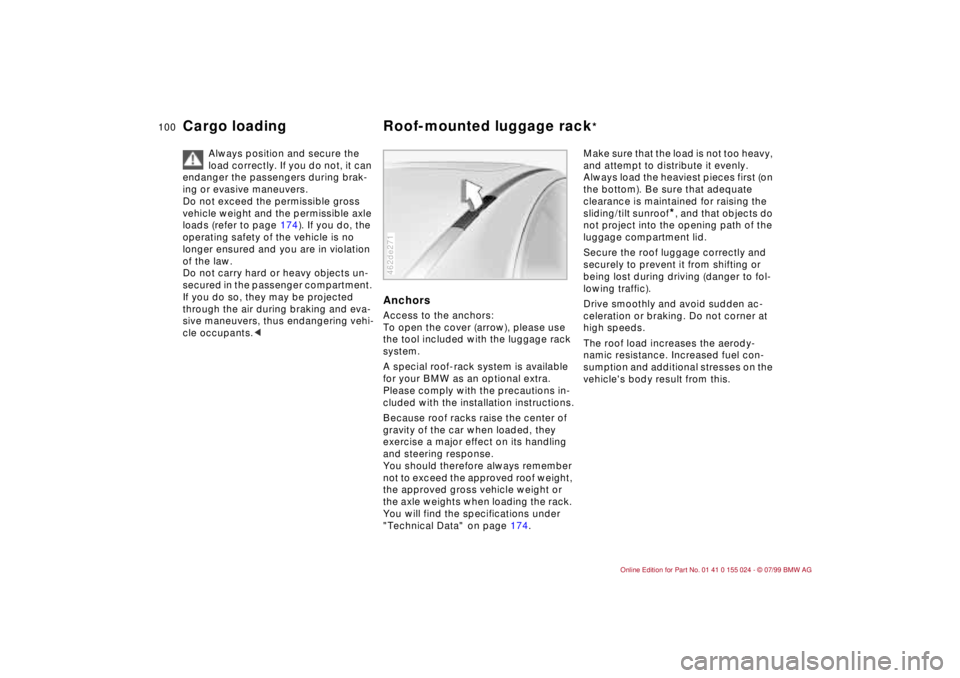
AnchorsAccess to the anchors:
To open the cover (arrow), please use
the tool included with the luggage rack
system.
A special roof-rack system is available
for your BMW as an optional extra.
Please comply with the precautions in-
cluded with the installation instructions.
Because roof racks raise the center of
gravity of the car when loaded, they
exercise a major effect on its handling
and steering response.
You should therefore always remember
not to exceed the approved roof weight,
the approved gross vehicle weight or
the axle weights when loading the rack.
You will find the specifications under
"Technical Data" on page 174.462de271
Make sure that the load is not too heavy,
and attempt to distribute it evenly.
Always load the heaviest pieces first (on
the bottom). Be sure that adequate
clearance is maintained for raising the
sliding/tilt sunroof
*, and that objects do
not project into the opening path of the
luggage compartment lid.
Secure the roof luggage correctly and
securely to prevent it from shifting or
being lost during driving (danger to fol-
lowing traffic).
Drive smoothly and avoid sudden ac-
celeration or braking. Do not corner at
high speeds.
The roof load increases the aerody-
namic resistance. Increased fuel con-
sumption and additional stresses on the
vehicle's body result from this.
Page 137 of 189
137n
IndexDataTechnologyRepairsCar careControlsOverview
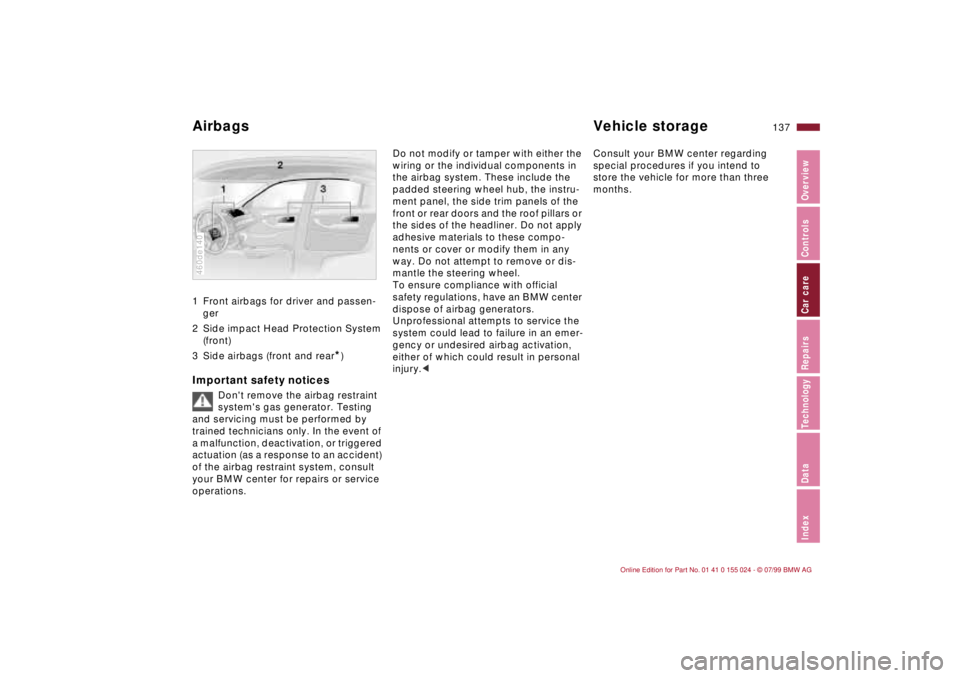
Airbags Vehicle storage1 Front airbags for driver and passen-
ger
2 Side impact Head Protection System
(front)
3 Side airbags (front and rear
*)
Important safety notices
Don't remove the airbag restraint
system's gas generator. Testing
and servicing must be performed by
trained technicians only. In the event of
a malfunction, deactivation, or triggered
actuation (as a response to an accident)
of the airbag restraint system, consult
your BMW center for repairs or service
operations.
460de140
Do not modify or tamper with either the
wiring or the individual components in
the airbag system. These include the
padded steering wheel hub, the instru-
ment panel, the side trim panels of the
front or rear doors and the roof pillars or
the sides of the headliner. Do not apply
adhesive materials to these compo-
nents or cover or modify them in any
way. Do not attempt to remove or dis-
mantle the steering wheel.
To ensure compliance with official
safety regulations, have an BMW center
dispose of airbag generators.
Unprofessional attempts to service the
system could lead to failure in an emer-
gency or undesired airbag activation,
either of which could result in personal
injury.
store the vehicle for more than three
months.
Page 141 of 189
Overview
Controls and features
Operation, care
and maintenance
Owner service procedures
Technical data
Index Advanced technology
141n
IndexDataTechnologyRepairsCar careControlsOverview
Replacement procedures:
Onboard tool kit142
Windshield wiper blades142
Lamps and bulbs142
Changing a wheel149
Battery152
Fuses154
Microfilter155
In case of electrical
malfunction:
Fuel filler door156
Sliding/Tilt sunroof156
Assistance, giving and
receiving:
Jump-starting157
Towing the vehicle158
Repairs
Page 156 of 189
156n
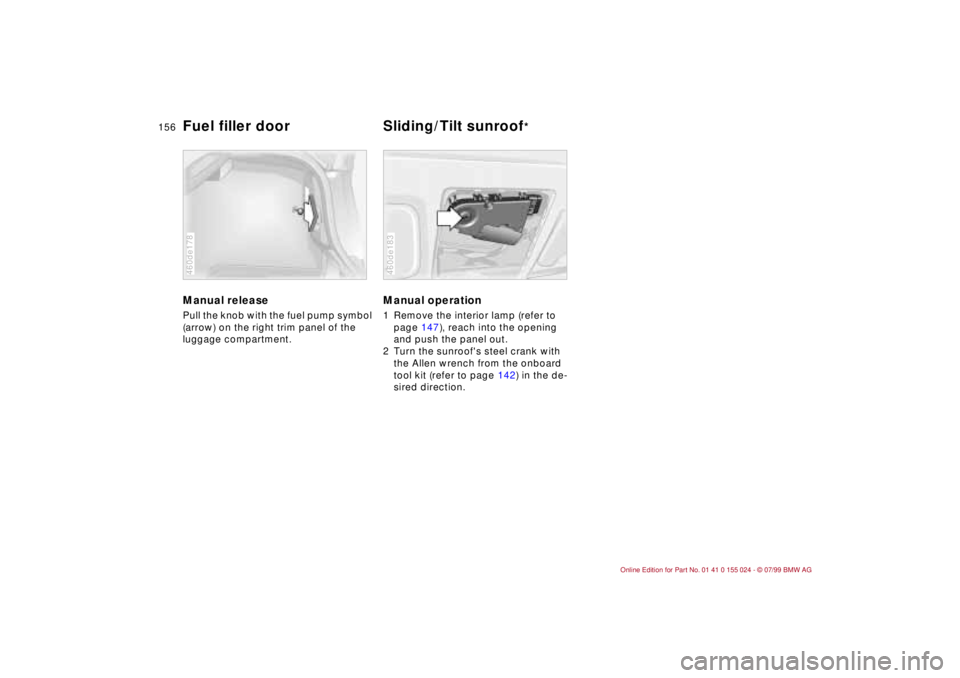
Manual release Pull the knob with the fuel pump symbol
(arrow) on the right trim panel of the
luggage compartment. 460de178
Manual operation 1 Remove the interior lamp (refer to
page 147), reach into the opening
and push the panel out.
2 Turn the sunroof's steel crank with
the Allen wrench from the onboard
tool kit (refer to page 142) in the de-
sired direction.460de183
Fuel filler door Sliding/Tilt sunroof
*
Page 168 of 189
168n
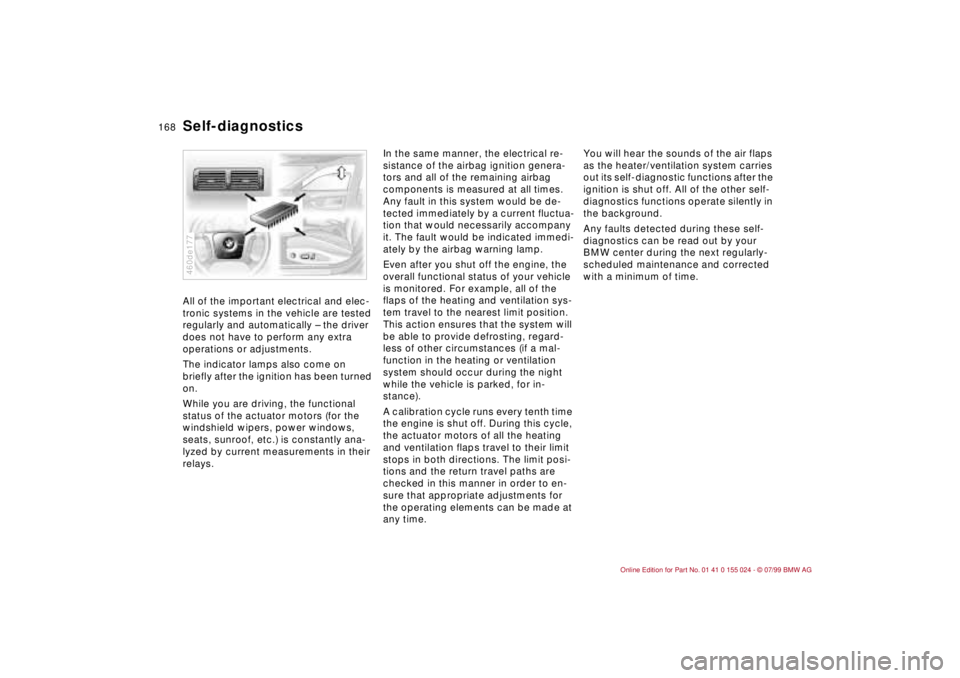
Self-diagnostics All of the important electrical and elec-
tronic systems in the vehicle are tested
regularly and automatically Ð the driver
does not have to perform any extra
operations or adjustments.
The indicator lamps also come on
briefly after the ignition has been turned
on.
While you are driving, the functional
status of the actuator motors (for the
windshield wipers, power windows,
seats, sunroof, etc.) is constantly ana-
lyzed by current measurements in their
relays.460de177
In the same manner, the electrical re-
sistance of the airbag ignition genera-
tors and all of the remaining airbag
components is measured at all times.
Any fault in this system would be de-
tected immediately by a current fluctua-
tion that would necessarily accompany
it. The fault would be indicated immedi-
ately by the airbag warning lamp.
Even after you shut off the engine, the
overall functional status of your vehicle
is monitored. For example, all of the
flaps of the heating and ventilation sys-
tem travel to the nearest limit position.
This action ensures that the system will
be able to provide defrosting, regard-
less of other circumstances (if a mal-
function in the heating or ventilation
system should occur during the night
while the vehicle is parked, for in-
stance).
A calibration cycle runs every tenth time
the engine is shut off. During this cycle,
the actuator motors of all the heating
and ventilation flaps travel to their limit
stops in both directions. The limit posi-
tions and the return travel paths are
checked in this manner in order to en-
sure that appropriate adjustments for
the operating elements can be made at
any time.You will hear the sounds of the air flaps
as the heater/ventilation system carries
out its self-diagnostic functions after the
ignition is shut off. All of the other self-
diagnostics functions operate silently in
the background.
Any faults detected during these self-
diagnostics can be read out by your
BMW center during the next regularly-
scheduled maintenance and corrected
with a minimum of time.
Page 174 of 189

174n
Weights
BMW 323i BMW 328i
Curb weight (with one person, ready for operation, full tank of fuel, options not included)
with manual transmission
with automatic transmissionlbs (kg)
lbs (kg)3,153 (1,430)
3,213 (1,457)3,197 (1,450)
3,256 (1,477)
Approved gross vehicle weight
with manual transmission
with automatic transmissionlbs (kg)
lbs (kg)4,211 (1,910)
4,255 (1,930)4,270 (1,937)
4,314 (1,957)
Approved front axle weight lbs (kg) 1,962 (890) 1,973 (895)
Approved rear axle weight lbs (kg) 2,348 (1,065) 2,370 (1,075)
Approved roof load capacity lbs (kg) 165 (75) 165 (75)
Luggage compartment capacity cu. ft. (liters) 14.5 (410) 14.5 (410)
Never exceed either the approved axle weights or the gross vehicle weight.
Page 183 of 189
Everything from A to Z
183n
IndexDataTechnologyRepairsCar careControlsOverview
OOBD interface socket139
Obstruction protection44
Odometer73
Oil
capacity175
consumption125
dipstick125
quality126
specifications126
viscosity126
Oil additives125
Oil change intervals, see the
Service and Warranty
Information Booklet
Oil filter change175
Oil level
check125
indicator lamp20
Oil pressure, indicator
lamp20
OILSERVICE74
Onboard computer76
Onboard tool kit142
Outside temperature
display76PPaint blemishes133
Paint, care133
Paintwork, minor
repairs134Paintwork, waxing134
Park Distance Control
(PDC)78
Parking brake63
Parking help78
Parking lamps83
Parking, winter111
PDC (Park Distance
Control)78
Performance172
Pocket flashlight92
Pollen90
Power seat49
Power steering111
Power windows44
safety switch45
Pressure monitoring,
tires80, 167
Pressure, tires27, 113
RRadiator175
Radio
refer to the separate
Owner's Manual
Radio Data System
(RDS)164
Radio reception112, 164
Rain sensor69, 166
RDC (Tire Pressure
Control)80, 167
RDS (Radio Data
System)164Reading lamps84
Rear backrest, folding97
Rear lamps145
Rear window
defroster70, 90
Rearview mirror52
Reclining seat47
Refueling26
Remote control35
Removing condensation,
windows89
Replacement key32
Reporting safety defects7
Restraint system59
Reverse17, 64
Roller blind, sun
protection91
Roller sun blind91
Roof load capacity174
Roof-mounted luggage
rack100
Rubber parts110
SSafety belt tensioner164
Safety belts54
height adjustment54
Safety feature44
Safety lock buttons38
Seat
mechanical47
power49
Seat adjustment47Seat heating91
Seat memory50
Securing cargo99
Securing loads99
Selector lever, automatic
transmission65
Self-defrosting mirrors52
Self-diagnostics168
Service and Warranty
Information Booklet131
Service Interval
Display74, 131
Shiftlock65
Side airbags56
Side impact Head Protection
System56
Side lamps82
bulb replacement144
Ski bag98
Skid control111
Sliding/Tilt sunroof45
closing following an
electrical malfunction156
convenience operation34
Slippery roads110
Snow chains110, 118
Space-saver spare tire149
Spare key32
Spare tire149
Spare wheel149
Spark plugs176
Speaker95
Speed control71
Page 186 of 189

Owner service proceduresAActivated-charcoal filter,
changing155
Adding brake fluid129
Adding engine coolant128
Adding engine oil125BBackup lamps
bulb replacement145
Battery
add distilled water153
charging154
Brake lamps
bulb replacement145
Brakes, brake faults109CChanging a tire149
Changing a wheel149
Check Control75
Checking air pressure27
Checking engine oil
level125
Checking oil level125DDefrosting the windows89
Difficult steering111
Doors, emergency
operation34
EElectrical accessories,
failure154
Electrical malfunction
fuel filler door156
sliding/tilt sunroof156
Emergency operation
doors34
fuel filler door156
sliding/tilt sunroof156
Engine oil
add125
quality126
specifications126
viscosity126FFailure messages75
Fault displays75
First aid25
First-aid kit25
Fittings, towing and
tow-starting158
Flat tire149
Footwell lamps
bulb replacement148
Front fog lamps
bulb replacement145
Fuses, replacing154GGlove compartment lamp
bulb replacement148
HHazard warning flashers25
Hazard warning triangle25
Headlamp cover, care143
High beams
bulb replacement143IIndicator lamps20
Inflated pressure27, 113
Interior lamps
bulb replacement147
Interior motion sensor,
switching off43JJack149LLicense plate lamp
bulb replacement147
Low beams
bulb replacement143
Lug wrench149
Luggage compartment
lamps
bulb replacement148
Luggage compartment lid,
emergency release39
MMaintenance131
Malfunction displays75
Microfilter, changing155OOil
quality126
specifications126
viscosity126
Onboard tool kit142PPressure, tires27RRear lamps145
Releasing the fuel filler door
following an electrical
malfunction156
Releasing the hood120
Removing condensation
from the windows89
Replacement key32
Replacing bulbs142
Replacing lamp bulbs142
Replacing windshield wiper
blades142
Replacing wiper blades142
Return used batteries154
Owner service procedures