Wheels BMW 323I 2011 E90 User Guide
[x] Cancel search | Manufacturer: BMW, Model Year: 2011, Model line: 323I, Model: BMW 323I 2011 E90Pages: 286, PDF Size: 8.25 MB
Page 94 of 286
Technology for driving comfort and safety
92 stop and check your tires as soon as possible,
and inflate them to the proper pressure. Driving
on a significantly underinflated tire causes the
tire to overheat and can lead to tire failure.
Underinflation also reduces fuel efficiency and
tire tread life, and may affect the vehicle’s han-
dling and stopping ability. Please note that the
TPMS is not a substitute for proper tire mainte-
nance, and it is the driver’s responsibility to
maintain correct tire pressure, even if underin-
flation has not reached the level at which the
TPMS low tire pressure telltale illuminates.
The TPMS malfunction indicator is combined
with the low tire pressure telltale. When the sys-
tem detects a malfunction, the telltale will flash
for approximately one minute and then remain
continuously lit. This sequence will continue
upon subsequent vehicle startups as long as
the malfunction exists. When the malfunction
indicator is illuminated, the system may not be
able to detect or signal low tire pressure as
intended. TPMS malfunctions may occur for a
variety of reasons, including the installation of
replacement or alternate tires or wheels on the
vehicle that prevent the TPMS from functioning
properly. Always check the TPMS malfunction
telltale after replacing one or more tires or
wheels on your vehicle to ensure that the
replacement or alternate tires and wheels allow
the TPMS to continue to function properly.
Active steering*
The concept
Active steering varies the turning angle of the
front wheels in relation to steering wheel move-
ments. It also varies the steering force required
to turn the wheels depending on the speed at
which you are driving.
When you are driving in the low road speed
range, e.g. in a town or when parking, the steer-
ing angle is increased, i.e. steering becomes
very direct and less effort is required to turn the
wheels. In the higher speed range, on the other
hand, the steering angle is reduced as the
speed increases. This improves the handling of
your BMW over the entire speed range.
In critical situations, the system can make tar-
geted corrections to the steering angle pro-
vided by the driver and thus stabilize the vehicle
before the driver intervenes. This stabilizing
intervention is simultaneously deactivated
when DSC is switched off, refer to page86.
Malfunction
The warning lamps light up and a
message is displayed on the Control
Display. Active steering is malfunc-
tioning or is temporarily deactivated.
At low speeds, greater steering wheel move-
ments are required, whereas at higher speeds
the vehicle reacts more sensitively to steering
wheel movements. The stability-enhancing
feature may also be deactivated. Drive cau-
tiously and think well ahead.
Deactivation
Active steering is deactivated to perform an ini-
tialization. A message indicates that the feature
is deactivated. Initialization may take several
minutes.
If the message does not disappear during the
current trip, have the system checked.
Defect
If there is a defect, a corresponding text mes-
sage appears. Have the system checked.
Page 95 of 286
Controls
93Reference
At a glance
Driving tips
Communications
Navigation
Entertainment
Mobility
Servotronic*
The concept
The Servotronic varies the steering force
required to turn the wheels relative to the vehi-
cle speed.
At low speeds, the steering force is strongly
assisted, i.e. less force is needed for steering.
As the vehicle speed increases, the steering
assisting power is reduced.
Malfunction
Malfunctions are displayed via Check Control,
refer to page80.
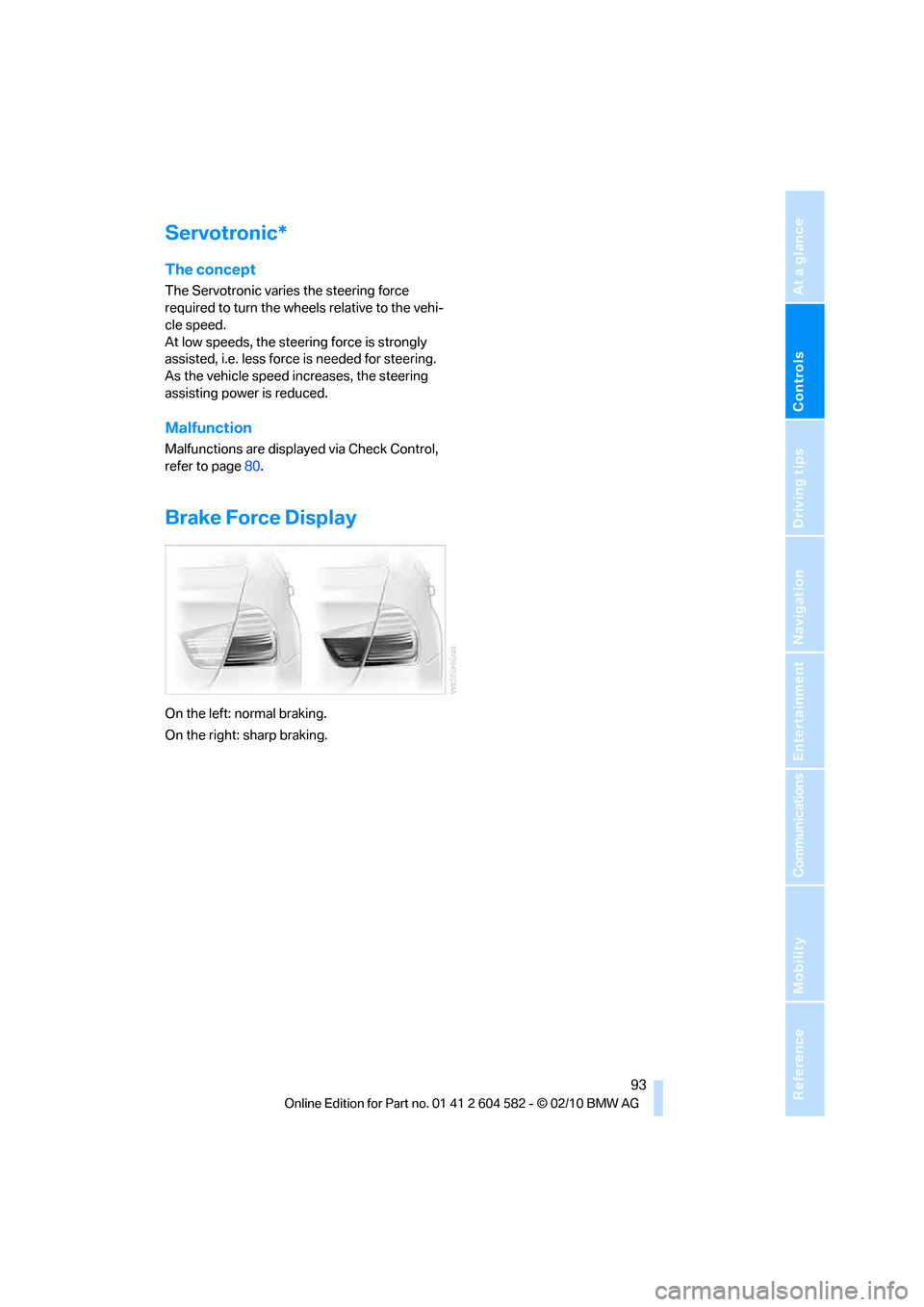
Brake Force Display
On the left: normal braking.
On the right: sharp braking.
Page 107 of 286
Controls
105Reference
At a glance
Driving tips
Communications
Navigation
Entertainment
Mobility
Switching the system on/off
Switching off
With the blower at its lowest set-
ting, press the left side of the but-
ton to switch off the automatic cli-
mate control.
All displays are cleared except for the rear win-
dow defroster if it is switched on.
The outside air supply is blocked when
the automatic climate control is switched
off. If the air quality deteriorates or the window
fogs over, switch the system back on and
increase the air volume.<
Switching on
Press any button except the ALL or the rear
window defroster button to reactivate the auto-
matic climate control.
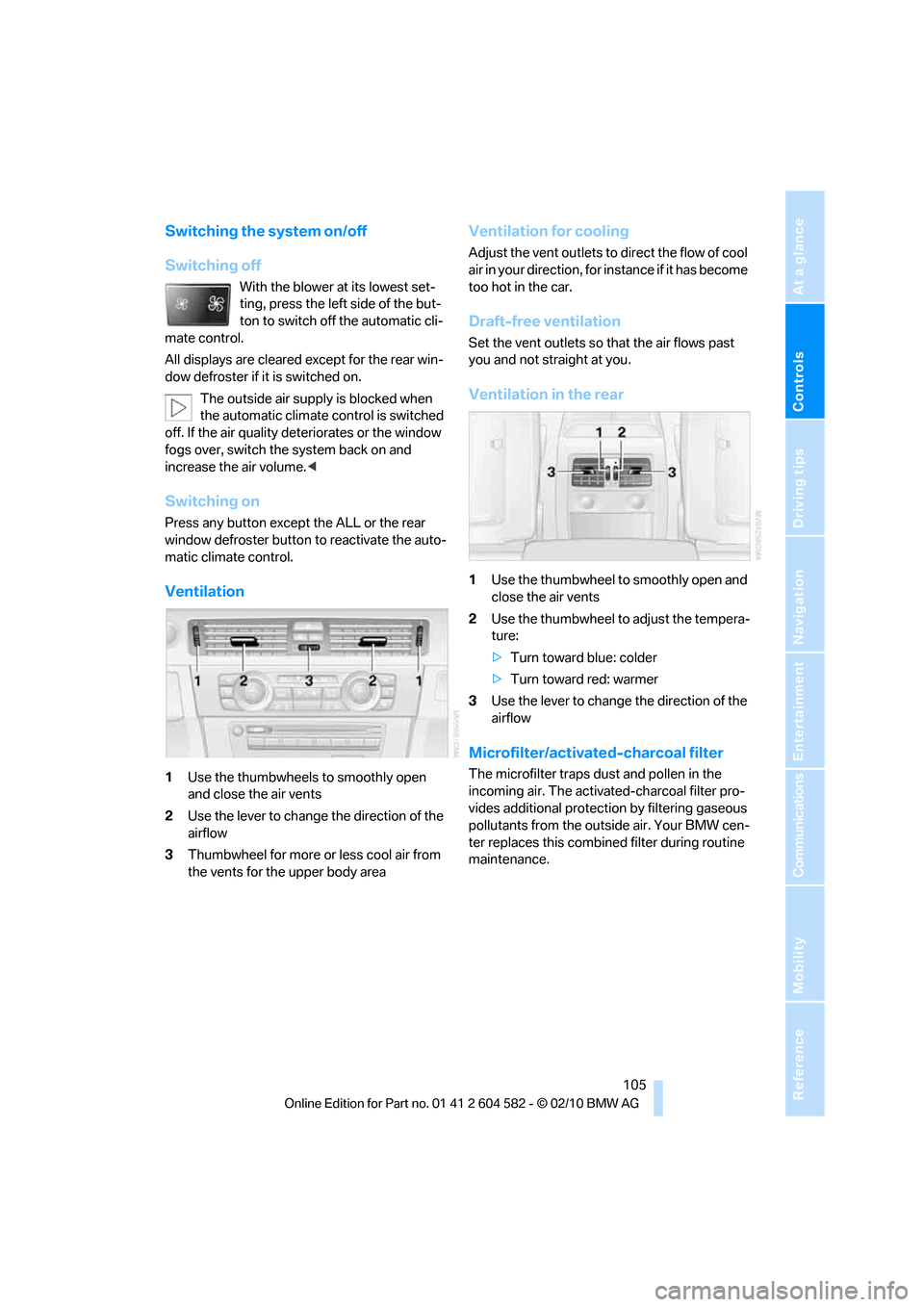
Ventilation
1Use the thumbwheels to smoothly open
and close the air vents
2Use the lever to change the direction of the
airflow
3Thumbwheel for more or less cool air from
the vents for the upper body area
Ventilation for cooling
Adjust the vent outlets to direct the flow of cool
air in your direction, for instance if it has become
too hot in the car.
Draft-free ventilation
Set the vent outlets so that the air flows past
you and not straight at you.
Ventilation in the rear
1Use the thumbwheel to smoothly open and
close the air vents
2Use the thumbwheel to adjust the tempera-
ture:
>Turn toward blue: colder
>Turn toward red: warmer
3Use the lever to change the direction of the
airflow
Microfilter/activated-charcoal filter
The microfilter traps dust and pollen in the
incoming air. The activated-charcoal filter pro-
vides additional protection by filtering gaseous
pollutants from the outside air. Your BMW cen-
ter replaces this combined filter during routine
maintenance.
Page 203 of 286
Mobility
This section helps you maintain your car's
mobility by supplying important information
on vital topics including fuels and lubricants,
wheels and tires, service, maintenance and
roadside assistance.
Mobility
Page 210 of 286
Wheels and tires
208
Wheels and tires
Tire inflation pressures
Information for your safety
It is not merely the tires' service life, but also
driving comfort and, to a great extent, driving
safety that depend on the condition of the tires
and the maintenance of the specified tire pres-
sure.
Check the tire inflation pressure regularly
and correct it, if necessary: at least twice a
month and before starting long trips. If you fail
to observe this precaution you may be driving
on tires with incorrect tire pressures, a condi-
tion that can not only compromise your vehi-
cle's driving stability, but also lead to tire dam-
age and the risk of an accident. Do not drive
with deflated, i.e. flat tires, except when using
run-flat tires. A flat tire will seriously impair your
vehicle's handling and braking response.
Attempts to drive on a flat tire can lead to loss of
control over the vehicle.<
Checking pressure
Only check tire inflation pressure when the
tires are cold. This means after a maximum of
1.25 miles/2 km driving or when the vehicle has
been parked for at least 2 hours. When tires are
warm, the tire inflation pressure is higher.
After correcting the tire inflation pressure,
reset the Tire Pressure Monitor, refer to
page90, or reinitialize the Flat Tire Monitor,
refer to page88.<
Inflation pressure specifications
The tables below provide all the correct inflation
pressures for the specified tire sizes at ambient
temperature.
The inflation pressures apply to the tire
sizes approved and tire brands recom-
mended by BMW; a list of these is available
from your BMW center.<
For correct identification of the right tire infla-
tion pressures, observe the following:>Tire sizes for your vehicle
>Load conditions
>Maximum allowable driving speed
Tire inflation pressures for driving up
to 100 mph or 160 km/h
For normal driving up to 100 mph or 160 km/h
and to achieve optimum driving comfort, adjust
pressures to the respective tire inflation pres-
sures listed on the following pages in the col-
umns for traveling speeds up to a maximum of
100 mph or 160 km/h.
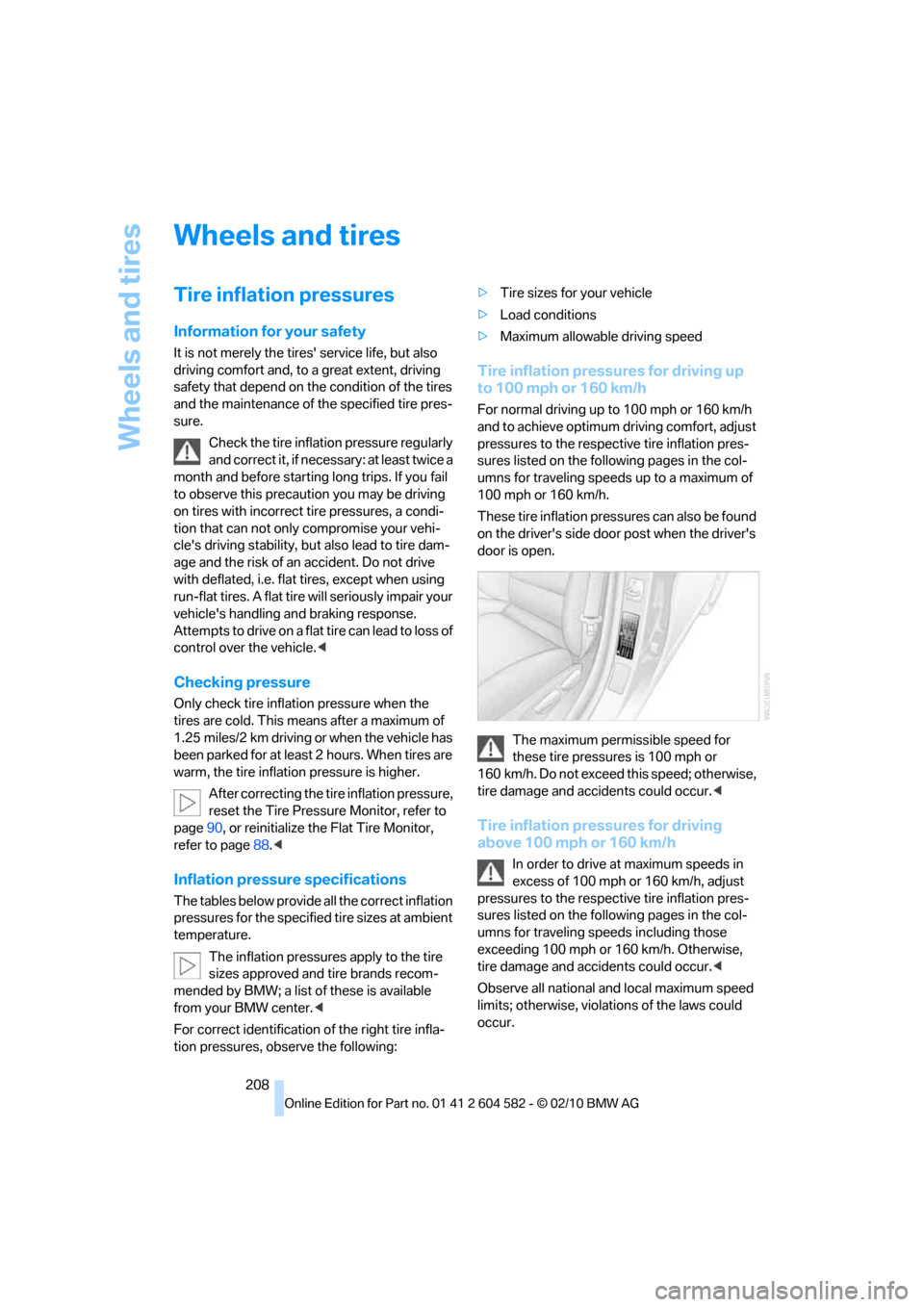
These tire inflation pressures can also be found
on the driver's side door post when the driver's
door is open.
The maximum permissible speed for
these tire pressures is 100 mph or
160 km/h. Do not exceed this speed; otherwise,
tire damage and accidents could occur.<
Tire inflation pressures for driving
above 100 mph or 160 km/h
In order to drive at maximum speeds in
excess of 100 mph or 160 km/h, adjust
pressures to the respective tire inflation pres-
sures listed on the following pages in the col-
umns for traveling speeds including those
exceeding 100 mph or 160 km/h. Otherwise,
tire damage and accidents could occur.<
Observe all national and local maximum speed
limits; otherwise, violations of the laws could
occur.
Page 212 of 286
Wheels and tires
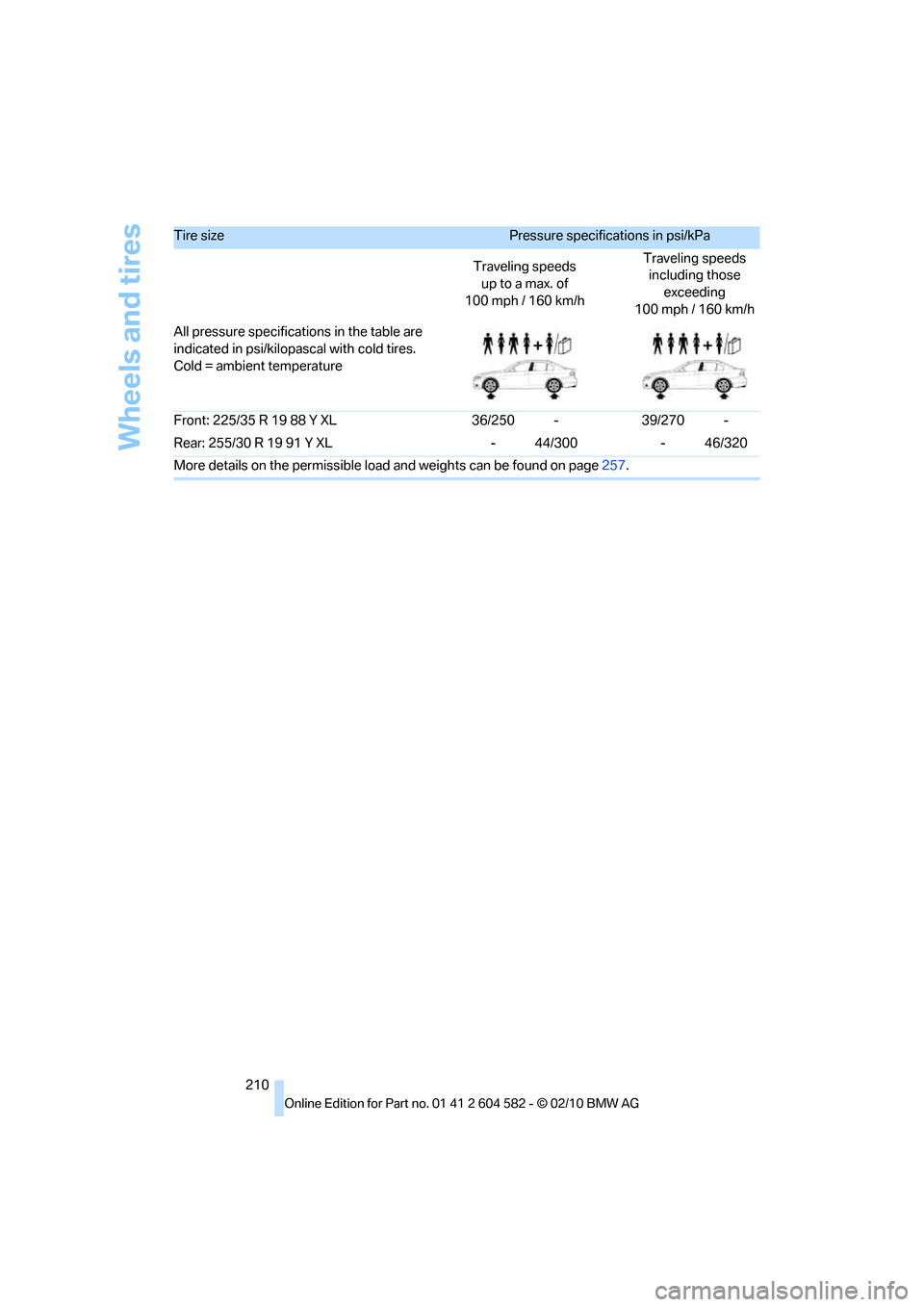
210 Front: 225/35 R 19 88 Y XL 36/250 - 39/270 -
Rear: 255/30 R 19 91 Y XL - 44/300 - 46/320
More details on the permissible load and weights can be found on page257.
Tire size Pressure specifications in psi/kPa
Traveling speeds
up to a max. of
100 mph / 160 km/hTraveling speeds
including those
exceeding
100 mph / 160 km/h
All pressure specifications in the table are
indicated in psi/kilopascal with cold tires.
Cold = ambient temperature
Page 214 of 286
Wheels and tires
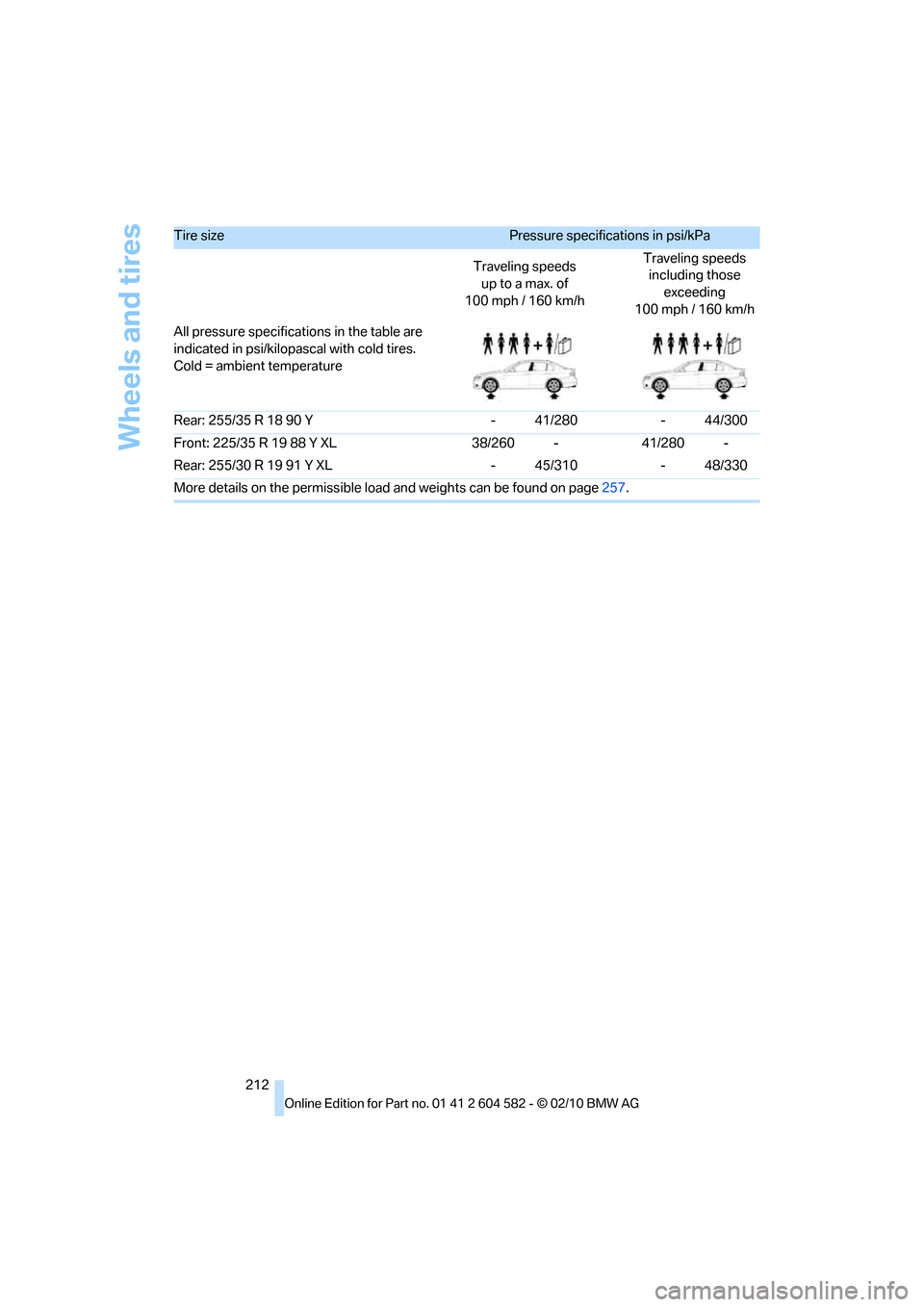
212 Rear: 255/35 R 18 90 Y - 41/280 - 44/300
Front: 225/35 R 19 88 Y XL 38/260 - 41/280 -
Rear: 255/30 R 19 91 Y XL - 45/310 - 48/330
More details on the permissible load and weights can be found on page257.
Tire size Pressure specifications in psi/kPa
Traveling speeds
up to a max. of
100 mph / 160 km/hTraveling speeds
including those
exceeding
100 mph / 160 km/h
All pressure specifications in the table are
indicated in psi/kilopascal with cold tires.
Cold = ambient temperature
Page 216 of 286
Wheels and tires
214
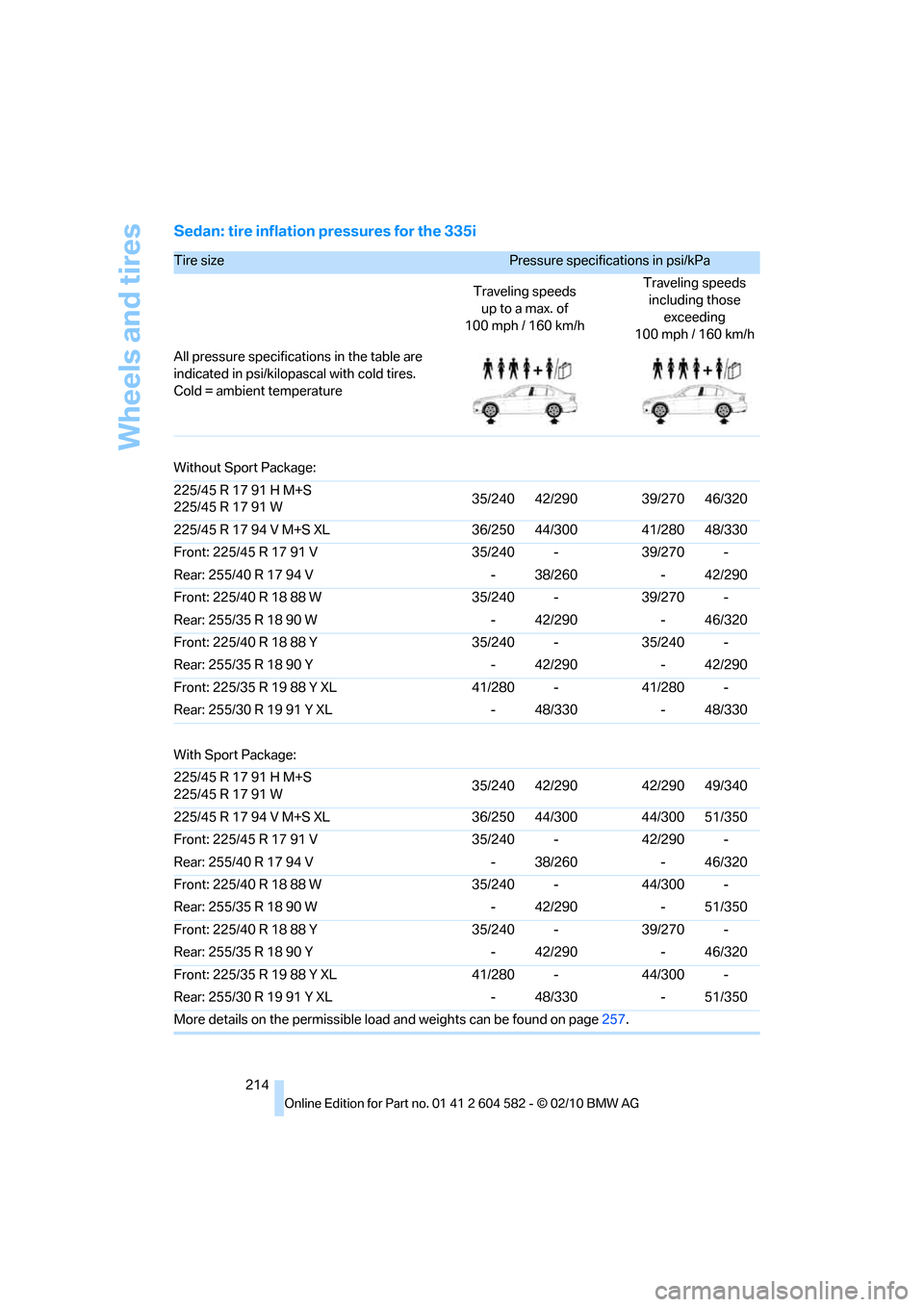
Sedan: tire inflation pressures for the 335i
Tire size Pressure specifications in psi/kPa
Traveling speeds
up to a max. of
100 mph / 160 km/hTraveling speeds
including those
exceeding
100 mph / 160 km/h
All pressure specifications in the table are
indicated in psi/kilopascal with cold tires.
Cold = ambient temperature
Without Sport Package:
225/45 R 17 91 H M+S
225/45 R 17 91 W35/240 42/290 39/270 46/320
225/45 R 17 94 V M+S XL 36/250 44/300 41/280 48/330
Front: 225/45 R 17 91 V 35/240 - 39/270 -
Rear: 255/40 R 17 94 V - 38/260 - 42/290
Front: 225/40 R 18 88 W 35/240 - 39/270 -
Rear: 255/35 R 18 90 W - 42/290 - 46/320
Front: 225/40 R 18 88 Y 35/240 - 35/240 -
Rear: 255/35 R 18 90 Y - 42/290 - 42/290
Front: 225/35 R 19 88 Y XL 41/280 - 41/280 -
Rear: 255/30 R 19 91 Y XL - 48/330 - 48/330
With Sport Package:
225/45 R 17 91 H M+S
225/45 R 17 91 W35/240 42/290 42/290 49/340
225/45 R 17 94 V M+S XL 36/250 44/300 44/300 51/350
Front: 225/45 R 17 91 V 35/240 - 42/290 -
Rear: 255/40 R 17 94 V - 38/260 - 46/320
Front: 225/40 R 18 88 W 35/240 - 44/300 -
Rear: 255/35 R 18 90 W - 42/290 - 51/350
Front: 225/40 R 18 88 Y 35/240 - 39/270 -
Rear: 255/35 R 18 90 Y - 42/290 - 46/320
Front: 225/35 R 19 88 Y XL 41/280 - 44/300 -
Rear: 255/30 R 19 91 Y XL - 48/330 - 51/350
More details on the permissible load and weights can be found on page257.
Page 218 of 286
Wheels and tires
216
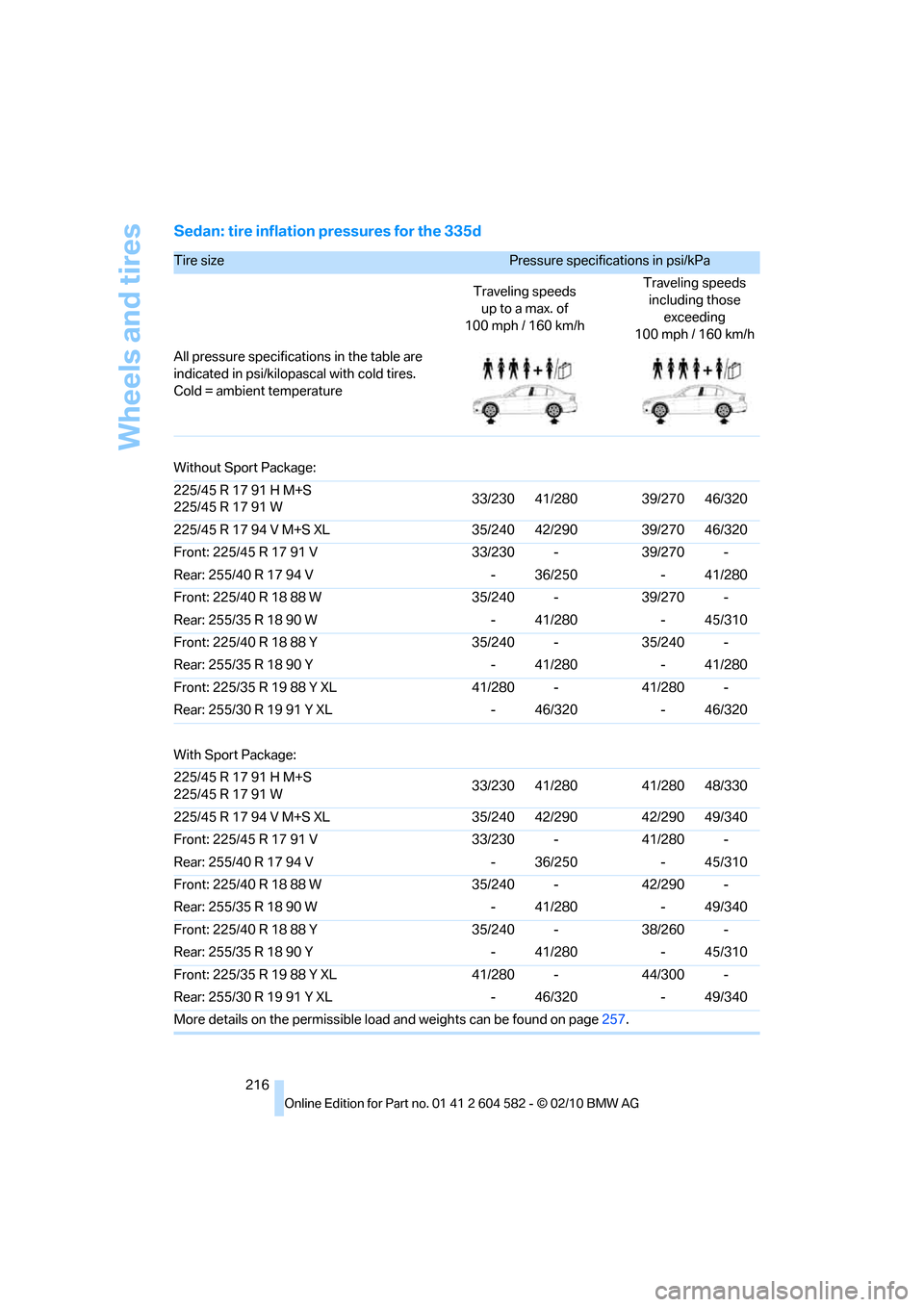
Sedan: tire inflation pressures for the 335d
Tire size Pressure specifications in psi/kPa
Traveling speeds
up to a max. of
100 mph / 160 km/hTraveling speeds
including those
exceeding
100 mph / 160 km/h
All pressure specifications in the table are
indicated in psi/kilopascal with cold tires.
Cold = ambient temperature
Without Sport Package:
225/45 R 17 91 H M+S
225/45 R 17 91 W33/230 41/280 39/270 46/320
225/45 R 17 94 V M+S XL 35/240 42/290 39/270 46/320
Front: 225/45 R 17 91 V 33/230 - 39/270 -
Rear: 255/40 R 17 94 V - 36/250 - 41/280
Front: 225/40 R 18 88 W 35/240 - 39/270 -
Rear: 255/35 R 18 90 W - 41/280 - 45/310
Front: 225/40 R 18 88 Y 35/240 - 35/240 -
Rear: 255/35 R 18 90 Y - 41/280 - 41/280
Front: 225/35 R 19 88 Y XL 41/280 - 41/280 -
Rear: 255/30 R 19 91 Y XL - 46/320 - 46/320
With Sport Package:
225/45 R 17 91 H M+S
225/45 R 17 91 W33/230 41/280 41/280 48/330
225/45 R 17 94 V M+S XL 35/240 42/290 42/290 49/340
Front: 225/45 R 17 91 V 33/230 - 41/280 -
Rear: 255/40 R 17 94 V - 36/250 - 45/310
Front: 225/40 R 18 88 W 35/240 - 42/290 -
Rear: 255/35 R 18 90 W - 41/280 - 49/340
Front: 225/40 R 18 88 Y 35/240 - 38/260 -
Rear: 255/35 R 18 90 Y - 41/280 - 45/310
Front: 225/35 R 19 88 Y XL 41/280 - 44/300 -
Rear: 255/30 R 19 91 Y XL - 46/320 - 49/340
More details on the permissible load and weights can be found on page257.
Page 220 of 286
Wheels and tires
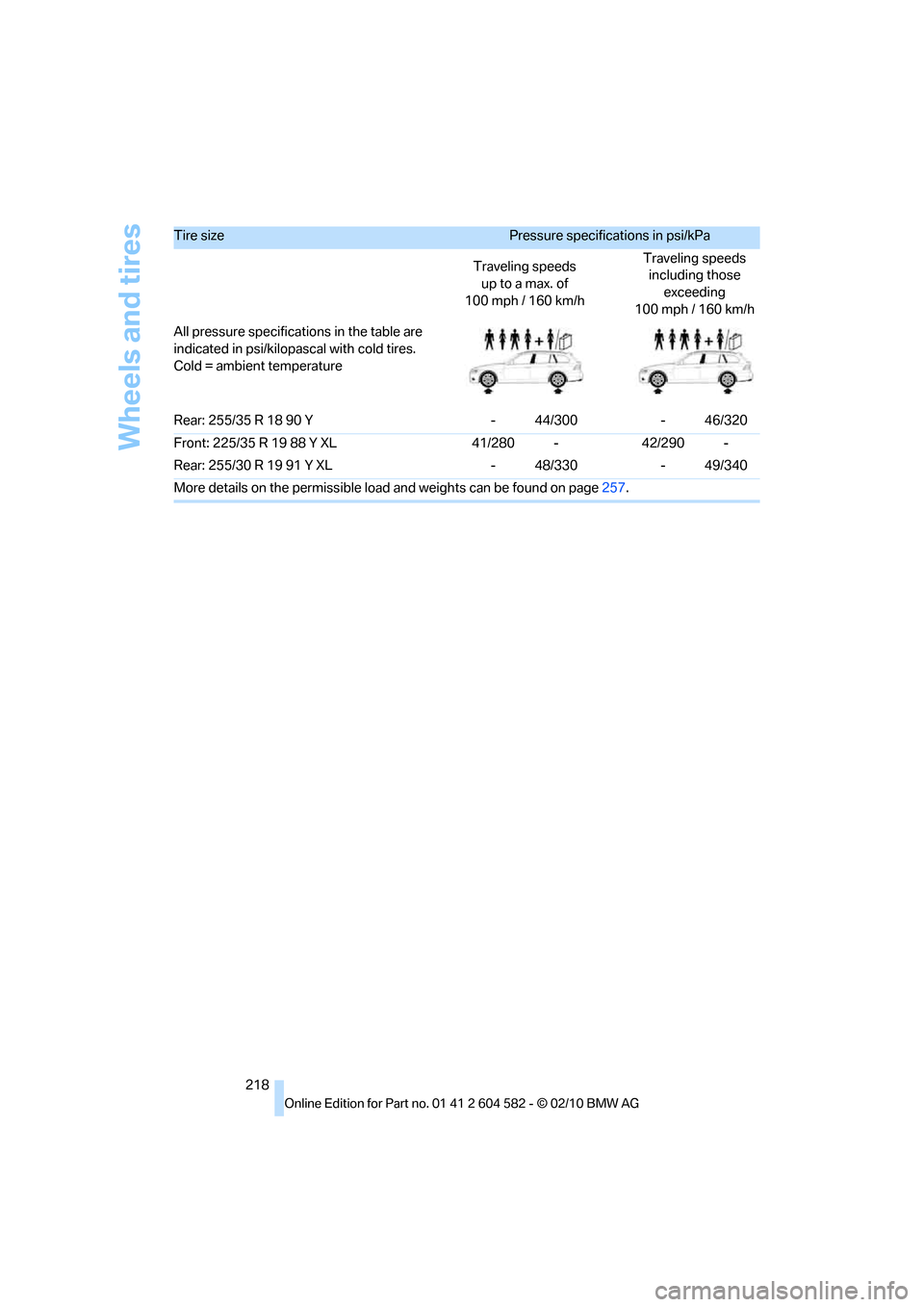
218 Rear: 255/35 R 18 90 Y - 44/300 - 46/320
Front: 225/35 R 19 88 Y XL 41/280 - 42/290 -
Rear: 255/30 R 19 91 Y XL - 48/330 - 49/340
More details on the permissible load and weights can be found on page257.
Tire size Pressure specifications in psi/kPa
Traveling speeds
up to a max. of
100 mph / 160 km/hTraveling speeds
including those
exceeding
100 mph / 160 km/h
All pressure specifications in the table are
indicated in psi/kilopascal with cold tires.
Cold = ambient temperature