wheels size BMW 323I 2011 E90 Owner's Manual
[x] Cancel search | Manufacturer: BMW, Model Year: 2011, Model line: 323I, Model: BMW 323I 2011 E90Pages: 286, PDF Size: 8.25 MB
Page 210 of 286
Wheels and tires
208
Wheels and tires
Tire inflation pressures
Information for your safety
It is not merely the tires' service life, but also
driving comfort and, to a great extent, driving
safety that depend on the condition of the tires
and the maintenance of the specified tire pres-
sure.
Check the tire inflation pressure regularly
and correct it, if necessary: at least twice a
month and before starting long trips. If you fail
to observe this precaution you may be driving
on tires with incorrect tire pressures, a condi-
tion that can not only compromise your vehi-
cle's driving stability, but also lead to tire dam-
age and the risk of an accident. Do not drive
with deflated, i.e. flat tires, except when using
run-flat tires. A flat tire will seriously impair your
vehicle's handling and braking response.
Attempts to drive on a flat tire can lead to loss of
control over the vehicle.<
Checking pressure
Only check tire inflation pressure when the
tires are cold. This means after a maximum of
1.25 miles/2 km driving or when the vehicle has
been parked for at least 2 hours. When tires are
warm, the tire inflation pressure is higher.
After correcting the tire inflation pressure,
reset the Tire Pressure Monitor, refer to
page90, or reinitialize the Flat Tire Monitor,
refer to page88.<
Inflation pressure specifications
The tables below provide all the correct inflation
pressures for the specified tire sizes at ambient
temperature.
The inflation pressures apply to the tire
sizes approved and tire brands recom-
mended by BMW; a list of these is available
from your BMW center.<
For correct identification of the right tire infla-
tion pressures, observe the following:>Tire sizes for your vehicle
>Load conditions
>Maximum allowable driving speed
Tire inflation pressures for driving up
to 100 mph or 160 km/h
For normal driving up to 100 mph or 160 km/h
and to achieve optimum driving comfort, adjust
pressures to the respective tire inflation pres-
sures listed on the following pages in the col-
umns for traveling speeds up to a maximum of
100 mph or 160 km/h.
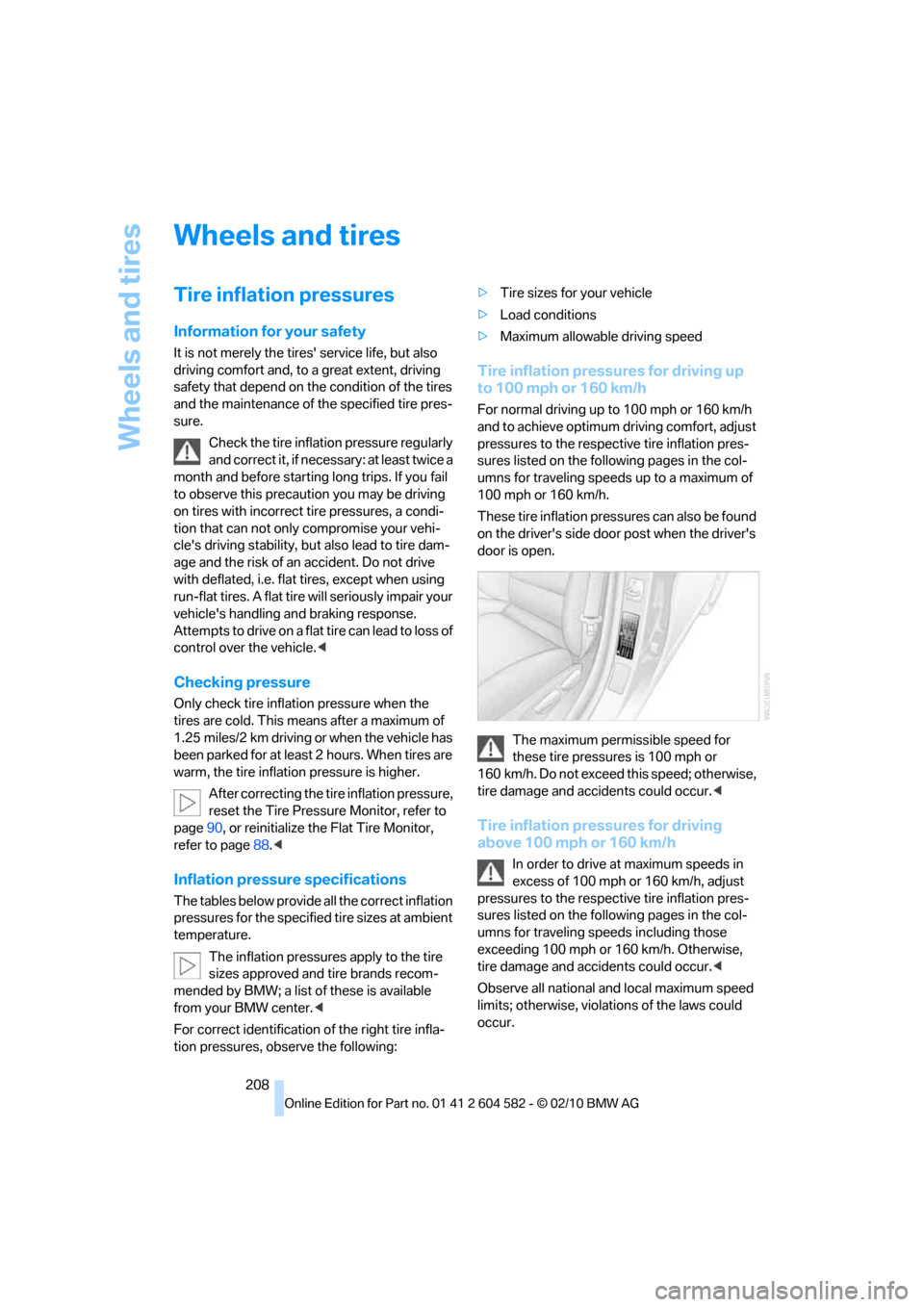
These tire inflation pressures can also be found
on the driver's side door post when the driver's
door is open.
The maximum permissible speed for
these tire pressures is 100 mph or
160 km/h. Do not exceed this speed; otherwise,
tire damage and accidents could occur.<
Tire inflation pressures for driving
above 100 mph or 160 km/h
In order to drive at maximum speeds in
excess of 100 mph or 160 km/h, adjust
pressures to the respective tire inflation pres-
sures listed on the following pages in the col-
umns for traveling speeds including those
exceeding 100 mph or 160 km/h. Otherwise,
tire damage and accidents could occur.<
Observe all national and local maximum speed
limits; otherwise, violations of the laws could
occur.
Page 212 of 286
Wheels and tires
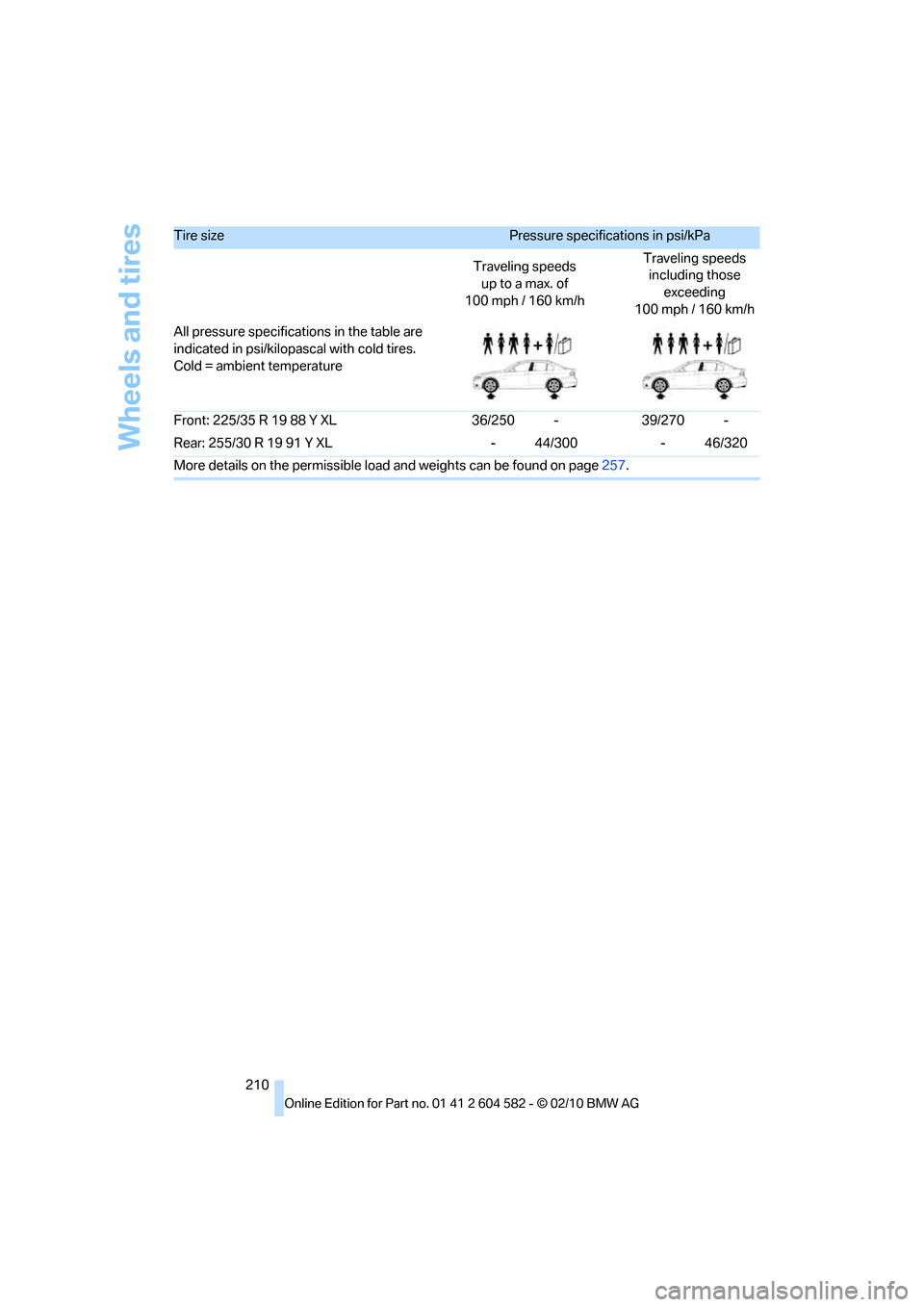
210 Front: 225/35 R 19 88 Y XL 36/250 - 39/270 -
Rear: 255/30 R 19 91 Y XL - 44/300 - 46/320
More details on the permissible load and weights can be found on page257.
Tire size Pressure specifications in psi/kPa
Traveling speeds
up to a max. of
100 mph / 160 km/hTraveling speeds
including those
exceeding
100 mph / 160 km/h
All pressure specifications in the table are
indicated in psi/kilopascal with cold tires.
Cold = ambient temperature
Page 214 of 286
Wheels and tires
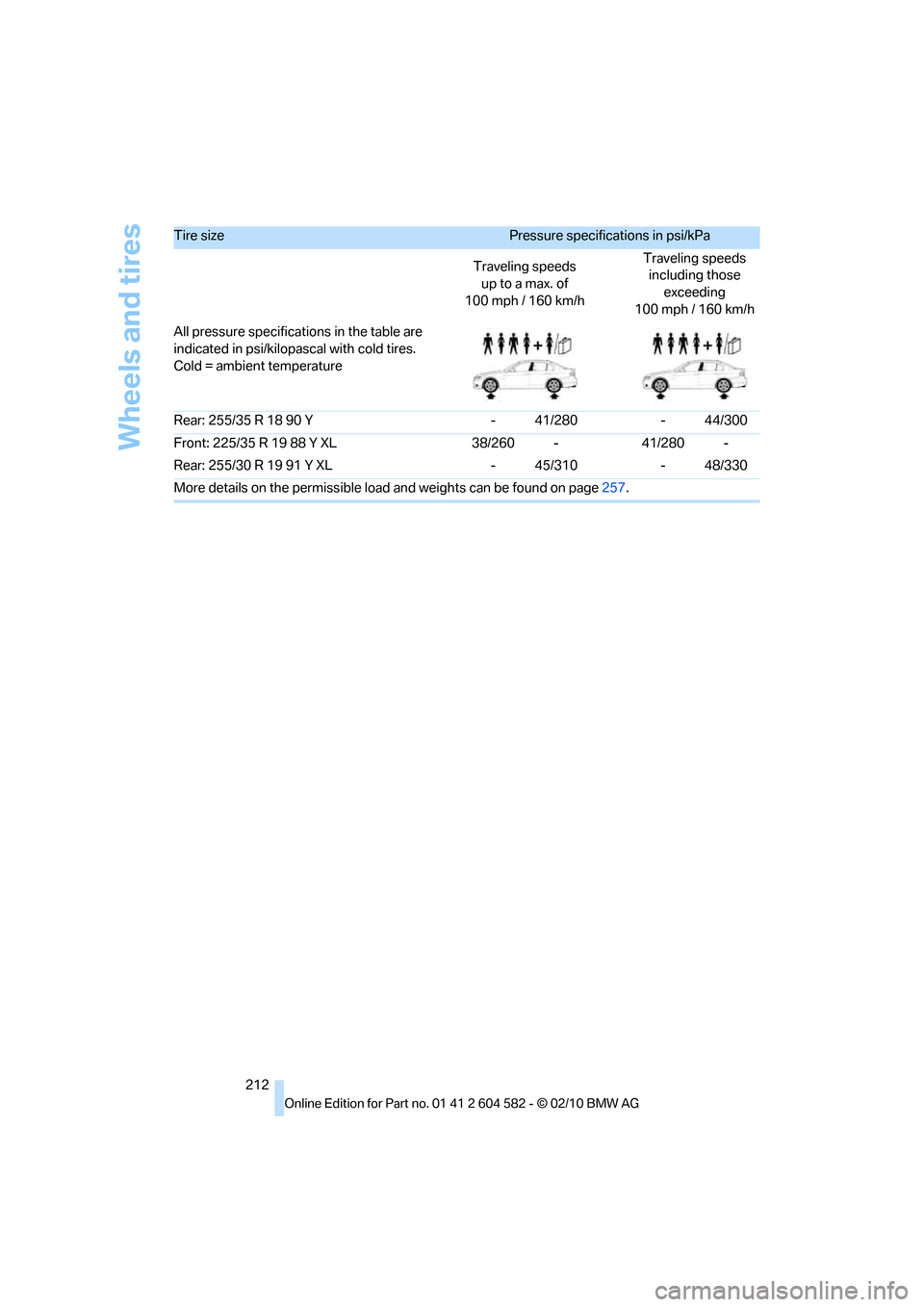
212 Rear: 255/35 R 18 90 Y - 41/280 - 44/300
Front: 225/35 R 19 88 Y XL 38/260 - 41/280 -
Rear: 255/30 R 19 91 Y XL - 45/310 - 48/330
More details on the permissible load and weights can be found on page257.
Tire size Pressure specifications in psi/kPa
Traveling speeds
up to a max. of
100 mph / 160 km/hTraveling speeds
including those
exceeding
100 mph / 160 km/h
All pressure specifications in the table are
indicated in psi/kilopascal with cold tires.
Cold = ambient temperature
Page 216 of 286
Wheels and tires
214
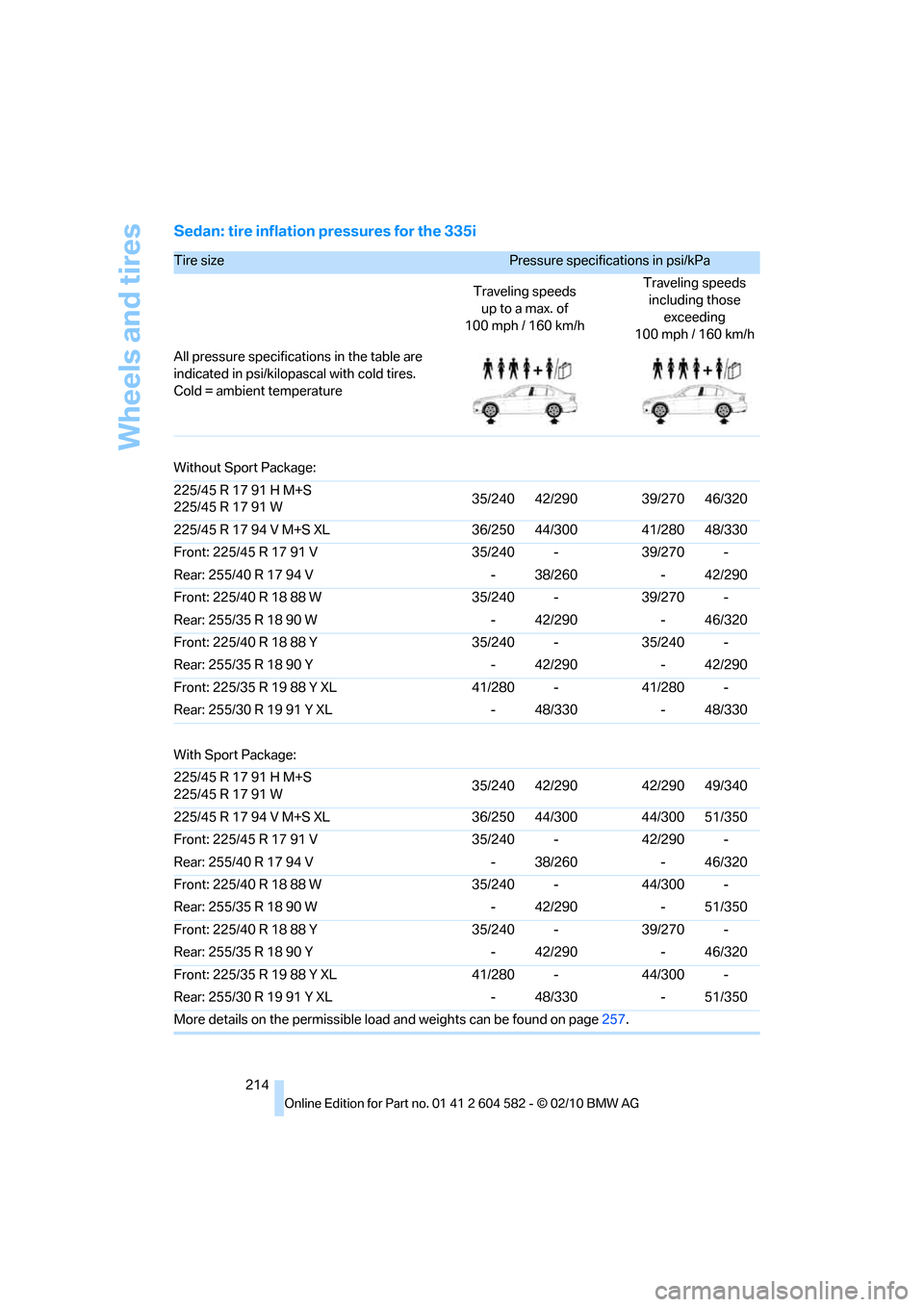
Sedan: tire inflation pressures for the 335i
Tire size Pressure specifications in psi/kPa
Traveling speeds
up to a max. of
100 mph / 160 km/hTraveling speeds
including those
exceeding
100 mph / 160 km/h
All pressure specifications in the table are
indicated in psi/kilopascal with cold tires.
Cold = ambient temperature
Without Sport Package:
225/45 R 17 91 H M+S
225/45 R 17 91 W35/240 42/290 39/270 46/320
225/45 R 17 94 V M+S XL 36/250 44/300 41/280 48/330
Front: 225/45 R 17 91 V 35/240 - 39/270 -
Rear: 255/40 R 17 94 V - 38/260 - 42/290
Front: 225/40 R 18 88 W 35/240 - 39/270 -
Rear: 255/35 R 18 90 W - 42/290 - 46/320
Front: 225/40 R 18 88 Y 35/240 - 35/240 -
Rear: 255/35 R 18 90 Y - 42/290 - 42/290
Front: 225/35 R 19 88 Y XL 41/280 - 41/280 -
Rear: 255/30 R 19 91 Y XL - 48/330 - 48/330
With Sport Package:
225/45 R 17 91 H M+S
225/45 R 17 91 W35/240 42/290 42/290 49/340
225/45 R 17 94 V M+S XL 36/250 44/300 44/300 51/350
Front: 225/45 R 17 91 V 35/240 - 42/290 -
Rear: 255/40 R 17 94 V - 38/260 - 46/320
Front: 225/40 R 18 88 W 35/240 - 44/300 -
Rear: 255/35 R 18 90 W - 42/290 - 51/350
Front: 225/40 R 18 88 Y 35/240 - 39/270 -
Rear: 255/35 R 18 90 Y - 42/290 - 46/320
Front: 225/35 R 19 88 Y XL 41/280 - 44/300 -
Rear: 255/30 R 19 91 Y XL - 48/330 - 51/350
More details on the permissible load and weights can be found on page257.
Page 218 of 286
Wheels and tires
216
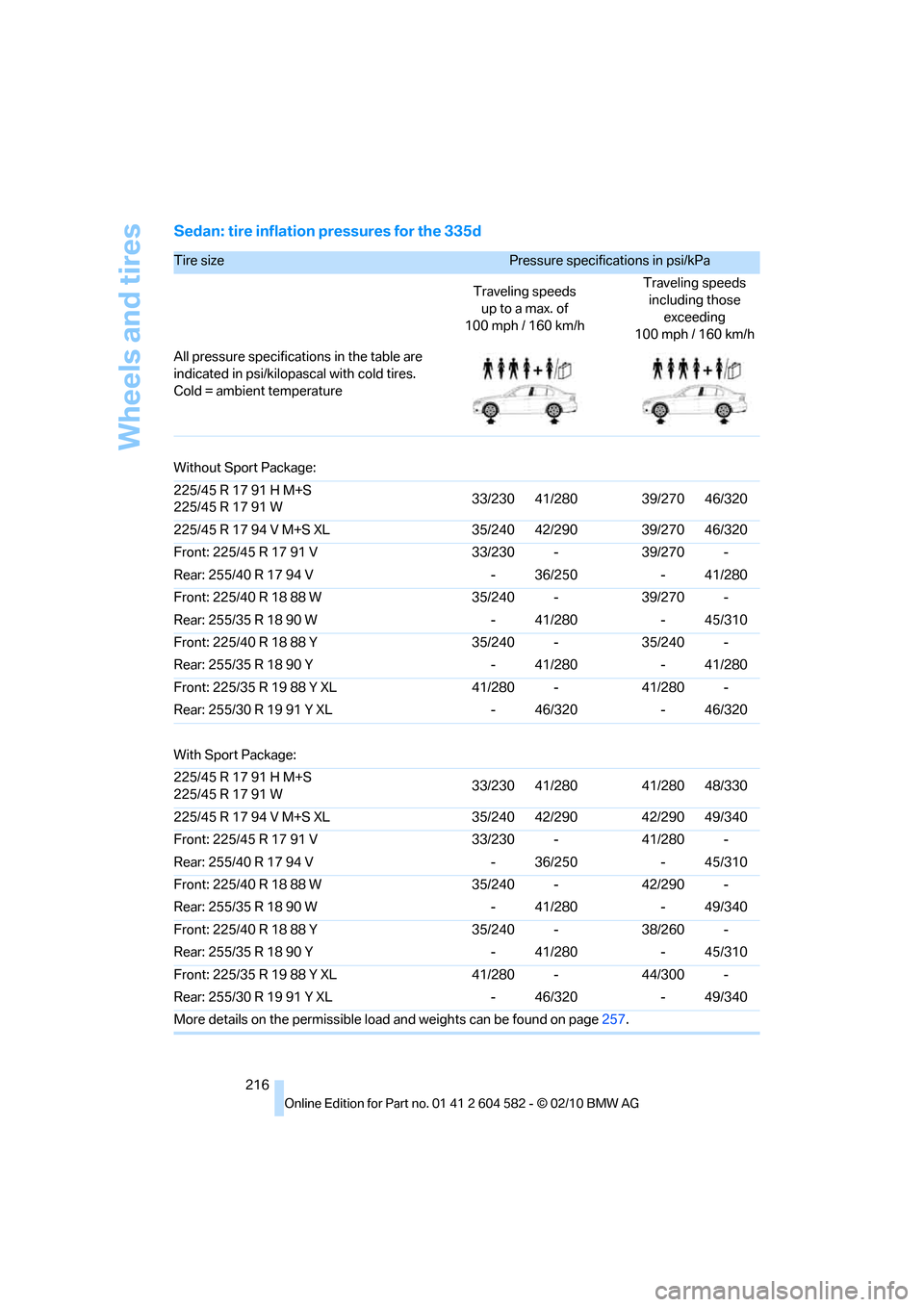
Sedan: tire inflation pressures for the 335d
Tire size Pressure specifications in psi/kPa
Traveling speeds
up to a max. of
100 mph / 160 km/hTraveling speeds
including those
exceeding
100 mph / 160 km/h
All pressure specifications in the table are
indicated in psi/kilopascal with cold tires.
Cold = ambient temperature
Without Sport Package:
225/45 R 17 91 H M+S
225/45 R 17 91 W33/230 41/280 39/270 46/320
225/45 R 17 94 V M+S XL 35/240 42/290 39/270 46/320
Front: 225/45 R 17 91 V 33/230 - 39/270 -
Rear: 255/40 R 17 94 V - 36/250 - 41/280
Front: 225/40 R 18 88 W 35/240 - 39/270 -
Rear: 255/35 R 18 90 W - 41/280 - 45/310
Front: 225/40 R 18 88 Y 35/240 - 35/240 -
Rear: 255/35 R 18 90 Y - 41/280 - 41/280
Front: 225/35 R 19 88 Y XL 41/280 - 41/280 -
Rear: 255/30 R 19 91 Y XL - 46/320 - 46/320
With Sport Package:
225/45 R 17 91 H M+S
225/45 R 17 91 W33/230 41/280 41/280 48/330
225/45 R 17 94 V M+S XL 35/240 42/290 42/290 49/340
Front: 225/45 R 17 91 V 33/230 - 41/280 -
Rear: 255/40 R 17 94 V - 36/250 - 45/310
Front: 225/40 R 18 88 W 35/240 - 42/290 -
Rear: 255/35 R 18 90 W - 41/280 - 49/340
Front: 225/40 R 18 88 Y 35/240 - 38/260 -
Rear: 255/35 R 18 90 Y - 41/280 - 45/310
Front: 225/35 R 19 88 Y XL 41/280 - 44/300 -
Rear: 255/30 R 19 91 Y XL - 46/320 - 49/340
More details on the permissible load and weights can be found on page257.
Page 220 of 286
Wheels and tires
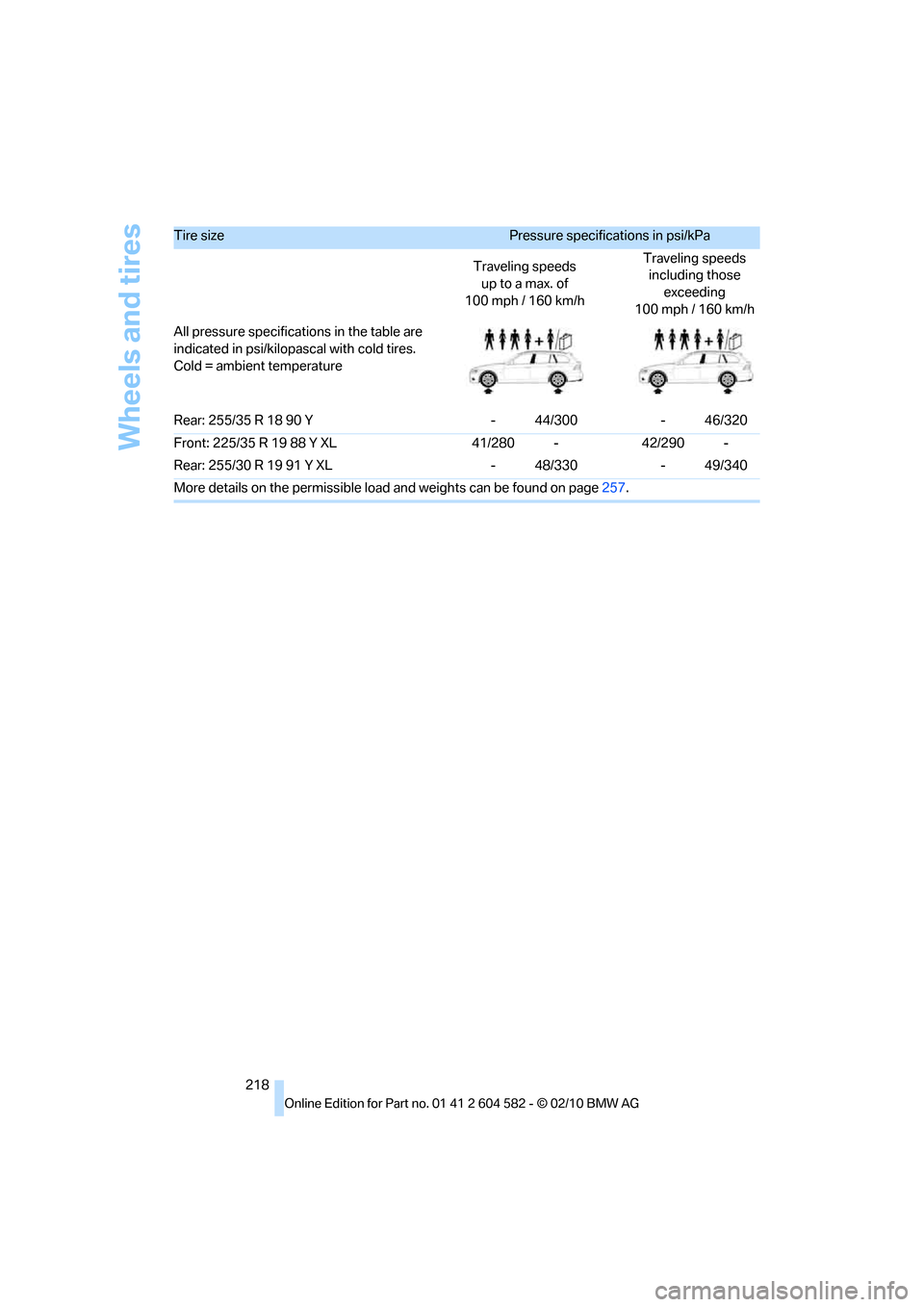
218 Rear: 255/35 R 18 90 Y - 44/300 - 46/320
Front: 225/35 R 19 88 Y XL 41/280 - 42/290 -
Rear: 255/30 R 19 91 Y XL - 48/330 - 49/340
More details on the permissible load and weights can be found on page257.
Tire size Pressure specifications in psi/kPa
Traveling speeds
up to a max. of
100 mph / 160 km/hTraveling speeds
including those
exceeding
100 mph / 160 km/h
All pressure specifications in the table are
indicated in psi/kilopascal with cold tires.
Cold = ambient temperature
Page 222 of 286
Wheels and tires
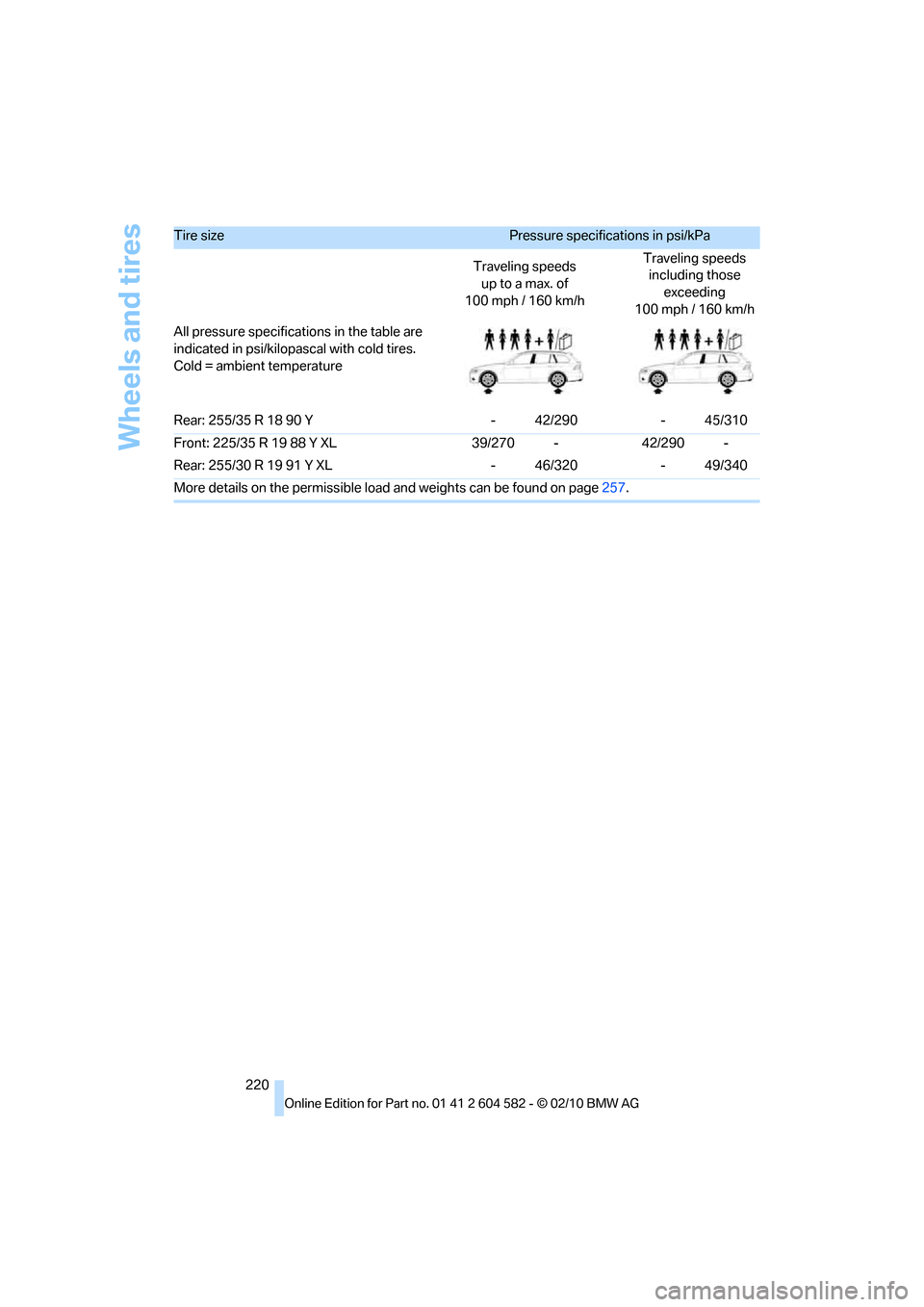
220 Rear: 255/35 R 18 90 Y - 42/290 - 45/310
Front: 225/35 R 19 88 Y XL 39/270 - 42/290 -
Rear: 255/30 R 19 91 Y XL - 46/320 - 49/340
More details on the permissible load and weights can be found on page257.
Tire size Pressure specifications in psi/kPa
Traveling speeds
up to a max. of
100 mph / 160 km/hTraveling speeds
including those
exceeding
100 mph / 160 km/h
All pressure specifications in the table are
indicated in psi/kilopascal with cold tires.
Cold = ambient temperature
Page 225 of 286
Mobility
223Reference
At a glance
Controls
Driving tips
Communications
Navigation
Entertainment
Tire age
For various reasons, such as the development
of brittleness, BMW recommends tire replace-
ment after no more than 6 years, regardless of
the actual wear of the tires.
The manufacturing date of tires is contained in
the tire coding:
DOT ... 1010 means that the tire was manufac-
tured in week 10 of 2010.
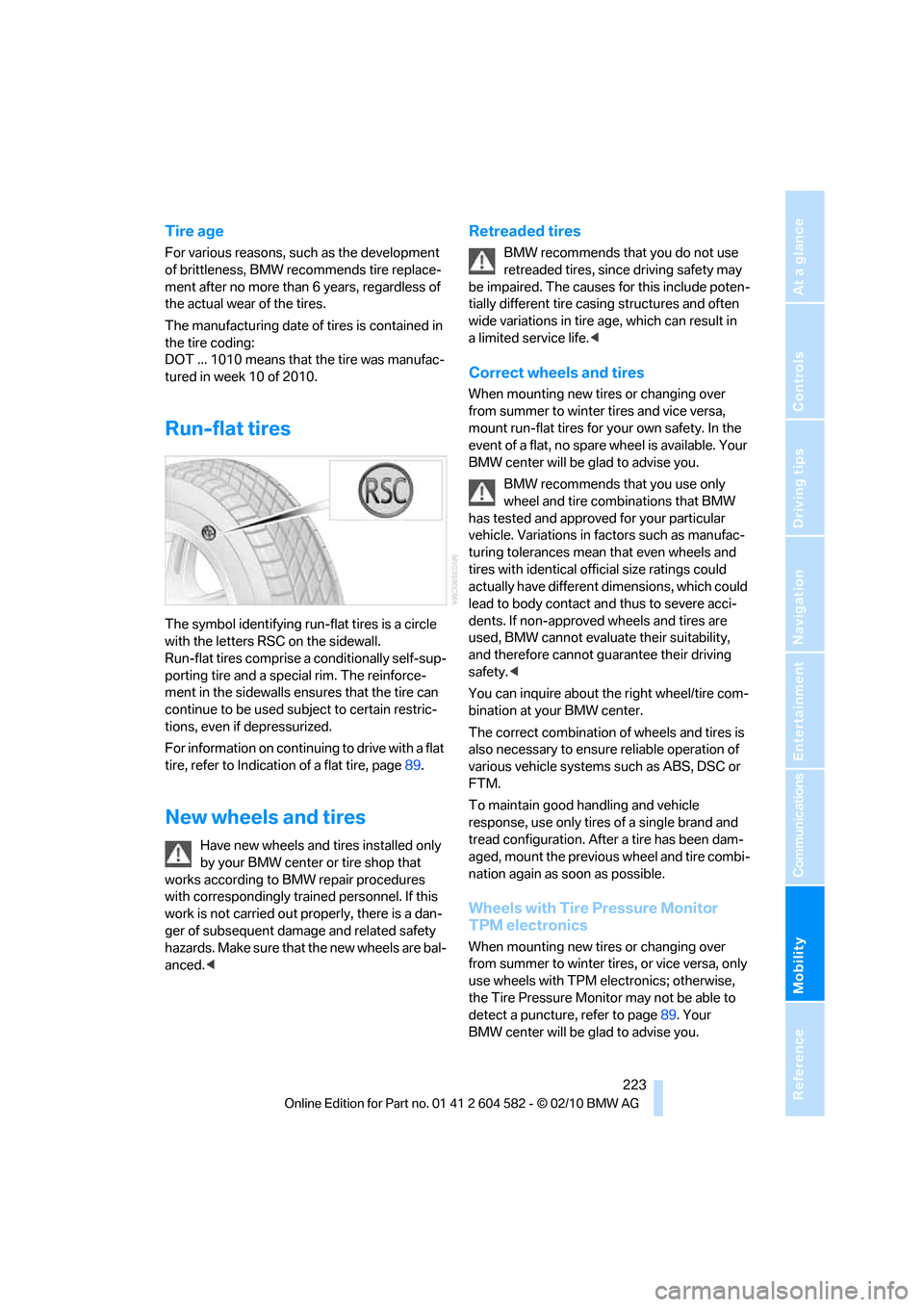
Run-flat tires
The symbol identifying run-flat tires is a circle
with the letters RSC on the sidewall.
Run-flat tires comprise a conditionally self-sup-
porting tire and a special rim. The reinforce-
ment in the sidewalls ensures that the tire can
continue to be used subject to certain restric-
tions, even if depressurized.
For information on continuing to drive with a flat
tire, refer to Indication of a flat tire, page89.
New wheels and tires
Have new wheels and tires installed only
by your BMW center or tire shop that
works according to BMW repair procedures
with correspondingly trained personnel. If this
work is not carried out properly, there is a dan-
ger of subsequent damage and related safety
hazards. Make sure that the new wheels are bal-
anced.<
Retreaded tires
BMW recommends that you do not use
retreaded tires, since driving safety may
be impaired. The causes for this include poten-
tially different tire casing structures and often
wide variations in tire age, which can result in
a limited service life.<
Correct wheels and tires
When mounting new tires or changing over
from summer to winter tires and vice versa,
mount run-flat tires for your own safety. In the
event of a flat, no spare wheel is available. Your
BMW center will be glad to advise you.
BMW recommends that you use only
wheel and tire combinations that BMW
has tested and approved for your particular
vehicle. Variations in factors such as manufac-
turing tolerances mean that even wheels and
tires with identical official size ratings could
actually have different dimensions, which could
lead to body contact and thus to severe acci-
dents. If non-approved wheels and tires are
used, BMW cannot evaluate their suitability,
and therefore cannot guarantee their driving
safety.<
You can inquire about the right wheel/tire com-
bination at your BMW center.
The correct combination of wheels and tires is
also necessary to ensure reliable operation of
various vehicle systems such as ABS, DSC or
FTM.
To maintain good handling and vehicle
response, use only tires of a single brand and
tread configuration. After a tire has been dam-
aged, mount the previous wheel and tire combi-
nation again as soon as possible.
Wheels with Tire Pressure Monitor
TPM electronics
When mounting new tires or changing over
from summer to winter tires, or vice versa, only
use wheels with TPM electronics; otherwise,
the Tire Pressure Monitor may not be able to
detect a puncture, refer to page89. Your
BMW center will be glad to advise you.
Page 226 of 286
Wheels and tires
224
Recommended tire brands
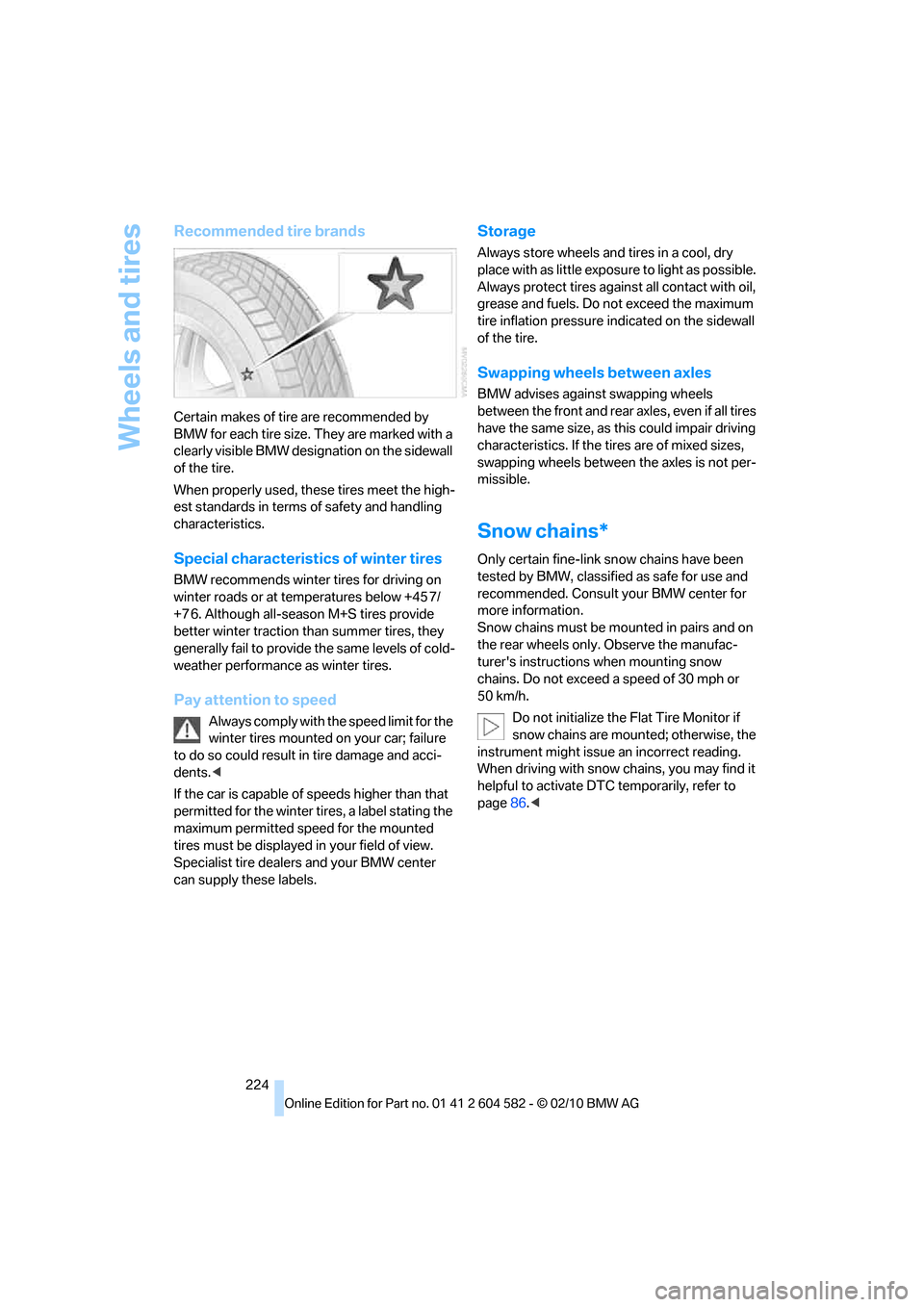
Certain makes of tire are recommended by
BMW for each tire size. They are marked with a
clearly visible BMW designation on the sidewall
of the tire.
When properly used, these tires meet the high-
est standards in terms of safety and handling
characteristics.
Special characteristics of winter tires
BMW recommends winter tires for driving on
winter roads or at temperatures below +45 7/
+7 6. Although all-season M+S tires provide
better winter traction than summer tires, they
generally fail to provide the same levels of cold-
weather performance as winter tires.
Pay attention to speed
Always comply with the speed limit for the
winter tires mounted on your car; failure
to do so could result in tire damage and acci-
dents.<
If the car is capable of speeds higher than that
permitted for the winter tires, a label stating the
maximum permitted speed for the mounted
tires must be displayed in your field of view.
Specialist tire dealers and your BMW center
can supply these labels.
Storage
Always store wheels and tires in a cool, dry
place with as little exposure to light as possible.
Always protect tires against all contact with oil,
grease and fuels. Do not exceed the maximum
tire inflation pressure indicated on the sidewall
of the tire.
Swapping wheels between axles
BMW advises against swapping wheels
between the front and rear axles, even if all tires
have the same size, as this could impair driving
characteristics. If the tires are of mixed sizes,
swapping wheels between the axles is not per-
missible.
Snow chains*
Only certain fine-link snow chains have been
tested by BMW, classified as safe for use and
recommended. Consult your BMW center for
more information.
Snow chains must be mounted in pairs and on
the rear wheels only. Observe the manufac-
turer's instructions when mounting snow
chains. Do not exceed a speed of 30 mph or
50 km/h.
Do not initialize the Flat Tire Monitor if
snow chains are mounted; otherwise, the
instrument might issue an incorrect reading.
When driving with snow chains, you may find it
helpful to activate DTC temporarily, refer to
page86.<
Page 281 of 286
Reference 279
At a glance
Controls
Driving tips
Communications
Navigation
Entertainment
Mobility
Temperature
– automatic climate
control103
– changing unit of measure76
– coolant, refer to Coolant
temperature72
Temperature display
– outside temperature71
– outside temperature
warning71
– setting the units76
Tempomat, refer to Cruise
control62
Tensioning straps, refer to
Securing cargo126
The individual vehicle5
Third brake lamp, refer to
Center brake lamp243
Through-loading system114
Through-loading system,
refer to Expanding the cargo
area115
Tilt alarm sensor34
Tilt function, passenger side
mirror49
Timer, refer to Preselecting
switch-on times106
Tire inflation pressure208
– loss89,90
Tire pressure monitoring,
refer to Flat Tire Monitor88
Tire Pressure Monitor
TPM89
– resetting the system90
– system limitations89
– warning lamp91
Tire puncture, refer to Flat Tire
Monitor89
Tire Quality Grading221Tires
– age221,223
– air loss91
– breaking in122
– changing, refer to Changing
wheels244
– condition222
– damage222
– inflation pressure208
– labels221
– minimum tread depth222
– new wheels and tires223
– pressure monitoring, refer to
Flat Tire Monitor88
– pressure monitoring, refer to
Tire Pressure Monitor
TPM89
– puncture89
– replacing223
– size221
– storage
224
– tread depth222
– wear indicators, refer to
Minimum tread depth222
– wheel/tire combination, refer
to Correct wheels and
tires223
– winter tires224
TMC station, refer to Traffic
bulletins144
Tone
– control150
– middle setting152
Tools, refer to Onboard
vehicle tool kit237
Top 50 of music
collection170
Torque, refer to Engine
data254
Tow bar249
Tow fitting249
– screw thread249
Tow fittings for tow-starting
and towing away249
Towing248
– car with automatic
transmission248
– methods249
Towing and tow-starting248Town/city, for navigation131
Tow rope250
Tow-starting248,250
TPM, refer to Tire Pressure
Monitor89
Track
– selecting on CD162
Traction control, refer to
Dynamic Stability Control
DSC85
Traffic bulletins
– categories145
Traffic bulletins, filtering145
Traffic bulletins for
navigation144
– display in map view145
– during destination
guidance146
Traffic jam
– displaying traffic
bulletins144
Transmission
– automatic transmission with
Steptronic57
– manual transmission57
– overriding selector lever lock
for automatic transmission
with Steptronic60
Transmission interlock
– refer to Changing selector
lever position58
– refer to P Park58
Transporting children
safely51
Transport securing devices,
refer to Securing cargo126
Tread depth, refer to Minimum
tire tread222
Trip, deleting139
Trip, storing139
Trip computer, refer to
Displays on the Control
Display74
Trip-distance counter, refer to
Trip odometer71
Triple turn signal activation60
Trip odometer71
Trips, changing139
Trunk, refer to Cargo area115