wheel BMW 325Ci 2003 Owners Manual
[x] Cancel search | Manufacturer: BMW, Model Year: 2003, Model line: 325Ci, Model: BMW 325Ci 2003Pages: 178, PDF Size: 4.59 MB
Page 5 of 178
5
Notes
Status at time of printing
BMW pursues a policy of continuous,
ongoing development conceived to
ensure that our vehicles continue to
embody the highest quality and safety
standards combined with advanced,
state-of-the-art technology. For this
reason, the features described in this
Owner's Manual could differ from those
in your vehicle. Nor can errors and
omissions be entirely ruled out. You are
therefore asked to appreciate that no
claims can be recognized on the basis
of the data, illustrations or descriptions
in this Owner's Manual.
For your own safety
Use unleaded gasoline only. Fuels
containing up to and including
10 % ethanol or other oxygenates with
up to 2.8 % oxygen by weight – that is,
15 % MTBE or 3 % methanol plus an
equivalent amount of co-solvent – will
not void the applicable warranties
respecting defects in materials or work-
manship. Field experience has indi-
cated significant differences in fuel
quality – volatility, composition, addi-
tives, etc. among gasolines offered for
sale in the United States and Canada.
The use of poor-quality fuels may result
in driveability, starting and stalling
problems, especially under certain
environmental conditions, such as high
ambient temperature and high altitude.
Should you encounter driveability prob-
lems which you suspect could be
related to the fuel you are using, we
recommend that you respond by
switching to a recognized high-quality
brand.
Failure to comply with these recom-
mendations may result in unscheduled
maintenance.
Obey all applicable safety rules when
handling gasoline.
<
Important safety information!
For your own safety, use genuine
parts and accessories approved by
BMW.
When you purchase accessories tested
and approved by BMW and Original
BMW Parts, you simultaneously acquire
the assurance that they have been thor-
oughly tested by BMW to ensure opti-
mum performance when installed on
your vehicle.
BMW warrants these parts to be free
from defects in material and workman-
ship.
BMW will not accept any liability for
damage resulting from installation of
parts and accessories not approved by
BMW.
BMW cannot test every product on the
market to determine whether it can be
used on a BMW safely and without risk
to either the vehicle, its operation, or its
occupants.
Original BMW Parts, BMW Accessories
and other products approved by BMW,
together with professional advice on
using these items, are available from all
BMW centers.
Installation and operation of non-BMW
approved accessories such as alarms,
radios, amplifiers, radar detectors,
wheels, suspension components, brake
handbook.book Page 5 Wednesday, July 31, 2002 9:29 AM
Page 8 of 178
Contents
Notes
About this Owner's Manual4
Symbols used4
Your individual vehicle4
Status at time of printing5
For your own safety5
Symbol on vehicle parts6
Service and warranty6
Reporting safety defects6
Overview
Cockpit14
Instrument cluster16
Indicator and warning lamps18
Steering wheel with multifunction
buttons*22
Hazard warning triangle*23
First-aid kit*23
Refueling24
Fuel specifications25
Tire inflation pressure25
Controls and features
Opening and closing:
Keys30
Central locking system30
Opening and closing – via the
remote control31
Opening and closing – via the
door lock33
Opening and closing – from the
inside34
Luggage compartment lid35
Luggage compartment37
Alarm system*38
Electric power windows40
Manual convertible top41
Fully-automatic convertible
top*46
Wind deflector*50
To adjust:
Safe seating position52
Seats52
Adjusting electric power
seats53
Lumbar support*53
Head restraints54
Entering the rear55
Safety belts56
Seat and mirror memory*57
Seat heating*58
Steering wheel59
Mirrors59
handbook.book Page 8 Wednesday, July 31, 2002 9:29 AM
Page 10 of 178
Contents
Operation, maintenance
Special operating instructions:
Break-in procedures122
Driving notes123
Antilock Brake System
(ABS)123
Brake system124
Hardtop*125
Wheels and tires:
Tire inflation pressure127
Tire condition127
Tire replacement128
Wheel and tire
combinations130
Winter tires130
In the engine compartment:
Hood132
Engine compartment
essentials134
Washer fluid136
Engine oil136
Coolant138
Brake fluid139
Maintenance:
The BMW Maintenance
System140
Laws and regulations:
California Proposition 65
warning141
OBD interface socket141
Owner service procedures
Replacement procedures:
Onboard tool kit146
Windshield wiper blades146
Lamps and bulbs147
Changing a wheel151
Run Flat tires*155
Battery156
Fuses156
Giving and receiving
assistance:
Jump-starting157
Towing the vehicle158
Technical data
Engine data162
Dimensions163
Weights164
Capacities165
handbook.book Page 10 Wednesday, July 31, 2002 9:29 AM
Page 15 of 178
15
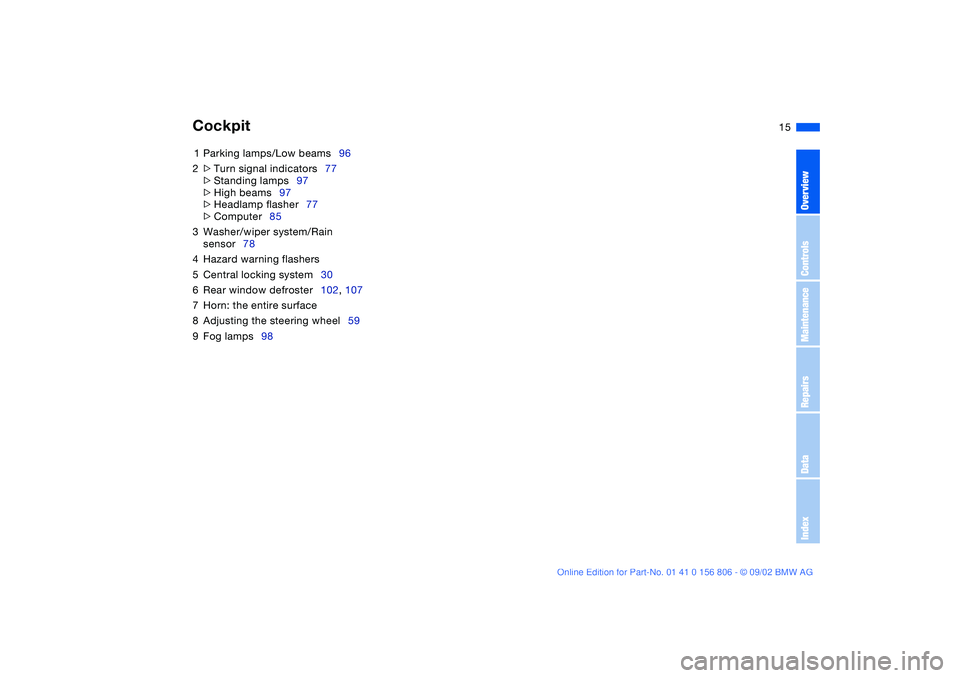
1Parking lamps/Low beams96
2
>
Turn signal indicators77
>
Standing lamps97
>
High beams97
>
Headlamp flasher77
>
Computer85
3Washer/wiper system/Rain
sensor78
4Hazard warning flashers
5Central locking system30
6Rear window defroster102, 107
7Horn: the entire surface
8Adjusting the steering wheel59
9Fog lamps98
Cockpit
OverviewControlsMaintenanceRepairsDataIndex
handbook.book Page 15 Wednesday, July 31, 2002 9:29 AM
Page 21 of 178
21
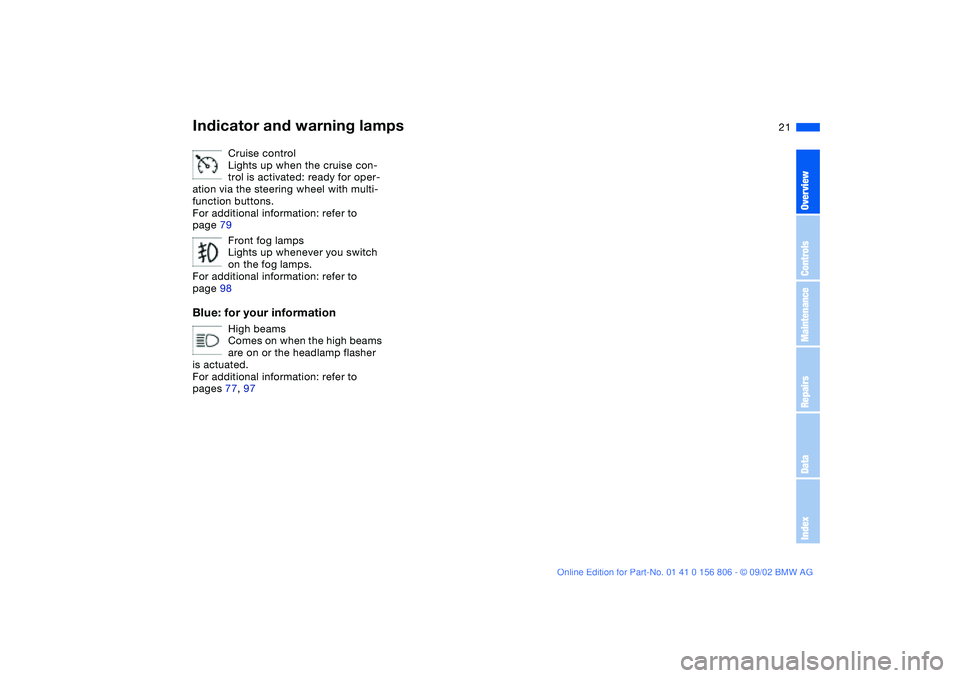
Cruise control
Lights up when the cruise con-
trol is activated: ready for oper-
ation via the steering wheel with multi-
function buttons.
For additional information: refer to
page 79
Front fog lamps
Lights up whenever you switch
on the fog lamps.
For additional information: refer to
page 98
Blue: for your information
High beams
Comes on when the high beams
are on or the headlamp flasher
is actuated.
For additional information: refer to
pages 77, 97
Indicator and warning lamps
OverviewControlsMaintenanceRepairsDataIndex
handbook.book Page 21 Wednesday, July 31, 2002 9:29 AM
Page 22 of 178
22
Steering wheel with multifunction buttons*
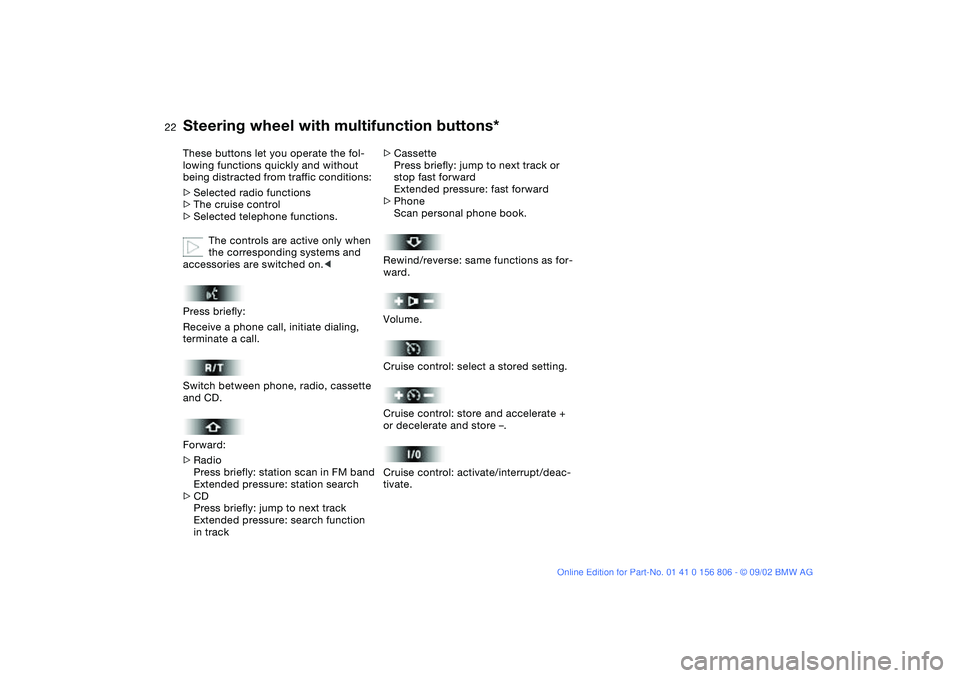
These buttons let you operate the fol-
lowing functions quickly and without
being distracted from traffic conditions:
>
Selected radio functions
>
The cruise control
>
Selected telephone functions.
The controls are active only when
the corresponding systems and
accessories are switched on.
<
Press briefly:
Receive a phone call, initiate dialing,
terminate a call.
Switch between phone, radio, cassette
and CD.
Forward:
>
Radio
Press briefly: station scan in FM band
Extended pressure: station search
>CD
Press briefly: jump to next track
Extended pressure: search function
in track
>Cassette
Press briefly: jump to next track or
stop fast forward
Extended pressure: fast forward
>Phone
Scan personal phone book.
Rewind/reverse: same functions as for-
ward.
Volume.
Cruise control: select a stored setting.
Cruise control: store and accelerate +
or decelerate and store –.
Cruise control: activate/interrupt/deac-
tivate.
handbook.book Page 22 Wednesday, July 31, 2002 9:29 AM
Page 38 of 178
38
Before lowering the convertible
top, refer to page 41 or 46, always
check to ensure that the luggage com-
partment panel has returned to its origi-
nal position. Attempts to lower the top
with the panel folded up can lead to
vehicle damage.<
Alarm system*The conceptThe vehicle alarm system responds:
>When a door, the hood or the lug-
gage compartment lid is opened
>To movements inside the vehicle –
interior motion sensor
>To variations in the vehicle's tilt angle
such as those occurring during
attempts to steal the wheels or tow
the vehicle – tilt alarm sensor
>To interruption of battery voltage.
The system responds to unauthorized
vehicle entry and attempted theft by
simultaneously activating the following:
>The acoustic alarm sounds for
30 seconds
>The hazard warning flashers are acti-
vated for approx. five minutes
>The high beams flash on and off in
rhythm with the hazard warning flash-
ers.To arm and disarm the alarm
systemWhen the vehicle is locked or unlocked
via the driver's door lock or with the
remote control, the alarm system is also
simultaneously armed or disarmed.You can have different acknowl-
edgment signals set to confirm
arming and disarming.<
You can open the luggage compart-
ment lid when the system is armed by
pressing the remote control button,
refer to page 32. The lid is once again
secured when it is closed.
Luggage compartment
handbook.book Page 38 Wednesday, July 31, 2002 9:29 AM
Page 52 of 178
52To adjust
Safe seating positionFor relaxed and fatigue-free driving you
should select a sitting position that
reflects your personal requirements. In
combination with the safety belts and
airbags, the correct seating position
plays an important role in enhancing
occupant safety in the event of an acci-
dent. To ensure that the vehicle's safety
systems provide you with optimal pro-
tection, we request that you direct your
careful attention to the following sec-
tion.
For supplementary information on
transporting children, refer to page 63.Sitting safely with airbags
Always maintain an adequate dis-
tance between yourself and the
airbags. Always hold the steering wheel
by the rim to keep any chance of injury
to hands or arms to an absolute mini-
mum should the airbag be deployed.
Never allow any objects, individuals or
animals to obstruct the areas between
passengers and airbags. Never use the
front airbag's cover as a storage tray or
support for objects of any kind. Never
allow front passengers to rest their feet
or legs on the airbag cover.<
For airbag locations and additional
information on airbags, refer to
page 61.Sitting safely with safety belts
Never allow more than one person
to wear a single safety belt. Never
allow infants or small children to ride in
a passenger's lap. Avoid twisting the
belt while routing it firmly across the
hips and shoulder, wear it as snugly
against your body as possible. Do not
allow the belt to rest against hard or
fragile objects. Do not route the belt
across your neck, or run it across sharp
edges. Be sure that the belt does not
become caught or jammed. Avoid
wearing bulky clothing and pull on the
lap belt periodically to retension it over
your shoulders. In the event of a frontal
impact, a loose lap belt could slide over
your hips, leading to abdominal injury.
In addition, the safety belt's restraint
effectiveness is reduced if it is worn
loosely. Expectant mothers should
always wear their safety belts, taking
care to position the lap belt against the
lower hips, where it will not exert pres-
sure against the abdominal area.<
For information on using the safety
belts, refer to page 56.
SeatsWhen adjusting your seat, always
observe the following precautions
Never try to adjust your seat while
operating the vehicle. The seat
could respond with unexpected move-
ment, and the ensuing loss of vehicle
control could lead to an accident. Never
ride with the backrest reclined to an
extreme angle. This is especially impor-
tant for the front passenger to remem-
ber. If you do so, there is a risk that you
will slide under the safety belt in an
accident, thus reducing the protection
provided by the safety belt.
With the wind deflector in place:
To avoid damaging the wind deflector
never push the front seats all the way
back.<
Seat adjustment>Power seat adjustment, refer to
page 53
>Head restraint, refer to page 54
>Entering the rear, refer to page 55.
handbook.book Page 52 Wednesday, July 31, 2002 9:29 AM
Page 59 of 178
59
Steering wheelTo adjust
Never attempt to adjust the steer-
ing wheel while driving the vehicle
– it could respond with unexpected
movement, posing a potential accident
hazard.<
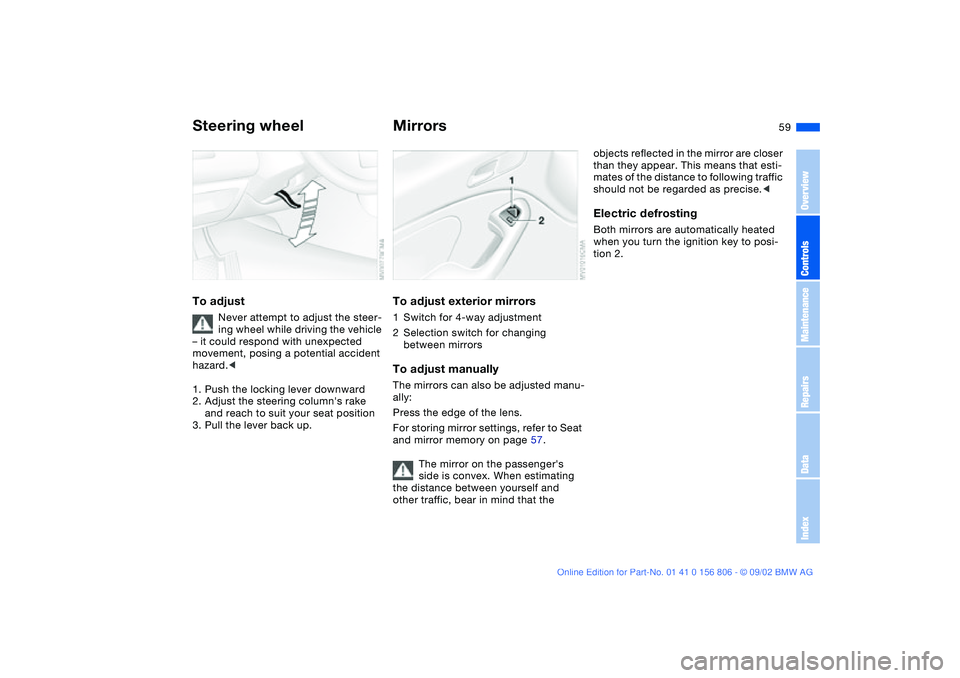
1. Push the locking lever downward
2. Adjust the steering column's rake
and reach to suit your seat position
3. Pull the lever back up.
MirrorsTo adjust exterior mirrors1Switch for 4-way adjustment
2Selection switch for changing
between mirrorsTo adjust manuallyThe mirrors can also be adjusted manu-
ally:
Press the edge of the lens.
For storing mirror settings, refer to Seat
and mirror memory on page 57.
The mirror on the passenger's
side is convex. When estimating
the distance between yourself and
other traffic, bear in mind that the
objects reflected in the mirror are closer
than they appear. This means that esti-
mates of the distance to following traffic
should not be regarded as precise.
tion 2.
OverviewControlsMaintenanceRepairsDataIndex
handbook.book Page 59 Wednesday, July 31, 2002 9:29 AM
Page 61 of 178
61 Passenger safety systems
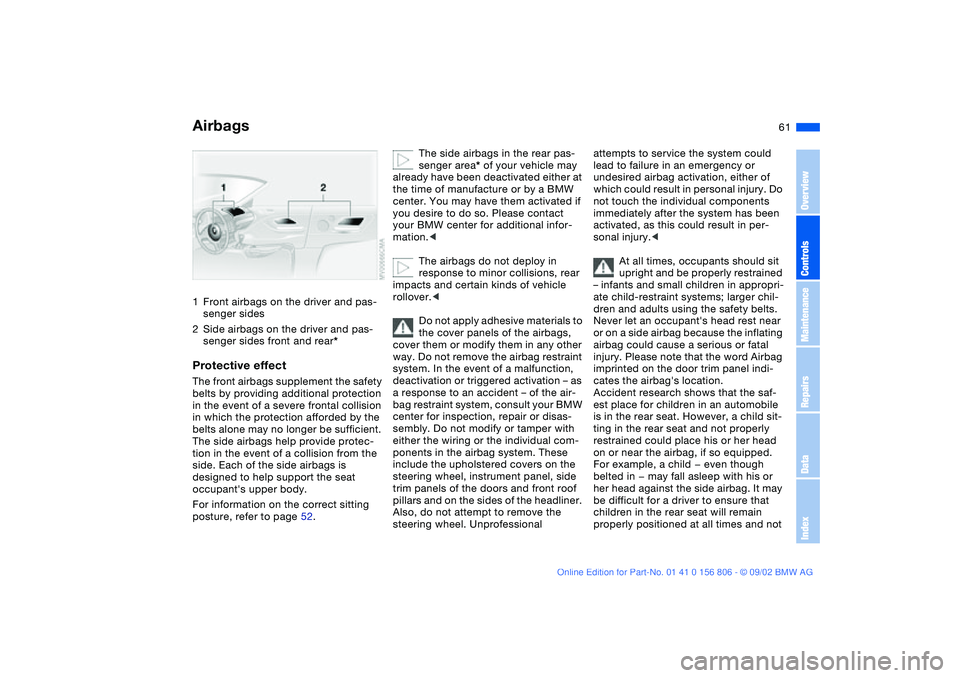
Airbags1Front airbags on the driver and pas-
senger sides
2Side airbags on the driver and pas-
senger sides front and rear*Protective effectThe front airbags supplement the safety
belts by providing additional protection
in the event of a severe frontal collision
in which the protection afforded by the
belts alone may no longer be sufficient.
The side airbags help provide protec-
tion in the event of a collision from the
side. Each of the side airbags is
designed to help support the seat
occupant's upper body.
For information on the correct sitting
posture, refer to page 52.
The side airbags in the rear pas-
senger area* of your vehicle may
already have been deactivated either at
the time of manufacture or by a BMW
center. You may have them activated if
you desire to do so. Please contact
your BMW center for additional infor-
mation.<
The airbags do not deploy in
response to minor collisions, rear
impacts and certain kinds of vehicle
rollover.<
Do not apply adhesive materials to
the cover panels of the airbags,
cover them or modify them in any other
way. Do not remove the airbag restraint
system. In the event of a malfunction,
deactivation or triggered activation – as
a response to an accident – of the air-
bag restraint system, consult your BMW
center for inspection, repair or disas-
sembly. Do not modify or tamper with
either the wiring or the individual com-
ponents in the airbag system. These
include the upholstered covers on the
steering wheel, instrument panel, side
trim panels of the doors and front roof
pillars and on the sides of the headliner.
Also, do not attempt to remove the
steering wheel. Unprofessional
attempts to service the system could
lead to failure in an emergency or
undesired airbag activation, either of
which could result in personal injury. Do
not touch the individual components
immediately after the system has been
activated, as this could result in per-
sonal injury.<
At all times, occupants should sit
upright and be properly restrained
– infants and small children in appropri-
ate child-restraint systems; larger chil-
dren and adults using the safety belts.
Never let an occupant's head rest near
or on a side airbag because the inflating
airbag could cause a serious or fatal
injury. Please note that the word Airbag
imprinted on the door trim panel indi-
cates the airbag's location.
Accident research shows that the saf-
est place for children in an automobile
is in the rear seat. However, a child sit-
ting in the rear seat and not properly
restrained could place his or her head
on or near the airbag, if so equipped.
For example, a child — even though
belted in — may fall asleep with his or
her head against the side airbag. It may
be difficult for a driver to ensure that
children in the rear seat will remain
properly positioned at all times and not
OverviewControlsMaintenanceRepairsDataIndex
handbook.book Page 61 Wednesday, July 31, 2002 9:29 AM