automatic transmission BMW 325CI 2004 User Guide
[x] Cancel search | Manufacturer: BMW, Model Year: 2004, Model line: 325CI, Model: BMW 325CI 2004Pages: 186, PDF Size: 2.76 MB
Page 81 of 186
81
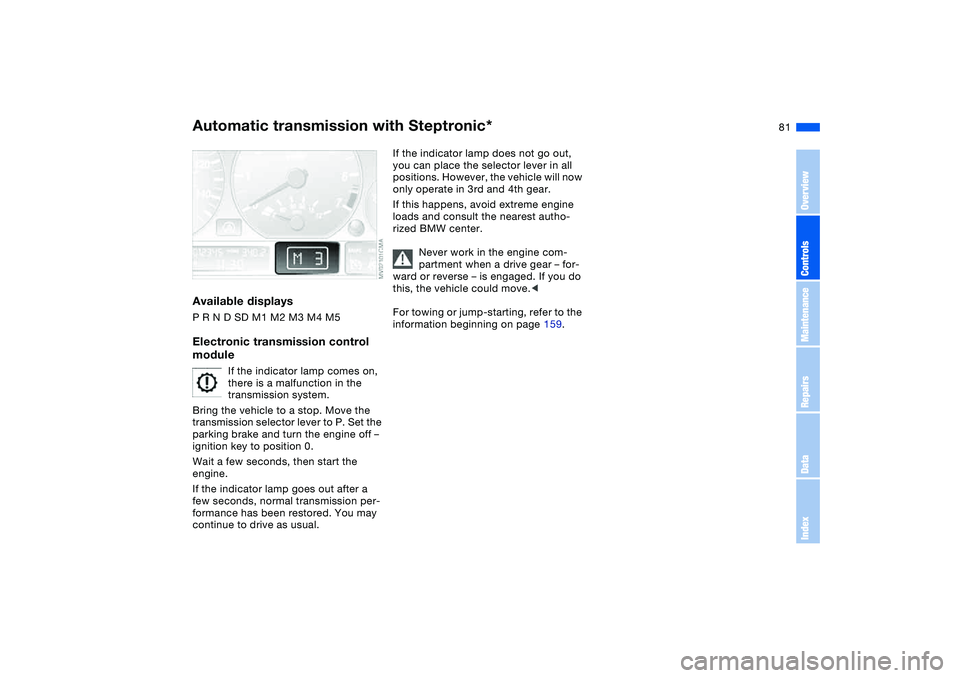
Available displaysP R N D SD M1 M2 M3 M4 M5Electronic transmission control
module
If the indicator lamp comes on,
there is a malfunction in the
transmission system.
Bring the vehicle to a stop. Move the
transmission selector lever to P. Set the
parking brake and turn the engine off –
ignition key to position 0.
Wait a few seconds, then start the
engine.
If the indicator lamp goes out after a
few seconds, normal transmission per-
formance has been restored. You may
continue to drive as usual.
If the indicator lamp does not go out,
you can place the selector lever in all
positions. However, the vehicle will now
only operate in 3rd and 4th gear.
If this happens, avoid extreme engine
loads and consult the nearest autho-
rized BMW center.
Never work in the engine com-
partment when a drive gear – for-
ward or reverse – is engaged. If you do
this, the vehicle could move.<
For towing or jump-starting, refer to the
information beginning on page 159.
Automatic transmission with Steptronic*
OverviewControlsMaintenanceRepairsDataIndex
Page 85 of 186
85
The speed stored in memory is deleted.To store and maintain speed or to
acceleratePress button + briefly:
The system maintains and stores the
current vehicle speed. Every time you
tap the button, the speed increases by
approx. 0.6 mph / 1 km/h.
Press and hold button +:
The vehicle accelerates without pres-
sure on the accelerator pedal. When
you release the button, the system
maintains and stores the current speed.
If on a downhill gradient the
engine braking effect is not suffi-
cient, the controlled speed can be
exceeded. Speed can drop on uphill
grades if the engine output is insuffi-
cient.<
To deceleratePress button – briefly:
If you are already driving with activated
cruise control, the speed is decreased
by approx. 0.6 mph / 1 km/h every time
you tap the button.
Press and hold button –:
With the cruise control active, the sys-
tem automatically reduces the throttle
opening to slow the vehicle. When you
release the button, the system main-
tains and stores the current speed.To interrupt the cruise controlWhen the system is activated, press the
button. The indicator lamp stays on.
You can use the cruise control again
whenever you want by calling up the
speed that was stored last.
In addition, cruise control is interrupted
automatically:
>When the brakes are applied
>When you apply pressure to the
clutch pedal, or when you move the
automatic transmission selector lever
from D to N
>If you exceed or fall below the pro-
grammed speed for an extended
period – by depressing the accelera-
tor, for example.To recall the stored settingPress the button:
The vehicle accelerates to and main-
tains the last speed stored.
Cruise control*
OverviewControlsMaintenanceRepairsDataIndex
Page 125 of 186
125
General driving notes
Brakes: do not drive with your foot
resting on the brake pedal. Even
light but consistent pedal pressure can
lead to high temperatures, brake wear
and possibly even brake failure.
Hydroplaning: when driving on wet or
slushy roads, reduce vehicle speed. If
you do not, a wedge of water may form
between the tires and the road surface.
This phenomenon can lead to partial or
complete loss of contact between the
tires and road surface, as well as loss of
vehicle control and braking ability.
Driving through water: do not drive
through water on the road if it is deeper
than 1 ft/30 cm, and then only at walk-
ing speed. Otherwise, the vehicle's
engine, the electrical systems and the
transmission may be damaged.
Clothes hooks, with hardtop: when
hanging clothing from the hooks, be
sure that they will not obstruct the
driver's vision. Do not hang heavy
objects on the hooks. If you do so, they
could cause personal injury during
braking or evasive maneuvers.<
Antilock Brake System (ABS)The conceptABS keeps the wheels from locking
during braking, thereby enhancing
active driving safety.Braking with ABSIf you are in a situation that requires full
braking, you will exploit the full benefits
of ABS system if you apply maximum
pedal pressure – panic stop.
Since the vehicle maintains steering
responsiveness, you can avoid possible
obstacles with a minimum of steering
effort, despite the full brake application.
Pulsation at the brake pedal combined
with sounds from the hydraulic circuits
indicates to the driver that ABS is in its
active mode.Dynamic Brake Control (DBC)DBC is included in the DSC, refer to
page 93. The system responds to sud-
den, high-intensity applications of force
to the brake pedal by automatically
braking the vehicle with maximum
boost to achieve the shortest possible
braking distances during panic stops.
This system also exploits the benefits of
ABS. Do not reduce the pressure exerted against the brake pedal until
the braking maneuver has been com-
pleted. DBC is deactivated when you
release the brake pedal.
Cornering Brake Control (CBC)CBC is an advanced engineering devel-
opment of ABS. When braking during
cornering with high lateral accelera-
tion, or when braking during a lane
change, vehicle stability is improved
and the steering response is enhanced.
OverviewControlsMaintenanceRepairsDataIndex
Page 139 of 186
139
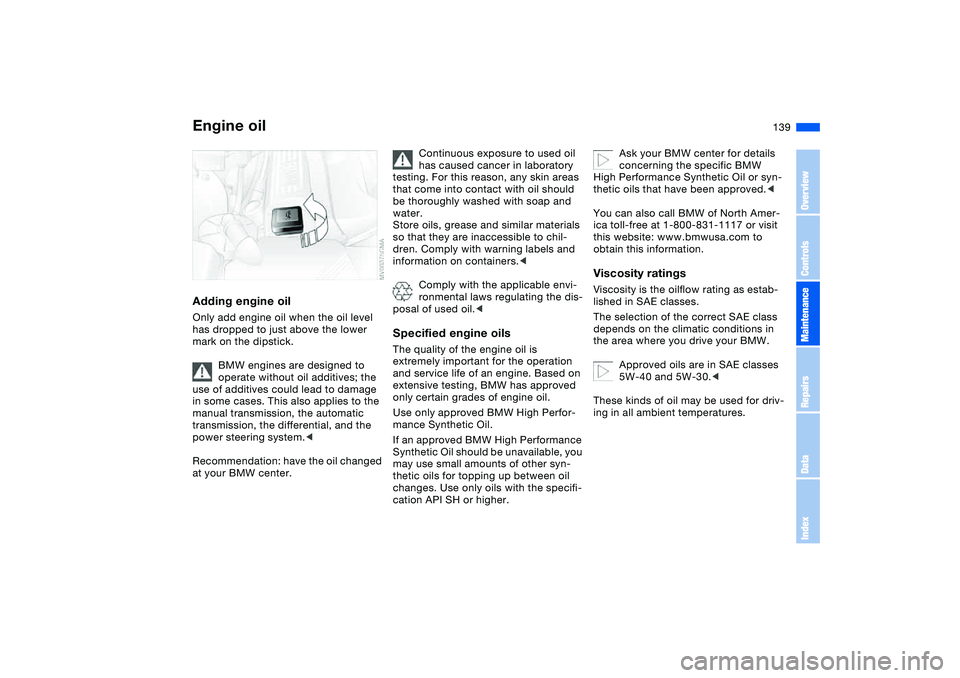
Adding engine oilOnly add engine oil when the oil level
has dropped to just above the lower
mark on the dipstick.
BMW engines are designed to
operate without oil additives; the
use of additives could lead to damage
in some cases. This also applies to the
manual transmission, the automatic
transmission, the differential, and the
power steering system.<
Recommendation: have the oil changed
at your BMW center.
Continuous exposure to used oil
has caused cancer in laboratory
testing. For this reason, any skin areas
that come into contact with oil should
be thoroughly washed with soap and
water.
Store oils, grease and similar materials
so that they are inaccessible to chil-
dren. Comply with warning labels and
information on containers.<
Comply with the applicable envi-
ronmental laws regulating the dis-
posal of used oil.<
Specified engine oilsThe quality of the engine oil is
extremely important for the operation
and service life of an engine. Based on
extensive testing, BMW has approved
only certain grades of engine oil.
Use only approved BMW High Perfor-
mance Synthetic Oil.
If an approved BMW High Performance
Synthetic Oil should be unavailable, you
may use small amounts of other syn-
thetic oils for topping up between oil
changes. Use only oils with the specifi-
cation API SH or higher.
Ask your BMW center for details
concerning the specific BMW
High Performance Synthetic Oil or syn-
thetic oils that have been approved.<
You can also call BMW of North Amer-
ica toll-free at 1-800-831-1117 or visit
this website: www.bmwusa.com to
obtain this information.
Viscosity ratingsViscosity is the oilflow rating as estab-
lished in SAE classes.
The selection of the correct SAE class
depends on the climatic conditions in
the area where you drive your BMW.
Approved oils are in SAE classes
5W-40 and 5W-30.<
These kinds of oil may be used for driv-
ing in all ambient temperatures.
Engine oil
OverviewControlsMaintenanceRepairsDataIndex
Page 161 of 186
161
Towing the vehicle with the front
axle raisedVehicles with automatic transmission:
1. Towing speed: maximum 45 mph /
70 km/h
2. Towing distance: maximum
90 miles/150 km.
Vehicles with sequential manual gear-
box SMG:
While the ignition is on, move the selec-
tor lever to position N, then turn off the
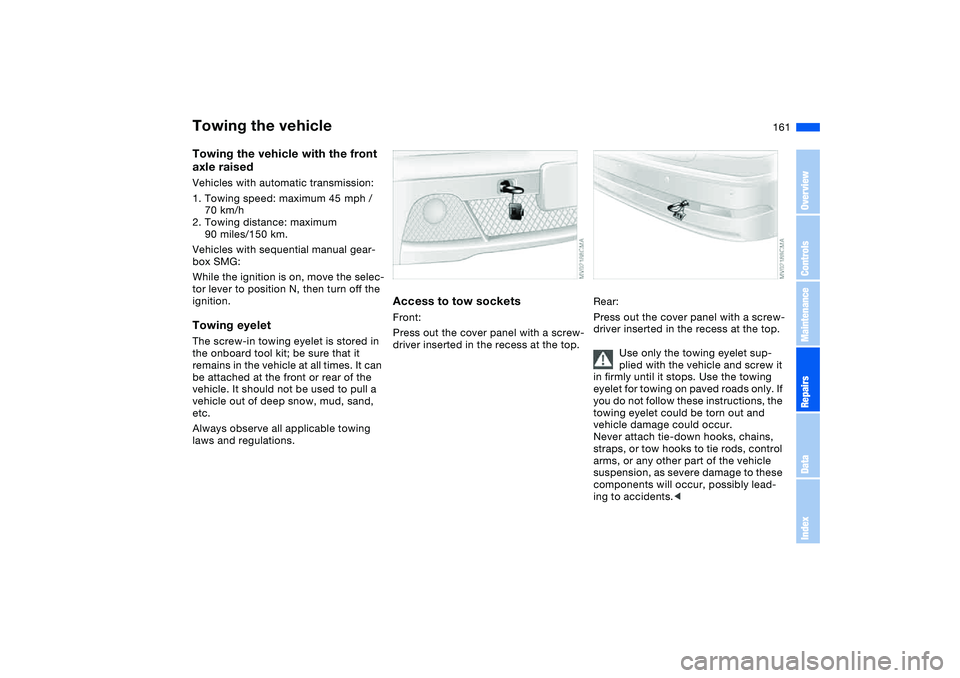
ignition.Towing eyeletThe screw-in towing eyelet is stored in
the onboard tool kit; be sure that it
remains in the vehicle at all times. It can
be attached at the front or rear of the
vehicle. It should not be used to pull a
vehicle out of deep snow, mud, sand,
etc.
Always observe all applicable towing
laws and regulations.
Access to tow socketsFront:
Press out the cover panel with a screw-
driver inserted in the recess at the top.
Rear:
Press out the cover panel with a screw-
driver inserted in the recess at the top.
Use only the towing eyelet sup-
plied with the vehicle and screw it
in firmly until it stops. Use the towing
eyelet for towing on paved roads only. If
you do not follow these instructions, the
towing eyelet could be torn out and
vehicle damage could occur.
Never attach tie-down hooks, chains,
straps, or tow hooks to tie rods, control
arms, or any other part of the vehicle
suspension, as severe damage to these
components will occur, possibly lead-
ing to accidents.<
Towing the vehicle
OverviewControlsMaintenanceRepairsDataIndex
Page 168 of 186
168
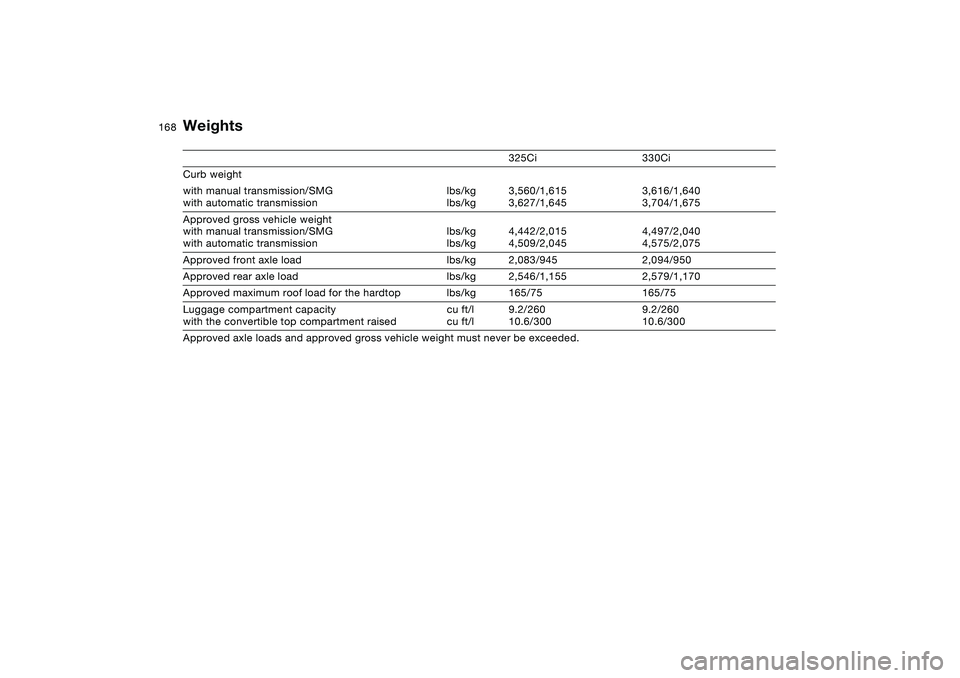
Weights
325Ci 330Ci
Curb weight
with manual transmission/SMG
with automatic transmissionlbs/kg
lbs/kg3,560/1,615
3,627/1,6453,616/1,640
3,704/1,675
Approved gross vehicle weight
with manual transmission/SMG
with automatic transmissionlbs/kg
lbs/kg4,442/2,015
4,509/2,0454,497/2,040
4,575/2,075
Approved front axle load lbs/kg 2,083/945 2,094/950
Approved rear axle load lbs/kg 2,546/1,155 2,579/1,170
Approved maximum roof load for the hardtop lbs/kg 165/75 165/75
Luggage compartment capacity
with the convertible top compartment raisedcu ft/l
cu ft/l9.2/260
10.6/3009.2/260
10.6/300
Approved axle loads and approved gross vehicle weight must never be exceeded.
Page 169 of 186
169
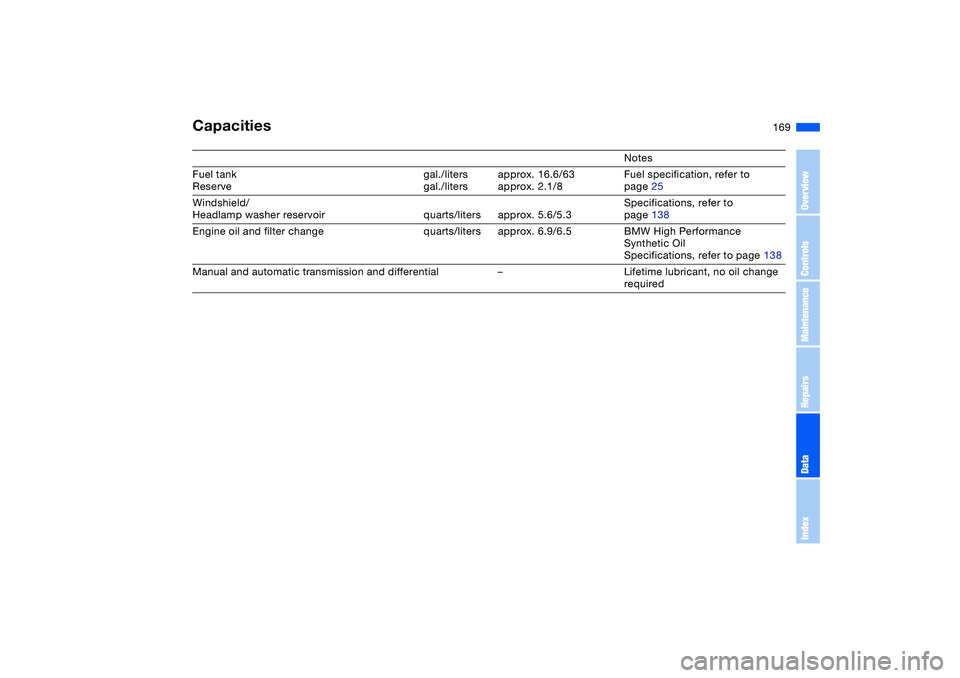
Capacities
Notes
Fuel tank
Reservegal./liters
gal./litersapprox. 16.6/63
approx. 2.1/8Fuel specification, refer to
page 25
Windshield/
Headlamp washer reservoir quarts/liters approx. 5.6/5.3Specifications, refer to
page 138
Engine oil and filter change quarts/liters approx. 6.9/6.5 BMW High Performance
Synthetic Oil
Specifications, refer to page 138
Manual and automatic transmission and differential – Lifetime lubricant, no oil change
required
OverviewControlsMaintenanceRepairsDataIndex
Page 172 of 186
Everything from A to ZA
ABS Antilock Brake
System 125
indicator lamp 19
Acceleration assistant 78
Accessories, refer to For
your own safety 5
Accident, refer to Emer-
gency call 158
Activated-charcoal filter 110
Adaptive headlights 98
Adding brake fluid 141
Additional sources of infor-
mation 4
Air conditioning 102
Air conditioning mode 104
automatic climate
control 108
Air distribution
air conditioning 104
automatic climate
control 108
Air distribution,
individual 108
Air outlets, refer to Ventila-
tion 102, 106
Air pressure, refer to Tire
inflation pressure 25, 129
Air recirculation, refer to
Recirculated-air mode
104, 109Air supply
air conditioning 104
automatic climate
control 108
Air, drying, refer to Air con-
ditioning mode 104, 108
Airbags 61
deactivating 64
indicator lamp 18, 63
sitting safely 52
Airing out, refer to Ventila-
tion 102, 106
AKI, refer to Fuel specifica-
tions 25
Alarm system 38
avoiding unintentional
alarms 39
All-season tires, refer to
Winter tires 132
Antifreeze 140
coolant 140
washer fluid 138
Antilock Brake System
(ABS) 125
indicator lamp 19
Anti-theft system 30
Anti-theft warning system,
refer to Alarm system 38
Approved axle loads, refer
to Weights 168
Approved gross weight,
refer to Weights 168Armrest 114
Artificial leather, refer to the
Caring for your vehicle
brochure
Ashtray
front 115
rear 116
Assistant systems, refer to
Dynamic Stability Control
(DSC) 93
AUC Automatic recircu-
lated-air control 109
AUTO program, refer to
Automatic air
distribution 108
Automatic
air distribution 108
air supply 108
cruise control 84
headlamp control 97
Automatic car wash, refer to
the Caring for your vehicle
brochure
Automatic climate
control 106
Automatic curb monitor 58
Automatic dimming, interior
rearview mirror 60
Automatic recirculated-air
control (AUC) 109Automatic transmission with
Steptronic 79
indicator lamp 19, 81
interlock 71
selector lever lock 79
shiftlock 79
Automatic windshield
washer, refer to Rain sen-
sor 83
Average fuel
consumption 91
Average speed 91
Avoiding unintentional
alarms 39
Axle loads, refer to
Weights 168
B
Backrest
unlock 55
Backrest, refer to Seat
adjustment 53
Backup lamps 74
bulb replacement 151
Bandages, refer to First-aid
kit 23
Bar, towing 161
Page 175 of 186
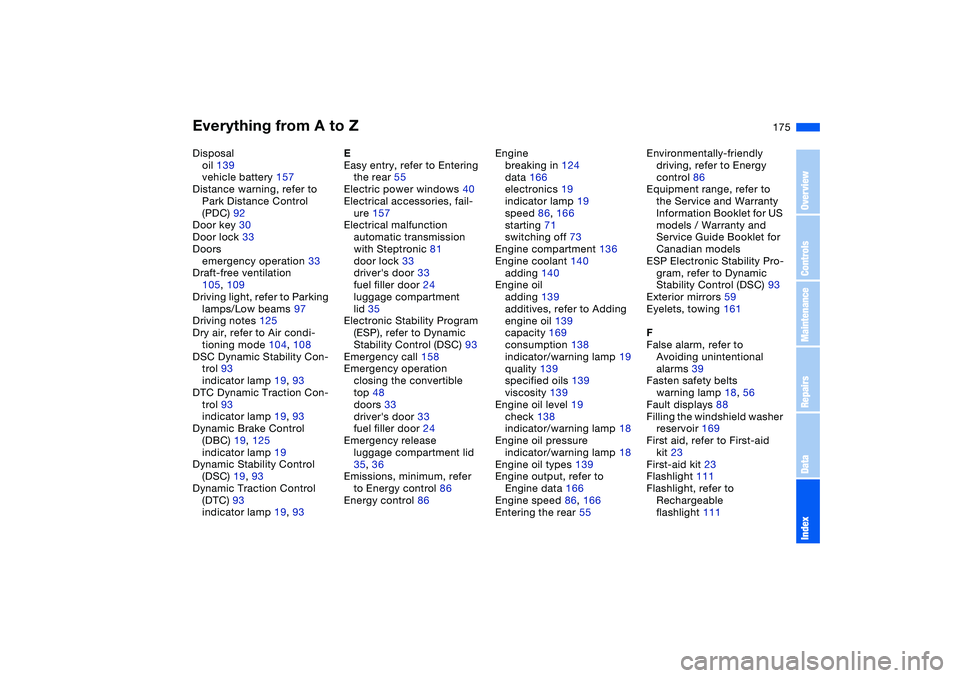
Everything from A to Z
175
Disposal
oil 139
vehicle battery 157
Distance warning, refer to
Park Distance Control
(PDC) 92
Door key 30
Door lock 33
Doors
emergency operation 33
Draft-free ventilation
105, 109
Driving light, refer to Parking
lamps/Low beams 97
Driving notes 125
Dry air, refer to Air condi-
tioning mode 104, 108
DSC Dynamic Stability Con-
trol 93
indicator lamp 19, 93
DTC Dynamic Traction Con-
trol 93
indicator lamp 19, 93
Dynamic Brake Control
(DBC) 19, 125
indicator lamp 19
Dynamic Stability Control
(DSC) 19, 93
Dynamic Traction Control
(DTC) 93
indicator lamp 19, 93E
Easy entry, refer to Entering
the rear 55
Electric power windows 40
Electrical accessories, fail-
ure 157
Electrical malfunction
automatic transmission
with Steptronic 81
door lock 33
driver's door 33
fuel filler door 24
luggage compartment
lid 35
Electronic Stability Program
(ESP), refer to Dynamic
Stability Control (DSC) 93
Emergency call 158
Emergency operation
closing the convertible
top 48
doors 33
driver's door 33
fuel filler door 24
Emergency release
luggage compartment lid
35, 36
Emissions, minimum, refer
to Energy control 86
Energy control 86Engine
breaking in 124
data 166
electronics 19
indicator lamp 19
speed 86, 166
starting 71
switching off 73
Engine compartment 136
Engine coolant 140
adding 140
Engine oil
adding 139
additives, refer to Adding
engine oil 139
capacity 169
consumption 138
indicator/warning lamp 19
quality 139
specified oils 139
viscosity 139
Engine oil level 19
check 138
indicator/warning lamp 18
Engine oil pressure
indicator/warning lamp 18
Engine oil types 139
Engine output, refer to
Engine data 166
Engine speed 86, 166
Entering the rear 55Environmentally-friendly
driving, refer to Energy
control 86
Equipment range, refer to
the Service and Warranty
Information Booklet for US
models / Warranty and
Service Guide Booklet for
Canadian models
ESP Electronic Stability Pro-
gram, refer to Dynamic
Stability Control (DSC) 93
Exterior mirrors 59
Eyelets, towing 161
F
False alarm, refer to
Avoiding unintentional
alarms 39
Fasten safety belts
warning lamp 18, 56
Fault displays 88
Filling the windshield washer
reservoir 169
First aid, refer to First-aid
kit 23
First-aid kit 23
Flashlight 111
Flashlight, refer to
Rechargeable
flashlight 111
OverviewControlsMaintenanceRepairsDataIndex
Page 176 of 186
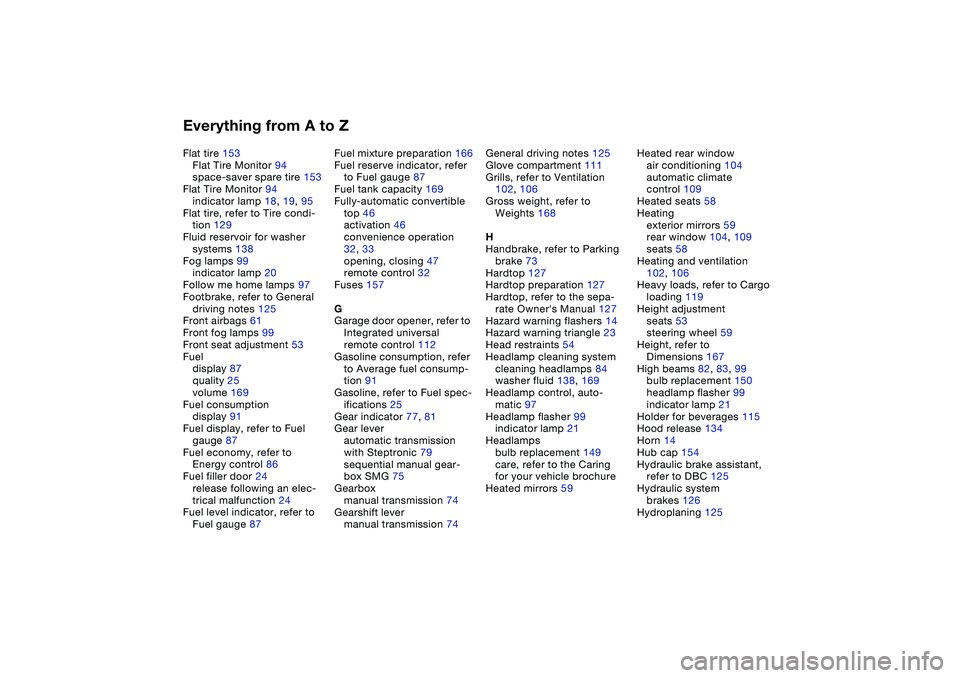
Everything from A to ZFlat tire 153
Flat Tire Monitor 94
space-saver spare tire 153
Flat Tire Monitor 94
indicator lamp 18, 19, 95
Flat tire, refer to Tire condi-
tion 129
Fluid reservoir for washer
systems 138
Fog lamps 99
indicator lamp 20
Follow me home lamps 97
Footbrake, refer to General
driving notes 125
Front airbags 61
Front fog lamps 99
Front seat adjustment 53
Fuel
display 87
quality 25
volume 169
Fuel consumption
display 91
Fuel display, refer to Fuel
gauge 87
Fuel economy, refer to
Energy control 86
Fuel filler door 24
release following an elec-
trical malfunction 24
Fuel level indicator, refer to
Fuel gauge 87Fuel mixture preparation 166
Fuel reserve indicator, refer
to Fuel gauge 87
Fuel tank capacity 169
Fully-automatic convertible
top 46
activation 46
convenience operation
32, 33
opening, closing 47
remote control 32
Fuses 157
G
Garage door opener, refer to
Integrated universal
remote control 112
Gasoline consumption, refer
to Average fuel consump-
tion 91
Gasoline, refer to Fuel spec-
ifications 25
Gear indicator 77, 81
Gear lever
automatic transmission
with Steptronic 79
sequential manual gear-
box SMG 75
Gearbox
manual transmission 74
Gearshift lever
manual transmission 74General driving notes 125
Glove compartment 111
Grills, refer to Ventilation
102, 106
Gross weight, refer to
Weights 168
H
Handbrake, refer to Parking
brake 73
Hardtop 127
Hardtop preparation 127
Hardtop, refer to the sepa-
rate Owner's Manual 127
Hazard warning flashers 14
Hazard warning triangle 23
Head restraints 54
Headlamp cleaning system
cleaning headlamps 84
washer fluid 138, 169
Headlamp control, auto-
matic 97
Headlamp flasher 99
indicator lamp 21
Headlamps
bulb replacement 149
care, refer to the Caring
for your vehicle brochure
Heated mirrors 59Heated rear window
air conditioning 104
automatic climate
control 109
Heated seats 58
Heating
exterior mirrors 59
rear window 104, 109
seats 58
Heating and ventilation
102, 106
Heavy loads, refer to Cargo
loading 119
Height adjustment
seats 53
steering wheel 59
Height, refer to
Dimensions 167
High beams 82, 83, 99
bulb replacement 150
headlamp flasher 99
indicator lamp 21
Holder for beverages 115
Hood release 134
Horn 14
Hub cap 154
Hydraulic brake assistant,
refer to DBC 125
Hydraulic system
brakes 126
Hydroplaning 125