lock BMW 325CI 2005 Service Manual
[x] Cancel search | Manufacturer: BMW, Model Year: 2005, Model line: 325CI, Model: BMW 325CI 2005Pages: 190, PDF Size: 2.79 MB
Page 109 of 190
109 Interior conveniences
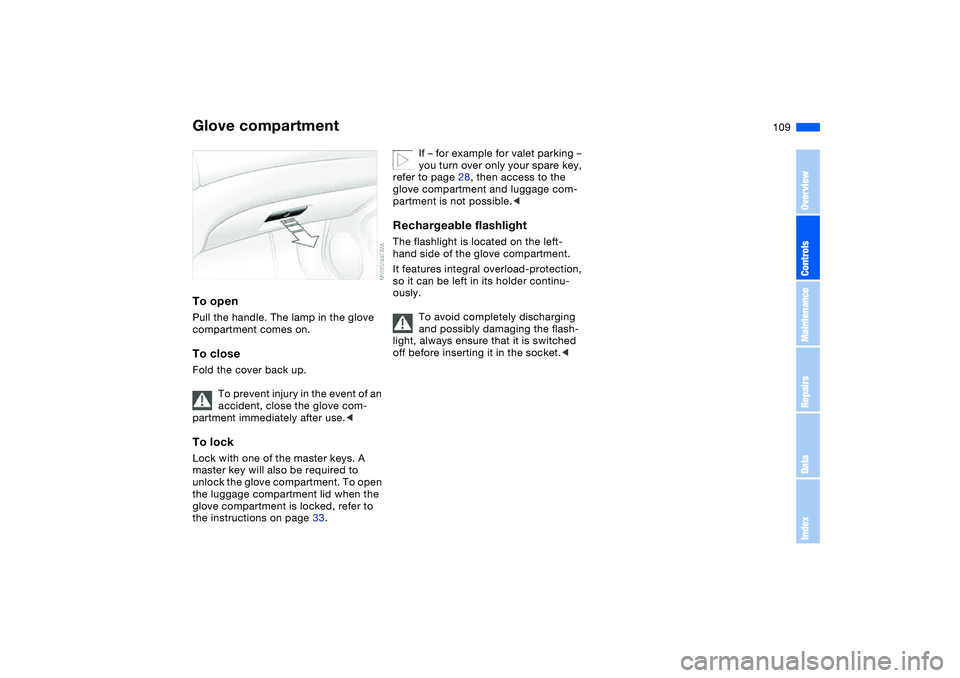
Glove compartmentTo openPull the handle. The lamp in the glove
compartment comes on.To closeFold the cover back up.
To prevent injury in the event of an
accident, close the glove com-
partment immediately after use.
unlock the glove compartment. To open
the luggage compartment lid when the
glove compartment is locked, refer to
the instructions on page 33.
If – for example for valet parking –
you turn over only your spare key,
refer to page 28, then access to the
glove compartment and luggage com-
partment is not possible.<
Rechargeable flashlightThe flashlight is located on the left-
hand side of the glove compartment.
It features integral overload-protection,
so it can be left in its holder continu-
ously.
To avoid completely discharging
and possibly damaging the flash-
light, always ensure that it is switched
off before inserting it in the socket.<
OverviewControlsMaintenanceRepairsDataIndex
Page 127 of 190
127
Antilock Brake System (ABS)The conceptABS keeps the wheels from locking
during braking, thereby enhancing
active driving safety.Braking with ABSIf you are in a situation that requires full
braking, you will exploit the full benefits
of ABS system if you apply maximum
pedal pressure: panic stop.
Since the vehicle maintains steering
responsiveness, you can avoid possible
obstacles with a minimum of steering
effort, despite the full brake application.
Pulsation at the brake pedal combined
with sounds from the hydraulic circuits
indicates to the driver that ABS is in its
active mode.Dynamic Brake Control (DBC)DBC is included in the DSC, refer to
page 91. The system responds to sud-
den, high-intensity applications of force
to the brake pedal by automatically
braking the vehicle with maximum
boost to achieve the shortest possible
braking distances during panic stops.
This system also exploits the benefits of
ABS. Do not reduce the pressure exerted against the brake pedal until
the braking maneuver has been com-
pleted. DBC is deactivated when you
release the brake pedal.
Cornering Brake Control (CBC)CBC is an advanced engineering devel-
opment of ABS. When braking during
cornering with high lateral accelera-
tion, or when braking during a lane
change, vehicle stability is improved
and the steering response is enhanced.
Hardtop*It is not necessary to remove the fabric
top even in the winter, when the hard-
top is generally in constant use. But you
can also remove it easily at any time.
Before the fabric top is stored in the
convertible top compartment, it must
be absolutely dry in order to avoid
water spots and mildew from forming.
The hardtop offers reading lamps and
clothes hooks that can be used just by
pressing. It is also possible to mount a
luggage rack on the roof. Please con-
sult your BMW center.
When hanging clothing from the
hooks, be sure that they will not
obstruct the driver's vision. Do not hang
heavy objects on the hooks. If you do
so, they could cause personal injury
during braking or evasive maneuvers.<
Two people are required for installation
or removal. Work with extreme caution
in order to avoid paint damage and
damage to the body or hardtop.
To facilitate hardtop installation or
removal, you can obtain a specially
designed hardtop lift* or hardtop rack*
at your BMW center.
OverviewControlsMaintenanceRepairsDataIndex
Page 128 of 190
128
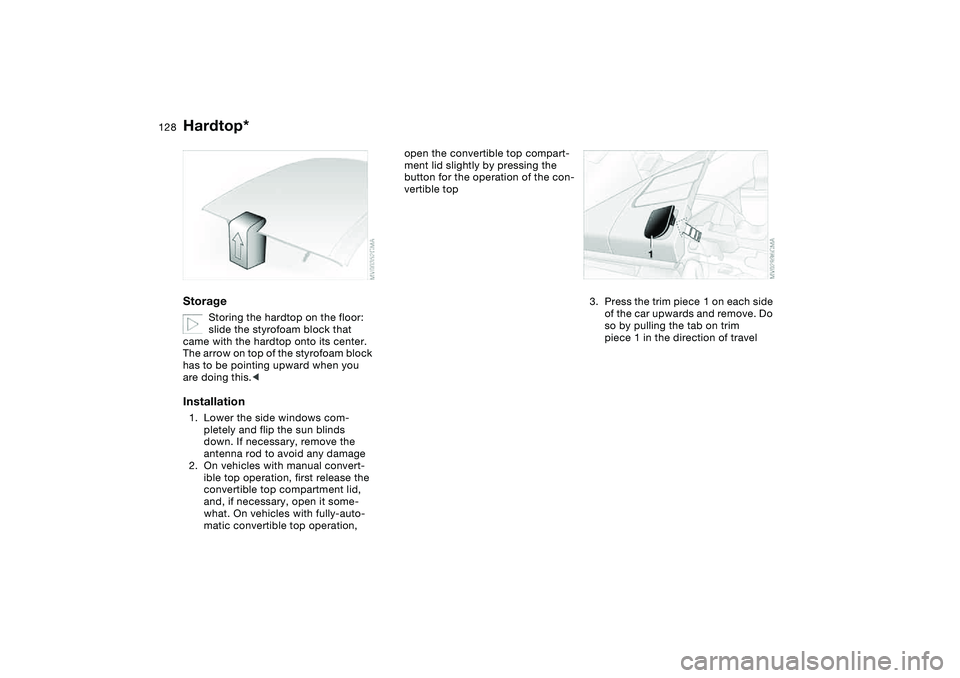
Storage
Storing the hardtop on the floor:
slide the styrofoam block that
came with the hardtop onto its center.
The arrow on top of the styrofoam block
has to be pointing upward when you
are doing this.<
Installation1. Lower the side windows com-
pletely and flip the sun blinds
down. If necessary, remove the
antenna rod to avoid any damage
2. On vehicles with manual convert-
ible top operation, first release the
convertible top compartment lid,
and, if necessary, open it some-
what. On vehicles with fully-auto-
matic convertible top operation,
open the convertible top compart-
ment lid slightly by pressing the
button for the operation of the con-
vertible top
3. Press the trim piece 1 on each side
of the car upwards and remove. Do
so by pulling the tab on trim
piece 1 in the direction of travel
Hardtop*
Page 129 of 190
129
4. Open the two locking levers at the
front of the hardtop. Press on the
buttons to do so. The levers will
release slightly. Open the levers as
far as possible
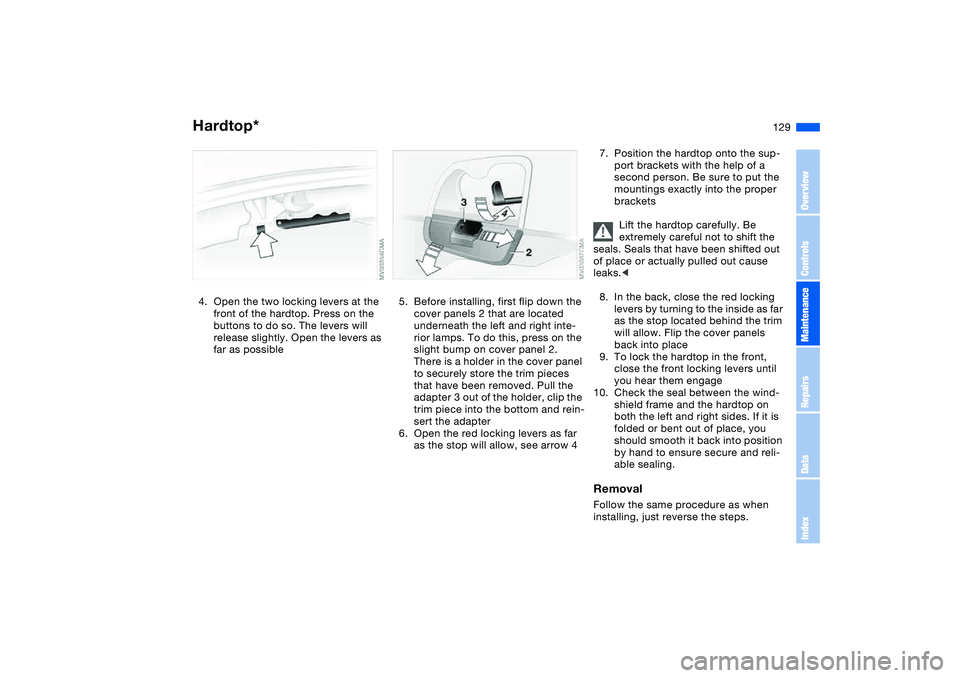
5. Before installing, first flip down the
cover panels 2 that are located
underneath the left and right inte-
rior lamps. To do this, press on the
slight bump on cover panel 2.
There is a holder in the cover panel
to securely store the trim pieces
that have been removed. Pull the
adapter 3 out of the holder, clip the
trim piece into the bottom and rein-
sert the adapter
6. Open the red locking levers as far
as the stop will allow, see arrow 4
7. Position the hardtop onto the sup-
port brackets with the help of a
second person. Be sure to put the
mountings exactly into the proper
brackets
Lift the hardtop carefully. Be
extremely careful not to shift the
seals. Seals that have been shifted out
of place or actually pulled out cause
leaks.<
8. In the back, close the red locking
levers by turning to the inside as far
as the stop located behind the trim
will allow. Flip the cover panels
back into place
9. To lock the hardtop in the front,
close the front locking levers until
you hear them engage
10. Check the seal between the wind-
shield frame and the hardtop on
both the left and right sides. If it is
folded or bent out of place, you
should smooth it back into position
by hand to ensure secure and reli-
able sealing.RemovalFollow the same procedure as when
installing, just reverse the steps.
Hardtop*
OverviewControlsMaintenanceRepairsDataIndex
Page 144 of 190
144
Coolant
Do not add coolant to the cooling
system when the engine is hot. If
you attempt to do so, escaping coolant
can cause burns.<
Coolant consists of water as well as an
additive such as antifreeze with corro-
sion inhibitor. Not all commercially
available additives are suitable for your
BMW. Your BMW center knows which
additives are appropriate.
Only use approved additives, as
the engine could otherwise be
damaged. The additives are hazardous
to your health; therefore, follow the
instructions on the containers.<
Comply with the applicable envi-
ronmental laws regulating the dis-
posal of antifreeze with corrosion inhib-
itor.<
Checking the coolant level and
adding coolantCheck the coolant level when the
engine is cold, approx. 687/+206.
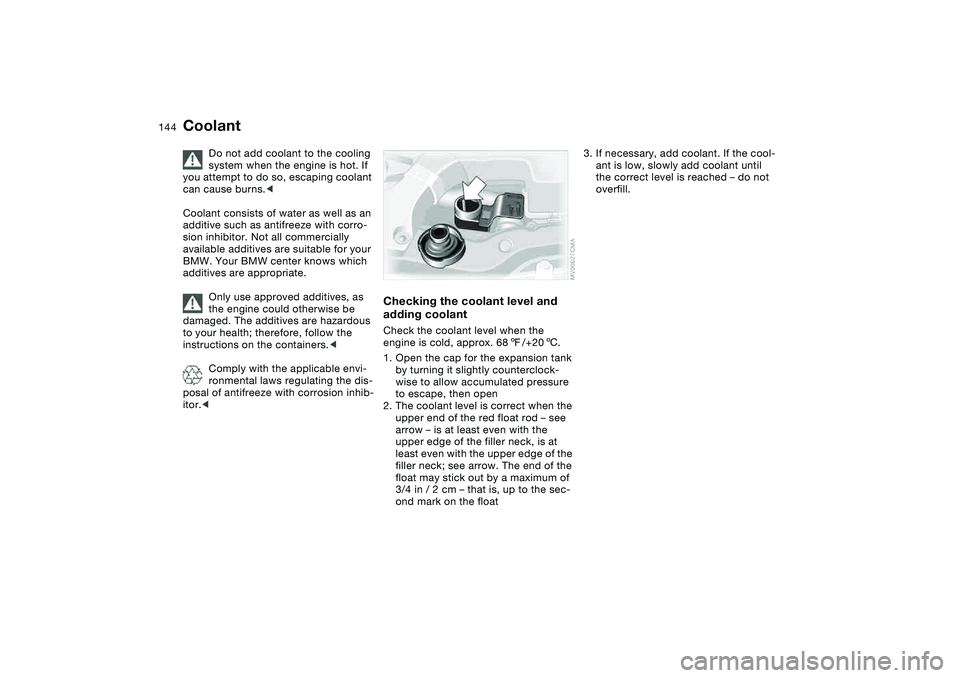
1. Open the cap for the expansion tank
by turning it slightly counterclock-
wise to allow accumulated pressure
to escape, then open
2. The coolant level is correct when the
upper end of the red float rod – see
arrow – is at least even with the
upper edge of the filler neck, is at
least even with the upper edge of the
filler neck; see arrow. The end of the
float may stick out by a maximum of
3/4 in / 2 cm – that is, up to the sec-
ond mark on the float
3. If necessary, add coolant. If the cool-
ant is low, slowly add coolant until
the correct level is reached – do not
overfill.
Page 156 of 190
156
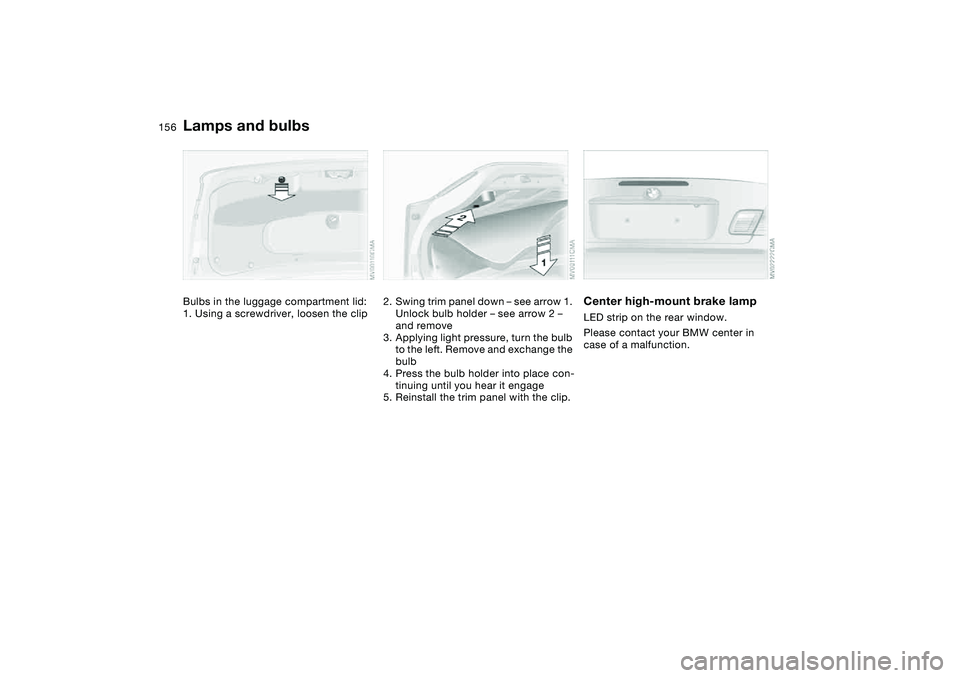
Bulbs in the luggage compartment lid:
1. Using a screwdriver, loosen the clip
2. Swing trim panel down – see arrow 1.
Unlock bulb holder – see arrow 2 –
and remove
3. Applying light pressure, turn the bulb
to the left. Remove and exchange the
bulb
4. Press the bulb holder into place con-
tinuing until you hear it engage
5. Reinstall the trim panel with the clip.
Center high-mount brake lampLED strip on the rear window.
Please contact your BMW center in
case of a malfunction.
Lamps and bulbs
Page 157 of 190
157
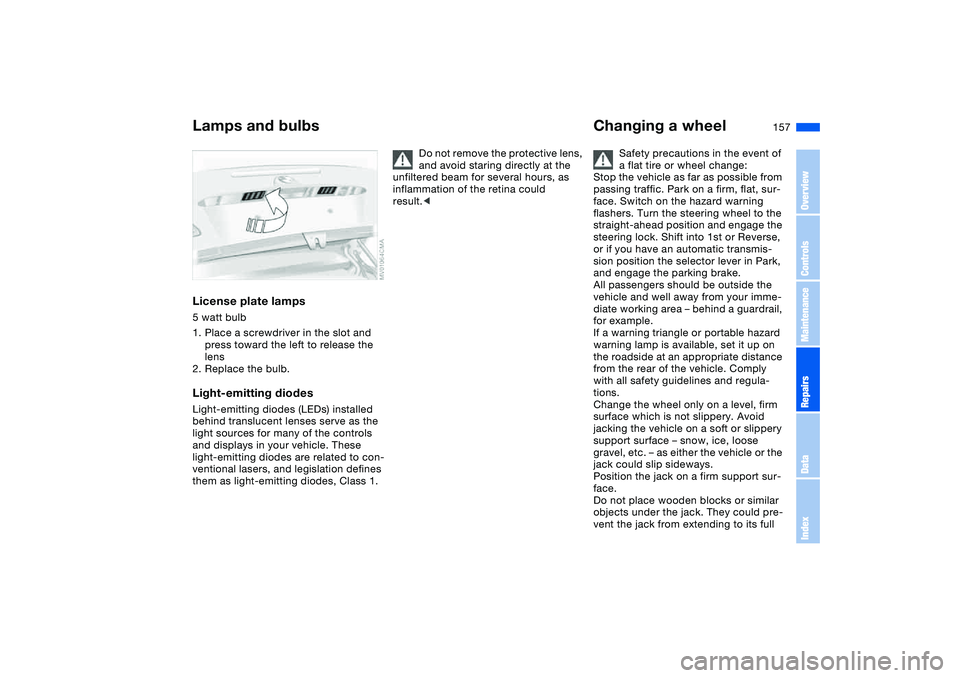
License plate lamps5 watt bulb
1. Place a screwdriver in the slot and
press toward the left to release the
lens
2. Replace the bulb.Light-emitting diodesLight-emitting diodes (LEDs) installed
behind translucent lenses serve as the
light sources for many of the controls
and displays in your vehicle. These
light-emitting diodes are related to con-
ventional lasers, and legislation defines
them as light-emitting diodes, Class 1.
Do not remove the protective lens,
and avoid staring directly at the
unfiltered beam for several hours, as
inflammation of the retina could
result.<
Changing a wheel
Safety precautions in the event of
a flat tire or wheel change:
Stop the vehicle as far as possible from
passing traffic. Park on a firm, flat, sur-
face. Switch on the hazard warning
flashers. Turn the steering wheel to the
straight-ahead position and engage the
steering lock. Shift into 1st or Reverse,
or if you have an automatic transmis-
sion position the selector lever in Park,
and engage the parking brake.
All passengers should be outside the
vehicle and well away from your imme-
diate working area – behind a guardrail,
for example.
If a warning triangle or portable hazard
warning lamp is available, set it up on
the roadside at an appropriate distance
from the rear of the vehicle. Comply
with all safety guidelines and regula-
tions.
Change the wheel only on a level, firm
surface which is not slippery. Avoid
jacking the vehicle on a soft or slippery
support surface – snow, ice, loose
gravel, etc. – as either the vehicle or the
jack could slip sideways.
Position the jack on a firm support sur-
face.
Do not place wooden blocks or similar
objects under the jack. They could pre-
vent the jack from extending to its full
Lamps and bulbs
OverviewControlsMaintenanceRepairsDataIndex
Page 161 of 190
161
BatteryMaintenanceThe battery is completely maintenance-
free. This means that the original bat-
tery acid will normally last for the ser-
vice life of the battery under moderate
climate conditions. Your BMW center
will be glad to advise you if you have
any questions concerning the battery.
Please consult your BMW center
whenever you have any questions
concerning the battery.
Connect the charge cables to the termi-
nals in the engine compartment. For
terminal locations, refer to Jump-start-
ing on page 163.Disposal
After changing the battery, have
the old battery disposed of by
your BMW center or bring it to a recy-
cling point. Maintain the battery in an
upright position for transport and stor-
age. Secure the battery against tilting
during transport.<
Power lossAfter a temporary power loss, e.g. due
to a discharged battery, some equip-
ment will be limited in its use and will
have to be reinitialized. Individual set-
tings are also lost and must be reset:
>Seat and mirror memory
The position settings must be stored
again, refer to page 55
>Clock
must be reset, refer to page 87
>Radio
Stations must be reset, refer to the
Owner's Manual for Radio/Onboard
Computer
>Navigation system
The system will not be operable
immediately, refer to the Owner's
Manual for Radio/Onboard Com-
puter.
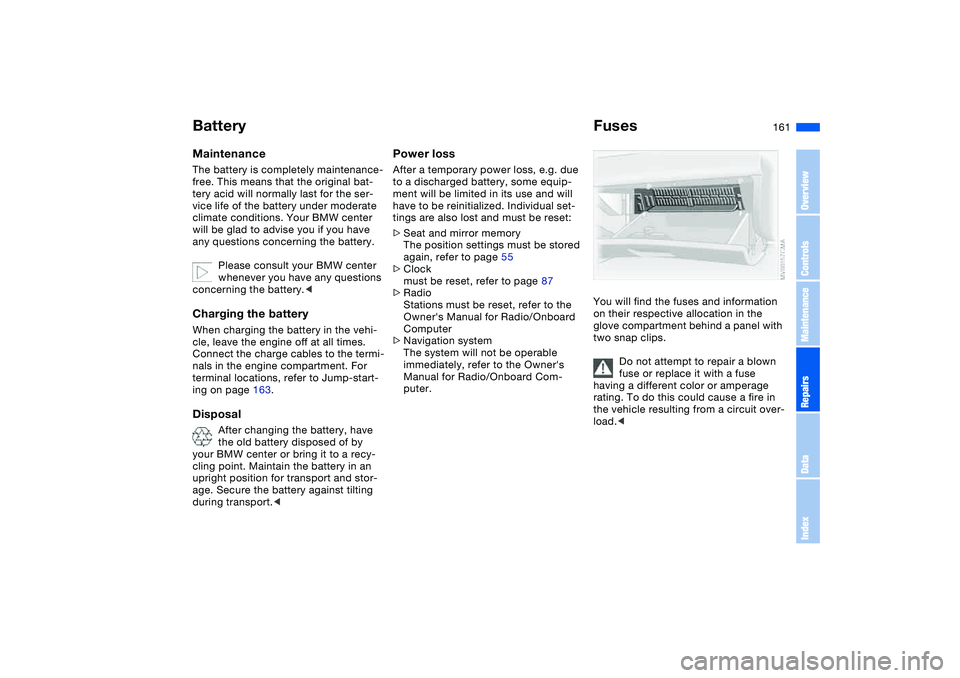
FusesYou will find the fuses and information
on their respective allocation in the
glove compartment behind a panel with
two snap clips.
Do not attempt to repair a blown
fuse or replace it with a fuse
having a different color or amperage
rating. To do this could cause a fire in
the vehicle resulting from a circuit over-
load.<
OverviewControlsMaintenanceRepairsDataIndex
Page 165 of 190
165
Towing and tow-starting the vehicle
Always comply with all applicable
towing laws and regulations.<
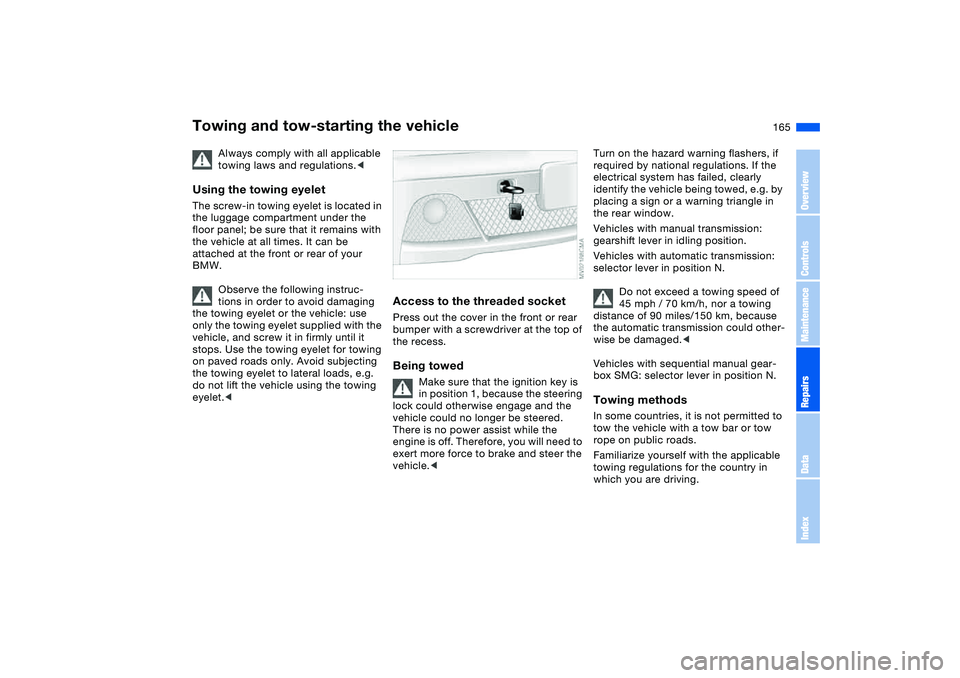
Using the towing eyeletThe screw-in towing eyelet is located in
the luggage compartment under the
floor panel; be sure that it remains with
the vehicle at all times. It can be
attached at the front or rear of your
BMW.
Observe the following instruc-
tions in order to avoid damaging
the towing eyelet or the vehicle: use
only the towing eyelet supplied with the
vehicle, and screw it in firmly until it
stops. Use the towing eyelet for towing
on paved roads only. Avoid subjecting
the towing eyelet to lateral loads, e.g.
do not lift the vehicle using the towing
eyelet.<
Access to the threaded socketPress out the cover in the front or rear
bumper with a screwdriver at the top of
the recess.Being towed
Make sure that the ignition key is
in position 1, because the steering
lock could otherwise engage and the
vehicle could no longer be steered.
There is no power assist while the
engine is off. Therefore, you will need to
exert more force to brake and steer the
vehicle.<
Turn on the hazard warning flashers, if
required by national regulations. If the
electrical system has failed, clearly
identify the vehicle being towed, e.g. by
placing a sign or a warning triangle in
the rear window.
Vehicles with manual transmission:
gearshift lever in idling position.
Vehicles with automatic transmission:
selector lever in position N.
Do not exceed a towing speed of
45 mph / 70 km/h, nor a towing
distance of 90 miles/150 km, because
the automatic transmission could other-
wise be damaged.<
Vehicles with sequential manual gear-
box SMG: selector lever in position N.Towing methodsIn some countries, it is not permitted to
tow the vehicle with a tow bar or tow
rope on public roads.
Familiarize yourself with the applicable
towing regulations for the country in
which you are driving.
OverviewControlsMaintenanceRepairsDataIndex
Page 176 of 190
Everything from A to ZA
ABS Antilock Brake
System 127
indicator lamp 18
Acceleration assistant 76
Accessories, refer to For
your own safety 5
Accident, refer to Emer-
gency call 162
Activated-charcoal filter 108
Adaptive brake lamp, refer
to Brake force display 94
Adaptive headlights 96
Adding brake fluid 145
Additional sources of infor-
mation 4
Air conditioning 100
Air conditioning mode 102
automatic climate
control 106
Air distribution
air conditioning 102
automatic climate
control 106
individual 106
Air outlets, refer to Ventila-
tion 100, 104
Air pressure, refer to Tire
inflation pressure 130
Air recirculation, refer to
Recirculated-air mode
102, 107Air supply
air conditioning 102
automatic climate
control 106
Air, drying, refer to Air con-
ditioning mode 102, 106
Airbags 59
deactivating 62
indicator lamp 18, 61
sitting safely 50
Airing out, refer to Ventila-
tion 100, 104
AKI, refer to Fuel specifica-
tions 24
Alarm system 36
avoiding unintentional
alarms 37
All-season tires, refer to
Winter tires 136
Antifreeze 144
coolant 144
washer fluid 142
Antilock Brake System
(ABS) 127
indicator lamp 18
Anti-theft system 28
Anti-theft warning system,
refer to Alarm system 36
Approved axle loads, refer
to Weights 172
Approved gross weight,
refer to Weights 172Armrest 112
Artificial leather, refer to the
Caring for your vehicle
brochure
Ashtray
front 113
rear 114
Assistant systems, refer to
Dynamic Stability Control
(DSC) 91
AUC Automatic recircu-
lated-air control 107
AUTO program 106
Automatic
cruise control 82
headlamp control 95
Automatic air distribution,
refer to AUTO
program 106
Automatic air supply, refer
to AUTO program 106
Automatic car wash, refer to
the Caring for your vehicle
brochure
Automatic climate
control 104
Automatic curb monitor 56
Automatic dimming, interior
rearview mirror 58
Automatic recirculated-air
control (AUC) 107Automatic transmission with
Steptronic 77
indicator lamp 19, 79
interlock 69
selector lever lock 77
shiftlock 77
tow-starting 166
Automatic windshield
washer, refer to Rain sen-
sor 81
Average fuel
consumption 89
Average speed 89
Avoiding unintentional
alarms 37
Axle loads, refer to
Weights 172
B
Backrest
unlock 53
Backrest, refer to Seat
adjustment 51
Backup lamps 72
bulb replacement 155
Bandages, refer to First-aid
kit 22
Bar, for towing 165