ECO mode BMW 325Ci CONVERTIBLE 2001 E46 User Guide
[x] Cancel search | Manufacturer: BMW, Model Year: 2001, Model line: 325Ci CONVERTIBLE, Model: BMW 325Ci CONVERTIBLE 2001 E46Pages: 215, PDF Size: 2.1 MB
Page 83 of 215
83n
IndexDataTechnologyRepairsCar careControlsOverview
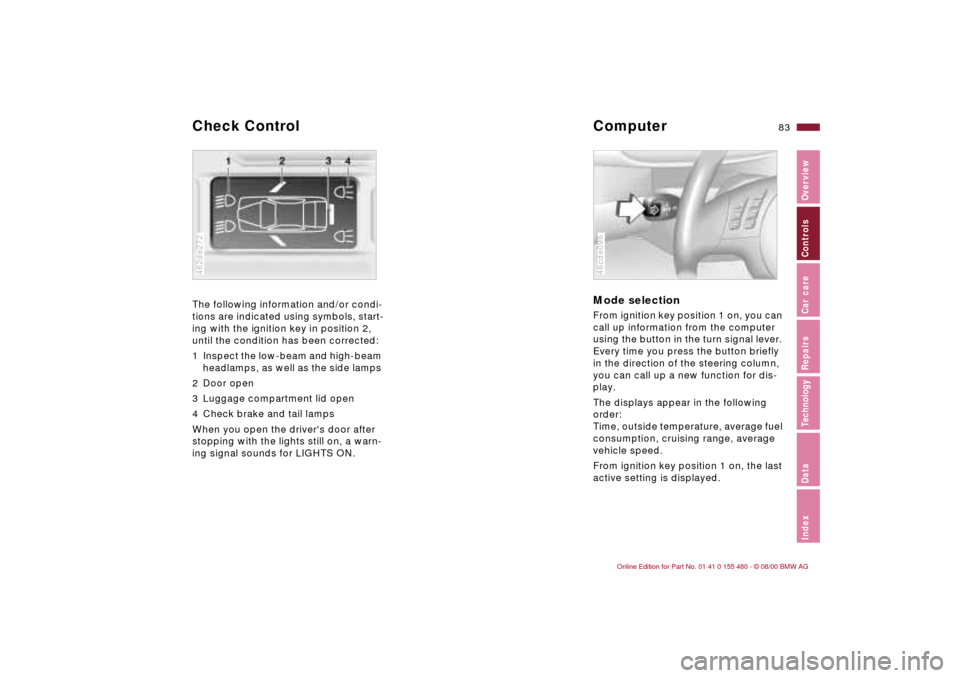
The following information and/or condi-
tions are indicated using symbols, start-
ing with the ignition key in position 2,
until the condition has been corrected:
1 Inspect the low-beam and high-beam
headlamps, as well as the side lamps
2 Door open
3 Luggage compartment lid open
4 Check brake and tail lamps
When you open the driver's door after
stopping with the lights still on, a warn-
ing signal sounds for LIGHTS ON.462de272
Mode selectionFrom ignition key position 1 on, you can
call up information from the computer
using the button in the turn signal lever.
Every time you press the button briefly
in the direction of the steering column,
you can call up a new function for dis-
play.
The displays appear in the following
order:
Time, outside temperature, average fuel
consumption, cruising range, average
vehicle speed.
From ignition key position 1 on, the last
active setting is displayed.46cde096
Check Control Computer
Page 84 of 215
84n
Computer ClockIf you wish to have a permanent time
display, you can make this adjustment
in the radio display (refer to the Radio
Owner's Manual).
You can adjust the clock and the time
display in the car radio as follows.
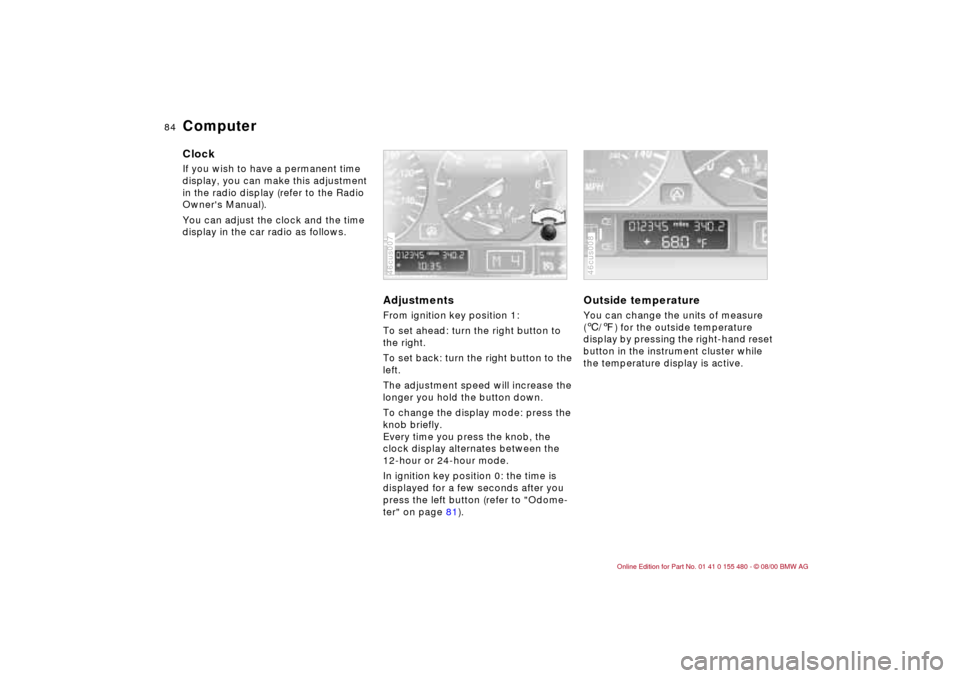
Adjustments From ignition key position 1:
To set ahead: turn the right button to
the right.
To set back: turn the right button to the
left.
The adjustment speed will increase the
longer you hold the button down.
To change the display mode: press the
knob briefly.
Every time you press the knob, the
clock display alternates between the
12-hour or 24-hour mode.
In ignition key position 0: the time is
displayed for a few seconds after you
press the left button (refer to "Odome-
ter" on page 81).46cus007
Outside temperature You can change the units of measure
(6/7) for the outside temperature
display by pressing the right-hand reset
button in the instrument cluster while
the temperature display is active.46cus008
Page 89 of 215
89n
IndexDataTechnologyRepairsCar careControlsOverview
ASC+T DSC*Reactivating ASC+TPress the button again; the indicator
lamp goes out.
The laws of physics cannot be
repealed, even with ASC+T. It will
always be the driver's responsibility to
drive in a manner that matches road
conditions. This is why you should not
use the additional safety margin the
system provides as an excuse to take
risks.<
For additional details concerning
ASC+T, please refer to the chapter
"Advanced Technology" on page 189.
The conceptDSC maintains vehicle stability, even in
critical driving situations.
The system optimizes vehicle stability
during acceleration and when starting
from a full stop, as well as optimizing
traction. In addition, it recognizes
unstable vehicle conditions, such as
understeering or oversteering, and, as
far as is possible within the laws of
physics, helps keeping the car on a
steady course by reducing the RPMs
and brake applications to the individual
wheels.
The DSC is operational every time you
start the engine. DSC includes the
functions of ADB and CBC, refer to
page 123.
The ADB (Automatic Differential
Braking) copies the function of conven-
tional differential and transverse lock
through brake intervention, and
increases traction whenever conditions
merit, e. g. when driving on snow-
covered roads.
If the DSC is switched off the ADB will
still be in ready mode.
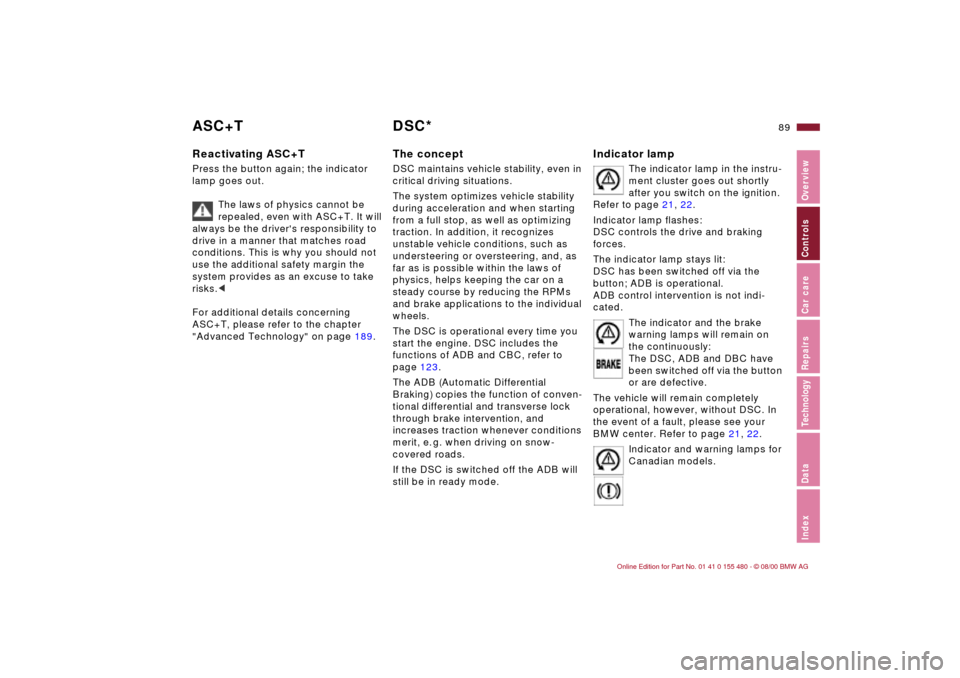
Indicator lamp
The indicator lamp in the instru-
ment cluster goes out shortly
after you switch on the ignition.
Refer to page 21, 22.
Indicator lamp flashes:
DSC controls the drive and braking
forces.
The indicator lamp stays lit:
DSC has been switched off via the
button; ADB is operational.
ADB control intervention is not indi-
cated.
The indicator and the brake
warning lamps will remain on
the continuously:
The DSC, ADB and DBC have
been switched off via the button
or are defective.
The vehicle will remain completely
operational, however, without DSC. In
the event of a fault, please see your
BMW center. Refer to page 21, 22.
Indicator and warning lamps for
Canadian models.
Page 90 of 215
90n
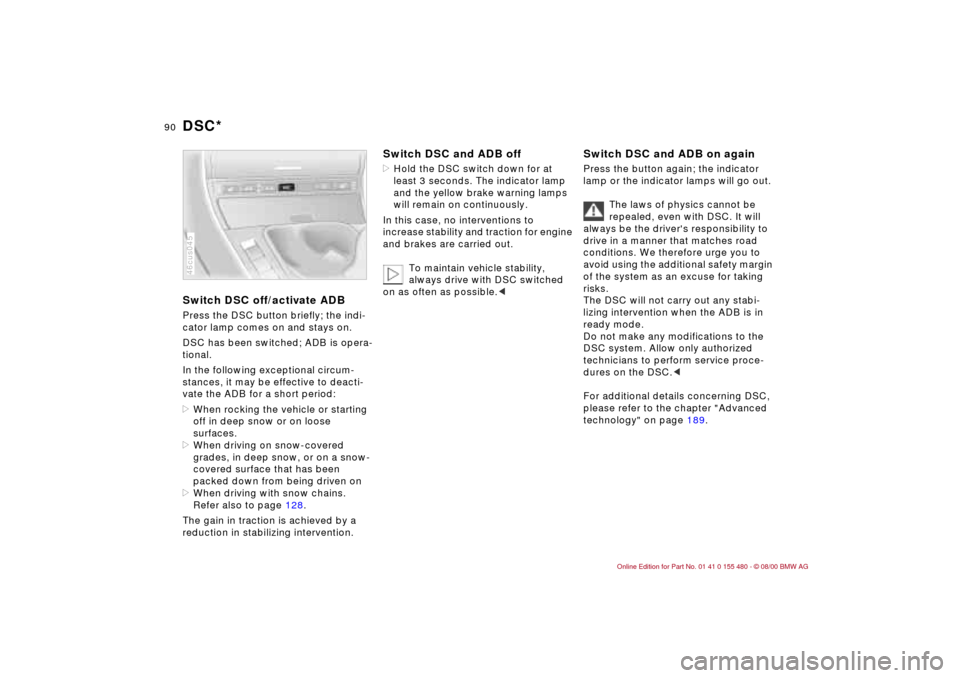
DSC*Switch DSC off/activate ADBPress the DSC button briefly; the indi-
cator lamp comes on and stays on.
DSC has been switched; ADB is opera-
tional.
In the following exceptional circum-
stances, it may be effective to deacti-
vate the ADB for a short period:
>When rocking the vehicle or starting
off in deep snow or on loose
surfaces.
>When driving on snow-covered
grades, in deep snow, or on a snow-
covered surface that has been
packed down from being driven on
>When driving with snow chains.
Refer also to page 128.
The gain in traction is achieved by a
reduction in stabilizing intervention.46cus045
Switch DSC and ADB off>Hold the DSC switch down for at
least 3 seconds. The indicator lamp
and the yellow brake warning lamps
will remain on continuously.
In this case, no interventions to
increase stability and traction for engine
and brakes are carried out.
To maintain vehicle stability,
always drive with DSC switched
on as often as possible.<
Switch DSC and ADB on againPress the button again; the indicator
lamp or the indicator lamps will go out.
The laws of physics cannot be
repealed, even with DSC. It will
always be the driver's responsibility to
drive in a manner that matches road
conditions. We therefore urge you to
avoid using the additional safety margin
of the system as an excuse for taking
risks.
The DSC will not carry out any stabi-
lizing intervention when the ADB is in
ready mode.
Do not make any modifications to the
DSC system. Allow only authorized
technicians to perform service proce-
dures on the DSC.<
For additional details concerning DSC,
please refer to the chapter "Advanced
technology" on page 189.
Page 97 of 215

97n
IndexDataTechnologyRepairsCar careControlsOverview
Air conditioner1 Air onto the windshield and onto the
side windows
2 Air for the upper body area
The side rotary dials open and close
the air supply through an infinitely-
variable range; the levers will change
the direction of the air flow. The
center rotary dial controls the
temperature of the air as it flows out.
Refer to page 98
3 Air for the front footwell
There are also vent outlets for the
rear footwell as well
4 Air supply
Heating and ventilation are available
starting with position 1. Refer to
page 98
5 Temperature98
6 Air distribution toward
>the windows
>the upper body
>the footwell
All intermediate settings are possible.
Refer to page 98
7 Rear window defroster98
8 Air conditioner98
9 Recirculated-air mode98
Page 98 of 215
98n
Air conditionerAir supply
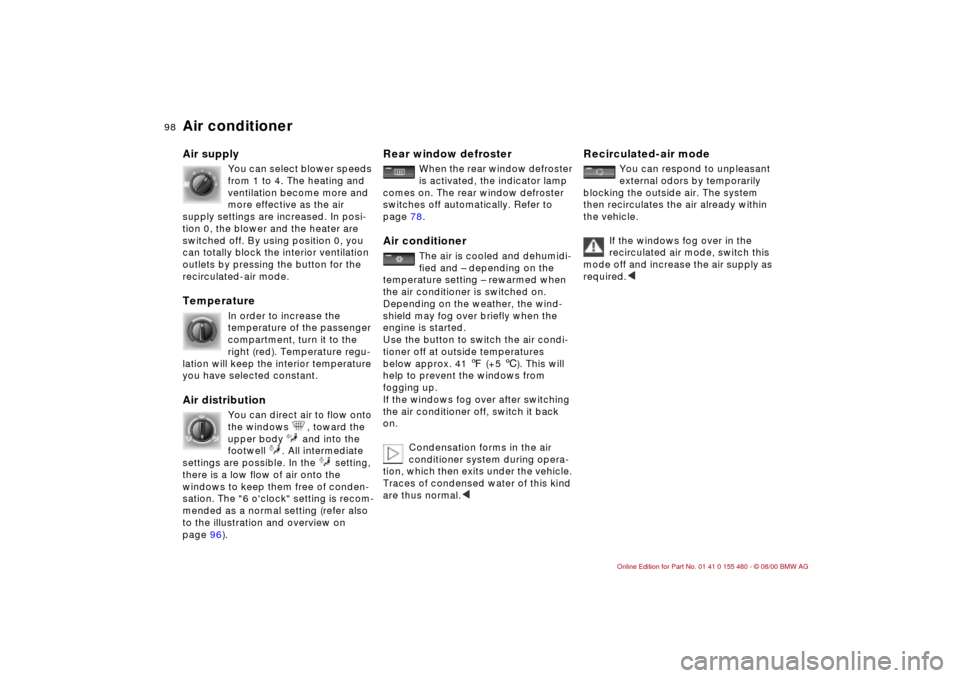
You can select blower speeds
from 1 to 4. The heating and
ventilation become more and
more effective as the air
supply settings are increased. In posi-
tion 0, the blower and the heater are
switched off. By using position 0, you
can totally block the interior ventilation
outlets by pressing the button for the
recirculated-air mode.
Temperature
In order to increase the
temperature of the passenger
compartment, turn it to the
right (red). Temperature regu-
lation will keep the interior temperature
you have selected constant.
Air distribution
You can direct air to flow onto
the windows , toward the
upper body and into the
footwell . All intermediate
settings are possible. In the setting,
there is a low flow of air onto the
windows to keep them free of conden-
sation. The "6 o'clock" setting is recom-
mended as a normal setting (refer also
to the illustration and overview on
page 96).
Rear window defroster
When the rear window defroster
is activated, the indicator lamp
comes on. The rear window defroster
switches off automatically. Refer to
page 78.
Air conditioner
The air is cooled and dehumidi-
fied and Ð depending on the
temperature setting Ð rewarmed when
the air conditioner is switched on.
Depending on the weather, the wind-
shield may fog over briefly when the
engine is started.
Use the button to switch the air condi-
tioner off at outside temperatures
below approx. 41 7 (+5 6). This will
help to prevent the windows from
fogging up.
If the windows fog over after switching
the air conditioner off, switch it back
on.
Condensation forms in the air
conditioner system during opera-
tion, which then exits under the vehicle.
Traces of condensed water of this kind
are thus normal.
<< < <
Recirculated-air mode
You can respond to unpleasant
external odors by temporarily
blocking the outside air. The system
then recirculates the air already within
the vehicle.
If the windows fog over in the
recirculated air mode, switch this
mode off and increase the air supply as
required.<< < <
Page 103 of 215
103n
IndexDataTechnologyRepairsCar careControlsOverview
Automatic climate control
*
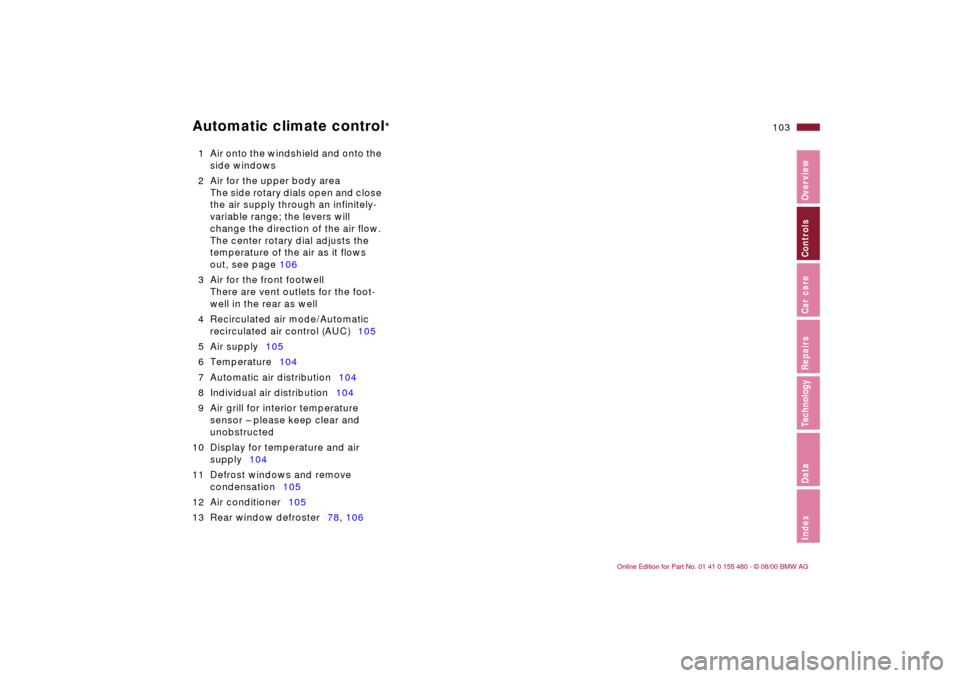
1 Air onto the windshield and onto the
side windows
2 Air for the upper body area
The side rotary dials open and close
the air supply through an infinitely-
variable range; the levers will
change the direction of the air flow.
The center rotary dial adjusts the
temperature of the air as it flows
out, see page 106
3 Air for the front footwell
There are vent outlets for the foot-
well in the rear as well
4 Recirculated air mode/Automatic
recirculated air control (AUC)105
5 Air supply105
6 Temperature104
7 Automatic air distribution104
8 Individual air distribution104
9 Air grill for interior temperature
sensor Ð please keep clear and
unobstructed
10 Display for temperature and air
supply104
11 Defrost windows and remove
condensation105
12 Air conditioner105
13 Rear window defroster78, 106
Page 105 of 215
105n
IndexDataTechnologyRepairsCar careControlsOverview
Automatic climate control
*
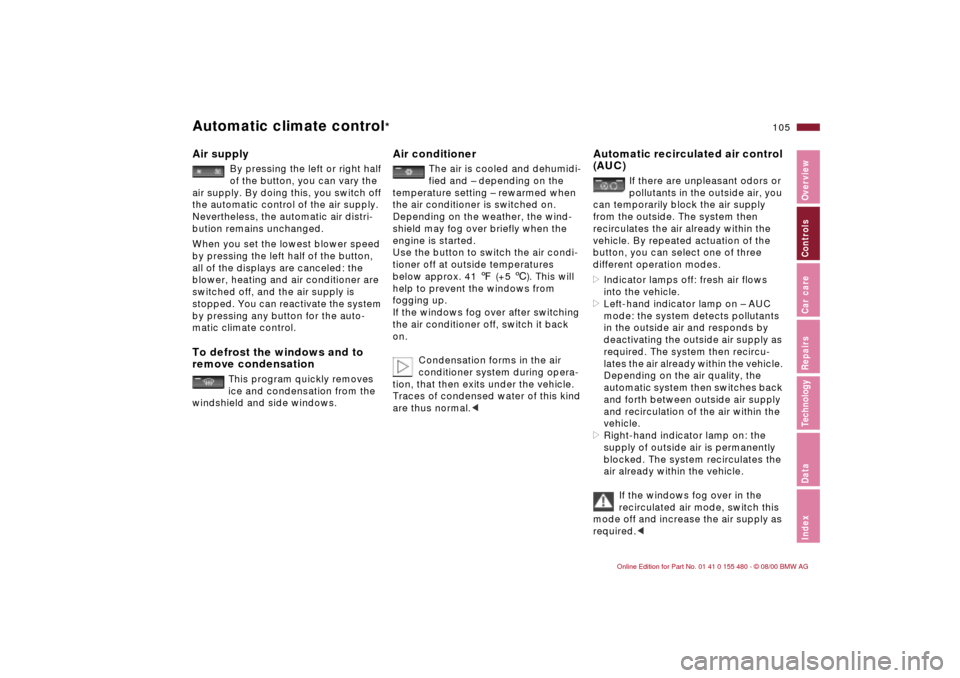
Air supply
By pressing the left or right half
of the button, you can vary the
air supply. By doing this, you switch off
the automatic control of the air supply.
Nevertheless, the automatic air distri-
bution remains unchanged.
When you set the lowest blower speed
by pressing the left half of the button,
all of the displays are canceled: the
blower, heating and air conditioner are
switched off, and the air supply is
stopped. You can reactivate the system
by pressing any button for the auto-
matic climate control.
To defrost the windows and to
remove condensation
This program quickly removes
ice and condensation from the
windshield and side windows.
Air conditioner
The air is cooled and dehumidi-
fied and Ð depending on the
temperature setting Ð rewarmed when
the air conditioner is switched on.
Depending on the weather, the wind-
shield may fog over briefly when the
engine is started.
Use the button to switch the air condi-
tioner off at outside temperatures
below approx. 41 7 (+5 6). This will
help to prevent the windows from
fogging up.
If the windows fog over after switching
the air conditioner off, switch it back
on.
Condensation forms in the air
conditioner system during opera-
tion, that then exits under the vehicle.
Traces of condensed water of this kind
are thus normal.<
Automatic recirculated air control
(AUC)
If there are unpleasant odors or
pollutants in the outside air, you
can temporarily block the air supply
from the outside. The system then
recirculates the air already within the
vehicle. By repeated actuation of the
button, you can select one of three
different operation modes.
>Indicator lamps off: fresh air flows
into the vehicle.
>Left-hand indicator lamp on Ð AUC
mode: the system detects pollutants
in the outside air and responds by
deactivating the outside air supply as
required. The system then recircu-
lates the air already within the vehicle.
Depending on the air quality, the
automatic system then switches back
and forth between outside air supply
and recirculation of the air within the
vehicle.
>Right-hand indicator lamp on: the
supply of outside air is permanently
blocked. The system recirculates the
air already within the vehicle.
If the windows fog over in the
recirculated air mode, switch this
mode off and increase the air supply as
required.<
Page 107 of 215
107n
IndexDataTechnologyRepairsCar careControlsOverview
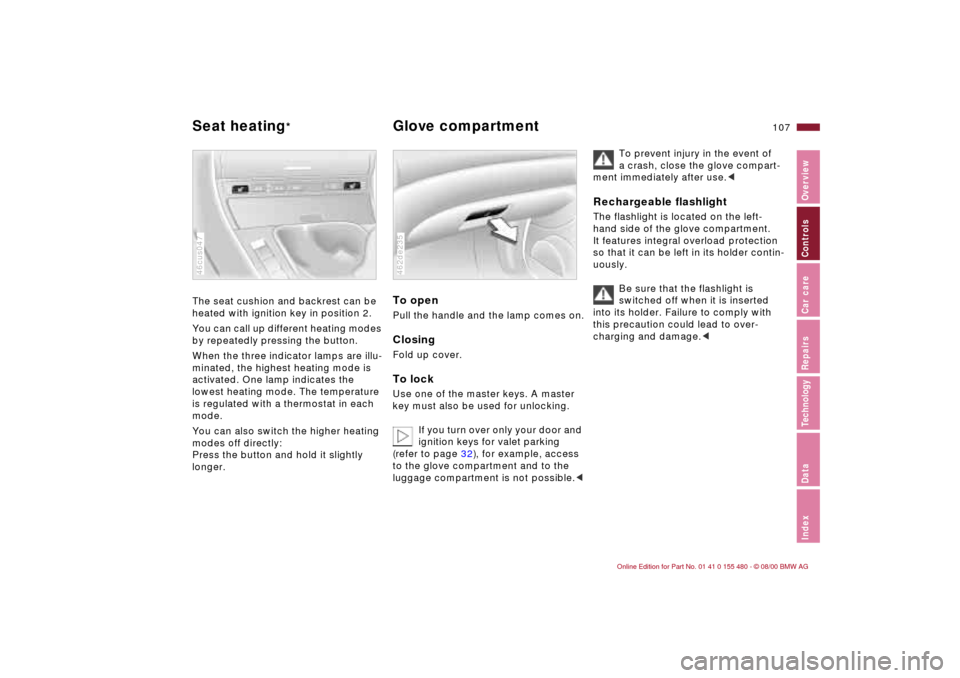
The seat cushion and backrest can be
heated with ignition key in position 2.
You can call up different heating modes
by repeatedly pressing the button.
When the three indicator lamps are illu-
minated, the highest heating mode is
activated. One lamp indicates the
lowest heating mode. The temperature
is regulated with a thermostat in each
mode.
You can also switch the higher heating
modes off directly:
Press the button and hold it slightly
longer.46cus047
To openPull the handle and the lamp comes on.ClosingFold up cover.To lockUse one of the master keys. A master
key must also be used for unlocking.
If you turn over only your door and
ignition keys for valet parking
(refer to page 32), for example, access
to the glove compartment and to the
luggage compartment is not possible.<462de235
To prevent injury in the event of
a crash, close the glove compart-
ment immediately after use.<
Rechargeable flashlightThe flashlight is located on the left-
hand side of the glove compartment.
It features integral overload protection
so that it can be left in its holder contin-
uously.
Be sure that the flashlight is
switched off when it is inserted
into its holder. Failure to comply with
this precaution could lead to over-
charging and damage.<
Seat heating
*
Glove compartment
Page 123 of 215
123n
IndexDataTechnologyRepairsCar careControlsOverview
Antilock Brake System (ABS)Antilock Brake System (ABS)/
Cornering Brake Control (CBC) CBC is an advanced engineering
design of the ABS. When braking while
cornering at high speed or braking
during high lateral acceleration, or
when braking during a lane change,
vehicle stability is improved and
steering response is enhanced.
In the event of a malfunction
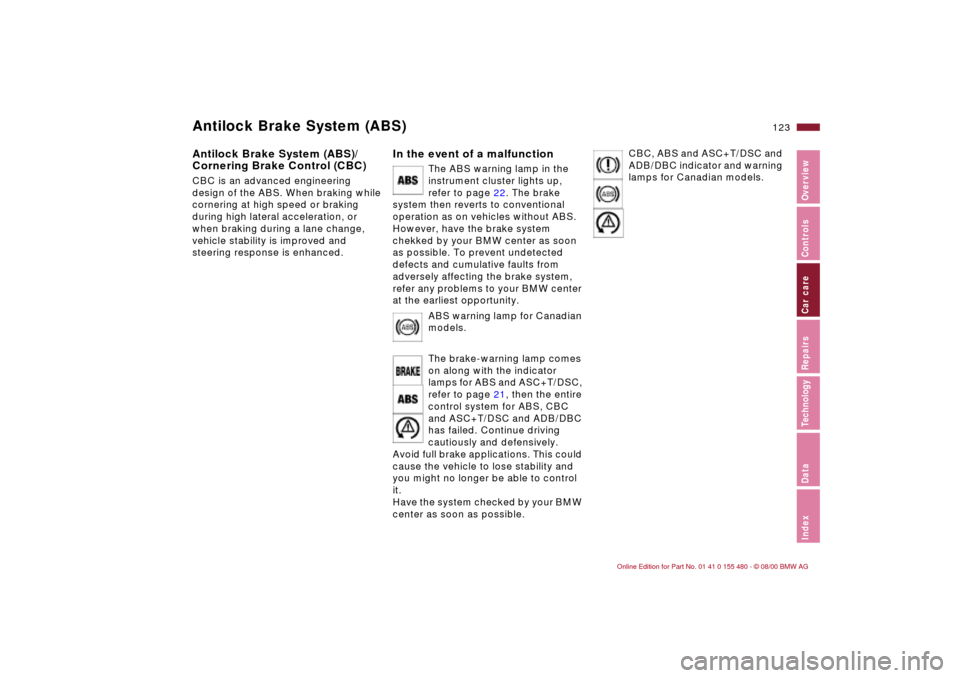
The ABS warning lamp in the
instrument cluster lights up,
refer to page 22. The brake
system then reverts to conventional
operation as on vehicles without ABS.
However, have the brake system
chekked by your BMW center as soon
as possible. To prevent undetected
defects and cumulative faults from
adversely affecting the brake system,
refer any problems to your BMW center
at the earliest opportunity.
ABS warning lamp for Canadian
models.
The brake-warning lamp comes
on along with the indicator
lamps for ABS and ASC+T/DSC,
refer to page 21, then the entire
control system for ABS, CBC
and ASC+T/DSC and ADB/DBC
has failed. Continue driving
cautiously and defensively.
Avoid full brake applications. This could
cause the vehicle to lose stability and
you might no longer be able to control
it.
Have the system checked by your BMW
center as soon as possible.
CBC, ABS and ASC+T/DSC and
ADB/DBC indicator and warning
lamps for Canadian models.