maintenance BMW 325Ci CONVERTIBLE 2001 E46 User Guide
[x] Cancel search | Manufacturer: BMW, Model Year: 2001, Model line: 325Ci CONVERTIBLE, Model: BMW 325Ci CONVERTIBLE 2001 E46Pages: 215, PDF Size: 2.1 MB
Page 121 of 215

121n
IndexDataTechnologyRepairsCar careControlsOverview
Brakes:
Do not drive with your foot resting
on the brake pedal. Even light but
consistent pedal pressure can lead to
high temperatures, brake wear, and
possibly to brake failure.
Aquaplaning:
When driving on wet or slushy roads,
reduce vehicle speed. If you do not, a
wedge of water may form between the
tires and the road surface. This
phenomenon is referred to as aqua-
planing or hydroplaning. It is character-
ized by a partial or complete loss of
contact between the tires and the road
surface. The ultimate results are loss of
steering and braking control.
Driving through water:
Do not drive through water on the road
if it is deeper than 1 ft (30 cm), and then
only at walking speed. Otherwise, the
vehicle's engine, the electrical systems
and the transmission may be damaged.
Clothes hooks (for the hardtop):
When suspending clothing from the
hooks, be sure that they will not
obstruct the driver's vision. Do not hang
heavy objects on the hooks. If you do
so, they could cause personal injury
during braking or evasive maneuvers.<
The catalytic converter reduces harmful
exhaust emissions.
It is designed for use with unleaded fuel
only. Even minute quantities of lead
would be enough to permanently
damage both the catalytic converter
and the system oxygen sensor.
To ensure efficient, trouble-free engine
operation and to avoid potential
damage:
>Be sure to comply with the scheduled
maintenance requirements.
>Fill the fuel tank well before it is
empty.
>Tow-start only when the engine is
cold. If you attempt to tow-start with
a warm engine, unburned residual
fuel in the catalytic converter could
ignite and cause damage. It is better
to jump-start the vehicle with outside
assistance.
>Avoid other situations in which the
fuel is not burned, or burns incom-
pletely, such as engaging the starter
frequently or for extended periods, or
repeated start attempts in which the
engine does not start (stopping and
restarting an engine which is running
properly does not present a problem).
Never allow the engine to run with
any of the spark plug cables discon-
nected.Be sure to comply with the
preceding instructions to prevent
unburned fuel from reaching the cata-
lytic converter. If you do not, the cata-
lytic converter could respond by
overheating, leading to serious
damage.
Very high temperatures occur in any
vehicle equipped with a catalytic
converter. Heat shields are installed
adjacent to some sections of the
exhaust system. Never remove these
shields; do not apply undercoating to
their surfaces. When driving, standing
at idle, and parking the vehicle, take
extra care to avoid contact between the
exhaust system and flammable mate-
rials (grass, hay, leaves, etc.). Such
contact could lead to a fire, resulting in
serious personal injury and property
damage.<
Driving notes Catalytic converter
Page 150 of 215
150n
The BMW Maintenance System has
been designed as a reliable means of
providing maximum driving and operat-
ing safety Ð and as cost-effectively as
possible for you.
Please keep in mind that regular main-
tenance is not only necessary for the
safety of your vehicle, but also plays a
significant role in maintaining the resale
value of the vehicle.
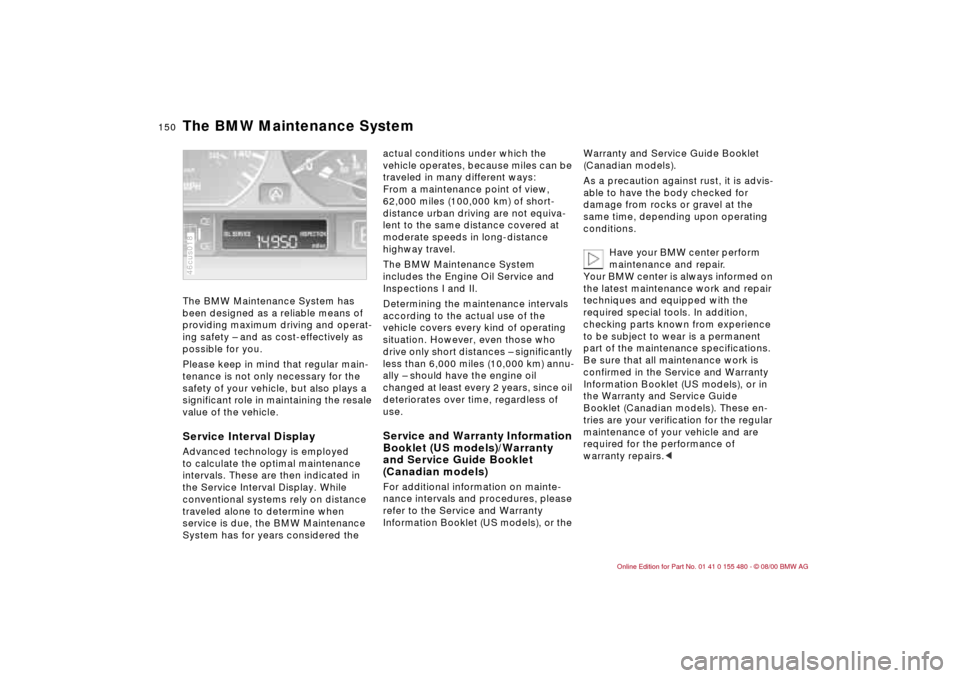
Service Interval DisplayAdvanced technology is employed
to calculate the optimal maintenance
intervals. These are then indicated in
the Service Interval Display. While
conventional systems rely on distance
traveled alone to determine when
service is due, the BMW Maintenance
System has for years considered the 46cus018
actual conditions under which the
vehicle operates, because miles can be
traveled in many different ways:
From a maintenance point of view,
62,000 miles (100,000 km) of short-
distance urban driving are not equiva-
lent to the same distance covered at
moderate speeds in long-distance
highway travel.
The BMW Maintenance System
includes the Engine Oil Service and
Inspections I and II.
Determining the maintenance intervals
according to the actual use of the
vehicle covers every kind of operating
situation. However, even those who
drive only short distances Ð significantly
less than 6,000 miles (10,000 km) annu-
ally Ð should have the engine oil
changed at least every 2 years, since oil
deteriorates over time, regardless of
use.Service and Warranty Information
Booklet (US models)/Warranty
and Service Guide Booklet
(Canadian models)For additional information on mainte-
nance intervals and procedures, please
refer to the Service and Warranty
Information Booklet (US models), or the Warranty and Service Guide Booklet
(Canadian models).
As a precaution against rust, it is advis-
able to have the body checked for
damage from rocks or gravel at the
same time, depending upon operating
conditions.
Have your BMW center perform
maintenance and repair.
Your BMW center is always informed on
the latest maintenance work and repair
techniques and equipped with the
required special tools. In addition,
checking parts known from experience
to be subject to wear is a permanent
part of the maintenance specifications.
Be sure that all maintenance work is
confirmed in the Service and Warranty
Information Booklet (US models), or in
the Warranty and Service Guide
Booklet (Canadian models). These en-
tries are your verification for the regular
maintenance of your vehicle and are
required for the performance of
warranty repairs.<
The BMW Maintenance System
Page 152 of 215

152n
Caring for your vehicleExterior finish To provide effective corrosion protec-
tion, multilayer paintwork is applied at
the factory. Cataphoretic immersion
priming techniques are supplemented
using special body-cavity protectants,
with the application of specially-devel-
oped and extensively tested materials.
A layer of flexible PVC is first applied to
the undercarriage. Following this, a
comprehensive undercoating treat-
ment with a wax-based protectant is
applied. Regular maintenance makes
an important contribution to maintaining
the safety and value of your vehicle.
Increasing awareness of the effects
of harmful environmental factors on
vehicle finishes have led paint and
vehicle manufacturers to initiate
ongoing programs designed to further
improve the durability of their finishes.
Despite this, environmental factors that
occur locally or regionally can have
negative effects on the finish of your
vehicle. Use the factors to determine
the frequency and extent of your efforts
to maintain the vehicle finish.Depending upon material and type of
impact (perforation of paint layer),
physical stresses from sand, road salt,
gravel, etc., can cause corrosion to
start extending beneath the finish,
starting at the point of impact.
Road dirt, tar spots, dead insects,
animal droppings (strong alkali effect)
and tree excretions (resins and pollen)
all contain substances capable of caus-
ing damage when allowed to remain on
the finish of your vehicle for any period
of time. This includes spots, etching,
flaking, and separations in the top coat.
In industrial areas, deposits of flue dust,
lime, oily soot, precipitation containing
sulfur-dioxide (acid rain) and other
environmental pollutants will damage
the vehicle's finish unless adequate
care is provided Ð even though this is
generally limited to the outside
horizontal surfaces.In coastal regions, high levels of
atmospheric salt and humidity promote
corrosion.
In tropical zones, temperatures of over
105 7 (+40 6) in the shade prevail, in
addition to heavy ultraviolet radiation
and high humidity. Under these condi-
tions, light paints can reach tempera-
tures of up to 175 7 (+80 6) and dark
paints up to 250 7 (+120 6).
Page 157 of 215

157n
IndexDataTechnologyRepairsCar careControlsOverview
Cleaning and care of the convertible topCareThe appearance and life of the convert-
ible top are highly dependent on its
proper care and operation. You should
pay particular attention to the following
instructions if your car has a light-
colored top.
Protect the vehicle from exposure to
intense sunlight whenever possible by
parking it in the shade. This will help to
prevent the paint, rubber and fabric-
covered parts from being worn out.
Never stow the convertible top in the
convertible top compartment when it is
wet, dirty or frozen, since this can
cause mildew stains and chafe marks.
To prevent mildew stains, do not keep
the convertible top enclosed in the
convertible top compartment for any
extended period of time.
If the vehicle will be parked for lengthy
periods in an enclosed space, be sure
that the convertible top is dry and that
there is adequate ventilation.
Clean off bird droppings immediately,
since they attack the convertible top
and cause the rubber seals to swell due
to their caustic characteristics.Besides water, treat rubber seals only
with talcum powder, rubber care prod-
ucts or silicone spray, particularly when
they feel dry or tend to stick.
Eliminate noises such as squeaks with
lubricant spray.
Depressions and discoloration may
occur in the convertible top as a result
of improper maintenance and cleaning
or due to loading from excessive use.
The convertible top and its seams may
also develop leaks. These occurrences
are not covered by the warranty. For
repairs, please consult your BMW
center.
Washing your carYou can wash your BMW at an auto-
matic car wash. Brushless systems are
preferable.
If a brushless car wash is unavailable
and a brush car wash must be used,
modern systems with soft brushes are
preferable. Do not select the wax finish
option. The small amount of beading
wax always used in automatic car
washes will not harm your vehicle's
finish.
In the case of more extensive dirt,
which is definitely visible on light-
colored top materials, clean the top
with the BMW Convertible Cleaning
Set. Please proceed as follows:
Spray the convertible top with the
cleaning agent and then rub with a
well-dampened sponge using circular
motions until a foam develops. Then
you can finish washing the vehicle in an
automatic car wash. After washing your
vehicle 3 to 5 times, you should treat
the convertible top with a special
convertible top impregnating spray.
Please follow the instructions on the
spray can.
Page 160 of 215

160n
Vehicle storage
If you plan on parking the vehicle
for more than three months, have
the maintenance operations described
on this page performed.<
Preparations for storageHave your BMW center perform the
following procedures:
1 Clean and apply a rustproofing agent
or other treatment to the engine,
engine compartment, undercarriage,
axles and major components in
accordance with approved repair
procedures. First wash the vehicle
surface, then clean the interior,
following up with paint and chrome
care, after which you clean the
rubber seals for the hood and doors.
2 Change the engine oil and oil filter at
operating temperature. As an addi-
tional corrosion protection measure,
an anticorrosive agent can be added
to the engine in accordance with the
manufacturer's instructions.
3 Check the coolant level and concen-
tration and top up if necessary.
4 Check the fluid level of the wind-
shield washer fluid reservoir and top
up if necessary.
5 Fill the fuel tank completely to pre-
vent the formation of condensation.
6 Increase the tire inflation pressure to
51 psi (350 kilopascal).
Before parking the vehicle1 To prevent the brake discs and
drums from corroding, dry the park-
ing and footbrake by applying the
brakes.
2 Park the vehicle in a covered, dry and
well-ventilated space. Place the
transmission in 1st gear or set the
selector lever to the "P" position.
Chock the wheels to prevent the
vehicle from rolling if necessary. Do
not set the parking brake.
3 Remove the battery, charge it
completely and store it in a cool (but
frost-free) room.
4 Remove the hardtop and store
separately. Refer to page 130.
5 Close the convertible top.During storageRecharge the battery every six months.
If it is not recharged, it will not be
serviceable. Every time the battery is
drained, especially over extended
periods, its service life is reduced.
Removing the vehicle from
storageRecharge the battery if the "Magic
Eye"
* turns black. Refer to page 176.
Then have Inspection I performed by
your BMW center, including a brake
fluid replacement if necessary. Refer
to the Service Manual.
Page 165 of 215
Overview
Controls and features
Operation, care
and maintenance
Owner service procedures
Technical data
Index Advanced technology
165n
IndexDataTechnologyRepairsCar careControlsOverview
Replacement procedures:
Onboard tool kit166
Windshield wiper blades166
Lamps and bulbs166
Changing a wheel173
Battery176
Fuses179
Microfilter/Activated-charcoal
filter180
In case of electrical
malfunction:
Fuel filler door180
Convertible top181
Assistance, giving and
receiving:
Jump-starting183
Towing the vehicle184
Repairs
Page 177 of 215

177n
IndexDataTechnologyRepairsCar careControlsOverview
BatteryBattery careThe battery is completely maintenance-
free. That means that the original
electrolyte will normally last for the
service life of the battery under
moderate climatic conditions.
For all questions that regard the
battery, please consult your BMW
center. Since the battery is absolutely
maintenance free, the following is for
your information only.<
SymbolsYou will find the following symbols on
your vehicle battery. To avoid injury,
please comply with the corresponding
precautions whenever you work with or
near the battery.
Before handling the battery,
please read the following infor-
mation.
Wear eye protection. Do not
allow particles containing
battery acid or lead to come into
contact with your eyes, your skin, or
your clothing.
Battery acid is extremely corro-
sive. Wear eye protection and
protective gloves. Do not tip the
battery. Battery acid can leak from the
ventilation openings.
Do not allow children access to
batteries and battery acid.
Never allow sparks or open
flame in the vicinity of the
battery. Avoid sparks from elec-
trical cables or electrical equipment.
Turn the key to position 0 in the ignition
lock when disconnecting or connecting
the battery. Do not short circuit the
battery terminals. This creates a risk of
injury from high-energy sparks.
A highly explosive gas is gener-
ated when the battery is
charged.
If you happen to get acid in your
eyes, rinse thoroughly for
15 minutes with clear water.
Consult a physician immediately. If you
get acid spray on your skin or clothing,
rinse with plenty of water. If electrolyte
is accidentally ingested, consult a
physician immediately.
In order to protect the battery
case from ultraviolet radiation,
do not place it in direct sunlight.
A discharged battery can freeze. Store
the battery in areas where temperature
remains above freezing.
Page 187 of 215
Overview
Controls and features
Operation, care
and maintenance
Owner service procedures
Technical data
Index Advanced technology
187n
IndexDataTechnologyRepairsCar careControlsOverview
Adaptive Transmission Control
(ATC)188
Airbags189
Automatic Stability Control plus
Traction (ASC+T)/Dynamic
Stability Control (DSC)189
Radio reception190
Safety belt tensioner190
Interior rearview mirror
with automatic dimming
feature191
Rain sensor191
Tire Pressure Control (RDC)192
Self-diagnostics192
Rollover protection system193
Xenon lamps193
Technol-
Page 192 of 215
192n
Tire Pressure Control* Self-diagnostics This system regularly checks tire pres-
sure and monitors all four tires even
while driving, so you do not have to.
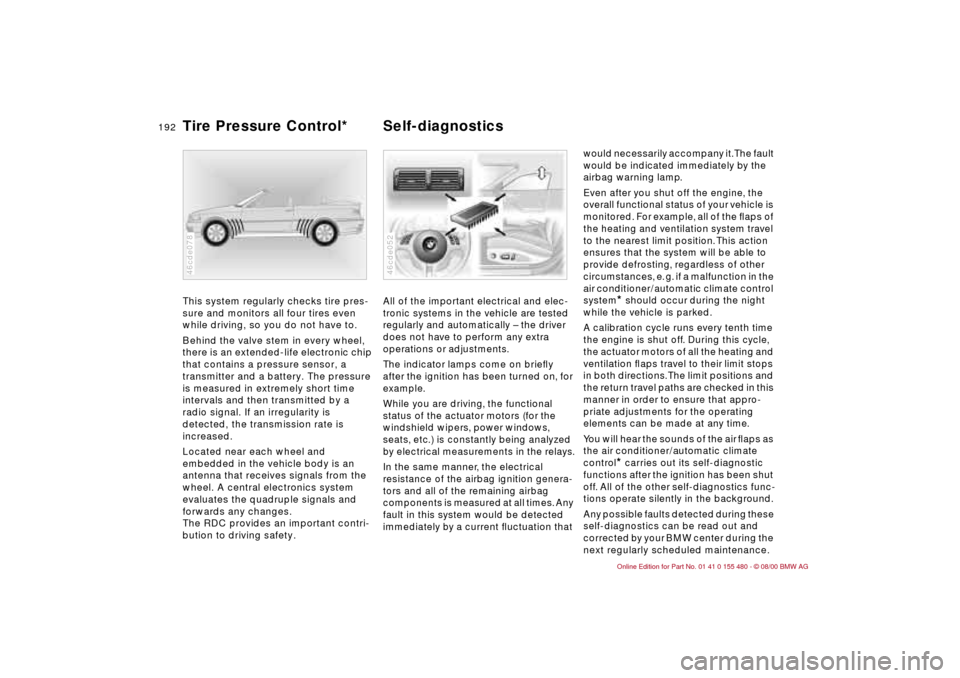
Behind the valve stem in every wheel,
there is an extended-life electronic chip
that contains a pressure sensor, a
transmitter and a battery. The pressure
is measured in extremely short time
intervals and then transmitted by a
radio signal. If an irregularity is
detected, the transmission rate is
increased.
Located near each wheel and
embedded in the vehicle body is an
antenna that receives signals from the
wheel. A central electronics system
evaluates the quadruple signals and
forwards any changes.
The RDC provides an important contri-
bution to driving safety.46cde078
All
of the important electrical and elec-
tronic systems in the vehicle are tested
regularly and automatically Ð the driver
does not have to perform any extra
operations or adjustments.
The indicator lamps come on brießy
after the ignition has been turned on, for
example.
While you are driving, the functional
status of the actuator motors (for the
windshield wipers, power windows,
seats, etc.) is constantly being analyzed
by electrical measurements in the relays.
In the same manner, the electrical
resistance of the airbag ignition genera-
tors and all of the remaining airbag
components is measured at all times. Any
fault in this system would be detected
immediately by a current ßuctuation that 46cde052
would necessarily accompany it.
The fault
would be indicated immediately by the
airbag warning lamp.
Even after you shut off the engine, the
overall functional status of your vehicle is
monitored. For example, all of the ßaps of
the heating and ventilation system travel
to the nearest limit position. This action
ensures that the system will be able to
provide defrosting, regardless of other
circumstances, e. g. if a malfunction in the
air conditioner/automatic climate control
system
* should occur during the night
while the vehicle is parked.
A calibration cycle runs every tenth time
the engine is shut off. During this cycle,
the actuator motors of all the heating and
ventilation ßaps travel to their limit stops
in both directions. The limit positions and
the return travel paths are checked in this
manner in order to ensure that appro-
priate adjustments for the operating
elements can be made at any time.
You will hear the sounds of the air ßaps as
the air conditioner/automatic climate
control* carries out its self-diagnostic
functions after the ignition has been shut
off. All of the other self-diagnostics func-
tions operate silently in the background.
Any possible faults detected during these
self-diagnostics can be read out and
corrected by your BMW center
during the
next regularly scheduled maintenance.
Page 195 of 215
Overview
Controls and features
Operation, care
and maintenance
Owner service procedures
Technical data
Index Advanced technology
195n
IndexDataTechnologyRepairsCar careControlsOverview
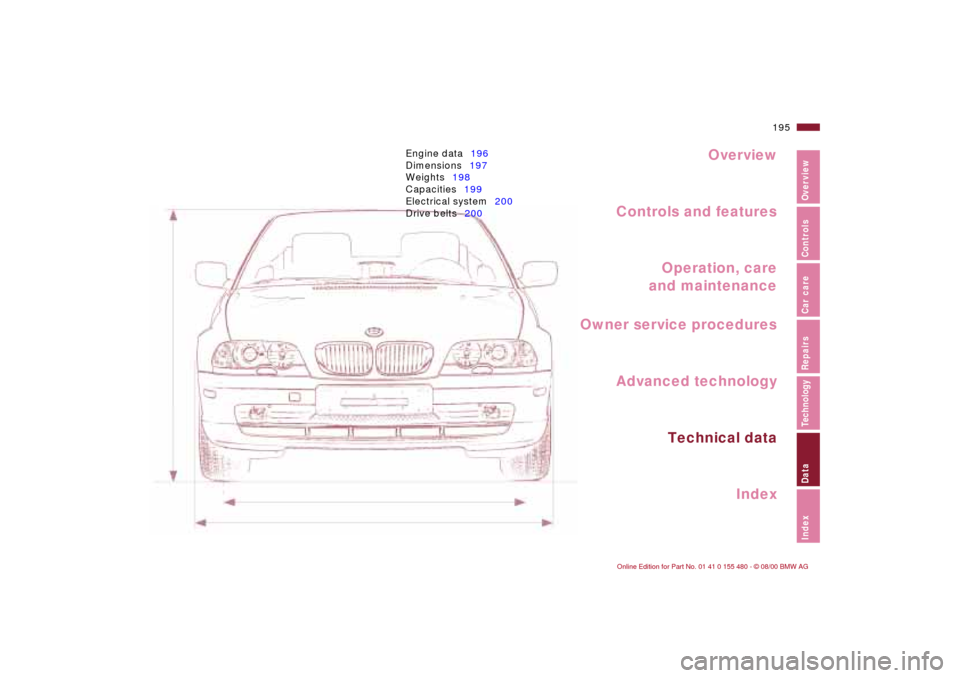
Engine data196
Dimensions197
Weights198
Capacities199
Electrical system200
Drive belts200
Data