steering BMW 325Ci CONVERTIBLE 2001 E46 Owner's Guide
[x] Cancel search | Manufacturer: BMW, Model Year: 2001, Model line: 325Ci CONVERTIBLE, Model: BMW 325Ci CONVERTIBLE 2001 E46Pages: 215, PDF Size: 2.1 MB
Page 123 of 215

123n
IndexDataTechnologyRepairsCar careControlsOverview
Antilock Brake System (ABS)Antilock Brake System (ABS)/
Cornering Brake Control (CBC) CBC is an advanced engineering
design of the ABS. When braking while
cornering at high speed or braking
during high lateral acceleration, or
when braking during a lane change,
vehicle stability is improved and
steering response is enhanced.
In the event of a malfunction
The ABS warning lamp in the
instrument cluster lights up,
refer to page 22. The brake
system then reverts to conventional
operation as on vehicles without ABS.
However, have the brake system
chekked by your BMW center as soon
as possible. To prevent undetected
defects and cumulative faults from
adversely affecting the brake system,
refer any problems to your BMW center
at the earliest opportunity.
ABS warning lamp for Canadian
models.
The brake-warning lamp comes
on along with the indicator
lamps for ABS and ASC+T/DSC,
refer to page 21, then the entire
control system for ABS, CBC
and ASC+T/DSC and ADB/DBC
has failed. Continue driving
cautiously and defensively.
Avoid full brake applications. This could
cause the vehicle to lose stability and
you might no longer be able to control
it.
Have the system checked by your BMW
center as soon as possible.
CBC, ABS and ASC+T/DSC and
ADB/DBC indicator and warning
lamps for Canadian models.
Page 125 of 215

125n
IndexDataTechnologyRepairsCar careControlsOverview
Disc brakesDisc brakes furnish optimum decelera-
tion and braking control and greater
fade resistance under heavy use.
When the vehicle is driven only occa-
sionally, during extended periods when
the vehicle is not used at all, and in
operating conditions where brake appli-
cations are less frequent, there is an
increased tendency for corrosion of the
discs and accumulation of contamina-
tion on the brake pads. This occurs
because the minimal pressure that must
be exerted by the pads to clean the
discs by brake applications is not
reached.
If the brake discs are corroded, they will
tend to respond to braking with a
pulsating effect that even extended
brake applications will fail to cure.
For your own safety: use only
brake pads that BMW has
approved for your particular vehicle
model. BMW cannot evaluate non-
approved brake pads to determine if
they are suited for use, and therefore
cannot ensure the operating safety of
the vehicle if they are installed.<
Driving notesWhen driving in wet conditions and in
heavy rain, it is effective to apply light
pressure to the brakes every few miles
or kilometers. Be aware of traffic condi-
tions to ensure that this maneuver does
not endanger other road users. The
heat which is generated by the brake
applications helps to dry the brake
pads and discs.
Maximum braking force is obtained
while the wheels are not locked, but
rather when they are still barely turning
immediately prior to locking. ABS main-
tains this state automatically. If the
antilock brake system ever fails, you
should revert to pumping the brakes
(refer to page 128).
Extended or steep mountain descents
should be driven in the gear in which
only minimal periodic brake application
is required. This avoids excessive strain
on the brakes and possible
impairment of the braking effect.
You can further increase the engine's
braking effect by selecting a lower gear,
downshifting as far as first gear. When
driving a vehicle with automatic trans-
mission, you can still downshift into first
gear. Refer to page 74.If engine braking should prove to be
inadequate, you should still avoid
extended, continuous braking. Instead
of maintaining low to moderate pres-
sure over an extended period of time,
you should decelerate by applying
more substantial pressure to the brake
pedal (watch for following traffic),
releasing the pedal, and then repeating
the application (staggered braking). The
cooling phases between active braking
intervals prevent the brakes from over-
heating, thus ensuring that full braking
capacity remains available at all times.
Do not coast with the clutch
depressed or with the shift lever
or selector lever in Neutral. Do not drive
with the engine shut off. The engine
provides no braking effect when the
clutch is depressed or the transmission
is in Neutral, and there is no power-
assist for braking or steering when the
engine is not running. Never allow floor
mats, carpets or any other objects to
protrude into the area around the brake,
clutch or accelerator pedals, which can
obstruct pedal travel.<
Page 128 of 215

128n
Winter operationBrakesWinter road conditions substantially
reduce the amount of traction available
between the tires and the road surface;
the resulting increase in braking
distance is considerable and should
always be kept in mind.
ABS is intended to prevent the wheels
from locking during brake applications,
thus helping to maintain vehicle stability
and steering response.
If the ABS does not respond in a critical
braking situation and the wheels lock:
reduce the pressure on the brake pedal
until the wheels just start to roll again
while still maintaining enough force to
continue braking.
Then increase the pressure, reduce the
pressure when the wheels lock, reapply
pressure etc.
This staggered braking procedure will
reduce stopping distances while
helping you maintain steering control.
You can then attempt to steer around
hazards after you have reduced pres-
sure on the brake pedal.Do not shift down on slick road
surfaces. Doing so could cause
the rear wheels to lose traction and
skid, that could result in the loss of
vehicle control.<
Depress the clutch during hard
braking on road surfaces that
provide only poor or uneven traction.<
Skid control Depress the clutch and let up on the
accelerator pedal, or place the selector
lever for the automatic transmission in
the "Neutral" position. Countersteer
carefully and attempt to regain control
of the vehicle.
ParkingEngage 1st or reverse gear. If your
vehicle is equipped with an automatic
transmission, place the selector lever in
"Park." On vehicles with manual trans-
mission, also apply the parking brake
when parking on inclined surfaces. In
order to prevent the parking brake pads
from locking due to frost or corrosion,
dry them by gently applying the parking
brake as the vehicle is coming to a
stop. Make sure that following traffic is
not endangered.
The brake lamps do not come
on when the parking brake is
applied.<
Page 129 of 215

129n
IndexDataTechnologyRepairsCar careControlsOverview
Power steering Cellular phone
* Radio reception
If the steering response changes, e.g.
high steering effort:
Have your BMW center inspect the
system.
If the power steering fails,
increased effort will be required to
steer the vehicle.<
Mobile communications systems
(cellular phone, radio, etc.) are
permitted with an output up to 10 watts
only. Mobile communications devices
not specifically designed for use in your
vehicle may trigger malfunctions while
operating your vehicle. BMW can
neither test nor assume responsibility
for every individual product being
offered on the market. We recommend
that you consult your BMW center
before purchasing any device of this
kind.
To ensure that your BMW continues to
provide reliable and trouble-free opera-
tion, do not use a cellular phone or
other radio device with an antenna
located inside the passenger compart-
ment. The antenna should always be
mounted on the outside of the vehicle.
Before loading the vehicle on a
car-carrier train or driving it
through a car wash, remove the
antenna.<
The reception and sound quality
obtained from mobile radios varies
according to a variety of factors,
including the broadcast range of the
transmitter and the directional orienta-
tion of the antenna. Interference factors
such as high-tension power lines, build-
ings and natural obstructions can all
lead to unavoidable reception interfer-
ence, regardless of how well the
vehicle's sound system is operating.
Climatic factors such as intense solar
radiation, fog, rain and snow can also
interfere with reception.
Car telephones or cellular phones not
approved by BMW can also cause
interference in the radio during a tele-
phone call. This phenomenon assumes
the form of a low-pitched hum
emanating from the speaker system.
Please refer to the Owner's Manual
provided with your sound system for
detailed information on its use.
Page 132 of 215
132n
Information for your safetyThe factory-approved radial tires are
matched to the vehicle and have been
selected to provide optimum safety and
driving comfort on your vehicle.
It is not merely the tire's service life, but
also driving comfort and Ð above all
else Ð driving safety that depend on the
condition of the tires and the mainte-
nance of the specified tire pressure.
Incorrect inflation pressure is a frequent
cause of tire damage. It also signifi-
cantly influences the roadholding ability
of your BMW.
Be sure to check the tire inflation
pressure Ð including the space-
saver spare tire Ð on a regular basis, i.e.
at least twice a month and before
beginning a longer trip. Refer to
page 28. If this is not done, incorrect
tire pressures can cause driving insta-
bility and tire damage, ultimately
resulting in an accident.<
Tire tread Ð tire damageInspect your tires frequently for tread
wear, signs of damage and for foreign
objects lodged in the tread. Check the
tread depth.
Tread depth should not be allowed to
go below 0.12 in (3 mm), even though
the legally specified minimum tread
depth is only 0.063 in (1.6 mm). At a
tread depth of 0.063 in (1.6 mm), tread
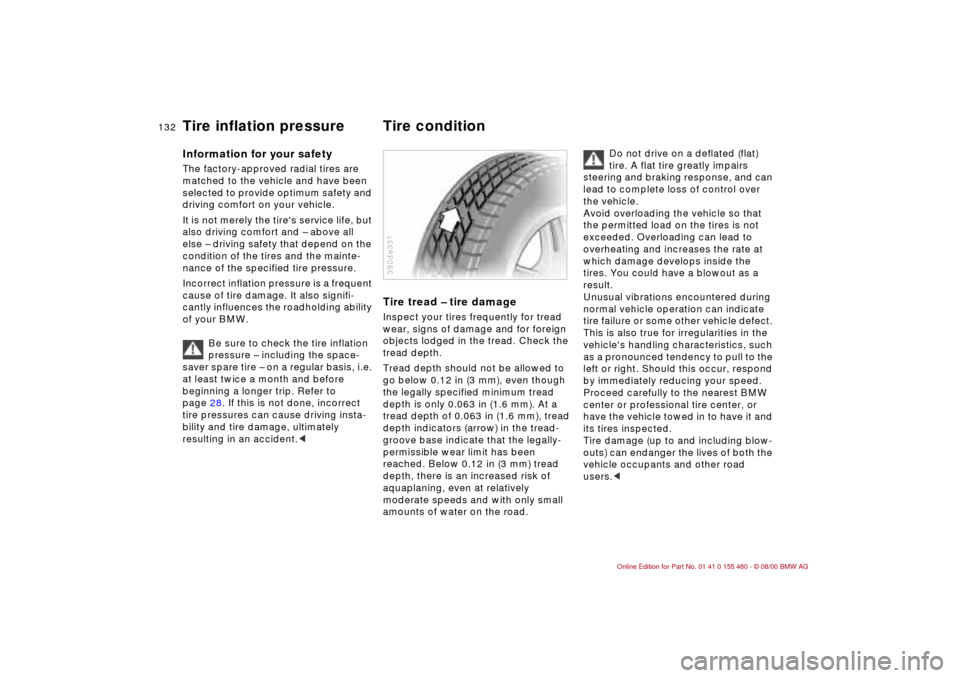
depth indicators (arrow) in the tread-
groove base indicate that the legally-
permissible wear limit has been
reached. Below 0.12 in (3 mm) tread
depth, there is an increased risk of
aquaplaning, even at relatively
moderate speeds and with only small
amounts of water on the road.390de331
Do not drive on a deflated (flat)
tire. A flat tire greatly impairs
steering and braking response, and can
lead to complete loss of control over
the vehicle.
Avoid overloading the vehicle so that
the permitted load on the tires is not
exceeded. Overloading can lead to
overheating and increases the rate at
which damage develops inside the
tires. You could have a blowout as a
result.
Unusual vibrations encountered during
normal vehicle operation can indicate
tire failure or some other vehicle defect.
This is also true for irregularities in the
vehicle's handling characteristics, such
as a pronounced tendency to pull to the
left or right. Should this occur, respond
by immediately reducing your speed.
Proceed carefully to the nearest BMW
center or professional tire center, or
have the vehicle towed in to have it and
its tires inspected.
Tire damage (up to and including blow-
outs) can endanger the lives of both the
vehicle occupants and other road
users.<
Tire inflation pressure Tire condition
Page 136 of 215

136n
Winter tiresChoosing the right tireBMW recommends winter tires (M+S
radial tires) for driving in adverse winter
road conditions. So-called all-season
tires with the M+S identification mark
do indeed possess better winter trac-
tion than summer tires that have the H,
V, W, Y and ZR speed ratings, but they
generally fail to provide the same levels
of performance as winter tires.
In the interest of safe tracking and
steering response, install winter tires
made by the same manufacturer having
the same tread configuration on all four
wheels.
Mount only winter tires which have
been approved by BMW. Any BMW
center will be glad to provide you with
information on the best winter tires for
every particular driving condition.
Do not exceed specified
maximum speeds
Never exceed the maximum speed
for which the tires are rated.
Unprofessional attempts by laymen to
service tires can lead to damage and
accidents.
Have this work performed by skilled
professionals only. Any BMW center
has the required technical knowledge
and the proper equipment and will be
happy to assist you.<
Tire condition, tire pressureWinter tires display a perceptible loss in
their ability to cope with winter driving
conditions once the tread wears to
below 0.16 in (4 mm), and therefore in
the interest of safety, should be
replaced.
Comply with the specified tire inflation
pressures Ð and be sure to have the
wheel and tire assemblies balanced
every time you change the tires.
StorageAlways store tires in a cool, dry place.
Store them away from light whenever
possible. Protect the tires against
contact with oil, grease and fuel.Snow chains
*
Use narrow-link BMW snow chains
on
winter tires only in pairs and only on the
rear wheels. Comply with all manufac-
turer's safety precautions when
mounting the chains.
Page 145 of 215
145n
IndexDataTechnologyRepairsCar careControlsOverview
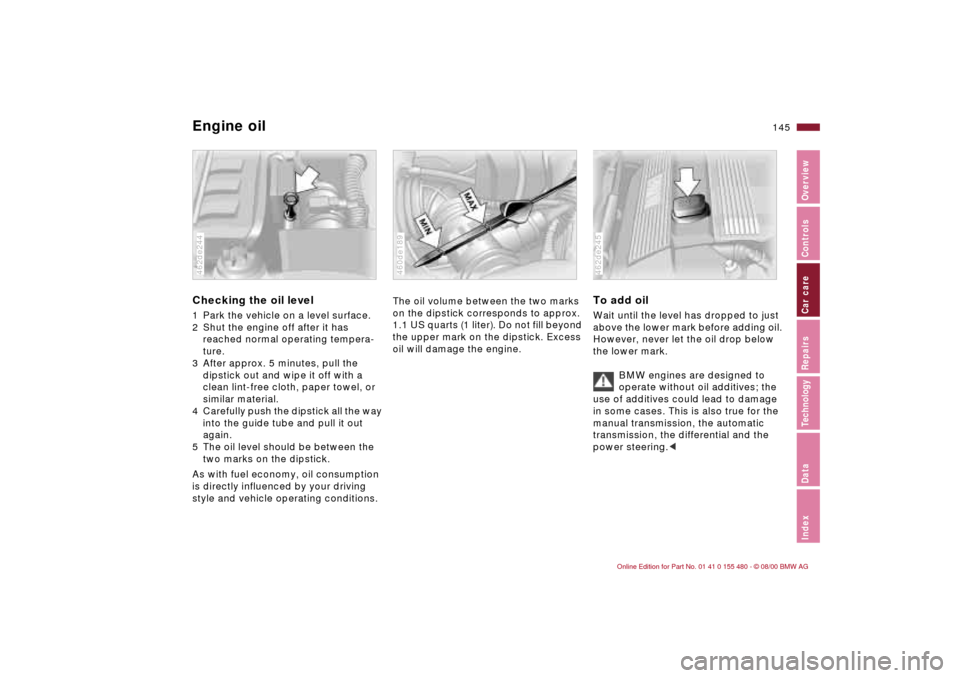
Engine oilChecking the oil level 1 Park the vehicle on a level surface.
2 Shut the engine off after it has
reached normal operating tempera-
ture.
3 After approx. 5 minutes, pull the
dipstick out and wipe it off with a
clean lint-free cloth, paper towel, or
similar material.
4 Carefully push the dipstick all the way
into the guide tube and pull it out
again.
5 The oil level should be between the
two marks on the dipstick.
As with fuel economy, oil consumption
is directly influenced by your driving
style and vehicle operating conditions.462de244
The oil volume between the two marks
on the dipstick corresponds to approx.
1.1 US quarts (1 liter). Do not fill beyond
the upper mark on the dipstick. Excess
oil will damage the engine.460de189
To add oil Wait until the level has dropped to just
above the lower mark before adding oil.
However, never let the oil drop below
the lower mark.
BMW engines are designed to
operate without oil additives; the
use of additives could lead to damage
in some cases. This is also true for the
manual transmission, the automatic
transmission, the differential and the
power steering.<462de245
Page 159 of 215
159n
IndexDataTechnologyRepairsCar careControlsOverview
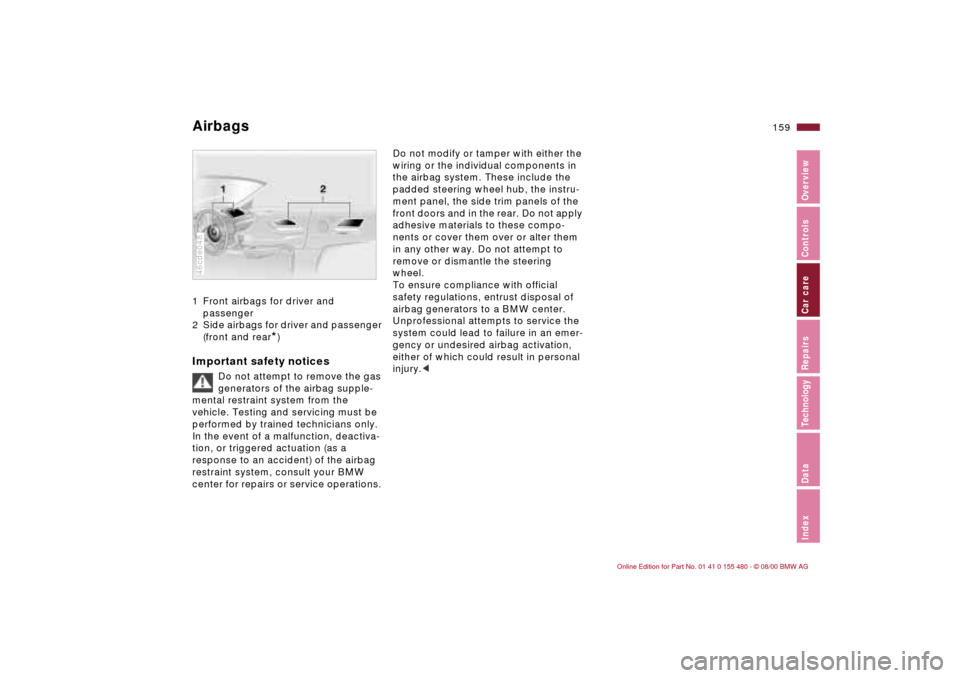
Airbags 1 Front airbags for driver and
passenger
2 Side airbags for driver and passenger
(front and rear
*)
Important safety notices
Do not attempt to remove the gas
generators of the airbag supple-
mental restraint system from the
vehicle. Testing and servicing must be
performed by trained technicians only.
In the event of a malfunction, deactiva-
tion, or triggered actuation (as a
response to an accident) of the airbag
restraint system, consult your BMW
center for repairs or service operations.
46cde048
Do not modify or tamper with either the
wiring or the individual components in
the airbag system. These include the
padded steering wheel hub, the instru-
ment panel, the side trim panels of the
front doors and in the rear. Do not apply
adhesive materials to these compo-
nents or cover them over or alter them
in any other way. Do not attempt to
remove or dismantle the steering
wheel.
To ensure compliance with official
safety regulations, entrust disposal of
airbag generators to a BMW center.
Unprofessional attempts to service the
system could lead to failure in an emer-
gency or undesired airbag activation,
either of which could result in personal
injury.<
Page 173 of 215
173n
IndexDataTechnologyRepairsCar careControlsOverview
Changing a wheel
Take these precautionary
measures if you have either a flat
tire or are changing the tire:
Stop the vehicle as far as possible from
passing traffic. Park on a firm, flat
surface. Switch on the hazard warning
flashers. Turn the steering wheel to the
straight-ahead position, remove the key
and engage the steering lock. Shift into
1st or reverse gear (selector lever in
"Park" with automatic transmission) and
engage the parking brake.
All passengers should be outside the
vehicle and well away from your imme-
diate working area (behind a guardrail,
for instance).
Set up a warning triangle
* or portable
hazard warning on the roadside at an
appropriate distance from the rear of
the vehicle. Comply with all safety
guidelines and regulations.
Change the wheel only on a level, firm
surface which is not slippery. Avoid
jacking the vehicle on a soft or slippery
support surface (snow, ice, loose
gravel, etc.), as it could slide sideways.
Position the jack on a firm support
surface.
Do not place wooden blocks or similar
objects under the jack. If this is done,
the jack might not be able to reach its
full support capacity because of the
limited height.
Do not lie under the vehicle or start the
engine when the vehicle is supported
by the jack. Failure to comply with this
creates a risk of fatal injury.<
Your BMW has a space-saver spare tire
for temporary use to ensure your
mobility.
To remove the space-saver spare
tire, take out the floor panel in the
luggage compartment completely (refer
to page 41).<
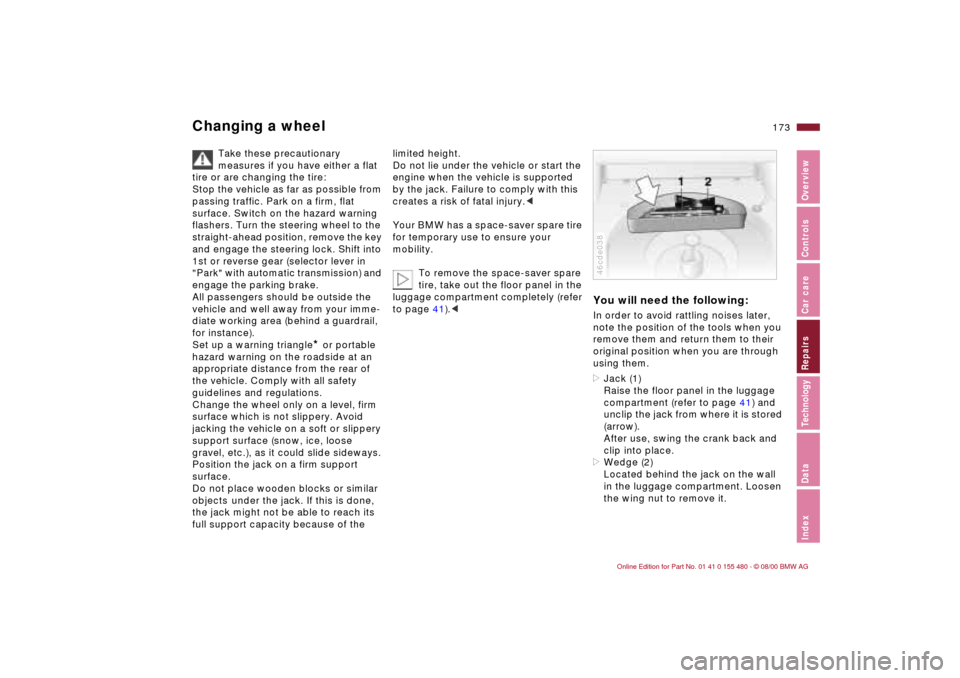
You will need the following:In order to avoid rattling noises later,
note the position of the tools when you
remove them and return them to their
original position when you are through
using them.
>Jack (1)
Raise the floor panel in the luggage
compartment (refer to page 41) and
unclip the jack from where it is stored
(arrow).
After use, swing the crank back and
clip into place.
>Wedge (2)
Located behind the jack on the wall
in the luggage compartment. Loosen
the wing nut to remove it.46cde038
Page 176 of 215
176n
Changing a wheel Battery Driving with the space-saver
spare tireDrive cautiously and do not exceed a
speed of 50 mph (80 km/h).
Be aware that vehicle handling will be
altered. Slower brake response time,
longer braking distances and changed
steering characteristics may be
anticipated when approaching limit
conditions.
The changes in handling characteristics
will be even more pronounced in
conjunction with winter tires.
Only one space-saver spare tire
*
may be mounted at a time. Mount
a wheel and tire with the same size
and specifications as the others at the
earliest possible opportunity. Maintain
correct tire pressures. Refer to
page 28.<
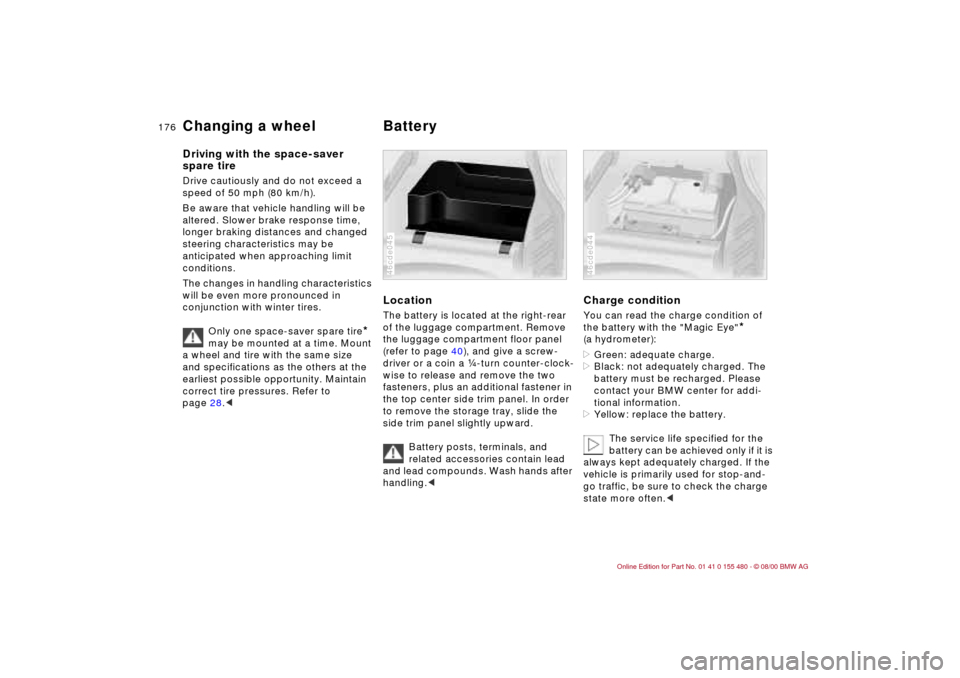
LocationThe battery is located at the right-rear
of the luggage compartment. Remove
the luggage compartment floor panel
(refer to page 40), and give a screw-
driver or a coin a f-turn counter-clock-
wise to release and remove the two
fasteners, plus an additional fastener in
the top center side trim panel. In order
to remove the storage tray, slide the
side trim panel slightly upward.
Battery posts, terminals, and
related accessories contain lead
and lead compounds. Wash hands after
handling.<46cde045
Charge conditionYou can read the charge condition of
the battery with the "Magic Eye"
*
(a hydrometer):
>Green: adequate charge.
>Black: not adequately charged. The
battery must be recharged. Please
contact your BMW center for addi-
tional information.
>Yellow: replace the battery.
The service life specified for the
battery can be achieved only if it is
always kept adequately charged. If the
vehicle is primarily used for stop-and-
go traffic, be sure to check the charge
state more often.<
46cde044