auto BMW 325Ci CONVERTIBLE 2001 E46 Repair Manual
[x] Cancel search | Manufacturer: BMW, Model Year: 2001, Model line: 325Ci CONVERTIBLE, Model: BMW 325Ci CONVERTIBLE 2001 E46Pages: 215, PDF Size: 2.1 MB
Page 151 of 215

151n
IndexDataTechnologyRepairsCar careControlsOverview
Washing your vehicle You can have your BMW washed in
an automatic car wash, even when it
is new. Car wash systems that do not
employ brushes are preferable, refer to
page 157.
Wipe away tough dirt and loosen and
remove dead insects before washing
the vehicle.
In order to avoid spots, do not wash the
vehicle when the hood is warm, or
during or immediately after exposure to
strong sunlight.
When using an automatic car wash, be
sure that:
>The car wash system is suited for the
dimensions of your vehicle.
>No damage will occur on vehicles
with attached body accessories (such
as spoilers or antennas). Consult the
car wash operator if necessary.
>The wheels and tires of your vehicle
cannot be damaged by the convey-
ance devices of the car wash system.
>The vehicle is cleaned with minimum
brush pressure, and that ample water
is available for washing and rinsing.Vehicles with rain sensor:
Clean the windshield regularly. Wax
from automatic car washes or insects
can cause malfunctions in the function
of the rain sensor.
Deactivate the rain sensor when
going through car washes (refer to
page 77) Ñ otherwise, the wipers could
be damaged if they inadvertently start
working.<
Parts of the vehicle that are inaccessi-
ble to the automatic washer Ð such as
door sills, door and hood edges, etc. Ð
should be cleaned by hand.
In the winter months, it is especially
important to be sure that the vehicle is
washed on a regular basis. Large quan-
tities of dirt and road salt are difficult to
remove, and they also damage the
vehicle.
If spray wands or high-pressure
washers are used, be sure to
maintain an adequate distance between
the spray source and the vehicle's sur-
face. Inadequate distance and exces-
sive pressure can damage or weaken
the finish, making it more susceptible to
subsequent attack. In addition,
moisture could penetrate to vehicle
components, leading to long-term
damage.<
When cleaning the headlamps,
please observe the following: do
not wipe dry with a cloth (scratches).
Never use abrasives or strong solvents
to clean the covers. Remove dirt and
contamination (such as insects) by
soaking with BMW Car Shampoo and
then rinsing with plenty of water.
Always use a deicer spray to remove
accumulated ice and snow Ð never use
a scraper.<
After washing the vehicle, apply
the brakes briefly to dry them.
Braking efficiency might otherwise be
reduced by the moisture and the brake
rotors could also be corroded.<
Caring for your vehicle
Page 157 of 215

157n
IndexDataTechnologyRepairsCar careControlsOverview
Cleaning and care of the convertible topCareThe appearance and life of the convert-
ible top are highly dependent on its
proper care and operation. You should
pay particular attention to the following
instructions if your car has a light-
colored top.
Protect the vehicle from exposure to
intense sunlight whenever possible by
parking it in the shade. This will help to
prevent the paint, rubber and fabric-
covered parts from being worn out.
Never stow the convertible top in the
convertible top compartment when it is
wet, dirty or frozen, since this can
cause mildew stains and chafe marks.
To prevent mildew stains, do not keep
the convertible top enclosed in the
convertible top compartment for any
extended period of time.
If the vehicle will be parked for lengthy
periods in an enclosed space, be sure
that the convertible top is dry and that
there is adequate ventilation.
Clean off bird droppings immediately,
since they attack the convertible top
and cause the rubber seals to swell due
to their caustic characteristics.Besides water, treat rubber seals only
with talcum powder, rubber care prod-
ucts or silicone spray, particularly when
they feel dry or tend to stick.
Eliminate noises such as squeaks with
lubricant spray.
Depressions and discoloration may
occur in the convertible top as a result
of improper maintenance and cleaning
or due to loading from excessive use.
The convertible top and its seams may
also develop leaks. These occurrences
are not covered by the warranty. For
repairs, please consult your BMW
center.
Washing your carYou can wash your BMW at an auto-
matic car wash. Brushless systems are
preferable.
If a brushless car wash is unavailable
and a brush car wash must be used,
modern systems with soft brushes are
preferable. Do not select the wax finish
option. The small amount of beading
wax always used in automatic car
washes will not harm your vehicle's
finish.
In the case of more extensive dirt,
which is definitely visible on light-
colored top materials, clean the top
with the BMW Convertible Cleaning
Set. Please proceed as follows:
Spray the convertible top with the
cleaning agent and then rub with a
well-dampened sponge using circular
motions until a foam develops. Then
you can finish washing the vehicle in an
automatic car wash. After washing your
vehicle 3 to 5 times, you should treat
the convertible top with a special
convertible top impregnating spray.
Please follow the instructions on the
spray can.
Page 173 of 215
173n
IndexDataTechnologyRepairsCar careControlsOverview
Changing a wheel
Take these precautionary
measures if you have either a flat
tire or are changing the tire:
Stop the vehicle as far as possible from
passing traffic. Park on a firm, flat
surface. Switch on the hazard warning
flashers. Turn the steering wheel to the
straight-ahead position, remove the key
and engage the steering lock. Shift into
1st or reverse gear (selector lever in
"Park" with automatic transmission) and
engage the parking brake.
All passengers should be outside the
vehicle and well away from your imme-
diate working area (behind a guardrail,
for instance).
Set up a warning triangle
* or portable
hazard warning on the roadside at an
appropriate distance from the rear of
the vehicle. Comply with all safety
guidelines and regulations.
Change the wheel only on a level, firm
surface which is not slippery. Avoid
jacking the vehicle on a soft or slippery
support surface (snow, ice, loose
gravel, etc.), as it could slide sideways.
Position the jack on a firm support
surface.
Do not place wooden blocks or similar
objects under the jack. If this is done,
the jack might not be able to reach its
full support capacity because of the
limited height.
Do not lie under the vehicle or start the
engine when the vehicle is supported
by the jack. Failure to comply with this
creates a risk of fatal injury.<
Your BMW has a space-saver spare tire
for temporary use to ensure your
mobility.
To remove the space-saver spare
tire, take out the floor panel in the
luggage compartment completely (refer
to page 41).<
You will need the following:In order to avoid rattling noises later,
note the position of the tools when you
remove them and return them to their
original position when you are through
using them.
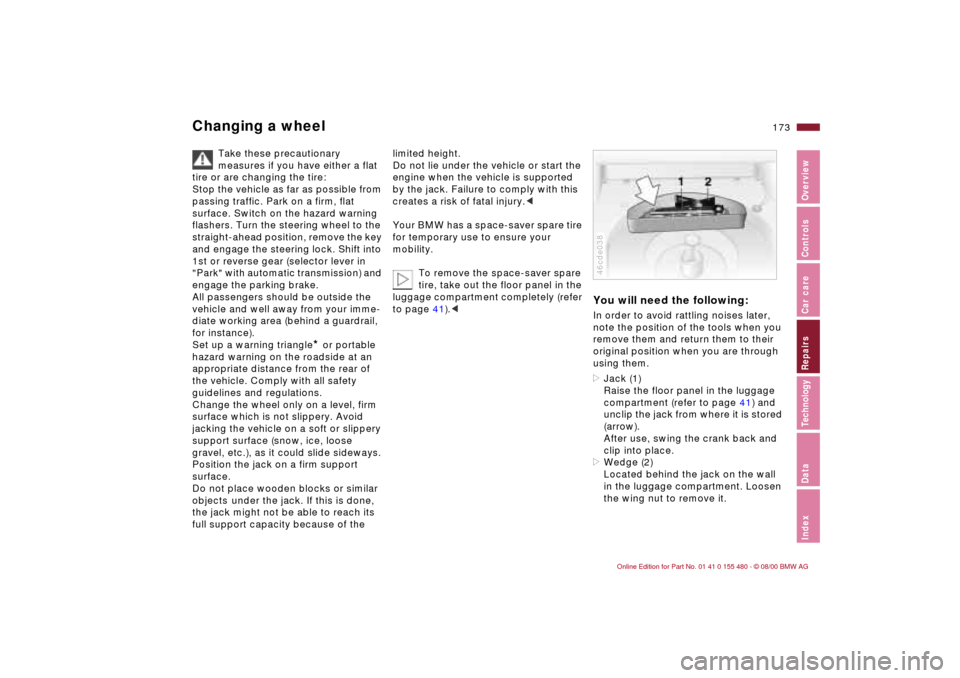
>Jack (1)
Raise the floor panel in the luggage
compartment (refer to page 41) and
unclip the jack from where it is stored
(arrow).
After use, swing the crank back and
clip into place.
>Wedge (2)
Located behind the jack on the wall
in the luggage compartment. Loosen
the wing nut to remove it.46cde038
Page 182 of 215
182n
Convertible top4 Use a screwdriver to lift out the cover
panel in the center of the front
convertible top frame.
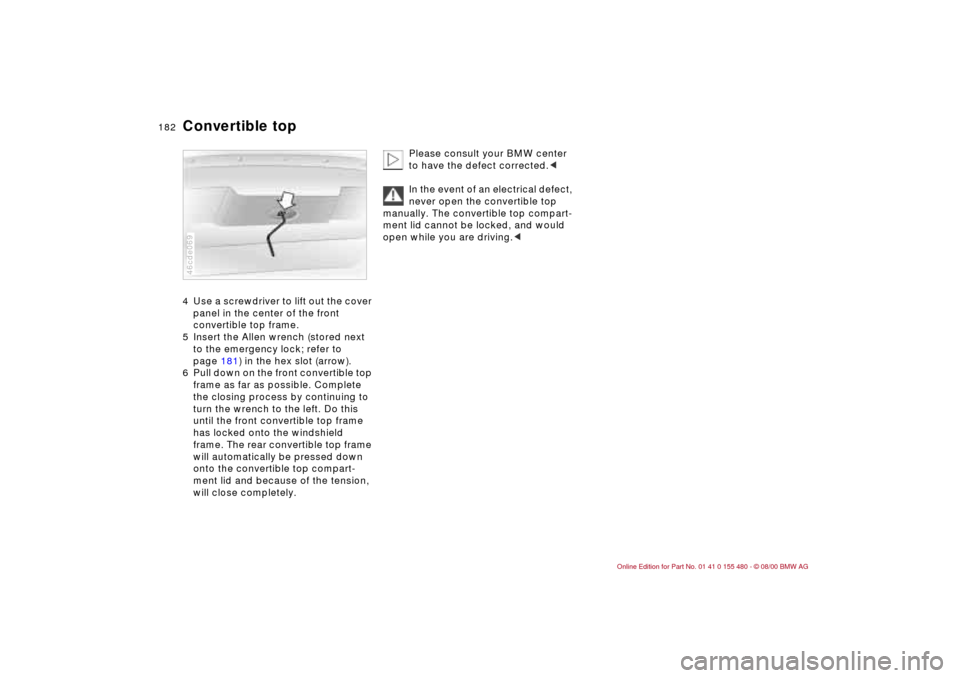
5 Insert the Allen wrench (stored next
to the emergency lock; refer to
page 181) in the hex slot (arrow).
6 Pull down on the front convertible top
frame as far as possible. Complete
the closing process by continuing to
turn the wrench to the left. Do this
until the front convertible top frame
has locked onto the windshield
frame. The rear convertible top frame
will automatically be pressed down
onto the convertible top compart-
ment lid and because of the tension,
will close completely.46cde069
Please consult your BMW center
to have the defect corrected.c
In the event of an electrical defect,
never open the convertible top
manually. The convertible top compart-
ment lid cannot be locked, and would
open while you are driving.c
Page 187 of 215
Overview
Controls and features
Operation, care
and maintenance
Owner service procedures
Technical data
Index Advanced technology
187n
IndexDataTechnologyRepairsCar careControlsOverview
Adaptive Transmission Control
(ATC)188
Airbags189
Automatic Stability Control plus
Traction (ASC+T)/Dynamic
Stability Control (DSC)189
Radio reception190
Safety belt tensioner190
Interior rearview mirror
with automatic dimming
feature191
Rain sensor191
Tire Pressure Control (RDC)192
Self-diagnostics192
Rollover protection system193
Xenon lamps193
Technol-
Page 188 of 215
188n
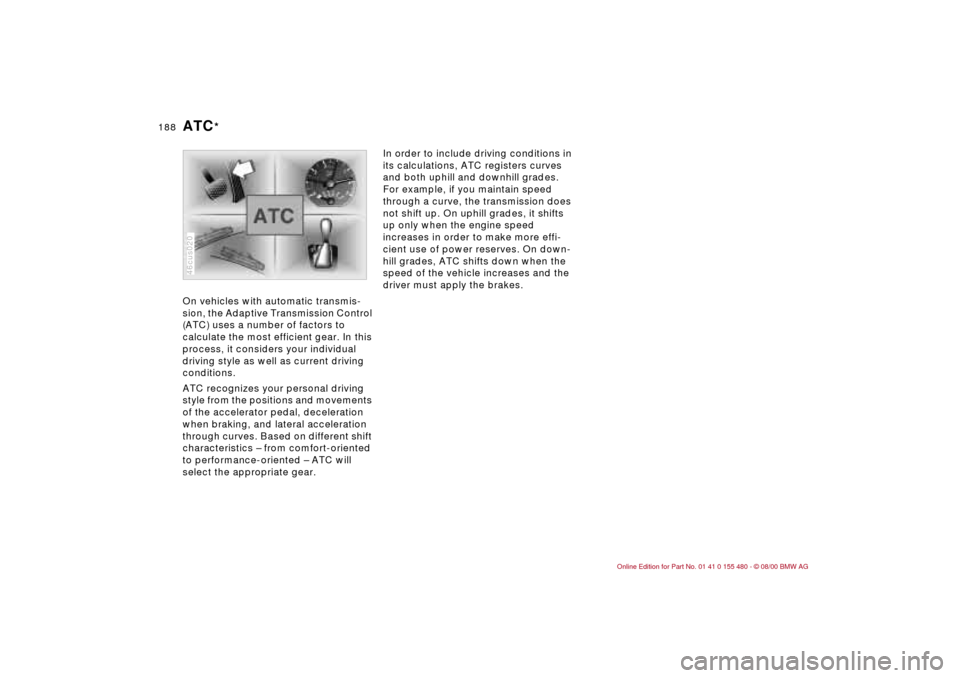
On vehicles with automatic transmis-
sion, the Adaptive Transmission Control
(ATC) uses a number of factors to
calculate the most efficient gear. In this
process, it considers your individual
driving style as well as current driving
conditions.
ATC recognizes your personal driving
style from the positions and movements
of the accelerator pedal, deceleration
when braking, and lateral acceleration
through curves. Based on different shift
characteristics Ð from comfort-oriented
to performance-oriented Ð ATC will
select the appropriate gear.
46cus020
In order to include driving conditions in
its calculations, ATC registers curves
and both uphill and downhill grades.
For example, if you maintain speed
through a curve, the transmission does
not shift up. On uphill grades, it shifts
up only when the engine speed
increases in order to make more effi-
cient use of power reserves. On down-
hill grades, ATC shifts down when the
speed of the vehicle increases and the
driver must apply the brakes.
ATC
*
Page 190 of 215
190n
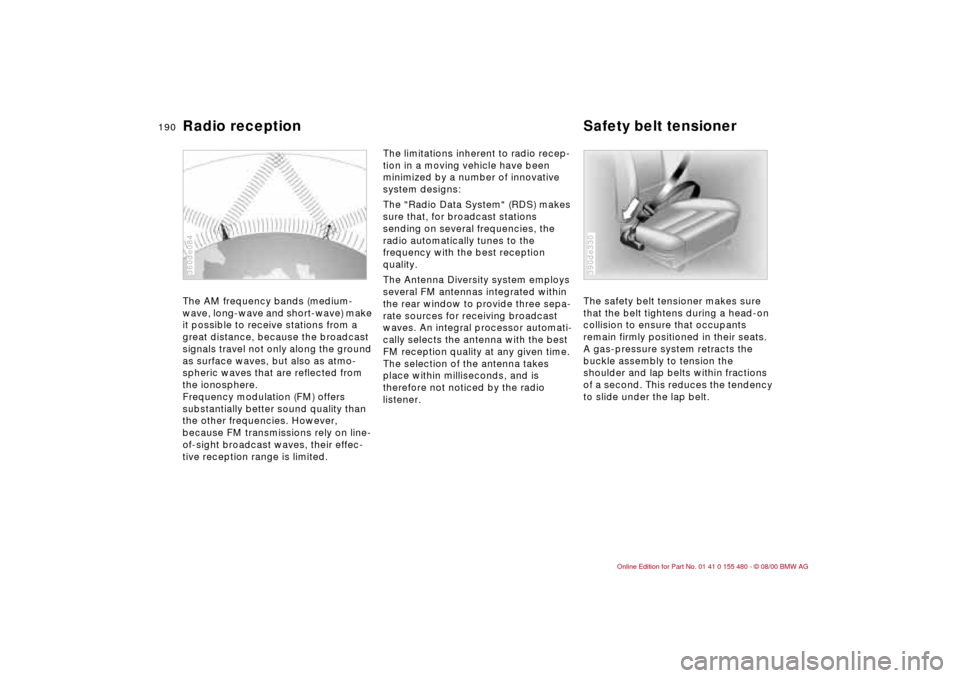
Radio reception Safety belt tensionerThe AM frequency bands (medium-
wave, long-wave and short-wave) make
it possible to receive stations from a
great distance, because the broadcast
signals travel not only along the ground
as surface waves, but also as atmo-
spheric waves that are reflected from
the ionosphere.
Frequency modulation (FM) offers
substantially better sound quality than
the other frequencies. However,
because FM transmissions rely on line-
of-sight broadcast waves, their effec-
tive reception range is limited. 360de084
The limitations inherent to radio recep-
tion in a moving vehicle have been
minimized by a number of innovative
system designs:
The "Radio Data System" (RDS) makes
sure that, for broadcast stations
sending on several frequencies, the
radio automatically tunes to the
frequency with the best reception
quality.
The Antenna Diversity system employs
several FM antennas integrated within
the rear window to provide three sepa-
rate sources for receiving broadcast
waves. An integral processor automati-
cally selects the antenna with the best
FM reception quality at any given time.
The selection of the antenna takes
place within milliseconds, and is
therefore not noticed by the radio
listener.The safety belt tensioner makes sure
that the belt tightens during a head-on
collision to ensure that occupants
remain firmly positioned in their seats.
A gas-pressure system retracts the
buckle assembly to tension the
shoulder and lap belts within fractions
of a second. This reduces the tendency
to slide under the lap belt.
390de330
Page 191 of 215
191n
IndexDataTechnologyRepairsCar careControlsOverview
Interior rearview mirror with automatic dimming feature
* Rain sensor
*
The interior rearview mirror with auto-
matic dimming feature reduces blinding
from following traffic by adapting the
intensity of the reflected images to
correspond to levels of light registered
by the unit's sensors. The mirror reverts
to its undimmed setting as soon as the
light source disappears. One lamp
sensor is mounted on the front of the
mirror housing. This sensor, which is
directed forward, measures light inten-
sity in the area ahead of the vehicle.
The second sensor is integrated within
the mirror's glass. The electronic
control system compares the light
intensity from front and rear. The differ-
ence provides the basic parameter
used to modulate an electrical current
and induce chemical changes in a
semisolid layer incorporated in the lens.46cus036
The semisolid reacts chemically to this
electrical current, thus providing
dimming of the mirror through an infi-
nitely-variable range (electrochromic
technology).
As a result, it is no longer necessary to
dim the mirror manually, and the driver
can concentrate completely on traffic
conditions.
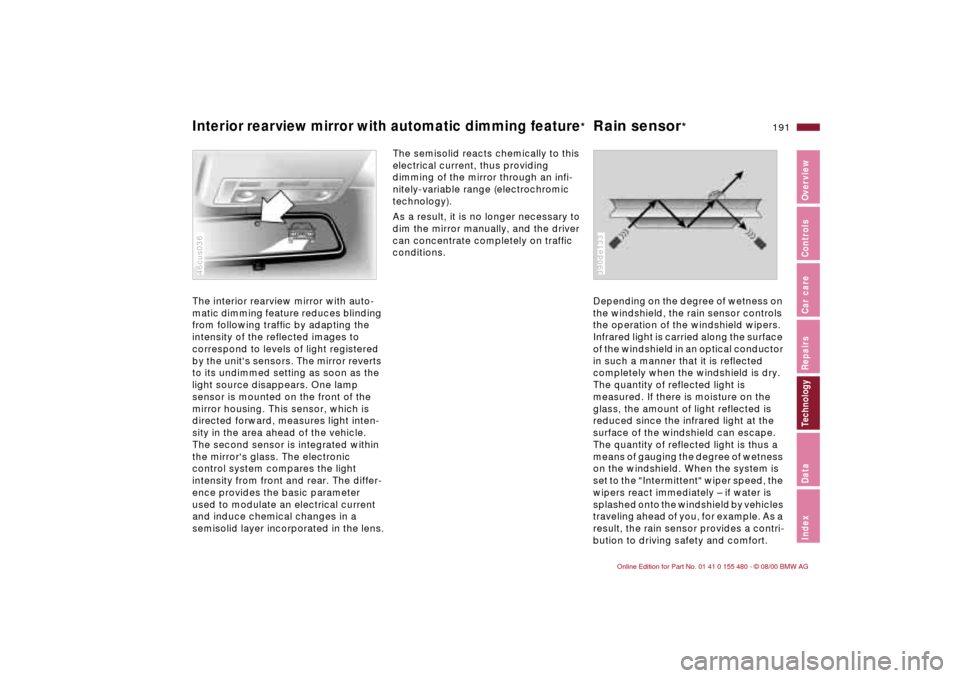
Depending on the degree of wetness on
the windshield, the rain sensor controls
the operation of the windshield wipers.
Infrared light is carried along the surface
of the windshield in an optical conductor
in such a manner that it is reflected
completely when the windshield is dry.
The quantity of reflected light is
measured. If there is moisture on the
glass, the amount of light reflected is
reduced since the infrared light at the
surface of the windshield can escape.
The quantity of reflected light is thus a
means of gauging the degree of wetness
on the windshield. When the system is
set to the "Intermittent" wiper speed, the
wipers react immediately Ð if water is
splashed onto the windshield by vehicles
traveling ahead of you, for example. As a
result, the rain sensor provides a contri-
bution to driving safety and comfort.
390de133
Page 192 of 215
192n
Tire Pressure Control* Self-diagnostics This system regularly checks tire pres-
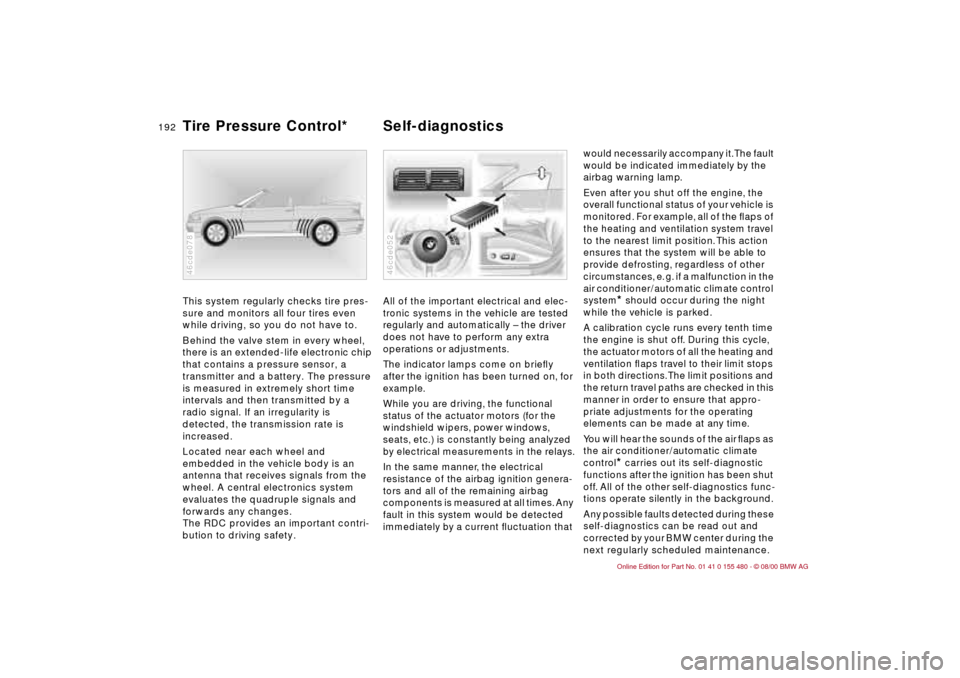
sure and monitors all four tires even
while driving, so you do not have to.
Behind the valve stem in every wheel,
there is an extended-life electronic chip
that contains a pressure sensor, a
transmitter and a battery. The pressure
is measured in extremely short time
intervals and then transmitted by a
radio signal. If an irregularity is
detected, the transmission rate is
increased.
Located near each wheel and
embedded in the vehicle body is an
antenna that receives signals from the
wheel. A central electronics system
evaluates the quadruple signals and
forwards any changes.
The RDC provides an important contri-
bution to driving safety.46cde078
All
of the important electrical and elec-
tronic systems in the vehicle are tested
regularly and automatically Ð the driver
does not have to perform any extra
operations or adjustments.
The indicator lamps come on brießy
after the ignition has been turned on, for
example.
While you are driving, the functional
status of the actuator motors (for the
windshield wipers, power windows,
seats, etc.) is constantly being analyzed
by electrical measurements in the relays.
In the same manner, the electrical
resistance of the airbag ignition genera-
tors and all of the remaining airbag
components is measured at all times. Any
fault in this system would be detected
immediately by a current ßuctuation that 46cde052
would necessarily accompany it.
The fault
would be indicated immediately by the
airbag warning lamp.
Even after you shut off the engine, the
overall functional status of your vehicle is
monitored. For example, all of the ßaps of
the heating and ventilation system travel
to the nearest limit position. This action
ensures that the system will be able to
provide defrosting, regardless of other
circumstances, e. g. if a malfunction in the
air conditioner/automatic climate control
system
* should occur during the night
while the vehicle is parked.
A calibration cycle runs every tenth time
the engine is shut off. During this cycle,
the actuator motors of all the heating and
ventilation ßaps travel to their limit stops
in both directions. The limit positions and
the return travel paths are checked in this
manner in order to ensure that appro-
priate adjustments for the operating
elements can be made at any time.
You will hear the sounds of the air ßaps as
the air conditioner/automatic climate
control* carries out its self-diagnostic
functions after the ignition has been shut
off. All of the other self-diagnostics func-
tions operate silently in the background.
Any possible faults detected during these
self-diagnostics can be read out and
corrected by your BMW center
during the
next regularly scheduled maintenance.
Page 193 of 215
193n
IndexDataTechnologyRepairsCar careControlsOverview
Rollover protection system
Xenon lamps
*
The rollover protection system offers
additional protection to the airbags and
the safety belts. It uses highly sensitive
sensors that respond immediately to
any unstable vehicle condition encoun-
tered while driving, e. g. a steep angle
or loss of wheel contact with the
ground. The protective bar in the rear
headrests would be triggered in this
type of situation.
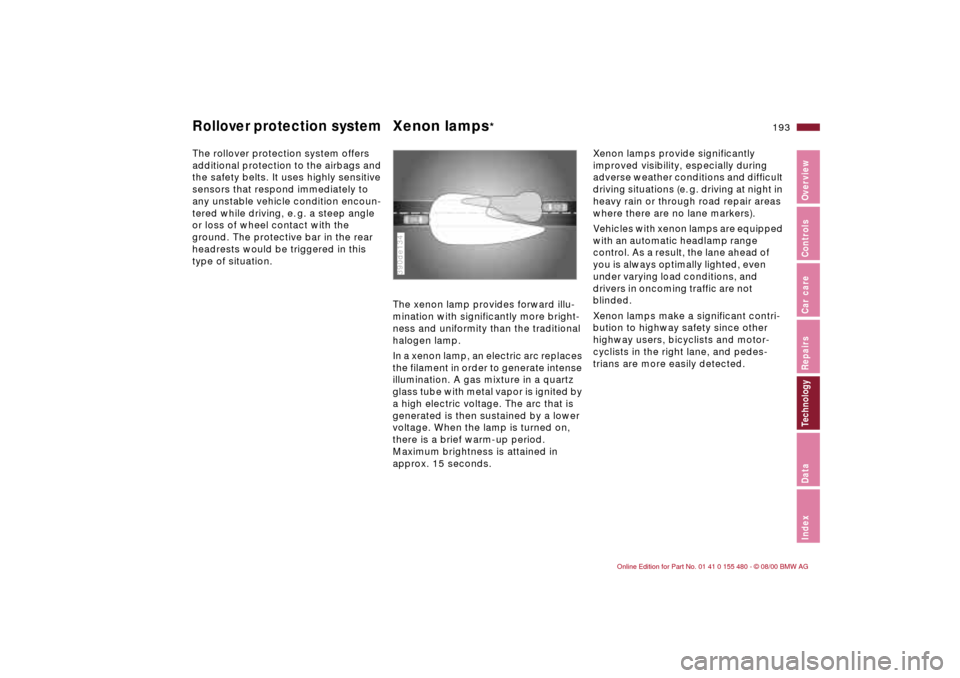
The xenon lamp provides forward illu-
mination with significantly more bright-
ness and uniformity than the traditional
halogen lamp.
In a xenon lamp, an electric arc replaces
the filament in order to generate intense
illumination. A gas mixture in a quartz
glass tube with metal vapor is ignited by
a high electric voltage. The arc that is
generated is then sustained by a lower
voltage. When the lamp is turned on,
there is a brief warm-up period.
Maximum brightness is attained in
approx. 15 seconds.
390de134
Xenon lamps provide significantly
improved visibility, especially during
adverse weather conditions and difficult
driving situations (e. g. driving at night in
heavy rain or through road repair areas
where there are no lane markers).
Vehicles with xenon lamps are equipped
with an automatic headlamp range
control. As a result, the lane ahead of
you is always optimally lighted, even
under varying load conditions, and
drivers in oncoming traffic are not
blinded.
Xenon lamps make a significant contri-
bution to highway safety since other
highway users, bicyclists and motor-
cyclists in the right lane, and pedes-
trians are more easily detected.