light BMW 325Ci CONVERTIBLE 2001 E46 Repair Manual
[x] Cancel search | Manufacturer: BMW, Model Year: 2001, Model line: 325Ci CONVERTIBLE, Model: BMW 325Ci CONVERTIBLE 2001 E46Pages: 215, PDF Size: 2.1 MB
Page 175 of 215
175n
IndexDataTechnologyRepairsCar careControlsOverview
Changing a wheel9 Position the new wheel or the
space-saver spare tire on the hub
and screw at least two lug bolts
finger-tight into opposite bolt holes.
10 Screw in the remaining lug bolts.
Tighten all the bolts securely.
11 Lower the jack and remove it from
beneath the vehicle.
12 Tighten the lug bolts in a diagonal
pattern.462de266
13 If your wheels are equipped with full
wheel covers
*: position the wheel
cover with the valve opening over
the valve (arrow) and press it onto
the wheel with both hands.
14 Check and correct the tire's inflation
pressure at the earliest possibility.
For vehicles with Tire
Pressure Control (RDC):
Reactivate the system after
mounting the space-saver spare tire
or after correcting the air pressure.
Refer to page 91.
Only use original BMW full wheel
covers, otherwise, the trim piece
may not fit securely. The full wheel
cover may not be installed on the
space-saver spare tire since this could
damage the cover.<
462de279
The vehicle jack is designed for
changing wheels only. Do not
attempt to raise another vehicle model
with it or to raise any load of any kind.
To do so could cause accidents and
personal injury.
To ensure continued safety, have the
tightness of the lug bolts checked with
a calibrated lug wrench [torque specifi-
cation: 72 lb.ft (100Nm)] at the earliest
opportunity.<
When storing the wheel, be sure that
you do not damage the retaining pin in
the spare tire recess.
If light-alloy wheels other than original
BMW light-alloy wheels have been
mounted, it may be necessary to use
different lug bolts for those wheels.
Replace the defective tire as soon as
possible and have the new wheel/tire
balanced.
Page 176 of 215
176n
Changing a wheel Battery Driving with the space-saver
spare tireDrive cautiously and do not exceed a
speed of 50 mph (80 km/h).
Be aware that vehicle handling will be
altered. Slower brake response time,
longer braking distances and changed
steering characteristics may be
anticipated when approaching limit
conditions.
The changes in handling characteristics
will be even more pronounced in
conjunction with winter tires.
Only one space-saver spare tire
*
may be mounted at a time. Mount
a wheel and tire with the same size
and specifications as the others at the
earliest possible opportunity. Maintain
correct tire pressures. Refer to
page 28.<
LocationThe battery is located at the right-rear
of the luggage compartment. Remove
the luggage compartment floor panel
(refer to page 40), and give a screw-
driver or a coin a f-turn counter-clock-
wise to release and remove the two
fasteners, plus an additional fastener in
the top center side trim panel. In order
to remove the storage tray, slide the
side trim panel slightly upward.
Battery posts, terminals, and
related accessories contain lead
and lead compounds. Wash hands after
handling.<46cde045
Charge conditionYou can read the charge condition of
the battery with the "Magic Eye"
*
(a hydrometer):
>Green: adequate charge.
>Black: not adequately charged. The
battery must be recharged. Please
contact your BMW center for addi-
tional information.
>Yellow: replace the battery.
The service life specified for the
battery can be achieved only if it is
always kept adequately charged. If the
vehicle is primarily used for stop-and-
go traffic, be sure to check the charge
state more often.<
46cde044
Page 177 of 215
177n
IndexDataTechnologyRepairsCar careControlsOverview
BatteryBattery careThe battery is completely maintenance-
free. That means that the original
electrolyte will normally last for the
service life of the battery under
moderate climatic conditions.
For all questions that regard the
battery, please consult your BMW
center. Since the battery is absolutely
maintenance free, the following is for
your information only.<
SymbolsYou will find the following symbols on
your vehicle battery. To avoid injury,
please comply with the corresponding
precautions whenever you work with or
near the battery.
Before handling the battery,
please read the following infor-
mation.
Wear eye protection. Do not
allow particles containing
battery acid or lead to come into
contact with your eyes, your skin, or
your clothing.
Battery acid is extremely corro-
sive. Wear eye protection and
protective gloves. Do not tip the
battery. Battery acid can leak from the
ventilation openings.
Do not allow children access to
batteries and battery acid.
Never allow sparks or open
flame in the vicinity of the
battery. Avoid sparks from elec-
trical cables or electrical equipment.
Turn the key to position 0 in the ignition
lock when disconnecting or connecting
the battery. Do not short circuit the
battery terminals. This creates a risk of
injury from high-energy sparks.
A highly explosive gas is gener-
ated when the battery is
charged.
If you happen to get acid in your
eyes, rinse thoroughly for
15 minutes with clear water.
Consult a physician immediately. If you
get acid spray on your skin or clothing,
rinse with plenty of water. If electrolyte
is accidentally ingested, consult a
physician immediately.
In order to protect the battery
case from ultraviolet radiation,
do not place it in direct sunlight.
A discharged battery can freeze. Store
the battery in areas where temperature
remains above freezing.
Page 183 of 215
183n
IndexDataTechnologyRepairsCar careControlsOverview
Do not use spray starter fluids.
If the battery is discharged, the engine
can be started with the use of two
jumper cables and the battery of
another vehicle. Use only jumper cables
with fully insulated grips on the terminal
clamps.
Do not touch the parts conducting
electrical current while the engine
is running. Failure to comply with this
creates a risk of fatal injury.<
Carefully comply with the following
instructions to avoid personal injury or
damage to one or both vehicles:
1 Be sure that the battery on the
support vehicle is also rated at
12 volts, and that the capacities of
the two batteries (Ah) are roughly
comparable (printed on casing).
2 Leave the drained battery connected
to the vehicle's electrical system.
3 Make sure that there is no contact
between the bodywork of the two
vehicles Ð this creates a risk of short
circuits.
4 Start by connecting the jumper cable
from the positive terminal of the
support vehicle to the positive
terminal connector located in your
BMW's engine compartment. The
cover of the positive terminal
connector is marked with a "+" sign.
Refer to the illustration. Remove by
pulling the tab (arrow 1).
5 Then connect the negative terminals.
Attach the cable to either the support
vehicle's negative battery terminal, or
to a suitable ground on its engine or
bodywork. Then connect the other
end of the cable to a ground on the
engine or on the bodywork of the
vehicle that is to be started. There is
a special nut provided for this on the
BMW (arrow 2).
Follow the same sequence for
connecting the jumper cables
when helping other vehicles. If you do
not, there is the risk of injury if sparks
are generated at the battery.<462us053
6 Start the support vehicle's engine
and let it run.
7 Start the engine on the vehicle
needing the jump-start, and allow it
to run as usual. If the first start
attempt is not successful, wait a few
minutes before another attempt in
order to allow the discharged battery
to recharge.
8 Before disconnecting the jumper
cables from your BMW, turn on the
lighting, the rear window defroster
and set the blower to the highest
speed; allow the engine to run
approx. 10 seconds. This will prevent
a voltage surge from the voltage
regulator to the electrical accesso-
ries.
9 Then disconnect the jumper cables in
reverse sequence.
Depending on the cause of the fault,
recharge the battery.
Jump-starting
Page 191 of 215
191n
IndexDataTechnologyRepairsCar careControlsOverview
Interior rearview mirror with automatic dimming feature
* Rain sensor
*
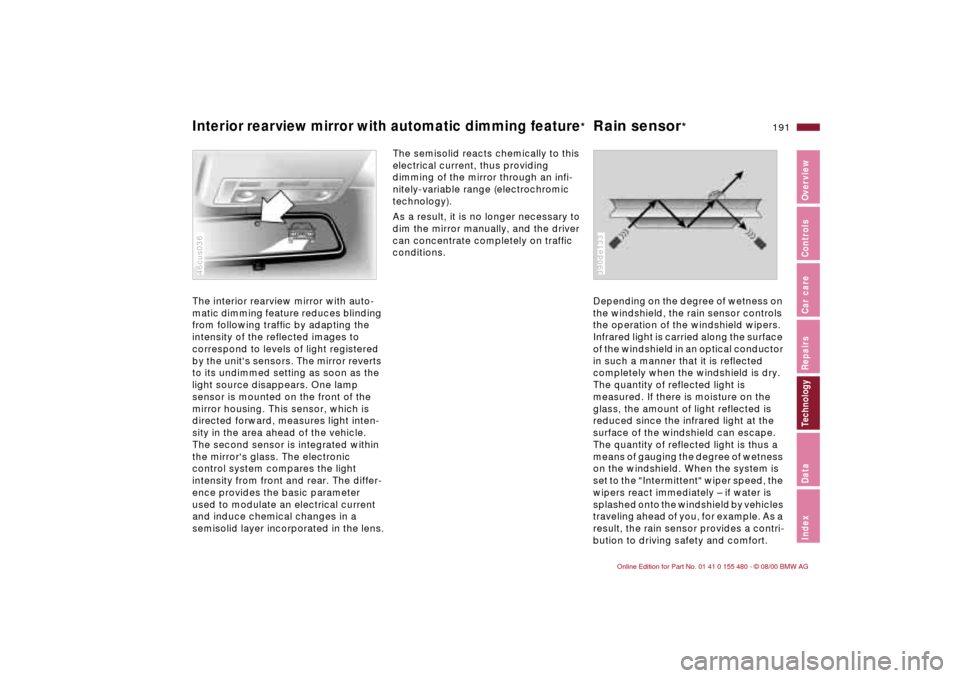
The interior rearview mirror with auto-
matic dimming feature reduces blinding
from following traffic by adapting the
intensity of the reflected images to
correspond to levels of light registered
by the unit's sensors. The mirror reverts
to its undimmed setting as soon as the
light source disappears. One lamp
sensor is mounted on the front of the
mirror housing. This sensor, which is
directed forward, measures light inten-
sity in the area ahead of the vehicle.
The second sensor is integrated within
the mirror's glass. The electronic
control system compares the light
intensity from front and rear. The differ-
ence provides the basic parameter
used to modulate an electrical current
and induce chemical changes in a
semisolid layer incorporated in the lens.46cus036
The semisolid reacts chemically to this
electrical current, thus providing
dimming of the mirror through an infi-
nitely-variable range (electrochromic
technology).
As a result, it is no longer necessary to
dim the mirror manually, and the driver
can concentrate completely on traffic
conditions.
Depending on the degree of wetness on
the windshield, the rain sensor controls
the operation of the windshield wipers.
Infrared light is carried along the surface
of the windshield in an optical conductor
in such a manner that it is reflected
completely when the windshield is dry.
The quantity of reflected light is
measured. If there is moisture on the
glass, the amount of light reflected is
reduced since the infrared light at the
surface of the windshield can escape.
The quantity of reflected light is thus a
means of gauging the degree of wetness
on the windshield. When the system is
set to the "Intermittent" wiper speed, the
wipers react immediately Ð if water is
splashed onto the windshield by vehicles
traveling ahead of you, for example. As a
result, the rain sensor provides a contri-
bution to driving safety and comfort.
390de133
Page 193 of 215
193n
IndexDataTechnologyRepairsCar careControlsOverview
Rollover protection system
Xenon lamps
*
The rollover protection system offers
additional protection to the airbags and
the safety belts. It uses highly sensitive
sensors that respond immediately to
any unstable vehicle condition encoun-
tered while driving, e. g. a steep angle
or loss of wheel contact with the
ground. The protective bar in the rear
headrests would be triggered in this
type of situation.
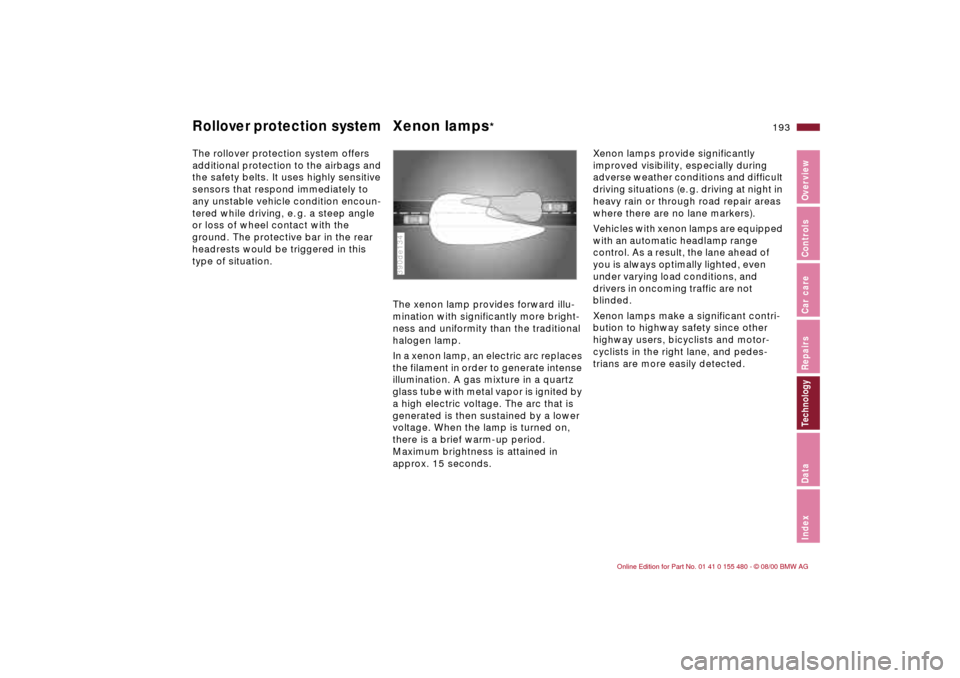
The xenon lamp provides forward illu-
mination with significantly more bright-
ness and uniformity than the traditional
halogen lamp.
In a xenon lamp, an electric arc replaces
the filament in order to generate intense
illumination. A gas mixture in a quartz
glass tube with metal vapor is ignited by
a high electric voltage. The arc that is
generated is then sustained by a lower
voltage. When the lamp is turned on,
there is a brief warm-up period.
Maximum brightness is attained in
approx. 15 seconds.
390de134
Xenon lamps provide significantly
improved visibility, especially during
adverse weather conditions and difficult
driving situations (e. g. driving at night in
heavy rain or through road repair areas
where there are no lane markers).
Vehicles with xenon lamps are equipped
with an automatic headlamp range
control. As a result, the lane ahead of
you is always optimally lighted, even
under varying load conditions, and
drivers in oncoming traffic are not
blinded.
Xenon lamps make a significant contri-
bution to highway safety since other
highway users, bicyclists and motor-
cyclists in the right lane, and pedes-
trians are more easily detected.
Page 205 of 215

Everything from A to Z
205n
IndexDataTechnologyRepairsCar careControlsOverview
upholstery155
vinyl upholstery154
wool velour155
Cargo
loading114
securing114
Caring for the vehicle's
finish153
Cassette operation, refer
also to the Radio Owner's
Manual
Catalytic converter121
CBC (Cornering Brake
Control)21,123
CD operation, refer also to
the Radio Owner's Manual
Cellular phone111,129
refer to also the separate
Owner's Manual
Center (high-mount) brake
lamp171
Center armrest110
Central locking system34
button38
Changing a tire173
Changing a wheel173
Check Control83
Child restraints64
Child restraint
systems61,64
Child seat security65
Child's seat61,64
Cigarette lighter112 Cleaning headlamps78
Cleaning windshield77
Clock84
Cockpit16
Code, refer to the radio
Owner's Manual
Coin box, cup holder111
Combination switch76
Compression196
Computer83
refer also to the separate
Owner's Manual
Configure settings59
Consumption85
Contents10
Convertible top45
cleaning and care157
closing following an
electrical malfunction181
compartment panel41
convenience operation34
electrical fault181
emergency closure181
Coolant127,147,199
antifreeze127
Cooling system199
Copyright4
Cornering Brake Control
(CBC)21,123
Cruise control79
Cruising range85
Curb weight198
Current check indicator20
D
Data
dimensions197
engine196
technical196
weights198
Daytime-driving lamp
switch93
DBC (Dynamic Brake
Control)124
Deep water121
Defrost setting100,105
Defrostable rear
window98,106
Defrosting the
windows100,105
Digital clock84
Dimensions197
Dipstick145
Disc brakes125
Displacement196
Display lighting93
Displays18
Disposal
batteries178
engine oil147
Distance warning87
Diversity Antenna190
Door key32
Door locks, care127 Doors
emergency operation34
remote control35
unlocking and locking34
DOT Quality Grades133
Draft-free
ventilation99,106
Drive belts200
Driving hints121
Driving in winter127
Driving lamps93
DSC (Dynamic Stability
Control)22,88,189
Dynamic Brake Control
(DBC)124
Dynamic Stability Control
(DSC)22,88,189
E
Electric power windows44
Electrical accessories,
failure179
Electrical system200
Electronic vehicle
immobilizer33
Elements of operation16
Emergency closure181
Emergency operation
convertible top181
doors34
fuel filler door180
Energy Control81
Page 206 of 215

Everything from A to ZEngine
compartment142,143
Engine coolant147,199
Engine data196
Engine oil145
adding145
capacity199
consumption145
disposal147
level check145
pressure20
quality146
specifications146
viscosity146
Engine speed196
Engine, starting69
Engine, switching off70
Enlarging the luggage
compartment41
Enter the rear55
Entry to the rear55
Exterior mirrors57
Eyelets, towing184 F
Failure messages83
Fault, ABS123
Filler cap cover26
Filling capacities199
Filling the washer
reservoir199
First-aid kit25 Fittings, towing and tow
starting184
Flashlight107
Flat tire132,173
Fog lamps94
bulb replacement169
Follow-Me-Home lamps93
Footbrake125
Footwell lamps94
bulb replacement172
Front seat adjusting52
Frost protection,
radiator147
Fuel27
consumption85
gauge82
preparation196
quality27
reserve indicator85
specifications27
tank capacity199
Fuel filler door
unlock in case of electrical
fault180
Functional status of
electrical and electronic
systems192
Fuses179
replacing179
G
Garage-door opener108
Gasoline27
Gasoline gauge82
Glove compartment107
Glove compartment lamp,
bulb replacement172
Gross vehicle weight198 H
Handbrake71
Handsfree system111
Hazard warning flashers25
Hazard warning triangle25
Head restraints53
Headlamp cover,
care151,167
Headlamp flasher76,94
Headlamp washer
system78,144,199
Heated seats107
Heating, rapid100
Heavy loads114
Height197
High beams23,76,94
bulb replacement167
High Performance Synthetic
Oils146
High-mount brake lamp171
Hood, release140
Horn17 Hubcap174
Hydraulic Brake assistant,
refer to DBC
I
Ice warning85
Identification, tires135
Ignition key32
Ignition lock69
Imprint4
Indicator lamps20
Inflation pressure27,132
monitoring91,192
INSPECTION82
Instrument cluster18
Instrument panel16,18
lighting93
Interaxle tire rotation134
Interface socket for Onboard
Diagnostics162
Interference
cellular phones129
Interior lamps36,94
bulb replacement171
remote control36
Interior motion
sensor36,43
Interior rearview mirror58
automatic dimming
feature58,191
Page 207 of 215

Everything from A to Z
207n
IndexDataTechnologyRepairsCar careControlsOverview
Interlock69
Intermittent mode, wiper
system76 J
Jack173
Jump-starting183 K
Key Memory59
Keys32
with remote control32 L
Lamps and bulbs166
LAMPS ON warning93
Lashing eyes115
LATCH attachment of the
child seat64
Leather care155
Length197
License plate lamp, bulb
replacement171
Light-alloy wheels137
Lighter112
Loads, securing114
Load-securing devices115
Low beam headlamps93
bulb replacement167
Lug bolts174 Luggage
compartment40,41
capacity198
emergency release39
floor panel40
lid39
lighting39
lock separately39
remote control36
Luggage compartment
lamps, bulb
replacement172
Luggage rack116
Lumbar support55
M
M+S tires136
Maintenance82,150
Malfunction displays83
Manual convertible top,
operating45
Manual transmission72
Manually controlled
recirculated-air105
Memory57
MFL (Multi-function steering
wheel)24
Microfilter99,180
Mirror memory57
Mirrors57
Mobile phones129 Modifications,
technical6,161
Motion sensor, interior43
Mounting child safety
seat64
Mounting the roof
carrier130
Multi-function steering
wheel (MFL)24
N
Navigation system, refer to
the radio Owner's Manual O
OBD interface socket162
Odometer81
Oil
additives145
capacity199
consumption145
dipstick145
quality146
specifications146
viscosity146
Oil change intervals, see the
Service and Warranty
Information Booklet (US
models)/Warranty and
Service Guide Booklet
(Canadian models) Oil filter change199
Oil level
check145
indicator lamp20
Oil pressure, indicator
lamp20
OILSERVICE82
Onboard tool kit166
Opening and closing
from the inside38
from the outside34
Operating the convertible
top manually in the event
of an electrical
malfunction181
Outside temperature
display84
P
Paint blemishes152
Paint, care152
Paintwork
minor repairs153
waxing153
Park Distance Control
(PDC)87
Parking brake71
Parking help87
Parking lamps94
Parking, winter128
Page 208 of 215

Everything from A to ZPDC (Park Distance
Control)87
Performance196
Phone, mobile129
Pocket flashlight107
Pollen99,106
Power steering129
Power windows44
convenience operation34
Pressure monitoring,
tires91,192
Pressure, tires27,132 Q
Quality Grades133 R
Radiator199
Radio
reception129,190
refer also to the separate
Owner's Manual
Radio Data System
(RDS)190
Rain sensor77,191
RDC (Tire Pressure
Control)91,192
RDS (Radio Data
System)190
Rear lamps169
Rear window
defroster78,98,106
Rear-entry assist55 Rearview mirror57
Recirculated air mode98
Reclining seat52
Refueling26
Remote control35
Remove condensation,
windows105
Replacement keys32
Reporting safety defects7
Restraint system61,64
Reverse17,72
Rollover protection
system67,68,193
Roof load capacity198
Roof-mounted luggage
rack116
Rubber seals and
components127
S
Safety belt tensioner190
Safety belts60
Safety buttons38
Safety defects, reporting7
Seat adjustment52
Seat heating107
Seat memory57
Seat-integrated safety
belts55
Seats52
Securing cargo114
Securing loads114 Selector lever, automatic
transmission73
Self-defrosting mirrors57
Self-diagnostics192
Service and Warranty
Information Booklet150
Service Interval
Display82,150
Shiftlock73
Side airbags61
Side impact Head Protection
System61
Side lamps93
bulb replacement168
Sitting properly with
airbag62
Ski bag113
Skid control128
Slippery roads127
Snow
chains127,136,137
Socket112
for flashlight112
for power supplies112
for vacuum cleaner112
Spare key32
Spare tire173
Spark plugs200
Speaker111
Specifications, fuel27
Speed, average86
Speedometer18
Sports seat54 Starting
problems121,183
Starting the engine69
Steel wheels137
Steering129
Steering lock69
Steering wheel57
adjusting57
Steptronic73
Stopping the vehicle70
Storage compartments110
Storage facilities110
Storing your vehicle160
Stroke196
Summer tires135
Sun visors58
Switching off the engine70
Symbols4,177
Synthetic oils146
T
Tachometer81
Tail lamp assembly, bulb
replacement169
Tank capacity199
Tank cover
unlock in case of electrical
fault180
Technical data196
Technical
modifications6,161
Telephone hookup111