esp BMW 325Ci CONVERTIBLE 2001 E46 Owner's Manual
[x] Cancel search | Manufacturer: BMW, Model Year: 2001, Model line: 325Ci CONVERTIBLE, Model: BMW 325Ci CONVERTIBLE 2001 E46Pages: 215, PDF Size: 2.1 MB
Page 6 of 215
6n
For your own safety
Use unleaded gasoline only. Fuels
containing up to and including
10 % ethanol or other oxygenates with
up to 2.8 % oxygen by weight (i.e. 15 %
MTBE or 3 % methanol plus an equiva-
lent amount of co-solvent) will not void
the applicable warranties respecting
defects in materials or workmanship.
Field experience has indicated signifi-
cant differences in fuel quality (volatility,
composition, additives, for example)
among gasolines offered for sale in the
United States and Canada. The use of
poor quality fuels may result in drive-
ability, starting and stalling problems
especially under certain environmental
conditions, such as high ambient
temperature and high altitude.
Should you encounter driveability prob-
lems which you suspect could be
related to the fuel you are using, we
recommend that you respond by
switching to a recognized high-quality
brand.
Failure to comply with these recom-
mendations may result in unscheduled
maintenance.
Follow the relevant safety rules when
you are handling gasoline.
<
Important safety information!
For your own safety, use genuine parts
and accessories approved by BMW.
When you purchase accessories tested
and approved by BMW and Original
BMW Parts, you simultaneously acquire
the assurance that they have been thor-
oughly tested by BMW to ensure
optimum performance when installed
on your vehicle.
BMW warrants these parts to be free
from defects in material and workman-
ship.
BMW will not accept any liability for
damage resulting from installation of
parts and accessories not approved by
BMW.
BMW cannot test every product from
other manufacturers to verify if it can be
used on a BMW safely and without risk
to either the vehicle, its operation, or its
occupants.
Original BMW Parts, BMW Accessories
and other products approved by BMW,
together with professional advice on
using these items, are available from all
BMW centers.
Installation and operation of non-BMW
approved accessories such as alarms,
radios, amplifiers, radar detectors,
wheels, suspension components, brake
dust shields, telephones (including
operation of any portable cellular phone
from within the vehicle without using an
externally mounted antenna) or trans-
ceiver equipment (such as C.B., walkie-
talkie, ham radio or similar) may cause
extensive damage to the vehicle,
compromise its safety, interfere with
the vehicle's electrical system or affect
the validity of the BMW Limited
Warranty. See your BMW center for
additional information.
<
Maintenance, replacement, or
repair of the emission control
devices and systems may be performed
by any automotive repair establishment
or individual using any certified auto-
motive part.
<
Symbol on vehicle parts
Indicates that you should consult
the relevant section of this
Owner's Manual for information on a
particular part or assembly.
Page 20 of 215
20n
Indicator and warning lamps
Technology that monitors itself
Many of the systems of your BMW
monitor themselves automatically, both
during engine starts and while you are
driving. Indicator and warning lamps
that are identified by "
l
" are tested for
proper functioning whenever the igni-
tion key is turned. They each light up
once for different periods of time.
If a fault should occur in one of these
systems, the corresponding lamp does
not go out after the engine is started, or
it lights up while the vehicle is moving.
You will see how to react to this below.
Red: stop immediately
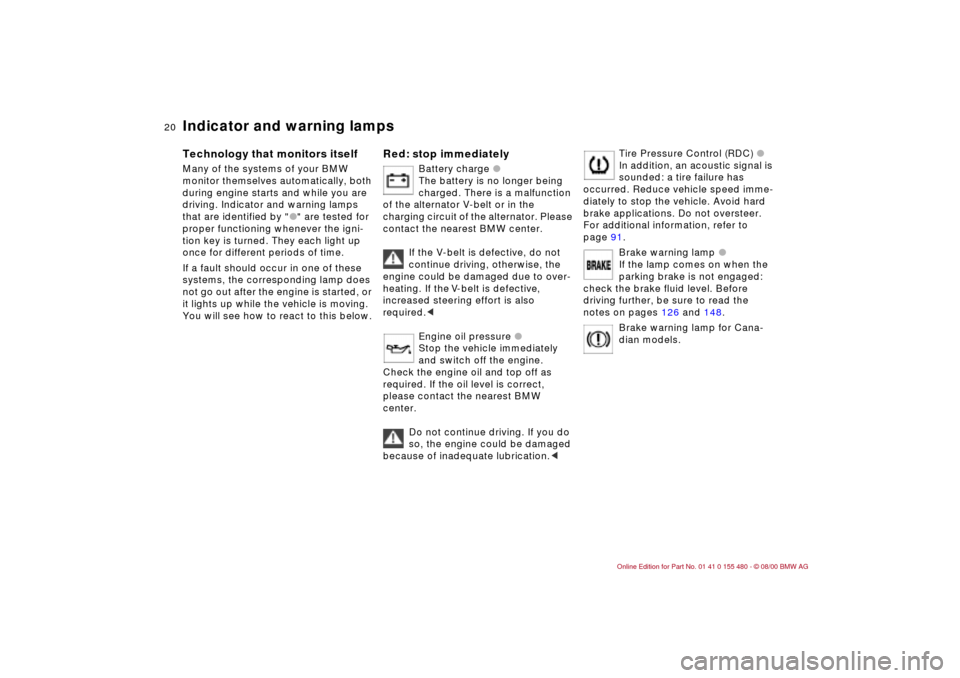
Battery charge
l
The battery is no longer being
charged. There is a malfunction
of the alternator V-belt or in the
charging circuit of the alternator. Please
contact the nearest BMW center.
If the V-belt is defective, do not
continue driving, otherwise, the
engine could be damaged due to over-
heating. If the V-belt is defective,
increased steering effort is also
required.
<
Engine oil pressure
l
Stop the vehicle immediately
and switch off the engine.
Check the engine oil and top off as
required. If the oil level is correct,
please contact the nearest BMW
center.
Do not continue driving. If you do
so, the engine could be damaged
because of inadequate lubrication.
<
Tire Pressure Control (RDC) l
In addition, an acoustic signal is
sounded: a tire failure has
occurred. Reduce vehicle speed imme-
diately to stop the vehicle. Avoid hard
brake applications. Do not oversteer.
For additional information, refer to
page 91.
Brake warning lamp l
If the lamp comes on when the
parking brake is not engaged:
check the brake fluid level. Before
driving further, be sure to read the
notes on pages 126 and 148.
Brake warning lamp for Cana-
dian models.
Page 22 of 215
22n
Indicator and warning lampsYellow: check as soon as possible
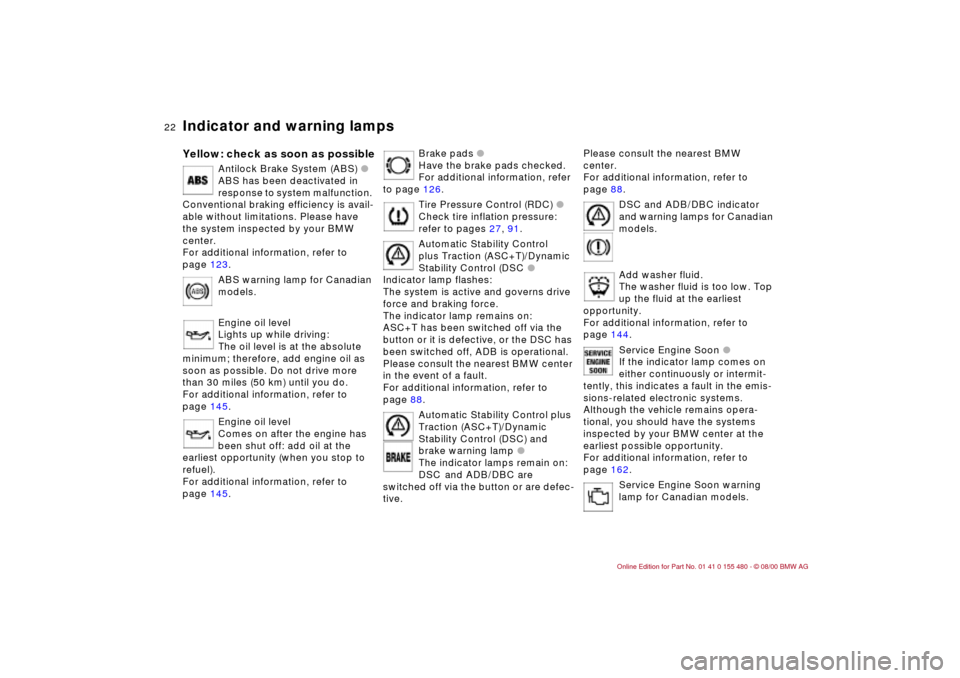
Antilock Brake System (ABS) l
ABS has been deactivated in
response to system malfunction.
Conventional braking efficiency is avail-
able without limitations. Please have
the system inspected by your BMW
center.
For additional information, refer to
page 123.
ABS warning lamp for Canadian
models.
Engine oil level
Lights up while driving:
The oil level is at the absolute
minimum; therefore, add engine oil as
soon as possible. Do not drive more
than 30 miles (50 km) until you do.
For additional information, refer to
page 145.
Engine oil level
Comes on after the engine has
been shut off: add oil at the
earliest opportunity (when you stop to
refuel).
For additional information, refer to
page 145.
Brake pads l
Have the brake pads checked.
For additional information, refer
to page 126.
Tire Pressure Control (RDC) l
Check tire inflation pressure:
refer to pages 27, 91.
Automatic Stability Control
plus Traction (ASC+T)/Dynamic
Stability Control (DSC l
Indicator lamp flashes:
The system is active and governs drive
force and braking force.
The indicator lamp remains on:
ASC+T has been switched off via the
button or it is defective, or the DSC has
been switched off, ADB is operational.
Please consult the nearest BMW center
in the event of a fault.
For additional information, refer to
page 88.
Automatic Stability Control plus
Traction (ASC+T)/Dynamic
Stability Control (DSC) and
brake warning lamp l
The indicator lamps remain on:
DSC
and ADB/DBC are
switched off via the button or are defec-
tive.
Please consult the nearest BMW
center.
For additional information, refer to
page 88.
DSC and ADB/DBC indicator
and warning lamps for Canadian
models.
Add washer fluid.
The washer fluid is too low. Top
up the fluid at the earliest
opportunity.
For additional information, refer to
page 144.
Service Engine Soon l
If the indicator lamp comes on
either continuously or intermit-
tently, this indicates a fault in the emis-
sions-related electronic systems.
Although the vehicle remains opera-
tional, you should have the systems
inspected by your BMW center at the
earliest possible opportunity.
For additional information, refer to
page 162.
Service Engine Soon warning
lamp for Canadian models.
Page 24 of 215
24n
Multifunction steering wheel (MFL)
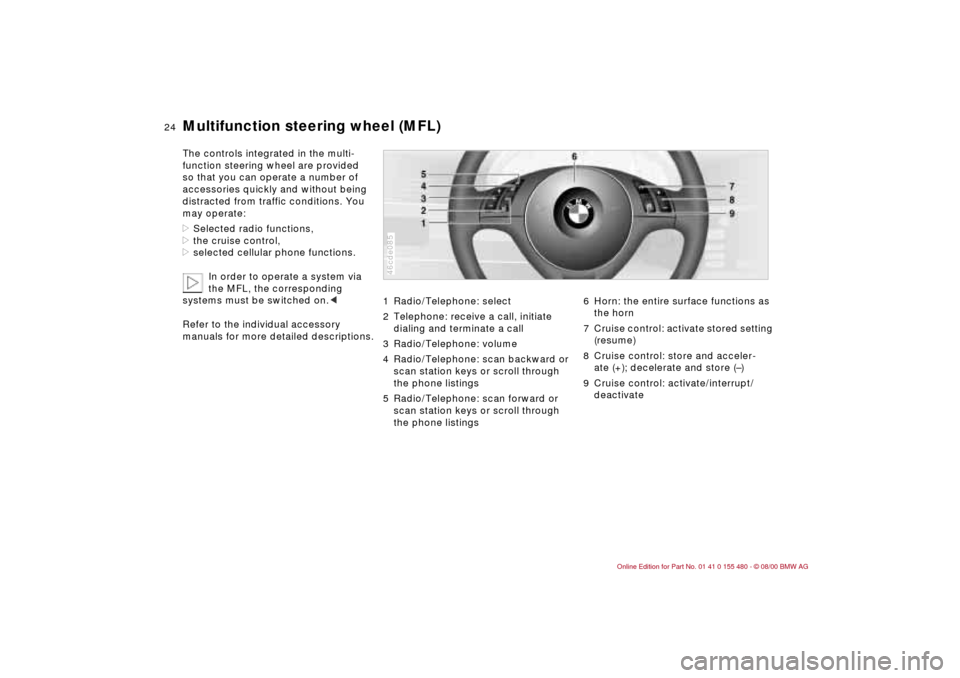
The controls integrated in the multi-
function steering wheel are provided
so that you can operate a number of
accessories quickly and without being
distracted from traffic conditions. You
may operate:
>Selected radio functions,
>the cruise control,
>selected cellular phone functions.
In order to operate a system via
the MFL, the corresponding
systems must be switched on.<
Refer to the individual accessory
manuals for more detailed descriptions.
1 Radio/Telephone: select
2 Telephone: receive a call, initiate
dialing and terminate a call
3 Radio/Telephone: volume
4 Radio/Telephone: scan backward or
scan station keys or scroll through
the phone listings
5 Radio/Telephone: scan forward or
scan station keys or scroll through
the phone listings46cde085
6 Horn: the entire surface functions as
the horn
7 Cruise control: activate stored setting
(resume)
8 Cruise control: store and acceler-
ate (+); decelerate and store (Ð)
9 Cruise control: activate/interrupt/
deactivate
Page 42 of 215
42n
Alarm system
*
The conceptThe vehicle alarm system responds:
>When a door, the hood or the
luggage compartment lid is opened.
>To movement inside the vehicle
(interior motion sensor).
>To a change of the vehicle's tilt Ð if
someone attempts to steal the
wheels or tow the vehicle without
authorization, for example.
>If there is an interruption in battery
voltage.
The system responds to unauthorized
vehicle entry and attempted theft by
simultaneously activating the following:
>Sounding an alarm for 30 seconds.
>The hazard warning flashers are acti-
vated for approx. five minutes.
>The high beams flash on and off in the
same rhythm.
To activate and deactivate the
alarm systemWhen the vehicle is locked or unlocked
by using a key or with the remote
control, the alarm system is also simul-
taneously armed or disarmed.
The interior motion sensor and the tilt
alarm sensor are activated approx.
30 seconds after you have finished
locking the vehicle.
If the alarm system has been armed
correctly, the hazard warning flashers
flash once.
You can have a signal set as
acknowledgment for both arming
and disarming the alarm system.<
You can also open the luggage
compartment lid when the system is
armed by pressing button 3 of the
remote control (refer to page 36). When
it is closed, the lid is once again
secured.
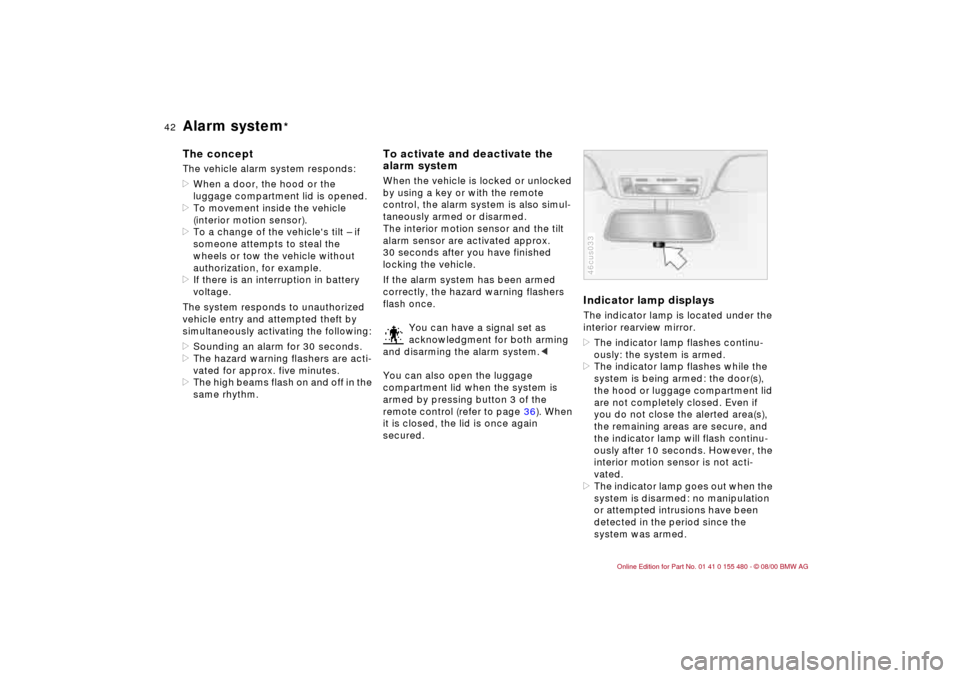
Indicator lamp displaysThe indicator lamp is located under the
interior rearview mirror.
>The indicator lamp flashes continu-
ously: the system is armed.
>The indicator lamp flashes while the
system is being armed: the door(s),
the hood or luggage compartment lid
are not completely closed. Even if
you do not close the alerted area(s),
the remaining areas are secure, and
the indicator lamp will flash continu-
ously after 10 seconds. However, the
interior motion sensor is not acti-
vated.
>The indicator lamp goes out when the
system is disarmed: no manipulation
or attempted intrusions have been
detected in the period since the
system was armed.46cus033
Page 46 of 215
46n
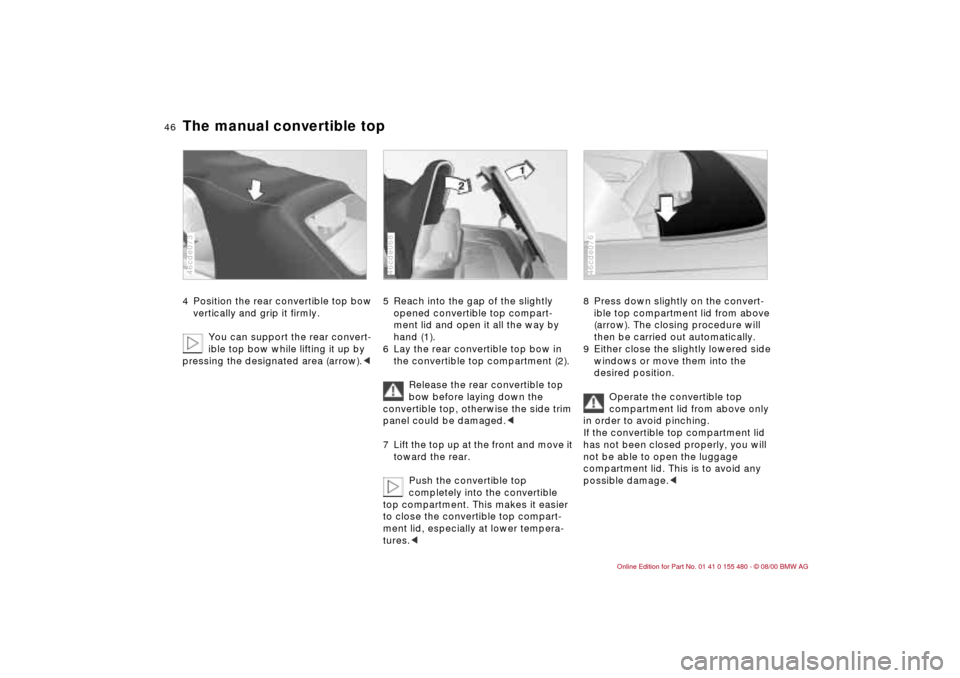
The manual convertible top4 Position the rear convertible top bow
vertically and grip it firmly.
You can support the rear convert-
ible top bow while lifting it up by
pressing the designated area (arrow).<46cde073
5 Reach into the gap of the slightly
opened convertible top compart-
ment lid and open it all the way by
hand (1).
6 Lay the rear convertible top bow in
the convertible top compartment (2).
Release the rear convertible top
bow before laying down the
convertible top, otherwise the side trim
panel could be damaged.<
7 Lift the top up at the front and move it
toward the rear.
Push the convertible top
completely into the convertible
top compartment. This makes it easier
to close the convertible top compart-
ment lid, especially at lower tempera-
tures.<46cde068
8 Press down slightly on the convert-
ible top compartment lid from above
(arrow). The closing procedure will
then be carried out automatically.
9 Either close the slightly lowered side
windows or move them into the
desired position.
Operate the convertible top
compartment lid from above only
in order to avoid pinching.
If the convertible top compartment lid
has not been closed properly, you will
not be able to open the luggage
compartment lid. This is to avoid any
possible damage.<46cde076
Page 52 of 215
52n
For your personal safety when adjusting
the seat position, please follow the
instructions below carefully:
Never try to adjust your seat while
driving the vehicle. The seat could
respond with an unexpected move-
ment, and the ensuing loss of vehicle
control could lead to an accident.
Be sure that the safety belt remains
firmly against your body at all times. In
the event of a frontal impact, a loose lap
belt could slide over the hips, leading to
abdominal injury. In addition, the safety
belt's restraint effectiveness is reduced
if the belt is worn loosely.
Never ride with the backrest reclined to
an extreme angle (especially important
for the front passenger to remember),
otherwise, you run the risk of sliding
under the safety belt during an acci-
dent, thus negating the protection the
safety belt provides.<
Correct sitting postureTo reduce strain on the spinal column,
sit all the way back in the seat and rest
your back fully against the backrest.
The ideal sitting posture is achieved
with your head extending from your
spine in a straight line.
For long-distance driving, you may wish
to increase the backrest angle slightly
to reduce muscular tension. You should
be able to grasp the steering wheel at
its highest point with your arms slightly
bent.
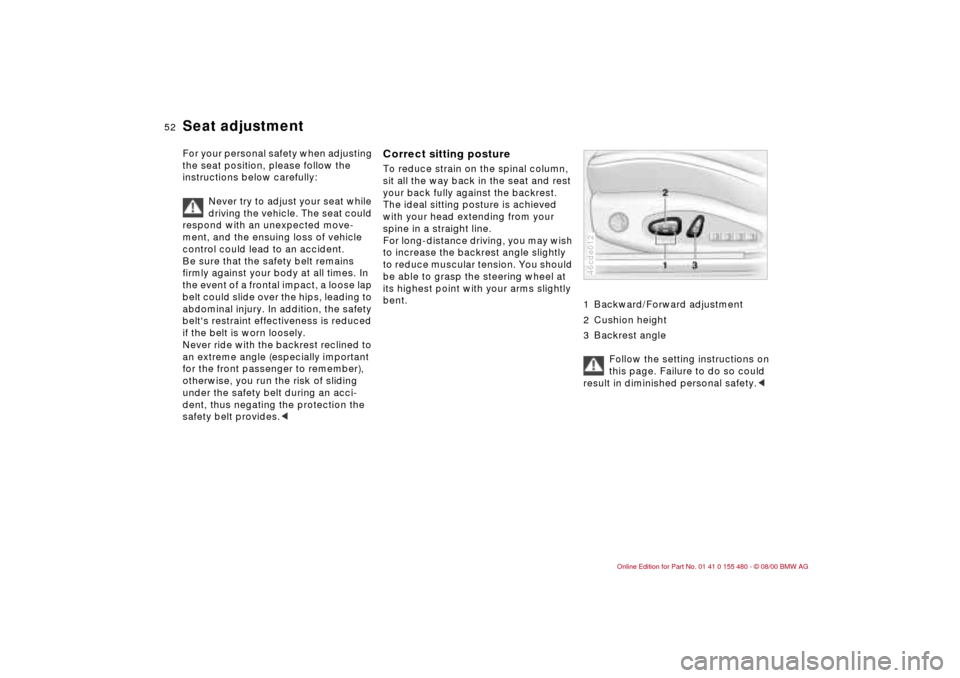
1 Backward/Forward adjustment
2 Cushion height
3 Backrest angle
Follow the setting instructions on
this page. Failure to do so could
result in diminished personal safety.<
46cde012
Seat adjustment
Page 58 of 215
58n
MirrorsYou can also adjust the mirrors manu-
ally by pressing against the outer edges
of their lenses.
The mirror on the passenger's
side features a lens with a more
convex surface than the mirror installed
on the driver's side. When estimating
the distance between yourself and
other traffic, bear in mind that the
objects reflected in the mirror are closer
than they appear. Estimations of the
distance to following traffic should
therefore not be regarded as precise.
Interior rearview mirror To reduce glare from vehicles behind
you when driving at night, tilt the mirror
by turning the rotary button.Sun visorsThese can be folded down toward the
windshield and swiveled out against the
side window.46cus034
Interior rearview mirror with
automatic dimming feature
*
By responding to the effects of ambient
light and the glare from following traffic,
this mirror automatically dims through
an infinitely-variable range.
The mirror switches to its clear,
undimmed mode whenever the trans-
mission is placed in reverse gear
(selector lever in "Reverse").
To ensure that the mirror continues to
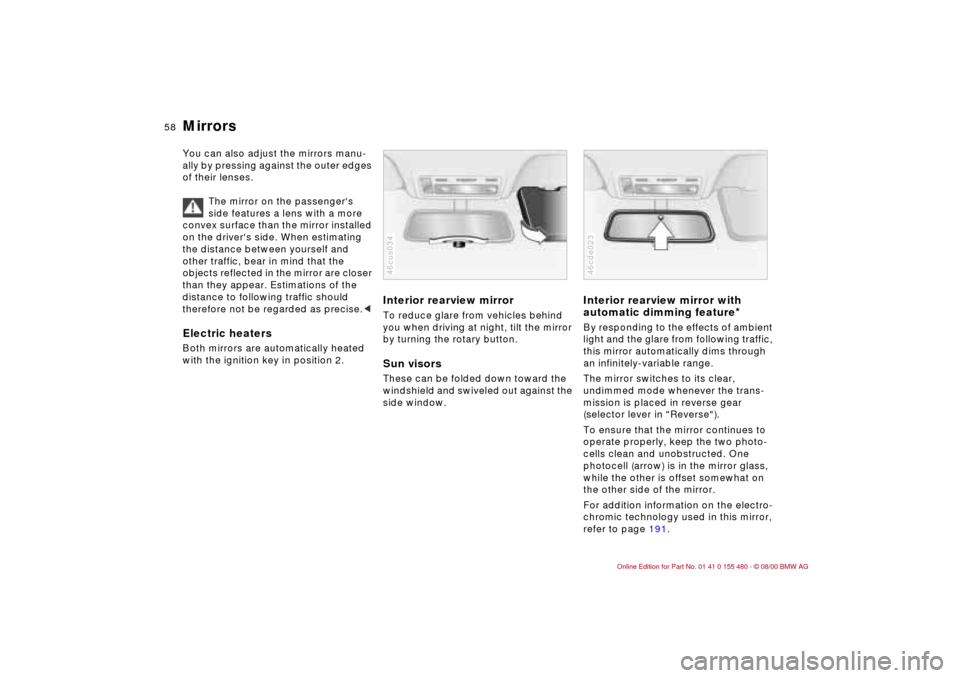
operate properly, keep the two photo-
cells clean and unobstructed. One
photocell (arrow) is in the mirror glass,
while the other is offset somewhat on
the other side of the mirror.
For addition information on the electro-
chromic technology used in this mirror,
refer to page 191.46cde023
Page 62 of 215

62n
AirbagsOperational status
The indicator lamp in the instru-
ment cluster displays the opera-
tional status of the airbag
system when the ignition key is in posi-
tion 1 and higher.
System operational:
>The indicator lamp comes on briefly
then goes out.
System malfunction:
>The indicator lamp fails to come on.
>The indicator lamp comes on briefly
before going out, and then lights up
again.
If there is a system malfunction, there is
a risk that the airbags will not be trig-
gered within their normal response
range, even if the level of impact would
normally have triggered them.
Have your BMW center inspect the
system immediately.
The airbag indicator lamp also
comes on if the safety belt
tensioners have been triggered.<
Sitting correctly with airbags
For your safety, comply with the
following instructions for the
airbags. If you do not, the airbags may
not be able to provide their maximum
protection. All passengers in the vehicle
should be aware of and comply with
this information:
The airbags are supplemental restraint
devices designed to provide extra
protection; they are not a substitute for
safety belts. Wear your safety belt at all
times. The airbags will not be triggered
in the event of a minor accident, a
vehicle roll-over, or collisions from the
rear. In these instances, the safety belt
provides optimal protection.
Airbags are located under cover panels
in the steering wheel, in the dashboard
and in the side trim panels in the front
and rear
*.
Adjust your seat to a position that
provides a maximum distance between
you and the steering wheel, the instru-
ment panel and the door while still
allowing comfortable and safe access
to all vehicle controls.
To avoid sustaining hand and arm inju-
ries, always grasp the steering wheel
on the rim with your hands at the 9 and
3 o'clock positions. Do not place your
hands on the center pad.
Never allow any objects to obstruct the
area between the airbag and an occu-
pant.
Do not use the cover panel above the
passenger-side airbag as a storage
area.
Do not apply adhesive materials to the
cover panels of the airbags, cover them
or modify them in any other way.
Do not install a rear-facing child
restraint system in the front passenger
seat of this vehicle.
Children under 13 years of age and
children less than 5 ft (150 cm) tall
should ride only in the rear seat.
Infants or small children should never
be held on the lap of a passenger.
If your car is equipped with side airbags
in the rear passenger area
*, be sure
that child restraints are mounted
correctly and provided with the grea-
test-possible distance between the
airbags in the side trim panels. Do not
allow children to lean out of the child's
seat in the direction of the side trim
panels. If they do so, serious injuries
can occur if the airbag is triggered.<
Page 65 of 215
65n
IndexDataTechnologyRepairsCar careControlsOverview
Transporting children safelyCommercially available child seats
complying with the legal standard are
designed to be secured with a seat belt
or with the seat belt portion of a combi-
nation lap/shoulder belt.
Improperly or inadequately installed
restraint systems can increase the risk
of injury to children. Always read and
follow the instructions that come with
the system.
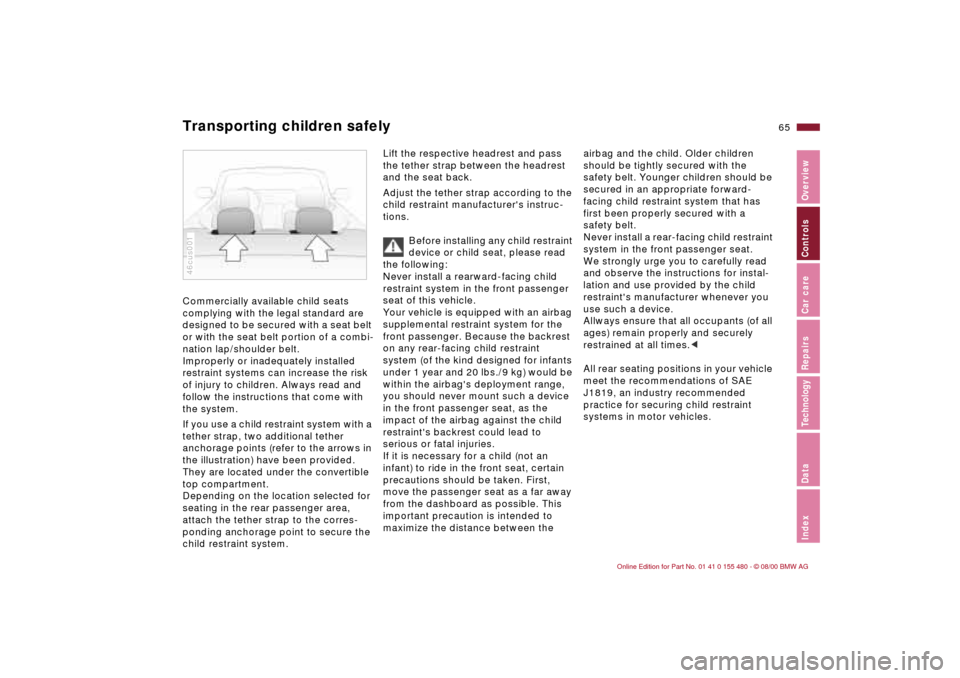
If you use a child restraint system with a
tether strap, two additional tether
anchorage points (refer to the arrows in
the illustration) have been provided.
They are located under the convertible
top compartment.
Depending on the location selected for
seating in the rear passenger area,
attach the tether strap to the corres-
ponding anchorage point to secure the
child restraint system.46cus001
Lift the respective headrest and pass
the tether strap between the headrest
and the seat back.
Adjust the tether strap according to the
child restraint manufacturer's instruc-
tions.
Before installing any child restraint
device or child seat, please read
the following:
Never install a rearward-facing child
restraint system in the front passenger
seat of this vehicle.
Your vehicle is equipped with an airbag
supplemental restraint system for the
front passenger. Because the backrest
on any rear-facing child restraint
system (of the kind designed for infants
under 1 year and 20 lbs./9 kg) would be
within the airbag's deployment range,
you should never mount such a device
in the front passenger seat, as the
impact of the airbag against the child
restraint's backrest could lead to
serious or fatal injuries.
If it is necessary for a child (not an
infant) to ride in the front seat, certain
precautions should be taken. First,
move the passenger seat as a far away
from the dashboard as possible. This
important precaution is intended to
maximize the distance between the
airbag and the child. Older children
should be tightly secured with the
safety belt. Younger children should be
secured in an appropriate forward-
facing child restraint system that has
first been properly secured with a
safety belt.
Never install a rear-facing child restraint
system in the front passenger seat.
We strongly urge you to carefully read
and observe the instructions for instal-
lation and use provided by the child
restraint's manufacturer whenever you
use such a device.
Allways ensure that all occupants (of all
ages) remain properly and securely
restrained at all times.c
All rear seating positions in your vehicle
meet the recommendations of SAE
J1819, an industry recommended
practice for securing child restraint
systems in motor vehicles.