service interval BMW 325Ci CONVERTIBLE 2001 E46 Owner's Manual
[x] Cancel search | Manufacturer: BMW, Model Year: 2001, Model line: 325Ci CONVERTIBLE, Model: BMW 325Ci CONVERTIBLE 2001 E46Pages: 215, PDF Size: 2.1 MB
Page 10 of 215

Contents
Overview
Controls and features
Cockpit16
Instrument cluster18
Indicator and warning lamps20
Multifunction steering wheel
(MFL)24
Hazard warning flashers25
Warning triangle25
First-aid kit25
Refueling26
Fuel specifications27
Tire inflation pressure27
Opening and closing:
Keys32
Electronic vehicle
immobilizer33
Central locking system34
Opening and closing Ð from the
outside34
Opening and closing Ð from the
inside38
Luggage compartment lid39
Luggage compartment40
Alarm system42
Electric power windows44
The manual convertible top45
The fully automatic convertible
top48
Wind deflector50
Adjusting:
Seats52
Seat and mirror memory56
Steering wheel57
Mirrors57
Car Memory, Key Memory59
Passenger safety systems:
Safety belts60
Airbags61
Transporting children safely64
Rollover protection system67
Driving:
Steering/Ignition lock69
Starting the engine69
Switching off the engine70
Parking brake71
Manual transmission72
Automatic transmission with
Steptronic73
Turn signal indicator/Headlamp
flasher76
Washer/Wiper system76
Rear window defroster78
Cruise control79
Everything under control:
Odometer81
Tachometer81
Energy Control81
Fuel temperature gauge82
Coolant temperature gauge82
Service Interval Display82
Check Control83
Computer83
Technology for driving comfort
and safety:
Park Distance Control (PDC)87
Automatic Stability Control plus
Traction (ASC+T)88
Dynamic Stability Control
(DSC)89
Tire Pressure Control (RDC)91
Contents
Page 19 of 215

19n
IndexDataTechnologyRepairsCar careControlsOverview
Instrument cluster
1 Fuel gauge with indicator lamp
for fuel reserve82
2 Turn signal indicator23
3 Speedometer
4 Indicator lamp for:
>
Battery charge current20
>
High beams23
>
Engine oil pressure/Engine oil
level20, 22
5 Tachometer and
Energy control81
6 Engine coolant temperature gauge
with "Coolant temperature too high"
indicator82
7 Indicator and warning lamps (clock-
wise) for:
>
Parking brake/Brake hydraulic
system/Cornering Brake Control
(CBC)/DBC20
>
Antilock Brake System (ABS)22
>
Brake pads22
>
Tire Pressure Control
(RDC)
*
20, 22
>
Rollover protection system67
>
Airbags21
>
Adjust and lock backrest/Please
fasten safety belts21
>
Cruise control23
8 Set button for the clock849 Program display for automatic
transmission
*
75
Indicator lamp for automatic
transmission
*
21, 75
10 Indicator lamp for Automatic
Stability Control plus Traction
(ASC+T)/Dynamic Stability Control
(DSC)
*
and ADB22
11 Indicator for:
>
Odometer81
>
Trip odometer81
>
Clock84
>
Service Interval82
Indicator for computer,
operation using the turn signal lever,
refer to page 83:
>
Clock
>
Outside temperature
>
Average fuel consumption
>
Range
>
Average speed
12 Indicator for Check Control83
13 Trip odometer, reset to zero8114 Indicator and warning lamps (clock-
wise) for:
>
Front fog lamps23
>
Add washer fluid22
>
Coolant level23
>
Electronic Throttle Control
(EML)
*
23
>
Service engine soon22
You can display the outside
temperature and distance driven
in different units of measurement.
<
Page 31 of 215
Overview
Controls and features
Operation, care
and maintenance
Owner service procedures
Technical data
Index Advanced technology
31n
IndexDataTechnologyRepairsCar careControlsOverview
Driving:
Steering/Ignition lock69
Starting the engine69
Switching off the engine70
Parking brake71
Manual transmission72
Automatic transmission with
Steptronic73
Turn signal indicator/Headlamp
flasher76
Washer/Wiper system76
Rear window defroster78
Cruise control79
Everything under control:
Odometer81
Tachometer81
Energy Control81
Fuel gauge82
Coolant temperature gauge82
Service Interval Display82
Check Control83
Computer83
Technology for driving comfort
and safety:
Park Distance Control (PDC)87
Automatic Stability Control plus
traction (ASC+T)88
Dynamic Stability Control
(DSC)89
Tire Pressure Control (RDC)91Lamps:
Side lamps/Low beams93
Instrument panel lighting93
High beams/Parking lamps94
Fog lamps94
Interior lamps94
Controlling the climate
for pleasant driving:
Air conditioner96
Automatic climate control102
Seat heating107
Interior convenience:
Glove compartment107
BMW Universal Transmitter108
Storage facilities110
Cellular phone111
Ashtray, front111
Cigarette lighter112
Ashtray rear112
Loading and transporting:
Ski bag113
Cargo loading114
Roof-mounted luggage rack for
hardtop116
Page 68 of 215
68n
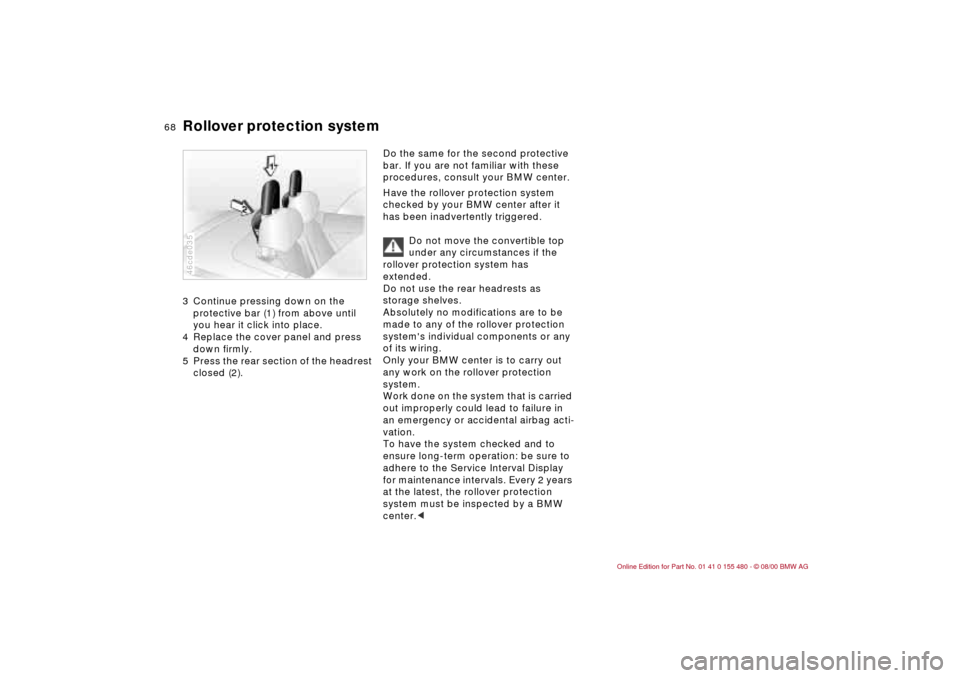
Rollover protection system3 Continue pressing down on the
protective bar (1) from above until
you hear it click into place.
4 Replace the cover panel and press
down firmly.
5 Press the rear section of the headrest
closed (2).46cde035
Do the same for the second protective
bar. If you are not familiar with these
procedures, consult your BMW center.
Have the rollover protection system
checked by your BMW center after it
has been inadvertently triggered.
Do not move the convertible top
under any circumstances if the
rollover protection system has
extended.
Do not use the rear headrests as
storage shelves.
Absolutely no modifications are to be
made to any of the rollover protection
system's individual components or any
of its wiring.
Only your BMW center is to carry out
any work on the rollover protection
system.
Work done on the system that is carried
out improperly could lead to failure in
an emergency or accidental airbag acti-
vation.
To have the system checked and to
ensure long-term operation: be sure to
adhere to the Service Interval Display
for maintenance intervals. Every 2 years
at the latest, the rollover protection
system must be inspected by a BMW
center.c
Page 82 of 215
82n
Fuel gauge Coolant temperature Service Interval Display When you switch on the ignition, the
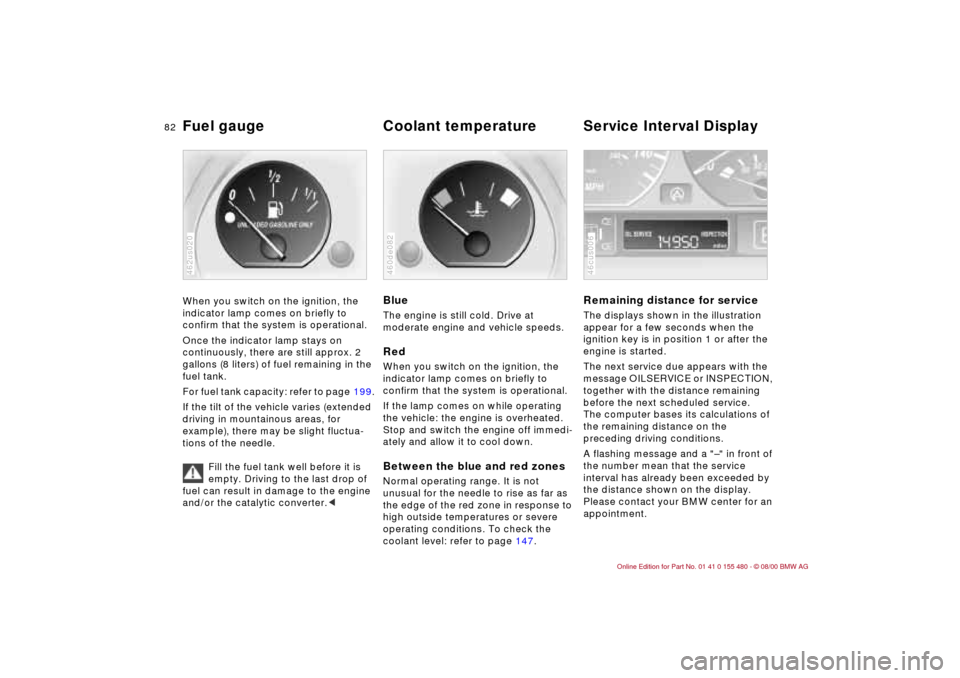
indicator lamp comes on briefly to
confirm that the system is operational.
Once the indicator lamp stays on
continuously, there are still approx. 2
gallons (8 liters) of fuel remaining in the
fuel tank.
For fuel tank capacity: refer to page 199.
If the tilt of the vehicle varies (extended
driving in mountainous areas, for
example), there may be slight fluctua-
tions of the needle.
Fill the fuel tank well before it is
empty. Driving to the last drop of
fuel can result in damage to the engine
and/or the catalytic converter.<462us020
BlueThe engine is still cold. Drive at
moderate engine and vehicle speeds.RedWhen you switch on the ignition, the
indicator lamp comes on briefly to
confirm that the system is operational.
If the lamp comes on while operating
the vehicle: the engine is overheated.
Stop and switch the engine off immedi-
ately and allow it to cool down.Between the blue and red zonesNormal operating range. It is not
unusual for the needle to rise as far as
the edge of the red zone in response to
high outside temperatures or severe
operating conditions. To check the
coolant level: refer to page 147.460de082
Remaining distance for serviceThe displays shown in the illustration
appear for a few seconds when the
ignition key is in position 1 or after the
engine is started.
The next service due appears with the
message OILSERVICE or INSPECTION,
together with the distance remaining
before the next scheduled service.
The computer bases its calculations of
the remaining distance on the
preceding driving conditions.
A flashing message and a "Ð" in front of
the number mean that the service
interval has already been exceeded by
the distance shown on the display.
Please contact your BMW center for an
appointment.46cus006
Page 134 of 215

134n
Tire replacement Tire rotationTire ageThe date on which the tire was manu-
factured is indicated by the code on the
sidewall:
DOT ... 4100 means that the tire was
manufactured in week 41of 2000.
BMW recommends the replacement of
all tires when the tires are no more than
6 years old, even if a tire life of 10 years
is possible.
Spare tires over 6 years old should be
used only in case of emergency. A tire
in this condition should be replaced by
a new tire immediately, and should not
be mounted together with new tires.
Between the axlesThe tread wear patterns at the front end
differ from those at the rear Ð the actual
patterns will vary according to indi-
vidual driving conditions. In the inter-
ests of safety and maintaining optimal
handling characteristics, tire rotation is
not recommended.
If a proposed interaxle rotation of tires
is based on economic considerations,
one should consider whether the costs
for the rotation are likely to be recap-
tured by any increase in the service life
of the tires that might be realized. In
principle, tire rotation must be
performed at short intervals (maximum
3,000 miles/5,000 km). Consult your
BMW center for more information.
Should you decide to rotate the tires,
it is essential to comply with the
following:
Rotate tires on the same side only,
since braking characteristics and road
grip could otherwise be adversely
affected.
Following rotation, the tire inflation
pressure should always be corrected.If different tire sizes are mounted
on the front and rear axles (refer
to page 137), the wheels may not be
rotated from one axle to the other.<
Page 150 of 215
150n
The BMW Maintenance System has
been designed as a reliable means of
providing maximum driving and operat-
ing safety Ð and as cost-effectively as
possible for you.
Please keep in mind that regular main-
tenance is not only necessary for the
safety of your vehicle, but also plays a
significant role in maintaining the resale
value of the vehicle.
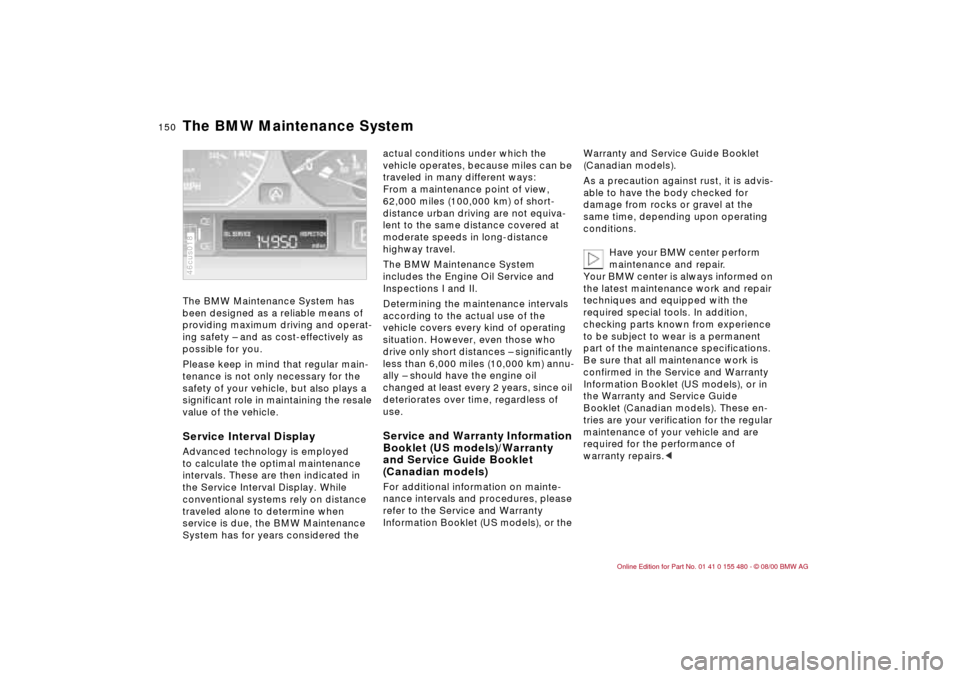
Service Interval DisplayAdvanced technology is employed
to calculate the optimal maintenance
intervals. These are then indicated in
the Service Interval Display. While
conventional systems rely on distance
traveled alone to determine when
service is due, the BMW Maintenance
System has for years considered the 46cus018
actual conditions under which the
vehicle operates, because miles can be
traveled in many different ways:
From a maintenance point of view,
62,000 miles (100,000 km) of short-
distance urban driving are not equiva-
lent to the same distance covered at
moderate speeds in long-distance
highway travel.
The BMW Maintenance System
includes the Engine Oil Service and
Inspections I and II.
Determining the maintenance intervals
according to the actual use of the
vehicle covers every kind of operating
situation. However, even those who
drive only short distances Ð significantly
less than 6,000 miles (10,000 km) annu-
ally Ð should have the engine oil
changed at least every 2 years, since oil
deteriorates over time, regardless of
use.Service and Warranty Information
Booklet (US models)/Warranty
and Service Guide Booklet
(Canadian models)For additional information on mainte-
nance intervals and procedures, please
refer to the Service and Warranty
Information Booklet (US models), or the Warranty and Service Guide Booklet
(Canadian models).
As a precaution against rust, it is advis-
able to have the body checked for
damage from rocks or gravel at the
same time, depending upon operating
conditions.
Have your BMW center perform
maintenance and repair.
Your BMW center is always informed on
the latest maintenance work and repair
techniques and equipped with the
required special tools. In addition,
checking parts known from experience
to be subject to wear is a permanent
part of the maintenance specifications.
Be sure that all maintenance work is
confirmed in the Service and Warranty
Information Booklet (US models), or in
the Warranty and Service Guide
Booklet (Canadian models). These en-
tries are your verification for the regular
maintenance of your vehicle and are
required for the performance of
warranty repairs.<
The BMW Maintenance System
Page 178 of 215

178n
BatteryRemoval and installation
Do not disconnect the battery
when the engine is running. If you
do so, the ensuing voltage surge will
damage the vehicle's onboard
electronics.
Do not make any modifications in the
wires to the positive terminal. If you do
so, the protective function of the safety
battery terminal is no longer ensured.
Repair and disposal must be performed
by trained technicians only.<
When removing the battery, disconnect
the cable on the negative terminal first,
then the cable on the positive terminal.
Loosen the center adjusting screw on
the battery retaining strap (use the
screwdriver included with the onboard
tool kit) and disconnect the strap.
When installing a battery, connect the
positive terminal first, then connect the
negative terminal.
When installing a battery, be sure
that it is mounted properly and that
the retaining bracket is installed with the
center adjustment screw. If this is not
done, the battery will not be adequately
secured in case of an accident.<
Charging the battery Charge the battery in the vehicle only
when the engine is not running.
Before doing any work on the
electrical system, be sure to
unclamp the cable from the battery's
negative terminal. Failure to do so can
result in short circuits, a fire or personal
injury.<
If you plan to park the vehicle for longer
than 4 weeks, disconnect the battery
from the vehicle electrical system by
disconnecting the cable at the negative
terminal. Have the battery recharged
with an appropriate battery charger.
If the vehicle is parked for more than
12 weeks, remove the battery, recharge
it and store it in a cool yet frost- and
dust-free area. During storage, have the
battery recharged every 3 months.
Also, recharge the battery before it is
reinstalled. If this is not done, the
battery will not be serviceable. Every
time the battery is discharged, espe-
cially over extended periods, its service
life is reduced.
Return used batteries to a
recycling center or your BMW
center. Maintain the battery in an
upright position for transport and
storage. Secure the battery to prevent it
from tilting during transport.<
Storage periods during which the
battery is disconnected are not
taken into consideration by the Service
Interval Display for changing the brake
fluid.
For this reason, be sure that the brake
fluid is changed every two years,
regardless of the information displayed.
Please read the pertinent information
on page 148.<
Page 207 of 215

Everything from A to Z
207n
IndexDataTechnologyRepairsCar careControlsOverview
Interlock69
Intermittent mode, wiper
system76 J
Jack173
Jump-starting183 K
Key Memory59
Keys32
with remote control32 L
Lamps and bulbs166
LAMPS ON warning93
Lashing eyes115
LATCH attachment of the
child seat64
Leather care155
Length197
License plate lamp, bulb
replacement171
Light-alloy wheels137
Lighter112
Loads, securing114
Load-securing devices115
Low beam headlamps93
bulb replacement167
Lug bolts174 Luggage
compartment40,41
capacity198
emergency release39
floor panel40
lid39
lighting39
lock separately39
remote control36
Luggage compartment
lamps, bulb
replacement172
Luggage rack116
Lumbar support55
M
M+S tires136
Maintenance82,150
Malfunction displays83
Manual convertible top,
operating45
Manual transmission72
Manually controlled
recirculated-air105
Memory57
MFL (Multi-function steering
wheel)24
Microfilter99,180
Mirror memory57
Mirrors57
Mobile phones129 Modifications,
technical6,161
Motion sensor, interior43
Mounting child safety
seat64
Mounting the roof
carrier130
Multi-function steering
wheel (MFL)24
N
Navigation system, refer to
the radio Owner's Manual O
OBD interface socket162
Odometer81
Oil
additives145
capacity199
consumption145
dipstick145
quality146
specifications146
viscosity146
Oil change intervals, see the
Service and Warranty
Information Booklet (US
models)/Warranty and
Service Guide Booklet
(Canadian models) Oil filter change199
Oil level
check145
indicator lamp20
Oil pressure, indicator
lamp20
OILSERVICE82
Onboard tool kit166
Opening and closing
from the inside38
from the outside34
Operating the convertible
top manually in the event
of an electrical
malfunction181
Outside temperature
display84
P
Paint blemishes152
Paint, care152
Paintwork
minor repairs153
waxing153
Park Distance Control
(PDC)87
Parking brake71
Parking help87
Parking lamps94
Parking, winter128
Page 208 of 215

Everything from A to ZPDC (Park Distance
Control)87
Performance196
Phone, mobile129
Pocket flashlight107
Pollen99,106
Power steering129
Power windows44
convenience operation34
Pressure monitoring,
tires91,192
Pressure, tires27,132 Q
Quality Grades133 R
Radiator199
Radio
reception129,190
refer also to the separate
Owner's Manual
Radio Data System
(RDS)190
Rain sensor77,191
RDC (Tire Pressure
Control)91,192
RDS (Radio Data
System)190
Rear lamps169
Rear window
defroster78,98,106
Rear-entry assist55 Rearview mirror57
Recirculated air mode98
Reclining seat52
Refueling26
Remote control35
Remove condensation,
windows105
Replacement keys32
Reporting safety defects7
Restraint system61,64
Reverse17,72
Rollover protection
system67,68,193
Roof load capacity198
Roof-mounted luggage
rack116
Rubber seals and
components127
S
Safety belt tensioner190
Safety belts60
Safety buttons38
Safety defects, reporting7
Seat adjustment52
Seat heating107
Seat memory57
Seat-integrated safety
belts55
Seats52
Securing cargo114
Securing loads114 Selector lever, automatic
transmission73
Self-defrosting mirrors57
Self-diagnostics192
Service and Warranty
Information Booklet150
Service Interval
Display82,150
Shiftlock73
Side airbags61
Side impact Head Protection
System61
Side lamps93
bulb replacement168
Sitting properly with
airbag62
Ski bag113
Skid control128
Slippery roads127
Snow
chains127,136,137
Socket112
for flashlight112
for power supplies112
for vacuum cleaner112
Spare key32
Spare tire173
Spark plugs200
Speaker111
Specifications, fuel27
Speed, average86
Speedometer18
Sports seat54 Starting
problems121,183
Starting the engine69
Steel wheels137
Steering129
Steering lock69
Steering wheel57
adjusting57
Steptronic73
Stopping the vehicle70
Storage compartments110
Storage facilities110
Storing your vehicle160
Stroke196
Summer tires135
Sun visors58
Switching off the engine70
Symbols4,177
Synthetic oils146
T
Tachometer81
Tail lamp assembly, bulb
replacement169
Tank capacity199
Tank cover
unlock in case of electrical
fault180
Technical data196
Technical
modifications6,161
Telephone hookup111