Convertible top BMW 325Ci CONVERTIBLE 2002 E46 User Guide
[x] Cancel search | Manufacturer: BMW, Model Year: 2002, Model line: 325Ci CONVERTIBLE, Model: BMW 325Ci CONVERTIBLE 2002 E46Pages: 159, PDF Size: 2.28 MB
Page 45 of 159
45n
OverviewControlsMaintenanceRepairsDataIndex
Fully-automatic convertible top
*
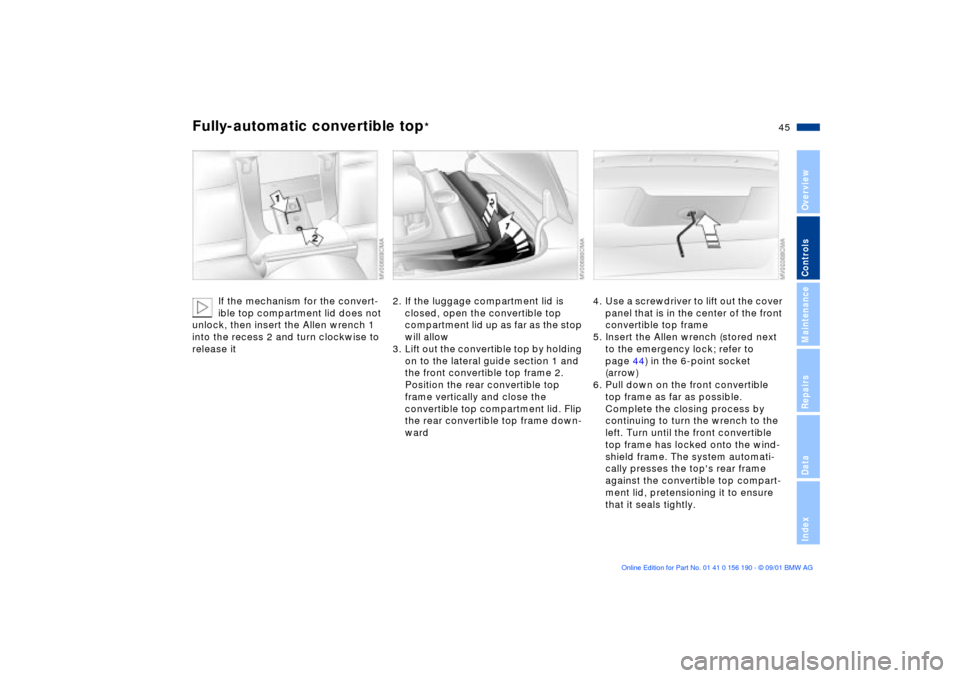
If the mechanism for the convert-
ible top compartment lid does not
unlock, then insert the Allen wrench 1
into the recess 2 and turn clockwise to
release it
2. If the luggage compartment lid is
closed, open the convertible top
compartment lid up as far as the stop
will allow
3. Lift out the convertible top by holding
on to the lateral guide section 1 and
the front convertible top frame 2.
Position the rear convertible top
frame vertically and close the
convertible top compartment lid. Flip
the rear convertible top frame down-
ward
4. Use a screwdriver to lift out the cover
panel that is in the center of the front
convertible top frame
5. Insert the Allen wrench (stored next
to the emergency lock; refer to
page 44) in the 6-point socket
(arrow)
6. Pull down on the front convertible
top frame as far as possible.
Complete the closing process by
continuing to turn the wrench to the
left. Turn until the front convertible
top frame has locked onto the wind-
shield frame. The system automati-
cally presses the top's rear frame
against the convertible top compart-
ment lid, pretensioning it to ensure
that it seals tightly.
Page 46 of 159

46n
Fully-automatic convertible top
*
Wind deflector
*
Please consult your BMW center
to have the defect corrected.<
In the event of an electrical
malfunction, never open the
convertible top manually. The convert-
ible top compartment lid cannot be
locked, and would open while you are
driving.<
With the convertible top open, the wind
deflector keeps air movement in the
passenger compartment to a minimum,
thus providing you with a pleasant
drive, even at higher speeds. The wind
deflector comes in a protective sleeve,
and because of its slim dimensions, can
be easily stored in the luggage
compartment.Installation1. Take the wind deflector out of its
protective sleeve
Page 47 of 159
47n
OverviewControlsMaintenanceRepairsDataIndex
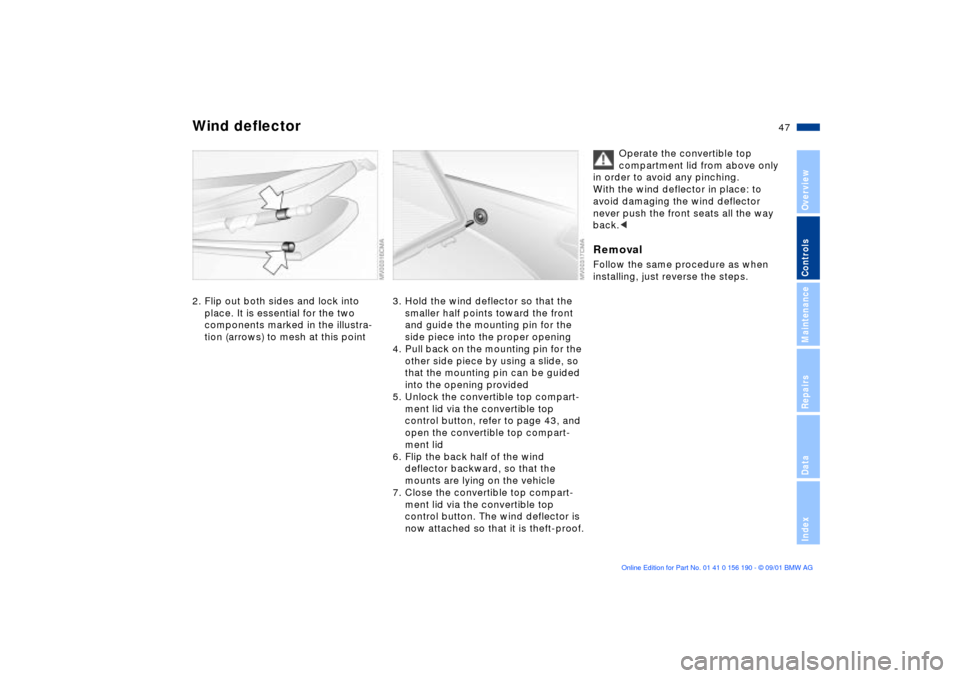
Wind deflector2. Flip out both sides and lock into
place. It is essential for the two
components marked in the illustra-
tion (arrows) to mesh at this point
3. Hold the wind deflector so that the
smaller half points toward the front
and guide the mounting pin for the
side piece into the proper opening
4. Pull back on the mounting pin for the
other side piece by using a slide, so
that the mounting pin can be guided
into the opening provided
5. Unlock the convertible top compart-
ment lid via the convertible top
control button, refer to page 43, and
open the convertible top compart-
ment lid
6. Flip the back half of the wind
deflector backward, so that the
mounts are lying on the vehicle
7. Close the convertible top compart-
ment lid via the convertible top
control button. The wind deflector is
now attached so that it is theft-proof.
Operate the convertible top
compartment lid from above only
in order to avoid any pinching.
With the wind deflector in place: to
avoid damaging the wind deflector
never push the front seats all the way
back.<
RemovalFollow the same procedure as when
installing, just reverse the steps.
Page 62 of 159
62n
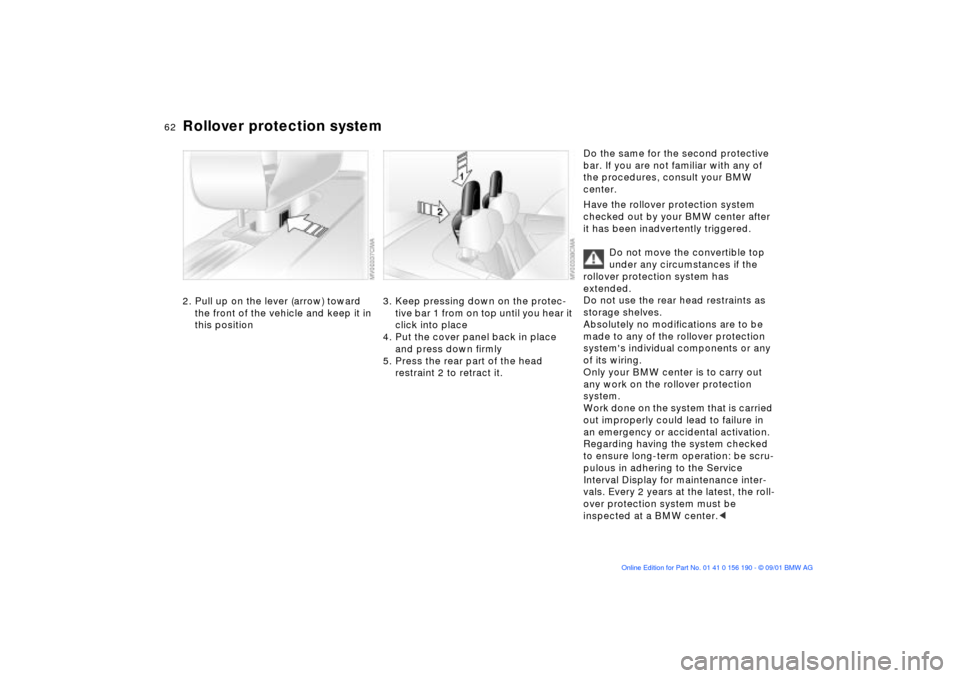
Rollover protection system2. Pull up on the lever (arrow) toward
the front of the vehicle and keep it in
this position
3. Keep pressing down on the protec-
tive bar 1 from on top until you hear it
click into place
4. Put the cover panel back in place
and press down firmly
5. Press the rear part of the head
restraint 2 to retract it.
Do the same for the second protective
bar. If you are not familiar with any of
the procedures, consult your BMW
center.
Have the rollover protection system
checked out by your BMW center after
it has been inadvertently triggered.
Do not move the convertible top
under any circumstances if the
rollover protection system has
extended.
Do not use the rear head restraints as
storage shelves.
Absolutely no modifications are to be
made to any of the rollover protection
system's individual components or any
of its wiring.
Only your BMW center is to carry out
any work on the rollover protection
system.
Work done on the system that is carried
out improperly could lead to failure in
an emergency or accidental activation.
Regarding having the system checked
to ensure long-term operation: be scru-
pulous in adhering to the Service
Interval Display for maintenance inter-
vals. Every 2 years at the latest, the roll-
over protection system must be
inspected at a BMW center.<
Page 103 of 159
103n
OverviewControlsMaintenanceRepairsDataIndex
Ski bag Cargo loading
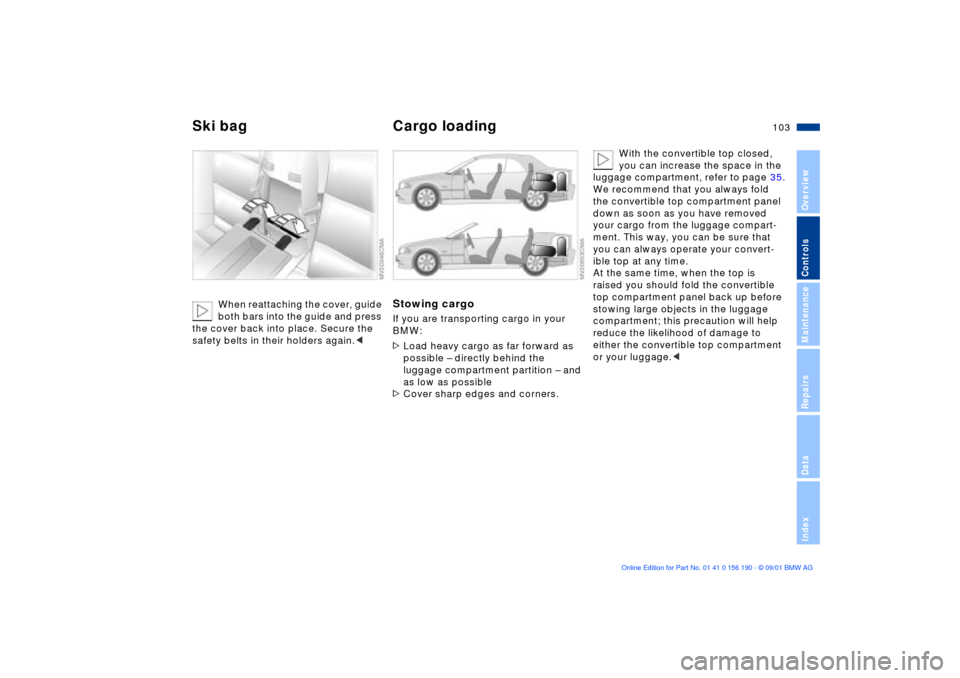
When reattaching the cover, guide
both bars into the guide and press
the cover back into place. Secure the
safety belts in their holders again.<
Stowing cargo If you are transporting cargo in your
BMW:
>Load heavy cargo as far forward as
possible Ð directly behind the
luggage compartment partition Ð and
as low as possible
>Cover sharp edges and corners.
With the convertible top closed,
you can increase the space in the
luggage compartment, refer to page 35.
We recommend that you always fold
the convertible top compartment panel
down as soon as you have removed
your cargo from the luggage compart-
ment. This way, you can be sure that
you can always operate your convert-
ible top at any time.
At the same time, when the top is
raised you should fold the convertible
top compartment panel back up before
stowing large objects in the luggage
compartment; this precaution will help
reduce the likelihood of damage to
either the convertible top compartment
or your luggage.<
Page 110 of 159

110n
Brake system Hardtop
*
Disc brakesLimited vehicle use, extended periods
with the vehicle parked or in storage,
and operating conditions in which
braking is restricted to gentle, low-
pressure applications will all increase
the tendency for corrosion to form on
the rotors; this is often accompanied by
a simultaneous accumulation of
contamination on the brake pads. The
pads must exert a certain minimal level
of pressure against the rotors for the
disc brakes' inherent self-cleaning
effect to remain effective.
If the brake rotors are corroded, they
will tend to respond to braking with a
pulsating effect that even extended
brake applications will fail to cure.
When driving in heavy rain and on wet
roads it is useful to apply light pressure
to the brake pedal every few miles.
Monitor traffic conditions to ensure that
this maneuver does not pose a hazard
to you or to other road users. The heat
generated in this process helps dry the
pads and rotors to ensure that your
brake system will respond with undi-
minished efficiency when you need it.
When descending steep hills and
extended grades, downshift to a gear
that will allow you to continue safely with only a minimal amount of braking.
By minimizing the loads placed on the
brake system, this strategy helps
ensure that optimal brake system
response will remain available at all
times. Use care to avoid exceeding the
approved engine-speed range, refer to
page 74.
Do not coast with the clutch
depressed or with the transmission
or selector lever in neutral. Do not coast
with the engine shut off. The engine
provides no braking effect when the
clutch is depressed and there is no
power-assist for braking or steering
when the engine is not running.
Never allow floor mats, carpets or any
other objects to protrude into the area
around the accelerator, clutch and brake
pedals and obstruct their movement.<
Brake pads
For your own safety: use only
brake pads that the manufacturer
has released for your particular vehicle
model. The manufacturer cannot eval-
uate non-approved brake pads to
determine if they are suited for use, and
therefore cannot ensure the operating
safety of the vehicle if they are
installed.<
It is not necessary to remove the fabric
top even in the winter, when the
hardtop is generally in constant use.
But you can also remove it at any time
with no problem. Before the fabric top
is stored in the convertible top
compartment, it must be absolutely dry
in order to avoid water spots and
mildew from forming.
The hardtop offers reading lamps and
clothes hooks that can be used just by
pressing. In addition, a roof-rack can be
mounted, for more information, please
contact your BMW center.
When suspending articles of
clothing from the hooks, be sure
that they will not obstruct the driver's
vision. Do not hang heavy objects on
the hooks. If you do so, they could
cause personal injury during braking or
evasive maneuvers.<
Two people are required for installation
or removal. Work with extreme caution
in order to avoid paint damage and
damage to the body or hardtop.
To facilitate hardtop installation or
removal, you can obtain a specially
designed hardtop lift
* or hardtop rack
*
at your BMW center.
Page 111 of 159
111n
OverviewControlsMaintenanceRepairsDataIndex
Hardtop
*
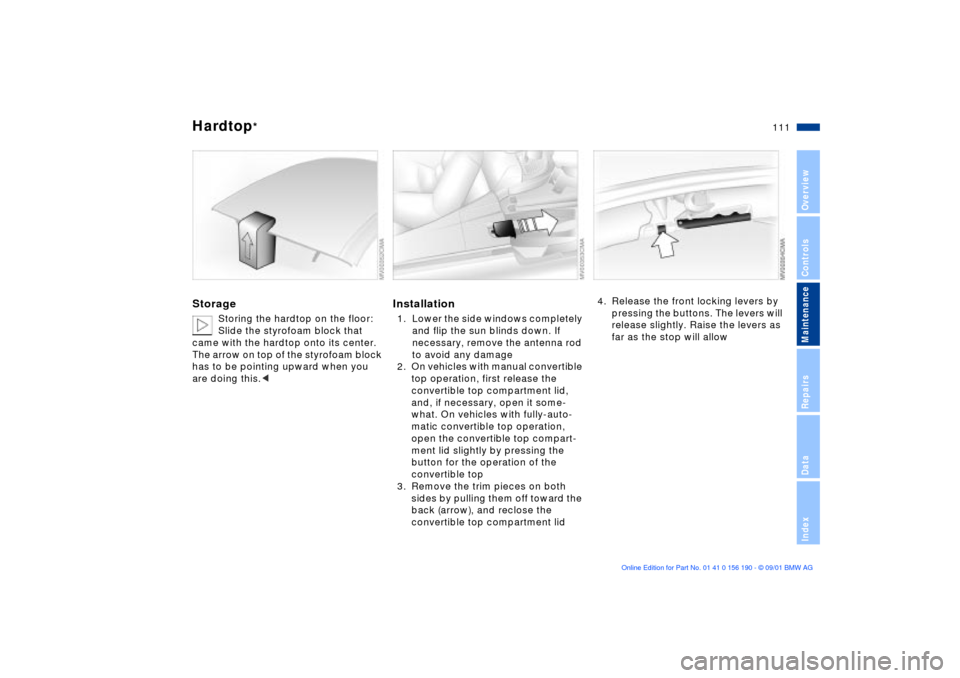
Storage
Storing the hardtop on the floor:
Slide the styrofoam block that
came with the hardtop onto its center.
The arrow on top of the styrofoam block
has to be pointing upward when you
are doing this.<
Installation1. Lower the side windows completely
and flip the sun blinds down. If
necessary, remove the antenna rod
to avoid any damage
2. On vehicles with manual convertible
top operation, first release the
convertible top compartment lid,
and, if necessary, open it some-
what. On vehicles with fully-auto-
matic convertible top operation,
open the convertible top compart-
ment lid slightly by pressing the
button for the operation of the
convertible top
3. Remove the trim pieces on both
sides by pulling them off toward the
back (arrow), and reclose the
convertible top compartment lid
4. Release the front locking levers by
pressing the buttons. The levers will
release slightly. Raise the levers as
far as the stop will allow
Page 146 of 159

146n
Weights
BMW 325Ci BMW 330Ci
Curb weight (with one person, ready for operation, full tank of fuel, options not included)
with manual transmission
with automatic transmissionlbs. (kg)
lbs (kg)3,560 (1,615)
3,627 (1,645)3,616 (1,640)
3,704 (1,675)
Approved gross vehicle weight
with manual transmission
with automatic transmissionlbs (kg)
lbs (kg)4,442 (2,015)
4,509 (2,045)4,497 (2,040)
4,575 (2,075)
Approved front axle loads lbs (kg) 2,083 (945) 2,094 (950)
Approved rear axle loads lbs (kg) 2,546 (1,155) 2,579 (1,170)
Approved maximum roof weight for the hardtop lbs (kg) 165 (75) 165 (75)
Luggage compartment capacity
with the convertible top compartment raisedcu ft (l)
cu ft (l)9.2 (260)
10.6 (300)9.2 (260)
10.6 (300)
Never exceed either the approved axle loads or the approved gross vehicle weight.
Page 151 of 159

Everything from A to Z
151n
OverviewControlsMaintenanceRepairsDataIndex
Brake system108, 109
brake pads110
brake rotors,
corrosion110
defect in hydraulic
circuits109
disc brakes110
Break-in procedure108
Bulbs and lamps,
replacement131 C
California Proposition
65 Warning126
Canned beverage
holder100
Capacities147
Car care, refer to the "Caring
for your vehicle" manual
Car phone100
Car wash systems, refer to
the "Caring for your
vehicle" manual
Care of upholstery materials,
refer to the "Caring for your
vehicle" manual Cargo loading103
CBC (Cornering Brake
Control)18, 81
Cellular phone
refer also to the
"Telephone Owner's
Manual"
Center (high-mount) brake
lamp134
Center armrest99
Central locking system28
inside control button32
Changing a wheel135
Charging the battery139
Check Control76
Check engine oil level121
Checking coolant level123
Checking tire pressures24
Child-restraint systems59
Cigarette lighter101
Cleaning headlamps71
Cleaning windshield71 Clock76
refer also to the
"Telephone Owner's
Manual"
Clutch108
Cockpit14
Coin box100
Compartments99
Compression ratio144
Computer76
refer also to the "Owner's
Manual for Onboard
Computer"
Configuring individual
settings via Vehicle and
Key Memory63
Consumption78
display75
Convenience operation via
driver's door lock
fully-automatic convertible
top31
power windows31
Convertible top
compartment panel35
Convertible top, fully
automatic operation42 Coolant123
capacity147
Coolant temperature
gauge75
Cooling system,
capacity147
Copyright4
Cornering Brake Control
(CBC)18, 81
Correct sitting posture48
Cruise control72
Cruising range78
Cup holder, refer to
beverage holder100
Curb weight146
D
Data
dimensions145
engine144
weights146
Daytime driving lamps87
DBC (Dynamic Brake
Control)82
Defrost windows92, 94
Digital clock76
Dimensions145
Dipstick, engine oil121
Displacement144
Page 152 of 159

Everything from A to ZDisplay lighting88
Displays15
Disposal
antifreeze and anti-
corrosion agents123
battery139
brake fluid124
engine oil122
Distance warning79
Door keys28
Doors
electrical malfunction31
locking and unlocking29
manual operation31
DOT Quality Grades,
tires114
Draft-free ventilation92, 95
Drive belts17
Driving notes109
DSC (Dynamic Stability
Control)81
DSC Dynamic Stability
Control19, 81
Dynamic Brake Control
(DBC)82
Dynamic Stability Control
(DSC)19, 81
E
Easy access to the rear51
Electric power seats,
adjustment49
Electric power windows38
Electrical malfunction
doors31
fuel filler door22
luggage compartment
lid33
Electrical malfunction,
closing only
fully-automatic convertible
top44
Elements of operation14
Emergency release of
luggage compartment lid
from luggage
compartment's interior34
Energy Control74
Engine and differential108
Engine compartment
essentials119
Engine coolant, refer to
coolant123 Engine data144
Engine oil
consumption121
disposal122
fluid capacity147
quality122
specifications122
viscosity122
Engine oil level121
check121
indicator19
Engine oil pressure
indicator17
Engine speed144
Engine, starting64
Engine, switching off65
Enlarging luggage
compartment35
Entering the rear51
Exterior mirrors55
F
Failure messages76
Filling capacities147
Fittings, tow starting and
towing141
Flashlight96 Flat Tire
Monitor85, 115, 138
Flat tires113, 135, 138
Floor panel, luggage
compartment35
Fog lamps88
Follow me home lamps87
Front fog lamps88
Front reading lamps89
Fuel consumption78
Fuel consumption
display75
Fuel filler door22
electrical malfunction22
manual operation22
Fuel gauge75
Fuel reserve indicator75
Fuel specifications23
Fuel tank capacity147
Fuel tank gauge75
Fuel-injection system144
Fully-automatic convertible
top42
electrical malfunction,
closing only44
manual closing44
Fuses139