transmission BMW 325Ci CONVERTIBLE 2002 E46 User Guide
[x] Cancel search | Manufacturer: BMW, Model Year: 2002, Model line: 325Ci CONVERTIBLE, Model: BMW 325Ci CONVERTIBLE 2002 E46Pages: 159, PDF Size: 2.28 MB
Page 98 of 159
98n
BMW Universal Transmitter
*
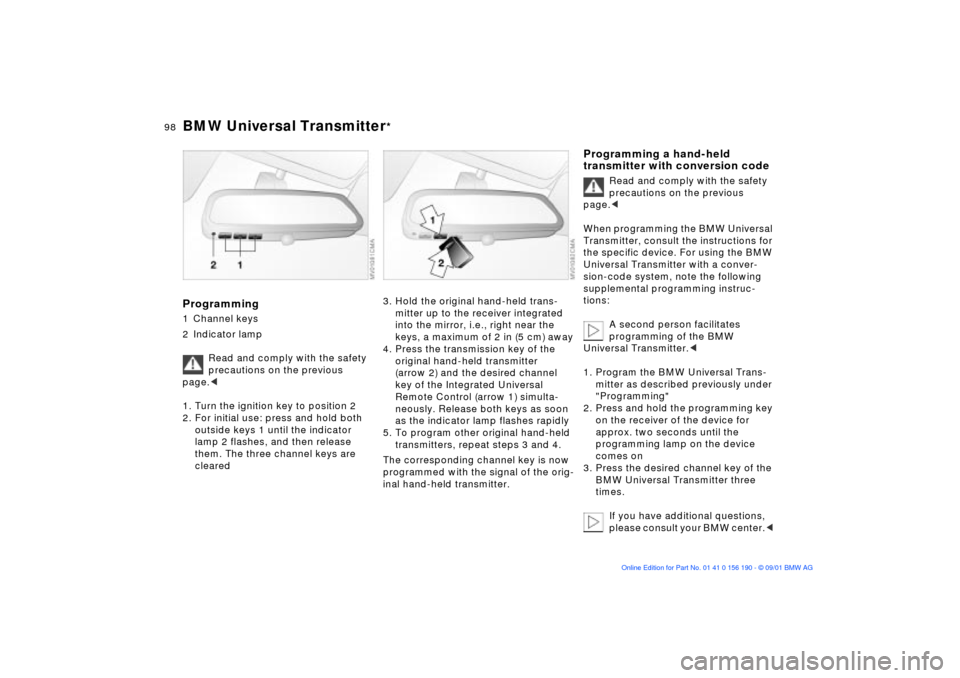
Programming 1 Channel keys
2 Indicator lamp
Read and comply with the safety
precautions on the previous
page.<
1. Turn the ignition key to position 2
2. For initial use: press and hold both
outside keys 1 until the indicator
lamp 2 flashes, and then release
them. The three channel keys are
cleared
3. Hold the original hand-held trans-
mitter up to the receiver integrated
into the mirror, i.e., right near the
keys, a maximum of 2 in (5 cm) away
4. Press the transmission key of the
original hand-held transmitter
(arrow 2) and the desired channel
key of the Integrated Universal
Remote Control (arrow 1) simulta-
neously. Release both keys as soon
as the indicator lamp flashes rapidly
5. To program other original hand-held
transmitters, repeat steps 3 and 4.
The corresponding channel key is now
programmed with the signal of the orig-
inal hand-held transmitter.
Programming a hand-held
transmitter with conversion code
Read and comply with the safety
precautions on the previous
page.<
When programming the BMW Universal
Transmitter, consult the instructions for
the specific device. For using the BMW
Universal Transmitter with a conver-
sion-code system, note the following
supplemental programming instruc-
tions:
A second person facilitates
programming of the BMW
Universal Transmitter.<
1. Program the BMW Universal Trans-
mitter as described previously under
"Programming"
2. Press and hold the programming key
on the receiver of the device for
approx. two seconds until the
programming lamp on the device
comes on
3. Press the desired channel key of the
BMW Universal Transmitter three
times.
If you have additional questions,
please consult your BMW center.<
Page 109 of 159

109n
OverviewControlsMaintenanceRepairsDataIndex
Driving notes Antilock Brake System Brake system
Brakes: do not drive with your foot
resting on the brake pedal. Even
light but consistent pedal pressure can
lead to high temperatures, brake wear
and possibly even brake failure.
Aquaplaning: when driving on wet or
slushy roads, reduce vehicle speed. If
you do not, a wedge of water may form
between the tires and the road surface.
This phenomenon can lead to partial or
complete loss of contact between the
tires and road surface, vehicle control
and braking ability.
Driving through water: do not drive
through water on the road if it is deeper
than 1 ft (30 cm), and then only at
walking speed. Otherwise, the vehicle's
engine, the electrical systems and the
transmission may be damaged.
Clothes hooks (with hardtop): when
hanging clothing from the hooks, be
sure that they will not obstruct the
driver's vision. Do not hang heavy
objects on the hooks. If you do so, they
could cause personal injury during
braking or evasive maneuvers.<
The conceptThe Antilock Brake System (ABS) keeps
the wheels from locking during braking,
thereby enhancing active driving safety.Braking with ABSIf you are in a situation that requires full
braking, you will exploit the full benefits
of the ABS system if you apply
maximum pedal pressure ("panic stop").
Since the vehicle maintains steering
responsiveness, you can avoid possible
obstacles with a minimum of steering
effort, despite the full brake application.
Pulsation at the brake pedal combined
with sounds from the hydraulic circuits
indicates to the driver that ABS is in its
active mode.
Brake fluid level If the brake fluid level is too low and
brake pedal travel has become longer,
there may be a defect in one of the
brake system's hydraulic circuits.
Proceed to the nearest BMW
center. It may be necessary to
apply higher levels of pressure to the
pedal when stopping and braking
distances may also be longer. Please
remember to adapt your driving style
accordingly.<
Page 110 of 159

110n
Brake system Hardtop
*
Disc brakesLimited vehicle use, extended periods
with the vehicle parked or in storage,
and operating conditions in which
braking is restricted to gentle, low-
pressure applications will all increase
the tendency for corrosion to form on
the rotors; this is often accompanied by
a simultaneous accumulation of
contamination on the brake pads. The
pads must exert a certain minimal level
of pressure against the rotors for the
disc brakes' inherent self-cleaning
effect to remain effective.
If the brake rotors are corroded, they
will tend to respond to braking with a
pulsating effect that even extended
brake applications will fail to cure.
When driving in heavy rain and on wet
roads it is useful to apply light pressure
to the brake pedal every few miles.
Monitor traffic conditions to ensure that
this maneuver does not pose a hazard
to you or to other road users. The heat
generated in this process helps dry the
pads and rotors to ensure that your
brake system will respond with undi-
minished efficiency when you need it.
When descending steep hills and
extended grades, downshift to a gear
that will allow you to continue safely with only a minimal amount of braking.
By minimizing the loads placed on the
brake system, this strategy helps
ensure that optimal brake system
response will remain available at all
times. Use care to avoid exceeding the
approved engine-speed range, refer to
page 74.
Do not coast with the clutch
depressed or with the transmission
or selector lever in neutral. Do not coast
with the engine shut off. The engine
provides no braking effect when the
clutch is depressed and there is no
power-assist for braking or steering
when the engine is not running.
Never allow floor mats, carpets or any
other objects to protrude into the area
around the accelerator, clutch and brake
pedals and obstruct their movement.<
Brake pads
For your own safety: use only
brake pads that the manufacturer
has released for your particular vehicle
model. The manufacturer cannot eval-
uate non-approved brake pads to
determine if they are suited for use, and
therefore cannot ensure the operating
safety of the vehicle if they are
installed.<
It is not necessary to remove the fabric
top even in the winter, when the
hardtop is generally in constant use.
But you can also remove it at any time
with no problem. Before the fabric top
is stored in the convertible top
compartment, it must be absolutely dry
in order to avoid water spots and
mildew from forming.
The hardtop offers reading lamps and
clothes hooks that can be used just by
pressing. In addition, a roof-rack can be
mounted, for more information, please
contact your BMW center.
When suspending articles of
clothing from the hooks, be sure
that they will not obstruct the driver's
vision. Do not hang heavy objects on
the hooks. If you do so, they could
cause personal injury during braking or
evasive maneuvers.<
Two people are required for installation
or removal. Work with extreme caution
in order to avoid paint damage and
damage to the body or hardtop.
To facilitate hardtop installation or
removal, you can obtain a specially
designed hardtop lift
* or hardtop rack
*
at your BMW center.
Page 121 of 159
121n
OverviewControlsMaintenanceRepairsDataIndex
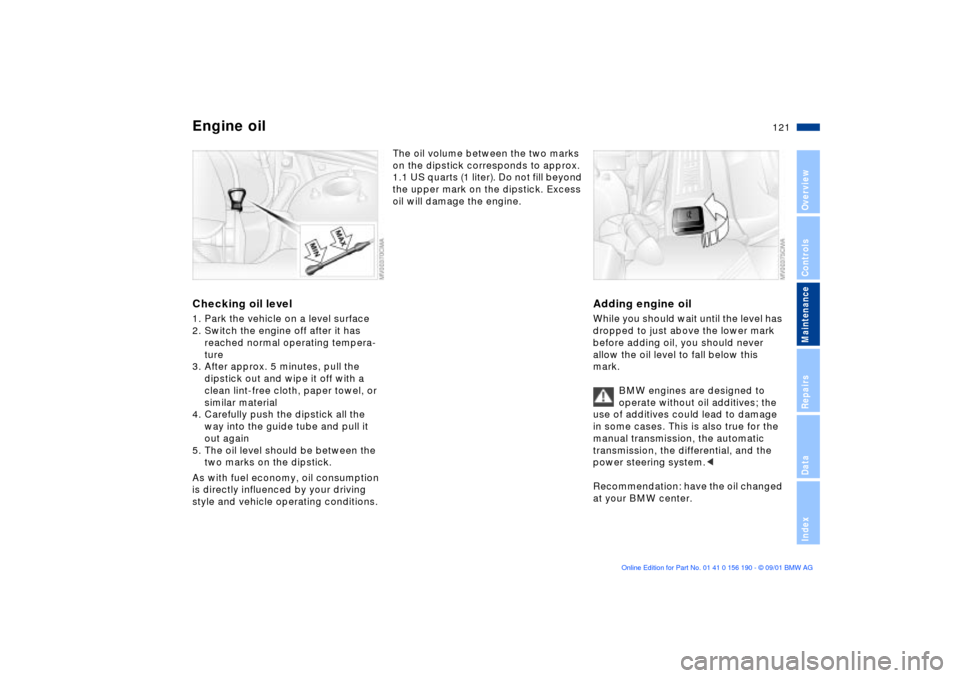
Engine oilChecking oil level1. Park the vehicle on a level surface
2. Switch the engine off after it has
reached normal operating tempera-
ture
3. After approx. 5 minutes, pull the
dipstick out and wipe it off with a
clean lint-free cloth, paper towel, or
similar material
4. Carefully push the dipstick all the
way into the guide tube and pull it
out again
5. The oil level should be between the
two marks on the dipstick.
As with fuel economy, oil consumption
is directly influenced by your driving
style and vehicle operating conditions.
The oil volume between the two marks
on the dipstick corresponds to approx.
1.1 US quarts (1 liter). Do not fill beyond
the upper mark on the dipstick. Excess
oil will damage the engine.
Adding engine oilWhile you should wait until the level has
dropped to just above the lower mark
before adding oil, you should never
allow the oil level to fall below this
mark.
BMW engines are designed to
operate without oil additives; the
use of additives could lead to damage
in some cases. This is also true for the
manual transmission, the automatic
transmission, the differential, and the
power steering system.<
Recommendation: have the oil changed
at your BMW center.
Page 135 of 159
135n
OverviewControlsMaintenanceRepairsDataIndex
Changing a wheel
Safety precautions for replacing
flat tires and all wheel changes:
Stop the vehicle as far as possible from
passing traffic. Park on a firm, flat,
surface. Switch on the hazard warning
flashers. Turn the steering wheel to the
straight-ahead position and engage the
steering lock. Shift into 1st or reverse
(selector lever in Park with automatic
transmission) and engage the parking
brake.
All passengers should be outside the
vehicle and well away from your imme-
diate working area (behind a guardrail,
for example).
If a warning triangle or portable hazard
warning lamp is available, set it up on
the roadside at an appropriate distance
from the rear of the vehicle. Comply
with all safety guidelines and regula-
tions.
Change the wheel only on a level, firm
surface which is not slippery. Avoid
jacking the vehicle on a soft or slippery
support surface (snow, ice, loose
gravel, etc.), as either the vehicle or the
jack could slip sideways.
Position the jack on a firm support
surface.
Do not place wooden blocks or similar
objects under the jack. They could
prevent the jack from extending to its
full height and reduce its support
capacity.
Do not lie under the vehicle or start the
engine when the vehicle is supported
by the jack Ð risk of fatal injury.<
Your BMW is equipped with a space-
saver spare tire designed for temporary
use in maintaining the vehicle's mobility
in an emergency.
To remove the space-saver spare
tire, lift the floor panel in the
luggage compartment completely out,
refer to page 35.<
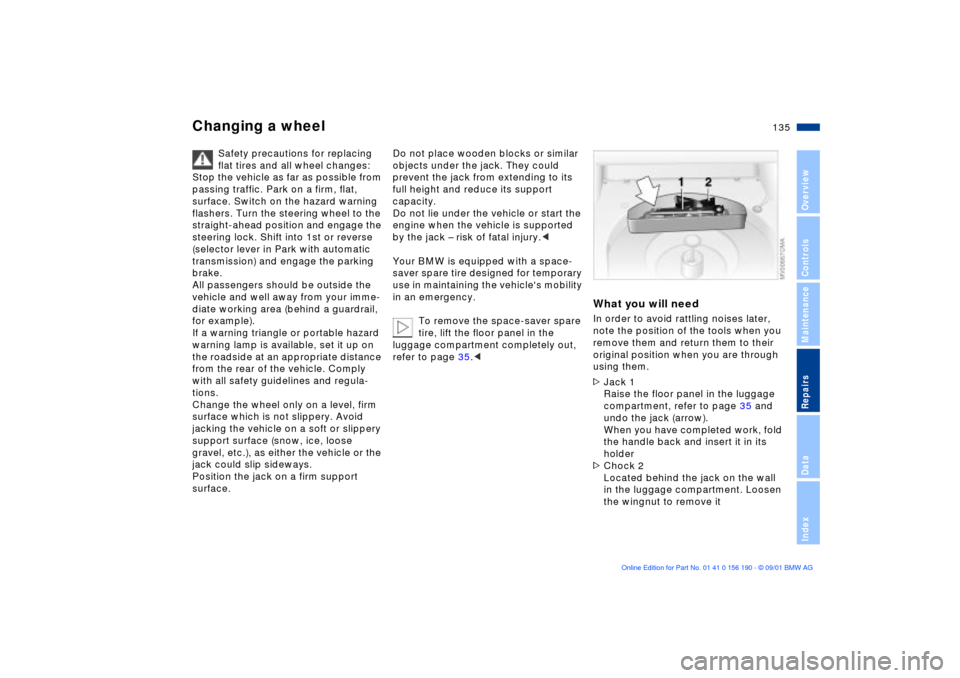
What you will needIn order to avoid rattling noises later,
note the position of the tools when you
remove them and return them to their
original position when you are through
using them.
>Jack 1
Raise the floor panel in the luggage
compartment, refer to page 35 and
undo the jack (arrow).
When you have completed work, fold
the handle back and insert it in its
holder
>Chock 2
Located behind the jack on the wall
in the luggage compartment. Loosen
the wingnut to remove it
Page 146 of 159

146n
Weights
BMW 325Ci BMW 330Ci
Curb weight (with one person, ready for operation, full tank of fuel, options not included)
with manual transmission
with automatic transmissionlbs. (kg)
lbs (kg)3,560 (1,615)
3,627 (1,645)3,616 (1,640)
3,704 (1,675)
Approved gross vehicle weight
with manual transmission
with automatic transmissionlbs (kg)
lbs (kg)4,442 (2,015)
4,509 (2,045)4,497 (2,040)
4,575 (2,075)
Approved front axle loads lbs (kg) 2,083 (945) 2,094 (950)
Approved rear axle loads lbs (kg) 2,546 (1,155) 2,579 (1,170)
Approved maximum roof weight for the hardtop lbs (kg) 165 (75) 165 (75)
Luggage compartment capacity
with the convertible top compartment raisedcu ft (l)
cu ft (l)9.2 (260)
10.6 (300)9.2 (260)
10.6 (300)
Never exceed either the approved axle loads or the approved gross vehicle weight.
Page 147 of 159

147n
OverviewControlsMaintenanceRepairsDataIndex
Capacities
Notes
Fuel tank
Reserve gal. (liters)
gal. (liters)approx. 16.6 (approx. 63)
approx. 2.1 (approx. 8)Fuel specification, refer to
page 23
Windshield/headlamp washer reservoir quarts (liters) approx. 5.6 (approx. 5.3) Specifications, refer to page 120
Cooling system including heating circuit quarts (liters) approx. 8.9 (approx. 8.4) Specifications, refer to page 123
Engine oil and filter change quarts (liters) approx. 6.9 (approx. 6.5) BMW High Performance
Synthetic Oil
Specifications, refer to page 121
Manual and automatic transmission
and differentialÐ Lifetime lubricant, no oil change
required
Page 150 of 159

Everything from A to ZA
ABS (Antilock Brake
System)19, 109
Access to the rear51
Accessories10
Activated-charcoal filter96
Adaptive Transmission
Control (ATC)68
ADB (Automatic Differential
Brake)81
Adding
brake fluid124
coolant123
engine oil121
washer fluids120
Adjusting
electric power seats49
head restraints50
lumbar support50
mirrors55
steering wheel54
Air conditioning90
temperature setting91
Air distribution91, 94
Air nozzles90
Air outlets
ventilation90, 93 Air supply91, 94
Airbags18, 56
sitting correctly48
Alarm system28, 36
Antifreeze and anti-
corrosion agents123
disposal123
Antilock Brake System
(ABS)19, 109
Anti-theft system28, 29, 32
Aquaplaning109
Armrest99
ASC+T (Automatic Stability
Control plus Traction)80
Ashtray
front100
rear101
ATC (Adaptive Transmission
Control)68
Attach vehicle vacuum
cleaner101
AUC (Automatic recircu-
lated-air control)95
Automatic climate
control93, 94
Automatic cruise control72 Automatic Differential Brake
(ADB)81
Automatic dimming feature,
mirrors56
Automatic headlight
control87
Automatic recirculated-air
control (AUC)95
Automatic Stability Control
plus Traction (ASC+T)80
Automatic transmission67
Automatic transmission with
Steptronic18, 67
Average fuel
consumption78
Average speed78
Axle loads146
B
Backup lamps66
bulb replacement133
Battery139
care139
charging139
disposal139
Battery charge current
indicator17 Belts, safety52
Beverage holder100
Blower91, 94
BMW High Performance
Synthetic Oil122
BMW Maintenance
System125
BMW sports seat,
adjustment49
BMW Universal
Transmitter97
Bore144
Bottle holder, refer to
beverage holder100
Brake fluid124
disposal124
warning lamp17, 124
Brake fluid level109
Brake hydraulic system,
warning lamp17
Brake lamps
bulb replacement133
Brake pads19
A-Z
Page 154 of 159

Everything from A to ZManual transmission66
Manually controlled recircu-
lated-air95
Master keys28
MFL (Multifunction steering
wheel)22
Microfilter92, 96
Mirror defrosting55
Mirror memory53
Mirrors55
Mobile phone, refer to
cellular phone100
Modifications,
technical10, 126
Motion sensor, refer to
interior motion sensor36
Mounting the roof rack110
Multifunction steering wheel
(MFL)22 O
OBD interface socket127
Odometer74
Oil
additives121
capacity147
consumption121
quality122
specifications122
viscosity122 Oil change intervals, refer to
the Service and Warranty
Information Booklet (US
models) or the Warranty
and Service Guide Booklet
(Canadian models)
Oil dipstick121
Oil filter change147
OIL SERVICE75
Onboard computer76
refer also to the "Owner's
Manual for Onboard
Computer"
Onboard tool kit130
Opening and closing
from the inside32
via the door lock31
via the remote control29
Original hand-held
transmitter97
Outside temperature
display77
P
Paint care, refer to the
"Caring for your vehicle"
manual
Park assistant79
Park Distance Control
(PDC)79 Parking aid79
Parking brake66
Parking lamps
bulb replacement131
PDC (Park Distance
Control)79
Phone, refer to cellular
phone100
Pocket light96
Power windows38
Q
Quality Grades, tires114 R
Radiator147
Rain sensor70
RDC (Tire Pressure
Monitor)83
Reading lamps
front89
rear89
Rear fog lamps
bulb replacement133
Rear lamps133
Rear reading lamps89
Rear window
defroster91, 95 Rearview mirror55
Recirculated-air mode91
Refueling22
Remote control29
Remove window
condensation92, 94
Replace windshield wiper
blades130
Replacement keys28
Replacing lamps and
bulbs130
Reporting safety defects11
Reverse66
Rollover protection
system61
Roof weight146
Roof-mounted luggage
rack105
S
Safe with safety belts48
Safety belts48, 52
seat-integrated51
Safety defects, reporting11
Safety tires115, 138
Seat heating54
Seat memory53
Seat-integrated safety belt
system (SGS)51
Page 155 of 159

Everything from A to Z
155n
OverviewControlsMaintenanceRepairsDataIndex
Seats48
adjustment48
adjustment
precautions48
Securing cargo103
Securing child-restraint
system59
Selector lever, automatic
transmission67
Service and Warranty Infor-
mation Booklet (US
models)125
Service Interval
Display75, 125
Setting the temperature91
Shiftlock67
Side airbags56
Sitting correctly with
airbags48
Ski bag102
Socket for electrical
appliances101
Spare key28
Spare tire135
Speedometer15
Sports seat, adjustment49
Standing lamps88
Starting the engine64 Steering wheel lock64
Stopping the vehicle65
Storage compartments99
Stowing cargo103
Stroke144
Switching off the engine65
Symbols8
Synthetic oils122
T
Tail lamps
bulb replacement133
Tank capacity147
Technical data144
Technical
modifications10, 126
Telephone preparation100
Temperature display
outside temperature77
Temperature gauge
engine coolant75
Temperature
layering92, 95
Temperature setting91, 94
Third brake light134 Tilt alarm sensor37
operating via remote
control30
switching off37
Tire change135
Tire condition113
Tire inflation
pressures24, 113
checking24
indicator83
monitoring83
Tire inflation pressures
table25
Tire Pressure Monitor
(RDC)83, 115, 138
Tire pressures24
refer also to tire inflation
pressures
Tire replacement114
Tire tread113
Tires108
Tools130
Torque144
Tow fittings141
Towing the vehicle141
Track145
Transmission66 Transmitter keys28
Transporting children
safely59
Tread depth, tires113
Tread wear113
Trip odometer74
Trunk lid, refer to luggage
compartment lid33
Trunk, refer to luggage
compartment35
Turn signal
indicators20, 69
Turn signals
bulb replacement132
Turning radius145
U
Uniform Tire Quality
Grading115
Universal Transmitter97
Use antifreeze, radiator123 V
Vehicle keys28
Vehicle Memory63
Vehicle weight146
Vehicle, starting64
Ventilation90, 93
draft-free92, 95