ESP BMW 325Ci COUPE 2001 E46 User Guide
[x] Cancel search | Manufacturer: BMW, Model Year: 2001, Model line: 325Ci COUPE, Model: BMW 325Ci COUPE 2001 E46Pages: 203, PDF Size: 2.03 MB
Page 71 of 203
71n
IndexDataTechnologyRepairsCar careControlsOverview
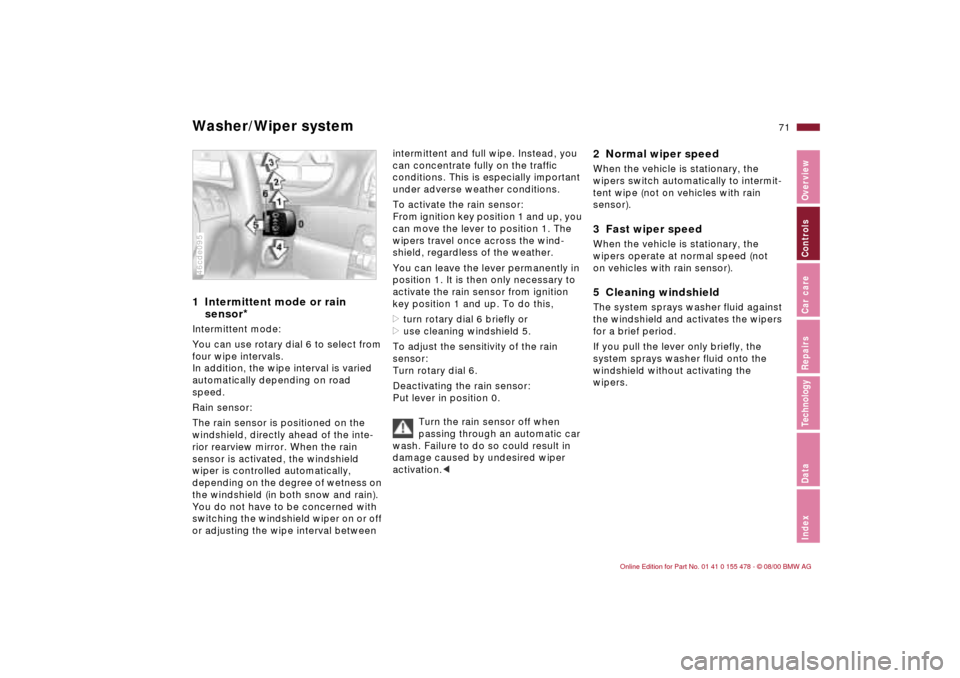
Washer/Wiper system1 Intermittent mode or rain
sensor
*
Intermittent mode:
You can use rotary dial 6 to select from
four wipe intervals.
In addition, the wipe interval is varied
automatically depending on road
speed.
Rain sensor:
The rain sensor is positioned on the
windshield, directly ahead of the inte-
rior rearview mirror. When the rain
sensor is activated, the windshield
wiper is controlled automatically,
depending on the degree of wetness on
the windshield (in both snow and rain).
You do not have to be concerned with
switching the windshield wiper on or off
or adjusting the wipe interval between 46cde095
intermittent and full wipe. Instead, you
can concentrate fully on the traffic
conditions. This is especially important
under adverse weather conditions.
To activate the rain sensor:
From ignition key position 1 and up, you
can move the lever to position 1. The
wipers travel once across the wind-
shield, regardless of the weather.
You can leave the lever permanently in
position 1. It is then only necessary to
activate the rain sensor from ignition
key position 1 and up. To do this,
>turn rotary dial 6 briefly or
>use cleaning windshield 5.
To adjust the sensitivity of the rain
sensor:
Turn rotary dial 6.
Deactivating the rain sensor:
Put lever in position 0.
Turn the rain sensor off when
passing through an automatic car
wash. Failure to do so could result in
damage caused by undesired wiper
activation.<
2 Normal wiper speedWhen the vehicle is stationary, the
wipers switch automatically to intermit-
tent wipe (not on vehicles with rain
sensor).3 Fast wiper speedWhen the vehicle is stationary, the
wipers operate at normal speed (not
on vehicles with rain sensor).5 Cleaning windshieldThe system sprays washer fluid against
the windshield and activates the wipers
for a brief period.
If you pull the lever only briefly, the
system sprays washer fluid onto the
windshield without activating the
wipers.
Page 76 of 203
76n
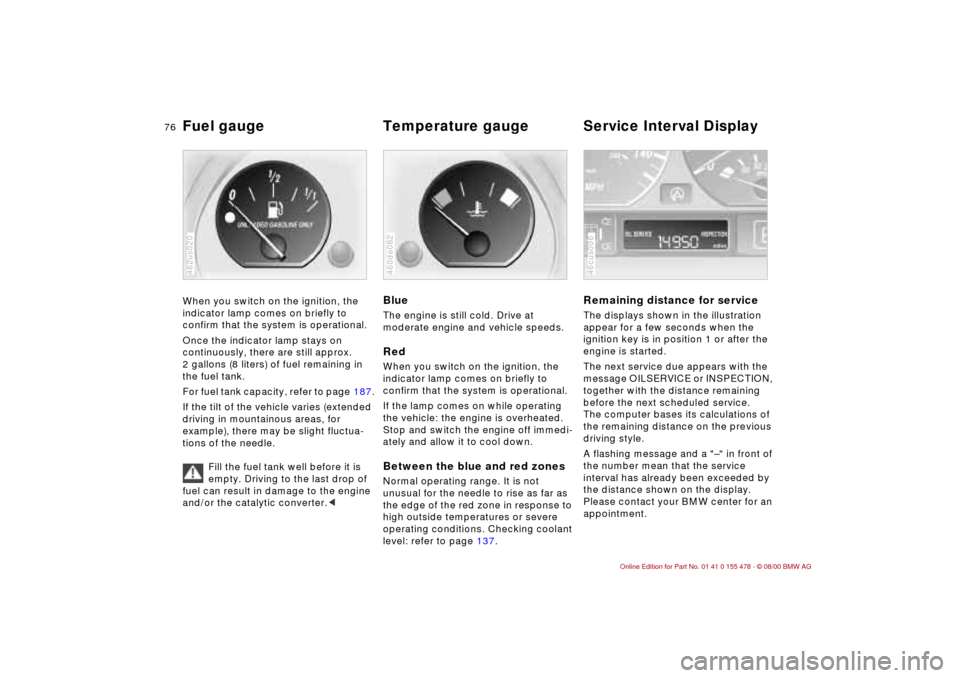
Fuel gauge Temperature gauge Service Interval Display When you switch on the ignition, the
indicator lamp comes on briefly to
confirm that the system is operational.
Once the indicator lamp stays on
continuously, there are still approx.
2 gallons (8 liters) of fuel remaining in
the fuel tank.
For fuel tank capacity, refer to page 187.
If the tilt of the vehicle varies (extended
driving in mountainous areas, for
example), there may be slight fluctua-
tions of the needle.
Fill the fuel tank well before it is
empty. Driving to the last drop of
fuel can result in damage to the engine
and/or the catalytic converter.<462us020
BlueThe engine is still cold. Drive at
moderate engine and vehicle speeds.RedWhen you switch on the ignition, the
indicator lamp comes on briefly to
confirm that the system is operational.
If the lamp comes on while operating
the vehicle: the engine is overheated.
Stop and switch the engine off immedi-
ately and allow it to cool down.Between the blue and red zonesNormal operating range. It is not
unusual for the needle to rise as far as
the edge of the red zone in response to
high outside temperatures or severe
operating conditions. Checking coolant
level: refer to page 137.460de082
Remaining distance for serviceThe displays shown in the illustration
appear for a few seconds when the
ignition key is in position 1 or after the
engine is started.
The next service due appears with the
message OILSERVICE or INSPECTION,
together with the distance remaining
before the next scheduled service.
The computer bases its calculations of
the remaining distance on the previous
driving style.
A flashing message and a "Ð" in front of
the number mean that the service
interval has already been exceeded by
the distance shown on the display.
Please contact your BMW center for an
appointment.46cus006
Page 81 of 203
81n
IndexDataTechnologyRepairsCar careControlsOverview
The conceptThe PDC assists you when you back
into a parking space. A signal warns
you of the distance to an obstacle. To
do this, four ultrasonic sensors in the
rear bumper measure the distance to
the nearest object. The range for the
sensors located at both rear corners
ends approx. 2 ft (60 cm) behind the
bumpers. The range for the two middle
sensors is slightly less than 4.9 ft
(1.50 meters).
The system starts to operate automati-
cally about one second after you select
reverse with the ignition key in posi-
tion 2. PDC is deactivated when you
shift back out of reverse.
Acoustical signalsThe distance to the nearest object is
indicated by a tone sounding at various
intervals. As the distance between
vehicle and object decreases, the
intervals between the tones become
shorter. A continuous tone indicates
the presence of an object less than 1 ft
(30 cm) away.
The warning signal is canceled after
approx. three seconds if the distance to
the obstacle remains constant during
this time (if you are moving parallel to
a wall, for instance).
System malfunctions will be indicated
by a continuous high-pitched tone
when the system is activated the first
time. Please refer the problem to your
BMW center.The PDC does not remove the
driver's personal responsibility for
evaluating the distance between the
vehicle and any obstacles. Even when
sensors are involved, there is a blind
spot in which objects cannot be
detected. This applies especially in
those cases where the system
approaches the physical limits of ultra-
sonic measurement, as occurs with tow
bars and trailer couplings, and in the
vicinity of thin and painted objects.
Certain sources of sound, such as a
loud radio, could drown the PDC signal
tone.<
Keep the sensors clean and free
of ice or snow in order to ensure
that they continue to operate effec-
tively.
Do not subject the sensors to high-
pressure washers for a prolonged
period of time. Always maintain a
distance of more than 4 in (10 cm).<
Park Distance Control (PDC)
*
Page 82 of 203
82n
ASC+T
The conceptThis system enhances driving stability
and traction, especially when you are
just starting off, accelerating or in
curves.
ASC+T recognizes the danger present
in traction loss and will increase driving
stability and traction by reducing the
engine's output, and if necessary, by
applying the brakes to the rear wheels.
ASC+T is available as soon as the
engine starts up.
Indicator lamp
The indicator lamp in the instru-
ment cluster goes out shortly
after you switch on the ignition.
Refer to pages 21 and 22.
Indicator lamp flashes:
ASC+T controls the drive forces.
If the indicator lamp fails to go out after
the engine is started, or if it comes on
during normal driving and stays on:
There is a system malfunction or the
system was deactivated with the
button. Consequently, interventions to
increase driving stability (as described
in the preceding column) are not avail-
able. However, you can still drive the
vehicle as usual, but without ASC+T.
Please consult your BMW center in the
event of a malfunction, refer to
pages 21 and 22.
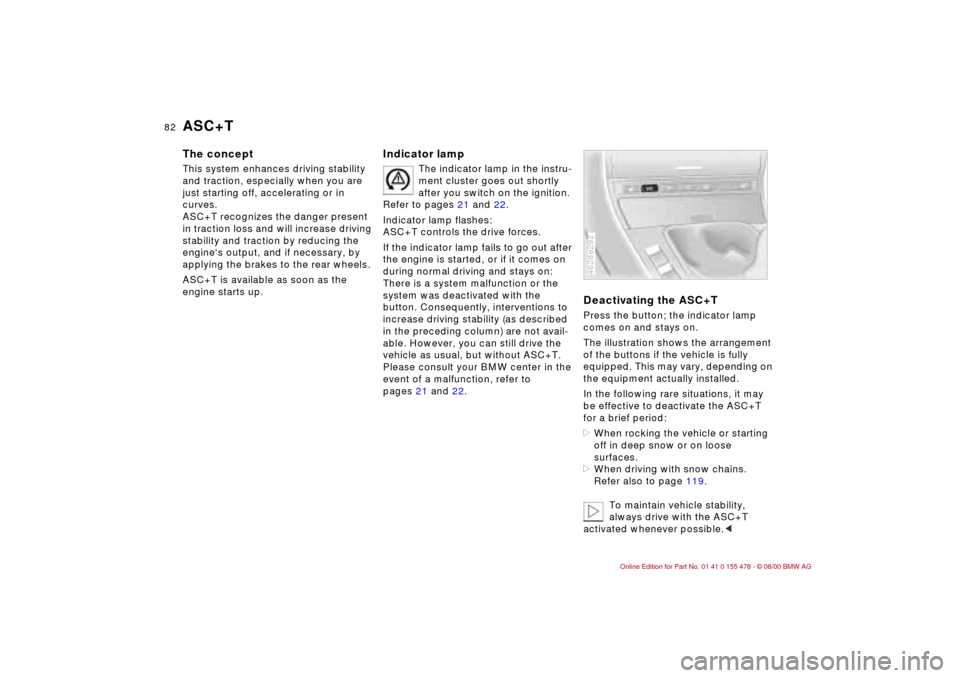
Deactivating the ASC+T Press the button; the indicator lamp
comes on and stays on.
The illustration shows the arrangement
of the buttons if the vehicle is fully
equipped. This may vary, depending on
the equipment actually installed.
In the following rare situations, it may
be effective to deactivate the ASC+T
for a brief period:
>When rocking the vehicle or starting
off in deep snow or on loose
surfaces.
>When driving with snow chains.
Refer also to page 119.
To maintain vehicle stability,
always drive with the ASC+T
activated whenever possible.<462de292
Page 83 of 203
83n
IndexDataTechnologyRepairsCar careControlsOverview
ASC+T DSC
*
Reactivating the ASC+TPress the button again; the indicator
lamp goes out.
The laws of physics cannot be
repealed, even with ASC+T. It will
always be the driver's responsibility to
drive in a manner that matches road
conditions. We therefore urge you to
avoid using the additional safety margin
of the system as an excuse for taking
risks.<
For additional details concerning
ASC+T, please refer to the chapter
"Advanced Technology" on page 175.
The ConceptDSC maintains vehicle stability, even in
critical driving situations.
The system optimizes vehicle stability
during acceleration and when starting
from a full stop, as well as optimizing
traction. In addition, it recognizes
unstable vehicle conditions, such as
understeering or oversteering, and, as
far as is possible within the laws of
physics, helps keep the car on a steady
course by reducing the engine spped
and brake applications to the individual
wheels.
The DSC is operational every time you
start the engine. DSC contains the
functions of ADB and CBC, refer to
page 116.
The ADB (automatic differential braking)
copies the function of conventional
differential and transverse lock through
brake intervention, and increases trac-
tion whenever conditions merit, e. g.
when driving on snow-covered roads.
If the DSC is switched off the ADB will
still be in ready mode.
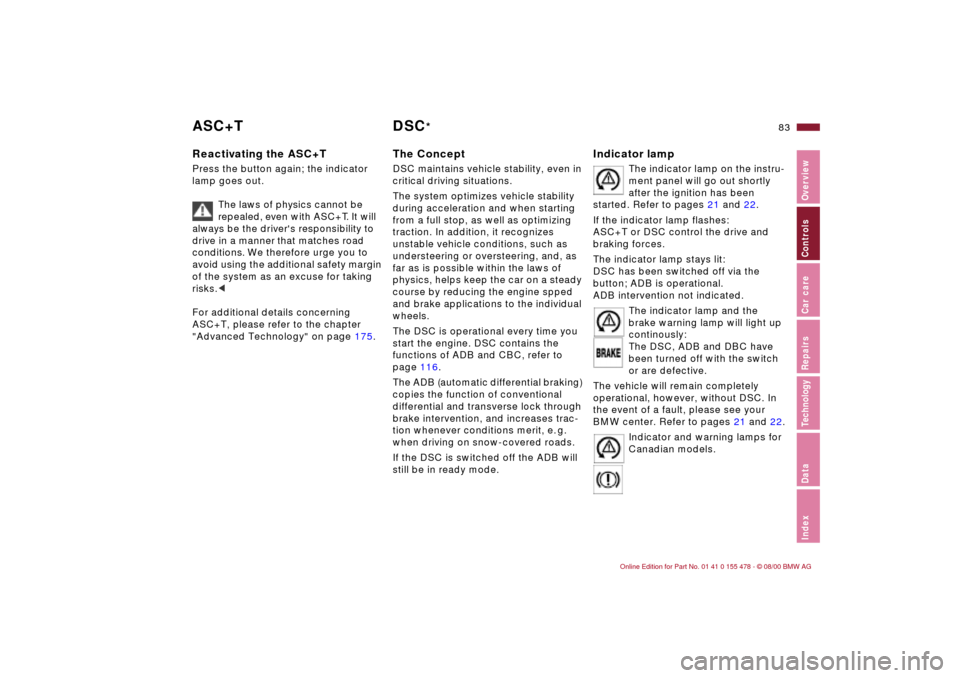
Indicator lamp
The indicator lamp on the instru-
ment panel will go out shortly
after the ignition has been
started. Refer to pages 21 and 22.
If the indicator lamp flashes:
ASC+T or DSC control the drive and
braking forces.
The indicator lamp stays lit:
DSC has been switched off via the
button; ADB is operational.
ADB intervention not indicated.
The indicator lamp and the
brake warning lamp will light up
continously:
The DSC, ADB and DBC have
been turned off with the switch
or are defective.
The vehicle will remain completely
operational, however, without DSC. In
the event of a fault, please see your
BMW center. Refer to pages 21 and 22.
Indicator and warning lamps for
Canadian models.
Page 84 of 203
84n
DSC
*
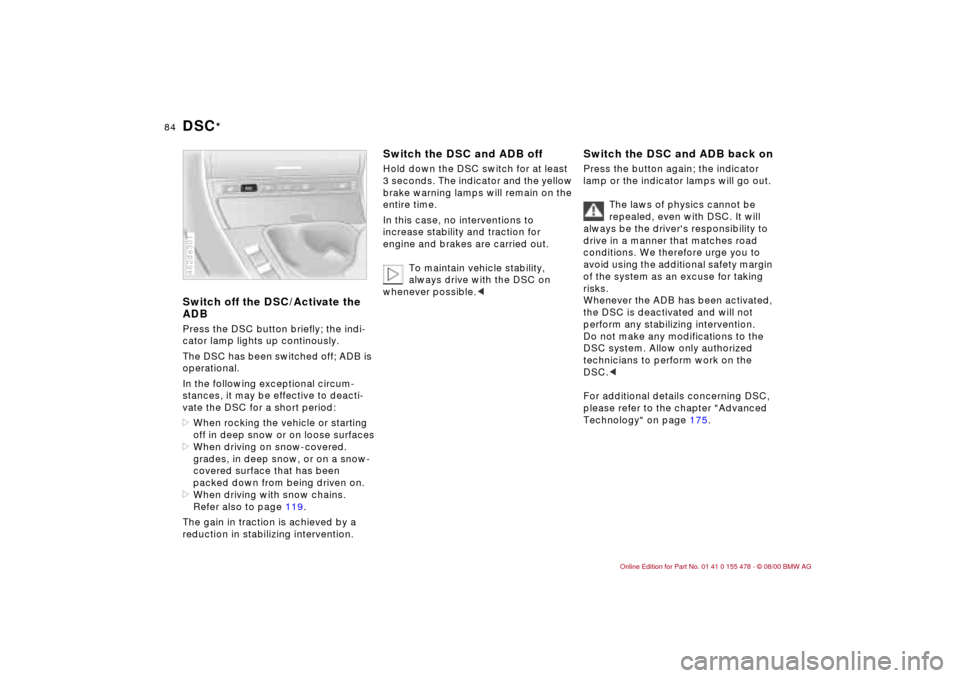
Switch off the DSC/Activate the
ADBPress the DSC button briefly; the indi-
cator lamp lights up continously.
The DSC has been switched off; ADB is
operational.
In the following exceptional circum-
stances, it may be effective to deacti-
vate the DSC for a short period:
>When rocking the vehicle or starting
off in deep snow or on loose surfaces
>When driving on snow-covered.
grades, in deep snow, or on a snow-
covered surface that has been
packed down from being driven on.
>When driving with snow chains.
Refer also to page 119.
The gain in traction is achieved by a
reduction in stabilizing intervention.462de301
Switch the DSC and ADB offHold down the DSC switch for at least
3 seconds. The indicator and the yellow
brake warning lamps will remain on the
entire time.
In this case, no interventions to
increase stability and traction for
engine and brakes are carried out.
To maintain vehicle stability,
always drive with the DSC on
whenever possible.<
Switch the DSC and ADB back onPress the button again; the indicator
lamp or the indicator lamps will go out.
The laws of physics cannot be
repealed, even with DSC. It will
always be the driver's responsibility to
drive in a manner that matches road
conditions. We therefore urge you to
avoid using the additional safety margin
of the system as an excuse for taking
risks.
Whenever the ADB has been activated,
the DSC is deactivated and will not
perform any stabilizing intervention.
Do not make any modifications to the
DSC system. Allow only authorized
technicians to perform work on the
DSC.<
For additional details concerning DSC,
please refer to the chapter "Advanced
Technology" on page 175.
Page 92 of 203
92n
Air conditionerAir supply
You can select blower speeds
from 1 to 4. The heating and
ventilation become more and
more effective as the air
supply settings are increased. In posi-
tion 0, the blower and the heater are
switched off. By using position 0, you
can totally block the interior ventilation
outlets by pressing the button for the
recirculated-air mode.
Temperature
In order to increase the
temperature of the passenger
compartment, turn it to the
right (red). Temperature regu-
lation will keep the interior temperature
you have selected constant.
Air distribution
You can direct air to flow onto
the windows , toward the
upper body and into the
footwell . You can also
make all intermediate settings. In the
setting, there is a low flow of air onto
the windows to keep them free of
condensation. The "6 o'clock" setting is
recommended as a normal setting (refer
also to the illustration and overview on
page 90).
Rear window defroster
When the rear window defroster
is activated, the indicator lamp
comes on. The rear window defroster
switches off automatically. Refer to
page 72.
Air conditioner
The air is cooled and dehumidi-
fied and Ð depending on the
temperature setting Ð rewarmed when
the air conditioner system is switched
on. Depending on the weather, the
windshield may fog over briefly when
the engine is started.
Use the button to switch the air condi-
tioner off at outside temperatures
below approx. 417(+56). This will
help to prevent the windows from
fogging up.
If the windows fog over after switching
the air conditioner off, switch it back
on.
Condensation forms in the air
conditioner system during opera-
tion, which then exits under the vehicle.
Traces of condensed water of this kind
are thus normal.
<< < <
Recirculated-air mode
You can respond to unpleasant
external odors by temporarily
blocking the outside air. The system
then recirculates the air already within
the vehicle.
If the windows fog over in the
recirculated air mode, switch this
mode off and increase the air supply as
required.<< < <
Page 99 of 203
99n
IndexDataTechnologyRepairsCar careControlsOverview
Automatic climate control
*
Air supply
By pressing the left or right half
of the button, you can vary the
air supply. By doing this, you switch off
the automatic control of the air supply.
Nevertheless, the automatic air distri-
bution remains unchanged.
When you set the lowest blower speed
by pressing the left half of the button,
all of the displays are canceled: the
blower, heating and air conditioner are
switched off, and the air supply is
stopped. You can reactivate the system
by pressing any button for the auto-
matic climate control.
To defrost the windshield and
side windows
This program quickly removes
ice and condensation from the
windshield and side windows.
Air conditioner
The air is cooled and dehumidi-
fied and Ð depending on the
temperature setting Ð rewarmed when
the air conditioner system is switched
on.
Depending on the weather, the wind-
shield may fog over briefly when the
engine is started.
Use the button to switch the air condi-
tioner off at outside temperatures
below approx. 41 7 (+5 6). This will
help to prevent the windows from
ogging up.
If the windows fog over after switching
the air conditioner off, switch it back
on.
Condensation forms in the air
conditioner system during opera-
tion, that then exits under the vehicle.
Traces of condensed water of this kind
are thus normal.<
Automatic recirculated air control
(AUC)
If there are unpleasant odors or
pollutants in the outside air, you
can temporarily block the air supply
from the outside. The system then
recirculates the air already within the
vehicle. By repeated actuation of the
button, you can select one of three
different operation modes.
>Indicator lamps off: fresh air flows
into the vehicle.
>Left-hand indicator lamp on Ð AUC
mode: the system detects pollutants
in the outside air and responds by
deactivating the outside air supply as
required. The system then recircu-
lates the air already within the vehicle.
Depending on the air quality, the
automatic system then switches back
and forth between outside air supply
and recirculation of the air within the
vehicle.
>Right-hand indicator lamp on: the
supply of outside air is permanently
blocked. The system recirculates the
air already within the vehicle.
If the windows fog over in the
recirculated air mode, switch this
mode off and increase the air supply as
required.<
Page 106 of 203
106n
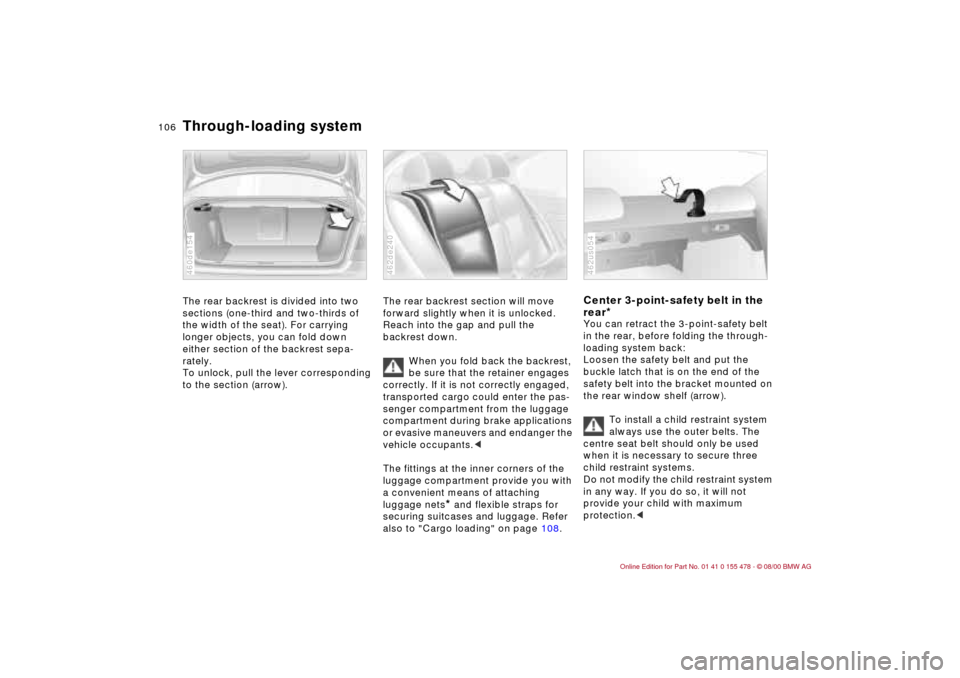
Through-loading systemThe rear backrest is divided into two
sections (one-third and two-thirds of
the width of the seat). For carrying
longer objects, you can fold down
either section of the backrest sepa-
rately.
To unlock, pull the lever corresponding
to the section (arrow).460de154
The rear backrest section will move
forward slightly when it is unlocked.
Reach into the gap and pull the
backrest down.
When you fold back the backrest,
be sure that the retainer engages
correctly. If it is not correctly engaged,
transported cargo could enter the pas-
senger compartment from the luggage
compartment during brake applications
or evasive maneuvers and endanger the
vehicle occupants.<
The fittings at the inner corners of the
luggage compartment provide you with
a convenient means of attaching
luggage nets
* and flexible straps for
securing suitcases and luggage. Refer
also to "Cargo loading" on page 108.
462de240
Center 3-point-safety belt in the
rear
*
You can retract the 3-point-safety belt
in the rear, before folding the through-
loading system back:
Loosen the safety belt and put the
buckle latch that is on the end of the
safety belt into the bracket mounted on
the rear window shelf (arrow).
To install a child restraint system
always use the outer belts. The
centre seat belt should only be used
when it is necessary to secure three
child restraint systems.
Do not modify the child restraint system
in any way. If you do so, it will not
provide your child with maximum
protection.<462us054
Page 109 of 203
109n
IndexDataTechnologyRepairsCar careControlsOverview
Cargo loading Roof-mounted luggage rack
*
Always position and secure the
load correctly. If you do not, it can
endanger the passengers during
braking or evasive maneuvers.
Do not exceed the permissible gross
weight and axle loads (refer to
page 186), otherwise the vehicle's oper-
ating safety is no longer assured and
you are in violation of the law.
Do not stow heavy or hard objects in
the passenger compartment without
securing them. Otherwise they would
be thrown around during braking and
evasive maneuvers and endanger the
occupants.<
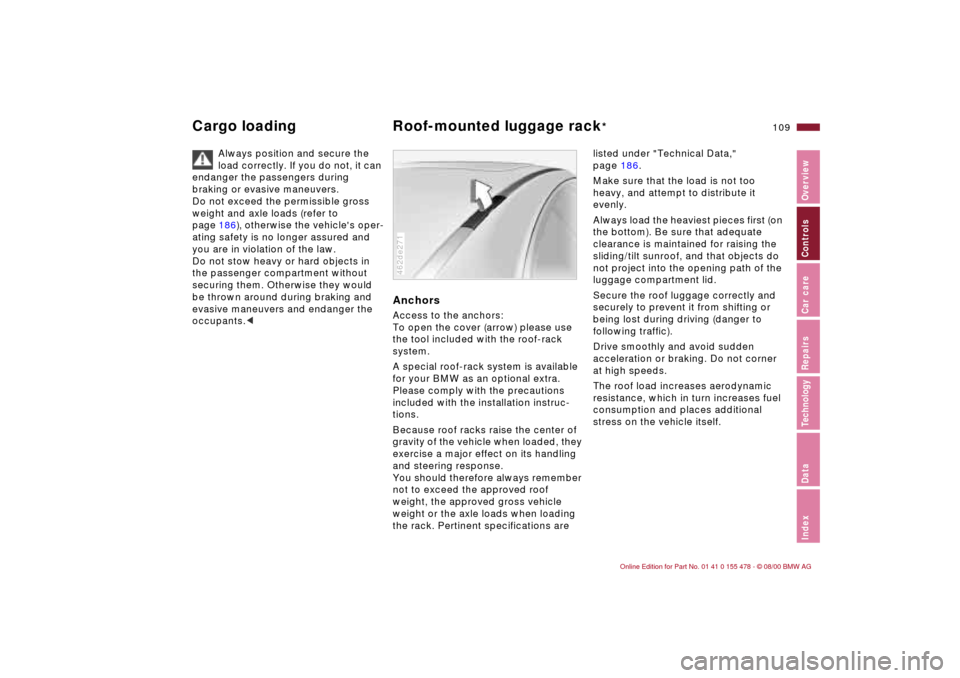
AnchorsAccess to the anchors:
To open the cover (arrow) please use
the tool included with the roof-rack
system.
A special roof-rack system is available
for your BMW as an optional extra.
Please comply with the precautions
included with the installation instruc-
tions.
Because roof racks raise the center of
gravity of the vehicle when loaded, they
exercise a major effect on its handling
and steering response.
You should therefore always remember
not to exceed the approved roof
weight, the approved gross vehicle
weight or the axle loads when loading
the rack. Pertinent specifications are 462de271
listed under "Technical Data,"
page 186.
Make sure that the load is not too
heavy, and attempt to distribute it
evenly.
Always load the heaviest pieces first (on
the bottom). Be sure that adequate
clearance is maintained for raising the
sliding/tilt sunroof, and that objects do
not project into the opening path of the
luggage compartment lid.
Secure the roof luggage correctly and
securely to prevent it from shifting or
being lost during driving (danger to
following traffic).
Drive smoothly and avoid sudden
acceleration or braking. Do not corner
at high speeds.
The roof load increases aerodynamic
resistance, which in turn increases fuel
consumption and places additional
stress on the vehicle itself.