air condition BMW 325Ci COUPE 2001 E46 User Guide
[x] Cancel search | Manufacturer: BMW, Model Year: 2001, Model line: 325Ci COUPE, Model: BMW 325Ci COUPE 2001 E46Pages: 203, PDF Size: 2.03 MB
Page 90 of 203

90n
462us042Air conditioner
Page 91 of 203
91n
IndexDataTechnologyRepairsCar careControlsOverview
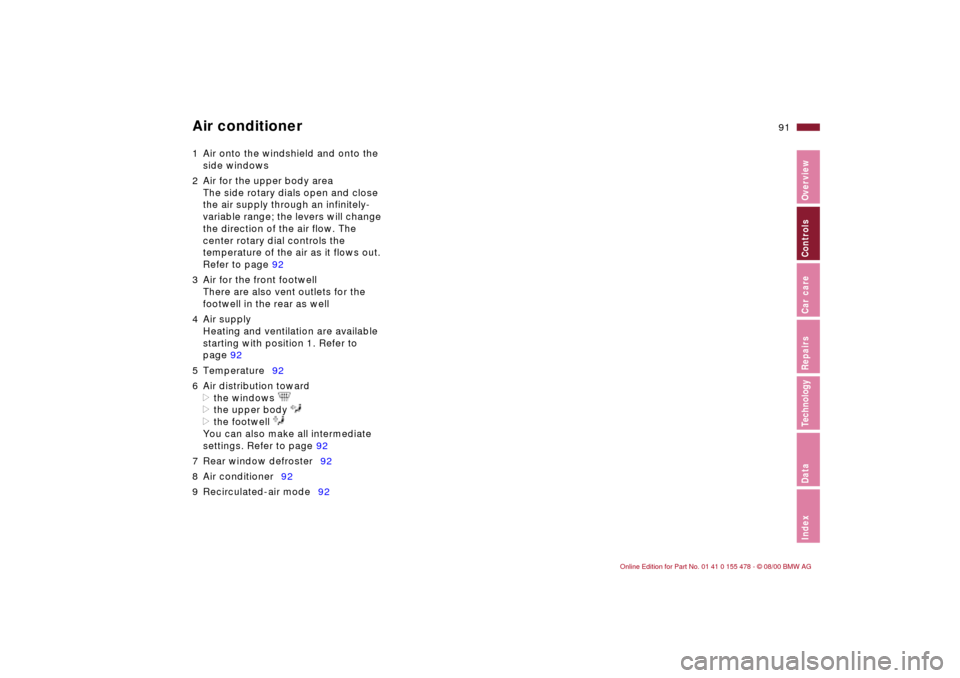
Air conditioner1 Air onto the windshield and onto the
side windows
2 Air for the upper body area
The side rotary dials open and close
the air supply through an infinitely-
variable range; the levers will change
the direction of the air flow. The
center rotary dial controls the
temperature of the air as it flows out.
Refer to page 92
3 Air for the front footwell
There are also vent outlets for the
footwell in the rear as well
4 Air supply
Heating and ventilation are available
starting with position 1. Refer to
page 92
5 Temperature92
6 Air distribution toward
>the windows
>the upper body
>the footwell
You can also make all intermediate
settings. Refer to page 92
7 Rear window defroster92
8 Air conditioner92
9 Recirculated-air mode92
Page 92 of 203
92n
Air conditionerAir supply
You can select blower speeds
from 1 to 4. The heating and
ventilation become more and
more effective as the air
supply settings are increased. In posi-
tion 0, the blower and the heater are
switched off. By using position 0, you
can totally block the interior ventilation
outlets by pressing the button for the
recirculated-air mode.
Temperature
In order to increase the
temperature of the passenger
compartment, turn it to the
right (red). Temperature regu-
lation will keep the interior temperature
you have selected constant.
Air distribution
You can direct air to flow onto
the windows , toward the
upper body and into the
footwell . You can also
make all intermediate settings. In the
setting, there is a low flow of air onto
the windows to keep them free of
condensation. The "6 o'clock" setting is
recommended as a normal setting (refer
also to the illustration and overview on
page 90).
Rear window defroster
When the rear window defroster
is activated, the indicator lamp
comes on. The rear window defroster
switches off automatically. Refer to
page 72.
Air conditioner
The air is cooled and dehumidi-
fied and Ð depending on the
temperature setting Ð rewarmed when
the air conditioner system is switched
on. Depending on the weather, the
windshield may fog over briefly when
the engine is started.
Use the button to switch the air condi-
tioner off at outside temperatures
below approx. 417(+56). This will
help to prevent the windows from
fogging up.
If the windows fog over after switching
the air conditioner off, switch it back
on.
Condensation forms in the air
conditioner system during opera-
tion, which then exits under the vehicle.
Traces of condensed water of this kind
are thus normal.
<< < <
Recirculated-air mode
You can respond to unpleasant
external odors by temporarily
blocking the outside air. The system
then recirculates the air already within
the vehicle.
If the windows fog over in the
recirculated air mode, switch this
mode off and increase the air supply as
required.<< < <
Page 93 of 203

93n
IndexDataTechnologyRepairsCar careControlsOverview
Air conditionerDraft-free ventilation You can adjust the air outlets for the
upper body area to select the optimum
air flow rates and directions for your
personal requirements:
Use rotary dials 1 to open and close the
air outlets through an infinitely-variable
range. You can adjust the direction of
the air flow with levers 2.
Set the outlets so that the air flows past
you and is not directed straight at you.
Rotary dial 3 allows you to mix the air
from the outlets for your upper body by
warming or cooling the air as desired.460de040
Microfilter An activated-charcoal microfilter, which
traps incoming dust and pollen, has
been installed in your vehicle. Your
BMW center will replace it during regu-
larly scheduled maintenance. A
substantial reduction in air supply indi-
cates that the filter must be replaced
before normal maintenance.
For additional details on the filter
change, refer to page 166.
Rapid ventilation1 Set the blower speed rotary dial for
the air flow rate to position 4.
2 Switch on the air conditioner.
3 Turn the rotary temperature control
completely to the left (blue).
4 Rotary control for air distribution in
position .
5 Open the air outlets for the upper
body.463de018
Page 94 of 203
94n
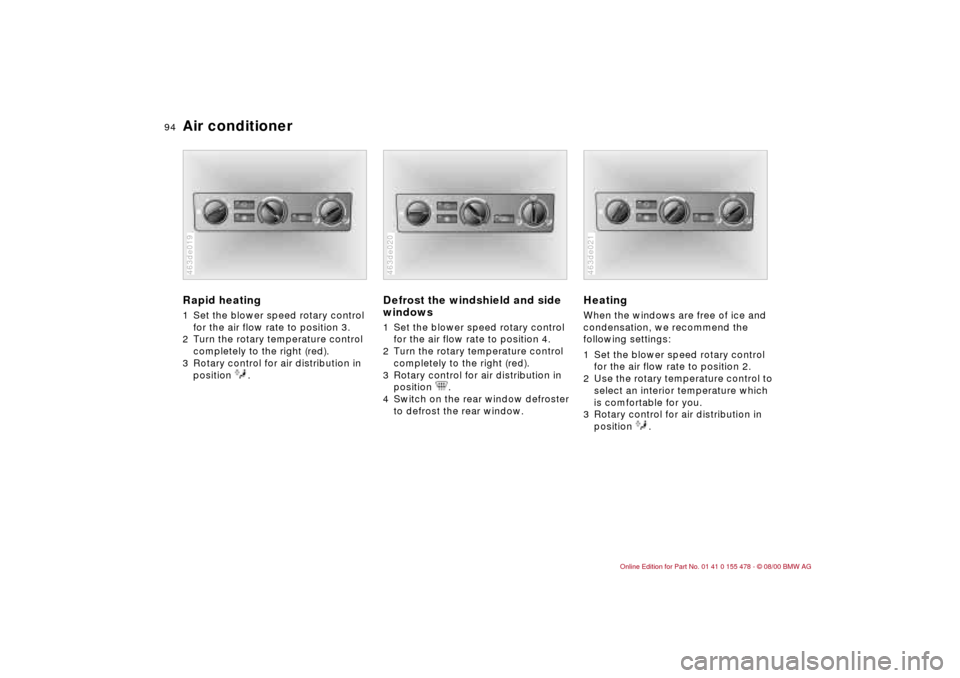
Air conditionerRapid heating 1 Set the blower speed rotary control
for the air flow rate to position 3.
2 Turn the rotary temperature control
completely to the right (red).
3 Rotary control for air distribution in
position .463de019
Defrost the windshield and side
windows 1 Set the blower speed rotary control
for the air flow rate to position 4.
2 Turn the rotary temperature control
completely to the right (red).
3 Rotary control for air distribution in
position .
4 Switch on the rear window defroster
to defrost the rear window. 463de020
HeatingWhen the windows are free of ice and
condensation, we recommend the
following settings:
1 Set the blower speed rotary control
for the air flow rate to position 2.
2 Use the rotary temperature control to
select an interior temperature which
is comfortable for you.
3 Rotary control for air distribution in
position .390de127463de021
Page 97 of 203
97n
IndexDataTechnologyRepairsCar careControlsOverview
Automatic climate control
*
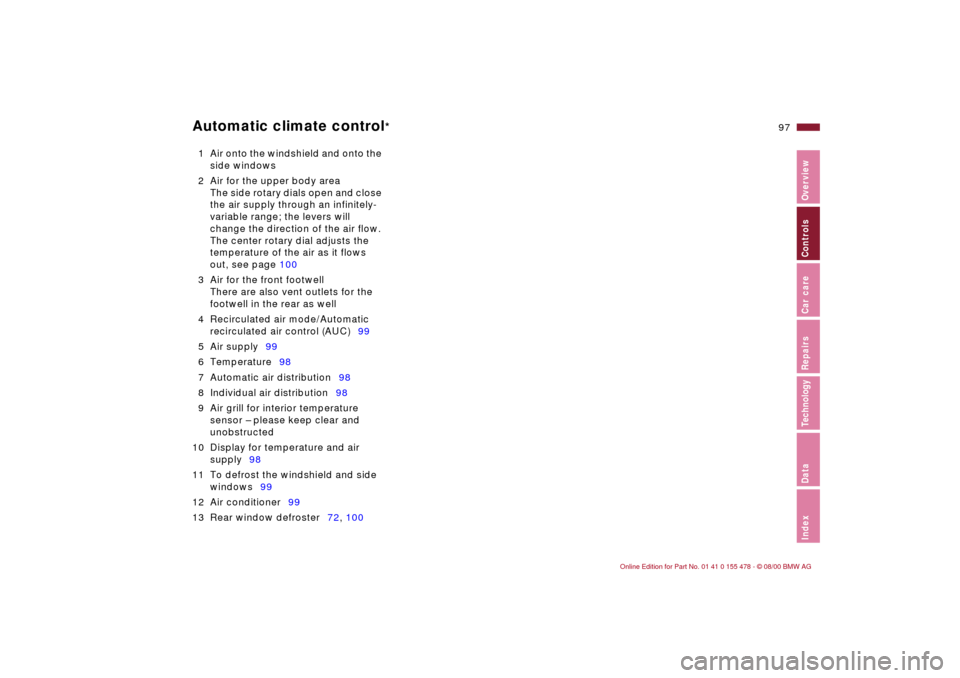
1 Air onto the windshield and onto the
side windows
2 Air for the upper body area
The side rotary dials open and close
the air supply through an infinitely-
variable range; the levers will
change the direction of the air flow.
The center rotary dial adjusts the
temperature of the air as it flows
out, see page 100
3 Air for the front footwell
There are also vent outlets for the
footwell in the rear as well
4 Recirculated air mode/Automatic
recirculated air control (AUC)99
5 Air supply99
6 Temperature98
7 Automatic air distribution98
8 Individual air distribution98
9 Air grill for interior temperature
sensor Ð please keep clear and
unobstructed
10 Display for temperature and air
supply98
11 To defrost the windshield and side
windows99
12 Air conditioner99
13 Rear window defroster72, 100
Page 98 of 203
98n
Automatic climate control
*
Tips for pleasant drivingUse the automatic system (switch on
AUTO Ð button 7). Select an interior
temperature that is comfortable for you
Ñ e. g. 72 7 (+22 6). Whenever the
outside temperature is above 41 7
(+5 6), you can also use the air condi-
tioner 12. This will dry the air as well
as preventing condensation on the
window surfaces Ð if there are passen-
gers with damp clothing, for example.
Set the air outlets 2 so that the air flows
past you and is not directed straight at
you. Set the rotary dial between the air
outlets 2 for the upper body to a
medium position, since air that is
somewhat cooler promotes driving
without fatigue.
Detailed setting options are described
for you in the following section.
Automatic air distribution
The AUTO program assumes
the adjustment of the air distri-
bution and the air supply for you and in
addition adapts the temperature to
external influences (summer, winter) to
meet preferences you can specify. This
program maintains a comfortable in-car
climate regardless of the season. Select
an interior temperature that is comfort-
able for you Ñ e. g. 72 7 (+22 6). The
temperature selected and AUTO for
the air supply appear in display 10,
refer to the overview on page 96. Open
the air outlets for the upper body area.
Switch on the air conditioner in warm
weather. The maximum cooling
capacity is achieved when you set
rotary dial 3 (refer to page 100) to cold.
Individual air distribution
You can cancel the AUTO
program by selecting specific
distribution patterns to suit your
own individual requirements.
You can direct air to flow onto the
windows , toward the upper body
, and into the footwell .
Temperature
The figures in the display
provide a general indication of
interior temperature. We recommend
72 7 (+22 6) as a comfortable setting,
even if the air conditioner is on. When
you start the vehicle, the system
ensures that the selected temperature
is reached as quickly as possible. It
then maintains this temperature,
regardless of the season.
Set rotary dial 3 (refer to "Draft-free
ventilation" on page 100) to a medium
setting, since air that is somewhat
cooler promotes driving without fatigue.
You can use this setting for mixing air to
make minor comfort modifications.
You can set uncontrolled heater
output up to 90 7 (+32 6). The
air conditioner is at full cooling output
at 60 7 (+16 6).<
Page 99 of 203
99n
IndexDataTechnologyRepairsCar careControlsOverview
Automatic climate control
*
Air supply
By pressing the left or right half
of the button, you can vary the
air supply. By doing this, you switch off
the automatic control of the air supply.
Nevertheless, the automatic air distri-
bution remains unchanged.
When you set the lowest blower speed
by pressing the left half of the button,
all of the displays are canceled: the
blower, heating and air conditioner are
switched off, and the air supply is
stopped. You can reactivate the system
by pressing any button for the auto-
matic climate control.
To defrost the windshield and
side windows
This program quickly removes
ice and condensation from the
windshield and side windows.
Air conditioner
The air is cooled and dehumidi-
fied and Ð depending on the
temperature setting Ð rewarmed when
the air conditioner system is switched
on.
Depending on the weather, the wind-
shield may fog over briefly when the
engine is started.
Use the button to switch the air condi-
tioner off at outside temperatures
below approx. 41 7 (+5 6). This will
help to prevent the windows from
ogging up.
If the windows fog over after switching
the air conditioner off, switch it back
on.
Condensation forms in the air
conditioner system during opera-
tion, that then exits under the vehicle.
Traces of condensed water of this kind
are thus normal.<
Automatic recirculated air control
(AUC)
If there are unpleasant odors or
pollutants in the outside air, you
can temporarily block the air supply
from the outside. The system then
recirculates the air already within the
vehicle. By repeated actuation of the
button, you can select one of three
different operation modes.
>Indicator lamps off: fresh air flows
into the vehicle.
>Left-hand indicator lamp on Ð AUC
mode: the system detects pollutants
in the outside air and responds by
deactivating the outside air supply as
required. The system then recircu-
lates the air already within the vehicle.
Depending on the air quality, the
automatic system then switches back
and forth between outside air supply
and recirculation of the air within the
vehicle.
>Right-hand indicator lamp on: the
supply of outside air is permanently
blocked. The system recirculates the
air already within the vehicle.
If the windows fog over in the
recirculated air mode, switch this
mode off and increase the air supply as
required.<
Page 111 of 203
Overview
Controls and features
Operation, care
and maintenance
Owner service procedures
Technical data
Index Advanced technology
111n
IndexDataTechnologyRepairsCar careControlsOverview
Special operating instructions:
Break-in procedures112
Driving notes113
Catalytic converter113
Antilock Brake System
(ABS)115
Disc brakes117
Brake system118
Winter operation119
Power steering121
Cellular phones121
Radio reception121
Wheels and tires:
Tire inflation pressure122
Tire condition122
Tire replacement123
Tire rotation124
Wheel and tire
combinations125
Winter tires126
Snow chains126
Approved wheel and tire
specifications127Under the hood:
Hood130
Engine compartment132
Washer fluids134
Washer nozzles134
Engine oil135
Coolant137
Brake fluid138
Vehicle Identification
Number139
Care and maintenance:
The BMW Maintenance
System140
Caring for your vehicle141
Airbags146
Vehicle storage147
Laws and regulations:
Technical modifications148
California Proposition
65 Warning148
OBD interface socket149
Car care
Page 115 of 203
115n
IndexDataTechnologyRepairsCar careControlsOverview
Antilock Brake System (ABS)The concept ABS enhances active safety by helping
to prevent the wheels from locking
under braking. This is because locked
wheels are dangerous. When the front
wheels slide, the driver loses steering
control over the vehicle. Traction loss at
the rear wheels can cause the rear end
to break into an uncontrolled skid.
The system can achieve the shortest
braking distances possible under most
conditions (on straight-aways and in
curves, on asphalt, ice, wet road
surfaces, etc.).
ABS is designed to meet two essential
requirements during every brake appli-
cation:
>To help provide vehicle stability.
>To help maintain steering control and
maneuverability Ð on all types of road
surfaces (asphalt, concrete, mud, on
wet road surfaces, snow, ice).
Braking with ABSAt approx. 6 mph (10 km/h), the system
becomes operative. Whenever the
vehicle's speed drops below approx.
4 mph (6 km/h), the ABS is deactivated.
This means that the wheels can lock in
the final phase of a panic stop Ð a factor
of no significance in actual use.
If you are in a situation that requires full
braking, you will exploit the full benefits
of the ABS system if you apply
maximum brake pressure ("panic
stop"). Since the vehicle maintains
steering responsiveness, you can
nevertheless avoid possible obstacles
with a minimum of steering effort.
The ABS system closed-loop control
circuit cycles in fractions of a second.
A pulsation at the brake pedal, together
with the sounds associated with the
hydraulic controls, tells you that the
brake system is within its maximum
limit range and reminds you that you
should adapt road speed to the road
conditions.On road surfaces that have a loose
surface layer on a firm base with good
traction (on gravel or snow, for
example), or when snow chains are
mounted, braking distances may be
longer than with locked wheels.
However, ABS continues to provide
enhanced vehicle stability and steering
response under these conditions.
Information for your safetyNot even ABS can suspend the laws of
physics. ABS cannot prevent the
consequences of brake applications
with inadequate clearances for safety
between vehicles, when exceeding the
speed limit, or the risks involved when
aquaplaning occurs. Responsibility for
these types of situations remains in the
hands (and at the feet) of the driver. You
should never allow the added safety of
ABS to lull you into a false sense of
security, or mislead you into taking
increased risks.
Do not make any modifications to
the ABS system.
Service procedures on ABS are to be
performed by authorized technicians
only.<