maintenance BMW 325Ci COUPE 2001 E46 User Guide
[x] Cancel search | Manufacturer: BMW, Model Year: 2001, Model line: 325Ci COUPE, Model: BMW 325Ci COUPE 2001 E46Pages: 203, PDF Size: 2.03 MB
Page 122 of 203
122n
Information for your safetyThe factory-approved radial tires are
matched to the vehicle and have been
selected to provide optimum safety and
driving comfort on your vehicle.
It is not merely the tire's service life, but
also driving comfort and Ð above all else
Ð driving safety that depend on the con-
dition of the tires and the maintenance
of the specified tire pressure.
Incorrect inflation pressure is a frequent
cause of tire damage. It also signifi-
cantly influences the roadholding ability
of your BMW.
Be sure to check the tire inflation
pressure Ð including the space-
saver spare tire or the spare tire Ð on a
regular basis, at least twice a month
and before doing any extended driving.
Refer to page 27. If this is not done, in-
correct tire pressures can cause driving
instability and tire damage, ultimately
resulting in an accident.<
Tire tread Ð tire damageInspect your tires frequently for tread
wear, signs of damage and for foreign
objects lodged in the tread. Check the
tread depth.
Tread depth should not be allowed to
go below 0.12 in (3 mm), even though
the legally specified minimum tread
depth is only 0.063 in (1.6 mm). At a
tread depth of 0.063 in (1.6 mm), tread
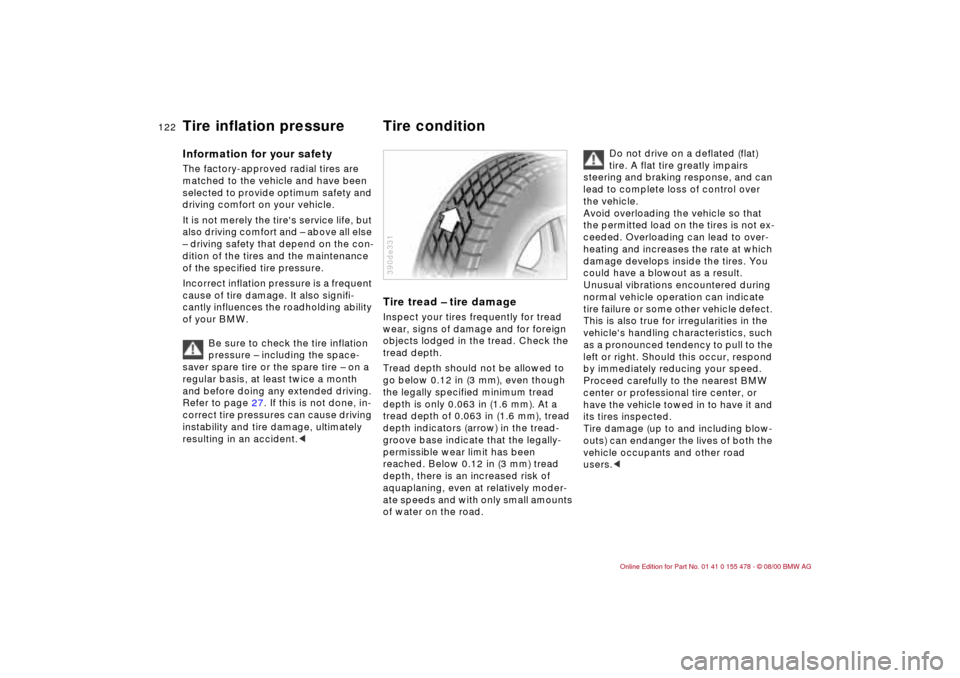
depth indicators (arrow) in the tread-
groove base indicate that the legally-
permissible wear limit has been
reached. Below 0.12 in (3 mm) tread
depth, there is an increased risk of
aquaplaning, even at relatively moder-
ate speeds and with only small amounts
of water on the road.390de331
Do not drive on a deflated (flat)
tire. A flat tire greatly impairs
steering and braking response, and can
lead to complete loss of control over
the vehicle.
Avoid overloading the vehicle so that
the permitted load on the tires is not ex-
ceeded. Overloading can lead to over-
heating and increases the rate at which
damage develops inside the tires. You
could have a blowout as a result.
Unusual vibrations encountered during
normal vehicle operation can indicate
tire failure or some other vehicle defect.
This is also true for irregularities in the
vehicle's handling characteristics, such
as a pronounced tendency to pull to the
left or right. Should this occur, respond
by immediately reducing your speed.
Proceed carefully to the nearest BMW
center or professional tire center, or
have the vehicle towed in to have it and
its tires inspected.
Tire damage (up to and including blow-
outs) can endanger the lives of both the
vehicle occupants and other road
users.<
Tire inflation pressure Tire condition
Page 140 of 203
140n
The BMW Maintenance System has
been designed as a reliable means of
providing maximum driving and oper-
ating safety Ð and as cost-effectively as
possible for you.
Please keep in mind that regular main-
tenance is not only necessary for the
safety of your vehicle, but also plays a
significant role in maintaining the resale
value of the vehicle.
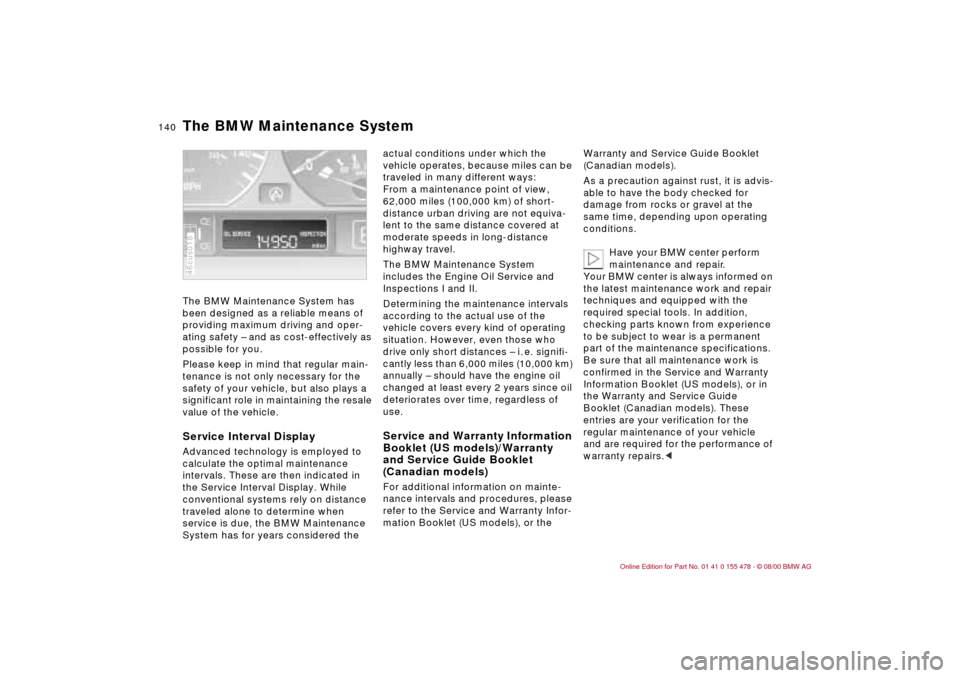
Service Interval DisplayAdvanced technology is employed to
calculate the optimal maintenance
intervals. These are then indicated in
the Service Interval Display. While
conventional systems rely on distance
traveled alone to determine when
service is due, the BMW Maintenance
System has for years considered the 46cus018
actual conditions under which the
vehicle operates, because miles can be
traveled in many different ways:
From a maintenance point of view,
62,000 miles (100,000 km) of short-
distance urban driving are not equiva-
lent to the same distance covered at
moderate speeds in long-distance
highway travel.
The BMW Maintenance System
includes the Engine Oil Service and
Inspections I and II.
Determining the maintenance intervals
according to the actual use of the
vehicle covers every kind of operating
situation. However, even those who
drive only short distances Ð i. e. signifi-
cantly less than 6,000 miles (10,000 km)
annually Ð should have the engine oil
changed at least every 2 years since oil
deteriorates over time, regardless of
use.Service and Warranty Information
Booklet (US models)/Warranty
and Service Guide Booklet
(Canadian models)For additional information on mainte-
nance intervals and procedures, please
refer to the Service and Warranty Infor-
mation Booklet (US models), or the Warranty and Service Guide Booklet
(Canadian models).
As a precaution against rust, it is advis-
able to have the body checked for
damage from rocks or gravel at the
same time, depending upon operating
conditions.
Have your BMW center perform
maintenance and repair.
Your BMW center is always informed on
the latest maintenance work and repair
techniques and equipped with the
required special tools. In addition,
checking parts known from experience
to be subject to wear is a permanent
part of the maintenance specifications.
Be sure that all maintenance work is
confirmed in the Service and Warranty
Information Booklet (US models), or in
the Warranty and Service Guide
Booklet (Canadian models). These
entries are your verification for the
regular maintenance of your vehicle
and are required for the performance of
warranty repairs.<
The BMW Maintenance System
Page 142 of 203

142n
Caring for your vehicleExterior finish To provide effective corrosion protec-
tion, multilayer paintwork is applied at
the factory. Cataphoretic immersion
priming techniques are supplemented
using special body-cavity protectants,
with the application of specially-devel-
oped and extensively tested materials.
A layer of flexible PVC is first applied to
the undercarriage. Following this, a
comprehensive undercoating treat-
ment with a wax-based protectant is
applied. Regular maintenance makes
an important contribution to maintaining
the safety and value of your vehicle.
Increasing awareness of the effects of
harmful environmental factors on
vehicle finishes have led paint and
vehicle manufacturers to initiate
ongoing programs designed to further
improve the durability of their finishes.
Despite this, environmental factors that
occur locally or regionally can have
negative effects on the finish of your
vehicle. Use the factors to determine
the frequency and extent of your efforts
to maintain the vehicle finish.Depending upon material and type of
impact (perforation of paint layer),
physical stresses from sand, road salt,
gravel, etc., can cause corrosion to
start extending beneath the finish,
starting at the point of impact.
Road dirt, tar spots, dead insects,
animal droppings (strong alkali effect)
and tree excretions (resins and pollen)
all contain substances capable of
causing damage when allowed to
remain on the finish of your vehicle for
any period of time. This includes spots,
etching, flaking, and separations in the
top coat.
In industrial areas, deposits of flue dust,
lime, oily soot, precipitation containing
sulfur-dioxide (acid rain) and other
environmental pollutants will damage
the vehicle's finish unless adequate
care is provided Ð even though this is
generally limited to the outside
horizontal surfaces.In coastal regions, high levels of atmo-
spheric salt and humidity promote
corrosion.
In tropical zones, temperatures of over
105 7 (+40 6) in the shade prevail, in
addition to heavy ultraviolet radiation
and high humidity. Under these condi-
tions, light paints can reach tempera-
tures of up to 175 7 (+80 6) and dark
paints up to 250 7 (+120 6).
Page 151 of 203
Overview
Controls and features
Operation, care
and maintenance
Owner service procedures
Technical data
Index Advanced technology
151n
IndexDataTechnologyRepairsCar careControlsOverview
Replacement procedures:
Onboard tool kit152
Windshield wiper blades152
Lamps and bulbs152
Changing a wheel159
Battery163
Fuses166
Microfilter/Activated-charcoal
filter166
In case of electrical
malfunction:
Fuel filler door167
Sliding/tilt sunroof167
Assistance, giving and
receiving:
Jump-starting168
Towing the vehicle169
Repairs
Page 163 of 203
163n
IndexDataTechnologyRepairsCar careControlsOverview
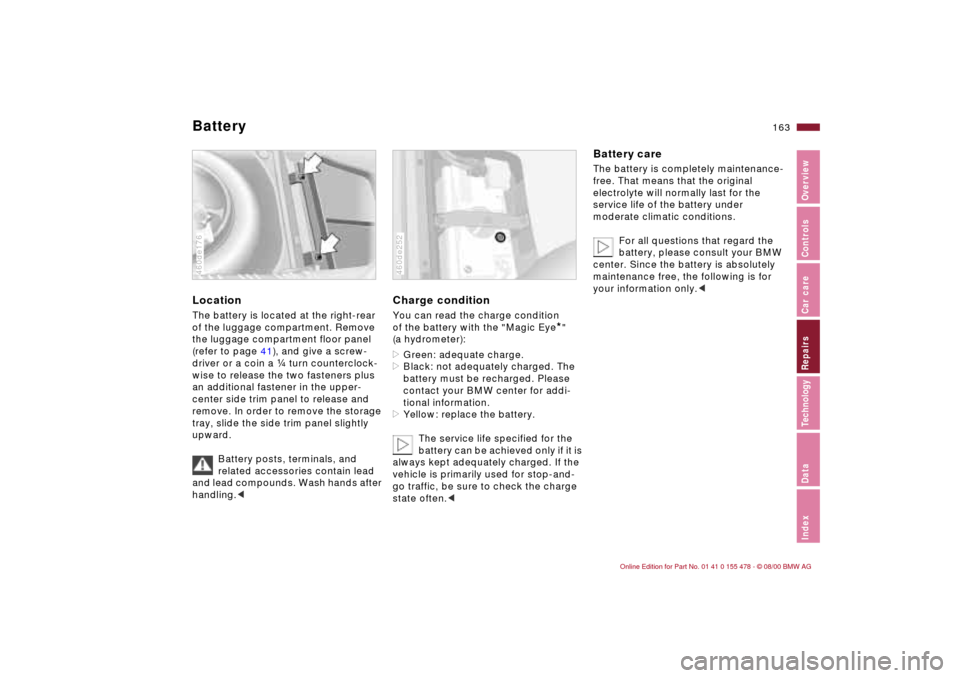
Battery LocationThe battery is located at the right-rear
of the luggage compartment. Remove
the luggage compartment floor panel
(refer to page 41), and give a screw-
driver or a coin a f turn counterclock-
wise to release the two fasteners plus
an additional fastener in the upper-
center side trim panel to release and
remove. In order to remove the storage
tray, slide the side trim panel slightly
upward.
Battery posts, terminals, and
related accessories contain lead
and lead compounds. Wash hands after
handling.<460de176
Charge conditionYou can read the charge condition
of the battery with the "Magic Eye
*"
(a hydrometer):
>Green: adequate charge.
>Black: not adequately charged. The
battery must be recharged. Please
contact your BMW center for addi-
tional information.
>Yellow: replace the battery.
The service life specified for the
battery can be achieved only if it is
always kept adequately charged. If the
vehicle is primarily used for stop-and-
go traffic, be sure to check the charge
state often.<
460de252
Battery careThe battery is completely maintenance-
free. That means that the original
electrolyte will normally last for the
service life of the battery under
moderate climatic conditions.
For all questions that regard the
battery, please consult your BMW
center. Since the battery is absolutely
maintenance free, the following is for
your information only.<
Page 173 of 203
Overview
Controls and features
Operation, care
and maintenance
Owner service procedures
Technical data
Index Advanced technology
173n
IndexDataTechnologyRepairsCar careControlsOverview
Adaptive Transmission Control
(ATC)174
Airbags175
Automatic Stability Control plus
Traction (ASC+T)/Dynamic
Stability Control (DSC)175
Radio reception176
Safety belt tensioner176
Interior rearview mirror
with automatic dimming
feature177
Rain sensor178
Tire Pressure Control (RDC)179
Self-diagnostics180
Xenon lamps181
Technol-
Page 180 of 203
180n
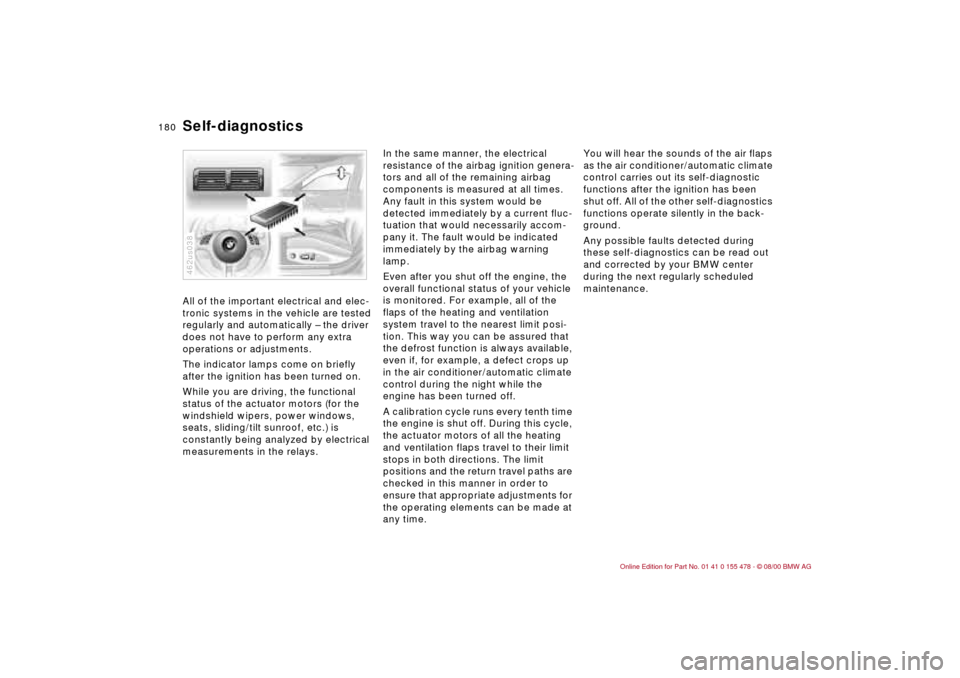
Self-diagnostics All of the important electrical and elec-
tronic systems in the vehicle are tested
regularly and automatically Ð the driver
does not have to perform any extra
operations or adjustments.
The indicator lamps come on briefly
after the ignition has been turned on.
While you are driving, the functional
status of the actuator motors (for the
windshield wipers, power windows,
seats, sliding/tilt sunroof, etc.) is
constantly being analyzed by electrical
measurements in the relays.462us038
In the same manner, the electrical
resistance of the airbag ignition genera-
tors and all of the remaining airbag
components is measured at all times.
Any fault in this system would be
detected immediately by a current fluc-
tuation that would necessarily accom-
pany it. The fault would be indicated
immediately by the airbag warning
lamp.
Even after you shut off the engine, the
overall functional status of your vehicle
is monitored. For example, all of the
flaps of the heating and ventilation
system travel to the nearest limit posi-
tion. This way you can be assured that
the defrost function is always available,
even if, for example, a defect crops up
in the air conditioner/automatic climate
control during the night while the
engine has been turned off.
A calibration cycle runs every tenth time
the engine is shut off. During this cycle,
the actuator motors of all the heating
and ventilation flaps travel to their limit
stops in both directions. The limit
positions and the return travel paths are
checked in this manner in order to
ensure that appropriate adjustments for
the operating elements can be made at
any time.You will hear the sounds of the air flaps
as the air conditioner/automatic climate
control carries out its self-diagnostic
functions after the ignition has been
shut off. All of the other self-diagnostics
functions operate silently in the back-
ground.
Any possible faults detected during
these self-diagnostics can be read out
and corrected by your BMW center
during the next regularly scheduled
maintenance.
Page 183 of 203
Overview
Controls and features
Operation, care
and maintenance
Owner service procedures
Technical data
Index Advanced technology
183n
IndexDataTechnologyRepairsCar careControlsOverview
Engine data184
Dimensions185
Weights186
Capacities187
Electrical system188
V-belts188
Data
Page 191 of 203
Overview
Controls and features
Operation, care
and maintenance
Owner service procedures
Technical data
Index Advanced technology
191n
IndexDataTechnologyRepairsCar careControlsOverview
Everything from A to Z192
Owner service procedures199
Index
Page 192 of 203

Everything from A to ZA
ABS (Antilock Brake
System)22,115
ABS, fault116
Accessories6
Activated-charcoal
filter100,166
Adaptive Transmission
Control (ATC)67,174
Adding
engine oil135
washer fluid134,187
Adjusting
backrest48
head restraints48
lumbar support49
steering wheel52
temperature92,98
Air conditioner90
Air distribution92,98
Air nozzles90,96
Air outlets90,96
ventilation90,96
Air pressure122
Air supply92,99
Airbags21,57,146,175
sitting properly58
Alarm system42
Antenna121
Diversity176
Antifreeze137
radiator119 Antilock Brake System
(ABS)22,115
Anti-theft alarm system42
Approved weight and load
capacities186
Approved wheel and tire
specifications127
Aquaplaning113,122
Armrest102
ASC+T (Automatic Stability
Control plus
Traction)22,82,175
Ashtray
front104
rear105
ATC (Adaptive Transmission
Control)67,174
Attach vacuum cleaner105
AUC (Automatic
recirculated-air
control)99
Automatic car washes141
Automatic climate
control96
remove window
condensation99
Automatic cruise control73
Automatic dimming, interior
rearview mirror53
Automatic recirculated-air
control (AUC)99 Automatic Stability Control
plus Traction
(ASC+T)22,82,175
Automatic transmission with
Steptronic21,67
Automatic windshield
washer71
Average consumption79
Average speed80
Avoiding unwanted
alarm43
Axle loads186
B
Backrest, releasing49
Backup lamps66
bulb replacement155
Battery163,188
capacity188
charge current20
charging165
discharged168
removal and
installation164
Battery safety terminal164
Battery terminal164
Belts55
Blower92,99
BMW High Performance
Synthetic Oil136
BMW Maintenance
System140 BMW sports seat49
Bore184
Brake fluid138
Brake hydraulic system20
Brake lamps, bulb
replacement155
Brake pads22
Brake system118
Brakes117
malfunctions118
Break-in procedures112
Bulb replacement152
Bulbs152
C
California Proposition
65 Warning148
Capacities187
Car Memory54
Car radio121
refer also to the separate
Owner's Manual
Car radio
reception121,176
Car vacuum cleaner105
Car wash141
Care
exterior142
interior144
Care of upholstery145
Care of wool velour145