roof BMW 325Ci COUPE 2001 E46 User Guide
[x] Cancel search | Manufacturer: BMW, Model Year: 2001, Model line: 325Ci COUPE, Model: BMW 325Ci COUPE 2001 E46Pages: 203, PDF Size: 2.03 MB
Page 46 of 203

46n
Sliding/tilt sunroof
*
Safety featureIf the sliding/tilt sunroof encounters
resistance at a point roughly past the
middle of its travel when it is closing,
the closing cycle is interrupted and the
sunroof will retract slightly.
At any rate, even with this safety
function, make sure that the
closing path is clear, otherwise, in
borderline cases (e. g. with thin
objects), the limit for triggering the
sunrooof's closing force cannot be
guaranteed. You can override this
safety feature by pressing the switch
beyond the pressure point and holding
it.<
Power loss or malfunctionIn the event of an electrical malfunction,
you can operate the sliding/tilt sunroof
manually, refer to page 167.
Page 58 of 203

58n
AirbagsSitting correctly with airbags
For your safety, comply with the
following instructions for the
airbags. If you do not, the airbags may
not be able to provide their maximum
protection. All passengers in the vehicle
should be aware of and comply with
this information:
The airbags are supplemental restraint
devices designed to provide extra
protection; they are not a substitute for
safety belts. Wear your safety belt at all
times. The airbags will not be triggered
in the event of a minor accident, a
vehicle roll-over, or collisions from the
rear. In these instances, the safety belt
provides optimal protection.
Airbags are located under cover panels
in the steering wheel, in the instrument
panel, in the side trim panels in the
front and rear
*, in the roof panels, and
in the sides of the inside roof lining.
Adjust your seat to a position that
provides maximum distance between
you and the steering wheel, the instru-
ment panel and the door while still
allowing comfortable and safe access
to all vehicle controls.
To avoid sustaining hand and arm inju-
ries, always grasp the steering wheel
on the rim with the hands at the 9 and
3 o'clock positions. Do not place your
hands on the center pad.
Never allow any objects to obstruct the
area between the airbag and an occu-
pant.
Do not use the cover panel above the
passenger-side airbag as a storage
area.
Do not apply adhesive materials to the
cover panels of the airbags, cover them
or modify them in any other way.
Do not install a rear-facing child
restraint system in the front passenger
seat of this vehicle.
Children under 13 years of age and
children less than 5 feet (150 cm) tall
should ride only in the rear seat.
Infants or small children should never
be held on the lap of a passenger.
If your vehicle is equipped with side
airbags in the rear passenger area
*, be
sure that child restraints are mounted
correctly and provided with the
greatest-possible distance between the
airbags in the side trim panels. Do not
allow children to lean out of the child's
seat in the direction of the side trim
panels. If they do so, serious injuries
can occur if the airbag is triggered.
(infants and small children in appro-
priate child restraint systems; larger
children and adults using the safety
belts). Never let an occupant's head
rest near or on a side airbag because
the inflating airbag could cause a
serious or fatal injury. Please note that
the word "Airbag" imprinted on the door
trim panel indicates the airbag's loca-
tion.
Accident research shows that the
safest place for children in an automo-
bile is in the rear seat. However, a child
sitting in the rear seat and not properly
restrained may place his or her head on
or near the airbag, if so equipped. For
example, a child Ñ even though belted
Ñ may fall asleep with his or her head
against the side airbag. It may be diffi-
cult for a driver to ensure that children
in the rear seat will remain properly
positioned at all times and not place
their heads on or near the side airbag.
Therefore, we recommend that the rear
seat side airbags, if so equipped, be
deactivated if children will travel in the
rear seat.
The rear seat side airbags may already
have been deactivated, either at the
time of manufacture or by a BMW
Page 109 of 203
109n
IndexDataTechnologyRepairsCar careControlsOverview
Cargo loading Roof-mounted luggage rack
*
Always position and secure the
load correctly. If you do not, it can
endanger the passengers during
braking or evasive maneuvers.
Do not exceed the permissible gross
weight and axle loads (refer to
page 186), otherwise the vehicle's oper-
ating safety is no longer assured and
you are in violation of the law.
Do not stow heavy or hard objects in
the passenger compartment without
securing them. Otherwise they would
be thrown around during braking and
evasive maneuvers and endanger the
occupants.<
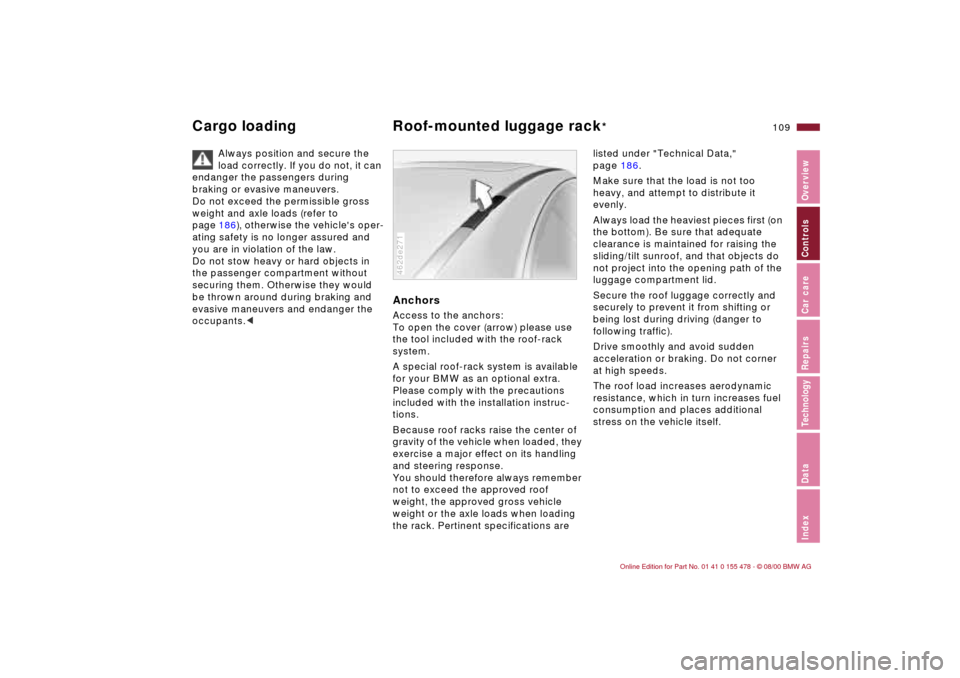
AnchorsAccess to the anchors:
To open the cover (arrow) please use
the tool included with the roof-rack
system.
A special roof-rack system is available
for your BMW as an optional extra.
Please comply with the precautions
included with the installation instruc-
tions.
Because roof racks raise the center of
gravity of the vehicle when loaded, they
exercise a major effect on its handling
and steering response.
You should therefore always remember
not to exceed the approved roof
weight, the approved gross vehicle
weight or the axle loads when loading
the rack. Pertinent specifications are 462de271
listed under "Technical Data,"
page 186.
Make sure that the load is not too
heavy, and attempt to distribute it
evenly.
Always load the heaviest pieces first (on
the bottom). Be sure that adequate
clearance is maintained for raising the
sliding/tilt sunroof, and that objects do
not project into the opening path of the
luggage compartment lid.
Secure the roof luggage correctly and
securely to prevent it from shifting or
being lost during driving (danger to
following traffic).
Drive smoothly and avoid sudden
acceleration or braking. Do not corner
at high speeds.
The roof load increases aerodynamic
resistance, which in turn increases fuel
consumption and places additional
stress on the vehicle itself.
Page 147 of 203
147n
IndexDataTechnologyRepairsCar careControlsOverview
Airbags Vehicle storageImportant safety notices
Do not attempt to remove the gas
generators of the airbag supple-
mental restraint system from the
vehicle. Testing and servicing must be
performed by trained technicians only.
In the event of a malfunction, deactiva-
tion, or triggered actuation (as a
response to an accident) of the airbag
restraint system, consult your BMW
center for repairs or service operations.
Do not modify or tamper with either the
wiring or the individual components in
the airbag system. These include the
padded steering wheel hub, the instru-
ment panel, the side trim panels of the
front or rear doors and the roof pillars or
the sides of the headliner. Do not apply
adhesive materials to these compo-
nents or cover them over or alter them
in any other way. Do not attempt to
remove or dismantle the steering
wheel.
To ensure compliance with official
safety regulations, entrust disposal of
airbag generators to a BMW center.
Unprofessional attempts to service the
system could lead to failure in an emer-
gency or undesired airbag activation,
either of which could result in personal
injury.<
Consult your BMW center regarding
special procedures if you intend to
store the vehicle for more than three
months.
Page 151 of 203
Overview
Controls and features
Operation, care
and maintenance
Owner service procedures
Technical data
Index Advanced technology
151n
IndexDataTechnologyRepairsCar careControlsOverview
Replacement procedures:
Onboard tool kit152
Windshield wiper blades152
Lamps and bulbs152
Changing a wheel159
Battery163
Fuses166
Microfilter/Activated-charcoal
filter166
In case of electrical
malfunction:
Fuel filler door167
Sliding/tilt sunroof167
Assistance, giving and
receiving:
Jump-starting168
Towing the vehicle169
Repairs
Page 167 of 203
167n
IndexDataTechnologyRepairsCar careControlsOverview
Microfilter Fuel filler door Sliding/tilt sunroof
*
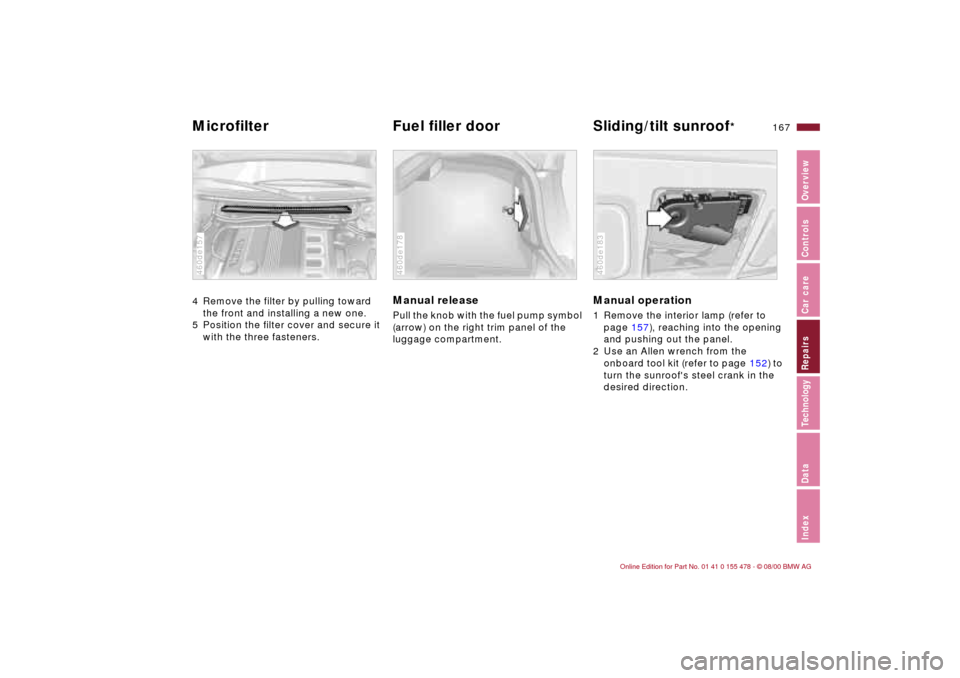
4 Remove the filter by pulling toward
the front and installing a new one.
5 Position the filter cover and secure it
with the three fasteners.460de157
Manual release Pull the knob with the fuel pump symbol
(arrow) on the right trim panel of the
luggage compartment. 460de178
Manual operation 1 Remove the interior lamp (refer to
page 157), reaching into the opening
and pushing out the panel.
2 Use an Allen wrench from the
onboard tool kit (refer to page 152) to
turn the sunroof's steel crank in the
desired direction.460de183
Page 180 of 203
180n
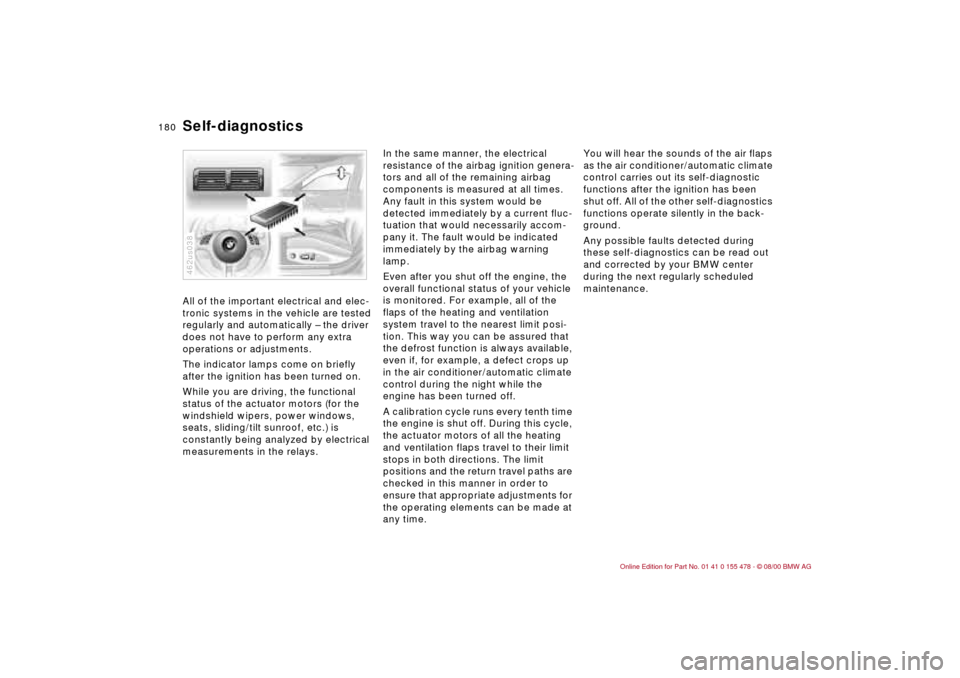
Self-diagnostics All of the important electrical and elec-
tronic systems in the vehicle are tested
regularly and automatically Ð the driver
does not have to perform any extra
operations or adjustments.
The indicator lamps come on briefly
after the ignition has been turned on.
While you are driving, the functional
status of the actuator motors (for the
windshield wipers, power windows,
seats, sliding/tilt sunroof, etc.) is
constantly being analyzed by electrical
measurements in the relays.462us038
In the same manner, the electrical
resistance of the airbag ignition genera-
tors and all of the remaining airbag
components is measured at all times.
Any fault in this system would be
detected immediately by a current fluc-
tuation that would necessarily accom-
pany it. The fault would be indicated
immediately by the airbag warning
lamp.
Even after you shut off the engine, the
overall functional status of your vehicle
is monitored. For example, all of the
flaps of the heating and ventilation
system travel to the nearest limit posi-
tion. This way you can be assured that
the defrost function is always available,
even if, for example, a defect crops up
in the air conditioner/automatic climate
control during the night while the
engine has been turned off.
A calibration cycle runs every tenth time
the engine is shut off. During this cycle,
the actuator motors of all the heating
and ventilation flaps travel to their limit
stops in both directions. The limit
positions and the return travel paths are
checked in this manner in order to
ensure that appropriate adjustments for
the operating elements can be made at
any time.You will hear the sounds of the air flaps
as the air conditioner/automatic climate
control carries out its self-diagnostic
functions after the ignition has been
shut off. All of the other self-diagnostics
functions operate silently in the back-
ground.
Any possible faults detected during
these self-diagnostics can be read out
and corrected by your BMW center
during the next regularly scheduled
maintenance.
Page 186 of 203

186n
Weights
BMW 325Ci BMW 330Ci
Curb weight (with one person, ready for operation, full tank of fuel, options not included)
with manual transmission
with automatic transmissionlbs. (kg)
lbs. (kg)3,252 (1,475)
3,340 (1,515)3,351 (1,520)
3,395 (1,540)
Approved gross vehicle weight
with manual transmission
with automatic transmissionlbs. (kg)
lbs. (kg)4,310 (1,955)
4,398 (1,995)4,409 (2,000)
4,453 (2,020)
Approved front axle weight lbs. (kg) 1,973 (895) 1,973 (895)
Approved rear axle weight lbs. (kg) 2,447 (1,110) 2,491 (1,130)
Approved roof load capacity lbs. (kg) 165 (75) 165 (75)
Luggage compartment capacity cu ft (l) 14.5 (410) 14.5 (410)
Approved axle loads and approved gross vehicle weight may not be exceeded .
Page 193 of 203
Everything from A to Z
193n
IndexDataTechnologyRepairsCar careControlsOverview
Cargo
loading108
securing108
Caring for the vehicle's
finish143
Cassette operation, refer to
the Radio Owner's Manual
Catalytic converter113
CBC (Cornering Brake
Control)21,116
CD operation, refer to the
Radio Owner's Manual
Cellular phone104,121
refer also to the separate
Owner's Manual
Center (high-mount) brake
lamp157
Center 3-point-safety belt in
the rear106
Center armrest102
Central locking system34
button38
Changing a wheel159
Changing tires159
Check Control77
Child restraint systems56
Child seat56
Child seat security62
Cigarette lighter105
Cleaning headlamps72
Cleaning windshield71
Clock78 Clock, refer also to the Radio
or Onboard Monitor
Owner's Manual
Clothes hooks105
Cockpit16
Code, refer to the Radio
Owner's Manual
Coin box, cup holder103
Combination switch70
Compression184
Computer77
Computer, refer also to the
Onboard Monitor Owner's
Manual
Configure settings54
Consumption79
Consumption display76
Contents10
Convenience operation
sliding/tilt sunroof34
windows34
Coolant119,137,187
antifreeze119
Coolant temperature
gauge76
Cooling system187
Copyright4
Cornering Brake Control
(CBC)21,116
Cruise control73
Cruising range79
Curb weight186
Current, check indicator20
D
Data
dimensions185
engine184
technical184
weights186
Daytime-driving lamp87
DBC (Dynamic Brake
Control)116
Deep water113
Defroster, rear
window92,100
Defrosting the
windows94,99
Digital clock78
Dimensions185
Dipstick135
Disc brakes117
Displacement184
Display lighting87
Displays18
Distance warning81
Diversity Antenna
system176
Divided rear backrest106
Door key32
Door locks, care119
Doors
emergency operation34
remote control35
unlocking and locking34
DOT Quality Grades123 Draft-free
ventilation93,100
Drive belts188
Driving hints113
Driving in winter119
Driving lamps87
DSC (Dynamic Stability
Control)22,82,175
Dynamic Brake Control
(DBC)116
Dynamic Stability Control
(DSC)22,82,175
E
Electric power seat50
Electric power windows44
Electrical accessories,
failure166
Electrical system188
Electronic vehicle
immobilizer33
Elements of operation16
Emergency operation
doors34
fuel filler door167
slidling/tilt sunrrof167
Energy Control75
Engine compartment132
Engine coolant137,187
Engine data184
Page 196 of 203

Everything from A to ZPDC (Park Distance
Control)81
Performance184
Pocket flashlight102
Pollen93,100
Power seat50
Power steering121
Power windows44
safety feature44
Pressure monitoring,
tires85,179
Pressure, tires27,122 Q
Quality Grades123 R
Radiator187
Radio Data System
(RDS)176
Radio reception121,176
Radio, refer also to the
separate Owner's Manual
Rain sensor71,178
RDC (Tire Pressure
Control)85,179
RDS (Radio Data
System)176
Reading lamps89
Rear backrest, folding106 Rear lamps155
Rear window
defroster72,92,100
Rear-entry assist49
Rearview mirror52
Recirculated air mode92
Reclining seat47
Refueling26
Remote control35
Removing condensation
from the windows94,99
Replacement keys32
Reporting safety defects7
Restraint system56
Reverse17,66
Roller blind, sun
protection101
Roof load capacity186
Roof-mounted luggage
rack109
Rubber parts119
S
Safety belt tensioner176
Safety belts55
height adjustment55
Safety buttons38
Safety feature44
Safety terminal, battery164 Seats47
adjusting47
electric power50
heating101
mechanical47
memory51
sitting properly58
Securing the load108
Selector lever, automatic
transmission67
Self-defrosting mirrors52
Self-diagnostics180
Service and Warranty
Information Booklet140
Service Interval Display76
Shiftlock67
Side airbags57
Side impact Head Protection
System57
Side lamps87
bulb replacement154
Sitting properly with
airbag58
Ski bag107
Skid control120
Sliding/tilt sunroof45
closing following an
electrical malfunction167
convenience operation34
Slippery roads119
Snow chains119,126 Socket105
for flashlights105
for power supplies105
for vacuum cleaner105
Spare key32
Spare tire159
Spark plugs188
Speaker104
Specifications, fuel27
Speed control75
Speed display18
Speed, average80
Speedometer18
Sports seat49
Starting assistance168
Starting
problems113,168
Starting the engine63
Steel rim127
Steering121
Steering lock63
Steering wheel52
adjusting52
Steptronic67
Stopping the vehicle64
Storage compartments102
Storage facilities102
Storing your vehicle147
Stroke184
Summer tires125,127
Sun roller blind101
Sun visors53