brake BMW 325Ci COUPE 2001 E46 Owner's Guide
[x] Cancel search | Manufacturer: BMW, Model Year: 2001, Model line: 325Ci COUPE, Model: BMW 325Ci COUPE 2001 E46Pages: 203, PDF Size: 2.03 MB
Page 138 of 203
138n
Coolant Brake fluidAdding coolant Wait until the engine cools before
removing the cap from the expansion
tank. The needle of the coolant
temperature gauge in the instrument
cluster must be located in the blue
zone. If it is not, there is a danger of
scalding.
1 Turn the cap slightly counterclock-
wise in order to allow accumulated
pressure to escape. Then open.
2 If the coolant is low, slowly add
coolant until the correct level is
reached Ð do not overfill.
The coolant is a mixture of water and
extended-duty antifreeze with corrosion
inhibitor. Always maintain the pre-
scribed all-season 50:50 mixture ratio
for year-round protection against inter-
nal corrosion. No other additives are
required.
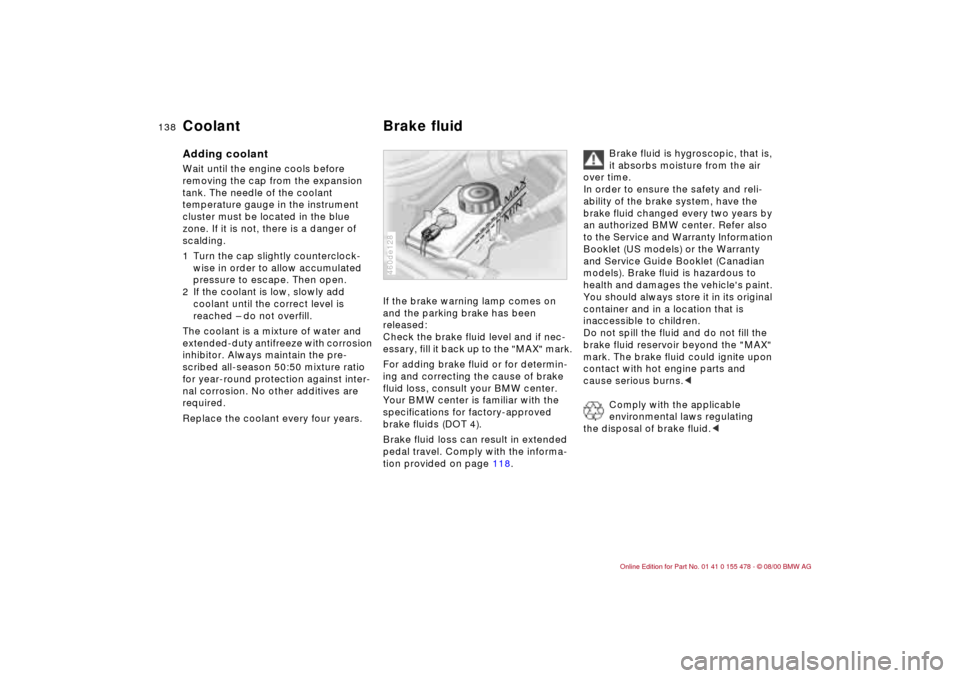
Replace the coolant every four years.If the brake warning lamp comes on
and the parking brake has been
released:
Check the brake fluid level and if nec-
essary, fill it back up to the "MAX" mark.
For adding brake fluid or for determin-
ing and correcting the cause of brake
fluid loss, consult your BMW center.
Your BMW center is familiar with the
specifications for factory-approved
brake fluids (DOT 4).
Brake fluid loss can result in extended
pedal travel. Comply with the informa-
tion provided on page 118.
460de128
Brake fluid is hygroscopic, that is,
it absorbs moisture from the air
over time.
In order to ensure the safety and reli-
ability of the brake system, have the
brake fluid changed every two years by
an authorized BMW center. Refer also
to the Service and Warranty Information
Booklet (US models) or the Warranty
and Service Guide Booklet (Canadian
models). Brake fluid is hazardous to
health and damages the vehicle's paint.
You should always store it in its original
container and in a location that is
inaccessible to children.
Do not spill the fluid and do not fill the
brake fluid reservoir beyond the "MAX"
mark. The brake fluid could ignite upon
contact with hot engine parts and
cause serious burns.<
Comply with the applicable
environmental laws regulating
the disposal of brake fluid.<
Page 141 of 203

141n
IndexDataTechnologyRepairsCar careControlsOverview
Washing your vehicle You can have your BMW washed in
an automatic car wash, even when it
is new. Car wash systems that do not
employ brushes are preferable.
Wipe away tough dirt and loosen and
remove dead insects before washing
the vehicle.
In order to avoid spots, do not wash the
vehicle when the hood is warm, or
during or immediately after exposure to
strong sunlight.
When using an automatic car wash, be
sure that:
>The car wash system is suited for the
dimensions of your vehicle.
>No damage will occur on vehicles
with attached body accessories (such
as spoilers or antennas). Consult the
car wash operator if necessary.
>The wheels and tires of your vehicle
cannot be damaged by the convey-
ance devices of the car wash system.
>The vehicle is cleaned with minimum
brush pressure, and that ample water
is available for washing and rinsing.Vehicles with rain sensor:
Clean the windshield regularly. Wax
from automatic car washes or insects
can cause malfunctions in the function
of the rain sensor.
Deactivate the rain sensor when
going through car washes (refer to
page 71), as otherwise the wipers could
be damaged if they inadvertently start
working.<
Parts of the vehicle that are inacces-
sible to the automatic washer Ð such as
door sills, door and hood edges, etc. Ð
should be cleaned by hand.
In the winter months, it is especially
important to be sure that the vehicle is
washed on a regular basis. Large quan-
tities of dirt and road salt are difficult to
remove, and they also damage the
vehicle.
If spray wands or high-pressure
washers are used, be sure to
maintain an adequate distance between
the spray source and the vehicle's
surface. Inadequate distance and
excessive pressure can damage or
weaken the finish, making it more
susceptible to subsequent attack.
In addition, moisture could penetrate to
vehicle components, leading to long-
term damage.<
When cleaning the headlamps,
please observe the following: do
not wipe dry with a cloth (scratches).
Never use abrasives or strong solvents
to clean the covers. Remove dirt and
contamination (such as insects) by
soaking with BMW Car Shampoo and
then rinsing with plenty of water.
Always use a deicer spray to remove
accumulated ice and snow Ð never use
a scraper.<
After washing the vehicle, apply
the brakes briefly to dry them.
Braking efficiency might otherwise be
reduced by the moisture and the brake
rotors could also be corroded.<
Caring for your vehicle
Page 143 of 203

143n
IndexDataTechnologyRepairsCar careControlsOverview
Caring for your vehicleCaring for the vehicle's finish Regular washing is a preventive
measure against long-term effects from
substances that are harmful to the
vehicle's finish, especially if you drive
your vehicle in areas with high levels of
air pollution or aggressive natural
substances (tree resins, pollen).
Nevertheless, you should immediately
remove especially aggressive
substances. Failure to do so can
lead to changes in the paint's chemical
structure or to discoloration. Gasoline
spilled during refueling, oil, grease and
brake fluid should always be cleaned
away immediately, as should bird drop-
pings.
Any contamination remaining on the
surface of the vehicle will be especially
conspicuous after washing. Use
cleaning fluid or alcohol with a clean
cloth or cotton pad to remove. Remove
tar spots with tar remover. After
cleaning, the affected areas should be
waxed to ensure continued protection.
Use the cleaning and car-care
products available at your BMW
center.<
Waxing your vehicle Protect the finish using carnauba or
synthetic-based waxes only.
The best way to determine when the
finish needs to be waxed is by noting
when water stops beading on the
surface.
You can use a glass cleaner to remove
any wax or silicone that may have been
left on the windows during waxing.
Use the cleaning and car-care
products available at your BMW
center.<
Paint damageYou can touch up small areas of paint
damage with a BMW spray paint or a
BMW touchup stick.
The paint color code for your vehicle
is provided on a sticker located on the
right hand-side under the hood and on
the first page of your Service and
Warranty Information Booklet (US
models) or Warranty and Service Guide
Booklet (Canadian models).
Damage caused by flying stones,
scratches, etc., must be touched up
without delay to prevent rust from
forming.
If corrosion has started to form in an
area with paint damage, remove all rust
and clean the area. Then prime the area
with a BMW Primer Stick. Finally, apply
the finish coat. Wait a few days, then
polish the repaired area. Finish by
applying a wax preservative.
More extensive paint damage should
be repaired professionally in accor-
dance with the manufacturer's instruc-
tions. Your BMW center uses original
BMW finish materials in accordance
with approved repair procedures.
Page 155 of 203
155n
IndexDataTechnologyRepairsCar careControlsOverview
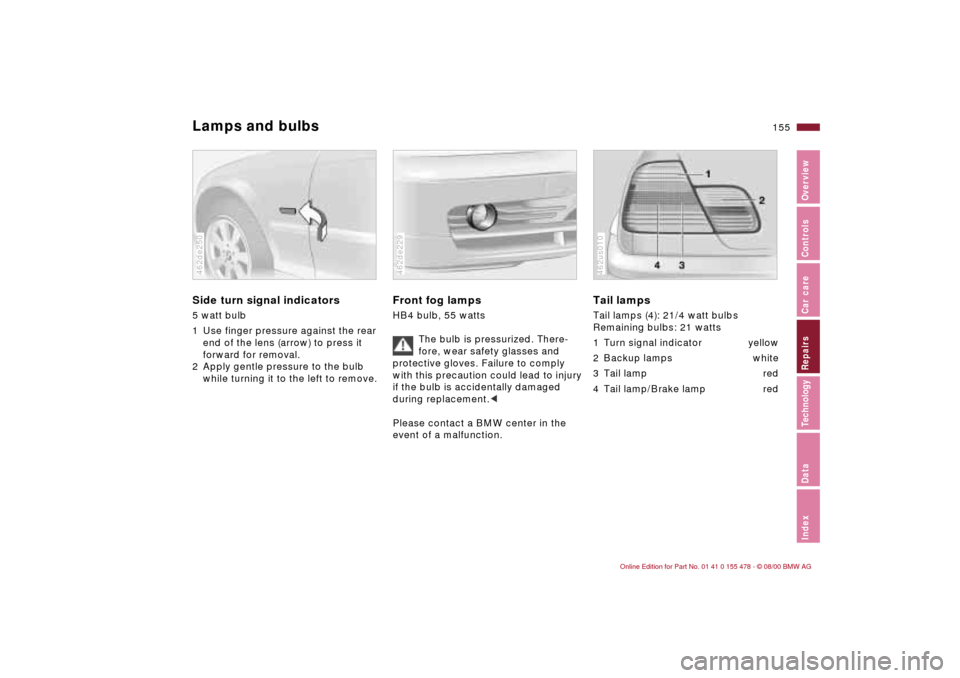
Lamps and bulbsSide turn signal indicators5 watt bulb
1 Use finger pressure against the rear
end of the lens (arrow) to press it
forward for removal.
2 Apply gentle pressure to the bulb
while turning it to the left to remove.462de250
Front fog lampsHB4 bulb, 55 watts
The bulb is pressurized. There-
fore, wear safety glasses and
protective gloves. Failure to comply
with this precaution could lead to injury
if the bulb is accidentally damaged
during replacement.<
Please contact a BMW center in the
event of a malfunction.462de229
Tail lamps Tail lamps (4): 21/4 watt bulbs
Remaining bulbs: 21 watts
1 Turn signal indicator yellow
2 Backup lamps white
3 Tail lamp red
4 Tail lamp/Brake lamp red462us010
Page 157 of 203
157n
IndexDataTechnologyRepairsCar careControlsOverview
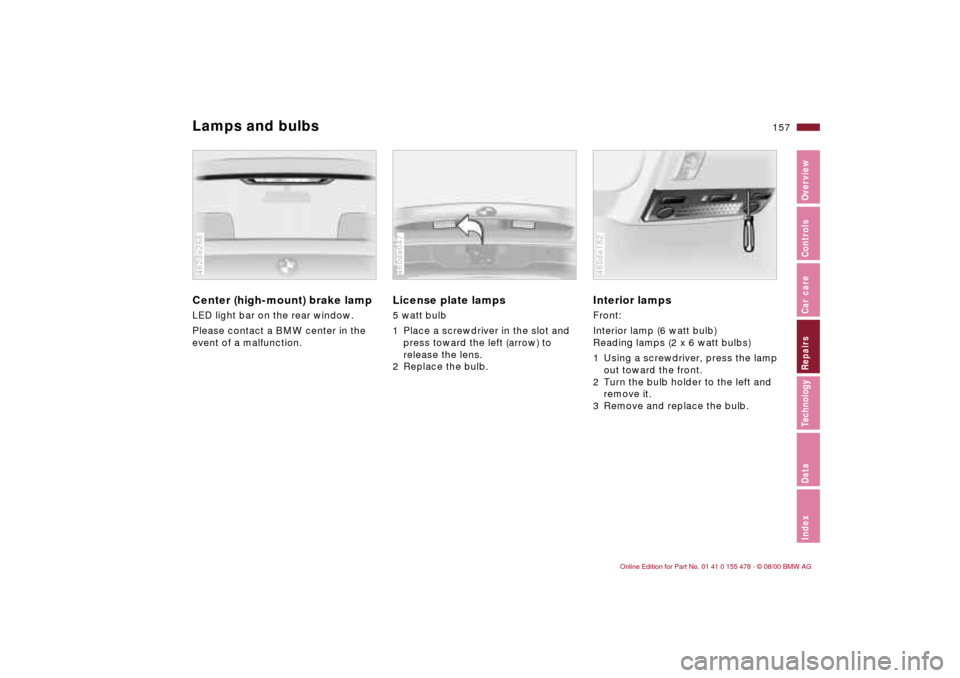
Lamps and bulbsCenter (high-mount) brake lampLED light bar on the rear window.
Please contact a BMW center in the
event of a malfunction.462de268
License plate lamps 5 watt bulb
1 Place a screwdriver in the slot and
press toward the left (arrow) to
release the lens.
2 Replace the bulb.460de047
Interior lamps Front:
Interior lamp (6 watt bulb)
Reading lamps (2 x 6 watt bulbs)
1 Using a screwdriver, press the lamp
out toward the front.
2 Turn the bulb holder to the left and
remove it.
3 Remove and replace the bulb.460de182
Page 159 of 203

159n
IndexDataTechnologyRepairsCar careControlsOverview
Changing a wheel
Take these precautionary
measures if you have either a flat
tire or are changing the tire:
Stop the vehicle as far as possible from
passing traffic. Park on a firm, flat
surface. Switch on the hazard warning
flashers. Turn the steering wheel to the
straight-ahead position, remove the key
and engage the steering lock. Shift into
1st gear or reverse (selector lever in
"Park" with automatic transmission) and
engage the parking brake.
All passengers should be outside the
vehicle and well away from your imme-
diate working area (behind a guardrail,
for instance).
If a warning triangle
or portable hazard
warning lamp is available, set it up on
the roadside at an appropriate distance
from the rear of the vehicle. Comply
with all safety guidelines and
regulations.
Change the wheel only on a level, firm
surface which is not slippery. Avoid
jacking the vehicle on a soft or slippery
support surface (snow, ice, loose
gravel, etc.), as it could slide sideways.
Position the jack on a firm support
surface. Do not place wooden blocks or
similar objects under the jack. If this is
done, the jack might not be able to
reach its full support capacity because
of the limited height.
Do not lie under the vehicle or start the
engine when the vehicle is supported
by the jack. Failure to comply with this
creates a risk of fatal injury.< Your BMW has a spare tire
or a space-
saver spare tire for temporary use to
ensure your mobility.
To remove the spare tire, lift out
the floor panel in the luggage
compartment completely (refer to
page 41).<
Page 162 of 203

162n
Changing a wheel
The vehicle jack is designed for
changing wheels only. Do not
attempt to raise another vehicle model
with it or to raise any load of any kind.
To do so could cause accidents and
personal injury.
To ensure continued safety, have the
tightness of the lug bolts checked with
a calibrated lug wrench [torque specifi-
cation: 72 lb.ft (100Nm)] at the earliest
opportunity.<
When storing the wheel, be sure that
you do not damage the retaining pin in
the spare tire recess.
If light-alloy wheels other than original
BMW light-alloy wheels have been
mounted, it may be necessary to use
different lug bolts for those wheels.
Replace the defective tire as soon as
possible and have the new wheel/tire
balanced.
For black-painted aluminum wheels
*,
use only those balancing weights
approved by BMW for use with light-
alloy wheels. Never attempt to balance
these wheels using standard balance
weights.
Driving with the space-saver
spare tireDrive cautiously and do not exceed a
speed of 50 mph (80 km/h).
Be aware that vehicle handling will be
altered. Slower brake response time,
longer braking distances and changed
steering characteristics may be anti-
cipated when approaching limit condi-
tions.
The changes in handling characteristics
will be even more pronounced in
conjunction with winter tires.
Only one space-saver spare tire
may be mounted at a time. Mount
a wheel and tire with the same size
and specifications as the others at the
earliest possible opportunity. Maintain
correct tire pressures. Refer to
page 28.<
Page 165 of 203

165n
IndexDataTechnologyRepairsCar careControlsOverview
BatteryCharging the battery Charge the battery in the vehicle only
when the engine is not running.
Before doing any work on the
electrical system, be sure to
unclamp the cable from the battery's
negative terminal. Failure to do so can
result in short circuits, a fire or personal
injury.<
If you plan to park the vehicle for longer
than 4 weeks, disconnect the battery
from the vehicle electrical system by
disconnecting the cable at the negative
terminal. Have the battery recharged
with an appropriate battery charger.
If the vehicle is parked for more than
12 weeks, remove the battery, recharge
it and store it in a cool yet frost- and
dust-free area. During storage, have the
battery recharged every 3 months.
Also, recharge the battery before it is
reinstalled. If this is not done, the
battery will not be serviceable. Every
time the battery is discharged, espe-
cially over extended periods, its service
life is reduced.
Return used batteries to a recy-
cling center or your BMW center.
Maintain the battery in an upright posi-
tion for transport and storage. Secure
the battery to prevent it from tilting
during transport.<
Storage periods during which the
battery is disconnected are not
taken into consideration by the Service
Interval Display for changing the brake
fluid.
For this reason, be sure that the brake
fluid is changed every two years,
regardless of the information displayed.
Please read the pertinent information
on page 138.<
Page 174 of 203
174n
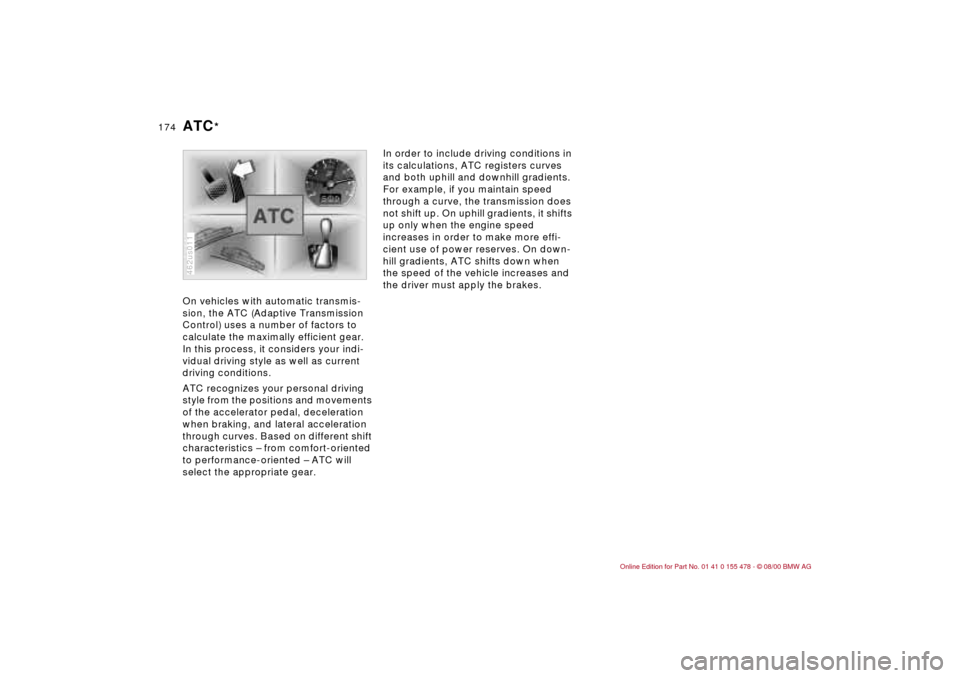
On vehicles with automatic transmis-
sion, the ATC (Adaptive Transmission
Control) uses a number of factors to
calculate the maximally efficient gear.
In this process, it considers your indi-
vidual driving style as well as current
driving conditions.
ATC recognizes your personal driving
style from the positions and movements
of the accelerator pedal, deceleration
when braking, and lateral acceleration
through curves. Based on different shift
characteristics Ð from comfort-oriented
to performance-oriented Ð ATC will
select the appropriate gear.
462us011
In order to include driving conditions in
its calculations, ATC registers curves
and both uphill and downhill gradients.
For example, if you maintain speed
through a curve, the transmission does
not shift up. On uphill gradients, it shifts
up only when the engine speed
increases in order to make more effi-
cient use of power reserves. On down-
hill gradients, ATC shifts down when
the speed of the vehicle increases and
the driver must apply the brakes.
ATC
*
Page 175 of 203
175n
IndexDataTechnologyRepairsCar careControlsOverview
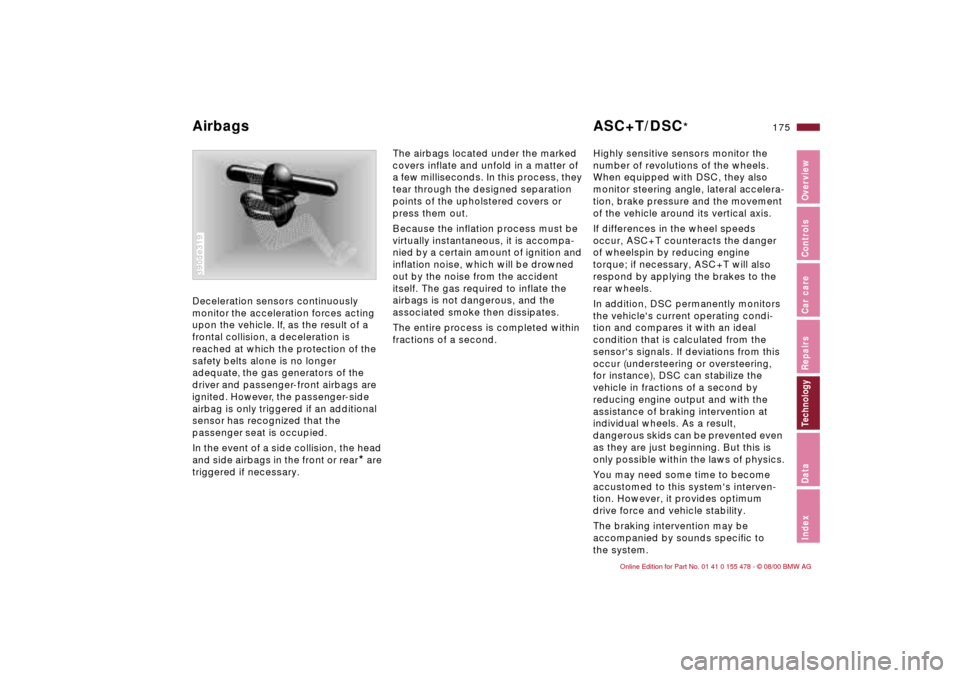
Deceleration sensors continuously
monitor the acceleration forces acting
upon the vehicle. If, as the result of a
frontal collision, a deceleration is
reached at which the protection of the
safety belts alone is no longer
adequate, the gas generators of the
driver and passenger-front airbags are
ignited. However, the passenger-side
airbag is only triggered if an additional
sensor has recognized that the
passenger seat is occupied.
In the event of a side collision, the head
and side airbags in the front or rear
* are
triggered if necessary.
390de319
The airbags located under the marked
covers inflate and unfold in a matter of
a few milliseconds. In this process, they
tear through the designed separation
points of the upholstered covers or
press them out.
Because the inflation process must be
virtually instantaneous, it is accompa-
nied by a certain amount of ignition and
inflation noise, which will be drowned
out by the noise from the accident
itself. The gas required to inflate the
airbags is not dangerous, and the
associated smoke then dissipates.
The entire process is completed within
fractions of a second.Highly sensitive sensors monitor the
number of revolutions of the wheels.
When equipped with DSC, they also
monitor steering angle, lateral accelera-
tion, brake pressure and the movement
of the vehicle around its vertical axis.
If differences in the wheel speeds
occur, ASC+T counteracts the danger
of wheelspin by reducing engine
torque; if necessary, ASC+T will also
respond by applying the brakes to the
rear wheels.
In addition, DSC permanently monitors
the vehicle's current operating condi-
tion and compares it with an ideal
condition that is calculated from the
sensor's signals. If deviations from this
occur (understeering or oversteering,
for instance), DSC can stabilize the
vehicle in fractions of a second by
reducing engine output and with the
assistance of braking intervention at
individual wheels. As a result,
dangerous skids can be prevented even
as they are just beginning. But this is
only possible within the laws of physics.
You may need some time to become
accustomed to this system's interven-
tion. However, it provides optimum
drive force and vehicle stability.
The braking intervention may be
accompanied by sounds specific to
the system.
Airbags ASC+T/DSC
*