climate control BMW 325Ci COUPE 2001 E46 Owner's Manual
[x] Cancel search | Manufacturer: BMW, Model Year: 2001, Model line: 325Ci COUPE, Model: BMW 325Ci COUPE 2001 E46Pages: 203, PDF Size: 2.03 MB
Page 11 of 203

11n
Controls and features
Operation, care and maintenance
Lamps:
Side lamps/Low beams87
Instrument panel lighting87
High beams/Parking lamps88
Fog lamps88
Interior lamps88
Controlling the climate
for pleasant driving:
Air conditioner90
Automatic climate control96
Seat heating101
Roller sun blind101
Interior convenience:
HiFi system101
Glove compartment102
Storage facilities102
Cellular phone104
Ashtray, front104
Cigarette lighter105
Ashtray, rear105
Clothes hooks105
Loading and transporting:
Through-loading system106
Ski bag107
Cargo loading108
Roof-mounted luggage rack109
Special operating instructions:
Break-in procedures112
Driving notes113
Catalytic converter113
Antilock Brake System
(ABS)115
Disc brakes117
Brake system118
Winter operation119
Power steering121
Cellular phones121
Radio reception121
Wheels and tires:
Tire inflation pressure122
Tire condition122
Tire replacement123
Tire rotation124
Wheel and tire
combinations125
Winter tires126
Snow chains126
Approved wheel and tire
specifications127
Under the hood:
Hood130
Engine compartment132
Washer fluids134
Washer nozzles134
Engine oil135
Coolant137
Brake fluid138
Vehicle Identification
Number139
Care and maintenance:
The BMW Maintenance
System140
Caring for your vehicle141
Airbags146
Vehicle storage147
Laws and regulations:
Technical modifications148
California Proposition
65 Warning148
ODB interface socket149
Page 31 of 203
Overview
Controls and features
Operation, care
and maintenance
Owner service procedures
Technical data
Index Advanced technology
31n
IndexDataTechnologyRepairsCar careControlsOverview
Driving:
Steering/Ignition lock63
Starting the engine63
Switching off the engine64
Parking brake65
Manual transmission66
Automatic transmission with
Steptronic67
Turn signal indicator/Headlamp
flasher70
Washer/Wiper system70
Rear window defroster72
Cruise control73
Everything under control:
Odometer75
Tachometer75
Energy Control75
Fuel gauge76
Temperature gauge76
Service Interval Display76
Check Control77
Computer77
Technology for driving comfort
and safety:
Park Distance Control (PDC)81
Automatic Stability Control plus
Traction (ASC+T)82
Dynamic Stability Control (DSC)
with Automatic Differential
Brake (ADB) and Dynamic
Brake Control (DBC)83
Tire Pressure Control (RDC)85Lamps:
Side lamps/Low beams87
Instrument panel lighting87
High beams/Parking lamps88
Fog lamps88
Interior lamps88
Controlling the climate
for pleasant driving:
Air conditioner90
Automatic climate control96
Seat heating101
Roller sun blind101
Interior convenience:
HiFi System101
Glove compartment102
Storage facilities102
Cellular phone104
Ashtray, front104
Cigarette lighter105
Ashtray, rear105
Clothes hooks105
Loading and transporting:
Through-loading system106
Ski bag107
Cargo loading108
Roof-mounted luggage rack109
Page 40 of 203
40n
Luggage compartment lidOpening from the inside
*
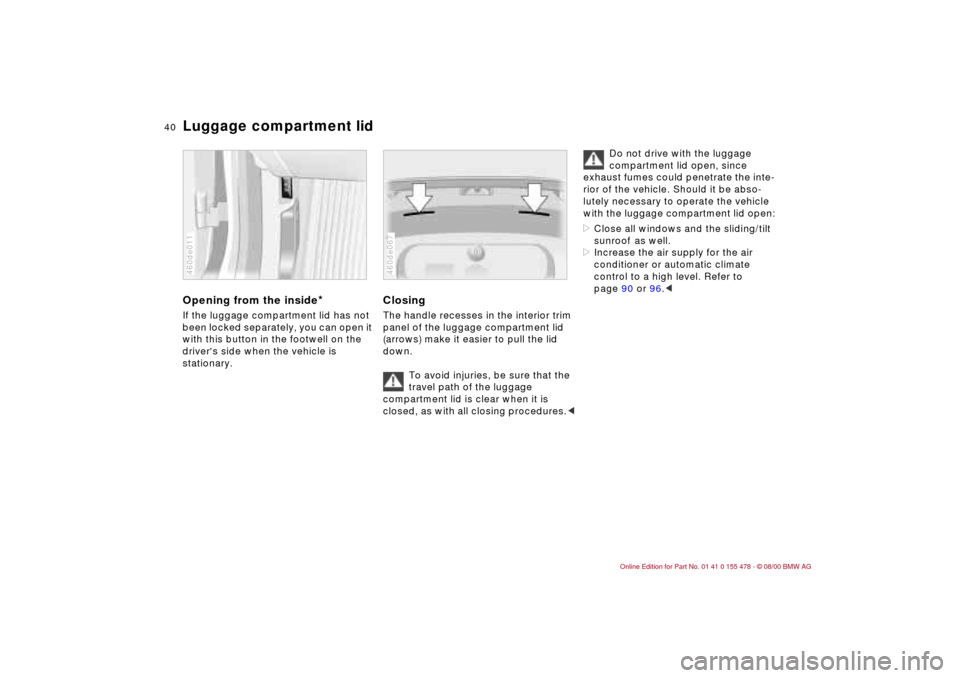
If the luggage compartment lid has not
been locked separately, you can open it
with this button in the footwell on the
driver's side when the vehicle is
stationary.460de011
ClosingThe handle recesses in the interior trim
panel of the luggage compartment lid
(arrows) make it easier to pull the lid
down.
To avoid injuries, be sure that the
travel path of the luggage
compartment lid is clear when it is
closed, as with all closing procedures.<460de067
Do not drive with the luggage
compartment lid open, since
exhaust fumes could penetrate the inte-
rior of the vehicle. Should it be abso-
lutely necessary to operate the vehicle
with the luggage compartment lid open:
>Close all windows and the sliding/tilt
sunroof
as well.
>Increase the air supply for the air
conditioner or automatic climate
control to a high level. Refer to
page 90 or 96.<
Page 72 of 203
72n
Washer/Wiper system Rear window defroster Cleaning headlamps
*
When the vehicle's lighting system is
switched on, the headlamps will also be
cleaned every fifth timecleaning wind-
shield is activated.
Do not use the washers if there
is any danger that the fluid will
freeze on the windshield. If you do so,
your vision could be obscured. Use an
antifreeze agent. Refer to page 134.
Do not use the washers if the reservoir
is empty, otherwise, the washer pump
could be damaged.
automatically when the ignition key is in
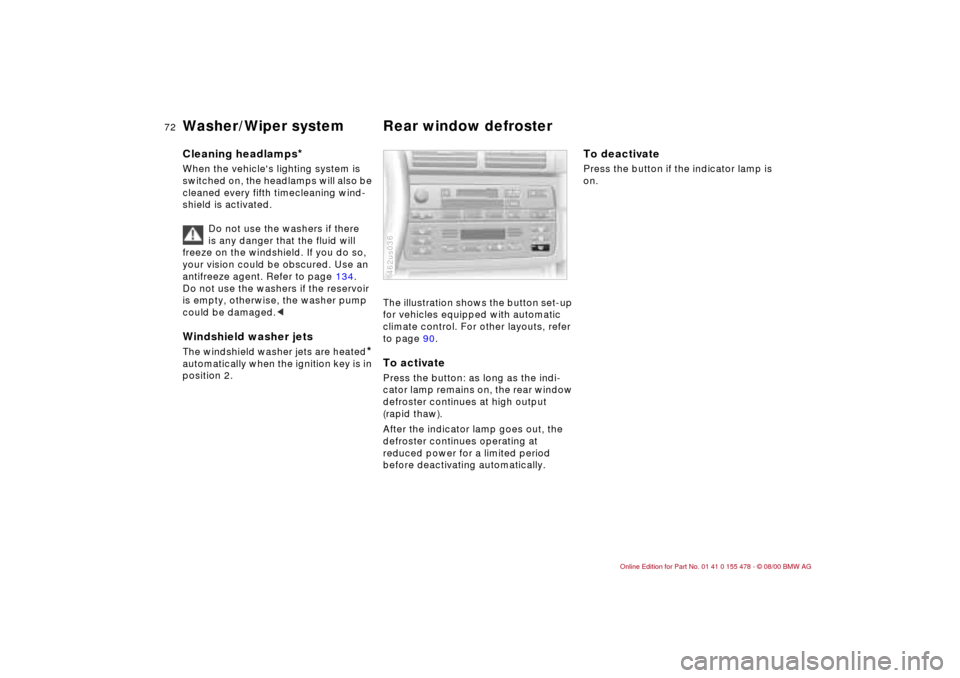
position 2.The illustration shows the button set-up
for vehicles equipped with automatic
climate control. For other layouts, refer
to page 90.To activatePress the button: as long as the indi-
cator lamp remains on, the rear window
defroster continues at high output
(rapid thaw).
After the indicator lamp goes out, the
defroster continues operating at
reduced power for a limited period
before deactivating automatically. 462us036
To deactivatePress the button if the indicator lamp is
on.
Page 96 of 203
96n
Automatic climate control
*
46cus021
Page 97 of 203

97n
IndexDataTechnologyRepairsCar careControlsOverview
Automatic climate control
*
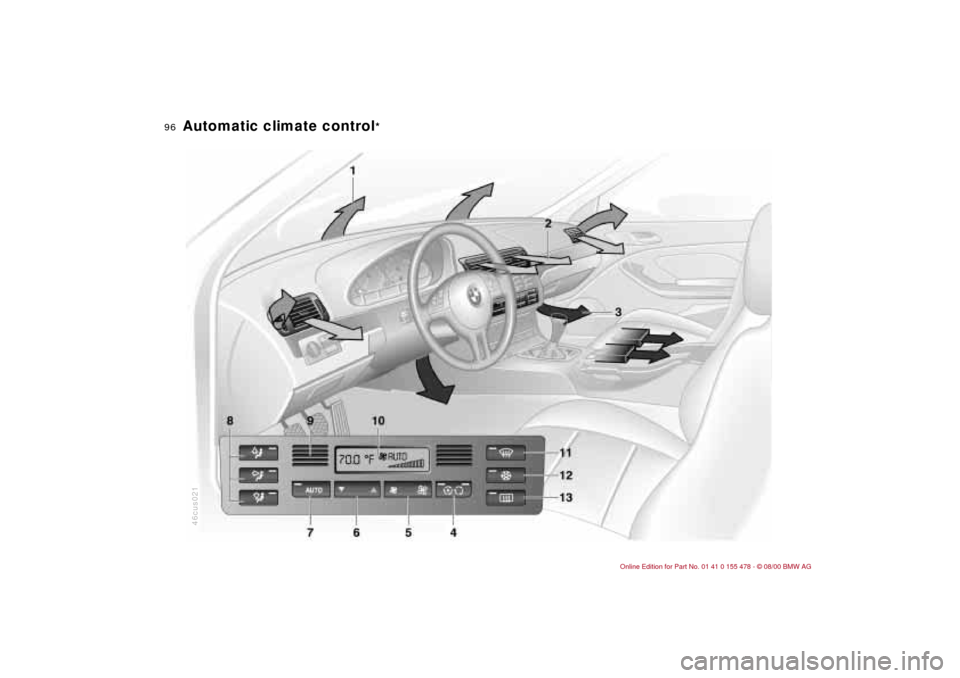
1 Air onto the windshield and onto the
side windows
2 Air for the upper body area
The side rotary dials open and close
the air supply through an infinitely-
variable range; the levers will
change the direction of the air flow.
The center rotary dial adjusts the
temperature of the air as it flows
out, see page 100
3 Air for the front footwell
There are also vent outlets for the
footwell in the rear as well
4 Recirculated air mode/Automatic
recirculated air control (AUC)99
5 Air supply99
6 Temperature98
7 Automatic air distribution98
8 Individual air distribution98
9 Air grill for interior temperature
sensor Ð please keep clear and
unobstructed
10 Display for temperature and air
supply98
11 To defrost the windshield and side
windows99
12 Air conditioner99
13 Rear window defroster72, 100
Page 98 of 203

98n
Automatic climate control
*
Tips for pleasant drivingUse the automatic system (switch on
AUTO Ð button 7). Select an interior
temperature that is comfortable for you
Ñ e. g. 72 7 (+22 6). Whenever the
outside temperature is above 41 7
(+5 6), you can also use the air condi-
tioner 12. This will dry the air as well
as preventing condensation on the
window surfaces Ð if there are passen-
gers with damp clothing, for example.
Set the air outlets 2 so that the air flows
past you and is not directed straight at
you. Set the rotary dial between the air
outlets 2 for the upper body to a
medium position, since air that is
somewhat cooler promotes driving
without fatigue.
Detailed setting options are described
for you in the following section.
Automatic air distribution
The AUTO program assumes
the adjustment of the air distri-
bution and the air supply for you and in
addition adapts the temperature to
external influences (summer, winter) to
meet preferences you can specify. This
program maintains a comfortable in-car
climate regardless of the season. Select
an interior temperature that is comfort-
able for you Ñ e. g. 72 7 (+22 6). The
temperature selected and AUTO for
the air supply appear in display 10,
refer to the overview on page 96. Open
the air outlets for the upper body area.
Switch on the air conditioner in warm
weather. The maximum cooling
capacity is achieved when you set
rotary dial 3 (refer to page 100) to cold.
Individual air distribution
You can cancel the AUTO
program by selecting specific
distribution patterns to suit your
own individual requirements.
You can direct air to flow onto the
windows , toward the upper body
, and into the footwell .
Temperature
The figures in the display
provide a general indication of
interior temperature. We recommend
72 7 (+22 6) as a comfortable setting,
even if the air conditioner is on. When
you start the vehicle, the system
ensures that the selected temperature
is reached as quickly as possible. It
then maintains this temperature,
regardless of the season.
Set rotary dial 3 (refer to "Draft-free
ventilation" on page 100) to a medium
setting, since air that is somewhat
cooler promotes driving without fatigue.
You can use this setting for mixing air to
make minor comfort modifications.
You can set uncontrolled heater
output up to 90 7 (+32 6). The
air conditioner is at full cooling output
at 60 7 (+16 6).<
Page 99 of 203

99n
IndexDataTechnologyRepairsCar careControlsOverview
Automatic climate control
*
Air supply
By pressing the left or right half
of the button, you can vary the
air supply. By doing this, you switch off
the automatic control of the air supply.
Nevertheless, the automatic air distri-
bution remains unchanged.
When you set the lowest blower speed
by pressing the left half of the button,
all of the displays are canceled: the
blower, heating and air conditioner are
switched off, and the air supply is
stopped. You can reactivate the system
by pressing any button for the auto-
matic climate control.
To defrost the windshield and
side windows
This program quickly removes
ice and condensation from the
windshield and side windows.
Air conditioner
The air is cooled and dehumidi-
fied and Ð depending on the
temperature setting Ð rewarmed when
the air conditioner system is switched
on.
Depending on the weather, the wind-
shield may fog over briefly when the
engine is started.
Use the button to switch the air condi-
tioner off at outside temperatures
below approx. 41 7 (+5 6). This will
help to prevent the windows from
ogging up.
If the windows fog over after switching
the air conditioner off, switch it back
on.
Condensation forms in the air
conditioner system during opera-
tion, that then exits under the vehicle.
Traces of condensed water of this kind
are thus normal.<
Automatic recirculated air control
(AUC)
If there are unpleasant odors or
pollutants in the outside air, you
can temporarily block the air supply
from the outside. The system then
recirculates the air already within the
vehicle. By repeated actuation of the
button, you can select one of three
different operation modes.
>Indicator lamps off: fresh air flows
into the vehicle.
>Left-hand indicator lamp on Ð AUC
mode: the system detects pollutants
in the outside air and responds by
deactivating the outside air supply as
required. The system then recircu-
lates the air already within the vehicle.
Depending on the air quality, the
automatic system then switches back
and forth between outside air supply
and recirculation of the air within the
vehicle.
>Right-hand indicator lamp on: the
supply of outside air is permanently
blocked. The system recirculates the
air already within the vehicle.
If the windows fog over in the
recirculated air mode, switch this
mode off and increase the air supply as
required.<
Page 100 of 203
100n
Automatic climate control
*
Rear window defroster
When the rear window defroster
is activated, the indicator lamp
comes on. The rear window defroster
switches off automatically. Refer to
page 72.
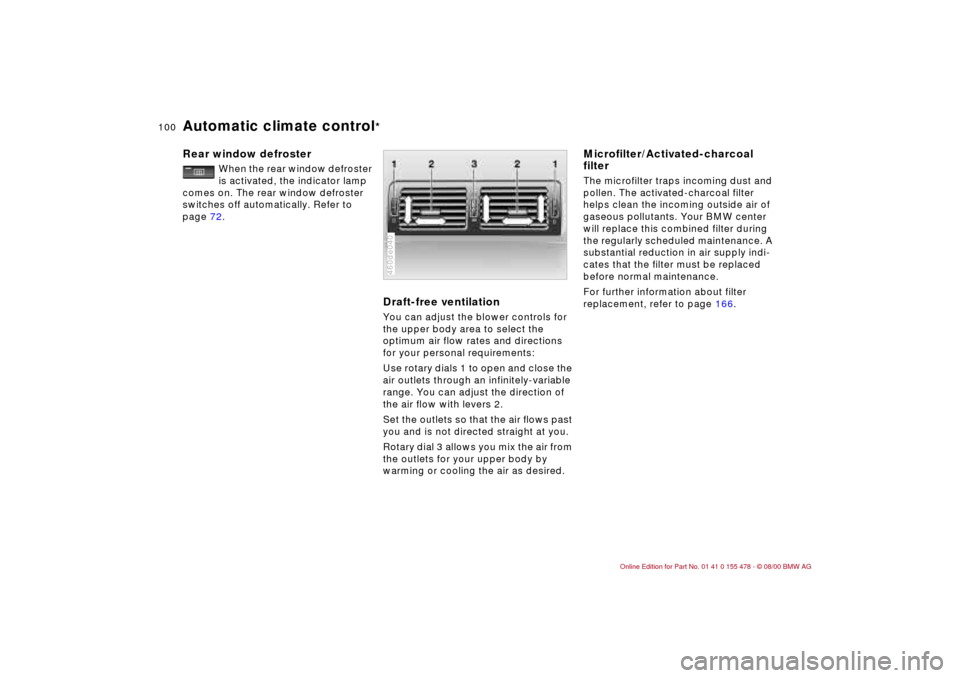
Draft-free ventilation You can adjust the blower controls for
the upper body area to select the
optimum air flow rates and directions
for your personal requirements:
Use rotary dials 1 to open and close the
air outlets through an infinitely-variable
range. You can adjust the direction of
the air flow with levers 2.
Set the outlets so that the air flows past
you and is not directed straight at you.
Rotary dial 3 allows you mix the air from
the outlets for your upper body by
warming or cooling the air as desired.460de040
Microfilter/Activated-charcoal
filterThe microfilter traps incoming dust and
pollen. The activated-charcoal filter
helps clean the incoming outside air of
gaseous pollutants. Your BMW center
will replace this combined filter during
the regularly scheduled maintenance. A
substantial reduction in air supply indi-
cates that the filter must be replaced
before normal maintenance.
For further information about filter
replacement, refer to page 166.
Page 123 of 203

123n
IndexDataTechnologyRepairsCar careControlsOverview
To maintain good handling and vehicle
response, use only tires of a single
tread configuration from a single manu-
facturer. BMW tests and approves
wheel/tire combinations, beginning on
page 127.DOT Quality GradesTreadwear
Traction AA A B C
Temperature A B C
All passenger vehicle tires must
conform to Federal Safety
Requirements in addition to these
grades.< Tread wearThe tread wear grade is a comparative
rating based on the wear rate of the tire
when tested under controlled condi-
tions on a specified government test
course.
For example, a tire graded 150 would
wear one and one-half (1g) times as
well on the government course as a tire
graded 100. The relative performance
of tires depends upon the actual condi-
tions of their use, however, and may
depart significantly from the norm due
to variations in driving habits, service
practices and differences in road char-
acteristics and climate.
TractionThe traction grades, from highest to
lowest, are AA, A, B, and C.
Those grades represent the tire's ability
to stop on wet pavement as measured
under controlled conditions on speci-
fied government test surfaces of as-
phalt and concrete. A tire marked C
may have poor traction performance.
The traction grade assigned to
this tire is based on straight-
ahead braking traction tests, and does
not include acceleration, cornering,
hydroplaning, or peak traction
characteristics.< TemperatureThe temperature grades are A (the
highest), B, and C, representing the
tire's resistance to the generation of
heat and its ability to dissipate heat
when tested under controlled condi-
tions on a specified indoor laboratory
test wheel.
Sustained high temperature can cause
the material of the tire to degenerate
and reduce tire life, and excessive tem-
perature can lead to sudden tire failure.
The grade C corresponds to a level of
performance which all passenger
vehicle tires must meet under the
Federal Motor Vehicle Safety Standard
No. 109. Grades B and A represent
higher levels of performance on the
laboratory test wheel than the minimum
required by law.
The temperature grade for this tire
is established for a tire that is
properly inflated and not overloaded.
Excessive speed, underinflation, or
excessive loading, either separately or
in combination, can cause heat buildup
and possible tire failure.< Uniform Tire Quality Grading Quality grades can be found where
applicable on the tire sidewall between
tread shoulder and maximum section
width. For example:
Tread wear 200 Traction AA
Temperature A
Do not use retreaded tires. Driving
safety may be impaired by their
use. This is due to the possible varia-
tions in casing structures and, in some
cases, to their extreme age, factors that
can lead to a decrease in their
durability.<
Tire replacement