ECU BMW 325Ci COUPE 2002 E46 User Guide
[x] Cancel search | Manufacturer: BMW, Model Year: 2002, Model line: 325Ci COUPE, Model: BMW 325Ci COUPE 2002 E46Pages: 147, PDF Size: 2.2 MB
Page 58 of 147
58n
Automatic transmission with Steptronic
*
N NeutralSelect only when stopping for an
extended period.D Drive (automatic shift program)This position is designed for driving
under all normal operating conditions.
All forward gears are available.KickdownIn the kickdown mode, you achieve
maximum acceleration and in
position D top speed.
Depress the accelerator pedal past the
increased resistance point at the full-
throttle position.
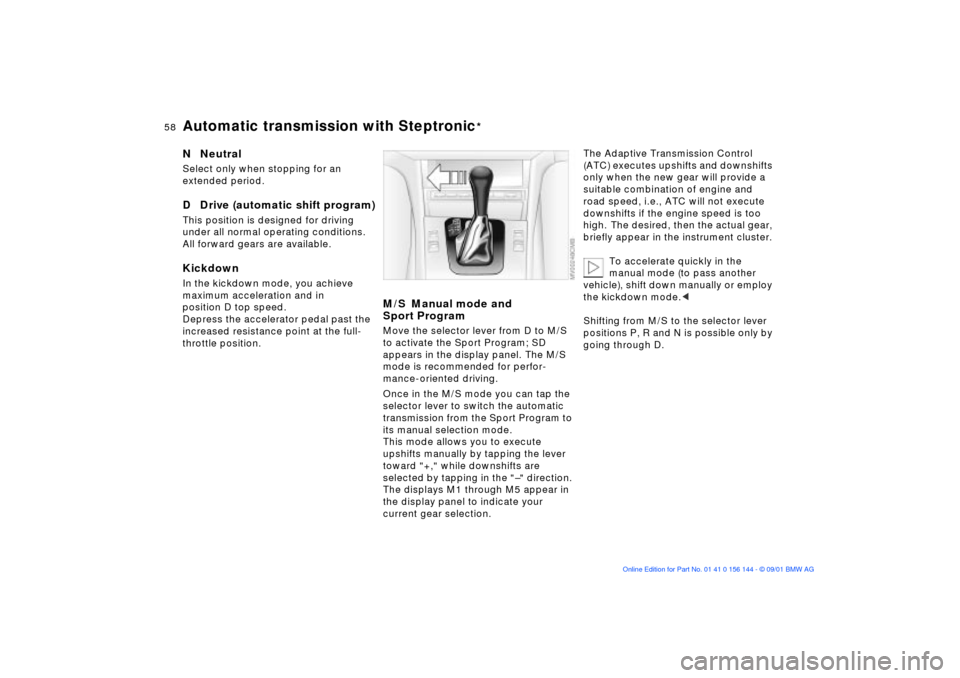
M/S Manual mode and
Sport ProgramMove the selector lever from D to M/S
to activate the Sport Program; SD
appears in the display panel. The M/S
mode is recommended for perfor-
mance-oriented driving.
Once in the M/S mode you can tap the
selector lever to switch the automatic
transmission from the Sport Program to
its manual selection mode.
This mode allows you to execute
upshifts manually by tapping the lever
toward "+," while downshifts are
selected by tapping in the "Ð" direction.
The displays M1 through M5 appear in
the display panel to indicate your
current gear selection.
The Adaptive Transmission Control
(ATC) executes upshifts and downshifts
only when the new gear will provide a
suitable combination of engine and
road speed, i.e., ATC will not execute
downshifts if the engine speed is too
high. The desired, then the actual gear,
briefly appear in the instrument cluster.
To accelerate quickly in the
manual mode (to pass another
vehicle), shift down manually or employ
the kickdown mode.<
Shifting from M/S to the selector lever
positions P, R and N is possible only by
going through D.
Page 91 of 147
91n
OverviewControlsMaintenanceRepairsDataIndex
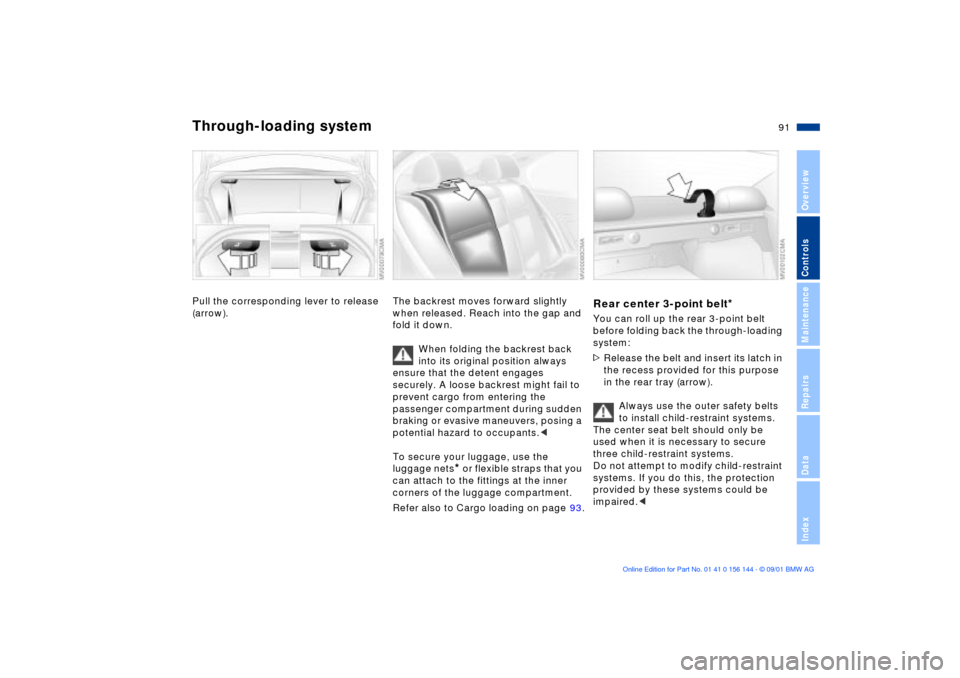
Through-loading systemPull the corresponding lever to release
(arrow).
The backrest moves forward slightly
when released. Reach into the gap and
fold it down.
When folding the backrest back
into its original position always
ensure that the detent engages
securely. A loose backrest might fail to
prevent cargo from entering the
passenger compartment during sudden
braking or evasive maneuvers, posing a
potential hazard to occupants.<
To secure your luggage, use the
luggage nets
* or flexible straps that you
can attach to the fittings at the inner
corners of the luggage compartment.
Refer also to Cargo loading on page 93.
Rear center 3-point belt
*
You can roll up the rear 3-point belt
before folding back the through-loading
system:
>Release the belt and insert its latch in
the recess provided for this purpose
in the rear tray (arrow).
Always use the outer safety belts
to install child-restraint systems.
The center seat belt should only be
used when it is necessary to secure
three child-restraint systems.
Do not attempt to modify child-restraint
systems. If you do this, the protection
provided by these systems could be
impaired.<
Page 92 of 147
92n
Ski bag
*
The ski bag allows the safe and clean
transport of up to 4 pairs of standard
skis or up to two snowboards.
The length of the ski bag and the addi-
tional space provided in the luggage
compartment make it possible to carry
skis up to 6.8 ft (2.1 m) long. Because
of the tapered shape of the bag, the ski
bag can only accommodate two pairs
of skis up to 6.8 ft (2.1 m) long.
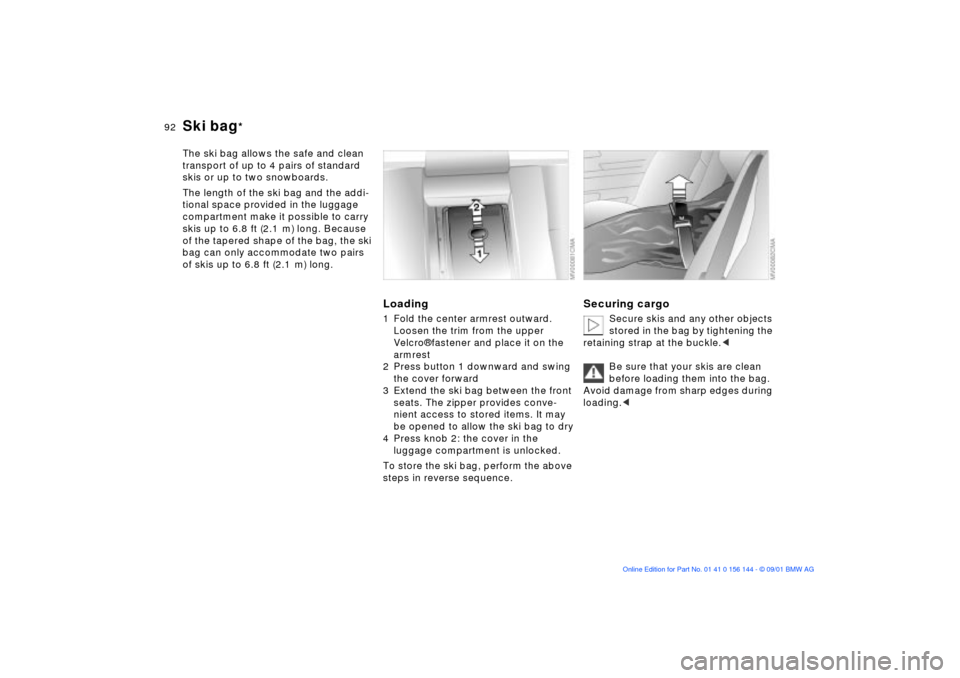
Loading1 Fold the center armrest outward.
Loosen the trim from the upper
Velcro¨ fastener and place it on the
armrest
2 Press button 1 downward and swing
the cover forward
3 Extend the ski bag between the front
seats. The zipper provides conve-
nient access to stored items. It may
be opened to allow the ski bag to dry
4 Press knob 2: the cover in the
luggage compartment is unlocked.
To store the ski bag, perform the above
steps in reverse sequence.
Securing cargo
Secure skis and any other objects
stored in the bag by tightening the
retaining strap at the buckle.<
Be sure that your skis are clean
before loading them into the bag.
Avoid damage from sharp edges during
loading.<
Page 93 of 147
93n
OverviewControlsMaintenanceRepairsDataIndex
Cargo loadingStowing cargoIf you are transporting a load in your
BMW:
>Load heavy cargo as far forward as
possible Ð directly behind the back-
rests or the luggage compartment
partition Ð and as low as possible
>Cover sharp edges and corners
>Do not pile objects higher than the
top edge of the backrest
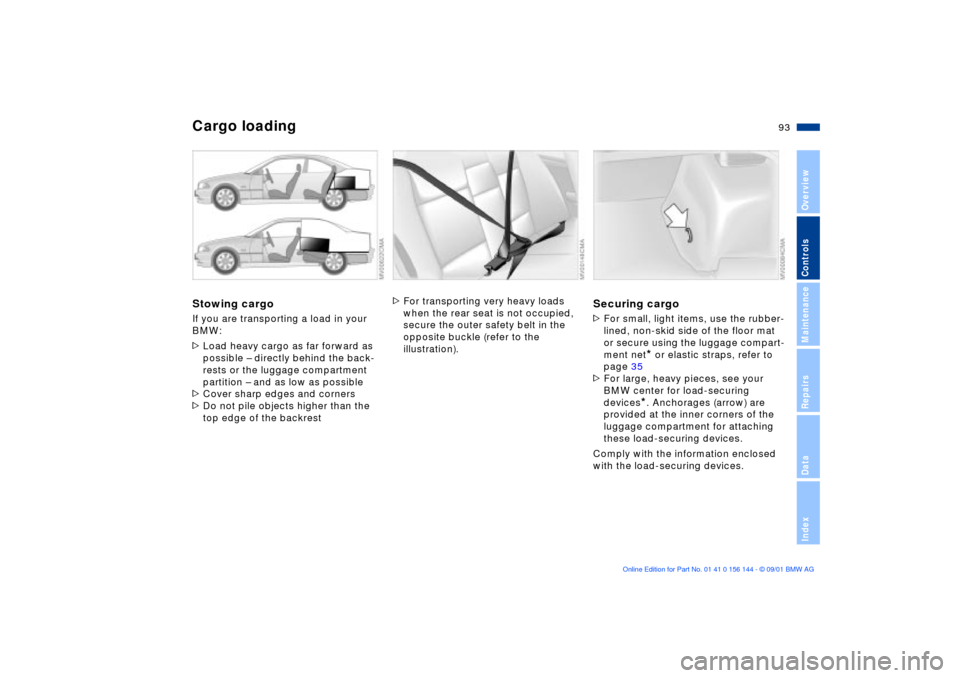
>For transporting very heavy loads
when the rear seat is not occupied,
secure the outer safety belt in the
opposite buckle (refer to the
illustration).
Securing cargo>For small, light items, use the rubber-
lined, non-skid side of the floor mat
or secure using the luggage compart-
ment net
* or elastic straps, refer to
page 35
>For large, heavy pieces, see your
BMW center for load-securing
devices*. Anchorages (arrow) are
provided at the inner corners of the
luggage compartment for attaching
these load-securing devices.
Comply with the information enclosed
with the load-securing devices.
Page 94 of 147
94n
Cargo loading Roof-mounted luggage rack
*
Always position and secure the
load correctly. If you do not, it can
endanger the passengers during
braking or evasive maneuvers.
Do not exceed the approved gross
weight or the approved maximum axle
loads, refer to page 134, otherwise the
vehicle's operating safety is no longer
assured and you are in violation of the
law.
Do not stow heavy or hard objects in
the passenger compartment without
securing them. Otherwise they would
be thrown around during braking and
evasive maneuvers and endanger the
passengers.<
A special roof-rack system is available
as an optional extra for your BMW.
Please observe the precautions
included with the installation instruc-
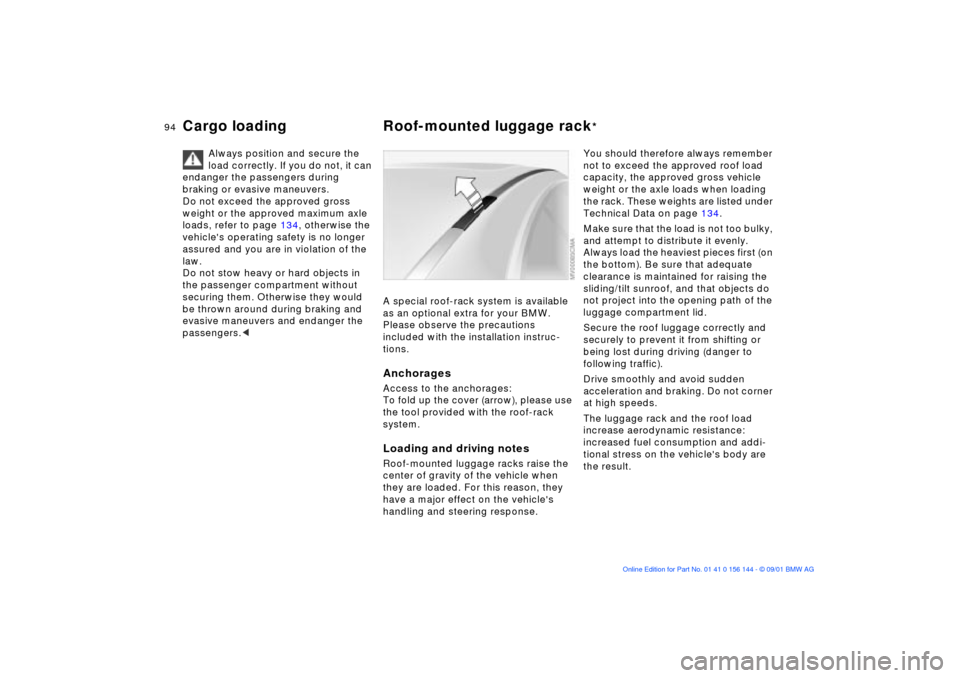
tions.AnchoragesAccess to the anchorages:
To fold up the cover (arrow), please use
the tool provided with the roof-rack
system.Loading and driving notesRoof-mounted luggage racks raise the
center of gravity of the vehicle when
they are loaded. For this reason, they
have a major effect on the vehicle's
handling and steering response.
You should therefore always remember
not to exceed the approved roof load
capacity, the approved gross vehicle
weight or the axle loads when loading
the rack. These weights are listed under
Technical Data on page 134.
Make sure that the load is not too bulky,
and attempt to distribute it evenly.
Always load the heaviest pieces first (on
the bottom). Be sure that adequate
clearance is maintained for raising the
sliding/tilt sunroof, and that objects do
not project into the opening path of the
luggage compartment lid.
Secure the roof luggage correctly and
securely to prevent it from shifting or
being lost during driving (danger to
following traffic).
Drive smoothly and avoid sudden
acceleration and braking. Do not corner
at high speeds.
The luggage rack and the roof load
increase aerodynamic resistance:
increased fuel consumption and addi-
tional stress on the vehicle's body are
the result.
Page 106 of 147
106n
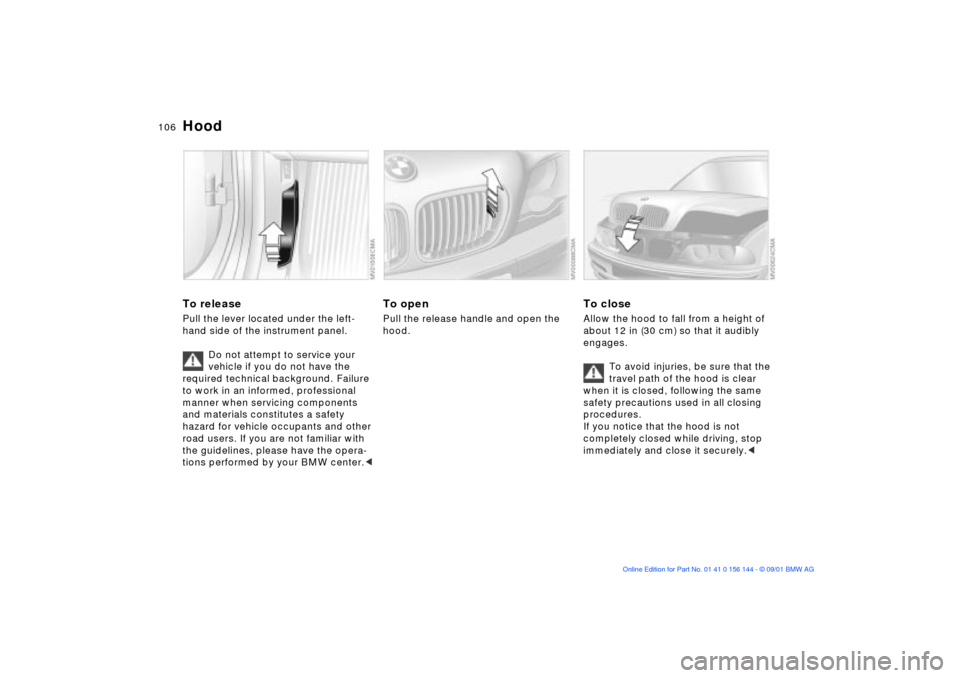
To releasePull the lever located under the left-
hand side of the instrument panel.
Do not attempt to service your
vehicle if you do not have the
required technical background. Failure
to work in an informed, professional
manner when servicing components
and materials constitutes a safety
hazard for vehicle occupants and other
road users. If you are not familiar with
the guidelines, please have the opera-
tions performed by your BMW center.<
To openPull the release handle and open the
hood.
To closeAllow the hood to fall from a height of
about 12 in (30 cm) so that it audibly
engages.
To avoid injuries, be sure that the
travel path of the hood is clear
when it is closed, following the same
safety precautions used in all closing
procedures.
If you notice that the hood is not
completely closed while driving, stop
immediately and close it securely.<
Hood
Page 124 of 147
124n
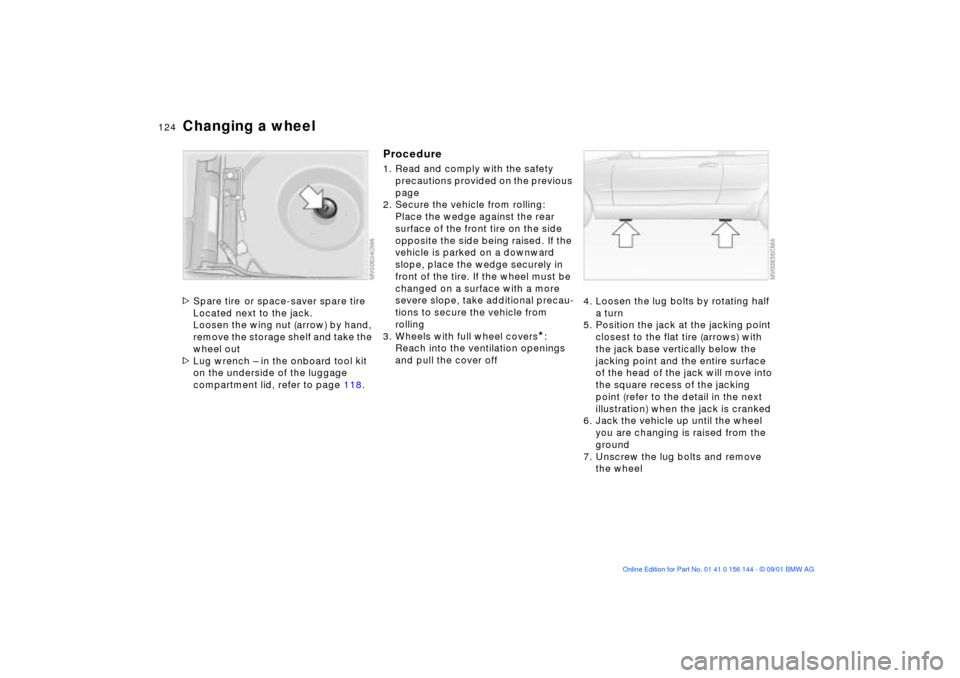
Changing a wheel>Spare tire
or space-saver spare tire
Located next to the jack.
Loosen the wing nut (arrow) by hand,
remove the storage shelf and take the
wheel out
>Lug wrench Ð in the onboard tool kit
on the underside of the luggage
compartment lid, refer to page 118.
Procedure1. Read and comply with the safety
precautions provided on the previous
page
2. Secure the vehicle from rolling:
Place the wedge against the rear
surface of the front tire on the side
opposite the side being raised. If the
vehicle is parked on a downward
slope, place the wedge securely in
front of the tire. If the wheel must be
changed on a surface with a more
severe slope, take additional precau-
tions to secure the vehicle from
rolling
3. Wheels with full wheel covers
*:
Reach into the ventilation openings
and pull the cover off4. Loosen the lug bolts by rotating half
a turn
5. Position the jack at the jacking point
closest to the flat tire (arrows) with
the jack base vertically below the
jacking point and the entire surface
of the head of the jack will move into
the square recess of the jacking
point (refer to the detail in the next
illustration) when the jack is cranked
6. Jack the vehicle up until the wheel
you are changing is raised from the
ground
7. Unscrew the lug bolts and remove
the wheel
Page 125 of 147
125n
OverviewControlsMaintenanceRepairsDataIndex
Changing a wheel8. Remove accumulations of mud or
dirt from the mounting surfaces of
the wheel and hub. Clean the lug
bolts
9. Position the new wheel or the
space-saver spare tire on the hub
and screw at least two lug bolts
finger-tight into opposite bolt holes
10. Screw in the remaining lug bolts.
Screw in all the bolts in diagonal
pattern
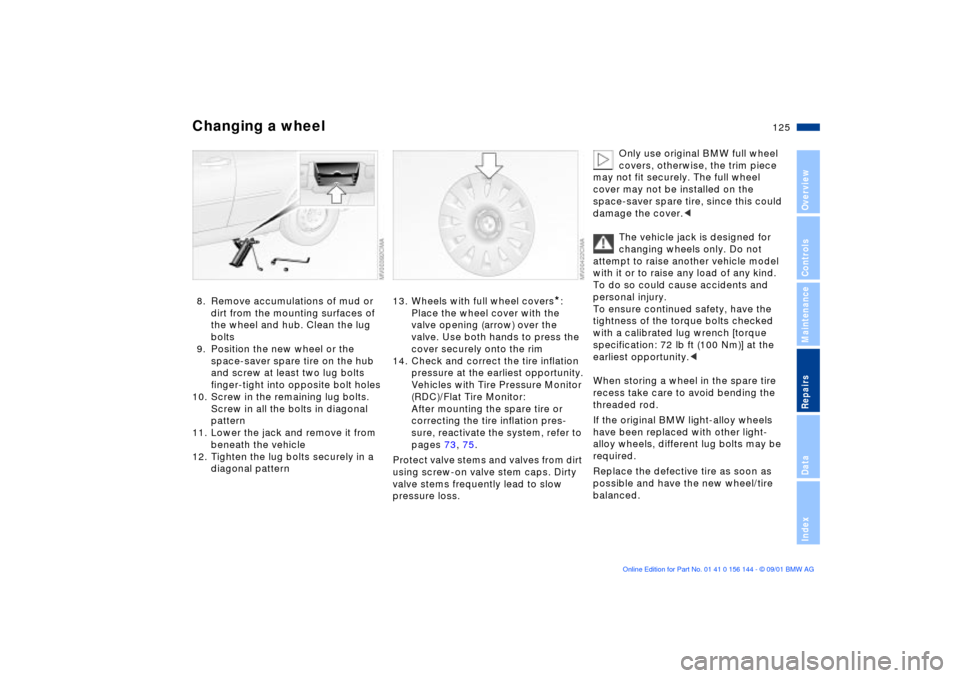
11. Lower the jack and remove it from
beneath the vehicle
12. Tighten the lug bolts securely in a
diagonal pattern
13. Wheels with full wheel covers
*:
Place the wheel cover with the
valve opening (arrow) over the
valve. Use both hands to press the
cover securely onto the rim
14. Check and correct the tire inflation
pressure at the earliest opportunity.
Vehicles with Tire Pressure Monitor
(RDC)/Flat Tire Monitor:
After mounting the spare tire or
correcting the tire inflation pres-
sure, reactivate the system, refer to
pages 73, 75.
Protect valve stems and valves from dirt
using screw-on valve stem caps. Dirty
valve stems frequently lead to slow
pressure loss.
Only use original BMW full wheel
covers, otherwise, the trim piece
may not fit securely. The full wheel
cover may not be installed on the
space-saver spare tire, since this could
damage the cover.<
The vehicle jack is designed for
changing wheels only. Do not
attempt to raise another vehicle model
with it or to raise any load of any kind.
To do so could cause accidents and
personal injury.
To ensure continued safety, have the
tightness of the torque bolts checked
with a calibrated lug wrench [torque
specification: 72 lb ft (100 Nm)] at the
earliest opportunity.<
When storing a wheel in the spare tire
recess take care to avoid bending the
threaded rod.
If the original BMW light-alloy wheels
have been replaced with other light-
alloy wheels, different lug bolts may be
required.
Replace the defective tire as soon as
possible and have the new wheel/tire
balanced.
Page 127 of 147
127n
OverviewControlsMaintenanceRepairsDataIndex
Battery FusesMaintenanceThe battery is absolutely maintenance-
free, that is, the original electrolyte will
normally last for the service life of the
battery under moderate climatic condi-
tions.
Please consult your BMW center
whenever you have any questions
concerning the battery. Since the
battery is absolutely maintenance-free,
the following is for your information
only.<
Never disconnect the battery
when the engine is running; the
ensuing voltage surge would seriously
damage the vehicle's onboard elec-
tronic systems.<
Charging the batteryWhen charging the battery in the
vehicle, leave the engine off at all times.
Connect the charge cables to the termi-
nals in the engine compartment. For
terminal locations, refer to Jump-
starting on page 128.
Return used batteries to a recycling
point or your BMW center. Maintain
the battery in an upright position for
transport and storage. Secure the
battery against falling over in transit.<
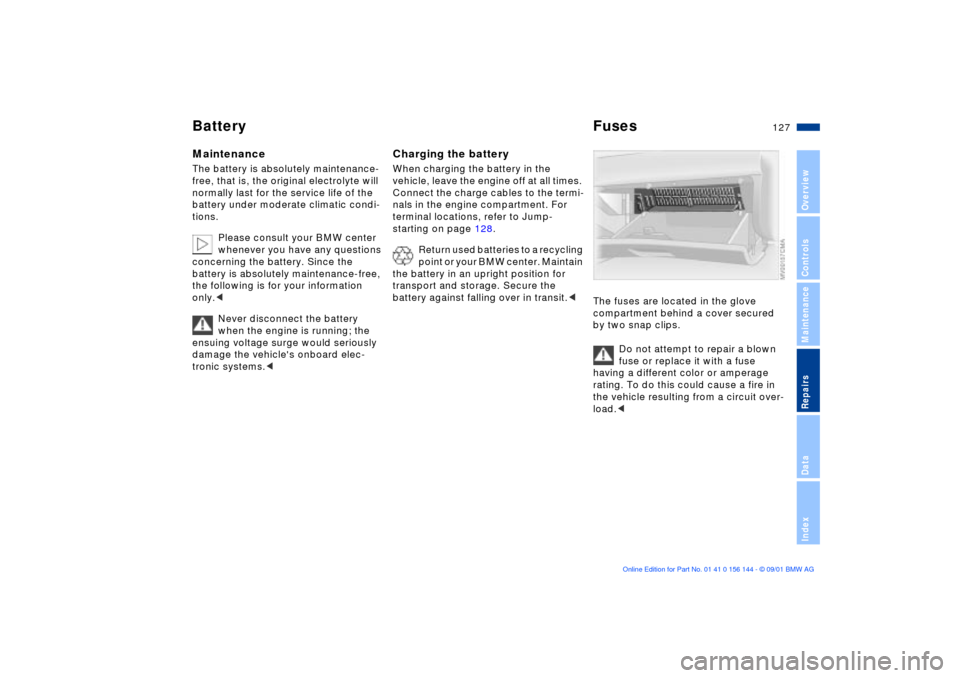
The fuses are located in the glove
compartment behind a cover secured
by two snap clips.
Do not attempt to repair a blown
fuse or replace it with a fuse
having a different color or amperage
rating. To do this could cause a fire in
the vehicle resulting from a circuit over-
load.<
Page 141 of 147

Everything from A to Z
141n
OverviewControlsMaintenancRepairsDataIndex
I
Ice warning67
Icy roads67
Ignition keys28
Ignition lock54
Imprint4
Indicator lamps17
Inflation pressures,
tires24, 25, 101
Inside rearview mirror
automatic-dimming
feature48
INSPECTION65
Instrument cluster15
Instrument lighting78
Instruments15
Interface socket
for Onboard
Diagnostics115
Interior lamps30, 79
remote control30
Interior motion sensor36
switching off37
Interior rearview mirror47
Interlock54
J
Jack123
Jump-starting128 K
Key Memory53
Key with remote control
unit28
Keys28 L
Lamps and bulbs,
replacement118
Lashing eyes93
LATCH child-restraint
mounting system51
Length133
License plate lamp
bulb replacement122
Litter bag holder88
Load-securing devices93
Lock buttons32
Louvers80
Low beams77
bulb replacement119
Lug wrench123 Luggage compartment35
capacity134
floor mat35
floor panel35
secure separately33
Luggage compartment lid
electrical malfunction33
emergency release from
luggage compartment's
interior35
manual operation33
remote control30
Luggage compartment
lighting33
Luggage rack94
Lumbar support42
M
M+S tires105
Maintenance65, 113
Malfunction displays66
Manual operation
doors31
fuel filler door22
luggage compartment
lid33
sliding/tilt sunroof39
Manual seat adjustment41
Manual transmission56 Manually controlled
recirculated-air85
Master key28
MFL (Multifunction steering
wheel)21
Microfilter82, 86
Mirror heating47
Mirror memory45
Mirrors47
Modifications,
technical10, 114
Motion sensor, refer to
interior motion sensor
Multifunction steering wheel
(MFL)21
O
OBD interface socket115
Odometer64
Oil
additives109
capacity135
consumption109
quality110
specifications110
viscosity110